




Abstract
This study found that Chinese journalism students and American journalism students are more different than similar in their value systems. Overall, American students give greater weight to social-interaction values and self-improvement values, and Chinese students give greater importance to morality-oriented values and competency-oriented values. Both groups prioritize “honest” and “responsible” as among the top five values. American students, however, give priority to the values of “courageous,” “ambitious,” and “broadminded,” whereas Chinese students give priority to the values of “civic-minded,” “justice,” and “aboveboard.” Furthermore, Chinese students rank “justice” higher than American students do. Although their similar rankings on honesty and responsibility may suggest that the Chinese and U.S. students share some common understanding of journalism practice, their differing rankings of the values may reflect the social and media realities in which the students study and practice journalism.
Keywords
Introduction
The moral climate of Chinese society has been undergoing dramatic changes in recent years. The general secretary of the Communist Party of China (CPC) Central Committee, Xi Jinping, promised to reduce official corruption by bringing down both “tigers,” senior-ranking government officials, and “flies,” lower level government officials (Branigan, 2013). Within 1 year, the CPC Central Committee for Discipline Inspection (CCDI) punished some 182,000 officials nationwide, 13.3% more than in 2012 (Xinhua, 2014). For the first time in its history, the CPC has shown a strong resolve to fight against official corruption at all levels and reinvigorate the party’s image.
The widespread dissatisfaction and public complaint about the country’s societal environment were evident from 2013 news media’s top stories. For example, among the 2013 top 10 stories polled by the South China Morning Post, a daily English newspaper published in Hong Kong, the second most popular one was about a Zhejiang entrepreneur who offered a senior official 200,000 yuan to swim in a polluted river for 20 minutes (“SCMP.com’s Top 10,” 2013). The 2013 top 10 stories on Weibo, China’s well-known micro blogging site, include reports on the government’s inadequate response to natural disasters, unfair trials of a businessman and a social media celebrity, and social unrest (Boehler, 2014).
Since the 1978 reform, the world has witnessed an unprecedented economic growth in China, but the achievement has been made at the cost of social injustice (Xin, 2010). A 2007 survey revealed that more than half of the Chinese respondents were concerned about inequality and injustice in distribution of income, welfare, and job opportunities among different social groups (Blue Book of China’s Society, 2007). Furthermore, most cases of social injustice in China are related, directly or indirectly, to corruption, governmental mismanagement, merchant misbehavior, property and labor rights violations, and environmental problems (Blue Book of China’s Society, 2005).
In contrast to China, the United States has long been an open, capitalistic, democratic country that enjoys greater political stability and overall economic prosperity. Although the United States has its own societal problems, and the American people’s trust in their government institutions has hit new lows (Jones, 2013), the nation’s news does not focus as much on government corruption. The top U.S. news stories in 2013 included Eric Snowden’s National Security Agency (NSA) leaks, the Oklahoma tornado natural disaster, the Boston Marathon bombing, the federal government shutdown, Detroit’s bankruptcy, gun control, the U.S. Supreme Court’s ruling on gay marriage, and the Affordable Care Act (“Top Ten U.S. News Stories,” 2013). Instances of government official corruption do not pervade the U.S. top news story list as they do in China’s top stories.
Given these contrasting societal backdrops, it is revealing to explore the differences in how Chinese journalism students prioritize justice compared with American journalism students and how their value system differs from that of their American counterparts living in a much more stable society. Values are standards or criteria that guide how people act, shape the attitudes they hold, and form the basis for making moral judgments and justifying behaviors (Rokeach, 1968-1969). Moreover, the exploration of value prioritization offers insight into the motivations of journalism students’ behavior and decision-making process (Plaisance & Deppa, 2008). In other words, values comprise the lens through which journalists or future journalists view their roles and decide what is essential in the daily work (Plaisance & Skewes, 2003). Second, journalism that emerges from democratic institutions is designed to protect individual rights (Luke, 1998) and serves as an instrument to ensure social justice from its government (Christians, 1986). Zooming in on how journalism students rank order values in the comparative settings can help us evaluate the educational and social shaping of future journalism professionals and discuss the implication of value differences and similarities in the increasingly globalized media environment.
Literature Review
Different Media Landscapes
China’s societal unrest and public dissatisfaction with officials at all levels are mostly due to widespread corruption, misadministration, and abuse of power. In a country in which the political system fails to provide public access to government functions and democratic avenues to censure official misconduct, the role of journalism as a watchdog to uncover official wrongdoing has become even more critical and valuable to the Chinese people. Although online media now provide alternatives for the less powerful to voice dissenting points of views (Xiao & Polumbaum, 2003), the traditional journalism is still dominated by the party-owned newspaper and television media that maintain mainstream ideologies. In contrast, the U.S. Constitution’s guarantees of freedom of speech and press provide perhaps the strongest legal protection for media independence. Even though those freedoms have come under pressure at various times in U.S. history, the Supreme Court has repeatedly upheld and expanded the rights of journalists to be free of state control (Freedom House, 2013).
For journalism students who are learning journalism skills and internalizing journalistic principles and ethics in the classroom, the societal environments and the media landscapes to which they are exposed daily can exert explicit as well as implicit influences on how they prioritize values, especially the value of justice in relation to others.
Justice
Plaisance (2009) noted that justice is a foundation for people’s idea of what constitutes a successful working society. Justice makes people acknowledge the existence of social values that balance and constrain selfish impulses (Plaisance, 2009). However, it is too simplistic to view justice as an issue between wrongdoers and victims (Plaisance, 2009). Rather, justice should be conceived in two dimensions: conservative justice and reformative justice (Plaisance, 2009).
Conservative justice is concerned with maintaining order and ensuring that social institutions are able to balance competing interests whereas reformative justice is concerned with righting perceived social wrongs or expanding the social system to include those who are historically marginalized (Plaisance, 2009). Admittedly, there exists some tension between the two justices. Although there are times when journalists contribute to conservative justice, journalists are more drawn to reformative justice (Plaisance, 2009). In general, journalists perceive their mission as giving voice to the voiceless and pointing out the plight of society’s most vulnerable. In doing so, journalists hope to provide an overall social good (Plaisance, 2009).
Journalism, therefore, is grounded in promoting justice (Luke, 1998), and reporting serves as an instrument for uncovering injustice (Christians, 1986). The Society of Professional Journalists, the largest professional organization of journalists in the United States, begins its “Code of Ethics” with a statement about justice: “Members of the Society of Professional Journalists (SPJ) believe that public enlightenment is the forerunner of justice and the foundation of democracy” (SPJ Code of Ethics, 2014). In January 1991, at the first plenary meeting of its Fourth Council, the All-China Journalists Association, commonly known as China Journalists Association, adopted its “Code of Ethics,” positing the fundamental role of journalism as “. . . to promote social justice and enhance social responsibility . . .” (China Journalists Code of Ethics, n.d.). Given that justice is central in the conception of journalism in both nations, how journalism students in two different societal and media environments perceive the universally recognized journalistic principle of justice and how they attach importance to this key value are questions that this study addresses.
Values and Value Systems
Justice, however, is only one value that journalists embrace. To have a more complete picture of the ethical predispositions of journalists, researchers investigate the overall value system of journalists. Values have been defined as concepts or beliefs ordered in relative importance (Schwartz & Bilsky, 1987), as philosophical principles on which people base their reasons for doing things (Plaisance & Deppa, 2008), as prototypes from which attitudes and behaviors are derived (Homer & Kahle, 1988), and as mental programs that are developed in the family in early childhood and reinforced in schools and in organizations (Hofstede, 1980). Rokeach viewed values as relating to preferable “modes of behaviors” and “end-states of existence,” and therefore, distinguished instrumental values, the means (e.g., ambition, self-control, and independence), from terminal values, the ends (e.g., leading an exciting life, family security, and pleasure; Rokeach, 1968, 1973).
Differences in values held by Western and Asian peoples have been documented by many researchers (Hall, 1986; Hofstede, 1980, 1997, 2001; Triandis, 2004). The most common value continuum used in studies comparing Western and Eastern cultural differences is individualism versus collectivism. Hofstede (2001) found that the highest individualism index values go to the United States, Australia, and Great Britain; the lowest to Venezuela, Columbia, and Pakistan. The Chinese Culture Connection (1987) constructed and administered a survey of Chinese values to university students in 22 different countries and identified four factors of values: integration, human heartedness, moderation, and Confucian work dynamism. Zhong (2008) identified the moral decision-making differences between Chinese and American journalism students along the cultural line of individualism and collectivism, with Chinese students taking colleagues’ views and editors’ reactions more seriously, and American students taking new media’s needs more seriously.
Conceptualized as “a hierarchical arrangement of values” or “a rank-ordering of values along a continuum of importance” (Rokeach, 1968-1969, p. 551), a person’s value system represents “a learned organization of rules for making choices and for resolving conflicts” (Rokeach, 1968-1969, p. 551). Many social factors such as social systems, cultures, castes, class, religion, education, and even political identification influence the way people rank the importance of values (Rokeach, 1968-1969). Rokeach (1968) argued that an individual has a limited set of values that form a value system, and once a value is learned, it is integrated into this structured system. Individuals can share the same set of values but prioritize them differently. Plaisance (2006) noted that the way in which people prioritize the set of values will largely determine how people solve ethical questions and embrace differing solutions.
In fact, researchers have operationally defined the value system in a list. Rokeach developed the classic Rokeach Value Survey with 18 instrumental values: ambitious, broadminded, capable, cheerful, clean, courageous, forgiving, helpful, honest, imaginative, independent, intellectual, logical, loving, obedient, polite, responsible, and self-controlled (Rokeach, 1968-1969, p. 554). Kahle and colleagues developed the list of nine values (LOV): sense of belonging, excitement, warm relationship, self-fulfillment, being well-respected, fun and enjoyment of life, security, self-respect, and a sense of accomplishment (Kahle, 1983, 1985; Kahle & Kennedy, 1988). Schwartz and Bilsky (1987) identified eight value domains comprising 34 distinct values. 1 These various typologies, however, are remarkably similar (Chang, 2005).
The investigation of values held by American newspaper journalists has revealed that in their everyday ethical decision making they apply both morality-based values such as “fair” and “honest” as well as competency-based values such as “capable” (Plaisance & Deppa, 2008). A study of the values of American media ethics students before and after taking an ethics course found that their top values included a mix of these morality-oriented and competency-oriented values: “honest,” “responsible,” “fair,” “just,” and “capable” (Plaisance, 2006).
What are missing in this line of research on values are comparative studies of the value systems of journalism professionals and, in particular, research on the values systems of those training to become professional journalists. That is why this research project targets aspiring journalism professionals in United States and China and offers a comparative analysis of their value prioritization.
Method
Participants
A total of 264 university journalism students, 124 from the United States and 140 from China, participated in this study from October to December 2011. The U.S. students were enrolled in a Mid-South university journalism program with about 400 undergraduates, and the Chinese students were enrolled in a journalism program with about 700 undergraduates. Both programs offer news, broadcasting, and advertising while the U.S. program also offers public relations.
The English version of the paper questionnaire was distributed in journalism classes at a U.S. university. The same English questionnaire with a corresponding Chinese translation to the side was distributed to classes of undergraduate students with the help of journalism professors at a Chinese university. In both locations, the data collection protocol was followed, and all students were made aware that their participation was voluntary and they could quit at any time. The classes were selected for the survey based on their availability and the willingness of the professors to participate.
Measurements
This study adopts the measuring instrument developed by Plaisance and his colleagues (Plaisance, 2006; Plaisance & Deppa, 2008; Plaisance & Skewes, 2003), which is a modified Rokeach Value Survey Instrument. It adds six values, “aboveboard,” “avoiding harm,” “civic-minded,” “empathetic,” “fair,” and “just,” to Rokeach’s 18 values to address the concern over the absence of “basic human rights” values such as dignity, privacy, and protection from harm (Plaisance, 2006). The six new values also reflect commonly covered priorities and principles in the media ethics literature (Plaisance, 2006). Respondents were presented with a table printed on one page with the following instruction:
On the page is a set of values arranged in alphabetical order. Each value is accompanied by a short description. Your goal is to arrange each value in its order of importance to you. To begin, select the value that is of most importance to you as a journalist. Then assign number 1 in the box next to the value. Next, choose the value that is second in importance to you and place the number of 2 in the box. Work your way through the list until you have ranked all values on the page. The last number you should assign is 24.
Demographic information such as age, year in school, gender, news use habits, and future careers was also collected.
Results
The U.S. and Chinese samples were both dominated by female students (China has 86%, U.S. 70%). Both samples had a good representation of students in all 4 years of school (China has 23% freshmen, 15% sophomore, 22% junior, 40% senior: U.S. 13% freshmen, 24% sophomore, 33% junior, 31% senior). Average age of the respondents was 20 years for Chinese students and 24 years for U.S. students. The U.S. sample was similar to its national journalism student population in terms of gender (Becker, Vlad, & Kalpen, 2012; Vlad, Becker, & Kazragis, 2011) and age (Anyaegbunam & Ryan, 2003; Flournoy, 2007). The current Chinese sample revealed a larger percentage of female students (86%) in comparison with an earlier 1998 survey of 1,052 Chinese journalism students about their journalistic professional socialization in which only 54.2% were female (Wu & Weaver, 1998). Regarding the career path, the number 1 choice for the Chinese sample is work outside media (22%), followed by newspapers (16%) and public relations (12%), but for the U.S. sample, the number 1 choice is public relations (27%), followed by broadcast news (20%) and newspapers (12%). Although around 22% of the Chinese sample plans to seek a non–mass media career, the rest of the Chinese sample (78%) expects to pursue mass media careers. Moreover, this 22% still represents journalism majors who have been exposed to journalism issues such as journalism roles, functions, and principles by taking journalism courses. Therefore, they can evaluate the values from a professional perspective.
RQ1: How Does the Value System of American Journalism Students Compare With That of Chinese Journalism Students?
Out of 24 values, American and Chinese students prioritized eight values very similarly, all of which were ranked as less important and oriented toward either sentiment (emotion) or character: “cheerful,” “courageous,” “empathetic,” “helpful,” “independent,” “logical,” “minimizing harm,” and “self-control.” The remaining 16 values were ranked differently by the two groups, including social interaction–based values, self-improvement–based values, competency-based values, as well as morality-based values. The eight values ranked significantly higher by American journalism students were related to social-interaction, such as “clean,” “polite,” “obedient,” or self-improvement, such as “ambitious,” “broadminded,” “honest,” “imaginative,” and “intellectual.” The eight values ranked significantly higher by Chinese journalism students were more competency-related or morality-related such as “capable,” “aboveboard,” “civic-minded,” “fair,” “just,” and “responsible.” Moreover, two emotion-related values, “loving” and “forgiving,” were ranked higher by the Chinese students. See Table 1 for the differences.
Comparing Value Systems of American and Chinese Journalism Students.
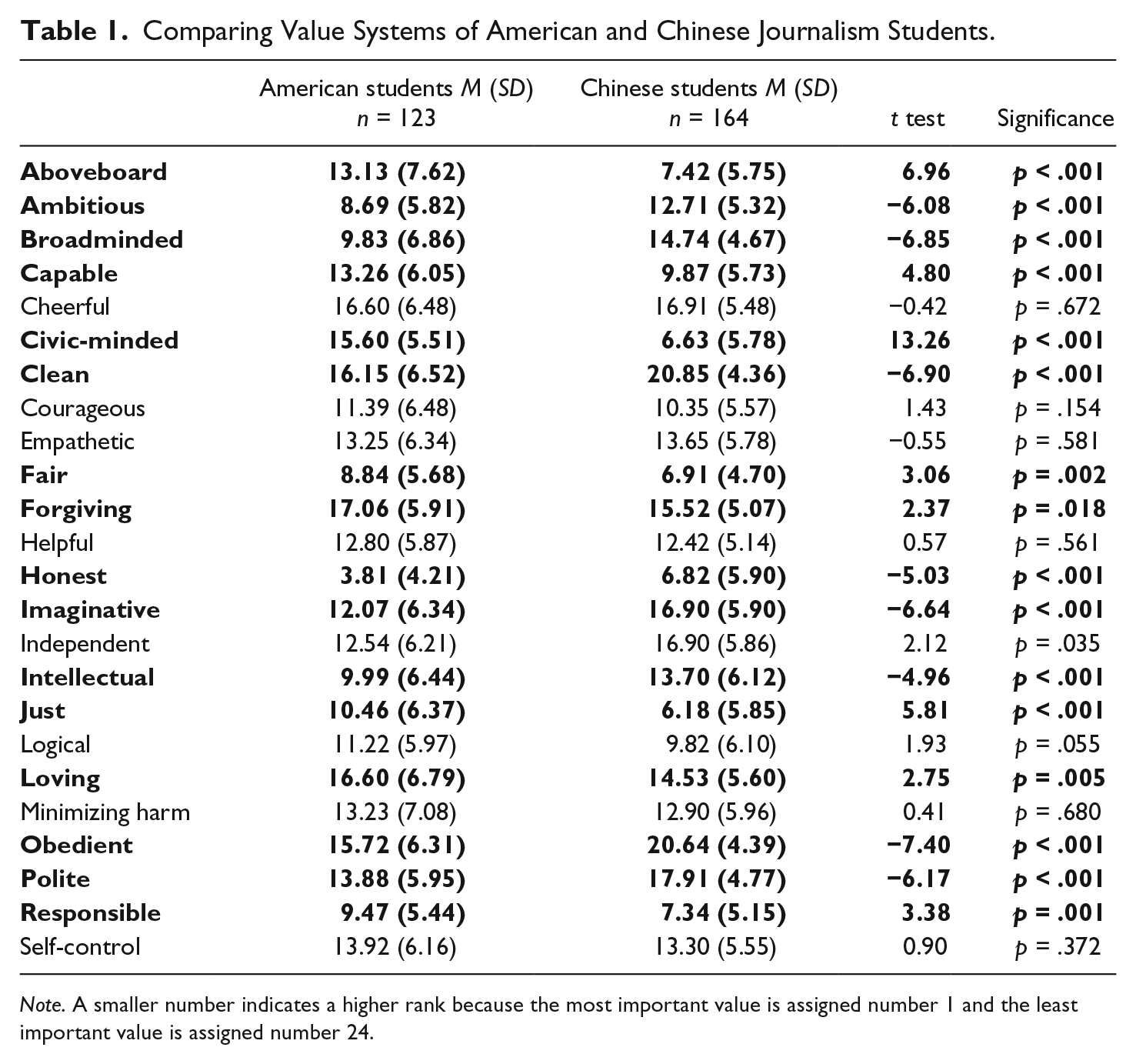
Note. A smaller number indicates a higher rank because the most important value is assigned number 1 and the least important value is assigned number 24.
RQ2: How Do the Top Five Values Rank Ordered by American Journalism Students Compare With Those by Chinese Journalism Students?
“Honest” was the value ranked number 1 most often by American journalism students (44%). “Courageous,” “ambitious,” and “broadminded” tied for second, each securing 6% of respondents as the most important value. “Responsible” garnered 5% of responses as the most important value. However, if the values were assessed using average rankings, the most important value was “honest” with a mean of 3.81. The second most important value was “ambitious,” followed by “fair,” “responsible,” and “broadminded.” In other words, “courageous” dropped out of the top five values and was replaced with “fair” (see Table 2).
American Students’ Top Five Values Based on Average Ranking and No. 1 Frequency.

Note. The smaller number indicates a higher rank because the most important value is assigned number 1 and the least important value is assigned number 24.
For their Chinese counterparts, the top five values based on how many respondents ranked as the most important value include “honest,” the same as for the American students, followed by “just,” “civic-minded,” “aboveboard,” and “responsible.” When viewed in terms of average rankings, “just” became the most important one, followed by “civic-minded,” “honest,” “fair,” and “responsible” (see Table 3).
Chinese Students’ Top Five Values Based on Average Rankings and No. 1 Frequency.

Note. The smaller number indicates a higher rank because the most important value is assigned number 1 and the least important value is assigned number 24.
In sum, both groups ranked “honest” as the most important value, and both groups prioritized “responsible” as one of the top five values. American students, however, weighed “ambitious,” “broadminded,” “courageous,” and “fair” higher. Chinese students weighed “civic-minded,” “just,” and “aboveboard” much higher. “Courageous,” “ambitious,” and “broadminded” seem to emphasize the journalistic, investigative spirit, while “civic-minded,” “just,” and “aboveboard” seem to support the importance of societal responsibilities and duties. For American students, character and personal qualities are more important in their value system. For Chinese students, sense of social obligation and professional responsibility outweigh others in their value system. Both groups, however, do share in commitment to the importance of honesty and responsibility.
RQ3: How Do American Journalism Students Compare With Chinese Journalism Students in Rank-Ordering Justice?
In rank-ordering justice as one of the 24 values, on average, Chinese students ranked it higher at sixth than American students did at 10th. The distribution of the rankings for justice reveals that the American sample has a more spread-out distribution than the Chinese sample. Based on the Kolmogorov–Smirnov normality test (.13 with p = .00 for the Chinese sample, .22 with p = .00 for the American sample) and the skewness value (1.42 for the American sample and .32 for the Chinese sample; see Table 4 for details), the Chinese sample’s distribution is more concentrated at the higher end. Therefore, more Chinese journalism students assigned a higher ranking to justice than did American journalism students. Although it is difficult to suggest a causal relationship between societal environment and the prioritizing of justice in the value system in this study, prior research does suggest that values derive from experiences, either from common societal experiences or from personal experiences (Schwartz, 1992). Perhaps Chinese journalism students tend to prioritize the value of justice because their societal environment calls for the immediate and constant redressing of grievances and social injustice.
Comparing American Journalism Students With Chinese Journalism Students in Rank-Ordering Justice.
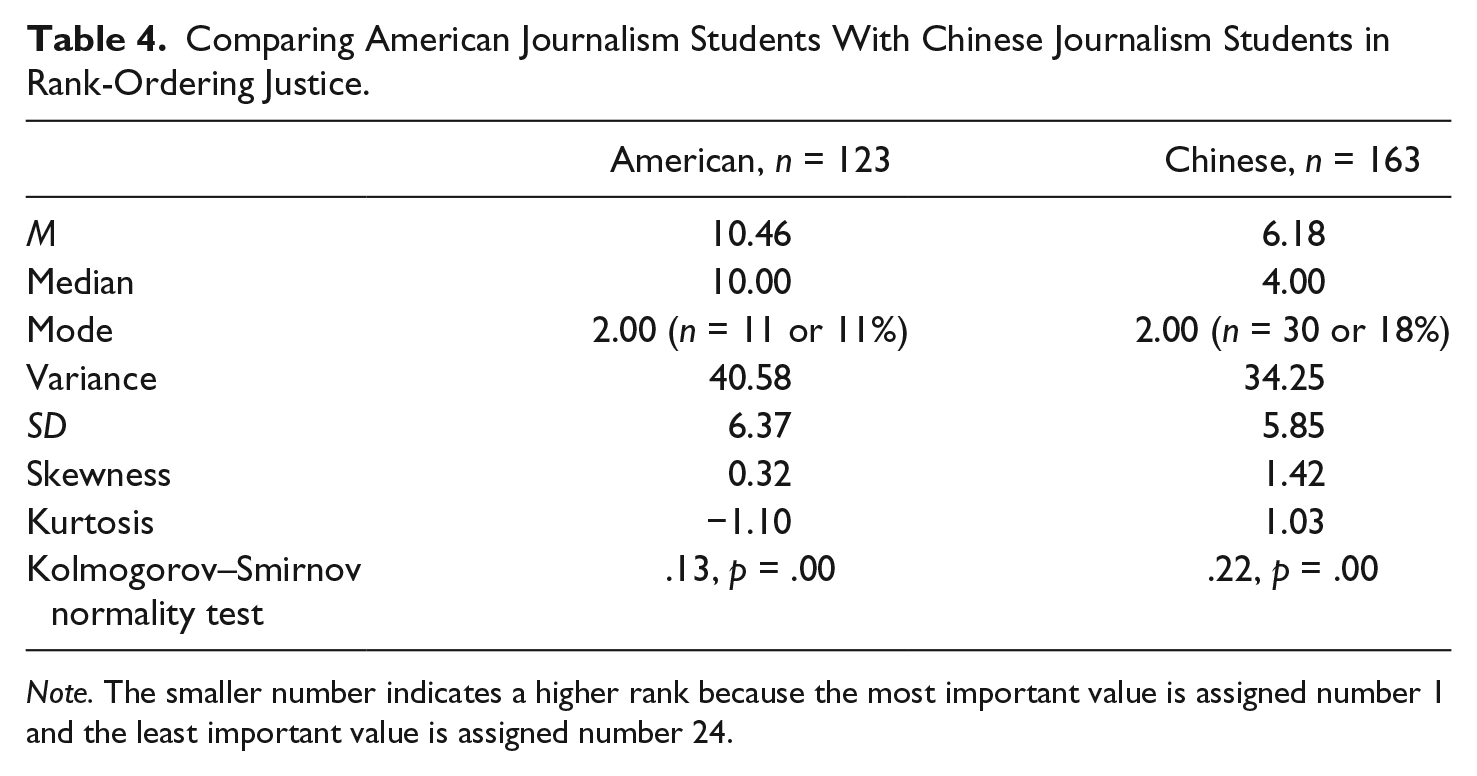
Note. The smaller number indicates a higher rank because the most important value is assigned number 1 and the least important value is assigned number 24.
Discussion and Conclusion
Chinese journalism students and American journalism students show both similarities and differences in how they rank instrumental values. They are similar in ranking one third of the value system, most of which are emotion- or sentiment-oriented low-ranking values, but they are different in how they ranked the other two thirds of the values. For American journalism students, social-interaction values (such as polite, clean, imaginative) and self-improvement (such as obedient, intellectual) values are given more weight than for their Chinese counterparts. For Chinese journalism students, morality-oriented values (just, aboveboard, fair) and competency-oriented values (capable, civic-minded) hold greater importance. Among the most important values, American journalism students and Chinese journalism students both prioritize “honest” and “responsible.” American students also give priority to the values of “courageous,” “ambitious,” and “broadminded,” which are more oriented to individualism and investigative journalism. Chinese journalism students give priority to the values of “civic-minded,” “justice,” and “aboveboard,” which are more oriented to social responsibility and equity in society. Chinese journalism students give a higher rank to “justice” than American journalism students, which might be due to the Chinese students’ direct and constant exposure to China’s current societal environment, in which official corruption and injustice are prevalent and need concerted efforts to address and correct.
This comparison of the value systems of journalism undergraduates from two nations provides a clear outline of where the two young groups differ and where they converge. They converge more on those values (mostly sentiment-oriented values) that are ranked lower and differ on those values (including morality-oriented, competency-oriented, personal-quality, and social-interaction values) that are ranked higher, suggesting they may be more different than similar. As discussed earlier, individuals can share the same set of values but prioritize them differently (Rokeach, 1968, 1973). There is no right or wrong in assigning different rankings to certain values. Any implication or suggestion that one group is superior to the other based on the rankings is a misinterpretation of the findings. However, it is not surprising that in a country with rampant official corruption, the values of “justice,” “civic-minded,” “aboveboard,” and “fair” would have heightened prominence among the future journalists, and aspiring journalists would rank order “just” much higher and focus on their role as a watchdog against government abuse.
As mentioned in the literature review, many factors such as social systems, cultures, castes, class, religion, education, and even political identification influence the way people rank the importance of values (Rokeach, 1968-1969). This study highlighted the influence of social systems and media landscapes on value prioritization. But what do the identified value differences mean for journalism education? Journalism educators and students should be aware that there are different value order prioritizations and no one prioritization is superior to another. The differences can be attributed to many possible factors including social systems and media systems. Learning the different value order prioritizations facilitates a greater understanding of motivations and decision-making processes by journalism counterparts in different cultures. After all, values are philosophical principles on which people base their reasons for doing things (Plaisance & Deppa, 2008) and are prototypes that shape attitudes and behaviors (Homer & Kahle, 1988). However, the similarities in value order prioritizations detected in this study can help journalism educators and students appreciate the current trend of media globalization and the universally recognized values embraced by journalism students from different countries. That the two common core values of “honest” and “responsible” are listed among the top five values by both American and Chinese journalism students suggests that common ground exists for cooperation among journalism professionals and students from these two countries. Specifically, globalization is occurring in journalism education as many Chinese students come to study in U.S. journalism programs and as increasing numbers of American students pursue study abroad opportunities in China.
Second, due to the importance of value prioritization in making ethical decisions and finding solutions in journalistic practice (Plaisance, 2006), it is important to include a component on comparative values in media ethics courses. A thorough and critical discussion of values might help journalism students better understand the ethical dilemmas they will be facing and learn to evaluate solutions from different value perspectives. Journalism professionals as well as journalism educators might need to reconceive journalism practices in the increasingly globalized media landscape. Questions such as whether the differences in value prioritizations necessarily lead to conflicting models of news practice, how global media organizations should respect value differences in responding to local ethical dilemmas, and whether shared values outweigh differences in finding common ground in reporting the news remain to be answered.
Limitations and Future Research
A limitation of this study is that the journalism students surveyed for the study do not represent the national populations of journalism students, especially the Chinese sample that is biased toward female students. The differences found in the study might be due to the bias and/or small sample effect. Moreover, the small samples composed of students lacking professional working experiences cannot represent the real value differences held by journalism professionals. The findings are exploratory. Also, the survey method provides limited answers to the questions asked. Other methods such as in-depth interviews and focus groups could reveal insights that would enrich these findings. The study, however, does provide a starting point for future research into the differences in value systems of journalism students across borders. We suggest that future research projects explore the reasons behind the value priorities; investigate further the social, cultural, and personal factors that might influence students’ value rankings; and focus more on the implications of value systems’ differences in the globalized mass media world.
Footnotes
Declaration of Conflicting Interests
The author(s) declared no potential conflicts of interest with respect to the research, authorship, and/or publication of this article.
Funding
The author(s) received no financial support for the research, authorship, and/or publication of this article.