




Abstract
Researchers collected and analyzed data from 85 undergraduate communication majors enrolled in a one-credit technology and coding course. Instructors offered various out-of-class supports to determine which ones students used and valued. Student behaviors clustered: One group preferred interpersonal support; another, content support. Most support types were not related to student success, at least as measured by course grades. Video support was negatively related to student success, suggesting that procrastinating and expecting last-minute help from extra resources is ineffective. The article includes a discussion of implications for faculty workloads.
Introduction
Coding skills are becoming increasingly desirable, as the popularity of Association for Education in Journalism and Mass Communication (AEJMC) conference sessions on teaching coding attests. As the ability to write computer code grows in importance for communication practitioners, some university programs are developing coding instruction for communications students (Spinner, 2014). The best way to teach these skills is an open question, especially as programs try to fit yet another skills course into an already full curriculum.
Although scholars of communication education are just beginning to pay attention to the realities of teaching coding and other technology skills to mass communication students, education scholars in technology fields have been investigating these methods for years. Learning a process such as coding is challenging, even for technology-oriented students in fields such as computer science and engineering. Popular media and novice-oriented resources such as code.org and Codecademy give the impression that coding is a simple process that can be self-taught. For many, this impression is incorrect. As noted in one popular media article (Ray, 2014), “the most common state for a programmer is a state of inadequacy” (p. 5).
Yet, the need is increasing for journalists, public relations practitioners, advertisers, and other communications professionals to develop technology skills. The platforms for audiences to consume content—and for communicators to produce it—continue to proliferate (Chimbel, 2015). These professional pressures, in turn, challenge communication departments to provide these technology skills to their audience: mass communications students who are often indifferent and sometimes hostile to learning these skills. This project is a first step in identifying best practices—a case study investigating the strategies that students use for learning coding in a one-semester, one-credit course designed to teach technology literacy along with basic front-end development skills in HTML and CSS to communications majors. Instructors provided materials consistent with a blended learning experience (Park, Yu, & Jo, 2016) to see whether additional supports of this type would be useful in student learning.
Related Literature
Scholars of teaching and learning in technology-related disciplines have explored several ways to increase student retention and learning, focusing primarily on student attitudes toward the tasks and instructional matter. For example, DeClue (2014) researched the affective dimension of learning how to code. For computer science students, he found that an assignment with real-world application was enjoyable and encouraged students to continue in the major. Rienties, Tempelaar, Van Den Bossche, Gijselaers, and Segers (2008) and Sansone, Fraughton, Zachary, Butner, and Heiner (2011) noted that motivation affects a student’s willingness to persist and try different techniques to gain knowledge and skills.
Generally, scholars have found that students who are learning to code want supplementary resources to help them learn. Providing these types of resources fits with the description of blended learning. As Carter, Dewan, and Pichiliani (2015) noted, computer programming is challenging, and students want high levels of support. These scholars developed a method of reviewing analytics for online resource use as a way to identify pain points for students. Their findings suggest that online resources can be useful for faculty members because they can be tracked, enabling faculty members to create interventions where they are needed most.
One type of intervention is interpersonal—coaching or help sessions with faculty or teaching assistants. Ruehr and Orr (2002) described a model to guide the conversation between the student and faculty member about the student’s work. As the authors noted, the dynamic give and take of an interpersonal interaction allows the instructor to provide immediate, tailored feedback to the student. The faculty member can then assess the student’s understanding of the concepts in context. Malan (2009) described virtual office hours in an introductory computer science class, where participation and satisfaction levels were comparable with those of the face-to-face help that also was available.
Other interventions involve non-real-time resources, such as websites and videos. Academic programs find these interesting because they allow a small number of faculty members to serve a large number of students. Dougherty and Parfitt (2009) created web-based supports for an engineering design capstone course. They found that web resources can make a course more efficient and provide easier access to support materials. Web resources may also allow instructors to bring outside constituents, including professionals, into course work.
The types of resources that instructors provide will vary. Among other things, Yang (2011) included reading, watching lecture recordings, and searching for relevant resources online under the definition of student–content interactions. Code examples are another possibility. Busjahn and Schulte (2013) conducted interviews and wrote a literature review related to instructional code reading and found that learning to assess and interpret existing code is useful, giving a multidimensional view of code and its context. This higher order understanding of how code is constructed can help students to learn to write their own code.
By creating online resources, faculty members are creating a hybrid, or blended class. A blended class incorporates traditional elements such as lecture or face-to-face discussion with novel elements such as online resources (Boyle, Bradley, Chalk, Jones, & Pickard, 2003). According to Bonakdarian, Whittaker, and Yang (2010), hybrid learning that combines classroom and online instruction is a “best of both worlds” practice in which the instructional modes work synergistically to enhance student happiness with instruction. Hybrid courses can also enhance learning, although this finding is not consistent across studies. When Olson (2002) compared traditional, face-to-face, and online instruction for an introductory computer science class, he found no significant differences in course completion rates or quiz grades. Rutz et al. (2003) also used random assignment to one of four conditions in an engineering class, and found that a traditional lecture course was the least effective in terms of final grade—a web-assisted hybrid course got the best results. Students also said they preferred the web-assisted hybrid.
These findings are inconsistent. Perhaps factors of motivation and learning style explain the differences. Ford and Chen (2001) compared students completing an HTML design task across groups who had resource materials that matched a preferred learning style with groups that were mismatched. They found that when resources matched a preferred learning style, students learned more. In contrast, Zacharis (2011) found that students will try multiple techniques to learn challenging skills such as coding but did not find that preferred learning style moderated participation in online education or affected grades. Intrinsic motivation can help make online learning more effective, but it can also be extremely detrimental (Ford and Chen, 2001). Interest in the lesson itself and the technology used to deliver it both play a part. As Wang (2011) noted, “At a distance, it is very easy for students who are poor self regulators to forget . . . ” (p. 2).
Other scholars have considered the effects of video. Wyatt’s (2000) early article spoke to the value of providing video lectures via the web. Vilner, Zur, and Sagi (2012) studied the effectiveness of stored videos in teaching computer science. They found that student interest in videos increased as assignment due dates approached. In their study, some students had access to face-to-face meetings, but there was not a significant difference in video watching between the students who met face-to-face and those who did not. They also did not find a significant relationship between video watching and course grades. “There is no proof that watching the video components improved the learning process,” Vilner et al. reported (p. 127). However, they noted that students attached high value to the video components, suggesting that online video’s major benefits are a perceived improvement in convenience and improved student attitudes.
Students appear to like having a variety of resources while they learn to code. But these resources are costly to institutions, both in terms of faculty time and time from instructional support staff. When teaching coding and technology concepts in communications programs, it is useful to investigate whether a blended approach provides an advantage in student learning, and why or why not. We ask the following:
Method
This study was conducted in three sections of a one-credit-hour course in web technologies and coding at a large communications program in a private university. The course met once weekly for 70 min for the entire semester. It was taught in a theater-style classroom with 30 to 40 students in each section. In addition to class lectures and demonstrations, students had access to several modes of support. For interpersonal support, students could attend scheduled office hours held by a faculty member. Faculty members also offered office hours by appointment, online consulting by appointment using Google Hangouts, and server space for students to upload code. Faculty members also scheduled open lab sessions as students completed course projects.
Several online resources were offered. Instructors maintained a common course blog that offered helpful links to outside resources, text articles on concepts covered in class, and embedded course videos.
There were also videos in a public YouTube channel and a required textbook, Learning Web Design: A Beginner’s Guide to HTML, CSS, JAVASCRIPT, and Web Graphics.
The university’s institutional review board reviewed and approved the protocol used. Researchers asked students to give informed consent and to identify the resources they used, reporting their usage levels as never, sometimes, or often. They also asked students to name the one resource they found the most helpful. A faculty member who was not the instructor distributed the questionnaires. Students were told that their participation was optional and that their instructors would not know whether they chose to participate or not. Researchers collected the students’ final grades from the university registrar’s rolls. To aid in data interpretation, a faculty member not involved in preparing or teaching the course interviewed faculty members who taught the course. Researchers coded and entered the data into SPSS for analysis.
Results
As Figure 1 shows, students reported using a wide variety of sources to support their learning. The textbook, which had assigned readings, was the least popular, with nearly half of the students failing to use it at all. Open lab hours were similarly unpopular, though nearly 17% of respondents said they used them often, suggesting that some students regularly relied on lab hours—a finding that was borne out by interviews with faculty members who taught the courses. One faculty member speculated that students did not use lab hours as much because they required more advanced preparation not to be embarrassed in front of peers. “I’d tell them [in class] that the lab hours were for finishing the project, not for starting it,” he said. The course blog was the most heavily used, according to the students’ self-reports, with more than half of them saying they took advantage of video resources and office hours, respectively.

Student-reported usage of course resources.
It was of interest to see whether students’ preferences for in-person help (office and lab hours) and content help (textbook, videos, and blog) were related. A correlation analysis of student responses suggested that preference for in-person help (r = .66, p < .0001) and for using videos and the text (r = .36, p < .001) were related, whereas preferences across type of resources did not have a statistically significant relationship.
When it came to students’ perceptions of utility, results were widely distributed (see Figure 2).
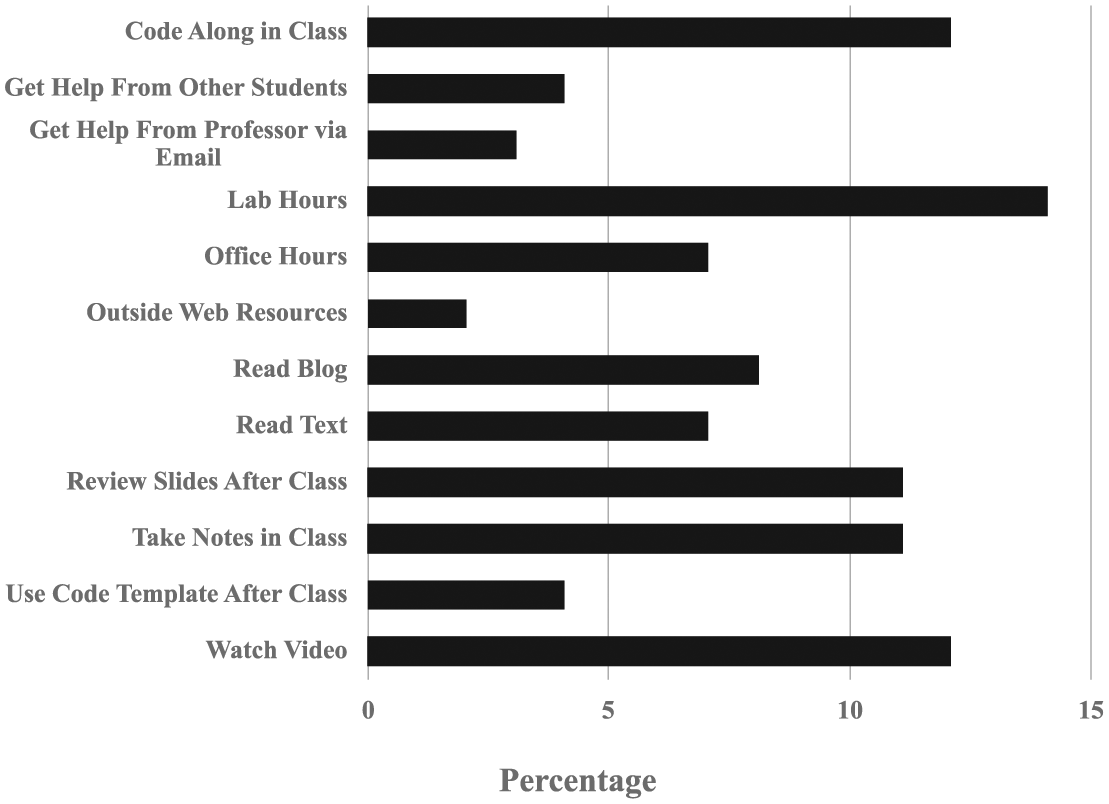
Student-reported usefulness of course resources (write-ins allowed).
Of instructor-created resources, students most valued lab hours, video, and posted slides. Students also identified two types of resources created during class that they could later reference: taking notes on the lectures and following along with coding examples in class, which provided code examples to refer to later.
With regard to the impact on learning, our results were similar to those of Vilner et al. (2012) and Zacharis (2011): Correlation analyses did not find any significant correlations between resource use and grades for most of the resources. However, there was a significant negative correlation between using course videos and final grades (r = −.36, p < .01). It seemed odd that a course resource could have a detrimental effect. Faculty interviews offered a possible interpretation: One instructor noted that emailed requests for help peaked as project due dates drew closer. YouTube analytics suggest that student video use peaked as the deadline approached, with a jump in both the number and duration of views the day before the project was due (see Figure 3).
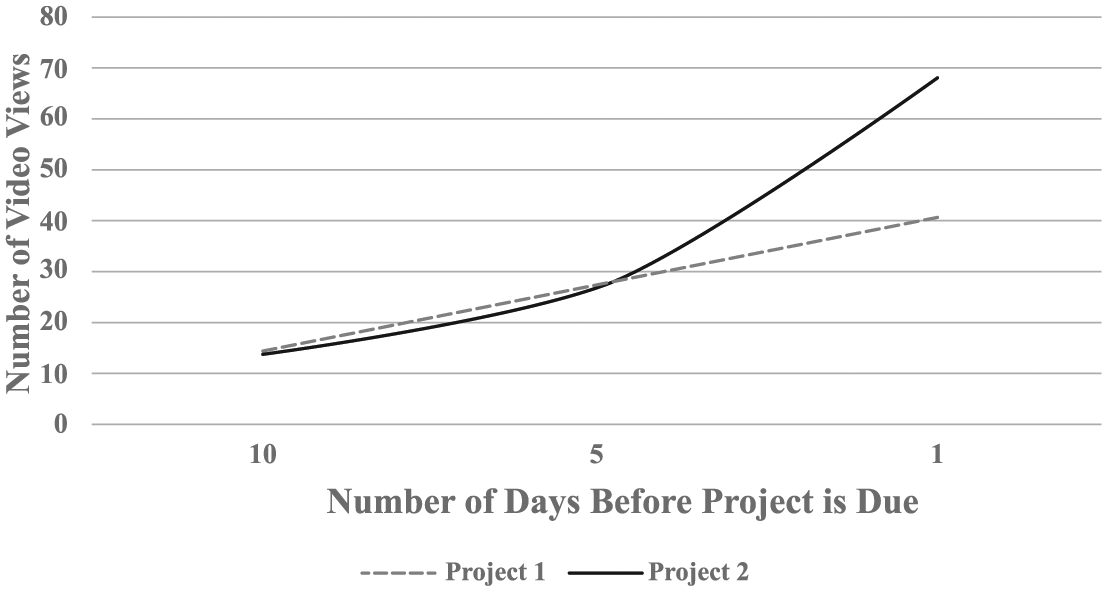
Student usage patterns of course video.
This suggests that video use was a marker of procrastination rather than learning. But the analytics do not reveal who watched the videos, or how many times, so it is possible that a small number of students watched the videos multiple times. However, given the length of the videos (20-30 min for Project 2), perhaps it is more likely that these were individual views.
Discussion
As previous researchers in technology-heavy fields have found, communications students were interested in, and used, a variety of resources to help them learn to code. However, although students reported using and finding value in most of the supporting materials, their experiences did not seem to be related to grades in the course. One faculty member interviewed said the instructors intentionally “presented a variety of supporting materials that could potentially help them.” The distribution of preference for the types of course material has implications for faculty members creating these materials.
In a course meeting for only thirteen 70-min sessions, faculty felt that both organizing content and providing external resources were essential for achieving the desired student-learning outcomes. The university’s learning management system, Moodle, was used, providing students with course policies, procedures, and expectations; a weekly breakdown of learning objectives; PDF documents of the weekly lecture; quizzes; homework assignments; and attendance records. Instructors also used Moodle to post links to additional readings and various external resources so that students could get most resources from one place. Setting up the framework took about 12 to 15 hr initially, but the instructors were encouraged because it could be used in future semesters. Quizzes, writing activities, and homework assignments were administered and collected on Moodle, requiring students to use the site regularly.
Beyond Moodle, faculty members created several tertiary resources that required significant setup time, in excess of 80 hr. The three biggest resources that required substantial faculty time are as follows:
A course blog, which answered specific student questions and allowed the faculty member to clarify points that warranted further discussion. Developing this content over the semester was a major time investment. That time was recovered, somewhat, when a faculty member was then able to reference a blog post with the answer to a common difficulty that had prompted many individual requests for help. For common issues, blog posts could be hidden and then shown at appropriate times in subsequent semesters.
YouTube video tutorials created by faculty members that addressed common misunderstandings and questions. Faculty members reported that these videos were extremely helpful in answering specific student-initiated questions, such as, “What is my URL?” The video tutorials range from 1 min to more than 30 min in length. Recording and editing video was at least a two- to one-time investment, not counting the time spent uploading and linking videos for students.
Testing external web resources—lynda.com, codeacademy.com, w3schools.com, css3generator.com, htmldog.com, css3.com, and others—to make sure they served the students’ needs.
There are already many resources for teaching about technology principles and coding, so faculty members did not always have to create new ones from scratch. The important thing is for faculty to provide context for the information the students are learning, one faculty member said. When faculty provide the resources in the context of the course material, it helps students find appropriate help. “Students have a drowning aspect and are grasping at straws,” another faculty member said.
Students found email, office hours, and open lab hours useful. These opportunities represented a large time commitment by faculty members. Working one-on-one with students was inefficient for faculty, but extremely helpful for students. This most time-consuming external class resource provided the most direct way for students to receive targeted feedback. Within minutes, the faculty could identify errors in code, inefficiencies, oversights, and inconsistencies. Faculty members tried to focus on helping students to connect key concepts and to identify better approaches to problem solving rather than simply editing and correcting the code.
Because of the effort required to create materials, it is best to avoid offering help that ultimately will not be helpful. Course videos may be such a resource, because their use was negatively related to project success. In this case, the videos were lengthy (20 and 30 min, respectively), and students may have avoided this known investment in time until it was clear that they were lost. Perhaps students, on their own, are not able to judge what kinds of resources are useful to them, or when.
As an initial foray into assessing practices for teaching coding to a general population of communications students, this work is a case study only. Results, although in line with findings in computer science and other fields with longer terms of pedagogical research, should not be generalized. Furthermore, although the course was taught to students in all communications majors including journalism, strategic communications, entertainment video, and so forth, the individual majors and preparation of the students was not evaluated. Snowball (2014) suggested that multiple opportunities to engage in the material through supplementary resources could support diverse learners. It is unknown from this study whether students in a major within the field of communications could require different supports in learning coding from students in another major.
The data suggest that despite numerous coding resources available, there may be a disconnect between students’ perception of what resources are helpful and whether they can use them effectively. External study resources may require some scaffolding for the students—instructors should make clear that these resources are helpful only if students already grasp the essential logic of the class content. Instructors can also refer to the resources and offer guidance on when and how to use them during class and individual sessions with struggling students. Further research, including measuring student behaviors during lecture sessions and interviewing students about preparation strategies, could help clarify the relationships between student actions, available resources, and student learning. In this case, students valued the creation of external resources. Balancing student desires with utility for learning and feasibility for instructors is key.
Footnotes
Appendix
Declaration of Conflicting Interests
The author(s) declared no potential conflicts of interest with respect to the research, authorship, and/or publication of this article.
Funding
The author(s) received no financial support for the research, authorship, and/or publication of this article.