




Abstract
The article presents a general picture of higher education institutions offering journalism undergraduate, graduate, and doctoral programs located in different parts of the Russian Federation. Monitoring websites of all the universities with journalism education discovered 150 such institutions. They are unevenly dispersed around the country, but represent a unified system financially supported and quality controlled by the government. Educational institutions mainly in state-owned but also private universities teach future journalists at undergraduate as well as graduate levels following international degree systems. Training is mainly in Russian but also in several national languages enhancing cultural pluralism. The article also discusses media revolution that is challenging journalism education in diverse market conditions.
History
Journalism education in Russia is nearly a 100 years old. It began in Russia after the 1917 October Revolution, with a number of special schools for journalists recruited from the working class. In 1921 the first Institut Zhurnalistiki [Institute of Journalism] was established in Moscow as a separate school outside the universities. Similar institutions were founded in St. Petersburg and other cities to train reporters, while prospective editors-in-chief and newspaper managers were trained separately at Communist party schools (Shiryaeva & Svitich, 1997).
However, after World War II, it was generally accepted that journalism education was indeed part of the Russian higher education system, and in the early 1950s, journalism programs were established within the philological departments of state universities. Therefore, journalism programs have so far included a great deal of philological elements in Russian and foreign languages and also rhetoric. Highly qualified academics, mostly with philological backgrounds, began teaching basic courses, determining the orientation for journalism education for years to come. At the same time, professional disciplines and media production courses were offered by former journalists, and internships in media organizations emerged as the first step for the future career.
As journalism evolved into a large profession, most of these programs were expanded and grew into separate journalism departments by the 1980s: altogether, 23 throughout the former USSR, including universities in the republics of Central Asia, the Caucasus, and the Baltic republics. During the Soviet period, the system of journalism education was part and parcel of an ideological framework for the media and was closely controlled by the Communist Party and the Government. Furthermore, there still existed High Communist Party schools, especially for training top media managers.
After perestroika in the late 1980s and the end of the USSR in 1991, liberal reforms transformed journalism education toward standards adopted in journalism schools worldwide (Vartanova, Lukina, Svitich, & Shiryaeva, 2010). The accreditation of private institutions, international cooperation with institutions abroad, an increased number of courses in liberal arts, and an alignment with Western theory and discourse introduced a fundamental reorientation of the field. The reform was also stimulated in 2010 by the implementation of the European Bologna system, which required academia to shape old programs according to UNESCO (United Nations Educational, Scientific and Cultural Organization) curricula models (The Constitution of the Russian Federation, 1993) and Model Curricula for Journalism Education, 2007, The Constitution of the Russian Federation, 1993) and 2013).
Today journalism education in Russia is available in different organizations: in institutions of higher education, in media themselves, and in some nongovernmental organizations. However, university journalism programs, which combine broad academic education with practical training, are the main contributors for the future journalism corps.
Overview
Journalism education in Russia is available within the Russian national system of education and operates in the frames of the Constitution (The Constitution of the Russian Federation, 1993) and the Law on Education (2012). The Constitution of the Russian Federation in article 43 guarantees the right to education and general access to free preschool, secondary, and higher vocational education. The Constitution also assumes that the state guarantees the quality of educational programs by establishing Federal State Educational Standards for all fields of education and supporting various forms of education and self-education.
The Law on Education regulates relations between the main stakeholders of the education process—educators and students—and it also presides over quality control. The state regulation concerns equally both state and private institutions and includes the licensing of educational activity, accreditation to provide a certain program, state and public quality expertise, and an obligation for the informational transparency of organizations. The financial background of higher education is shaped by both allocations from the state and local financial resources and also from private investments from individuals and organizations. Admission quotas from the state budget for applicants in public and private schools are openly distributed between institutions on a competitive basis and published annually on the website of the Russian Ministry of Education and Science.
To offer a higher education program in journalism, both state and private universities must obtain a license and submit to an accreditation procedure. The supervisory authority Rosobrnadzor affiliated to the Ministry of Education is responsible for the obligatory state accreditation, which is compulsory for all educational institutions. Parallel to that, professional and public accreditation provided by a number of nongovernmental expert organizations is today an optional but recommended criterion in the higher education ranking system. Moreover, the Russian education system and journalism programs in higher education are open to international review. For example, after a quality assessment procedure, three Russian state universities—Moscow, North Caucasian (Stavropol), and South-Urals (Chelyabinsk)—have become members of the European Journalism Training Association (EJTA).
The Russian Federation was the first country of the former Soviet Union to sign the Bologna Declaration in 2003 and harmonize its education with that of Europe. Since 2010, journalism higher education in Russia has started its shift toward the comparable competence-oriented qualification model with the ECTS (European Credit Transfer System) credit system contributing to common quality control and promoting student and staff mobility.
Journalism higher education programs in Russia are offered in 150 institutions at three qualification levels: undergraduate (bachelor’s), graduate (master’s), and doctoral (aspirantura)—the third level for those who decide to pursue an academic career in journalism and mass communication with a doctoral degree.
Undergraduate level with bachelor’s qualification takes 4 years of studies (240 ECTS), graduate level with master’s qualification takes 2 further years (120 ECTS), and doctoral level takes 3 further years (360 ECTS). This model differs dramatically from the former 5-year one-level specialist model of education. As conceived by the reform idea, this multi-level system should meet the demands of the market economies which impose special requirements regarding flexibility and student mobility. Accordingly, reporters for more or less mass professions are trained to bachelor’s level, while the higher positions in newsrooms as well as communication researchers are trained to master’s level and finally university teachers, and scholars of journalism and media studies are trained on doctoral programs.
The national intake of students at different levels could be calculated via admission quotas paid by the state budget and announced annually by the Ministry of Education. For the academic year 2016-2017, the quotas have been distributed between wider categories of education. In the classification system adopted in Russia, Journalism is included in Mass Media and Library Studies together with Television, Advertising and Public Relations, Media Communications, and Publishing. For all these five directions, the universities have been allocated 2,979 places on bachelor’s programs, 2,898 places on master’s programs, and 87 places on doctoral programs. Those institutions which apply for quotas paid for by the state budget have the right to divide places among these programs according to local job markets and program profiles. Our rough estimate is that out of some 3,000 places in Mass Media and Library Studies at the bachelor’s level, approximately one out of two or about 1,700 go to Journalism.
Moreover, the annual intake is bigger because in addition to the free of charge “budget places,” which are distributed on a competitive basis, there is an opportunity for applicants to enter journalism programs on a self-funding basis. Several schools are granted no places paid by the state budget and accept applications on a solely self-funding basis. The intake of this category of students is almost twice as much as for the “budget places.”
Consequently, a rough estimate for the total number of students who every year begin their university studies at the bachelor’s level is about 4,000. The total number of students enrolled at this level of their journalism studies in the country must be multiplied by four (the length of the bachelor’s program), making it about 16,000. In addition, there are the students enrolled in master’s and doctoral programs—roughly 2,000. All in all, the total number of journalism students in Russia can be estimated to be roughly up to 20,000.
The enrolment figures should naturally be related to the number of journalists in the country. No firm statistics on it exists but experts estimate that there are about 150,000 full-time journalists in Russia and that of these up to 90% have a background in academic education in various fields. Those who have specifically studied journalism constitute approximately two thirds of the journalistic labor force.
The Federal State Educational Standard in Journalism (2012) determines the quality requirements for the syllabus, infrastructure, and human resources involved in teaching and research. The syllabus for all levels is designed to provide the main four components: (a) the basic studies obligatory to all schools, (b) the optional studies enriching the program with its own specifics, (c) internships, and (d) final exam and the writing of a thesis. The basic part at bachelor’s level includes studies in the humanities and social sciences as well as a large component consisting of liberal arts, languages and literature. Whether all these subjects are required for modern journalism education is still under debate. Another topic of discussion is the balance of theoretical disciplines and practical training in classes and during internships—and increasingly also as regards how much information technology should be included. The basic studies cover media and journalism theory, professional ethics, media economics, media systems, and so on. The elective studies vary from school to school, but usually respond to the demands of the labor market, local culture, and are related to the schools’ human resources and technical facilities. Master’s programs include in their basic studies theories of communication, intercultural communication, philosophy, deontology, and so on. For the optional part, each school chooses what suits its profile and the labor market. A master’s degree in journalism means training media managers, media analysts, and media researchers.
In terms of permanent faculty and visiting faculty, universities are obliged to use more than 70% of staff with corresponding research and teaching interests in journalism and mass communication, not less than 60% of them should hold a doctoral degree. The proportion of employees who have worked at least 3 years in the media industry should be not less than 10% of the whole staff. These requirements are necessary to pass the accreditation procedure.
Mapping of Programs
For the mapping of journalism education in Russia, an online examination of institutional websites was conducted. All the Russian websites documenting journalism education were monitored in March 2016. Because the Law on Education requires all educational institutions to be transparent to consumers regarding the services offered, the most important information concerning applications and numbers of vacant places, details of curricula, and so on is published online. Although the data collected were obtained from open online sources and could be defined as a primary source, it was critically double checked and verified to minimize the occurrence of erroneous information.
The survey yielded 150 educational institutions where journalists are trained. To help understand the quantitative dynamics of institutional developments, we should examine the numbers of institutions since the early 1990s, when journalism education was transferred to new training schemes proliferating not only at state universities but also at pedagogical institutions and even at polytechnics, as well as at private universities. At that time, degree courses in journalism were offered at 120 higher education institutions (Vartanova et al., 2010, p. 203). In the present decade, the number has been increasing by 12% every 3 years: in 2013, the number was 134, and in 2016, it was 150 institutions.
There is a clear correlation of the number of educational institutions with numbers of population and gross regional product (GRP) in different regions of the Russian Federation, as shown in Figure 1. The greatest number of schools is concentrated in the most developed and the most populated districts, as documented in Table 1. For example, in the Central district, where population and GRP are twice as great as in the Volga district, the number of institutions is also twice as many—51 versus 27.

Map of journalism programs in higher education institutions of Russian Federation.
Ownership and Levels of Journalism Programs.

There is a clear institutional concentration around the most economically developed Federal districts—Central, Volga, Siberian, Northwestern, and Ural districts. The institutional concentration is particularly evident in the Central District with 51 schools offering journalism programs, including Moscow, the capital of the Russian Federation with 30 units, while the other 21 are distributed around towns with population of over one million, such as Belgorod, Bryansk, Vladimir, Voronezh, Ivanovo, Kostroma, Kursk, Lipetsk, and so on. However, there are still regions without any journalism programs, for example, the distant and inaccessible territories like Kamchatka in the Far East and Altai in Siberia.
Table 1 shows that out of the 150 Russian universities where future journalists are being trained, 120 belong to the state and 30 are private. Privately owned higher education institutions and the journalism programs within them emerged in 1990s. It was a move to reduce education costs in the state budget as well as to improve access to education. The share of privately owned institutions with journalism programs was 18% in 2007, and by 2013, it increased to 28%. However, in 2016, the share had decreased to 20%—reflecting an unfavorable economic development. Accordingly, the ratio between state and private units in graduate and especially in postgraduate programs is in favor of state education.
The main difference between these two types of institutions concerns the nature of the founder: state universities are founded by the federal government or local governments, whereas private institutions may be founded by public bodies, commercial organizations, or by individuals. The source of funding for state programs comes from the state or local treasury; however, institutions have the right to admit students on a self-funding basis. For private schools, revenue accrues from students’ fees, although sometimes allocations are made from the state budget. Thus, both state and private institutions have mixed forms of financing.
The ranking of state and nongovernmental higher education institutions provided in 2014 by the Ministry of Communication pointed out the three top universities located in Moscow and Saint Petersburg, among them Moscow State University, St. Petersburg State University, and MGIMO University in Moscow.
Table 1 shows the availability of the three degree levels in the 150 institutions.
As in all other spheres of education, Russian journalism schools construct their programs and syllabuses within the framework of the Federal State Educational Standard. In 2010-2011, third generation standards came into force in accordance with global educational practices: two levels of studies, bachelor’s and master’s tracks, and an opportunity to continue training in postgraduate studies for further academic or professional careers. Journalism education in Russia now meets international standards and is similar to the European system with comparable periods of study: 4 years for a bachelor’s degree (240 credits) and 2 further years for a master’s degree (120 credits).
The basic principle of curricula in all journalism schools is a balanced combination of theory and practice (Shiryaeva & Svitich, 2006). As for fundamental subjects, they are mostly focused on the humanities, liberal arts, and philology, traditionally important in Russian journalism practices since the 19th century. Professional training in classes and during internships, as well as teaching modern information technologies has come to form a significant part of journalism programs (Shiryaeva & Svitich, 2007, p. 129). And when it comes to journalism itself, the main components of journalism programs in all schools are devoted to media law and journalistic ethics. Media economics is obligatory as well as practical training, which focuses on teaching the practice of quality journalism: news gathering, writing and storytelling, text structures and formats, content producing, and editing. Special attention is paid to information accuracy and verifying, to distinguishing news from opinion, to balancing information, and so on.
These standards and ethical values are related to the Code of Professional Ethics of Russian Journalists, accepted by the Russian Union of Journalists (Kodeks professionalnoy etiki rossiyskogo zhurnalista, 1994). Until now, it still remains the main ethical framework for the majority of Russian journalists thus being one of the professional documents for journalism educators, although not all media companies follow this Code on a full scale and the media practice tends to score poorly on international press freedom surveys (Reporters Without Borders, 2017). According to the latest version of the Federal State Educational Standard, generally accepted professional values are included in program templates of all journalism schools.
Curriculum requirements also include elective courses, which in regional institutions maintain a local flavor. Russian academic institutions construct their own curricula and allow students to build personal educational curricula as well. The significant growth in electives is an important indicator of academic freedom. For example, the number of elective courses in bachelor’s degrees grew from 12% in the 1980s to about 50% in 2010 (Federal State Educational Standard of Higher Education in Journalism, 2012).
At the same time, traditions of classical university education with basic courses in undergraduate level literature and philology as the essence of the journalism program contradict the media industry’s demand for practical-oriented, tech-savvy graduates. Although media researchers and experts actively discuss the need for new, mandatory digital media competences (Balmaeva & Lukina, 2016), education administrators in some local universities do not rank such competencies highly; they consider skills in writing and editing as the most important for journalistic work.
Diversification in journalism education is clearly visible in program profiles. As Figure 2 demonstrates, institutions might be divided into two big groups—the first one with a general journalism profile, combining training for all media platforms, the second—with more narrowly focused profiles. Quantitatively they are distributed as follows: almost half of programs (49%) construct their curricula for training in the general profile, while the other half (51%) focuses programs on more specific areas (see Figure 2). The most popular are TV and radio programs (16%), which could be easily explained by the key role of television on the Russian media landscape. Programs in the traditional periodical press (11%) are mostly concentrated not in metropolitan but in local universities, where local press markets hold steady. Online journalism, also called multimedia, digital, new media, or web journalism is apparently less attractive to scholars (5%) and is often combined with print journalism. These data correlate with an earlier study on how Russian journalism education executives evaluate industrial demand stating that multimedia and digital journalism programs are not yet at the top of the list (Vartanova & Lukina, 2014). Furthermore to a certain degree, this coincides with the main conclusion of the European research on journalism qualifications described in a formula “back to basics” meaning that there is no evidence that majority of journalists (Russia was the part of the sample) is ready to make jump to professional renewal and appear to hold a rather traditional understanding of their profession (Drok, 2012, p. 68). Journalists in the developing and transitional contexts of Bulgaria, Chile, China, Egypt, Indonesia, Romania, and Russia seem to be more skeptical toward universal ethical principles and more attuned to the (potential) consequences of their reporting (Hanitzsch et al., 2010, p. 285).
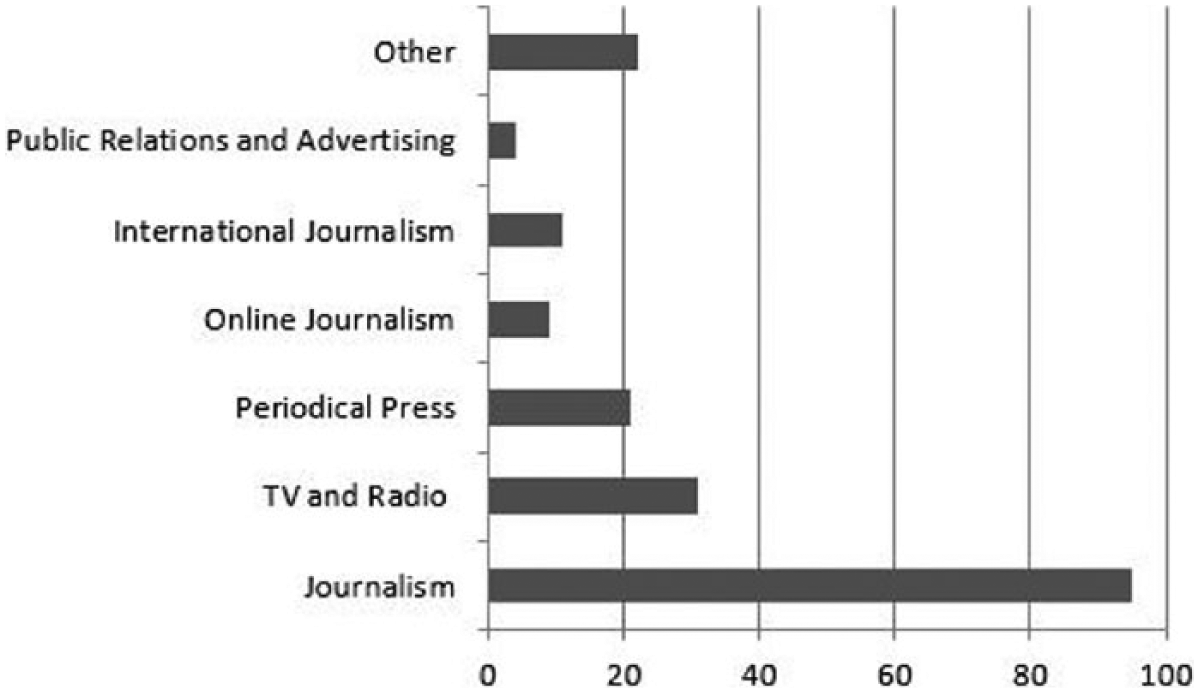
Types of journalism program profiles.
Cultural pluralism in journalism education could be seen via teaching in national languages (Gladkova, 2013). Out of 150 institutions where journalists are trained, 14 include programs in national languages. All these institutions belong to the state/public segment, and all of them are located in three federal districts: Volga, North Caucasian, and Southern districts. The findings concur with the data of the latest Russian census (2010), which identified the number of non-Russian speaking nationalities. Some nationalities, but not all of them, have journalism education programs. In Volga federal district, students are trained in the Tatar (Kazan State University, Tatarstan), Bashkir (Bashkir State University, Bashkortostan), Mordovian (Mordovia State University), Udmurtian (Udmurtian State University), and Chuvashian (Chuvashian State University) languages. In the North Caucasian federal district, five republics offer training in different languages: Dagestan, Kabardino-Balkaria, Karachaevo-Cherkessia, North Ossetia-Alania, and Chechnya. In the South federal district, Adygea and Kalmykia initiate offer journalism programs in minority languages.
All higher education institutions which offer journalism programs in national languages implement bachelor’s programs, seven offer master’s programs, and only two offer doctoral programs—in Tatar and Mordovia, where highly qualified researchers and academicians are trained.
Conclusion
Journalism education in Russia has increased within the system of Russian higher education up to 150 institutions (Zhurnalistskoye obrazovaniye v Rossii, 2007). From the beginning of the 1990s, journalism education changed its strategies from promoting a mandatory ideological component to standards adopted in journalism schools worldwide. Today journalism education in Russia is framed by two driving forces: media revolutionary changes and educational reforms.
Open data monitoring of all websites of institutions where future journalists are trained demonstrated that all 150 institutions have transferred to a model comparable to European model offering three qualification levels of education: bachelor’s, master’s, and doctoral level. Journalism education, like other segments of higher education, is regulated by the Federal State Educational Standard in Journalism, which determines the quality control of curricula, technical infrastructure, and human resources involved in teaching and research.
The survey revealed that the number of schools has increased by 12% every 3 years, although distributed unevenly around the country. There is a clear institutional concentration around the most economically developed districts and a correlation of the number of educational institutions with numbers of population and GRP. Out of 150 Russian universities, 80% are state owned and 20% are privately owned. The statistics also show a small decrease in the private segment that could be explained by the unfavorable economic situation. The ratio in more complex master’s and especially doctoral programs is moving in favor of state education.
Diversification in journalism education is clearly visible in program profiles. Quantitatively almost half of the programs construct their curricula with a general profile, while the other half focuses programs on narrower areas—audiovisual, periodical press, and online journalism. The last is not yet at the top of the list, which confirms that journalism education still does not meet the needs of the media industry. At the same time, several journalism programs offer training in a wide range of national languages that contribute to developments of cultural pluralism and stimulate future professionals to remain competitive on the media market.
Footnotes
Declaration of Conflicting Interests
The author(s) declared no potential conflicts of interest with respect to the research, authorship, and/or publication of this article.
Funding
The author(s) received no financial support for the research, authorship, and/or publication of this article.