




Abstract
Since 1994, South African journalism education has undergone waves of introspection about curricula and methods of teaching as educators respond to the challenging realities of the post-apartheid environment. The most recent challenge to journalism educators is the student protests which started at the end of 2015, questioning the high costs of education and demanding “decolonization” of curricula. The traditional alignment with media companies has also been upended as the drastic contraction of newsrooms removes the promise of jobs upon graduation and the swiftly shifting digital terrain rearranges the financial basis of all journalism. These factors introduce a dynamism and uncertainty into South African journalism that educators are compelled to respond to with imagination and principle.
History
Journalism education started in South Africa in the apartheid era with the first program established at Potchefstroom University
1
in 1959 followed by the University of South Africa in 1963. Three different university systems characterized the establishment of journalism programs as they were founded in more universities: One was a liberal, English tradition which drew on the “Oxbridge” model as well as aspects of the Scottish university tradition . . . The second tradition was that of Afrikaans-language universities, and the third that of black universities which were primarily established as part of the infrastructures of the apartheid state. (Du Toit & De Beer, 2010, p. 13)
Rhodes University launched a Department of Journalism and Media Studies in 1972 and the Rand Afrikaanse University 2 and the University of the Orange Free State 3 founded communication programs with some journalistic content in the early 1970s. The Afrikaans-language universities were “central to the intellectual infrastructure of the South African state” and understood their role as serving the state (Du Toit & De Beer, 2010, p. 13).
The period from the mid-1970s to the 1980s in South Africa was characterized generally by dramatic contestation against apartheid ideology, which spilled onto liberal, English-speaking university campuses (Du Toit & De Beer, 2010). Institutions of Afrikanerdom were in a power struggle with the Black majority, while the English-speaking academic community was mostly marginalized from the political sphere. The response to this situation from left-wing, journalism teachers was to infiltrate the English-language press and to use the teaching of journalism production skills to people involved in the progressive movement of resistance to apartheid as a form of activism. Campuses like Rhodes, the University of Cape Town, the University of the Witwatersrand, and University of Natal (now KwaZulu-Natal), became sites of struggle. A critical approach emerged at Rhodes, where teaching the fundamentals of journalism and critical theories and mind-sets were combined.
After the 1994 political transition, South African universities were faced with economic changes demanding that higher education be commercially viable. Many social science disciplines were redefined in terms of professionalism, and critical scholarship was influenced by an instrumentalist approach to knowledge, but now in service of the democratic state. This socio-political-economic context for journalism education in South Africa is an important, impinging factor on curricular design. As soon as the African National Congress came to power, it began to put pressure on the media to transform its personnel, content, and stance (considered to be overly watchdog and hostile to government), and some of this pressure devolved onto the training and education institutions who were seen to be necessary for providing the intellectually transformed journalism of the future. An account of this transition for journalism education is to be found in Steenveld (2006). Looking back at her own experience of teaching across the apartheid and post-apartheid years, Steenveld puts emphasis on both the socio-political context and the economic context against which curricula have been designed. While the political situation was overtly a consideration, so was the pressure from the journalism profession that the teaching of journalism should be primarily about preparing students to be fit for industry.
Overview
Journalism education is taught in both universities and universities of technology. The universities of technology are (in name) fairly recent additions to the tertiary education framework and many of them were “merged” into existing universities under a plan to reform the academic landscape by the South African Minister of Education in 2003. Many of these institutions still produce graduates considered by editors as more likely to “hit the ground running” when they apply for jobs. 4
The universities which teach both journalism practice and theory (and this of two varieties, theory of practice like ethics and sociology of news courses, and social theory) group their courses and emphasize their curricula in different ways. Some teach journalism within schools of communication (University of South Africa, University of the Free State, University of Johannesburg), some group their offerings as journalism and media/cultural studies (Rhodes, University of KwaZulu-Natal, University of Cape Town), and some offer stand-alone journalism programs at only postgraduate level (University of the Witwatersrand and Stellenbosch University). According to Du Toit (2013), this bifurcation between communication studies and media/cultural studies has historical routes with the formerly White Afrikaans-language and formerly Bantustan universities aligning their teaching of journalism with intellectual trajectories in communications studies (often as taught in Europe and the United States) and the formerly White English-language universities aligning their intellectual trajectories with media/cultural studies (as taught in the United Kingdom). This has shifted somewhat since the 2000s with more communication and staff movement across campuses.
The other division between universities offering journalism is between those which offer undergraduate courses for a 3-year or 4-year Bachelor’s degree (usually as one major course in an undergraduate degree) and those which offer postgraduate courses for a 1-year honors degree (a postgraduate year following a 3-year undergraduate degree) with a focus solely on journalism (Wits, Stellenbosch).
Usually the journalism practice courses (plus ethics and courses in journalism studies) form the major part of undergraduate degrees, and as students study further (honors, master’s, and doctoral levels), they take courses that are increasingly theoretical. A few universities allow students to do documentary-style journalism at master’s level as a creative equivalence to research (Wits and University of Cape Town).
In the 13 institutions which focus on teaching journalism practice in a variety of degrees there are in the region of 1,731 graduating each year and seeking work (Table 1). When this number is placed against the number of journalists with jobs—a maximum 4,000 5 —it does show that most journalism students are not likely to find a job in the field, but that the media are able to recruit well-educated candidates.
Number of Students in Journalism Programs in Final Years of Study, 2017.
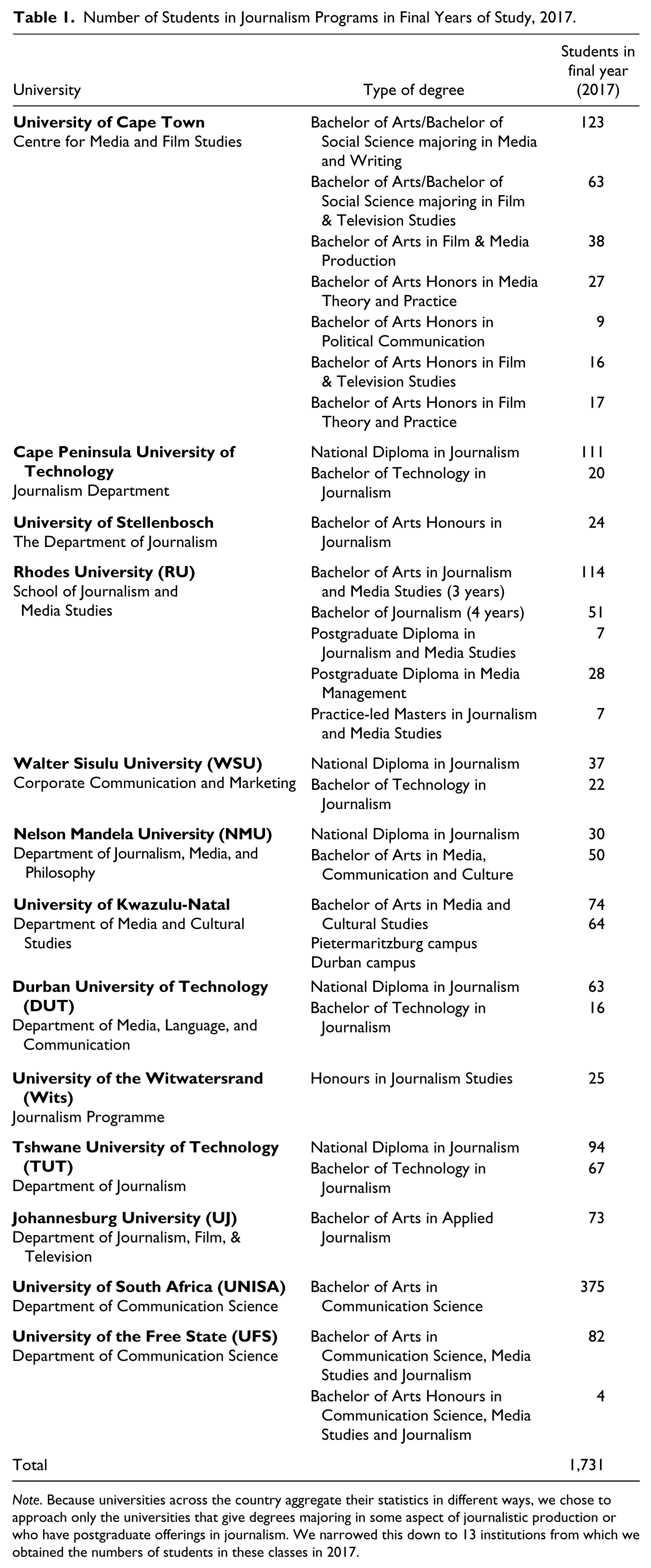
Note. Because universities across the country aggregate their statistics in different ways, we chose to approach only the universities that give degrees majoring in some aspect of journalistic production or who have postgraduate offerings in journalism. We narrowed this down to 13 institutions from which we obtained the numbers of students in these classes in 2017.
Three concerns about journalism education have dominated the media landscape since the transition to democracy: the need for a free flow of independent journalism, the educating of independent-minded journalists, and the transformation of the institutional media out of its lingering tri-furcation of the public sphere (Afrikaans-language media aimed at predominantly White Afrikaans speakers, 6 and English-language media aimed at White English speakers and Black South Africans with some media in vernacular languages). A group lobbying for the interests of independent journalism was seen as utterly critical in the new political era, so in 1997, the White Conference of Editors and the Black Editors’ Forum formed a new nonracial body called the South African National Editors’ Forum (Sanef). This body made possible the membership of senior journalism educators alongside editors so that the interface between editors and educators was facilitated and joint action against government or other parties hostile to independent journalism was made possible. It did not take long for this body to decide that journalism education itself needed attention in the new dispensation. In the same year (1997), Sanef hosted the first of many conversations with journalism teachers on journalism education and transformation of the media. 7
In the late 1990s and early 2000s, Rhodes University played an important role in hosting a series of discussions on journalism curricula. These debates, conferences, colloquia, and issues are captured in the pages of the Rhodes Journalism Review 8 and in journal articles in Equid Novi (now African Journalism Studies 9 ). Since the transition to democracy, the pressing question has been how to indigenize and Africanize journalism and journalism education so that they address themselves to democratization, the restoration of dignity to those oppressed by apartheid, and the important documenting of political and social transition, without losing the public role of calling power to account. Attempts to root theory and intellectual resources in Africa and the South African context have also been made with sporadic attention. 10
At the same time, South African journalism education has been faced with the digital revolution which has come as part of the increasing capitalization of the media for the gain of investors. Journalism educators are under constant pressure to revise curricula to take account of the major upheaval of the digital revolution and subsequent shifting financial basis for the media, the political stresses brought to bear by the ANC as the South African government, and the most recent demands by the 2015 student uprising against the high costs of tertiary education and which also made strident demands for the “decolonization” of curricula and theory. The transformation of South African society from one raced across all social spaces has been imbued with renewed urgency by these protests and is an issue which directly impacts on teaching and the practice of journalism as we discuss below.
Waves of Change
The Digital Wave
The digitization of media started in South Africa nearly four decades ago with all production of copy—input by reporters, subediting, and layout—converted to computer. In the 1990s, another wave ushered in wholescale digitalization of journalism production with an accompanying loss of jobs. For the very first time, the Internet via a dedicated computer terminal and telephone line became a reality in newsrooms. This process of increasing digitalization and job loss has continued since then. Digitalization did, however, have one extraordinary effect in its first incarnation: When the anti-apartheid Rand Daily Mail was shut down by its timid board in the mid-1980s, the young, retrenched journalists were able to use new desktop publishing software and computers to set up the The Weekly Mail (now the Mail & Guardian), a crusading, anti-apartheid newspaper. Since then, small and alternative media have benefited from the low costs of digital media set-up. But it is more recently that South African media outlets have been profoundly affected by newsroom contraction and job losses in such a way that despair about the future of institutional journalism in South Africa has begun to take hold. When advertising (particularly classified advertising) moved into the terrain of the Internet, the financial bedrock of newspapers shifted, and this impact continues to produce shock waves across the industry. There are many start-up, Internet-only digital media companies in South Africa, but there is only one which takes general, daily news journalism seriously as a core activity (The Daily Maverick, www.dailymaverick.co.za) and this is not yet financially viable.
The State of the Newsroom study focuses on charting these drastic shifts caused by digitalization and the advent of social media news dissemination. As Anton Harber and Franz Kruger write in the preface to the 2014 edition: Disruption in our newsrooms opens up opportunities as it shakes up institutions and leadership which may have become complacent, rigid and defensive. It can also be challenging and punishing, costing jobs, creating fear and uncertainty and sacrificing skills and experience . . . This turmoil is a global phenomenon as newsrooms take on the challenges of new technologies, but it has distinct local characteristics, particularly because of the on-going demands of social and political transformation needed to create a media which can best serve democracy and deal with the legacies of apartheid. (Daniels, 2014, p. vi)
Tracking the impact that social media platforms are having on the dissemination of journalism has now become important particularly when giants like Facebook do deals with major news outlets (like the New York Times). This is a qualitative shift from the situation where Facebook and Twitter were used by journalists to just gather information and to track events and issues. In the #FeesMustFall protests of 2015 and 2016, we also saw students around the country use these platforms for organizing, for news, and for analysis and opinion dissemination. The protests gave impetus to a new outlet The Daily Vox, which took advantage of this surge in new, young producers of politically engaged news.
In the latest State of the Newsroom report, editor Alan Finlay points out that journalism is now produced “inside” and “outside” of newsrooms. He asks “What do we mean by the ‘newsroom,’ now, in 2016, in South Africa?” (Finlay, 2016, p. iii). Since 2014, at Rhodes University, we no longer require of the students who choose a writing and editing specialization (which used to be a route toward working on newspapers and magazines) to do a semester on Grocott’s Mail, the community newspaper in our city. They now set up their own blogs as news dissemination sites and use social media to create audiences. This has added an important element to our task as educators—creating an audience for a platform that has only just come into existence—and emphasizes that the loss of a ready-made audience/readership has been the most profound impact of the shift to “outside” the newsroom.
A more recent digitization development we have had to make sense of has been the advent of “fake news” into South Africa and the abuse of Twitter to besmirch the character of journalists. 11 Political commentators and researchers have linked the determined production of fake news to the Gupta family who have funded The New Age newspaper and TV station ANN7, and who have ties to President Jacob Zuma. 12 This development, which is both like and unlike the propaganda of the past, links the facility to create false news stories with false social media identities and has a powerful political agenda which is fundamentally undemocratic. The test for journalism education is to understand the volatile mix of technology and manipulative politics and to help journalism students make sense of the phenomenon and acquire the skills of digital verification.
The Newsroom Contraction Wave
The South African media landscape looks healthy on the surface: 46 commercial newspapers (21 dailies and 25 weeklies), mostly owned by four major groups (Independent, Caxton, Naspers/Media 24, and Times Media). The community newspaper sector is interestingly resilient given its shaky financial basis and the Association of Independent Publishers has 250 members with 97 titles published in indigenous African languages. In television, there is DSTV Multichoice owned by Naspers and run as a paid-for service, which hosts entertainment and news programs (this is where South Africans can get BBC news, CNN, Sky, Al Jazeera, and Russia Today), the SA Broadcasting Corporation (SABC), eNCA and ANN7. The SABC is dominant in broadcasting; in addition to television channels, it owns both public and private radio stations. There are seven community television stations in the country: Cape Town TV, Soweto TV, Bay TV, One KZN, Tshwane TV, Bara TV, and North West Television. In addition, about 300 radio stations (commercial, public, and community) have the widest audience reach of any medium (Finlay, 2016). The SABC provincial radio stations also broadcast in local indigenous languages.
However, in the 2013 State of the Newsroom report, Daniels found that a significant number of jobs were being shed across the media outlets. For example, at Media 24, 10% of the editorial workforce in the Afrikaans news division was lost, while in English titles, 53 actual positions were axed. In the space of a year to April 2013, Times Media shed 18 senior staff members. Independent Newspapers had cut 3,000 jobs since 1994 and the SABC had cut about 1,200 jobs. Although the 2016 and 2014 reports do not focus on these job losses in the way the 2013 report did, it is clear that thousands of jobs lost since 1994 with more universities producing journalism graduates than was the case 20 years ago is not a good ratio of graduates to employment opportunities. In March 2015, a particular blow (both in jobs lost—35—and psychologically) for the news media was the closure of the South African Press Agency (Sapa), a nonprofit newswire which started in 1938 (Finlay, 2016). Despite this dire situation, journalism graduates do still find jobs. Daniels (2014) did a survey of 146 people who had graduated between 2010 and 2013. Daniels (2014) found that it had taken on average 15 months to secure a first full-time job. Eleven percent of the 146 had internships at the time of the survey, three were self-employed, and 23% had managed to secure a full-time job immediately after completing their degree. The surprising but pleasing result from this survey is that a majority with jobs (60%) were actually in journalism and not in the allied communication fields or elsewhere entirely.
The contraction of newsrooms has also strongly affected specialist journalism. Today, there are very few dedicated reporters in arts, environment, health, or investigations. Those who continue to work in these fields often do so with outside funding from agencies like the Open Society Foundation (like the stand-alone investigative unit AmaBhungane).
The consequence of the drastic nature of these developments means that those of us within educational environments see the rationale and motivation for teaching and preparing students for vibrant and interesting careers in institutional media dissipating. We have to reorient ourselves toward the “outside” online journalism environment, hoping that its vibrancy will find a financial footing. There is no doubt that Internet use in South Africa is increasing in leaps and bounds (particularly via mobile phones) but still the stability of a sure financial model for online news is not yet in place.
The Politics Wave
The strained relationship between the ANC government and the media since 1994 has been well documented (see Ciaglia, 2016, focusing on the public broadcaster; Berger, 1999; Daniels, 2012; Duncan, 2011; Ndlovu, 2015; Strelitz & Steenveld, 1998; Tomaselli, 1997; Wasserman & De Beer, 2005). This relationship is an omnipresent backdrop to the teaching of journalism often requiring solidarity with affected journalists. It has also required interventions, such as when the ANC reiterated in 2015 13 that it intended to set up a media appeals tribunal to oversee all reporting in the country. Educators, editors, and members of the public appeared at a commission of inquiry set up by industry owners and Sanef resulting in changes to the Press Council. This preemptive action circumvented the ANC party proposal and strengthened and legitimized co-regulation of the press (self-regulation with public participation) as well as bringing digital media (previously unregulated and at risk of falling within the Film and Publications Board’s much more-onerous rules) under co-regulation. In addition to the ANC–media relationship, there is the very worrying development that the South African state’s ability to operate as a democracy might be deeply compromised by President Jacob Zuma’s relationship with the Gupta family. This situation has come to be known in journalistic parlance as “state capture” and dominates political and news journalism.
But, the more insistent politics that South African educational institutions are being subjected to right now is the wave of protests that started on the UCT campus in March 2015. At first, the demands related to the removal of the statue of the British imperialist Cecil John Rhodes from a prominent place on the campus, but they soon engendered protests right across the country and on every campus about the very high costs of higher education and about curricula that do not root themselves in African thought and experience. While the university Vice-Chancellors and the Ministry of Education, as well as a range of vocal, intellectual, and highly motivated students, battle out the issues, it is left to the teachers in the classrooms to figure out how to reorient journalism teaching so that this generation of young Black South Africans sees that it has purchase and value.
The issues that this generation of students is insisting be addressed in higher education range from the material (costs of education, the realities of ongoing poverty, and unemployment in the families they come from), to the symbolic (universities are steeped in Western, liberal, agonistic, individualistic practices, and spaces), to the intellectual (the value of sources of knowledge rooted in Western and northern contexts).
Responding to these issues, and building on her 2013 doctoral study into transformation in journalism curricula in South Africa, Dube (2016) has also surveyed journalism education in other African contexts and finds that it is no simple matter for educators to determine the best combination of global and local knowledge and skills for their students. But she does say that curricula rooted in the West have the effect of “alienating” African students and underpreparing them to interpret African conditions (pp. 13, 16).
For us as journalism educators, these are challenging issues. South Africa has very few locally written textbooks to draw upon and most also do not consider the digital environment with the attention it demands. Calls to “de-westernize” the media have circulated among media theorists but had little effect on actual taught curricula (Dube, 2013).
The commercialization of our industry also means that there is very little debate about whether we should as a profession and as educators simply adopt and accept as an inevitable future whatever developments happen technologically in the North and West. There is an urgent desire in the industry to be cutting edge and very adept technologically and not to be seen in any way as backward in production values. This rush headlong into the future does not help the situation of educators who are trying to assess and weigh up curricula that are often put in place for years and need peer review and student feedback.
Conclusion
In the quote above, Harber and Kruger remind us that moments of crisis hold opportunities for those brave enough to seize the moment imaginatively. Digitization combined with newsroom contraction because of hyper-capitalization, combined with worrying political developments plus the resurgence of a political movement demanding justice and change, has posed major challenges to journalism curricula, methods of teaching, and the purpose of journalism. But there is still great value in students discovering and practicing storytelling for the purpose of enhancing human lives and making justice and equality a reality. It is also important to recognize that the changing digital terrain is opening up new platforms, new uses of media, and new users—Facebook now has 13 million users in the country with seven million accessing the site via smartphone (Finlay, 2016). As Finlay (2016) says in the latest State of the Newsroom report about Facebook and Twitter use, “there is a sense of active engagement with and participation in the newsmaking” (p. iii). He also points out that independent media websites are “talking about in-depth issues that the mainstream media won’t talk about, or don’t have the capacity to” (p. iii). This is definitely true for new Internet-based news outlets like GroundUp, 14 The Daily Vox 15 which position themselves as social justice journalism, and which seek out relationships with activist, student journalists. The politics around “state capture” has also resulted in a new investigative unit, Scorpio, 16 which operates somewhat like Wikileaks. As educators grapple with these complexities, and try to adopt a flexible, responsive attitude to the crafting of courses, there is no guarantee that the media environment in South Africa will settle back into the kind of stasis and dependability that marked the previous legacy media regime. For the foreseeable future, preparing students to make journalism of both “inside” and “outside” varieties seems to be the balancing act we must manage.
Footnotes
Declaration of Conflicting Interests
The author(s) declared no potential conflicts of interest with respect to the research, authorship, and/or publication of this article.
Funding
The author(s) received no financial support for the research, authorship, and/or publication of this article.