



Abstract
This study examined instructor and learner experiences in a Journalism for Social Change (JSC) Massive Open Online Course (MOOC) designed to introduce learners around the world to constructive, solutions-based journalism techniques, as well as engage learners in developing news stories promoting positive change about critical child welfare (CW) issues. Mixed-methods were used to identify five themes across instructor and learner experiences. Results suggest MOOCs have the potential to increase learners’ journalism content knowledge and to mobilize citizen journalists around social justice topics impacting communities. This study adds to an ongoing body of work investigating MOOC design for changing attitudes.
Keywords
Introduction
Higher education, journalism education, and the journalism profession have become democratized by mobile technologies, global interconnectedness, and immediate access to information via the Internet of Things. Massive Open Online Courses (MOOCs) have played a part in the democratization of education. MOOCs connect universities, industry, nonprofits, instructors, and learners around the world to engage in science and humanities-based subjects, including journalism (Knight Center, 2012; Liyanagunawardena, Adams, & Williams, 2013). Concurrently, social media and public interactive forums have led to an online global culture in which citizens can engage in journalism activities such as reporting, writing, and photography via blogs, video, and podcasting. MOOCs and online citizen journalism both have the potential to influence perceptions and attitudes for mobilizing and activating social justice efforts around critical public issues (Cherian, 2011; Nah, Namkoong, Van Stee, & Record, 2014). This study examined instructor and learners’ experiences in a case where a MOOC and citizen journalism for social change (SoC) collided. The results are significant for the instructional design of online journalism education programs, as well as future iterations of MOOCs aimed at influencing attitudes and mobilization about social justice topics.
Literature Review
Shifting to Citizen Journalism and Constructive Journalism
Citizens themselves now engage in journalism activities and publish their stories for online worldwide audiences (KDeuze, Brus, & Neuberger, 2007; KNip, 2006; KSplichal & Dahlgren, 2016; KWesley & Hota, 2015). Citizen journalists may work alone or in teams to deliver information via blogs and social media, or they may work with news sites, professional journalists, and/or participatory media platforms (Kus, Eberwein, Porlezza, & Splendore, 2017). Kus et al. identified four motives of citizen journalists: (a) programmer—implements computer skills into journalism contexts, (b) expert—aims to share her rich knowledge of a subject via various platforms, (c) humanist—engages in intellectualism about humanities subjects, and (d) community builder—calls audiences to discuss/participate in local issues. In a study of community journalism and user-generated content for a Belgian local newspaper, Paulussen and D’heer (2013) found that professional journalists contributed more of the hard news stories, while citizen journalists developed softer stories. “Citizen journalists prefer to create news stories based on their personal interests and experiences, or on information from the local organizations to which they are affiliated” (Paulussen & D’heer, 2013, p. 599). Hence, it appears citizen journalists who may not have extensive professional journalism training tend to report information they have a personal interest in or connection to via their backgrounds, life experiences, or content expertise.
A second shift underway in journalism is a connection to the field of positive psychology, which is the study of “human potentials, motives, and capacities” (Glydensted, 2015; Sheldon & King, 2001, p. 216). The upcoming iteration has been referred to as constructive journalism, solutions-based journalism, or journalism for SoC (Glydensted, 2015; Haagerup, 2015). Haagerup (2015) discussed how professional journalists are often asked, “Why are you always so negative?” (p. 5). Public perception is often that journalism is focused on presenting problems and not necessarily positive stories.
The Solutions Journalism Network (SJN; Solutions, 2016) is an example of a concerted effort to teach skills, develop partnerships, and build community around journalism focused on reporting solutions-based stories encouraging readers and viewers to engage in making positive change. In a SJN nationwide survey, Curry and Hammonds (2016) presented each participant with an article that solely focused on a problem such as “the effects of traumatic experiences on children in American schools” and an article that presented a possible solution to the problem. The researchers reported that the solutions-based articles had three positive impacts: (a) increased readers’ knowledge and self-efficacy, (b) strengthened the relationship between the readers and news organizations, and (c) inspired readers to engage in improving the issues (Curry & Hammonds, 2016). These findings demonstrated citizens’ appreciation for a solutions-based approach.
At the intersection of constructive journalism and citizen journalism, there is an opportunity to educate professional and citizen journalists about how to develop solutions-focused stories. As this study shows, MOOCs are one avenue for delivering this type of education.
MOOCs for Journalism Education
Higher education is also in a state of change concerning instructional approaches, design, delivery, learner engagement, and cost. MOOCs have become a point of controversy as they have enlarged distance education courses to deliver instruction from universities and nonprofits to thousands of learners around the globe (Bulfin, Pangrazio, & Selwyn, 2014). MOOCs are typically taught by a subject matter expert and delivered via online learning management systems such as Coursera, edX, Udacity, and Canvas (Liyanagunawardena et al., 2013). Allen and Seaman (2016) reported that the percentage of higher education institutions offering a MOOC increased from 2.6% in 2012 to 11.3% in 2016. Some key points of contention with MOOCs have centered on (a) their low completion rates, with typically 15% or less of enrolled learners finishing the courses (Jordan, 2014), (b) financial models for sustaining MOOCs offered for free (Hollands & Tirthali, 2014), and (c) the need for reputable credentialing for learners who require evidence of completion for progress toward degrees and career advancement (Liu et al., 2014).
MOOCs quickly made an appearance in journalism education. While distance education is not new, there is a growing potential for online learning and MOOCS to reach masses of nontraditional learners, engage citizen journalists, and mobilize learners who may not typically enroll in for-credit college classes. MOOCs provide an arena for higher education institutions to reach adult professional learners seeking professional development, opportunity to expand their interest in a subject area, or engage in a social issue without enrolling in a typical course. Kus et al. (2017) found the training of citizen journalists in the United Kingdom lay on a continuum between “no professional training” and “extensive professional training and experience” (p. 362). MOOCs could potentially fill the need for training citizens with little to no experience working in the journalism field.
An online search for journalism MOOCs showed courses with titles such as “Effectively Delivering News to Your Audience,” “Making Sense of News,” and “Community Journalism: Digital and Social Media” being delivered across Coursera, edX, and FutureLearn platforms (MOOC List, 2016). The Knight Center for Journalism (2012) in the Americas offered one of its first MOOCs about “Infographics and Data Visualization” to 2,000 learners in 109 countries. The center continues to offer more MOOCs to anyone interested in enrolling about topics such as social media (Knight Center, 2016). As MOOCs and journalism education continue to collide, it is important to examine instructor experiences and impact on learners’ attitudes and perceptions.
MOOCs for Attitude Change
An attitude is commonly defined as representing an individual’s psychological evaluation of an event, person, or object (Gagne, Briggs, & Wager, 1992; Zimbardo & Leippe, 1991). Attitudes are sometimes described as comprised of affective, cognitive, and behavioral components, reflecting evaluation based on emotion, knowledge, and actions taken, respectively (Kamradt & Kamradt, 1999; Simonson, 1979; Simonson & Maushak, 1996). Attitudes are changed by bringing them more in line with the targeted evaluation and, while not often explicitly targeted by instruction, are recognized as impacting learning outcomes (Gagne et al., 1992).
We have conducted several recent studies examining the impact of MOOCs on learner attitudes, including attitudes toward human trafficking (HT; S. L. Watson, Loizzo, et al., 2016) and animal behavior and welfare (ABW; S. L. Watson, Kim, & Watson, 2016). Both MOOCs were designed with attitudinal learning outcomes in mind, and both studies found evidence of student-perceived learning and attitude change. The case examined in this study shares elements with both MOOCs in the prior studies. Like the HT MOOC, the Journalism for Social Change (JSC) MOOC in this study is also situated around a social activism topic—the application of journalism to promote social solutions and change about child welfare (CW) issues. JSC also focused more overtly on developing cognitive knowledge and skills similar to the ABW MOOC’s focus on animal science and its application. Both prior MOOC studies also examined instructor perspectives and facilitation techniques, and a third study (S. L. Watson, Watson, Richardson, & Loizzo, 2016) examined how social, teaching, and attitudinal presence were utilized by instructors in communications in the HT MOOC. Together, these three studies describe the instructional design of MOOCs for attitudinal change, their ability to change learners’ attitudes, and how instructors facilitate a MOOC to promote attitudinal learning and change. This study examines an additional case of how a journalism MOOC with a goal of changing attitudes was designed and facilitated and how it affected learner attitudes.
Method
Research Context and Questions
The context for this study was a 7-week MOOC titled Journalism for Social Change offered by a public university in the southwestern part of the United States via the edX MOOC platform in 2015. The course was originally offered as a face-to-face course. Then, it was tested as a small private online course and, eventually, it evolved into a MOOC. Approximately 6,533 students enrolled in the MOOC, 474 of whom were active in the last week of the course, and 86 earned certificates of completion. Sixty-nine percent of learners enrolled had bachelor’s and master’s degrees. Learning objectives of the course included introducing learners to JSC concepts and techniques within the context of solutions-based reporting of CW issues and to mobilize learners (see Figure 1). The culminating project of the course entailed learners developing a print constructivist journalism article about a CW issue impacting their area that had the potential to be published by a real-world nonprofit organization owned and operated by the MOOC instructor. Our research questions are as follows:
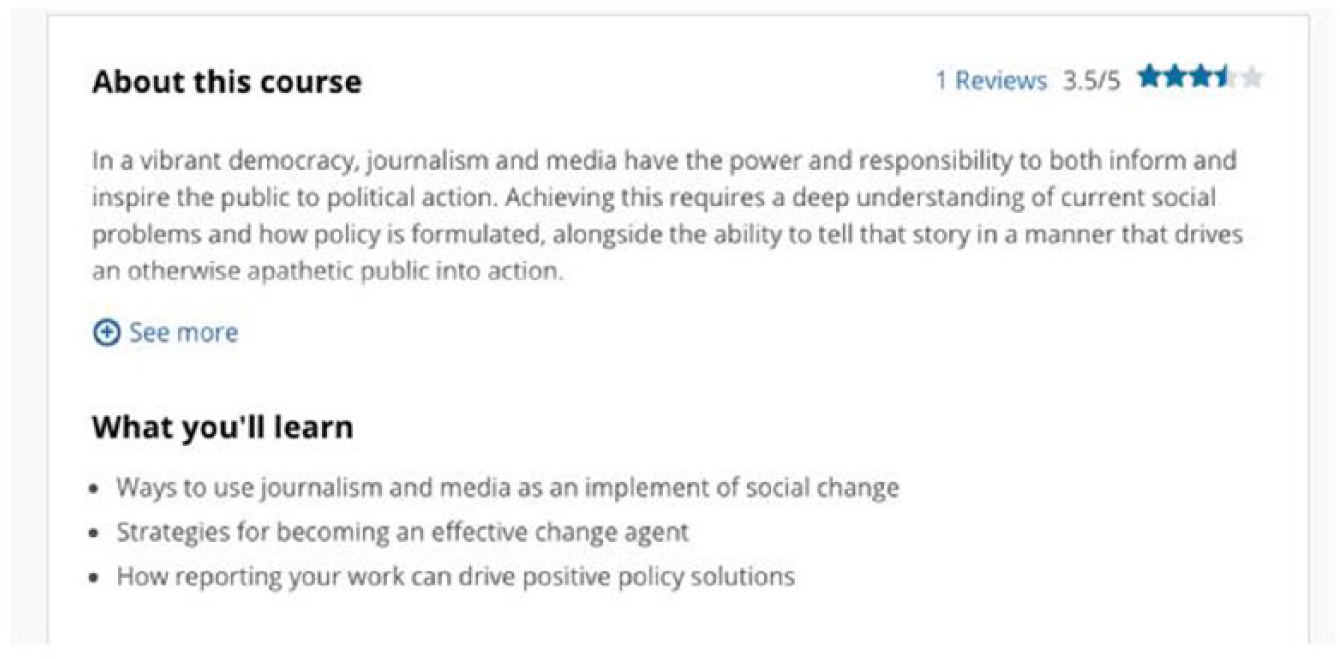
Screen capture of Journalism for Social Change MOOC learning objectives from homepage. MOOC = Massive Open Online Course.
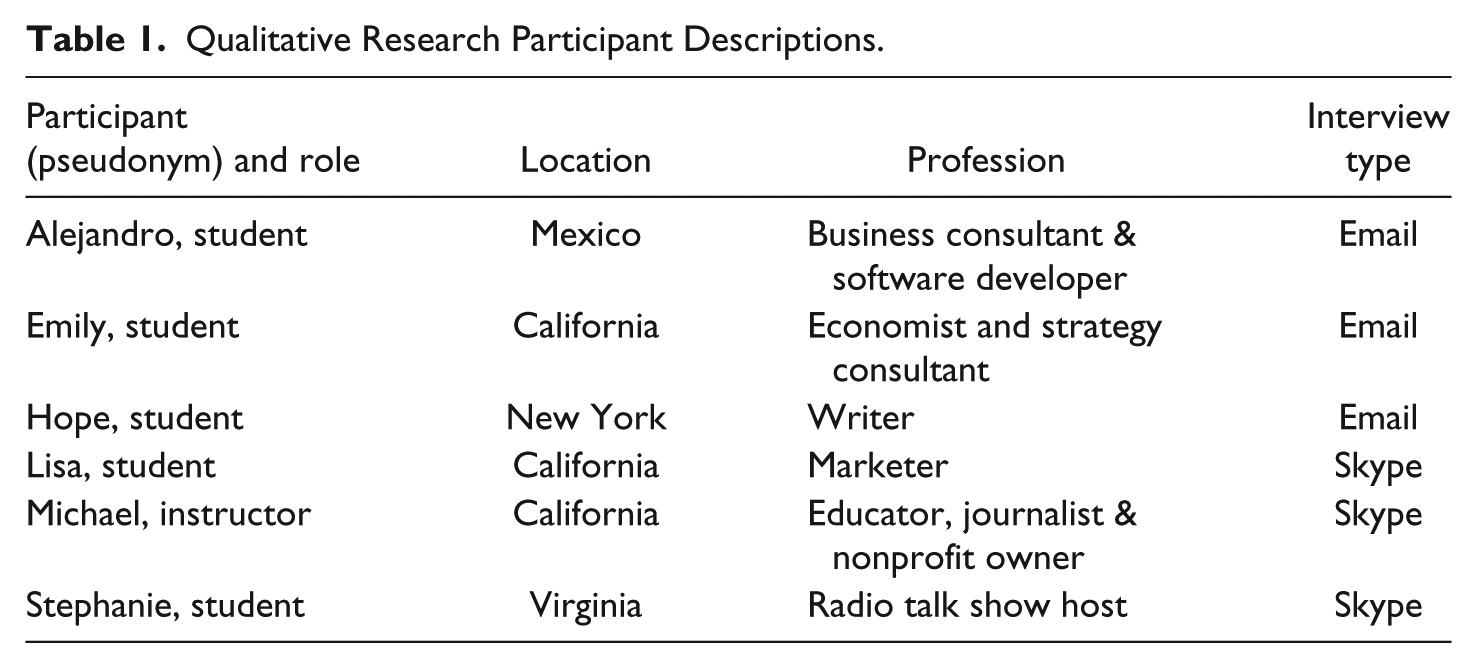
Qualitative Research Participant Descriptions.
A mixed-methods research design was used to gain insights into effective and ineffective MOOC instructional design approaches for engaging global learners in constructive journalism and for impacting learner attitudes about journalism and social justice issues. Virtual ethnography and a post-survey were used to triangulate researcher observations, interviews, and attitude survey results for a more holistic viewpoint of learner and instructor experiences in the MOOC. This study had approval of the Institutional Review Board of Purdue University through expedited review procedure because it presented a minimal risk of breach of confidentiality to human subjects.
Virtual Ethnography
Virtual ethnography is rooted in anthropology and is the study of online communities across virtual, in-person, synchronous, and asynchronous environments to develop an understanding of cultures and interactions (Hine, 2000, 2008). Virtual ethnography often involves the researcher embedding herself in the research context for a duration of time for conducting observations and interviews. Specifically, within the JSC MOOC, we conducted overt observations of the MOOC each week and collected screen captures (N = 30) of course artifacts such as the instructor’s conceptual explanation of SoC. We also reviewed the syllabus, assignment instructions, study participants’ completed assignments, and instructor announcements and discussion posts.
Ninety-minute individual semistructured interviews were conducted with the MOOC instructor and learners (N = 5) within 2 weeks after the MOOC ended. Each participant in this study volunteered and consented to engage via an online informed consent form that was included in the attitude survey emailed to all enrolled MOOC learners via the edX platform at the end of the course. Three learners chose to participate in an email-based interview, while one participated via Skype, and one participated in a phone interview. The MOOC instructor also consented to participate via an online consent form and participated in a Skype post-interview. It is possible that the different types of interviews (Skype vs. phone vs. email) could have influenced results. Participants’ facial expressions, voice tone, researcher–participant rapport, and opportunities for asking probing questions were not captured via email, while some of these qualities were possible to experience via phone and almost all via Skype. Hesse-Biber (2017) pointed out social science researchers are increasingly facing these trade-offs in online research due to the synchronous and asynchronous nature of the environment. To increase interview participation, we utilized all three modalities of interviewing a diverse MOOC population with multiple time and technology constraints. The interview protocol included the following questions: What were your thoughts/attitude about journalism for SoC/CW before/after this course? If your thoughts changed, how and why did they change? Did you learn any new journalism skills as a result of participating in this MOOC? Pseudonyms are used in this report to protect participants’ identities.
Survey Instrument
In addition to the virtual ethnographic observations and interviews, we conducted a quantitative email post-survey of adult learners’ MOOC attitudes. Thirteen survey items asked learners to rate their agreement levels between strong disagreement (1) and strong agreement (5). Fifty-two enrolled MOOC learners completed the online attitude post-survey. That is a response rate of approximately 11% of the MOOC learners active in the last week of the course. Three areas of attitudinal learning (cognitive, affective, and behavioral) and a section on general learning were included in the survey. Strictly learner attitude data were collected, not changes in content knowledge. The three attitudinal learning questions were created based on research literature on attitudinal learning and change (Bednar & Levie, 1993; Daruwalla & Darcy, 2005; Kamradt & Kamradt, 1999; Rogers, 1986; Simonson, 1979; Simonson & Maushak, 1996). The general learning questions were from the Affective Learning Scale (ALS; Scott & Wheeless, 1977), which focuses on accessing the positive attitudes on completing learning tasks. ALS has been used in a variety of learning contexts to examine affective learning (Chory & McCroskey, 1999; Rovai, Wighting, Baker, & Grooms, 2009; Ruggiero, 2015; Witt & Wheeless, 2001). The reliability with Cronbach’s alpha values of the general learning, cognitive learning, affective learning, and behavior learning scales were at .75, .63, .80, and .87 in this learner sample.
Data Analysis
First, learners’ attitudinal learning survey results were reviewed, with the mean and standard deviation of each item being recorded. Then, all interview transcripts were open-coded for emergent similarities and differences across learner experiences and attitudes. Each researcher coded individually and collapsed their open-codes into overarching categories such as “MOOC Purpose” and “Child Welfare Context.” We then met to confirm emergent codes and categories to further combine overlapping categories to arrive at themes across the data sources (Creswell, 2014). As an example, researchers individually identified that the instructor and learners in the study described their personal connections, interests, and motivations for participating in the MOOC. Thus, the category of passion/motivation emerged and evolved into the theme of “Passionate and motivated instructor and learners,” which connected to our first research question. The results were then member-checked with the MOOC instructor for feedback and accuracy.
Results
Five themes emerged from the analysis of participant interview transcript coding, observations, and attitude survey analysis. The subsequent sections include qualitative and quantitative support to provide rich insight into instructor and learners’ experiences with each theme within the JSC MOOC.
A MOOC With Multiple Purposes
JSC appeared to be a very active MOOC with three main purposes: (a) to teach a solutions-based journalism approach, (b) to raise awareness about CW issues, and (c) to engage learners in promoting positive change. These three purposes were apparent across data sources. The MOOC was challenging in that it combined critical thinking, development of and application of journalism skills, and content learning about a social justice topic.
For the first purpose, the instructor aimed to educate learners about basic journalism skills such as researching topics, writing, pitching story ideas, and proposing CW solutions. Michael, the instructor, outlined, I wanted them to be able to identify what’s newsworthy, and be able to find a story that could resonate with the mainstream media and with the public. So, assessment of newsworthiness. And their capacity to write a pitch based on the rubric we gave them, how you would write a simple pitch that you could apply in pitching other outlets and pitching us. And then, writing a story clearly, how do you go about writing a story? Basics in reporting. How you actually call somebody up. How do you identify yourself? How do you do it ethically? How do you report on vulnerable populations, children, in an ethical manner?
When asked what new journalism skills they learned in the MOOC, learners were able to describe specific details about their increases in knowledge. Hope explained, “I learned how to write a couple of pitches. I had never done so before. That was a fun challenge.” Emily said, “I learned the power of a story, how to pitch a story, and the challenge of landing a source.”
In regard to raising awareness about CW issues, Michael said his objective was to introduce learners to the tensions that exist in child protection “ . . . about when you use a coercive power of the state versus when you try to keep families together, essentially.” Learners expressed the course impacted their understanding of the issue. Lisa said, “I never realized the conflict between trying to keep the child with the family versus putting them into care.” Emily shared, “Child abuse: it is more prevalent than I thought. It is predictable, but not perfectly. Youth can make a huge difference in changing the system once they escape it. Many of the decisions on child placement are heartbreaking.”
The third purpose of the MOOC was to encourage learners to become positive change agents for CW. The instructor said, “I wanted to get people asking the people in power questions about issues that they wouldn’t otherwise be queried on.” A learner in this study described how the course introduced her to an issue she had not previously considered. Lisa discussed, It certainly was interesting learning about the foster care system and efforts to change it and what needs to be changed, so that was something that kind of got me interested in a new cause that I never would have probably thought about because I don’t have children.
From this study, it appears MOOCs can strive to achieve multiple purposes. Specifically, MOOCs have the capacity to increase content knowledge and awareness of social justice issues.
Passionate and Motivated Instructor and Learners
Interviews and observations showed that the instructor and learners in this case were passionate and motivated individuals. Michael was an experienced journalist, educator, owner of a nonprofit organization for CW issues. He described his passion for journalism and CW: I’ve written about children’s issues for a long time so it would be easy to label me an advocate. An advocate is a bad word in America for some reason, but it would be easy to label me an advocate, but I don’t really think I am. But if I have that scrutiny, then the only thing I have is my reputation and my capacity to tell the truth. So, you actually have a higher burden of proof if you’re transparent.
Learners in this study seemed to appreciate Michael’s expertise and passion. Lisa described her respect for Michael and his work, “and what the professor does, he’s got foster connections. He does so much what I’m really interested in—even beyond just the class.” Hence, the background, passion, and credibility of the instructor appeared to be crucial in the design and delivery of a MOOC intended to not only educate but to also mobilize change agents.
Along with an interest in the instructor, learners discussed various motivations for enrolling in JSC. Some of the learners had journalism education backgrounds and utilized the MOOC for personal and professional development. Emily, Hope, and Stephanie all described having journalism-related careers in industry and nonprofits. Stephanie was a free-lance writer, host of a weekly radio talk show focused on women’s issues, and on the board of directors for a nonprofit focused on women’s rights. She was motivated to take the MOOC because I just thought that this class is perfect because it’s what I do. I do social change, and I do journalism, and I’ve never seen them connected in any concrete way before. I saw it, and I thought, “Well this is perfect because maybe they can teach me something in this class about how to be more persuasive than I’m being and make my articles more effective.” And I did, I learned a lot.
Similarly, Emily, an economist and strategy consultant, wrote a business blog and looked to the MOOC to inform her writing approach for economics and social policy. Hope was also a blog writer who focused on organic gardening, weaving, and social justice topics. She described taking MOOCs for enjoyment and her goal to take a “meaningful writing course.” Lisa shared that she was already active in “trying to promote the federal foster care tax credit act.” The instructor and learners in this study were passionate about their own personal causes, but also they appeared to be motivated to learn more and engage in SoC journalism for their careers and blogs.
Importance of a Real-World Context for Developing Constructivist Journalists
The focal point of the MOOC was the final project. Learners were charged with investigating a CW issue of their own interest, identify and conduct an interview with a source about the topic, and write a solutions-based story that could possibly be published. Michael said, “The ultimate goal is to get them to write stuff that is publish worthy. I think that’s the ultimate exercise. If you’re trying to do solution-based journalism, you should go out there and do some solution-based journalism.” Developing an article about a real-world issue appeared to engage learners in applying journalism techniques taught in the class, as well as expand their knowledge and thinking about issues surrounding children’s, families’, and government’s rights.
Learners’ articles focused on a variety of topics. Alejandro investigated youth rights in Mexico and discussed how the project impacted him, “The project made me aware that social norms and traditions in Mexico regard minors as the property of their parents and that we Mexicans have a hard time giving children a voice.” The writing projects also seemed to connect learners with their communities and pathways for getting involved. Emily described, “I wrote about the current and potential use of big data for prevention. I met two fascinating people and have ended up with an opportunity to help a non-profit that researches and helps abused kids and their parents.”
Learners’ stories showed a beginning grasp of journalism for SoC writing approaches. Stephanie researched and wrote about HT of children and how the legislation that was tabled in 2015 due to political clashes. Stephanie reflected on her learning, I learned the importance of data and the importance of putting statistics in which is something that I had never really thought of before. Basically, I had been doing social and political commentary, so you don’t necessarily need statistics, but for actually writing news articles, you’ve gotta kind of back everything up and show the data.
Stephanie’s article also pointed readers toward learning more about a safe house for trafficking victims as a potential way to be involved in helping others.
The appearance of possible solutions presented in learners’ class projects aimed at the crux of Michael’s objective to flip the conversation in journalism. He said, Solutions are harder to report on than problems. If that was more indoctrinated in journalism education, you’d have a heightened public discourse, period. I’d hope that other folks kind of take note of this and that it can have some kind of change in the way that we do journalism.
Alejandro discussed how his understanding of constructive journalism emerged from the MOOC: “The course made me realize that it is important to set an agenda of things that need to be done. Not just whine about bad situations.” Alejandro seemed to echo Michael’s teaching: “Just the facts is not good enough. It is impossible to be objective. The journalist must be aware and transparent about his position on the issue.” Overall, the final project and potential to publish a real-world article seemed to be a success in the MOOC design. The project moved students beyond simply reading about solutions-based journalism and CW issues to applying and demonstrating constructive journalism techniques, as well as awareness of and engagement in child protection efforts in their own communities.
Humanities MOOC Design Challenges
The instructor and learners expressed three challenges related to the design of MOOCs for humanities subjects: (a) keeping up with the volume of discussion board threads and posts, (b) grading and providing meaningful feedback on the thousands of submitted articles, and (c) presenting content that appeals to learners from all over world.
Michael described the discussion board as somewhat overwhelming to monitor and ineffective for promoting deep discussion. He said, “I have an assistant, she’s been very active in staying on top of the discussion boards. What I do is go into the discussion board whenever I can and try to keep up with the flood.” Lisa said, “That’s the difference between this [MOOC format] and my MBA program. We’d have 30 people in the class. You were really dialoguing back and forth, which is not really possible in this format.” Hope mentioned, “Comments in the discussion forum from MOOC personnel were brief and usually generic.” Michael also discussed how it was impossible for him to grade every single article that was submitted. He shared that it is easier to grade papers and provide detailed comments in face-to-face courses with a smaller number or enrolled learners.
JSC focused on CW issues within the United States, which was not an appealing topic for some of the learners. Alejandro commented, “The case of routine access to court cases involving children is overplayed in the course.” Hope said, “We were limited to writing about child maltreatment.” Michael stated, I’d like to rethink about how to broaden the subject matter for an international audience. It’s a little too domestic focused considering that only 25% of our students are from the states. I think that’s probably ubiquitous with these MOOCs.
This third challenge of the MOOC instructional design highlights the need to offer course content at a global scale in a way that will appeal to learners’ diverse interests, backgrounds, and contexts.
MOOCs for Attitude Change and Activism
The instructor, Michael, clearly viewed the MOOC as a venue for promoting attitude shift and developing “change agents” in journalism education, saying that he “would like them [learners] to change their perspective on journalism.”
The learner survey responses also reported that learners had positive perceptions of learning as a result of the MOOC. The means of perceived learning gains for all four categories averaged between 3.54 and 4.48 out of 5 (Table 2).
Descriptive Statistics of Perceptions on Attitudinal Learning Gains Survey (N = 52).

Note. JSC = Journalism for Social Change; MOOC = Massive Open Online Course.
Cognitive learning
Learners had positive perceptions in cognitive learning, reporting that they were much more informed (M = 4.54), more inclined to consider multiple perspectives regarding the topic (M = 4.23), and in agreement with the perspective (M = 3.98) the MOOC presented. Interview data also showed the degree to which participants valued the content of the course, with positive comments mostly pointing toward the more nuanced understanding of the topic. Lisa, an adoptive mother shared, I guess the MOOC has helped me shift a little. I’m an adoptive mom so my opinion was always remove the child, you blew it. The child needs to come first, always, but I’ve come to value and maybe understand the other side a little bit more.
Alejandro stated, Before the course, I just assumed that journalists have and should have access to the courts, regardless. Now, I am not so sure. On one hand, children must have their own voice heard. On the other, they are minors and someone must take responsibility for their privacy.
Affective learning
In regard to affective learning, learners reported that they felt more connected to the topic (M = 4.06) and felt confident that their opinion was more informed (M = 4.06). Interviews also indicated positive feelings about the course, with learners sharing they were very impressed with what they did. They [instructor] clearly cared about the topic and about teaching people to go out there and learn how to actually do something to change this. But, I’m an activist, so I do that all the time. So, nothing really changed, but I was really impressed by both the lead instructor and his assistants.
Behavioral learning
Behavioral learning showed much lower levels of positive gains when compared with the other categories. Still, learners indicated somewhat positive gains on changing personal lifestyle (M = 3.54), and in convincing others (M = 3.58). Interviews showed that there were a variety of perceptions about behavior change. While there were learners who stated that the course changed them, there were also learners who felt that the course did not have much impact on their behavior, stating “I don’t think it changed my attitude,” even though they enjoyed the course and were impressed with the enthusiasm of the instructor.
Discussion and Conclusion
This study examined the case of a Journalism for Social Change MOOC and identified six themes surrounding an instructor and learners’ perceptions and experiences. The MOOC was complex with multiple learning objectives including solutions-journalism education, as well as promoting attitude change about CW issues. The instructor and learners in this study were educated adults from all over the world. They had varying motivations and expectations for the course, but they did seem to share a passion for learning and wanting to make a difference in society. Learners appeared to value the real-world project of writing a constructivist journalism article as a meaningful learning exercise for demonstrating and applying knowledge gained from the course. Yet, there were some instructional design challenges that included effectively managing and engaging in high-volume discussion boards and presenting content that appealed to diverse learners from varied international contexts. These challenges echo prior studies we have conducted on MOOCs for attitudinal change where instructors identified discussion forums as challenging in terms of the overwhelming numbers of learners participating in them (S. L. Watson, Loizzo, et al., 2016), inadequacies of the platform’s discussion management (W. R. Watson, Kim, & Watson, 2016), and concerns about the quality of learner posts (S. L. Watson, Watson, Richardson, & Loizzo, 2016). This is not surprising given the massive nature of MOOC enrollments that creates related challenges with instructor and student interactions and assessment (Adair et al., 2014). Our prior study found that a large team of instructors were able to focus on successfully establishing social presence in the discussion forums of their attitudinal change MOOC by sharing responsibilities (S. L. Watson, Watson, Janakiraman, & Richardson, 2017), a finding that confirmed previous research (Kilgore & Lowenthal, 2015); however, institutional support for MOOC instructors is often limited (Head, 2013).
While this single case study is limited in its generalizability, nevertheless implications for the instructional design of MOOCs for attitudinal change and MOOCs in general can be drawn. First, both quantitative and qualitative results indicated that MOOCs can be effective in promoting attitude change when intentionally designed for this purpose; this is consistent with our previous findings (S. L. Watson, Loizzo, et al., 2016; W. R. Watson, Kim, & Watson, 2016; S. L. Watson, Watson, Richardson, & Loizzo, 2016). This study also demonstrates that MOOCs can also be designed with multiple instructional purposes in mind as this MOOC targeted varied learning outcomes including cognitive and behavioral learning in addition to attitude change. However, it is also important to consider the limitations of the platform—including the difficulty in effectively establishing critical and deep conversation, even when the instructor has support with reading and responding to learner posts. Another recommendation is to consider the global audience of MOOCs as this MOOC focused largely on the context of JSC in the United States despite a majority of learners being from other countries. This is consistent with other recommendations in the literature to consider designing MOOCs to better meet the varied needs of what is typically a very diverse group of learners (Beaven, Hauck, Comas-Quinn, Lewis, & de los Arcos, 2014).
The MOOC in this study appeared to reach its primary objectives of solutions-based journalism education and activism around CW. The results of this research indicate that MOOCs have the potential to introduce professional and citizen journalists to not only solutions-journalism concepts and skills, but also to change attitudes and mobilize learners to engage in real-world communication efforts about social justice topics. Hanitzsch, Hanusch, and Lauerer (2016) examined journalists’ roles in influencing societies around the world and pointed out that “interventionist journalism is not to stay apart from the flow of events, but to participate, intervene, get involved, and promote change” (p. 3). The instructor in this study directly challenged learners’ perceptions of journalism and to actively write stories to impact issues of child maltreatment. By digging into CW as a context, learners’ attitudes toward journalism, the courts, government, and childcare providers did not appear to have dramatic shifts, but there did appear to be an increase in learners’ awareness and intent to engage in solutions-based journalism and CW issues in their own communities. This supports similar studies conducted by this research team about attitude change instruction and learning in MOOCs (S. L. Watson, Loizzo, et al., 2016; S. L. Watson et al., 2017; W. R. Watson, Kim, & Watson, 2016; S. L. Watson, Watson, Richardson, & Loizzo, 2016).
It should be noted, however, that MOOC learners reported behavioral learning at a lower level than cognitive or affective learning. This is perhaps unsurprising given that changing actual behavior is perhaps the most challenging aspect of attitude change even though it is often the ultimate goal. This could be a result of learners seeking to learn about journalism without the intent to actually implement it—After all, journalism is typically a professional pursuit. However, several of the learners interviewed did report that they were professional journalists or bloggers. Another possibility could be the limitation of the survey instrument as it has not been validated, and learners could interpret terminology such as “lifestyle change” differently than the authors intended. Future research could support assessment of attitudinal learning and change by validating instruments to support evaluation and comparison of attitudinal instruction. Ultimately, a consistent challenge in evaluating attitude change is the long-term viability of attitude shifts. Therefore, future studies should also consider measuring how well learners retain attitudinal learning components over time. The instructional design of this course included a focus on behavioral learning activities—learners actually writing JSC pieces and pitches that were highlighted as successfully providing real-world context and problems. While reported behavior change was lower than the other components of attitude, it was nonetheless still positive and does not diminish the overall success of the MOOC, which was designed with varied goals and perceived as successful by both instructor and learners.
Footnotes
Declaration of Conflicting Interests
The author(s) declared no potential conflicts of interest with respect to the research, authorship, and/or publication of this article.
Funding
The author(s) received no financial support for the research, authorship, and/or publication of this article.