




Abstract
This longitudinal pedagogical research investigates students’ perceptions and learning outcomes by integrating web and social analytics–based learning activities (i.e., Google Analytics courses and certification test) into Public Relations Research course design. Results from the pretest before introducing the analytics learning assignment confirmed that students’ knowledge on web and social analytics is low but their desire to learn is high. Results from the posttest after passing the certification test indicated students are eager to have more experience-based learning activities to apply knowledge related to web and social analytics in public relations research and practice. More pedagogical recommendations are discussed.
Keywords
Introduction
In today’s competitive and rapidly changing digital communication environment, it is important for public relations graduates to acquire social analytic skills to tracking and engaging stakeholders across all different communication platforms (Alexander, 2004). Across different sectors and communication functions within the communication unit of an organization, competencies in conducting social analytics and using data to drive powerful insights are a workplace necessity (Joshi & Gimenez, 2014), especially for the Millennial communication professionals who value diversity, engagement, and connectivity both in a professional and social level (Meng & Berger, 2017; Meng & Berger, 2018).
Recently, as reflected in the industrial trends, web and social analytics have drawn the attention of researchers and educators. As the speed and quantity of information flow have increased, the attention of researchers, educators, and businesses has turned to new solutions to understand and make sense of the data. The discussion over the emergence of big data and analytics is now viewed as having the potential to transform communication models (Joshi & Gimenez, 2014), improve the targeting of messages (De Swaan Arons & van den Driest, 2014), and increase competitiveness (Kiron, Shockley, Kruschwitz, Finch, & Haydock, 2011). As reflected in the field of public relations education, despite the strong focus on developing students’ communication skills and strategic thinking ethos, educators and researchers have agreed that public relations students are better equipped for employment if they gain certain level of knowledge in monitoring and analyzing social conversations during their university education (Alexander, 2004; Commission on Public Relations Education 2017 Report, 2018; Kent, Carr, Husted, & Pop, 2011).
Therefore, this research is inspired by the motivation to design, plan, and implement a web analytics (i.e., Google Analytics Certification) learning experience to public relations majors through a required core course, Public Relations Research. By urging public relations majors to study Google Analytics and take the Certification test, the researchers hope to demonstrate the successful implementation of an innovative assignment into a Public Relations Research course, thereby providing guidance and discussion for educators who wish to implement a web and social analytics pedagogy in their present courses. By comparing public relations majors’ knowledge and expectations on social analytics before and after they study for the subjects, we are interested in investigating whether the subjects or courses of social analytics would engage students at multiple levels and help them build a holistic perspective on the role of social analytics in today’s public relations research and practice.
Literature Review
Background: Google Analytics Certification Program
Google Analytics is a measurement tool to gather website visitors’ behavior data. Such information aims at helping website publishers have a better understanding of the frequency and duration per visit. It also provides other advanced information to help website publishers track the unique attention, sections, and usage of their website by each individual visitor (Geary, 2013). To better understand and build the knowledge of social and digital analytics, Google developed the Google Analytics online certification program that allows individuals to learn by themselves and obtain the certificate as a demonstration of their proficiency in analytics.
The process of obtaining Google Analytics Certification consists of signing up and going to the Google Partners, watching the course videos for each topic, reviewing additional guides and tips, taking a practice test and reviewing exam study materials, and then taking the actual certification exam (Google Analytics Academy; Hardman, 2015). Since Google Analytics launched online courses and the certification procedure in October 2013, more than 30,000 individuals finished the course and earned a certificate of completion (Google Analytics Solutions, 2014). In addition, in late 2014, to appeal to cost-conscious individuals, Google made the exam free (Staton, 2016).
In March 2017, Google Analytics team has released two updated courses, including Google Analytics for Beginners and Advanced Google Analytics (Richardson, 2017). The course for Beginners covers creating an account, implementing code, setting up filters, navigating the interface, analyzing reports, setting up goals, tracking campaigns, and creating dashboards (Hudson, 2018; Richardson, 2017). The advanced course covers how to collect and process data, how to use configurations (e.g., Custom Dimensions, Custom Metrics, and Event Tracking), and how to use advanced techniques (e.g., segmentation, channel reports, audience reports, custom reports, and marketing strategies; Hudson, 2018; Richardson, 2017). Analytics Academy has enabled individuals having free access to the course videos and assessment materials of the two updated courses via its online platform and taking the certification test through Academy for Ads (Google Partners Help, n.d.; Hudson, 2018).
The procedure to earn the Google Analytics Certification is largely self-study based. Individuals must learn the topics that covered in the two updated courses before they can take and pass the exam. There are eight units and 35 lessons developed and built into those two online courses. The Analytics Academy recommends individuals to view and study all units and lessons before taking the exam. The overall length of completing all units and lessons varied, depending on each individual’s study plan and time management. For instance, Kelsey (2017) suggested to review the units at the rate of one per week whereas Staton (2016) mentioned to spend 3 hr and 15 min to view all lessons when the certification program was implemented in the marketing class and blended learning techniques.
Individuals also have the options to answer practicing questions to verify their learning and strengthen their understanding after watching all course videos, but before they take the actual exam (Daily Beast Shop, 2018). They could also reach out for help on the accompanying online discussion forum when they had questions about relevant subjects (Daily Beast Shop, 2018). Once individuals finish watching all course videos, answering the practice questions, and digesting the information and knowledge based on their notes, they may take the actual exam. The exam itself is about 90-min long and individuals need to obtain 80% correct on the exam to pass and retrieve the certificate (Google Analytics Academy).
Essential Roles of Research and Analytics in Undergraduate Public Relations Education
A Port of Entry: Public Relations Education for the 21st Century, the landmark education report published by the Commission on Public Relations Education (1999), highlights the importance of preparing graduates of the public relations academy in understanding PR theory and practice, as well as the connection between public relations practice and managerial functions within the organization. Writing, analyzing, and thinking were named the most important and foundational skills for public relations majors.
As the industry evolves and develops, new skill sets and expectations are also added. For instance, in the 2006 report published by the Commission on Public Relations Education, The Professional Bond, the understanding of research and new technology was emphasized as essential in undergraduate public relations curriculum. Specifically, uses of research and forecasting were recommended as key PR knowledge. At the same time, research methods and analysis were recommended as core skills in solving PR problems. The need for undergraduate PR majors to command research skills and the ability to interpret and use research findings in decision-making was regarded critical, ranging from conducting research, analyzing and interpreting data and information, to integrating research into planning and management and conducting evaluation that demonstrates results. When addressing the essential skills and knowledge in technology, the 2006 report emphasizes on students’ ability to use current technology and adapt such skills to rapid changes and advancements in various communication contexts.
Such emphases are further strengthened in the Commission on Public Relations Education 2017 Report (2018), Fast Forward: Foundations and Future State. Educators and Practitioners. The report summarizes trends and changes that emerged between 2006 and 2016 and addresses that analytics being the most important item for undergraduate PR curriculum to adopt. The report highlights technology is “not only a rapidly growing subject for study, it is also a core part of how educators teach and practitioners work, and it is a strategy for effective public relations” (Commission on Public Relations Education 2017 Report, 2018, p. 14). While research methods remain as one of the Commission-recommended courses for an undergraduate PR program, the Commission recommends that students have at least minimal exposure to several additional areas of study, including data analytics, digital technology, business literacy, content creation, and measurement and evaluation (Commission on Public Relations Education 2017 Report, 2018, p. 20). The Commission further points out educators should help students understand not only what analytics is, but also, more importantly, what analytics means to PR practice and being able to “interpret the data and draw insights from it” (Commission on Public Relations Education 2017 Report, 2018, p. 28).
The value and critical role of research and analytics are also emphasized by the PR industry. According to Weiner and Kochhar (2017), research plays a critical role in informing the process of public relations. In the context of analytics, they advocated, The most limiting aspect of big data—and the area in which public relations can provide the greatest value—is that data alone do not answer “why?” For that, social and traditional media analysis provides context to go beyond just “what happened?” to derive why it happened and what should be done about it. (p. 29)
In the Arthur W. Page Society (n.d.) report, Social Engagement: Trends, Cases & the New Model in Action, the evolution of social media as a business tool, listening and monitoring, and social media performance metrics were among the top priorities for corporate communication and PR leaders to be mindful about when it comes to practice, education, and professional training. To echo such calls from PR practitioners and industry leaders, the 2017 report emphasized that entry-level practitioners need to have strong analytic and interpretation capacities.
To reflect this crucial need, the Arthur W. Page Society report also calls for the attention from university undergraduate programs to consider embedding research and analytical assignments in research and campaigns classes. The report argues it is necessary to provide some training on digital and social listening, as well as case studies, to help students understand how to use the insights from analytics to find the best communication and public relations solutions for organizations. The Commission on Public Relations Education 2017 Report (2018) further outlines the goals for analytics training, which aims at “equipping students with the ability to gather, assess, and analyze data used for trend-spotting, policy recommendations, and forward-looking communication strategy” (p. 63). Google Analytics was particularly mentioned as one of the research tools that need to be integrated into PR research methods class (The Commission on Public Relations Education 2017 Report, 2018, p. 83).
Web and Social Analytics in Public Relations Education
Alexander (2004) pointed out the importance and need for public relations educators to introduce new theories and skills into the public relations curriculum. On the front of new skills, Alexander (2004) emphasized the importance of integrating public relations with information technology, especially for students taking upper level courses. James (2007) discussed the impacts of new media and technology, including Google Analytics, on public relations education. Although Google Analytics was mentioned in a more general term, James (2007) pointed out one of the issues public relations undergraduate curriculum faced is how to provide sufficient training in new media and technology to college students so they can be ready for future practice in the industry. One key aspect of such new skills is how to use analytics tools.
Jansen, Hudson, Hunter, Liu, and Murphy (2008) conducted a study on the campaign experience from Google Online Marketing Challenge, which is related to Google AdWords. Based on the results from a post-Challenge survey, Jansen and colleagues found that while students seemed to have some understanding of the tools, what they needed the most was the hands-on experience in using AdWords or similar platforms. Instructors need to help students get familiar with keyword advertising to enhance their teaching with this new analytics tool.
Similarly, Broyles and Slater (2014) discussed how to integrate big data and analytics into advertising curriculum. They suggested that it is necessary to (a) add analytics into the research or media classes, (b) build the knowledge about how to interpret the big data and analytics, and (c) give students an opportunity to have the analytics certificates and skills listed on their resumes.
In discussing the usefulness of web analytics for students majoring in public relations and strategic communication, Kent et al. (2011) highlighted the value of incorporating web analytics (including Google Analytics) in in-class activities and pointed that web analytics are particularly important in campaigns classes. More recently, in discussing the benefits of having the Google Analytics Certificate for marketing majors, Staton (2016) suggested that Google Analytics Certificate could serve as an innovative pedagogical tool to enhance students’ learning outcomes and competitiveness on the job market.
However, after a decade, little public relations pedagogy research has focused on the implementation of Google Analytics in PR curriculum, despite its critical role in undergraduate PR education as advocated by the Commission on Public Relations Education Reports in 2006 and 2017. Consequently, systematic assessment of PR students’ learning outcomes as a result of such pedagogical approach is also missing. In addition, the value of accreditation and certification in public relations education and professional training is still under debate. According to the Commission on Public Relations Education 2017 Report (2018), although accreditation and certification are desirable, they are not necessarily “rewarded as would be expected” (p. 17). One challenge being the fact that only small minority of schools have departments of public relations that are recognized specifically for public relations by one of the two existing programs, Accrediting Council on Education in Journalism and Mass Communications (ACEJMC) and Certification in Education for Public Relations (CEPR), both based on a volunteer-run effort. Although “Industry support would be welcomed and may become essential, but faculty, administrators and even students need to be convinced about the value of formal recognition” (Commission on Public Relations Education 2017 Report, 2018, p. 17). Such a mentality and challenge are likely to carryover to analytics training and certification program as well.
Therefore, our research echoes the need of addressing analytics as a rapidly growing subject for undergraduate public relations education. By designing this longitudinal research, we aim at filling the pedagogical gap by addressing the possibility of designing and integrating web and social analytics–learning activities to fulfill students’ learning expectations and enrich students’ learning experience.
Rationale for Research Questions
Not knowing to what extent, if any, students majoring in public relations would have relevant knowledge in Google Analytics and their willingness to devote their time to study for it, we proposed the following research questions to guide our study on pre- and post-Google Analytics Certification tests:
As this is a longitudinal panel research design, we have aimed at tracking changes, if there is any, in students’ perceptions on course subjects before and after they study and take the Google Analytics Certification test. Not knowing whether watching Google Analytics online course videos contributes to enriching their learning experience, the following research question was proposed to compare panels’ pre- and postlearning perceptions:
Method
Overall Research Design
A longitudinal panel research design was used to guide our study to fully capture students’ learning expectations, experience, and outcomes with Google Analytics Certification. Participants were undergraduate students majoring in public relations and enrolled in public relations research courses (a required core course for public relations majors) during the past two academic years (four academic semesters in total) at a large public university in the Southeast. The purposive panel sample includes public relations majors in an upper division standing, such as juniors and seniors. Unlike those first- and second-year students, students in an upper division standing have more accumulated public relations knowledge and skills, as well as have been exposed to some public relations practical experiences through upper level courses on campus and/or internship positions. Therefore, they are closer to moving into the competitive job market and eager to build up their resume by acquiring additional social media analytics skill sets such as Google Analytics Certification as reflected in industrial trends.
Specifically, two separate but related studies were designed and carried out. The first study is the pre-Google Analytics Certification test survey, and the second is the post-Google Analytics Certification test survey. The following paragraphs describe the sample and procedures.
Study 1: Pre-Google Analytics Certification test survey
Participants
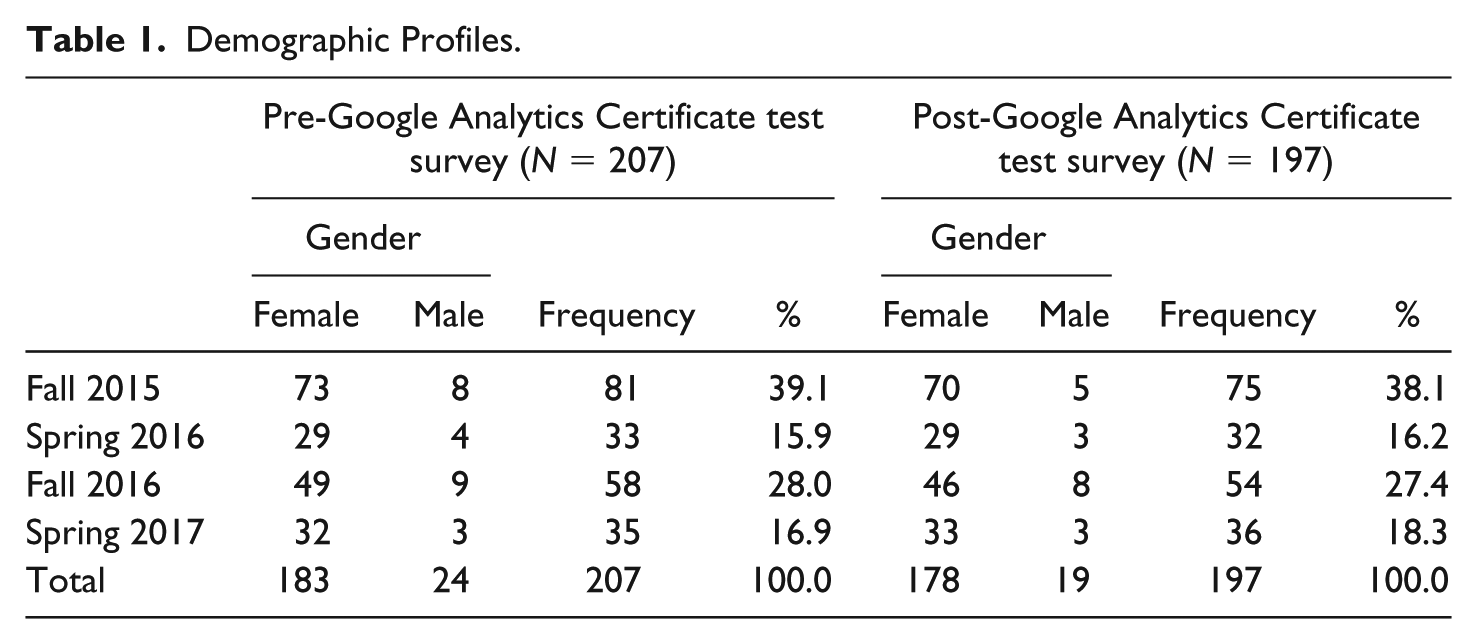
Participants for the pretest survey were public relations majors and enrolled in public relations research courses in four academic semesters from fall 2015 to spring 2017. The final complete sample size for the pretest survey was 207. The mean age of the sample was 20.98 years (SD = 0.65) with a range of 19 to 23 years. The majority of the sample were in their fourth year at college (n = 147; 71.0%), followed by third year (n = 55; 26.6%). Only 2.4% of the sample reported as in their second year or other. There were 183 females (88.4%) and 24 males (11.6%), which is a typical reflection of gender distributions in public relations majors at higher education institutions. No ethnic or racial data were collected but it is assumed that the sample is overrepresentative of Caucasians based upon the racial background of the university where the study was conducted. In addition, the students voluntarily completed the questionnaire, and in classes where instructors granted permission, students were awarded research credit for participation.
Procedure
To reduce the possible bias and priming effects of existing knowledge relevant to Google Analytics Academy and the Certification itself, student volunteers were invited to participate in Study 1 before they were given the individual assignment instructions on how to study, prepare, and take the Google Analytics Certification test. The questionnaire begins with a series of brief questions assessing their preexisting knowledge, if there is any, of Google Analytics Certification. A sample question in this section is, “If you have heard about Google Analytics Certificate, how much to you know about the certificate itself?” Answers ranged from “1 = I heard about it, but I knew nothing about it,” to “7 = I heard about it, and I am very confident about my knowledge in it.”). Then, students were asked to evaluate their own interest and confidence in studying and taking the analytics test itself, as well as their learning expectations and their perceptions on course subjects as addressed by Google Analytics online course videos. Finally, students were asked to complete basic demographic questions such as gender and age. Only partial and complete responses were recorded. After cleaning the data, the final complete sample size was 207 as mentioned above.
Study 2: Post-Google Analytics Certification test survey
Participants
The same groups of student volunteers were invited to participate in Study 2 after they finished the individual assignment of obtaining the Google Analytics Certification through self-studying. Students had approximately 2 weeks to study for and take the test immediately after they participated in Study 1, the pre-Google Analytics Certification test survey. Overall, we were able to obtain 197 complete responses for Study 2. The mean age of the sample was 21.02 (SD = 0.66) with a range from 19 to 23 years. There were 178 females (90.4%) and 19 males (9.6%). The majority of the sample were in their fourth year at college (n = 137; 69.5%), followed by third year (n = 59; 29.9%) and one sophomore. Similarly, participation in Study 2 was voluntary. Those students who chose not to participate in this study were given an alternative manner in which to receive extra credit. Table 1 displays demographic profiles in each surveyed semester before and after the Certificate test.
Demographic Profiles.
Procedure
To have student participants best recall their learning process and experience in studying for and taking the Google Analytics Certificate test, we granted students’ online access to Study 2 on the day when the assignment was due for all four academic semesters (fall 2015, spring 2016, fall 2016, and spring 2017). Similarly, after completing a series of brief questions assessing their own studying efforts in Google Analytics Certification (A sample question is, “How many hours did you actually spend on watching the course videos and learning the subjects.” Categorical answers ranged from “less than 2 hr” up to “more than 10 hr.”), students were asked to evaluate their actual learning experience on Google Analytics online course videos, followed by their own learning interests in this subject, as well as their expected learning outcomes as related to public relations research and practice. Finally, students were asked to complete basic demographic questions. Similarly, only complete responses were included in the analysis (N = 197).
Results
RQ1: Students’ General Knowledge About Google Analytics Certification Before Studying
Descriptive analyses on questions related to students’ general knowledge identified that 126 surveyed PR majors (60.9%) in the pretest reported that they have heard about Google Analytics Certification before, while 81 students (39.1%) answered no. For those who have heard about Google Analytics Certification, they reported a low level of specific knowledge about the Certification itself (M = 2.64, SD = 1.48) based on a 7-point Likert-type scale. It is also interesting to find out that 55.6% of this group (n = 70) reported that they have thought about getting the Google Analytics Certification but admitting they had never had a chance to study for it. In addition, 42.1% of this group (n = 53) expressed that they have never thought about getting Google Analytics Certification.
Descriptive analyses also found that, across the entire sample in Study 1, respondents indicated a high level of interest in getting a Google Analytics Certificate (M = 5.76, SD = 1.35) based on a 7-point Likert-type scale. They also believed that obtaining a Google Analytics Certificate will eventually benefit them in landing an internship or a full-time job (M = 5.86, SD = 0.97). Students reported a high level of confidence in studying and obtaining the Certificate itself (M = 5.30, SD = 1.21). All ratings were based on 7-point Likert-type scales with 1 = strongly disagree/not at all to 7 = strongly agree/very much. However, when asking students to estimate the total number of studying hours for the Certificate test, nearly half of them (n = 101; 48.8%) expected to spend 2 to 4 hr, followed by “less than 2 hr” (n = 53; 25.6%) and “5 to 7 hr” (n = 37; 17.9%). Less than 10% students (n = 16) reported they expected to spend either “8 to 10 hr” or “more than 10 hr” in studying for the Certification test.
RQ2: Students’ General Perceptions on Google Analytics Course Subjects
To answer
Results indicated that students generally reported low levels of perceived knowledge on course subjects, with the mean scores ranging from 1.87 to 2.49. The course subject on Ecommerce Analytics received the lowest score, reflecting students lacking general knowledge in this area. Consequently, students also perceived the course on Ecommerce Analytics being the most challenging one (M = 4.71, SD = 1.22), if compared with the other three courses. Students’ interests in the four course subjects were average, ranging from 3.51 to 4.26. Students appeared to be interested in Course 4 (Mobile App Analytics Fundamentals) the most. Although the mean scores on knowledge, interest, and challenge remain relatively low, students did perceive high levels of usefulness across with all four course subjects, ranging from 5.27 to 5.56. Table 2 displays the mean scores of students’ perceptions on each course subject. We also followed up with mean comparisons on perceptions across four student groups as breaking down by academic semester. No significant differences across the four groups were found. Therefore, consistent levels of perceptions on knowledge, interest, challenge, and usefulness were identified before students study for and take the Certification test.
Students’ Perceptions on Course Subjects Prior to Their Studying Efforts (N = 207).
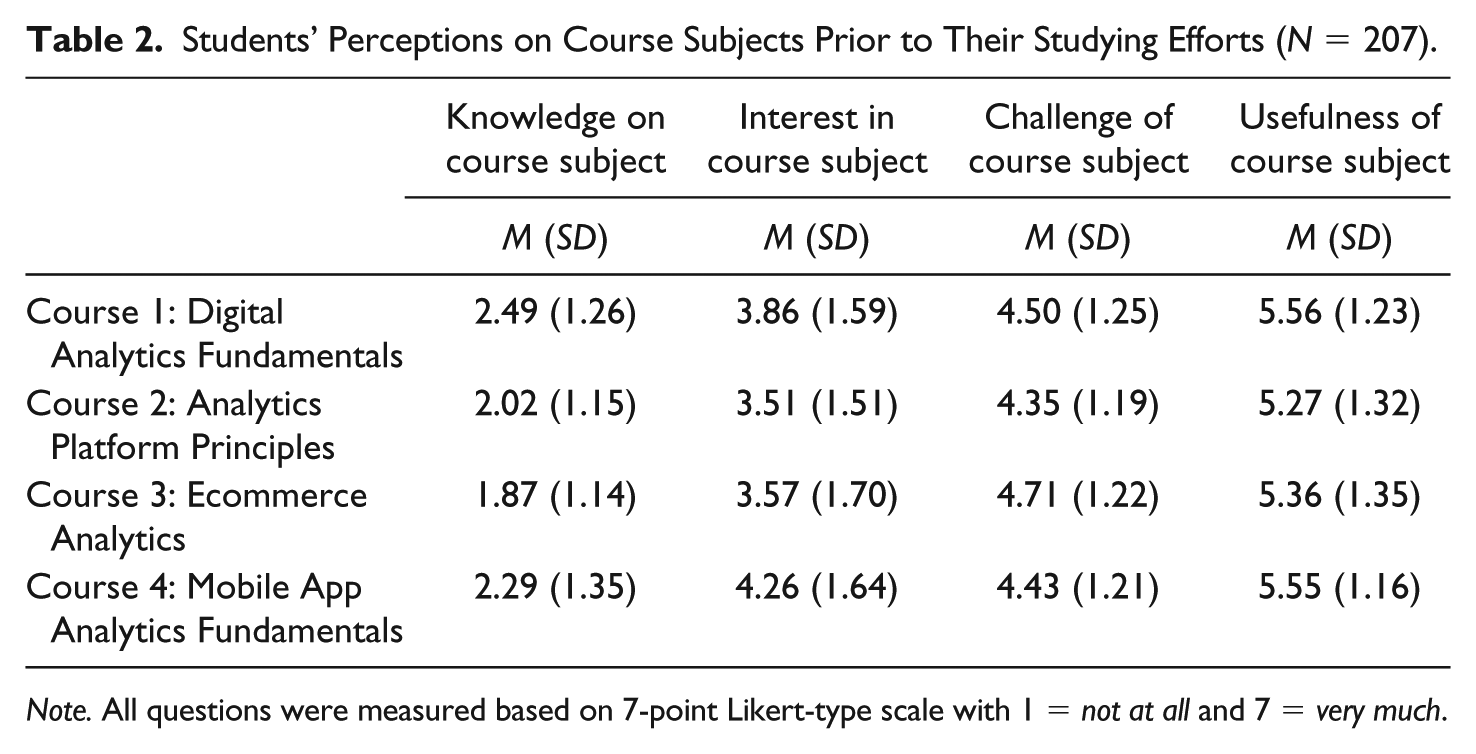
Note. All questions were measured based on 7-point Likert-type scale with 1 = not at all and 7 = very much.
RQ3: Students’ Overall Studying Efforts in Preparing for Google Analytics Certification Test
Anticipated Time Needed Versus Actual Time Spent in Studying for the Certification (N = 404).
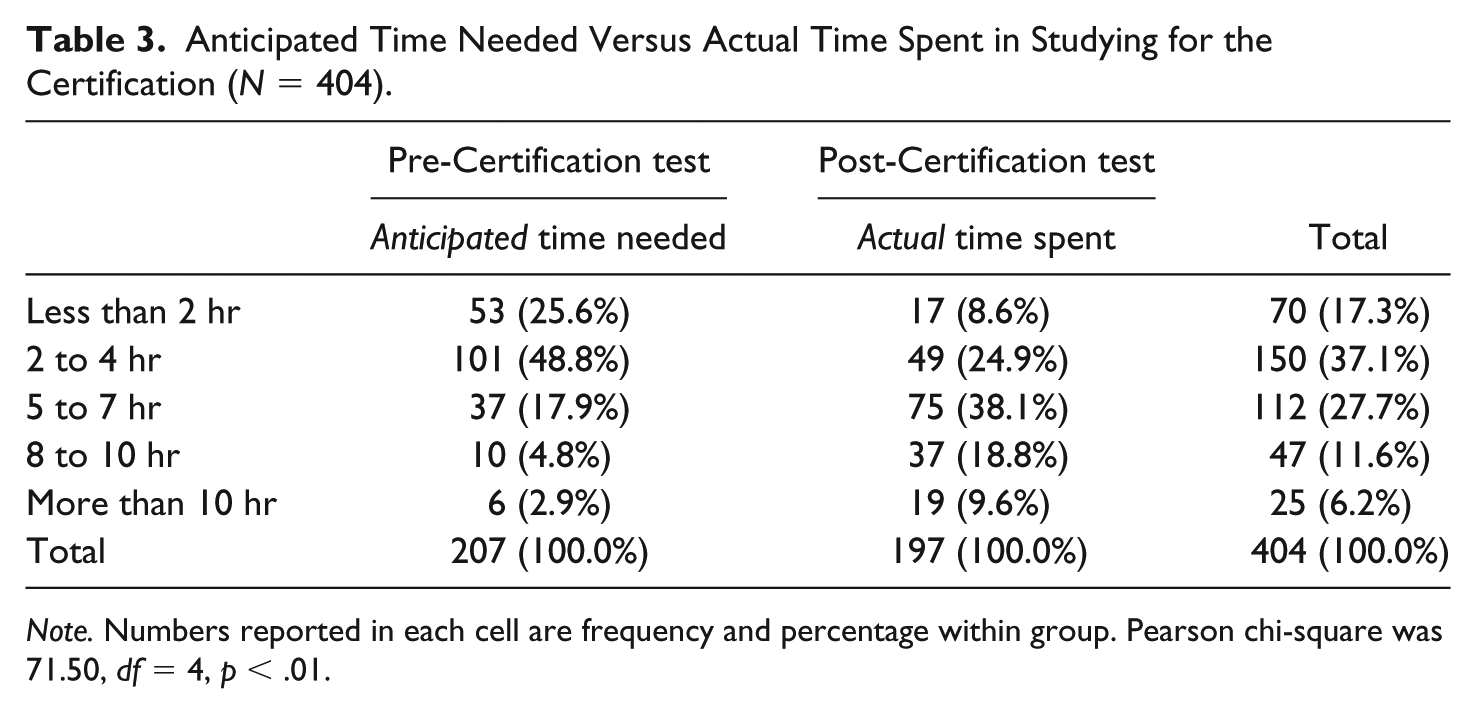
Note. Numbers reported in each cell are frequency and percentage within group. Pearson chi-square was 71.50, df = 4, p < .01.
We also asked students to estimate their confidence in passing the Certification test while studying for it. It is very interesting to find out their confidence level significantly dropped as they were studying for it (M = 4.51, SD = 1.25), if compared with their confidence level prior to the study (M = 5.30, SD = 1.21). Mean difference was −0.80 (t = −6.49, df = 2, p < .01). Students in the posttest also reported that they took notes while watching the online course videos (n = 160; 81.2%), and the notes they took were quite useful in preparing them for the Certification test (M = 4.73, SD = 1.36, based on a 7-point Likert-type scale). The majority of students reported they took and passed the Certification test on their first try (n = 175; 88.8%), with 9.6% (n = 19) reporting they took it twice before they passed the test. Across the entire sample in Study 2, we only had one student reporting he or she did not pass the test and did not want to try again. When being asked about the discrepancy between content covered in the course videos and content covered in the actual Certification test, students reported a relatively neutral score (M = 3.34, SD = 1.45, based on a 7-point Likert-type scale with 1 = not at all and 7 = very much). They did not feel there was a significant discrepancy between the course videos and the test itself.
RQ4: Students’ Actual Perceptions on Course Subjects After Taking the Certification Test
To compare students’ actual learning experiences in watching the online course videos and their general perceptions on course subjects as addressed by Google Analytics Academy, we used the same sets of assessment questions on knowledge, interest, challenge, and usefulness in Study 2 (post-Certification test). We asked students to report their perceptions on course subjects after they took the Certification test. Results indicated there is a significant increase in their knowledge on course subjects after studying for and taking the test. Such significant increase was consistently reported across all four course subjects. Particularly, Course 2 (Analytics Platform Principles) was the subject receiving the highest increase in knowledge across student sample (mean difference = 2.41, t = 18.69**), followed by Course 3 (Ecommerce Analytics; mean difference = 2.25, t = 17.00**), Course 1 (Digital Analytics Fundamentals; mean difference = 2.14, t = 16.85*), and Course 4 (Mobile App analytics; mean difference = 1.96, t = 14.00**).
It is interesting to observe that while students’ knowledge on course subjects increased after watching the course videos, their interests in course subjects decreased, such as Course 1 (Digital Analytics Fundamental; mean difference = −0.21, t = −1.29), or virtually remained the same, such as Course 3 (Ecommerce Analytics; mean difference = 0.02, t = 0.10). Students’ interest in learning Course 4 (Mobile App Analytics) was the highest one (M = 4.26, SD = 1.64) before taking the test. However, their interest in this course subject dropped significantly after taking the test (mean difference = −0.35, t = −2.1*).
In terms of the perceived challenge of course subjects, students reported relatively consistent scores across all four subjects except for Course 2 (Analytics Platform Principles) in our posttest. Students felt the subject of analytics platform principles being significantly more challenging after they studied and took the test (mean difference = 0.34, t = 2.67**).
Finally, opposite trends emerged from student sample when assessing the usefulness of the course subjects. The perceived usefulness of all four course subjects has significantly dropped, if compared with the results from the pre-Certification test. It is surprising to see Course 4 (Mobile App Analytics) was the one received the lowest assessment score on usefulness after students took the test (mean difference = −1.08, t = −7.81**). Table 4 displays the detailed mean comparisons on students’ perceptions on course subjects as addressed by Google Analytics course videos before and after the Certification test.
Comparative Results on Students’ Perceptions on Course Subjects Before and After the Certification Test.
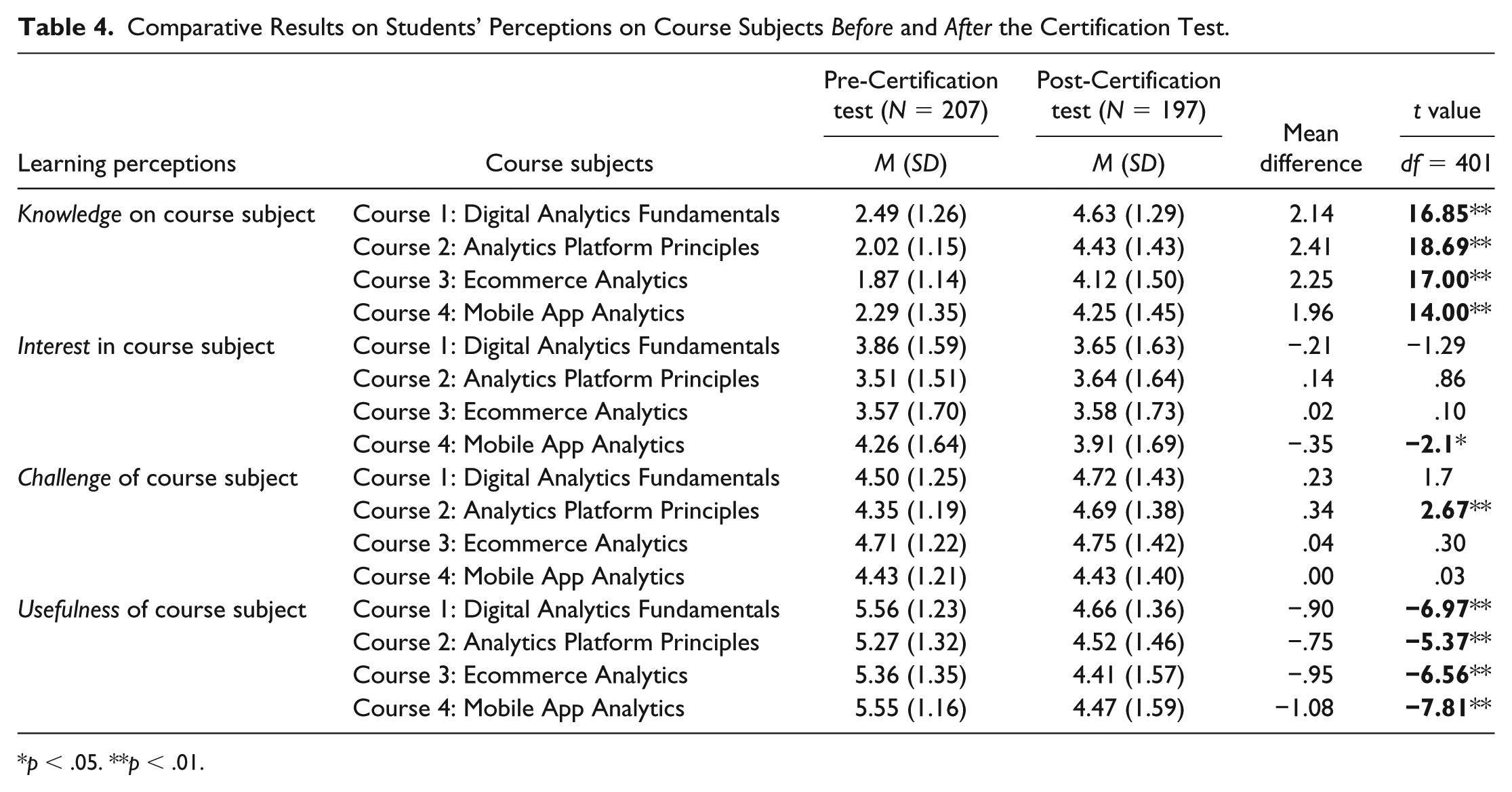
p < .05. **p < .01.
Discussion
As an exploratory study, our longitudinal panel research on a timely subject, social analytics, over four groups of public relations majors enrolled in public relations research courses over a 2-year period revealed interesting findings in students’ perceptions, expectations, and experience in learning and taking the Google Analytics Certification test. Results in pre- and posttest studies found solid evidence that students lack both general and specific knowledge on social analytics, even though they have been constantly asked to conduct social analytics at various situations in their internships without any on-the-job training.
It is important to find out students majoring in public relations actually expressed a high level of interest in getting a Google Analytics Certification as they hold a general belief that such effort will eventually benefit them in landing an internship or a full-time job in the near future, especially when the job is highly relevant to social media strategies. It is promising to find out students expressed a high level of confidence in passing the Certification test even though they reported low levels of knowledge on all four course subjects. It is even more promising to see students showing strong interests in learning course subjects as well as believing in the usefulness of learning analytics-related subjects in helping them build up resume and lead to a successful career. The surveyed public relations majors seemed to be in agreement regarding many aspects of social analytics, especially the importance of necessary knowledge, the challenge of mastering analytics-related knowledge, as well as the applications of social analytical skill sets.
Overall, consistent patterns on learning outcomes were identified among student samples in both pre- and post-Certification test surveys. It is very interesting to see, although students’ knowledge on course subjects has significantly increased after watching the course videos and studying for the course subjects, their perceptions on the usefulness of course subjects decreased. Watching the online course videos did not necessarily increase their interest in course subjects. On the contrary, their interests on certain course subjects have decreased after they took the test. Similarly, the perceived challenges of course subjects were not significantly affected by the course videos. The perceptual gaps found and depicted in Table 4 provide a general picture for educators to understand the areas that have helped students in the self-learning process, as well as the aspects pedagogical implications can be built in to increase students’ interests in certain course subjects, which may eventually improve their perceived usefulness in applications.
As the researchers have experimented in the course of public relations research when conducting this longitudinal pedagogical research, studying for and obtaining a Google Analytics Certification is a required assignment for students enrolled in the course. Surveyed students expressed various levels of learning interests based on their experience in watching Google Analytics course videos and taking the Certification test. For example, after students passed the Certification test, they indicated a high level of interest in reading more about the topic of social media analytics in the future. Learning Google Analytics–related knowledge also urges students to start thinking about applying social analytical knowledge and skills in future courses and internship projects, as well as future professional development. Students also indicated that they would like to renew their Certificate in 18 months or when it is expired.
However, students also reported various levels of dissatisfaction as related to course videos which had decreased their learning interest. For example, based on their learning experience, students reported that the content in the course videos was presented in a less interesting and less engaging way that they never got caught up in the discussion of the subject and topics when watching the video courses. The way the course subjects were explained in the course videos was boring and barely grabbed their attention. Therefore, they did not perceive the course videos being interesting and are effective self-study tools.
Regardless of the dissatisfaction students had experienced in learning the course subjects by watching the course videos, it is promising to confirm that students generally believed that learning Google Analytics or other social media analytics enriches their learning outcomes as related to public relations research and practice. For example, students agreed that courses provided by Google Analytics Academy helped them better understand social media research. They indicated they would like to use Google Analytics in their capstone course, Public Relations Campaigns, to drive insights. They also agreed that the self-training they did through the Google Analytics Certification procedure makes them more confident in carrying out public relations research and interpreting research results as part of social media analytics. Although surveyed PR majors reported low levels of knowledge in Google Analytics before they took the online video courses, it is promising to know that their interest in learning analytics and their desire to obtain the certificate are high. Such interest and desire open up opportunities for educators to integrate more digital analytical content into various subjects to enhance students’ learning experience. Such pedagogical opportunities may include but not limited to the following:
Implement a Google Analytics training session or workshop to senior public relations majors by building a partnership with a local organization. Therefore, students will have the opportunity to apply learned analytical skills to understand partner organization’s social activities and pull out user-based insights.
Create a social analytics–related research assignment through which students research and prepare a social analytical report regarding the “real-world” situations that acquire students to explore the needed analytic capabilities.
Invite professionals specialized in web and social analytics to join the class discussion through virtual collaboration, and share cases and projects in public relations practice that have relied on web and social analytics to drive insights and decisions.
Create a set of assessment metrics to be applied to relevant supervised public relations experience in helping students monitor, recheck, and update their social analytics knowledge and skill sets.
Our results also suggested that certain learning outcomes did not meet students’ expectations. One of major missing outcomes is the actual application of Google Analytics in practice. For instance, even though students expressed they understood social media research better after studying for it, they were not sure about the application of such social analytical tools in their future internship or full-time position after graduation. They indicated the course videos can be good resources to look up for specific content as related to Google Analytics but they are not the best tools to guide on application. Although students all indicated they felt more prepared for the public relations and communication job market after completing the Google Analytics training, they are not necessarily confident in claiming mastering application-related knowledge. From the perspectives of educators and job recruiters, such feedback calls for more attention to integrate application into learning while letting students study for the Google Analytics Certification.
Limitations and Future Research
Although we believe that the findings in this study hold promise for how public relations educators can consider integrating web and social analytics into core curriculum to help public relations majors approach their academic careers and achieve their initial professional career goals, there is at least one very important limitation affiliated with the results. Although the study compared the perceptual differences on knowledge, interests, challenge, and usefulness of course subjects as addressed in Google Analytics course videos before and after the test, the deep reasons of why students’ scores fluctuated were unknown. Future research should engage public relations majors in deep conversations to find out the reasons. For example, what specific areas of knowledge have they acquired and why did students feel the subjects learned were not as useful as they have expected. Deep and engaging conversations acquired through qualitative research such as a focus group would help educators spot areas that can be improved by adding more experienced-based learning activities.
Although this study collected feedback on Google Analytics from public relations majors, it is also important to look into a recruiter’s perspective. It is critical to find out what social analytical skills are essential and important for this generation of college graduates. It is even more important to find out what types of social analytical skills and to what extent a job candidate should possess such knowledge and skill sets in leading to the hiring decision. Future comparative research might attempt to determine how these important social analytical skills are manifested in actual hiring practices, which can further validate our teaching efforts in undergraduate public relations education.
In any case, these suggestions in combination with the results of this study suggest that the context of social analytics offers a rich opportunity for public relations educators to expand our curriculum and understanding of the connection or disconnect between public relations education and data-driven insights and decision-making in public relations practice. At a minimum, we hope that insights from this study may help public relations faculty and students prepare themselves for an increasingly competitive job market and a rapidly changing information society and for an enhanced value both in education and in professional careers.
Footnotes
Declaration of Conflicting Interests
The author(s) declared no potential conflicts of interest with respect to the research, authorship, and/or publication of this article.
Funding
The author(s) received no financial support for the research, authorship, and/or publication of this article.