



Abstract
The post-truth era has challenged traditional ways of teaching journalism and media literacy. Media literacy education can offer a useful lens for teaching students to be more critical. This pedagogy article describes a semester-long undergraduate course designed to deconstruct information disorder in the post-truth era by looking at economics, ideology, and power relations. Applying a project-based learning model allowed students to enhance their digital and media literacy skills by inquiring about the accuracy of a variety of sources centered on a single story.
As a first day activity for my class Truth, Lies, and Accuracy in the Digital Age, I asked my students to collaboratively come up with definitions related to the course’s topics. I was asked to teach and transform the class to focus on media literacy practices to discuss the reliability, validity, and trustworthiness of media messages with a broader body of students at the college. Besides four journalism majors, most of the students in the course were media arts students who had not thought much about the course’s topic prior to stepping into the classroom. For the introductory activity to the class, I wanted students to use their prior knowledge to define the course topics. I used a four-corners activity where students were divided into small groups at each corner; they then wrote their concept definitions on the head of a poster. The four concepts they needed to define were reliable sources, political correctness, ethics, and fake news. Each group rotated to a new concept after a short duration. The subsequent groups added to or modified the definition created by of the previous group. After 15 min, the students returned to their initial corners to synthesize their collaborative definitions. By the time that all four groups synthesized their initial definitions, they had a better understanding of each concept. This activity was followed by a class discussion that went through each poster. The fake news corner came up with the following definition for the term: “Distorted truth motivated by bias, speculation, and agenda.” This was a great start for a class addressing issues of reliability, validity, and trustworthiness of media texts. Yet, I wondered about my students’ understanding of the intentionality within information disorder and how to deal with it.
This class was originally a news literacy class on best practices to check the fact and evaluate the reliability of news sources within a digital context. With the growing concern about fake news in mainstream, alternative, and social media, I modified the course to engage students in analysis, evaluation, and reflection on the reliability, validity, and trustworthiness of controversial media messages. Following the Oxford Dictionaries’ (2016) word of the year definition to post-truth as “relating to or denoting circumstances in which objective facts are less influential in shaping public opinion than appeals to emotion and personal belief,” I decided to focus on controversial messages that evoke an emotional response and are based on personal opinions. From an educational perspective, it was important for me to apply Wardle and Derakhshan’s (2017) concept of information disorder rather than the popular term fake news as I will explain in the next section.
Why Media Literacy Education
Although journalism students strive to be independent and often perceive themselves as such, they may be reducing their independence through the choices they make on sourcing, funding, location, and guidance (Gutsche & Salkin, 2011). In particular, students in Gutsche and Salkin’s sample displayed a lack of media literacy and often relinquished their control over how the content they produced was posted online, how advertising was placed, and who owned their servers. Having journalism students unaware of how media news operates in “real life” can be addressed by a reciprocal process with various stakeholders (Gutsche, Jacobson, Pinto, & Michel, 2017). This is why it is important to add a project-based learning (PBL) activity to produce media as an engaged journalism process, while also analyzing and evaluating narratives that enhance journalism skills such as writing and listening well, constructing a story, and adapting narratives to various situations (Auger, Tanes-Ehle, & Gee, 2017). Brooks and Ward (2007) showed that using media technologies in the classroom helped to synthesize multiple pedagogies and make participants more engaged, which enhanced students’ ability to analyze media representations of diversity, especially regarding gender and race. The authors concluded that the use of multiple pedagogies that include media technology (e.g., in-class video screenings and discussions) made students more engaged and as a result enhanced their media literacy and understanding of diversity.
As a media educator, I believe that we need to combine media analysis with media production as a PBL pedagogy (Blumenfeld et al., 1991) that would benefit students in journalism and media fields. Media studies as a discipline has offered methods of analyzing, evaluating, reflecting, and communicating. However, students often look at the world outside of class and wonder how to connect best practices of media consumption and production with their own experience (Gutsche et al., 2017; Gutsche & Salkin, 2011). If as media educators, we accept McLuhan’s (1964/1994) notion of the media as an extension of the human body and mind, we should consider how our students can reflect on their media use as part of their identity. In other words, while our students consider their mobile devices an inseparable part of their own identity, they hardly ever look into the effects of their consumption of media not to mention the ethical implications of the media messages they receive and send (boyd, 2014). Media literacy courses can be a place to practice how to use media in alignment with higher ethical and technical standards that at the same time can address students’ cognitive, social, and emotional needs.
In the last decade, online communication increased human connectivity toward what van Dijck, Poell, and de Waal (2018) called a platform society where people can socialize across borders, while also destabilizing the status quo of the traditional gatekeepers of information. The same technologies were also used to threaten the stability of democracy in many countries with various types of information disorder. In their report to the European Council, Wardle and Derakhshan (2017) from Harvard’s Shorenstein Center on Media, Politics And Public policy found three types of false and harmful information (misinformation, disinformation, and malinformation) that include all seven types of information disorders, which are as follows: Fabricated content: new content is 100% false, designed to deceive and do harm. Imposter content: when genuine sources are impersonated. Misleading content: misleading use of information to frame an issue or individual. Satire or parody: no intention to cause harm but has the potential to fool. False connection: when headlines, visuals, and captions don’t support the content. False context: when genuine content is shared with false contextual information. Manipulated content: when genuine information or imagery is manipulated to deceive. (Wardle & Derakhshan, 2017, p. 17)
Following the discourse in academia that disapproves the use of fake news, information disorder seems to capture more accurately the rage of issues that are at stake. The ability to analyze and evaluate media messages is not enough in an age of false and harmful online content. Reflecting on reader and author’s biases is not enough in cyberspace where identity is fluid. One step toward developing interpretive proficiency in a post-truth era is learning to create your own media message; this step allows future practitioners to understand the complexity of conveying meaning. Applying media literacy practices of access, analysis, production, reflection, and civic engagement can offer a strategy to deploy ethical and theoretical standards into the professional practice of our students’ future careers (Hobbs, 2017; Jenkins, Purushotma, Weigel, Clinton, & Robison, 2009).
This article explores the media literacy pedagogical approach I used in an elective course designed and deployed for future media professionals ranging from journalism, public relations and advertisement, photography, radio, and fashion. As seen in Table 1, I combined PBL with the five digital and media literacy competencies (Hobbs, 2011) over a semester.
PBL Stages, Literacy Competencies, and Classroom Activities.

Note. PBL = project-based learning.
Critical Media Literacy, PBL, and Personal Digital Inquiry
Wardle and Derakhshan (2017) called for stakeholders to take explicit measures to fight information disorder. For educators, they recommended collaborations with librarians and to update journalism curricula. However, they did not provide a specific method to update journalism instruction to fight information disorder. One of the most recognized resource for educators to teach news literacy is The Center for New Literacy online curriculum that is used by 22 universities in the United States and was funded by the Knight, Ford, and McCormik foundations to train more than 10,000 undergraduates at Stony Brook University and offer professional development to media educators (Center for News Literacy, 2016). The resources on the website offer many strategies and 13 lesson plans for teaching verification, fairness, accuracy, and for reflecting on journalism practices. There is something missing from the Center for New Literacy strategies and plans: They lack an interdisciplinary approach. They do not address issues of power and media representation beyond the traditional field of journalism.
The concept of critical media literacy supports efforts to unmask biases, hidden agendas, and the economic structures of media representation and information. For Kellner and Share (2007), in addition to broadening the traditional aspect of literacy to include news literacy, information literacy, and other tools and modes of communication, critical media literacy links power and information using an analysis of the ideologies and structures of power and domination of the media message, the authors, and its audience. The pedagogical model of the five digital and media literacy competencies by Hobbs (2017) can provide techniques to bring students to a full circle of accessing the information, analyzing it, creating their own messages, reflecting on their consumption, and being socially responsible.
Going through a spiral process of learning to access, analyze and evaluate, create, reflect, and act helps students to acquire critical media literacy skills by reviewing their own consumption as they produce their own messages. Each iteration can be for one lesson or the whole semester-long project. Dewey (1938/1997) advocated for experiential learning in the classroom involving an authentic audience. Almost a century later, studies currently highlight the benefits of learning-by-doing for teaching undergraduate majors in journalism over passive lecture listening (Burns, 1997; de Burgh, 2003; Greenberg, 2007; Reese & Cohen, 2000). I apply it as a form of an inquiry (i.e., looking at the process of answering a research question). It allows students to explore, validate, discuss, collaborate, and communicate the story they were interested in while being responsible and reflective on their research methods (Coiro, Castek, & Quinn, 2016). As pedagogy, it can be referred to as PBL.
PBL (Blumenfeld et al., 1991) is an instructional design method that clearly defines the goals of the course from the beginning by having students work for the whole semester on one project with a specific outcome. Students worked on a research project examining the accuracy of various resources of the same story. By doing so, students learned to evaluate online information, create a research paper and presentation as well as reflect and connect it to their work. This type of PBL following a research question is called a personal digital inquiry (Coiro et al., 2016). Students learn to work on an inquiry while practicing social deliberation, collaboration, reflection, and exploring topics online. Following these models, I structured my class as a PBL of a personal digital inquiry, which follows the five media literacy competencies (Table 2).
Weekly Assignments and Learning Outcomes for the Class.
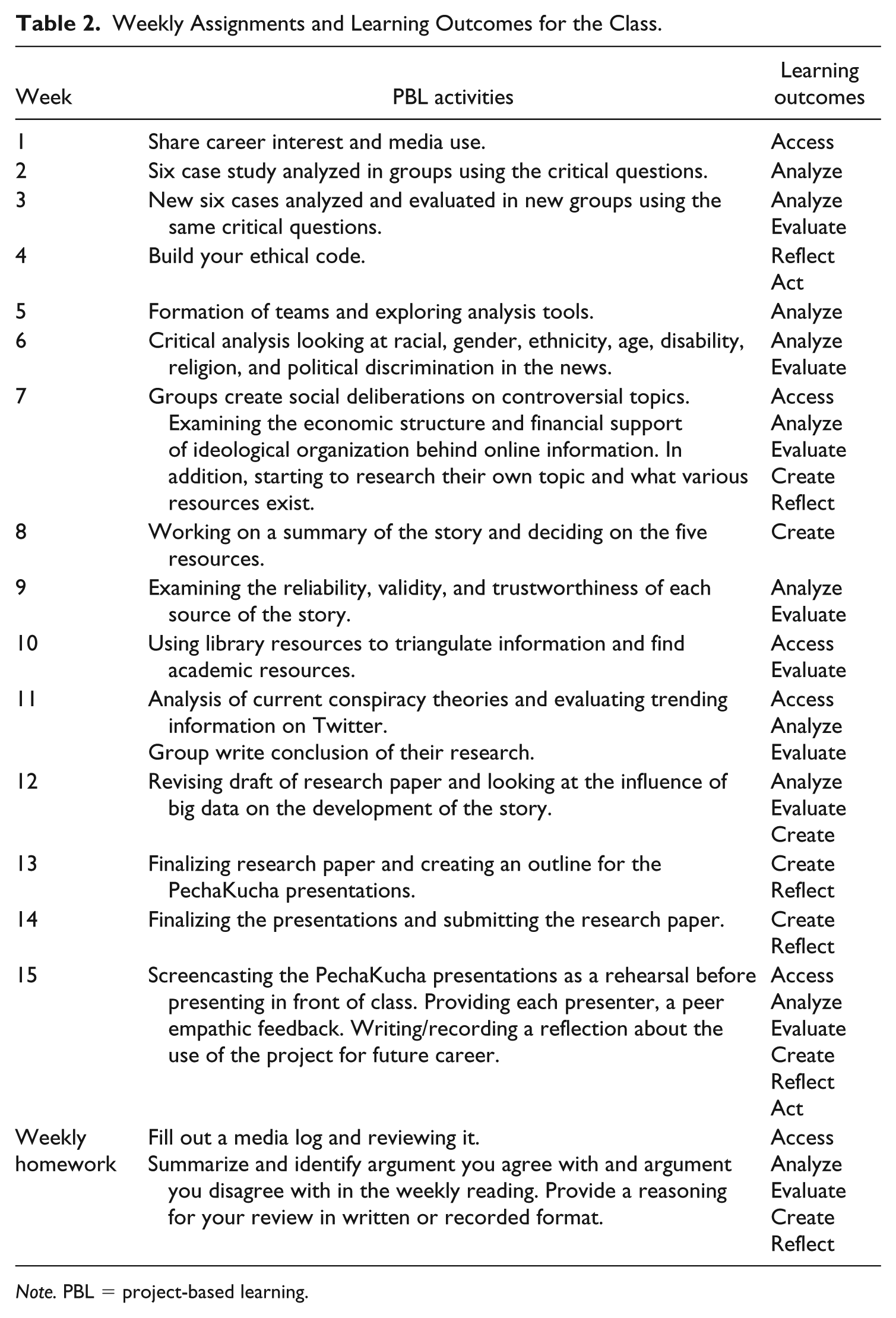
Note. PBL = project-based learning.
Teaching Truth, Lies, and Accuracy in the Post-Truth Era
On the first day of class, I had students identify their career interests and share their experiences of becoming media professionals (see demographics in Table 3). In less than 5 weeks, they self-selected partners to work with, in either a dyad or triad depending on their common interests. During the first month, the class practiced analyzing, evaluating, and deliberating on various case studies of information disorder and/or misrepresentations.
Demographics of the Class.
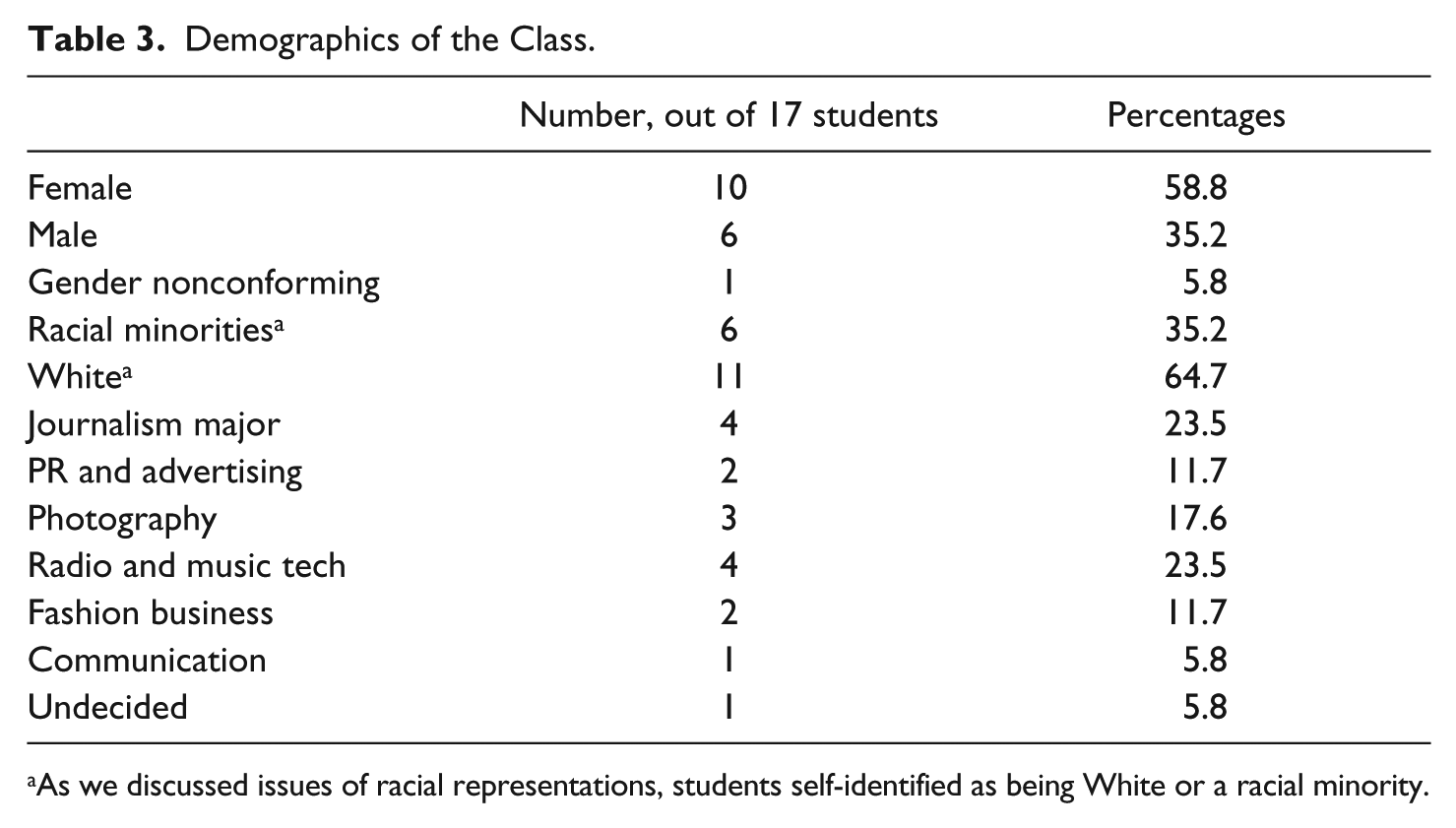
As we discussed issues of racial representations, students self-identified as being White or a racial minority.
Learning to access and validate information was the first step toward a deeper understanding of the complexity of information flow in the post-truth era. The ability to access information is a more insightful skill than merely knowing to operate a digital device. Having the capability to access means to be able to know what the source of information is while also being able to articulate the political, economic, and philosophical perspective of that source. Instead of showcasing exemplary media text, I decided to bring controversial media text that appeared in the news to explore its reliability, validity, and trustworthiness. A year after the 2016 presidential election in the United States, in the middle of the #MeToo and #BlackLivesMatter and with many school shootings, the post-truth era offered weekly examples of opinion-based and emotional evoking messages to analyze, evaluate, and reflect upon. For example, the class followed weekly on stories describing the Parkland, FL, high school survivors. We were able to explore sources and their agendas in real time. We used hashtag research on Twitter to compare various points of view and information about the debate of the NRA and InfoWars with the #WalkForOurLives organizers. As each group shared their findings, as a class we discussed if the information was accurate or false and how each group got to their conclusion using evidence beyond Twitter. Analyzing and evaluating sources more deeply was the next step in learning to be critical about information posted online. To examine constructs and the agendas behind them, we used the Media Literacy Smartphone (Hobbs, 2011) with five critical questions:
Who is the author and what is the purpose?
What techniques are used to attract and hold your attention?
What lifestyle, values, and points of view are represented?
How might different people interpret the message?
What is omitted from the message?
The students posted online for each aforementioned case as a social deliberation on the accuracy, biases, and agenda of the information. I decided to use Google documents as a jigsaw activity where students could separately sit on their own computer and create an analysis of one part in the same one document as their team members. Students collaboratively deliberated while aggregating their data. Then, each group presented to the whole class having their document with text, pictures, and infographics projected on the screen.
For the second class, I wanted students to exercise their analysis and evaluation with recent controversial media messages. I asked students to group up and analyze one out of the following six case studies that followed their career interests:
Broadcast journalism: Brian Williams’s apology/suspension from NBC News
PR and advertisement: Dodge Super Bowl Ram commercial that used a Martin Luther King Jr. voiceover
Photography: H&M’s “coolest monkey in the jungle” image controversy
Radio and music tech: Topics from Dave Chappelle’s Netflix stand-ups
Fashion business: American Apparel’s Hurricane Sandy sale
Communication: Cambridge Analytica’s use of Facebook to target political campaigns
Cases varied according to the career interests of the students from broadcast journalism, public relations and advertisement, photography, radio and music tech, fashion business, and communication. I curated each case to reflect professional areas that students would be interested in and to showcase to them that critical analysis can be done within a variety of fields. I also wanted them to see mutual themes that appeared between field-specific cases. Again, each group shared their case study and their analysis using a Google document; class discussion focused on different ways of analyzing the purpose of creating the message and how it might be misinterpreted. For example, one group looked at Brian Williams’s apology for his false report of being under attack while covering the Iraq war in 2003 and his subsequent suspension from NBC News. Williams’s false claim that the helicopter he was in was hit by a rocket is one example that the students wrestled with that questions the role of journalists as ethical and reliable reporters of information. This example initiated a whole class discussion on the role of journalists and the ethical role in reporting information.
For the purpose of addressing students’ concerns about the ethics and reliability of sources of information, they were assigned to create their ethical code using The Online News Association’s Build Your Own Code. One means of learning how to examine the intentionality of journalists is to understand and examine their ethical code and looking across fields to equivalent ethical codes in other disciplines. The website allows visitors to build their own ethical code based on statements that they want to include or omit. Using ethical issues such as payment for information, the privacy of subjects, and other moral dilemmas of journalists, the students built their own ethical code and screencasted their work as they read aloud their decision processes, explained their rationales, and outlined the challenges they faced in building their own ethical code. Some students found it challenging to relate to a code statement that was purely journalistic. Others saw the benefits of looking at issues of censorship, privacy, racial, and gender description within that disciplinary framework. Introducing students to the idea of reporting on their own organizations and transparency—as well as financial interests—helped students better understand ethical standards of credible reporting. Although some students found the activity useful to be aware of the news consumption, others found it irrelevant to their discipline and future career practice.
Students who were not journalism majors were permitted to find the ethical code of their own discipline and submit it in place of the journalism code. These codes had similar themes but the ways that individual fields tailored their codes for their disciplinary practices made them more relevant for nonjournalism students. This activity helped provide a common language for further analysis and evaluation of source reliability as well as for looking at financial connections/political biases toward presented information. Furthermore, this activity set up the tone to thrive for the common good by examining meticulously what it means to be ethical in the post-truth era.
As the students felt more comfortable deconstructing complex media messages, they self-assigned into pairs or group of three according to their interests. Then, the students sought out stories that they would research. They found sources to triangulate and present to the class during the last week of the semester. Our librarian, Arlie Sims, came to class and offered a session on research. Students started to look for stories they were interested in, using Google, Google Scholar, as well as EBSCO data search. A week later, the librarian showcased the use of SimplyAnalytics to find information about consumption habits and lifestyle statistics using visual maps. Our librarian was helpful in providing resources that he researched specifically for our class. Most importantly, he provided guidance for finding reliable and academic resources customized to each working group.
In their groups, students researched a topic/story that is of interest to them. They explored multiple angles, accuracy, and representations. Starting with one source, they used the five critical questions and apply the analysis and evaluation to the story from that one source. In addition, they looked to find different perspectives that showcased a diverse set of perspectives of the same story. For their research project, students were allowed to use various types of information as long as there was a range of sources such as academic articles, news articles, books, online magazines, tweets, Facebook posts, broadcast stories from YouTube or news channels. For the next 6 weeks, students worked in class on their research project, while strengthening their access, analysis, evaluation, and reflection competencies.
Reflection Toward Social Responsibility
Reflection on one’s own perspective and media consumption habits is essential to reveal personal bias when decoding information. For that reason, I had my students take The Implicit Association Test (IAT) so to structure self-reflection on their own explicit biases. Although some students were surprised with or angry at the results, others acknowledged that the results did present their biases correctly. Part of my role as an educator was to address this emotional response and have a class discussion on discrimination as students shared experiences on their reactions to offensive online information. As a segue, the groups used the site AllSides to look at news reports and the understand the variety of perspectives for each story. Unlike other fact-checking websites, AllSides is a portal of aggregated news stories that showcases reporting of each story from liberal, conservative, and independent news outlet to compare perspectives. Use of the site helps to foster the practice of triangulating sources and aiding students in looking at various perspectives in which information was delivered online. The website allowed students to value other opinions and see that the opposition political reports can be also accurate.
Students understood the complexity of verifying the reliability of sources as they looked into the power relations and economics behind the online information. One way was to reveal the business models and the sponsors of specific ideologies. For example, students looked at the revenue that companies such as Google, Facebook, Twitter, Apple, and Microsoft receive from getting personal data of their user in return to free services (Rushkoff, 2016). In addition, while discussing polarizing issues such as immigration, abortion, gun legislation, climate change, GMOs, the health care system, and first amendment rights, students researched organizations, which financially supported each side of the debate. They then discussed how they felt that economic pressures influenced the coverage of the topic.
Each of the seven working groups then decided on their topic to research the variety of representations to uncover the accuracy of the story as a whole. The stories varied according to the students’ interests:
Journalism: The effects of torture at Guantanamo Bay prison
PR and advertisement: The Fyre Festival Fiasco
Photography: Sexual assault accusations at photographer Cameron Wilson by two of his male models
Radio: Tai Lopez self-improvement YouTube videos
Music tech: The musicians battle for royalties from Spotify
Fashion business: Designers supporting or boycotting the First Lady, Melania Trump
Communication: Adopted children finding their biological parents through social media
Once the students analyzed five different sources, they had to aggregate the information from those sources and create a single report on the story. The students used the aforementioned five critical questions for analysis, placing emphasis on the reliability, validly, and trustworthiness of each source. At this point in the semester, the Cambridge Analytica scandal and Mark Zuckerberg’s Capitol Hill testimony were dominating the online news cycle. The reporting—as well as the memes and posts—provided a useful real-time case study of the reliability, validity, and trustworthiness of the information about Zuckerberg’s testimony and the breached privacy of Facebook accounts. Having a real-time event allows students to see how public opinion through social media can evolve according to the story development a week later. This class discussion itself led to a discussion of the role of conspiracy theories and algorithms in the information ecosystem.
Debunking conspiracy theories is a significant part of teaching truth, lies, and accuracy in the post-truth era. The spread of conspiracy theories has increased through the Internet by people who use it as a way to advocate for freedom of speech at any cost (Bjerg & Presskorn-Thygesen, 2017). Many conspiracy theorists, like Alex Jones from InfoWars, claim that the mainstream media is hiding the truth because of a sponsor’s economic influence. To learn how to debunk conspiracy theories, the class played the media literacy board game of the European Association for Viewers Interests (EAVI) called Behind the Headlines. Looking at a BuzzFeed article (Lytvynenko, 2018) that described eight conspiracy theories about the Parkland, FL, shooting, an event that happened earlier that semester, we applied the game to examine each source’s accuracy and ideology. Conspiracy theories ranged from a 2007 photograph of Britney Spears breaking into a car claiming it was Emma Gonzales, a Facebook post claiming that David Hogg was in CA during the shooting, a photoshopped gif of Gonzales tearing the constitution, a fake antigay tweet of Hogg, and a retouched false cover of Time magazine with the high school survivors as communists. The absence of sources on these conspiracy theories, as well as the fact that there were no other examples elsewhere, made students question the accuracy of the information. This activity was engaging and well received as the students applied it to their own research projects.
With the backlash that Facebook received over the misuse of private information from Cambridge Analytica, we discussed the implications of algorithms to our lives in the digital age. Algorithms are becoming important factors in the sorting of information and its personalized delivery. Whereas in the first class session, students claimed that there is no more privacy in the digital age, they were now upset about the selling and usage of their personal data by Facebook. There was a significant disconnect between abstract beliefs about the role of privacy and information security in society and the reality of having your own data exposed. This disconnect fueled the class discussion on the economics of data companies and the political and economic agendas behind the usage and consumption of information. To make the discussion more personal, we used Indiana University’s Botometer by OSoMe to examine on their scale of automated tweets, if it identified a Twitter account as a bot. The user can put any Twitter account name into the Botometer once they have logged into Twitter to examine the scale. Circling back to the students’ experience was helpful to see how the theoretical discussion has specific outcomes. What more, one student showed to the whole class how under the setting of the Facebook account, it is possible to discover how Facebook tags an account for marketing companies to sell products to the users. Many students were frightened by the surprising labeling of products around gender preferences, lifestyle, consumption habits, and political views.
By the 11th week, students were ready with their first draft of their research papers and started to work on their presentations simultaneously. I asked my students to use the PechaKucha format. For 6 min and 40 s, the students need to present their ideas as each slide (out of 20) flips automatically every 20 s, while the students have no control over the transition. This format forces students to be concise, use simple and coherent visuals representations, and follow a rigid narrative structure. All these factors allow the students to focus on the content while the delivery is structured. The students had to find visuals to support their work based on the research paper. They had to represent the five sources of their story as well as the economics, agenda, and the answers to the five critical questions. For the first hour of the class, students in their groups did a screencast of their presentations for 6 min and 40 s to practice their presentation and prepare to present.
The oral presentations and the supporting visuals introduced to the class their semester-long research. To model how it works, 2 weeks earlier, I opened the class about algorithms with a PechaKucha presentation so that the students will have an idea of the format and the requirements. In their reflections on the class, students pointed out that making the screencast after the presentations would be more effective. After receiving written feedback from me and their classmates, they wanted to go and modify their screencast. This was one piece of evidence that the work they performed was meaningful for them, and that they wanted to spread their findings to educate others. However, without producing their screencasts, they would not be as organized and articulate.
Handing in the research papers and presenting their PechaKucha presentation, students started to see the connections between the semester-long inquiry project and their own careers and interests. In their reflections on the class, students shared their thoughts and experiences from the semester. While two students explained that they could not see the link to their careers, they still found the course useful for learning to see the information they consume online in a different light. One student did not appreciate the group work, whereas the rest valued the opportunity to learn from others, to be able to brainstorm, and to work collaboratively. Some students emphasized how the feedback portion of the last lesson was helpful for their own oral and visual presentation skills.
Conclusion
This article showcases how journalism, communication, and media undergraduates can benefit from a combined pedagogical approach between PBL and media literacy education to explore the reliability, validity, and trustworthiness of various media text across platforms. Research showed that there is a gap between students’ perception of control over media messages and their actual consumption (boyd, 2014; Gutsche et al., 2017; Gutsche & Salkin, 2011). It is important to add a production component to not only teach the mechanics of conveying a media message, but also learn the multiple complex layers of context and construct of a message (Brooks & Ward, 2007). By offering a week-to-week description of the multiple tools, various examples of texts, and the instructional methods used, this case study allow for journalism and media educators to have a roadmap for their students to explore how to access, analyze, produce, reflect, and act responsibly with current media texts of the post-truth era.
The case study of my class, Truth, Lies, and Accuracy in the Digital Age applied PBL and media literacy pedagogies and theories into the classroom using current media texts that are part of the post-truth era. Especially in a time of increased information disorder (Wardle & Derakhshan, 2017), it is crucial to find methods and texts that can engage undergraduate students who will become part of the media industry (Auger et al., 2017). This pedagogy allows journalism and media educators to broaden the learning to be able to see the economics, power relations, and ideology beyond merely focusing on verification and accuracy. Having students create their own project relevant to their future career is the first step toward fighting information disorder in a post-truth era as they learn how their media messages can make a difference in the world.
Supplemental Material
Online_resources – Supplemental material for Teaching Truth, Lies, and Accuracy in the Digital Age: Media Literacy as Project-Based Learning
Supplemental material, Online_resources for Teaching Truth, Lies, and Accuracy in the Digital Age: Media Literacy as Project-Based Learning by Yonty Friesem in Journalism & Mass Communication Educator
Footnotes
Acknowledgements
I want to thank Stephanie Goldberg, Sharon Bloyd-Peshkin, Suzanne McBride, and the Communication Department at Columbia College Chicago for all the guidance and support.
Declaration of Conflicting Interests
The author(s) declared no potential conflicts of interest with respect to the research, authorship, and/or publication of this article.
Funding
The author(s) received no financial support for the research, authorship, and/or publication of this article.

Author Biography
References
Supplementary Material
Please find the following supplemental material available below.
For Open Access articles published under a Creative Commons License, all supplemental material carries the same license as the article it is associated with.
For non-Open Access articles published, all supplemental material carries a non-exclusive license, and permission requests for re-use of supplemental material or any part of supplemental material shall be sent directly to the copyright owner as specified in the copyright notice associated with the article.
