




Abstract
Knowledge of emerging social media technology and intelligence platforms is in high demand for prospective employees and new graduates entering the journalism and media industries. However, journalism and mass communication departments have historically struggled to keep up with changing trends and new technologies used in industry, although some departments and educators are adopting these tools and integrating them into their courses. This study will explore the social media technologies that educators (N = 39) are teaching in higher education curriculum and offer insights into their strategies and motivations for classroom implementation.
Keywords
Introduction
The current digital landscape is full of tools, platforms, and services that are used across various industries and a subset of these tools use social media data and intelligence in aggregate forms (e.g., Banjo, CrowdTangle, Dataminr, Buffer, and Crimson Hexagon). For example, Banjo is an event-detection platform that accesses social content from a number of social platforms including Facebook, Twitter, Instagram, and VK (Banjo.com, n.d.), and CrowdTangle is a content discovery tool that gathers social media posts from Facebook, Twitter, Instagram, and Reddit (CrowdTangle.com, n.d.).
These tools, which go beyond the use of individual platforms, are prevalent in the media and online journalism industry. Larrondo Ureta and Peña Fernández (2017) argued that online journalism is continually exposed to change because adaptation is required to offer content to audiences across formats. Shifts in the industry, and the resulting need for practitioners to adopt new skills and learn emerging technologies, have occurred throughout history, with a notable shift occurring in the 1990s and early 2000s, when blogging began being used for news purposes (Standage, 2013).
These emerging technologies have put a narrower focus on website analytics, social media metrics, and audience engagement. In addition to reporting and writing stories, reporters are increasingly concerned with site traffic, page views, likes, and retweets (Anderson, 2011). Many reporters have adapted to the digital environment and use social media tools, and the data they provide, to collect information, diversify their sources, and expand the perspectives presented (Santana & Hopp, 2016). Research (N = 1,500) examining newspaper reporters’ use of Facebook and Twitter found that Twitter was used to query friends, conduct research, and contact sources, whereas Facebook’s value was strongly tied to performing research (Santana & Hopp, 2016).
These changes in industry mean that journalists with multimedia and social media competencies are in high demand in the marketplace (Larrondo Ureta & Peña Fernández, 2017). However, the role of journalism education in this training is not clear, and concerns exist around how to keep journalism education and training relevant and up-to-date given the advancements in technology (Larrondo Ureta & Peña Fernández, 2017). However, if journalism and mass communication (JMC) schools are adopting the “teaching hospital model” (which Newton of the Knight Foundation suggests is desirable; Newton, 2016), wherein students learn the practices and values of the trade by doing journalistic work, the implementation of these emerging technologies should be considered. It may also be assumed that these tools and skills do not need to be taught, as many students enter school with access to smartphones and social media accounts, but scholars suggest that students’ use of these technologies is largely juvenile and personal (Kothari & Hickerson, 2016). However, choosing which specific tools to teach can be challenging given the fleeting popularity of many platforms in this realm.
The purpose of this research is to better understand how JMC educators are using and adopting technological tools related to social media in the classroom. This work also examines what motivates educators to integrate these tools in their curriculum, as these skills and tools may not be required or considered core competencies within many departments. This knowledge contributes to the field of journalism education and provides practical takeaways for educators who may be considering introducing new technology into their course curriculum.
Literature Review
Social Media Technology in University Classrooms
Several studies suggest that technology in the classroom enhances student learning (Ivala & Gachago, 2012; Krentler & Willis-Flurry, 2005; Revere & Kovach, 2011), and other research suggests that both graduate and undergraduate students value the use of computer technology for learning (Lowerison, Sclater, Schmid, & Abrami, 2006). Students also seem to enjoy the inclusion of social media, and research suggests that it increases enthusiasm and engagement along with grades (Junco, Heiberger, & Loken, 2011; Kothari & Hickerson, 2016). Yet, the adoption of social media in university-level classrooms is not always encouraged and can be taxing on departments and educators (Larrondo Ureta & Peña Fernández, 2017). Therefore, levels of adoption vary across departments.
Some argue that teaching emerging media skills may be more pertinent than ever, given the contemporary demand for social media-savvy journalists (Larrondo Ureta & Peña Fernández, 2017). Some work argues that online journalism courses should prepare students to work across platforms (i.e., blogs, social media), work with different content types (i.e., news stories, tweets, posts), and in a variety of formats (i.e., text, audio, and video; Larrondo Ureta & Peña Fernández, 2017).
In 2003, the majority of JMC schools in the United States (85%) had begun pursuing curriculum to address convergence (Criado & Kraeplin, 2003). Another study found that 300 JMC schools had made some changes to account for convergence (Huang et al., 2003). More recent scholarship, discussed throughout, suggests that changes are indeed happening.
Examining social media technologies in the classroom
Several studies have examined the use of digital tools in the classroom. In a review of the literature about journalism education, Twitter and Facebook appear frequently, although this conflation may simply mean they are the most studied. One study identified tools that were seen as valuable for teaching purposes by educators: YouTube-Vimeo (19.8%), Blog-Wiki (14%), and Facebook (12.8%) (Manca & Ranieri, 2016b). This same study found that social media tools like Facebook (52.7%), YouTube, and Vimeo (81.4%), and blogs and wikis (62.8%) were used to have students view content (Manca & Ranieri, 2016b), Facebook was used to allow students to comment on content, and blogs and wikis were used to have students create content (Manca & Ranieri, 2016b).
Work that focused only on Facebook, Twitter, LinkedIn, Pinterest, and Google+ and examined the differences between personal social media use and course-based social media use for both students and faculty found that Twitter is the most used social media platform in classroom settings, followed by Facebook (Kothari & Hickerson, 2016).
A more recent study that surveyed journalism professors’ use of technology tools in the classroom identified three “super tools”: Facebook, Google Drive, and Twitter (Hepworth, Mensing, & Yun, 2018). Of the 99 different technology tools mentioned by professors in the interviews, only nine were categorized by the researchers as social media tools: Twitter, Facebook, Instagram, Storify, Hootsuite, LinkedIn, Tweetdeck, Sina Weibo, and Banjo (Hepworth et al., 2018).
Examining teaching strategies for technology integration
Several works have also studied the teaching strategies used along with these tools. A study on courses attempting to integrate social media instruction into the classroom found that it is important for professors to emphasize that in-class activities around social media and developing audiences can be applied beyond the classroom and may enhance students’ employability (Bor, 2014). Larrondo Ureta and Peña Fernández (2017; N = 60) studied a journalism class and echoed this sentiment, finding classroom activities that mimicked actual newsroom conditions to be successful. The authors argued that teaching technical skills alongside transferable skills like teamwork, responsibility, and ability to connect with audience interests leads to success (Larrondo Ureta & Peña Fernández, 2017).
Although the teaching of actual skills cannot be ignored, with Bor noting that technical instruction is important (Bor, 2014). Students in the 2017 study blogged, tweeted, interacted with audiences and other journalists, and created multimedia elements using software like Storify, WeVideo, ThingLink, and Picasa (Larrondo Ureta & Peña Fernández, 2017). They also used Google Analytics, Hootsuite, and Analyzer to measure the impact of their work (Larrondo Ureta & Peña Fernández, 2017). Fifty-two percent of students said search engine optimization skills were the most valuable skill learned, whereas 33% appreciated learning about social media management and monitoring tools (Larrondo Ureta & Peña Fernández, 2017).
Scholars also note that motivating students and helping them understand online media for professional use early on in their journalism training are critical (Larrondo Ureta & Peña Fernández, 2017).
Identifying Motivations and Obstacles to Implementing Social Media Technologies
Some researchers have explored the motivations behind professors’ adoption of technologies in the classroom. Research on Italian academics by Manca and Ranieri (2016a) suggests that motivations for using specific digital tools varied by platform. Facebook and Twitter were used to increase student motivation and involvement, whereas YouTube and Vimeo were used to improve the quality of teaching (Manca & Ranieri, 2016b).
Knowledge of specific tools also plays a role in adoption, and research suggests that journalism professors rely on one another when considering whether or not to adopt new technologies, and when ultimately deciding which tools to adopt (Hepworth et al., 2018). Educators also reported relying on media-related foundations, media professionals, and conferences to discover new tools (Hepworth et al., 2018).
However, the process of identifying new technologies and adopting them into course curriculum is not without barriers. Ninety percent of journalism educators mentioned stress related to finding new online tools (Hepworth et al., 2018). Other obstacles prevent educators from teaching and introducing new technologies, too, including privacy concerns, concerns about assessment, inability to measure effectiveness, time it takes to learn the tool, and lack of support from institutions (Manca & Ranieri, 2016a, 2016b).
In addition, educators may not understand these tools, or may be skeptical, and although educators may find value in social media generally, they may not see their classroom value. Research into this distinction found that although nearly 90% of the sample (N = 6,139) report using at least one social media tool for personal reasons, only 64% of the respondents report teaching at least one tool (Manca & Ranieri, 2016b). The same study found that only 38.6% of the respondents found social media useful for teaching purposes (Manca & Ranieri, 2016b). This gap may suggest that educators are interested in and value social media, but they lack the understanding, motivation, and strategies needed to teach them.
Research Questions
Method
Data were collected in October and November of 2018 through Qualtrics. The survey was sent to educators at institutions of higher education in the United States. Emails were obtained from Banjo, which built a web scraper to access email addresses from publicly available websites. The scraper looked for faculty who noted a teaching or research interest in online, digital, or social journalism. In total, the survey was sent to 641 educators at U.S. colleges and universities. The survey was sent to the faculty three times, and a response rate of 6% was achieved, yielding a sample of 39. All participants taught, or currently teach, a social media-related tool.
The social media tools included in the survey were not meant to be representative of tools in the current environment; rather, they were chosen to cover a range of platforms. In Thurman’s work (2018) on social media and news work, he discusses tools that focus on two increasingly important factors relevant to journalists: (a) location-based monitoring of social media and (b) use of artificial intelligence or algorithms used to detect events or trends. The tools studied here fall into one (or both) of those buckets. Some tools were pulled from a list compiled by former Knight journalism fellow Hebblethwaite (2014, 2016), who, in another article, calls Banjo an “incredibly powerful tool” for accessing geolocated social content.
Quantitative results, although largely descriptive, were analyzed using SPSS Statistics, and qualitative results were analyzed using NVivo. Qualitative results were analyzed through an open coding process using grounded theory (Glaser & Strauss, 1967). Within NVivo, the qualitative responses were also analyzed using the word frequency feature.
Findings
Of the 39 educators surveyed, the majority (85%) teach in a department of journalism, with others teaching in departments of mass or media communication. The majority of respondents teach at large public universities (66.7%) followed by 15.4% at small private universities, 10.3% at small public universities, and 7.7% at large private universities.
The majority of educators teach social tools in academic labs or newsrooms (52.5%) or lecture-style classes (40%). Based on a word frequency query, many course titles included the words media (16), digital (13), journalism (13), reporting (12), and social (8). Other words appearing with some frequency were news, writing, development, multimedia, online, and audience. Some examples of course titles include “Professional Social Media and Online Audience Growth,” “Analytics for Emerging Media,” and “Social Media Strategies; Writing for Media.”
Results related to Research Question 1 found that educators teach an average of 3.8 social media tools in their classes. Findings also identified a gap between the number of educators familiar with a tool and the number of educators utilizing the tool in courses. For example, 89% of the educators are familiar with Hootsuite, but only 41% teach or use it. Similarly, 82% are familiar with Tweetdeck but only 48% implement it in class. See Table 1 for a full breakdown of tools familiar with and taught.
Gap Between Educator Knowledge and Implementation of Social Media Tools.
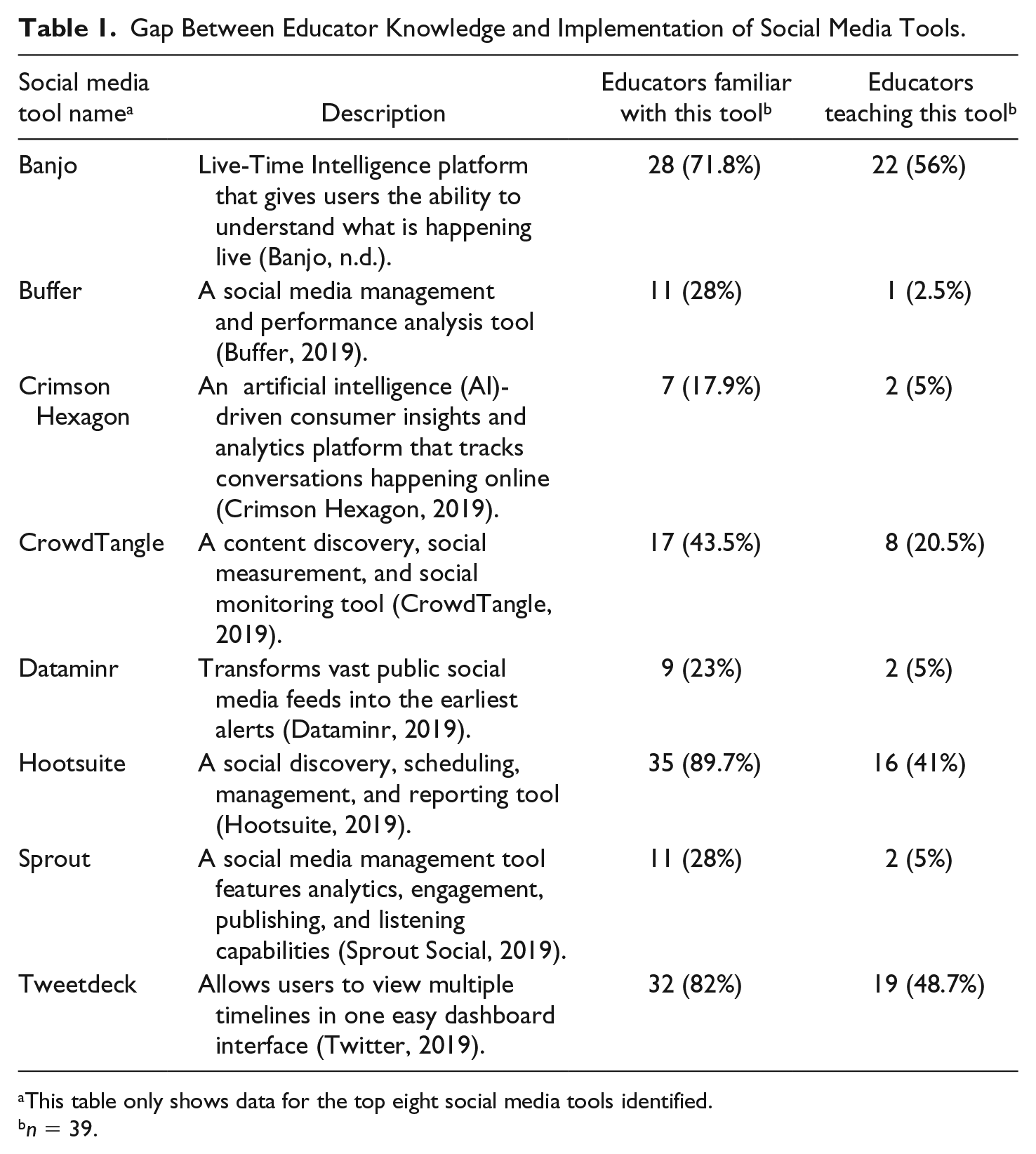
This table only shows data for the top eight social media tools identified.
n = 39.
Research Question 2 focused on specific strategies used. When asked how they introduce new tools, most said they do a full in-class training (34.2%), whereas others have students watch tutorials and trainings (17.5%), allow students to explore on their own (12.5%), or have someone else conduct the training (7.5%). Many educators (26.3%) do a combination of the aforementioned.
When asked about strategies used to encourage student adoption of the social media-related tools and technologies, several themes emerged including graded assignments and projects, engagement, real-world applications, and example-sharing.
A common strategy was to use assignments and projects (both in-class and out-of-class) to teach and assess students’ understanding of the platform. Grading this work was also discussed as a way of incentivizing completion. There were 18 coded references to assignment and/or projects and six references to grading and/or grades in the responses.
Multiple assignments to require them to use the technology. Simply assigning a training video without an assignment baked in is a recipe for disaster. Students will just go through the training to get the checkmark. Give assignments so they can practice, relate the tasks to both current student media and real-world tasks.
Real-world examples are utilized frequently as a teaching tool. This includes educating students about how these tools are used in the industry, as well as having students use tools to produce publishable work on behalf of a local news organization or non-profit. There were 14 coded references to real-world applications in the responses.
I talk about how they are used in newsrooms where these students might want to get jobs, and I stress that it will help them in their reporting. Show them how tools are used by professionals, have guests come in. The second semester students partner with a newspaper, TV station or non-profit, etc and they help them improve their social media outreach/presence.
Example-sharing was also a common strategy used by educators, which includes showing positive examples, reviewing case studies, and showing students how they themselves use the platform. There were four coded references to example-sharing in the responses.
I often show students what I use personally for various tasks and explain the pros and cons, and I make a point to ask any guest speakers about the tools they use.
A small number of participants talked about tracking engagement as being an important driver for implementing these tools into the classroom. There were three coded references to engagement in the responses.
It’s not just about producing a story. They need to be able to promote and track engagement. Increasing their reach and engagement on social platforms is part of their grade for the class.
Other interesting, but less common, strategies included requiring the completion of a social media certification program, assessing student tweets in front of the whole class, encouraging student-led learning, and more.
Required Twitter account. Reporters and producers must tweet 3 times on days they report and produce. We review in class. I give detailed feedback on each tweet to whole class. I encourage Hootsuite or Tweetdeck for producers to follow multiple streams during newscast days. I typically try to create a situation in which students first attempt to accomplish something manually. I then offer an array of tools that might help and let them explore them. The ones they are most likely to gravitate toward I will then offer some additional instruction about. Basically, I’m trying to simulate how students in the workplace will discover and implement new tools as means to an end rather than teaching the tools as ends unto themselves.
Research Question 3 examined educators’ motivations for implementing tools and technologies. The majority of educators said teaching their students new technologies is very important (65%) or important (12.5%), although 17.5% said teaching new technologies is only slightly to moderately important.
Some educators saw no barriers to the implementation of new technology in coursework, others cite time (46.2%), cost (41%), and lack of knowledge and awareness about new technologies (41%) as being preventive. Other responses included concerns: “not sure what’s going to stick around” and “mental overload of students.”
Eighty-five percent of educators, however, report being encouraged by administration to integrate new technology. Types of encouragement varied: verbal encouragement (80%), professional development or continuing education opportunities (47.5%), and funding (27.5%). One educator noted that this encouragement came in the form of an acknowledgment on an annual review.
Educator Motivations for Teaching Banjo
A portion of the survey was dedicated to Banjo because of social intelligence capabilities, its use in the journalism industry, and the free license which was previously offered to universities. This license decreased barriers to access for faculty use, unlike tools like Dataminr, Sprout, and Crimson Hexagon which are costly and have no university partnership program. Banjo’s university program has since been limited, along with its broad access to social media data, due to the application programming interface (API) changes of several platforms.
The sample was gathered through an email list provided by Banjo, so it was also likely that a significant portion of the sample would be familiar with the tool. In addition, by asking about one tool, educators were able to give more specific answers about their motivations and practices, rather than answer in the abstract.
The participants who stated teaching Banjo currently or in the past were also asked specifically about their motivations for using the platform. Twenty-one respondents had some experience teaching Banjo (either currently or in the past) and they had various strategies for integration as well as levels of usage. Sixty-six percent said they talk about Banjo in their classes frequently or occasionally, and some educators (33%) said they require students to use the platform for multiple assignments and others (33%) said there is no requirement to use the platform. Five percent of the educators required students to use the tool every day.
When educators were asked about their motivations for teaching Banjo, several themes emerged, falling into four main categories: the tool’s capabilities for news gathering and source discovery, the accessibility of the tool, the geographic nature of the platform, and its relevance in the industry.
There were several mentions of Banjo’s use for story-finding, news gathering, source discovery, and crowdsourcing. This motivation for teaching Banjo was mentioned by seven educators, making it the most salient theme in this response group.
We use it to help find events over a wide rural area, and also to find contacts for stories about the event. It is a valuable tool that introduces students to a real-world way to monitor social media for news and to find news sources.
Another salient theme was the accessibility of the tool, which included mentions of the free license offered to educators, the user-friendly interface, and the straightforward and robust nature of the platform.
. . . my students found it to be the most user friendly of a variety of social search tools. I’ve also found the Banjo team to be very helpful in terms of giving us access and training, which helps. Banjo offers a university license at no cost, which means we can afford to use it.
Educators also find the relevance of the platform to the industry to be a motivator for teaching Banjo.
We were in the first group of college program schools. We did it as a favor to a Banjo employee/friend of our school and then saw that it was becoming more prolific in industry—and that graduates were coming back and telling us how impressed their employers were that they’d already had access and knew how to use. Because it’s a good tool to enhance reporting, and I think it’s important to expose students to digital reporting tools.
Finally, several educators mentioned the geographic capabilities of Banjo. The ability to search for social media content within specific geolocations seemed valuable to some educators.
. . . it is the future of journalism in which geolocated content and location-based content are part of the newsgathering process. “I enjoy geographic orientation of Banjo. It allows us to quickly localize things we are discussing.”
Discussion
The findings from this study suggest that there is a gap between educators’ knowledge of social media tools and the implementation of such tools into the classroom. This finding is in-line with previous research that finds that educators are aware of social media technologies and perhaps even find value in them for personal use but may not understand the value in teaching them (Manca & Ranieri, 2016a, 2016b). This work also adds to the work of Bor (2014) and Larrondo Ureta and Peña Fernández (2017) around pedagogical strategies used by educators in JMC departments related to digital technologies. For example, emphasizing the value of tools to students is as important as teaching technical skills.
In addition, this work discusses educators’ motivations for integrating social media technology into the classroom, which has implications for educators, administrators, and social media technology companies. Educators looking to integrate social media technology into their courses could utilize these findings as a starting point for course development and improvement. Administrators can use these results as guidance for motivating their faculties to implement social media technology into the classroom, and they could use the strategies offered to create trainings and informational sessions around emerging technology integration. As barriers were also studied, educators interested in teaching digital technologies should consider industry trends and the needs of students to avoid investing in tools that may not be valuable. If bandwidth or funding barriers exist, educators may consider requesting additional time and funding to access new platforms or further training. They may also consider contacting platforms to request a university license or partnership. This work found that several educators who used Banjo in their classes did so because of the accessibility of the tool (i.e., the free university license). Social media technology companies, especially those new to the market and looking to raise awareness, should consider a similar program.
This study adds to the literature on journalism education, as most of the existing research in this space focused only on specific social media tools (e.g., Facebook, Twitter, and Instagram). This research adds a new dimension and category of tools to the scholarship.
Limitations and Future Work
The sample used in this study is limited. For example, the sample is limited by JMC educators who already integrate social media tools into their classroom experience, so responses about motivations and adoption may be skewed. In addition, the sample is not representative of all JMC educators. Future work could expand this study by broadening the sample.
In addition, the focus on Banjo as a smaller case study within the research segmented the sample. In future work, a different tool, or multiple tools, could be used to gather insights. This work could also be expanded to a different category of emerging tools relevant to the journalism industry, like data journalism or data visualization tools.
Conclusion
The goal of this work is to better understand how educators in JMC departments are using and strategically integrating social media tools and technologies in the classroom. This research also examined educator motivations. The findings from this work have implications for educators, administrators, and social media companies alike.
Footnotes
Declaration of Conflicting Interests
The author(s) declared no potential conflicts of interest with respect to the research, authorship, and/or publication of this article.
Funding
The author(s) received no financial support for the research, authorship, and/or publication of this article.
