



Abstract
Journalism jobs decreased significantly in the last decade and so have training opportunities for students, including Black college students. This essay explores the national student journalism project Black on Campus, a partnership with a national magazine and a university research center, that aimed to offer Black college students an opportunity to gain journalism training and be published by a national publication. This essay details how the program filled a gap in journalism training and education for Black students and documented the experiences of Black students during high racial polarization in the nation and on college campuses.
Around the same time that I was a panelist at a forum on diversity and inclusion in university media, an unidentified White man plastered Confederate flag flyers and cotton stalks across campus in September 2017. A group of mostly White students organized the session because they wanted to learn how to better cover previous racial incidents on their campus. The recent racial incident gave them a new story to cover. Five months earlier when the university’s first Black woman Student Government president took office, bananas were hung on nooses and the letters of her Black sorority were scribbled on them. She was also harassed online by White supremacists and later sued a neo-Nazi website for prompting a wave of racist online harassment and won a U.S.$750,000 judgment (Padilla, 2019). The May 2017 incident sent tremors through the campus. Racial fault lines went from fractured to cracked, leaving gaping chasms and wounds at the school, especially among students of color. Months later, the plastering of the Confederate flag rekindled some of those feelings of fear and frustration.
It was at that moment that I decided we had to move forward with the idea of the Black on Campus student journalism project to document Black college students’ experiences. My former postdoctoral fellowship chair, Wake Forest University Political Science Professor Dr. Melissa Harris-Perry, and I previously worked together on a student journalism project about collective care (#SquadCare) with a national media partner, ELLE. We wanted to do another project. But this time I wanted the journalism project to have a stronger news angle, a series that could explore a significant issue that affected students in a profound way. I knew that the experiences of this generation needed to be documented. I thought fusing the lived experience of Black college students with their journalism skills was a good way to have them record their generation’s history. Dr. Harris-Perry had a relationship with The Nation, so we pitched the idea to them. They agreed to work with us and Black on Campus was born. This project was a partnership between the Anna Julia Cooper Center, a research center founded and directed by Harris-Perry based at Wake Forest University, and The Nation. The magazine is a weekly founded by abolitionists and it published work by famed Black writers, including Toni Morrison and James Baldwin (Hsu, 2019).
We intended to create an affinity space—an informal space in which interests are shared and learning takes place, often online, among people drawn to a specific area (Gee, 2004). We also attempted to craft an affirming space for students, a supportive learning community. Because of the intense anti-Blackness on predominantly White college campuses, we wanted to form an atmosphere where Black student journalists would be supported and have their lived experience recognized as solid expertise. Essentially, we wanted to create an experience that they were not getting through their campus newspapers or professional newsrooms. During the 8-month project in 2018, the student journalists and co-directors produced 12 stories about Black college students’ contemporary experiences. Those stories garnered almost 500,000 views and a national journalism award. The purpose of this essay is to explore how the Black on Campus national journalism project created a unique training experience and nurturing atmosphere for Black student journalists to amplify their work.
Literature Review
Racist incidents on college campuses emerged as a major issue in higher education during the second decade of the new millennium. Between 2011 and 2016, campus hate crimes increased by 40% with 763 racist incidents reported in 2011 and 1,070 reported in 2016, according to a Center for American Progress report released in August 2019 (V. Nelson, 2019). After that time period, racism on campuses continued and sometimes became deadly. Richard Collins III, a Black man, was fatally stabbed in May 2017 at the University of Maryland by a White student associated with White racist groups (Campbell & Prudente, 2017). Collins died days before he was to graduate from the historically Black Bowie State University where his father accepted his son’s posthumous degree (Campbell, 2017). Three months later, one of the ugliest demonstrations of White supremacy in recent history occurred on a college campus. On August 11, 2017, about 250 White men marched through the campus of the University of Virginia in Charlottesville, Virginia, carrying burning tiki torches (reminiscent of Ku Klux Klan burning crosses) chanting “Jews will not replace us” and “you will not replace us.” When they arrived at the Thomas Jefferson statue, a multiracial group of about 30 students stood in resistance, White nationalists yelled “white lives matter,” and a physical conflict ensued (Heim, 2017). The next day a White supremacist killed a woman at a separate rally off campus in Charlottesville. White supremacist rhetoric also rose at universities. Between 2016 and 2018, the distribution of White supremacist propaganda on college campuses increased with a recorded total of 346 incidents of fliers, posters, and banners advocating for White domination and preservation (Anti-Defamation League, 2018). Black students felt pervasive racism on college campuses. Black students were more than twice as likely as White students to say they had a poor racial climate on their campus (Gallup, 2016). Racism on college campuses during the 2010s was a significant problem that affected students, especially Black students, and needed to be documented.
The American news industry historically had issues hiring, retaining, and covering people of color. In the United States, journalists tend to be college-educated, middle-class White men (Weaver & Willnat, 2012). In 1968, the Kerner Commission report found that “the media report and write from the standpoint of a white man’s world”; moreover, the report noted that the journalism industry’s negligence in covering the Black community left the rest of the nation uninformed of the realities of Black life and deepened Black Americans’ distrust of the media (Zelizer, 2016). The Kerner report also suggested actions to improve coverage of Black communities, including creating beats around the Black community and hiring more Black journalists. Today, the economy and technological shifts dealt a devastating blow to diversity in newsrooms. Financial recessions in 2001 and 2008 affected the news industry and Black employment. There were nearly 1,200 newspaper job losses among Black journalists from 1997 (2,946 jobs) to 2013 (1,754 jobs) (Anderson, 2014). Economic losses also meant overall job losses in journalism. Between 2008 and 2018, newsroom jobs dropped by 25% and most of those job losses were at newspapers (Grieco, 2018). But those who are employed in the news industry are mostly White. Most newsroom employees, 77%, are White compared with White workers comprising 65% of the overall American workforce (Grieco, 2019).
The economy also affected students’ journalism opportunities. After the 2008 recession, many newspapers eliminated paid internships (Skowronski, 2009). Working for free often is not an option for working class and middle-class students; therefore, they miss the experience and connections that internships provide while affluent students who already have access to professionals with power continue to excel (Mohan, 2019). Securing internships at top news outlets in the country is competitive, especially if students do not attend a top university. A Voices 2019 analysis found that 65% of the interns employed in 2018 at The Wall Street Journal, The New York Times, The Washington Post, Los Angeles Times, NPR, Politico, and The Chicago Tribune all attended elite and highly selective universities that comprised 13% of the nation’s higher education institutions (Amiri et al., 2019). Even journalism education needs to shift toward racial equity. Journalism departments do not have a diverse faculty or student body (Gutsche, 2019). Transforming journalism education to be more diverse is an important step in creating journalism that is more complete and a national dialogue that is inclusive (Biswas et al., 2012). The institutional racial barriers that exist in journalism make it clear that journalism education programs that offer students of color professional development are desperately needed.
The Program
The Black on Campus national student journalism project operated from January to September 2018. The spring semester, January to June, was the most intense and active time of the project when stories were developed, researched, and written. In my primary roles of co-founder and co-director, I spent a significant amount of time with students and worked with them closely and helped them develop their ideas into solid enterprise stories and essays and edit them. Throughout the project, I noted my observations, tracked participation in group meetings, and collected pedagogical items associated with the project, including the project outline and skills assessments. I also documented the students’ skill maturation and progress, the project directors’ reactions to students’ needs, and the strengths and weaknesses in the structure of the project and the way in which the organization of the project helped or hindered student journalists’ success. Throughout the project, I made note of successes, challenges, and the affirming/supportive space we intended to create for students; moreover, I chronicled the goals of the project and the actual outcomes.
Students were required to attend weekly virtual video meetings with the program directors to discuss the progress and development of individual stories and the overall project. The 10 student fellows in the project were from 10 institutions across the country. They were selected from a nationwide pool of 102 applicants. Although all of the students chosen are Black, they were a diverse group: eight women and two men, undergraduate and graduate students from schools on the West Coast, Midwest, South, and East Coast attending historically Black colleges and predominantly White institutions. Students were from different economic backgrounds. One director is an assistant professor, junior faculty, in journalism at a university in Washington, D.C., and the other is a tenured political science professor at a university in North Carolina. Both professors have significant journalism and media experience. Almost all the instruction and communication for this project was digital. The training portion of the program was from January to June 2018. The series launched in May 2018 at the end of the school year to give readers an idea of the issues that Black students just encountered. Stories were published until mid-June 2018. Two new essays were published in September 2018 to reintroduce the series to readers at the start of a new school year.
Besides the weekly training and development provided by the program directors, other training opportunities were arranged for students. The students all physically met one another for the first time at Wake Forest University in Winston-Salem, North Carolina, March 22–25, 2018, when they attended the Know Her Truths Conference sponsored by the Anna Julia Cooper Center. At the national conference, top writers, thinkers, educators, activists, and storytellers (including transgender activist and writer Janet Mock, Ferguson protester and citizen journalist Johnetta Elzie, and advocate for incarcerated people Marissa Alexander) discussed social realities that affect the lives of women and girls of color—including racism and barriers in education. While at that conference, students were able to gain insight for their stories, take notes, and potentially conduct interviews with national experts. A Census data dissemination specialist also held a 2-hr session and taught students to navigate the website and glean data that would illuminate inequities they wanted to illustrate in their stories.
The next day students attended a day-long investigative journalism bootcamp training session with the Ida B. Wells Society, a nonprofit organization that works to increase the number of investigative journalists of color. Two of the organization’s founders, investigative reporters who were then working at The New York Times (Ron Nixon) and ProPublica (Topher Sanders), taught the student journalists best practices (including interviewing techniques, story development, and data collection and analysis). After that, students were taken to the nearby International Civil Rights Center & Museum in Greensboro, North Carolina. It is the site of the F. W. Woolworth store where four Black North Carolina A. & T. State College students staged a major sit-in protest on February 1, 1960, to desegregate the store’s lunch counter. That act sparked a significant wave of anti-racist student activism. The co-directors wanted the students to visit the museum to know that (a) Black students’ activism of today is an extension of the work started generations earlier and (b) the importance of documenting Black college students’ contemporary experiences because the racist incidents Black students experience today become history in the future.
Affirming, Supportive Space
That weekend was particularly important in creating an affirming and supportive space. It was the first time the student journalists and directors physically met since the project started 2 months earlier. Up to that point, all communication was digital: including email, weekly virtual video meetings, a GroupMe group chat where student journalists and directors could communicate with one another quickly and directly through the app and text messages (students also created their own separate GroupMe to communicate among themselves) and a team Google drive where the project lived along with editing notes and instructions from the project directors. That weekend allowed students to have time to get to know one another and the directors outside of the digital space. All of them stayed at the same hotel and used the same shuttle to be transported together for the entire trip. They were all required to attend the conference and the training sessions. So, students spent a considerable amount of time with one another during that North Carolina weekend. The Nation and the Anna Julia Cooper Center paid for travel.
Three events that weekend helped us create community in the project: the Friday night dinner at a co-director’s home, the trip to the International Civil Rights Center & Museum, and the final dinner at a nearby Black-owned restaurant. At the professor’s home, students were able to see her and the other co-director outside of their professional roles and relate to them as people. During an evening of dinner, dancing, free-style rapping, collective and individual conversations, the student cohort connected with one another and the directors. The next day at the International Civil Rights Center & Museum during the guided tour, students learned some history of Black college students’ activism and their connection to it. One student who doubted their progress, skills, and place in the project was assured that they were in fact thriving and was a valued member of the team. The entire cohort, except for one student whose summer internship began, went to New York City for The Nation’s annual student journalism conference on social justice journalism in June, another professional development opportunity for students to learn from top national journalists and bond with one another.
Outcome
The published work produced by students and co-directors was paramount to the successes of the project. Before students started their stories, co-directors sent them a schedule for the semester which served as an informal syllabus. The outline included readings (about journalism, media diversity, and examples of good intersectional journalism), assignments, and deadlines. The assignments were intended to build on the enterprise stories. The co-directors required students to complete a skills assessment to determine the skills that needed to be strengthened. Students also completed a story memo—a detailed pitch that explained the significance of the story and potential human and data sources. The idea was to have students develop their enterprise story and create an initial roadmap for it to be sure they could execute it and make it appeal to a national audience. Because text stories were the major component of storytelling, the co-directors spent time discussing how to conduct interviews, develop good questions, and incorporate quotes into a story. Writing good leads and nut grafs was also a priority. Students were also taught to contextualize their work and consider the language they used when writing about marginalized communities and contemplate their own bias while reporting.
The stories and essays mostly came from the students. They considered their own experiences, those of their peers, and those that were missing in media narratives about college students—stories where Black students were visible. It was important for students to bring stories to the project that they thought needed to be covered. Intersectionality theory recognizes lived experience as a legitimate source of knowledge (Crenshaw, 1989). We wanted students’ expertise to be central in the project. This paid off because many of them pitched stories about trends and issues they noticed on their own campuses. Those who had trouble developing stories with national appeal worked with directors to tap into important and unreported issues and brought those stories to life.
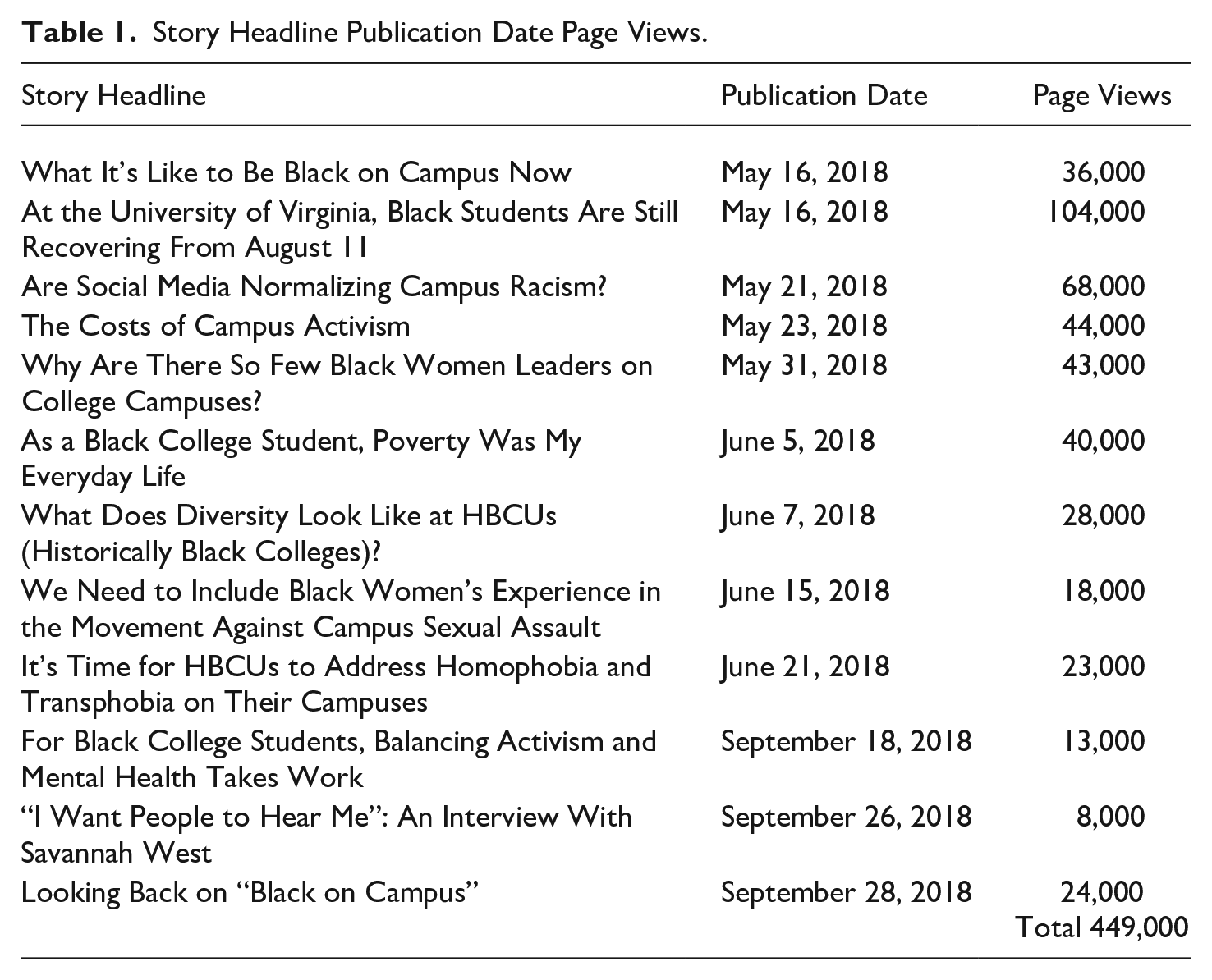
The topics students wrote about included the mental health of Black student activists who work against racism on campus, Black women’s barriers to leadership in higher education, how social media amplifies campus racism, changes in the demographics of the students attending historically Black colleges, and the challenges of balancing the costs of education while struggling with income inequality. The most-read story in the project was a news feature about how Black students at the University of Virginia coped with White supremacists marching on their campus. That story was produced by a Black student who attended University of Virginia. After the country’s attention turned away from that campus, our student journalist used her knowledge of the culture of the campus to create a powerful narrative that showed the country that the Unite the Right rally was more than just a racist gathering. It was perceived to be a terrorist act that affected Black students’ ability to be productive and feel safe on their campus. That story garnered 104,000 views. Another student wrote about the need to include Black women’s stories in the movement to end campus rape. That article was a needed exploration of how social ideas about Black women affect the ways in which their sexual assaults are not taken seriously; moreover, it addressed the tendency to sometimes not hold Black men accountable who are accused of perpetuating sex crimes against Black women students to protect Black men from White authorities. That story earned the National Association of Black Journalists Salute to Excellence Award in online feature reporting in the graduate division. The narratives that student journalists produced were complex and nuanced stories that gave readers insight into Black students’ unique experiences.
The co-directors amplified the project and students’ stories through a strategic social media plan. This started with promoting the call for applications. A staffer at the Anna Julia Cooper Center created polished graphics for us to circulate information on social media about the project. We wanted to tell the story of the project along the way. We shared a graphic that showed how many applicants were under review and the cities they were from. Once fellows were chosen, we posted graphics with their name, school, and the project logo. We wanted people to know who our fellows were and to anticipate their work. Photos from our digital and in-person meetings and trainings were shared on social media, along with the trips to Washington, D.C., Winston-Salem (North Carolina), and New York City. We wanted to build interest in the project and an audience for it so that we could drive readers to the series when the series launched. All of the content related to the project was shared on the Anna Julia Cooper Center’s social media accounts. The center had an online following of 12,600 (9,000 followers on Twitter, 2,500 on Facebook, and 1,100 on Instagram). The Nation also shared the stories on its social media accounts. We wanted to teach the students the importance of developing a social media strategy to draw readers to their work. The series garnered 449,000 views (Table 1).
Story Headline Publication Date Page Views.
Challenges
There were clear challenges in the project. Initially, we had technical difficulties setting up the weekly virtual video meetings. The students, and especially the directors, were unfamiliar with the specific technology we used and learning how to use it during the first few weeks caused those meetings to be less effective. Keeping this project a priority among some students was also a challenge. They were accomplished full-time students, worked part-time jobs and internships, wrote for school newspapers, and participated in extracurricular activities. For some students, the project was more time-consuming than they anticipated. It became an added responsibility in an already crowded schedule. Students’ classes were their priority during the spring 2018 semester and it should have been because many of them were approaching graduation. So having this informal affinity space was not always effective. While students were taught skills, assigned readings, and issued deadlines, not having a formal classroom structure with a grade on the line caused the project to drop on students’ list of priorities. I believe if we had the structure and responsibility of a formal class, that would have enabled students to better balance the demands of the project. That informal program design was a flaw I wish that we, the directors, would have considered before we launched the project. The time commitment was also sometimes heavy for the directors who were not always able to attend every virtual meeting. Moreover, the labor and time required for me to invest in this project as a co-director was considerable and amounted to the workload of teaching an additional class. It was also cumbersome to establish a meeting time with 12 people who lived in three different time zones. The norms and conventions of a college course would have helped all of us to organize and formalize this long-term student reporting project.
Discussion and Conclusion
Black on Campus was a successful effort to train Black student journalists and amplify stories about Black college students’ experiences. A key factor in the success of the program was the partnership with The Nation. The magazine already had a commitment to nurture young journalists with its internship program and annual national student journalism conference in New York City which focuses on covering social justice issues (the magazine pays for students’ travel expenses). Black on Campus students had great story ideas and received training to execute them but having a national news media outlet publish their work really helped elevate their stories to readers who needed to see them. Moreover, The Nation helped professionalize students by publishing their work alongside seasoned professionals and exposing it to a nationwide audience. The Nation invested in young Black journalists. The magazine, along with the Anna Julia Cooper Center, earmarked money to pay for training and travel. Students were also paid as freelancers for their work. The work students produced for The Nation undoubtedly helped them early in their careers. After the project, students secured positions as interns, contributors, and full-time employees at outlets, including the Wall Street Journal, New York Times, Baltimore Sun, Detroit Free Press, CNN, Blavity, and Vice.
This unique partnership between a university research center and a national magazine is rare. The collaboration was covered by media outlets, including Black Enterprise (Goode, 2018) and Diverse Issues in Higher Education magazines (Pennamon, 2018) and public radio in North Carolina (Chafin, 2018). This collaboration brought attention to Black college students’ experiences, provided training for them, and increased diversity in The Nation’s editorial content. Schools and media outlets can and should be establishing collaborations like this to create more reporting opportunities for students of color. Racial inclusion in American newsrooms still lags and the lived experience from reporters from different backgrounds is needed now more than ever in this nation to contextualize the issues happening around us. Through this partnership, the directors created a professional development opportunity that students would not have had otherwise. With Black on Campus, we created space for Black college students in a challenging industry at a time when they experienced a resurgence of campus racism across the nation. While the logistics presented a challenge, we successfully established an atmosphere where students knew that their experience as young Black journalists was valued and amplified. Moreover, they gained professional editing, individual mentoring, their work received national attention, and some of them established solid friendships. More partnerships like this one between universities and newsrooms can help develop Black student journalists and provide inclusive coverage for newsrooms.
Footnotes
Declaration of Conflicting Interests
The author(s) declared no potential conflicts of interest with respect to the research, authorship, and/or publication of this article.
Funding
The author(s) received no financial support for the research, authorship, and/or publication of this article.