



Abstract
Innovation is driving major changes in journalism globally. Understanding how journalism educators, students, and journalists perceive of innovation—in themselves and their organizations—is another layer by which to understand how the overall industry is evolving. This study explores the perceptions of innovation through an international survey (N = 1,543) of journalism educators, students, and journalists from Latin America. Findings show that journalists perceive themselves as more innovative than those in the academy. A significant gap appears between the academy and newsroom of how innovation is being defined and what it means to be innovative, which poses implications for the future of journalism students and journalists alike.
The journalism industry globally is at a pivotal moment. When news organizations are fighting for survival due to a business model collapse, as digital media is transforming news consumption and distribution models, and as governmental structures and systems affect press freedoms, the journalism profession is undergoing a major transformation (Boczkowski & Anderson, 2017; SembraMedia, 2019).
Journalists are recognizing that their work routines of the past might no longer fit the digital and mobile media ecosystem of today and that they need to rely on new methods and practices (Mellado et al., 2017). As part of this new ecosystem, journalism entrepreneurs have created startups in their respective countries to help (a) provide a new form of journalism, (b) revive a healthy press system, and (c) innovate with new storytelling methods (Hang, 2018).
One region of the world where entrepreneurs are developing new forms of storytelling and journalism practices is in Latin America. The growth of startups in the region has grown quickly in the past decade from only a few to over 600 currently (SembraMedia, 2017, 2019). Researchers have tracked these developments that showcase unique business models and innovative approaches are being launched throughout the region (Gorriti, 2013; Meléndez Yúdico, 2016; Mioli & Nafria, 2018; Requejo-Alemán & Lugo-Ocando, 2014). This poses a unique opportunity to delve deeper into the entrepreneurial media ecosystem to discover what exact innovations are being used in journalism, how they are perceived, and particularly, how one is being educated on innovation. With this in mind, this survey (N = 1,543) of journalism educators, students, and professionals from 20 Latin American countries explores differences in how they judge innovation. This approach can shed light on any gaps that might exist between theory and practice, and what that means for transferring innovation from the classroom to the newsroom.
Innovation is defined in this study as identified by Everett Rogers (1995) as “an idea, practice or object that is perceived as new by an individual” (p. 11). Multiple scholars have studied innovation in the journalism profession from various approaches, such as seeing how innovative structures have been implemented in the newsroom or examining the innovation of a new product launched by a news organization (Cohen, 2015; Elmore & Massey, 2012; García-Avilés et al., 2018; Hang & Van Weezel, 2007; Siapera & Papadopoulou, 2016; Vos & Singer, 2016; Westlund & Lewis, 2014). An aspect of innovation not fully explored in this crucial timeframe of change is how innovation is perceived by the wider journalism community which includes journalism educators, students, and practitioners. Understanding the particularities of the different members of the journalism community in how they are learning, conceptualizing, adapting to, and forming innovation is an important layer to understanding the evolution of the industry. Furthermore, by removing the disconnect between these three entities (practitioners, educators, and students) and seeing them as a whole, one can have a better understanding of where the journalism profession is currently today in Latin America and how it can be affected by those who train the journalists of tomorrow as well as those who are learning to become journalists in the region.
Literature Review
Before delving into the specifics of this study, it is necessary to address how journalism innovation and entrepreneurship have evolved in the newsroom and classroom overall, as well as in Latin America. These areas will be addressed in the next section.
Innovation and Entrepreneurship in Journalism
Scholars have explored the development of innovation in the journalism profession for several years. Specifically, scholars have identified innovation as a product or service that is implemented into a news organization (Cohen, 2015; García-Avilés et al., 2018), as part of a system or process in the newsroom (Jarvis, 2009; Siapera & Papadopoulou, 2016; Vos & Singer, 2016), and as a leadership approach in the profession (Elmore & Massey, 2012; Westlund & Lewis, 2014).
Innovation can stem from actors (journalists), actants (technology), the audience, or activities (news production practices) (Westlund & Lewis, 2014). The degree of innovation can be seen as incremental or revolutionizing (García-Avilés et al., 2018; Schumpeter, 1943) or “sustaining” or “disruptive” (Christensen, 2003). For example, the “Index of Media Innovation” (García-Avilés et al., 2018) found most media innovations represent small advances—changes in the product/service or production/distribution—rather than any kind of radical change. Such radical changes appeared overwhelmingly at digital-only sites, leading the authors to highlight the importance of technology-related innovations in helping drive change (García-Avilés et al., 2018). Similarly, Lowrey (2012) suggested that traditional media’s efforts toward innovation are mostly “shallow and fleeting,” failing to “disrupt traditional routines or institutional arrangements” (p. 231). As such, Küng (2015) argued that media innovation is fundamentally about transitioning from traditional print business models to new digital business models. Entrepreneurial journalism lies within this innovation framework.
Innovation typically is considered a hallmark of entrepreneurial journalism (Jarvis, 2010). Entrepreneurial journalism can be understood according to a spectrum, from freelancers or the “part-time solo entrepreneurial journalist” to “jacks of all trades” who wear multiple hats: founders, owners, publishers, sales representatives, and content producers (Elmore & Massey, 2012). For Vos and Singer (2016), entrepreneurial journalism can vary according to purpose, norms, operations, and business structures. Cohen (2015) suggested that what makes journalists entrepreneurial is their use of “new technologies and ‘innovative’ practices to reinvent journalism as socially relevant, but also as profitable” (p. 517). Entrepreneurial journalism can thus be understood as a focus on technological innovations with new approaches to business models and profit (Jarvis, 2009; Siapera & Papadopoulou, 2016) to “save” the floundering traditional journalism industry (Naldi & Picard, 2012). Considering that the “future of journalism is increasingly sought in both journalism practice and education in this entrepreneurial form of journalism” (Wagemans et al., 2016, p. 161), understanding innovation—the foundation of entrepreneurialism— becomes all the more urgent.
Although innovation and entrepreneurialism are interrelated, they are not synonymous (Landström et al., 2015). For Shane and Venkataraman (2000), entrepreneurship is about finding and creating opportunities, whereas innovation is about exploiting them. Zhao (2005) noted that innovation is the basis of entrepreneurship, whereas entrepreneurship provides the space for innovation to occur. While innovation is one of the most commonly researched elements of entrepreneurship, most of these studies are limited to the audiovisual industry of media firms in general (Hang & Van Weezel, 2007), allowing this study to advance the literature by focusing on innovation in the journalism industry among a wider community.
As the literature has noted, journalism innovation is typically studied from an organizational lens (Cohen, 2015; Elmore & Massey, 2012; García-Avilés et al., 2018; Hang & Van Weezel, 2007; Küng, 2015; Siapera & Papadopoulou, 2016; Vos & Singer, 2016), ignoring individual journalists’ perceptions. Because research indicates that individual, organizational, and societal-level factors influence journalistic values and practices (e.g., Mellado, 2012; Shoemaker & Reese, 1996; Weaver & Wilhoit, 1996), it is worth examining how different work contexts might relate to individuals’ understandings of innovation. Furthermore, considering innovation is a hallmark of entrepreneurial journalism (Authors, 2018), it becomes necessary to question to what extent entrepreneurial journalists have different definitions of innovation than non-entrepreneurial journalists. As such, our first research question is as follows:
Innovation and Entrepreneurship in Journalism Education
From the standpoint of the wider journalism community, this study provides an opportunity to explore journalism innovation, serving as a starting point for dialog between the different agents in the journalism community. When exploring journalism innovation, one can look to the development of journalism and media entrepreneurship in the classroom.
Ferrier (2013) noted that entrepreneurial journalism courses are needed to highlight changes in the industry and to encourage innovation. Sindik and Graybeal (2017) studied media entrepreneurship programs in the United States to conclude that the development of pedagogy in this field in higher education is changing/growing and becoming more common while helping to legitimize the overall media entrepreneurship industry.
Casero-Ripollés and colleagues (2016) surveyed college journalism students in Spain and found most associated entrepreneurialism with innovation, but they did not necessarily link innovation with the use of new digital technologies so much as the creation of a new media outlet, whether online or offline. At the same time, the authors found that students most valued skills related to using digital technologies, being creative, and taking initiative, all of which the authors argued are related to innovation and entrepreneurialism (Casero-Ripollés et al., 2016).
Even when the scaffolding is there for innovativeness, students might not transfer it from the classroom to practice. Sparre and Faergemann (2016) examined entrepreneurial journalism approaches among postgraduate journalism students in a full-time internship where they could identify innovative approaches but did not take advantage of the ways innovation or an entrepreneurial identity could be developed. Similarly, Elmore and Massey (2012) found that freelance journalists said their journalism educations did not adequately prepare them to work as entrepreneurial journalists. What these studies and others about journalism entrepreneurship show is the gap between the classroom and the newsroom.
Despite the growth of entrepreneurship programs in the United States and other parts of the world, such as Latin America, the course offerings and training opportunities for media entrepreneurship are limited (Guiterrez-Renteria, 2018; SembraMedia, 2019).
For example, a recent study from SembraMedia (2019) examining professors who teach media entrepreneurship at universities in Latin America found “48 Latin American universities offer entrepreneurial journalism courses, which means that only 2.82% of universities that provide communications courses in Latin America offer this subject” (p. 7). Of those professors teaching media entrepreneurship, most of those interviewed had only started teaching the subject recently. However, among those teaching the subject, “64% of the professors interviewed have been or are media entrepreneurs.” This finding reflects the larger notion that journalism educators should not be isolated to a silo when it comes to innovation perceptions, as they are also former journalists involved in innovative and entrepreneurship projects.
This education gap is not unusual to the region as literature has noted overall that the latest journalism skills and training are lacking in the university systems in Latin America where overall, the students are not meeting the demands of what is needed in the newsroom due to a lack of proper scaffolding in the classroom (Arroyave & Barrios, 2012; Cleary, 2003; Ferreira et al., 2000; Herscovitz, 2012; Schmitz Weiss et al., 2017). This study is intended to be the first step toward filling this research gap by examining specifically innovation perceptions among journalism students, educators, and journalists. By looking at this wider journalism community, insights can be gained as a whole as to ways the classroom to newsroom gap can be bridged.
Thus, as research shows that innovation studies are siloed instead of inclusive and that when one looks holistically at journalists, journalism educators, and journalism students, a more comprehensive view can be captured about the ways innovation is being shaped in the profession and the classroom. Considering all three types of actors within the wider journalism community thus helps to provide an additional layer to scholarship. Furthermore, research is starting to indicate a potential gap between the classroom and the newsroom when it comes to innovation (SembraMedia, 2019; Sparre & Faergemann, 2016). Thus, our second research question is as follows:
Latin America and Media Entrepreneurship
In Latin America, scholars have explored the nuances of innovation from the standpoint of news startups launching in the region (Mioli & Nafria, 2018), unique business models (Gorriti, 2013; Meléndez Yúdico, 2016; Requejo-Alemán & Lugo-Ocando, 2014), and efforts to distinguish themselves from traditional mainstream media in terms of stories told and sources quoted (Mioli & Nafria, 2018). For example, research has (Harlow & Salaverría, 2016) mapped the region’s online-native sites to show how ownership, funding, content, degree of activism, organizational goals, and inclusion of multimedia, interactive, and participatory digital elements were related to influence, innovation, and challenging traditional, mainstream media. While most research explores innovation and entrepreneurship from the media outlet’s perspective, another researcher (Harlow, 2018) took a unique approach by examining how audiences of entrepreneurial sites in Central America perceived innovation. Readers saw innovation as not necessarily about the use of new technologies, but rather about offering independent journalism with alternative business models that set these sites apart from mainstream media throughout the region.
Latin America offers an ideal setting for studying innovation in light of the ongoing digital media entrepreneurship boom region wide. A recent report (SembraMedia, 2017) identified more than 650 Spanish-language news startups, mostly in Latin America, that are innovating journalism in their communities. Calling them “generators of change,” the report noted these sites’ innovation, from the ways they report and distribute the news to the business model their organization is operating from. A recent study of journalists (Schmitz Weiss et al., 2018) working for news startups in the region showed innovation is not only about the business, the tools or technologies used, or the storytelling style, but it is also about the individual—journalists saw themselves as radical innovators changing journalism practices in their country. This identification with innovation demands further inquiry to identify how individuals in the region perceive innovation with themselves, within the organizations they work for, and how they compare with those around them, which this study intends to examine. Our final research question, then, is as follows:
Method
This study is based on an online survey administered in December 2017 to journalists (n = 1,094), journalism educators (n = 221), and journalism students (n = 228) for a total of 1,543 participants in the Latin American region. This breakdown of the sample does show more representation of journalists than educators and students, and it is also representative of the region. It is important to note that in Latin America, it is not unusual that journalism educators and students can be former or active journalists. This approach of bringing these three groups together provides a more holistic picture of the current landscape in the region. This research is part of a larger project that examines the state of journalism in Latin America. Respondents were recruited from a database of 15,500 people (which included journalists, journalism students, and educators from a nonprofit outreach organization). The survey was created in English and then translated into Spanish and Portuguese for the appropriate language by country (Argentina, Bolivia, Brazil, Chile, Colombia, Costa Rica, Cuba, Dominican Republic, Ecuador, El Salvador, Guatemala, Honduras, Mexico, Nicaragua, Panama, Paraguay, Peru, Puerto Rico, Uruguay, and Venezuela). As for the whole sample (including journalism educators, students, and journalists), 52.2% were female, 47.7% were male, and .1% stated other. The median age was 38 years and the average number of years one had worked in the industry was 10 years for the whole sample. Most had attained a college degree.
Unit of Analysis
The unit of analysis in this study is the journalism community in Latin America. The definition of innovation that is applied to this study is based on the definition by Everett Rogers (1995), where innovation is seen as “an idea, practice or object that is perceived as new by an individual (p. 11).” In this study, we further identify innovation as related to new or different ways journalists might perform their news reporting and news gathering duties, the types of tools and technologies they use in their work, the business model of the news organization they work for, and newsroom processes or structures that are implemented. These forms of innovation were incorporated into the questions that survey respondents received, but the actual definition of innovation was left up to respondents, allowing them to determine whether they viewed innovation in terms of technological developments, funding mechanisms, business models, or reporting practices (Schmitz Weiss et al., 2018).
Measures
To answer the research questions for this study, respondents were asked a variety of questions about their career and their perceptions on innovation in the journalism industry.
To answer
To answer
The nine innovation items originated from innovations defined by Latin American journalists in a focus group conducted by this research group (Schmitz Weiss et al., 2018). Innovation was categorized as the type of news they cover, the quality of journalism they produce, the tools/platforms they use, and the possibility of independence. Within those categories, journalists identified advances that could more specifically relate to each of these categories, such as infographics which is a tool used for storytelling with data, variety of topics covered which relates to an expansion of the types of stories that now have space and newfound relevance, and reporting/narrative style which includes collaboration with audiences and greater openness to the inclusion of a reporter’s voice. With the nine innovation items, this study seeks to find the relative importance of such innovations and variability throughout Latin America.
Upon further analysis, a factor analysis was run among the nine innovation statements to identify possible factor loadings and reliability in such factors. Using the principal component analysis extraction method, Factor 1 was comprised of six items reported on a 5-point Likert-type scale that explained 62% of the variance with factor loadings from .73 to .85. Those statements included perceived importance in financial structure of the organization, data journalism, multimedia content use, editorial independence, financial independence, and sourcing. Cronbach’s alpha for these six items was .87. An alpha of this size is considered to have moderate-to-high reliability (Carmines & Zeller, 1979).
Results
RQ1 : How do journalists with different work circumstances perceive innovation?
Journalists perceive themselves as innovative depending on their work circumstances, F(6, 1057) = 7.420, p = .001. As shown in Table 1, journalists who work for their own news operation and those who work for startups tend to have the highest agreement of being innovative in their work in comparison with those who are freelancers, interns, or work in a news organization for someone else. There was no statistical difference in how journalists working in these six different types of platforms perceive innovation, F(5, 883) = 1.663, p = .149.
Journalist Innovation Perceptions by Work Circumstance.
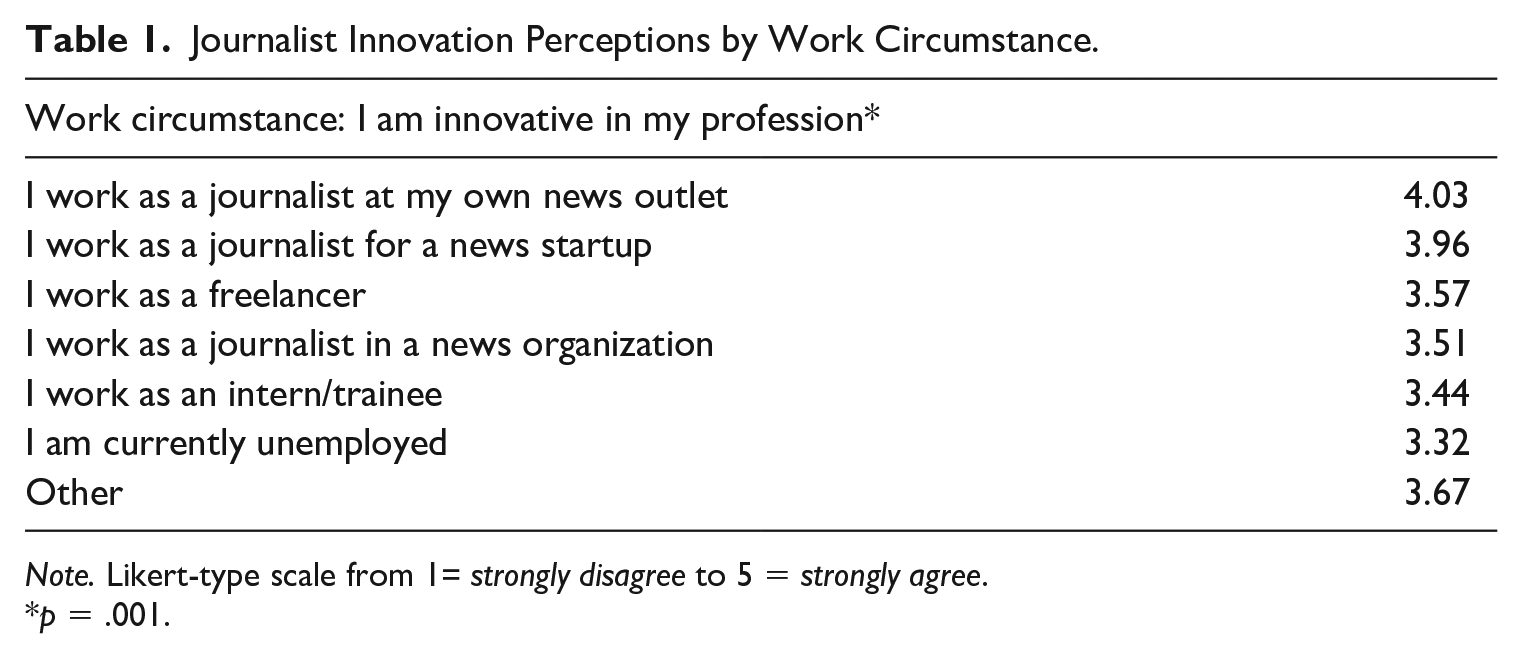
Note. Likert-type scale from 1= strongly disagree to 5 = strongly agree.
p = .001.
RQ2 : How do journalists, journalism students and journalism educators in the region perceive innovation of the profession?
Journalists, journalism educators, and students perceive innovation of the profession somewhat differently (see Table 2). Based on an ANOVA test, statistically significant results, F(6, 1057) = 7.053, p = .001, showed that journalists agreed that they were innovative in the organization they worked for and that their news organization was more innovative than other news organizations in the country. Journalism students and educators were more likely to disagree that they were innovative.
Innovation Perception by Journalism Community Role.
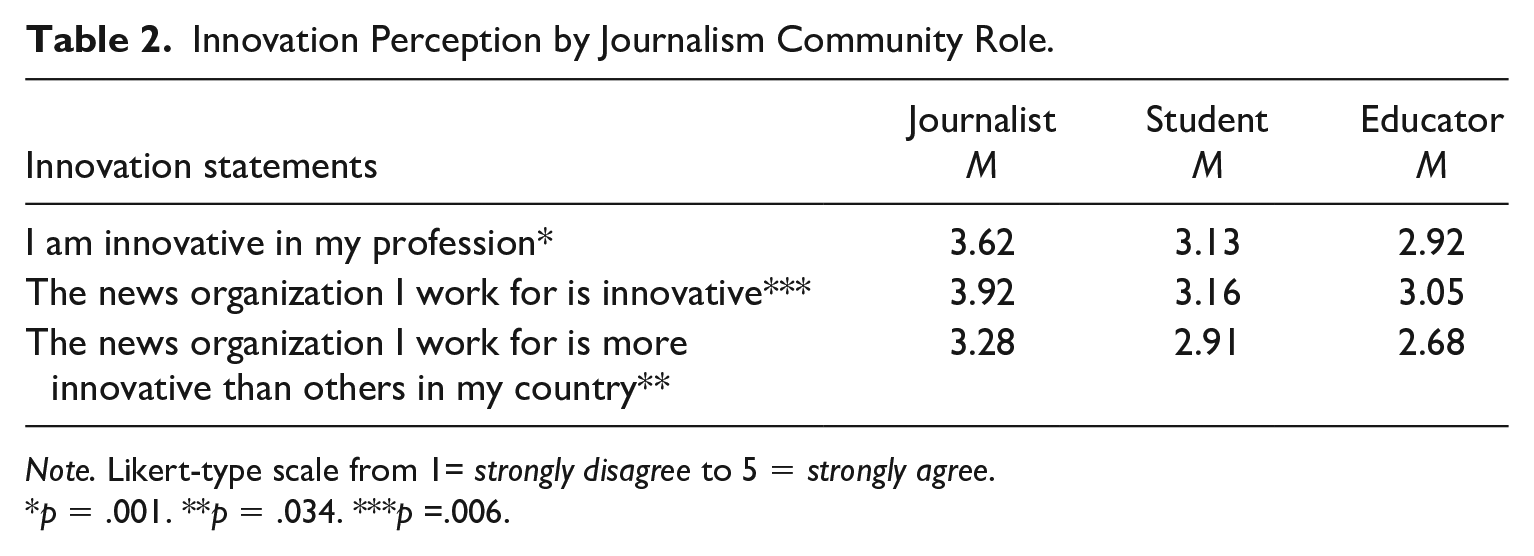
Note. Likert-type scale from 1= strongly disagree to 5 = strongly agree.
p = .001. **p = .034. ***p =.006.
When analyzing all survey participants’ responses, results showed statistically significant differences of individual innovativeness, F(19, 1517) = 7.310, p = .001, the innovativeness of the news organization, F(19, 1498) = 7.415, p = .001, and the innovativeness of the news organization they work for in comparison with others in the country, F(19, 1502) = 5.263, p = .001. As shown in Table 3, results of an ANOVA test show that more survey participants from Ecuador, Guatemala, Panama, Puerto Rico, Dominican Republic, and Uruguay agreed that they were innovative in their own work in comparison with respondents from other countries.
Journalism Innovation Perceptions by Country.
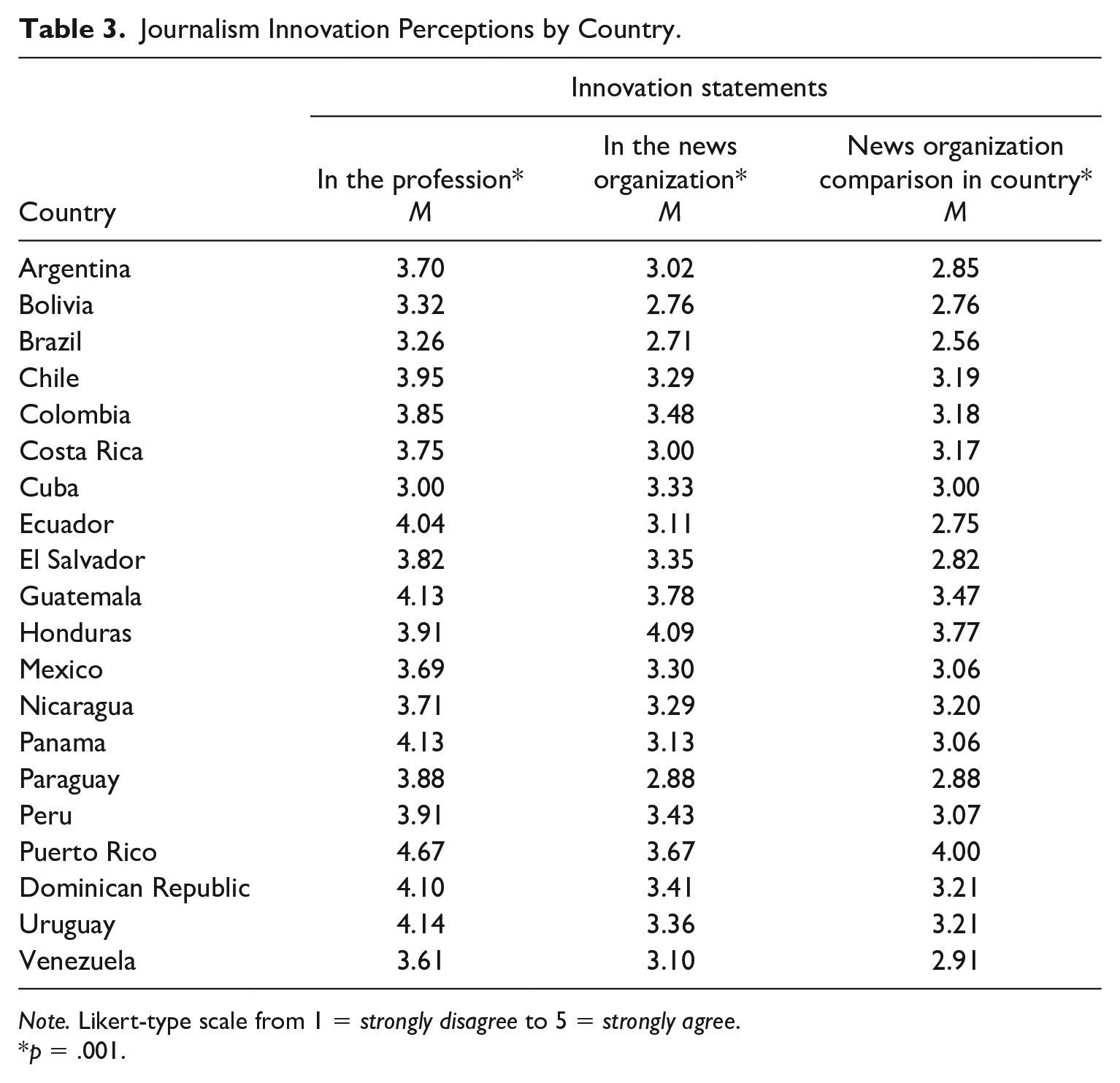
Note. Likert-type scale from 1 = strongly disagree to 5 = strongly agree.
p = .001.
RQ3 : What do journalists, journalism students, and journalism educators in the region qualify as innovation in the profession?
Only three statements showed statistical significance by country as innovative areas in journalism: variety of topics covered, F(19, 1513) = 1.510, p = .073, reporting/narrative style, F(19, 1511) = 2.758, p = .001, and use of infographics, F(19, 1501) = 1.616, p = .045. The remaining six statements (perceived importance in innovations like data journalism, multimedia, editorial independence, financial independence, source variety, and financial structure of organization) were not statistically significant.
As shown in Table 4, Costa Rica and Puerto Rico had the highest means for topic variety, whereas Costa Rica, Ecuador, and Puerto Rico had the highest means for narrative style, and Nicaragua and Guatemala had the highest means for infographic use.
Perceived Journalism Innovations by Country.

Note. Likert-type scale from 1 = not important at all to 5 = very important.
p = .001. **p = .045. ***p = .073.
For further analysis, a factor analysis of all nine statements was run among all the three groups (journalists, educators, and students). Only six statements (perceived importance in financial structure of the organization, data journalism, multimedia content use, editorial independence, financial independence, and sourcing) showed statistical significance. These findings demonstrate that the more techniques and processes that are used, the more important the journalistic innovation will be and perceived as innovative to the organization as well.
Discussion
This study showed that the wider journalism community—journalists, educators, and students—differ in their perceptions of innovation depending on where they work, where they live, and how they define innovation. Rather than merely approaching the understanding of innovation from an organizational perspective (e.g., García-Avilés, 2018; Siapera & Papadopoulou, 2016), this study is important for its holistic approach, taking into account not just those currently working as journalists but also future journalists (students) and those educating them. This study thus adds to scholarship by demonstrating gaps between the classroom and the newsroom when it comes to innovative thinking and practices.
Journalists perceived themselves as innovative if they worked in an entrepreneurial capacity, running the news outlet where they worked rather than working for someone else. In light of the growth of innovative entrepreneurial news outlets throughout Latin America (SembraMedia, 2017), such a finding is important as it suggests non-entrepreneurial journalists—such as those working for traditional mainstream news organizations—could lack the technological skills and training that innovation demands. No wonder, then, that Lowrey (2012, p. 231) characterized as “shallow and fleeting” most traditional media’s attempts at innovation. Future research should compare digital training opportunities and know-how between entrepreneurial and non-entrepreneurial news outlets. It is also possible that non-entrepreneurial journalists consider themselves less innovative simply because they work for traditional media, and perhaps see less of an opportunity for innovating in technology, practices, or business models. Furthermore, more innovative and creative-minded journalists might also be drawn toward working for startups and entrepreneurial ventures, seeing traditional media perhaps as stifling or stuck in the past. Research should explore this further, as addressing these differences is key to understanding what traditional and entrepreneurial outlets need to do to achieve innovation, which is seen as fundamental to profit and sustainability (Cohen, 2015; Jarvis, 2009) in an industry in flux driven toward entrepreneurialism as a fix for declining ad revenues, readership, and resulting dissatisfaction and job loss (Naldi & Picard, 2012).
Journalists also tended to see their work as more innovative in comparison with students and educators. This can be an obvious finding as students and educators may not be as active in the journalism industry (despite part-time or contract work, perhaps) that may prevent them from having the opportunities to do innovative work or be a part of an innovative initiative. This can also mean, however, that universities in Latin America may not be fostering innovation as much as educators and students would like, and may possibly be lagging behind the industry in terms of fostering an innovative environment (SembraMedia, 2019). Within that context, students may be less likely to have incentives to be innovative in their work. Furthermore, this result might be connected to the lack of being able to teach or learn about media entrepreneurship as the course offerings in the academy in the region have been limited (Guiterrez-Renteria, 2018; SembraMedia, 2019). This finding has practical value as it points to a need for more journalistic innovation and entrepreneurship classes at the university level, which requires new training for journalism educators. Without more such classes for journalism students, once they graduate they might not feel comfortable working for entrepreneurial outlets, thus limiting their job prospects and exacerbating the differences found here between entrepreneurial and non-entrepreneurial journalists.
Furthermore, this study showed differences by country in terms of how respondents perceived innovation, adding to existing literature suggesting news values and practices differ according to country and culture (Mellado, 2012; Weaver & Wilhoit, 1996). Respondents in some countries identified themselves as more innovative than others. This finding warrants further research to examine the specific nuances in those countries to identify what other factors, such as availability of entrepreneurship courses, might drive that perception.
Finally, the factors that all survey participants from the journalism community noted that make journalism innovative were reporting style, the use of infographics, and story topic variety. This finding furthers previous studies (Harlow, 2018; Higgins Joyce, 2018; Schmitz Weiss et al., 2018) that found these areas drive innovation at startups in the region—entrepreneurial news organizations sought to cover subjects or topics different than those in the mainstream media, pushing the envelope of what ways stories can be told, whether through multimedia such as podcasts or social media videos, or the use of data through infographics. Our finding demonstrates how much the news product—and not simply the tools used to produce it—is considered the innovation in today’s media ecosystem in this region. Furthermore, this finding extends previous research about innovation in Central America to all of Latin America, indicating that the industry region-wide is seeking to innovate in a way that distinguishes today’s journalism from traditional practices and products.
There are some limitations to this study that should be addressed. This study captures a sample of journalists, educators, and students from the Latin America region and cannot be completely generalizable to the wider population. However, the results can provide some insights that warrant further investigation. This study also captures innovation from the standpoint of the adoption of the term innovation in the newsroom through specific practices, perceptions, and approaches. The idea of innovation may differ by newsroom, student, and teacher and thus one could also identify further nuances as such. Finally, one may argue that journalists, journalism educators, and students are distinct groups that cannot exactly be compared and thus results cannot be insightful. However, when one considers the path a person takes in journalism, a significant overlap can occur when a student is actively working in the industry while finishing their degree and one may also teach a class while also working in the newsroom. The idea of innovation only being practiced and perceived in one situation neglects the current state of how the larger journalism industry as well as academy is operating today and how each can influence each other.
Overall, this study contributes to existing research that has shown that journalism innovation remains tied to the way news organizations implement innovative practices (Jarvis, 2009; Siapera & Papadopoulou, 2016; Vos & Singer, 2016; Schmitz Weiss et al., 2018), as journalists at innovative entrepreneurial outlets saw themselves as more innovative than their colleagues who worked for someone else. Furthermore, innovation is connected to actual news processes (i.e., reporting style, topics covered) and products (i.e., infographics) (Cohen, 2015; García-Avilés et al., 2018; Schmitz Weiss et al., 2018), and not just the tools themselves. Such a finding is important for considering how educators should approach innovation in the classroom as creative thinking (Casero-Ripollés et al., 2016; Nee, 2013) and not just the latest tools and technology must be part of any innovation curriculum.
Future research could include focus groups or in-depth interviews with journalists, journalism students, and educators to delve into the nuances of each of these groups to get a more detailed understanding of what innovation means. Also, conducting a content analysis of news startups in the region to see exactly how the innovative journalism areas identified in this study are being implemented might provide another layer to seeing how journalism innovation is transforming the industry.
Conclusion
This study sheds light on the idea of innovation from the perception of the educator, student, and journalist, adding to our understanding of how journalism practices are taught, learned, and then brought into the newsroom throughout Latin America. This study identified an important gap between the classroom and the newsroom when it comes to defining innovation, and being innovative. More exploration is needed to further understand how these gaps can be bridged, but this study provides an important step toward seeing another perspective of how innovation is shaping journalism practices in this part of the world.
Footnotes
Declaration of Conflicting Interests
The author(s) declared no potential conflicts of interest with respect to the research, authorship, and/or publication of this article.
Funding
The author(s) received no financial support for the research, authorship, and/or publication of this article.