



Abstract
Journalism and mass communication faculty in Central Asian countries face increased institution and government pressure to produce research that appears in Scopus-indexed publications. This study interviews faculty members in Kazakhstan and Kyrgyzstan to examine how they attempt to meet these publication requirements. The findings suggest a disturbing research environment where some faculty resort to unethical means, such as buying and selling research co-authorship or paying to publish in predatory and fake journals.
Keywords
Introduction
Some developing countries are focusing more attention on the significance of university faculty research publications to improve their chances of being included in top global university rankings and increase their international visibility. Central Asian universities are joining this trend by pushing faculty to increase publications in international peer-reviewed venues.
This study examines the situation in Kyrgyzstan and Kazakhstan, where journalism and mass communication (J&MC) faculty face growing institution and governmental pressures to publish in Scopus-indexed publications or other peer-reviewed journals in indices such as Web of Science and the Social Science Citation Index. For example, Kazakhstan’s Minister of National Economy has said that only 10 universities in the country are among the world’s top 1,000 and need to enter the world’s top 150 by 2025 (Matritca.kz, 2019). To achieve that, Kazakhstan is taking steps to improve the quality of teaching and research, including monitoring institutions where faculty without proper academic qualifications, such as terminal degrees, may be teaching graduate courses; it seeks to ensure that faculty who supervise theses and dissertations have sufficient scholarly publications of their own.
A recent SWOT (strengths, weaknesses, opportunities, threats) analysis and development plan for 2020–2025 from the ministry calls for strengthening the blind peer review process for domestic journals, indexing those journals with international databases, integrating the country’s research into the world research community, raising salaries, and improving researchers’ motivation to work in higher education (Ministry of Education and Science of Kazakhstan, 2020). On improving the quality of domestic journals in Kazakhstan, one study concluded that since the 2011 publish-or-perish mandate, the country’s journals have been “gradually moving toward Western editorial and peer review practices” (Kuzhabekova & Yembergenova, 2017, p. 17), but only one has earned an impact factor so far. They classified domestic journals into a three-tier hierarchy:
“Early adopters,” mostly in the natural sciences, that introduced a blind peer review process and established international editorial boards;
“Conformists” slowly working to bring their own practices into compliance with new requirements;
“Nonconformists,” many from private universities or “in low status social sciences,” that publish primarily work of PhD students and “junior faculty members who do not use English but need to publish to meet graduation or promotion requirements” (Kuzhabekova & Yembergenova, 2017, p. 17).
The Scopus mandate is daunting for scholars of Central Asia journalism. Scopus lists 415 journals in “Communication,” but that total is misleading in the context of our study. It includes many journals outside the realm of what most Central Asian J&MC scholars research. That includes titles in advertising, informatics, cinema, book publishing, political communication, public opinion, speech, rhetoric, cyberpsychology, discourse, linguistics, and other areas not directly relevant to our interviewees. The number includes titles that are no longer published, changed names, focus on countries outside Central Asia, or appear in languages other than English.
To identify articles and book reviews about media and journalism in the region since the 1991 collapse of the Soviet Union when Kyrgyzstan and Kazakhstan became independent, we searched the online archives of seven journals in the discipline, using the search terms “Central Asia” and “Central Asian.” We found that the flagship journal of the Association for Education in Journalism and Mass Communication (AEJMC), Journalism & Mass Communication Quarterly, had published only three substantive items about Central Asia. All were reviews of books, one by a Kazakh professor and the others by American professors; one reviewer was from Kazakhstan and the other two were from the United States. Journalism & Mass Communication Educator published one substantive article co-authored by two scholars from Kyrgyzstan and two from the United States. Journalism published only two substantive articles about Central Asia during the period; neither author was from the region. Journalism Studies published three articles and one book review about Central Asia; all the authors were from the United States or Europe. Journalism Practice published none.
Even a pan-Asian disciplinary title doesn’t ensure fertile territory. The Asian Journal of Communication published no articles focused on Central Asia during that period; Asia Pacific Media Educator published three, one by a researcher in the region and the others by an American. Scopus listings in other categories include a handful of multidisciplinary journals with “Central Asia” or “Central Asian” in their titles that occasionally accept articles about J&MC, but journals outside one’s field are sometimes valued less than those within the discipline (Seipel, 2003).
Sanctions for nonpublication can include lack of raises and even dismissal. Thus, this study explores the extent to which Central Asian J&MC faculty have sufficient resources, broadly defined, to produce high-quality international research articles.
The findings are important in understanding priorities, working environment, and ethical challenges for scholars in the region.
Literature Review
Origins of Publish or Perish
The phrase “publish or perish” refers to the requirement to publish peer-reviewed research or present juried creative work as a condition of promotion or to retain jobs. The origin apparently dates back more than 90 years to a sociology journal article that said, If it be true that, for the time being at least, the quality of American sociological writing is in inverse ratio to its quantity, the reason is to be sought, among other things, in the fact, first, that the system of promotion used in our universities amounts to the warning, “Publish or perish!” (Case, 1928, p. 325)
Supporters defend such requirements as an encouragement to conduct research, as a merit-based metric to evaluate performance, as a contributor to positive university reputations, and as an incentive for receiving grants. Meanwhile, critics attack such requirements as overemphasizing quantity over quality—reflecting Case’s comment—as biased against female and minority scholars, as a detraction from teaching, and as an incentive to unethical conduct.
Predatory Journals
There is growing research about the scope, operations, financial motivations, and pseudo-scholarly pretensions of “predatory/fake journals” (PFJs) masquerading as credible peer-reviewed publications but preying on aspiring scholars, many of them pressured to publish or perish (Allen, 2018; Demir, 2018; Rich, 2016; Yeoh et al., 2017). The term “predatory journal” originates from work by University of Colorado Denver librarian Jeffrey Beall. They generally are characterized by “subpar standards,” “prey on the naïve,” and charge “publication processing fees” (Rich, 2016, p. 265). They “promise rapid, unsubstantiated peer review, leading to a short timeline to publication; they also tend to have a fake foundation or management addresses and fake editors and reviewers” and falsely claim to be “indexed by prestigious indices and have high impact factors” (Demir, 2018, p. 1296).
The numbers are startling. Shen and Björk (2015) found the number of volumes of predatory journals had jumped from 53,000 articles in 2010 to an estimated 420,000 in about 8,000 journals in 2014. Three quarters of authors came from Asia and Africa, and authors paid an average of US$178 as so-called “processing” fees. Some scholars may not understand these journals’ lack of credibility in academe, including that other scholars are unlikely to cite them or build upon their research. “Individual researchers are often unable to distinguish between reputable and POA [predatory open access] publishers, and even experienced senior scientists are sometimes misled” (Eykens et al., 2018, p. 804).
This lack of intellectual integrity is a major concern to scholarly organizations in communications. A statement by the Association for Education in Journalism & Mass Communication says, Evaluation is requisite to this scientific method. And the integrity of journalism and mass communication research should be rigorously evaluated before its publication in peer-reviewed journals. Such integrity is currently challenged by the recent proliferation of open-access electronic journals that charge author fees for publication, including those that have been described as “predatory.” The standards of manuscript acceptance for these predatory journals may lack rigor, and the quality of their articles may bear scrutiny. (AEJMC, 2013)
Rich (2016) says the growth of PFJs complicates the gatekeeper role of peer-reviewed journals and creates confusion between legitimate and fake journals with similar titles. For instance, the AEJMC’s flagship journalism is Journalism & Mass Communication Quarterly, while a predatory publisher titles one of its journals Journalism and Mass Communication. The only differences are that the predatory journal uses the word “and” rather than an ampersand and omits the word “Quarterly.”
Research Context of Central Asia
It is important to discuss Central Asia’s overall research culture. Overall, the region poses exceptional challenges for scholars undertaking J&MC research (Central Eurasian Studies Society, 2016; Freedman & Shafer, 2012; Jonbekova, 2020; Shamatov et al., 2010; Wachtel, 2015). Freedman and Shafer (2012) outline some obstacles in researching Central Asia, such as lack of access to media content. Past content of media outlets such as newspapers often is difficult to obtain for framing or content analysis because they maintain no archives. For survey, interview, and focus group studies, many local and international researchers find prospective respondents unwilling to participate. Jonbekova (2020) says gaining access to research sites and research participants is a lengthy process and may require multiple official permissions. Prospective respondents are sometimes scared to sign informed consent forms or similar documents for fear of being traced, and ethics guidelines developed in the West do not fit in Central Asia (Jonbekova, 2020). In essence, surveillance, censorship, and bureaucracy are characteristics of research in Central Asia (Jonbekova, 2020).
Wachtel (2015) offers a different argument about challenges in researching Central Asia. He argues that the region is of less interest to scholars than the United States or China, and thus it is difficult to get journals to publish studies about Central Asia. Some scholars are cautioned that doing research about Central Asia “does not sell” (Reeves, 2019, p. 308). Reeves notes that some doctoral candidates at elite universities in Europe, North America, and elsewhere are encouraged to eschew research in Central Asia because research publications about the region are “likely to be disadvantaged in an academic job market that privileges the knowledge of certain regions” (p. 308). A 2016 Central Eurasian Studies Society report described the overall environment for scholarship in the region as “risky.” This helps explain why some local scholars who successfully undertake research studies end up self-censoring their findings, or at least softening what they write (Jonbekova, 2020). Importantly, faculty are generally overburdened with heavy teaching and administrative tasks, leaving little or no research time. Poor research infrastructure exists in universities, such as lack of access to quantitative or qualitative research software. Inadequate access to journals online or in print sometimes limits scholars to reliance on abstracts, without details on methods, data, and the basis of findings. Most Scopus-indexed journals are published in English, but local scholars in Central Asia may lack language skills at a sufficient level for academic writing and, thus, are disadvantaged—regardless of the merits of their research.
As a result of this growing “publish or perish” culture, Central Asia appears to be increasing the number of its research submissions to certain journals. A chief editor of the well-regarded Central Asian Survey notes that the editorial office receives a higher number of submissions about Kazakhstan and Kyrgyzstan than on the region’s three other former Soviet republics. Although the editor did not single out these two countries, she notes that “some submissions are insufficiently developed or inadequately pitched for a broad interdisciplinary audience and this has helped fuel a dubious speculative market in commercial outfits facilitating or guaranteeing publication in Scopus-indexed journals typically for a hefty fee” (Reeves, 2019, p. 308).
With these considerations concerning publication expectations, intellectual integrity, and research environment, we look at how J&MC faculty in these two countries respond to such realities and what their career concerns are.
Research Question
Do J&MC professors in Kazakhstan and Kyrgyzstan have sufficient research resources, including time, to produce high-quality international research articles that meet government and university requirements, and how do these they function under such mandates?
Method
The authors selected these countries because of their similar policies promoting higher publication expectations and because their universities are closer to Western pedagogical methods and research expectations than those in the other three Central Asian republics. That is true despite the high degree of control the national governments wield over curriculum in state and private universities. This study uses qualitative in-depth interviews with full-time faculty in both countries; it excludes part-time faculty because they usually face less pressure, if any, to publish research.
To find interviewees, the authors used snowball (Lewis-Beck et al., 2004) and convenience sampling approaches by contacting faculty members based on prior familiarity with them and soliciting suggestions of other suitable faculty. Interviews took place in Russian, an official language in both countries, between October 7, 2019, and November 26, 2019. They included a series of open-ended questions, beginning with routine questions, then moving to respondents’ views and observations on the pressure to publish. Interviews ranged from 23 to 93 minutes. Most took place at respondents’ workplace or a neutral location; several took place via Skype or WhatsApp. This study is also informed by a discussion with 10 journalism instructors at a Kazakhstan university where one author conducted a workshop on the peer review process and Scopus-listed journals in J&MC and Central Asia area studies.
The sample of 19 qualitative interviews is sufficient to reach saturation, the point at which new information would contribute little or nothing to identification of potential themes and an understanding of the phenomenon studied (Francis et al., 2010; Guest et al., 2006).
Participants
The authors solicited about 45 faculty members. Most ignored interview requests; several declined with such explanations as “I do not have anything to share,” “I am traveling,” and “I am busy.” Nineteen full-time faculty participated (Table 1).
List of Participants.
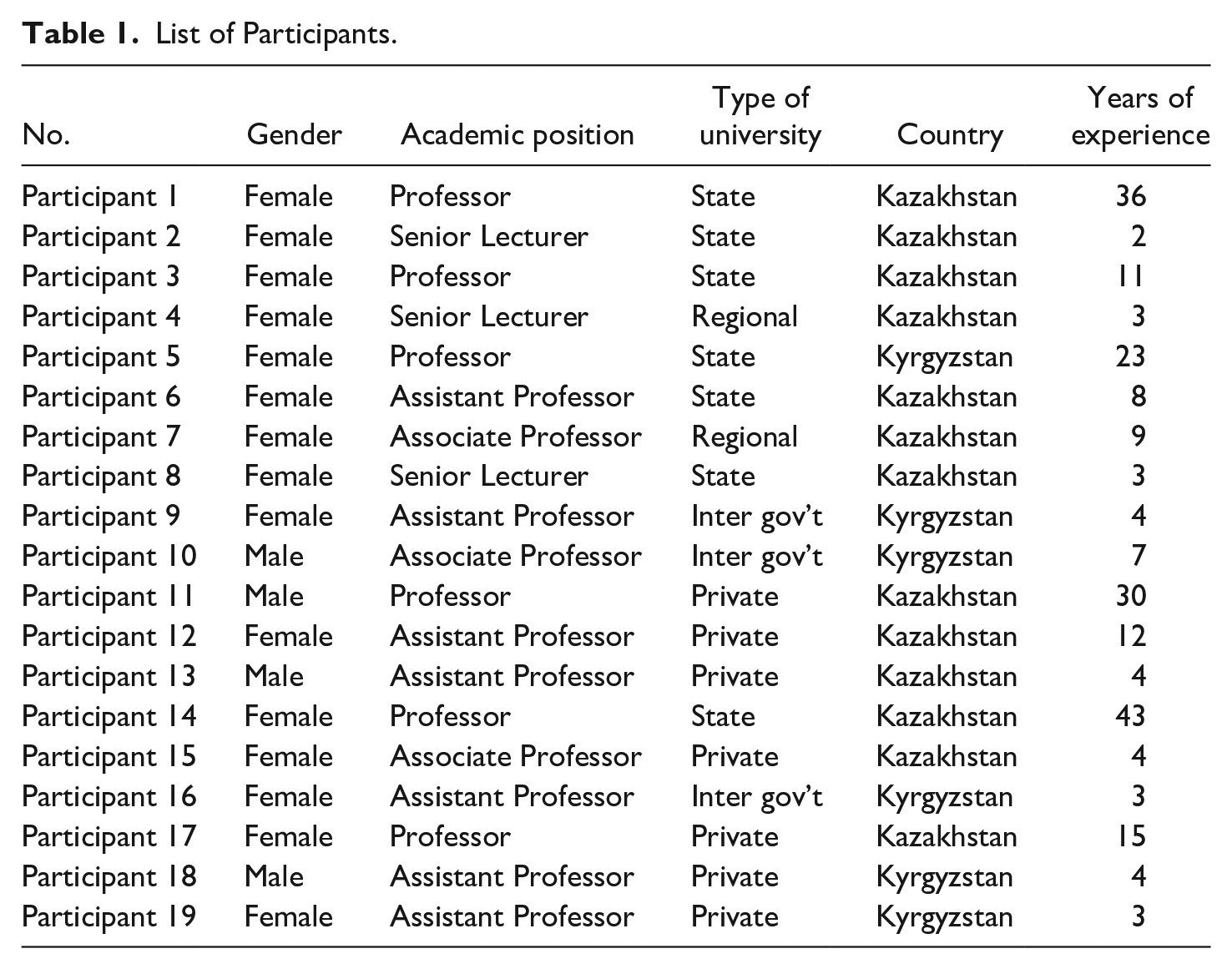
Two participants also held senior-level administrative positions at their universities; one was a faculty member in another discipline but also a senior administrator within a college housing the journalism program. Overall, we interviewed four men and 15 women with teaching experience ranging from 2 to 43 years. Seven taught at private universities, three worked at inter-governmental institutions, and nine worked at state-funded universities. Three were senior lecturers, seven were assistant professors, three were associate professors, and six were full professors.
Results
All participants agreed that their university administrators require publication in high-impact-factor journals. Several said their universities demand “guaranteed” quality publications within a 1-year period; one had only 3 months to produce an article for a Scopus-listed journal. Our research question asked whether faculty have necessary research resources to publish high-quality studies and how they attempt to meet publication quotas.
Overall, three main themes surface from the data:
“Guaranteed Scopus Publications”: A disturbing situation where faculty receive little or no institutional research support but are still expected to produce high-quality-impact-factor articles.
“Commercialization Practice of Authorship”: How professors sell and buy authorship. This has produced many pseudo-scholars and pseudo-PhD holders in the region.
“We morally support our faculty”: One participant’s response when asked what kind of research support professors receive from that scholar’s institution. This section focuses on how faculty members are overburdened.
Theme: “Guaranteed Scopus Publications”
The most critical theme among respondents was how universities and ministries demand publications within a limited period of time. They detailed how unrealistic such expectations are. One professor in Kazakhstan said, The university grants one course (3-credit) reduction for those who would like to do research. However, the requirements include . . . that you will publish one research article in Scopus/high impact factor journals . . . You will get paid for the entire year, but . . . if you do not publish within one year, then you will have to return the money . . . One year is not enough for designing a research study, doing the research study, and writing up the research study and then publishing within this period . . . [E]ven the experienced editor of a prestigious journal in the United States said that he cannot guarantee that our co-authored article will be published.
Another Kazakhstan professor discussed similar pressure: We were forced to publish in Scopus . . . [ management] pressured us to publish in a foreign journal by paying a fee. We paid. These journal people got our money twice, and we saw no published article or money.
Some universities offer English-language courses for faculty to encourage them to write in English. One participant explained how her university encourages faculty to learn and publish in English: Faculty members . . . study the English language for one year or one and half years at the university for free . . . If faculty members fail the test or do not obtain required scores, then the faculty members must return the money that the university invested [spent] in teaching the English language.
Another professor sees growing pressure to publish because so few Kazakh authors appear in reputable journals. She added, I understand that being a part of the Bologna process,
1
being a part of major international research projects beginning from the Erasmus program and ending with different research projects, Kazakhstan probably wants to show the world that we are eligible [for those international projects] and can produce serious research articles. I think it is such a desire/ambition, and it coincides with Kazakhstan’s desire to have a positive image.
Theme: “Commercialization Practice of Authorship”
The second theme deals with how authorship is sold and bought. This includes cases where faculty give authorship as a gift and token of collegial support.
Many worry about losing their jobs if they fall short. Overall, they see international high-quality journals as inaccessible and say “the requirements are tough and difficult to satisfy.” They cite the high cost of translation and editing and say colleagues who do no work sometimes get listed as co-authors in exchange for sharing costs. One faculty member from a Kyrgyzstan state university shared her experience: We now have many pseudo-scholars/pseudo-doctorate holders. These people are those who pay someone else to do the writing part for a fee. There are so many people nowadays . . People find those willing to write for money via their own circles. It does not happen over the Internet because it is dangerous. This happens only within a small circle of trusted colleagues who would never reveal it to outsiders.
Paying for publication is common. Some acknowledged that they did not know one can publish in a quality journal without a fee. In this context, most faculty appear to use third-party organizations or companies that charge for publication help in English. A Kazakhstani respondent said, Our faculty members who wish to publish in Scopus approach [use] third-party organizations which help faculty members to format the research paper, translate it into [the] English language, and all of these require . . . at minimum $1,000 per article. Our faculty members do not have such money . . . I have a Scopus article coming out soon. I paid 25,000 Russian rubles [about U.S. $400] for an article processing fee. This is almost half of my salary.
Another Kazakhstan professor mentioned what appears to be a common practice generally viewed as unethical elsewhere. Her colleagues submit an article to multiple journals simultaneously. Alternatively, they pay for quick publication. So, they say, money decides. One associate professor advises colleagues how to get speedy publication: There is a company [name removed] and this company negotiates with various journals and gets your article published. On average, this service is about $1,000 per article. Some of our colleagues approach me for advising about this issue . . . because I went through this experience . . . [Once] I was told that I have three months to provide a Scopus publication . . . I paid them 50,000 Russian rubles [about U.S. $800] at my own risk.
Another faculty member with 43 years of experience at a Kazakhstan university said, “If you have money, then you publish a book. You can write anything. You pay and you even become the ‘best professor of the year.’ This is what I called ‘devaluation of academic work.’”
Theme: “We Morally Support Our Faculty”
This theme focuses on how faculty members are overloaded with teaching and administrative tasks, leaving inadequate time for research. Every interviewee emphasized the absence of sufficient research time and said they are buried with administrative assignments and other duties. Their typical full-time teaching load is four or five courses per semester, depending on the institution. One institution from our sample assigned six courses per semester to full-time faculty; one faculty member was teaching seven courses at the time of the interview.
One said, “New types of paperwork appear every year. For example, new formats of syllabus writing.” Another expressed concern, saying she is in a classroom 19 hours per week, not counting preparation time and office hours. She teaches seven straight hours on Mondays from 11 a.m. to 5:50 p.m. without a lunch break. “On Mondays I eat chocolate only [for lunch], and today I could not even finish eating it because students already entered the classroom by that time.”
Discussion and Conclusion
This study examined the research environment for J&MC faculty in Kazakhstan and Kyrgyzstan, where they face escalating demands to generate high-quality publications that boost their universities’ chances for listing in global university rankings.
This pressure pushes Central Asian scholars to publish predominantly in predatory or nonindexed journals. This can be partly explained, according to one Western expert on higher education who works extensively in Central Asia, because “many social sciences faculty lack ‘Western-level skills’” and the “capacity to meet Western publication standards.” In other words, conditions are unconducive for research, except at a few select Western-style institutions.
Our findings suggest a need to dramatically improve support and guidance so J&MC faculty can comply with publication mandates and avoid turning to questionable journals that hurt institutions and researchers in the long term.
Meanwhile, proliferating predatory journals pose perilous temptations for scholars and institutions. For universities, the presence of pseudo-journal citations may weaken an institution’s hope to build its reputation, yet it may be difficult to verify the legitimacy of every journal listed on faculty CVs. Also, the Western expert said, a publish-or-perish policy “creates unnecessary problems [for universities] if they are obliged to fire people they don’t want to fire”—such as experienced teachers.
As additional evidence of barriers faced by these scholars, research confirms that the United States dominates journal publishing (Demeter, 2019). An analysis of all 79 communication and media studies journals indexed on Web of Science shows dominance of those published in English-language countries. One reason is barriers imposed by repressive political regimes “that made the development of CMS [communication and media studies] literally impossible for decades,” including “the state socialism of all Eastern European and some Asian, South American, and African countries” (Demeter, 2019, p. 40), among them the Central Asian republics. A related factor was that “lack of appropriate language learning—except Russian—led to isolation from the international scientific community, especially in the case of the ideologically more sensitive social sciences” (Demeter, 2019).
Hanitzsch (2019) observed approvingly that the field of journalism studies is “much more international than, say, 25 years ago”: However, despite an increasing quantity of publication output from the Global South, its qualitative impact on the field is still relatively minor. By far, most of the studies we typically consider groundbreaking or field-defining were authored by scholars from the West. Internationalization in journalism studies has largely taken place within the confines of the Western world . . . (p. 215).
As for the implications: Arguably, this Western dominance, and the uneven coverage of world regions by researchers, has consequences for our understanding of journalism. “International” journalism research, still too often, problematizes journalism from within the Western experience and a Western analytical framework. Western cultures of journalism, and particularly the news media in the United States, have become the prism through which we have constructed normality with respect to how we understand journalism globally (Hanitzsch, 2019).
What Hantizsch (2019) describes as “the paucity of recognition of non-Western scholarship” (p. 215) is not limited to scholarship by Central Asian researchers. For example, Ganter and Ortega (2019) deplored the dearth of Latin American media scholarship in European journals. “The marginalized position of Latin American media and communication scholarship in Europe is part of a postcolonial reality of a discipline in which the research of a whole region is vastly underrepresented and more talked about than talked with,” they wrote (p. 79), advocating more “academic cosmopolitanism” in European media and communication studies (p. 82).
Nor does the situation appear likely to change significantly in the foreseeable future. Ha (2019) observed that communication and psychology are the two disciplines with the fewest non-U.S. contributors, “with very little improvement over time.” Referring to the Demeter study, Ha (2019) wrote, Journals in different regions establish their own ghettos with their own journals, and scholars in the peripheral countries are likely to stay in their own ghettos to get published, unless they collaborate with scholars in the United States to publish in U.S. journals (p. 963).
The results of these interviews and the analysis may give guidance to academic administrators and education ministries in Central Asia and other post-Soviet countries as they consider complex questions about their institutions, including how to best improve their international reputations and intellectual contribution to journalism and mass communication. Another challenge is how to build research skills of faculty who fall short of the Western standards that quality journals demand, including those teaching graduate courses.
Footnotes
Declaration of Conflicting Interests
The author(s) declared no potential conflicts of interest with respect to the research, authorship, and/or publication of this article.
Funding
The author(s) received no financial support for the research, authorship, and/or publication of this article.
