




Abstract
This study seeks to bridge the gap between education and practice by conducting qualitative research with hiring managers at legacy media companies. Semi-structured, in-depth interviews were conducted with 15 media managers on the East and West coasts of the United States to understand how to prepare students for a dynamic media industry. The study identified themes related to experience, resume writing, successful interning, showing passion, interviewing, self-branding, and advice for educators. It is recommended that educators and media programs provide students with a broad overview of the media landscape, more skills-based classes, and a strong connection to the industry.
Introduction
Assisting students with finding postgraduate employment continues to be a key goal for undergraduate programs in telecommunications, television, and other applied media subject areas. Securing coveted positions at the nation’s largest media firms, subsequently, remains a target for many undergraduate media majors. However, as these jobs are very competitive to obtain and are often located in high-cost-of-living regions with high barriers to entry, not all students have the same level of preparedness to join the entertainment industry in that capacity. The demands for skills in the media industry are dynamic and include a combination of technical, creative, collaborative, and problem-solving skills (Cooper et al., 2020). It is believed that current and future media professionals may need a distinct set of skills in order to succeed within an industry marked by rapid technological advancements in addition to jobs that are becoming increasingly decentralized, requiring employees to work independently. It is, therefore, pertinent for educators to best prepare students to face these opportunities and challenges that await them in their careers.
In a previous study, Aupperle and Grzeslo (2020) performed a content analysis on a sampling of nonproduction entry-level job postings from several of the largest U.S. legacy media companies geared toward newly graduated students. These included location-specific needs, technical or “hard skills,” like a proficiency in using Microsoft Office, and the “soft skills” listed as necessary or desired in job postings seeking entry-level talent. However, these results lead to several additional questions, including: What are the processes at play when hiring for entry-level jobs? What are the most important hard and soft skills being sought by media managers? What advice can managers provide to professors preparing the next generation of talent to work for media companies in positions such as audience research, marketing, sales, and other nonproduction positions?
As a result, this study builds upon the prior content analysis by performing qualitative interviews with mid-level and upper-level media managers at a variety of different-sized media firms, who are most likely to be the direct hiring managers for entry-level jobs. This study builds on the Aupperle and Grzeslo (2020) study by asking what hiring managers are really looking for in their subordinates, and by attempting to bridge the gap between the online job posting and what the company actually desires from a successful employee. Through 15 interviews with media professionals, this article explores the skills and qualities managers most desire in candidates and any advice they would provide to educators as undergraduate programs grow and change along with the media industry.
Literature Review
The fields of journalism and public relations are perhaps easily chosen for skills assessment work since university programs in those subjects have historically often existed with the express purpose of developing practitioners in these fields. If a student wants to write news articles or make television news, they can study journalism and reasonably expect to be qualified for entry-level work in that field after graduating. If a student wants to become a social media manager or other public relations professional, they can select an academic course of study in strategic communications or public relations. Therefore, it is not surprising that most of the research conducted on skills development and the preparation of college students for media-related employment has centered on these subject areas.
Previous research in journalism and public relations has relied on content analyses, surveys, and interviews with a heavy focus on the development of hard skills. Some of the prior research is centered on the needs of the industry (Brunner et al., 2018; Eschenfelder, 2019; Wenger et al., 2014, 2018) while, in other cases, it concentrates on assisting professors with pedagogy (Auger & Cho, 2016; Ferrucci, 2018). These studies unveiled the importance of the hard skills of writing and newsgathering in addition to the soft skills of time management and completing tasks by deadline. In addition, some discrepancies were found between what programs offered and the skills desired for industry professionals.
As compared with journalism and public relations, television management outside of production fields is more nebulous in its preparatory ability. Television and telecommunication departments across the country take a wide array of different approaches to the nonproduction curricula offered and the skills emphasized in their programs. Many programs will only offer a course or two in nonproduction areas, such as audience research, programming, or management. Nonetheless, there are some select media programs that have a specific curricular track in media management, albeit these programs are typically limited to major media markets, particularly New York and Los Angeles.
Skills Sought by Today’s Media Managers
The skill sets necessary for those pursuing careers in the management of media firms include both hard and soft skills. Hard skills are those that pertain to knowledge of the field and technical expertise (Robles, 2012) while soft skills encompass personal qualities, habits, outlooks, and interpersonal skills, including language skills (Schulz, 2008). A 2009 report by Michelle Ferrier examined the skills needed for digital media work. Although the researchers identified that certification of skills would help “articulate and solidify the body of knowledge required of practitioners” it would also be an expensive and labor-intensive process (p. 4). In addition to the concerns raised by Ferrier (2009), it is believed that the skills and competencies needed by practitioners are also moving targets, with new social media platforms emerging and new versions of tools being released regularly. Moreover, Ferrier (2013) examined curricula and professors’ needs while teaching in a changing media environment. Through interviews and surveys with faculty members, she found that the main objective of courses in media entrepreneurship is that they introduce students to the business side of media industry startups and train them on how to identify opportunities for innovation. Although the development of hard skills is being emphasized within television management programs, soft skills have also been found to be increasingly important within communications and media-related fields. Through survey research, Cooper and Tang (2010) found that industry practitioners and students agreed that adaptability, reliability, being articulate, persistence, and resourcefulness were the top traits for career success. However, there were significant differences between the two groups with respect to the degree of importance of these traits. Practitioners felt that being adaptable, reliable, and resourceful were significantly more important for career success than did students. In addition, the study investigated career success whether someone was early or late in their career and it assessed all types of media positions (Cooper & Tang, 2010). Due to the importance of soft skills to an individual’s career success, academic programs need to improve upon their teaching of soft skills (Zehr, 1998) and balance this with their focus on hard skills.
Research specifically addressing the preparation of students for entry-level positions in television or media management is virtually nonexistent. In fact, only one known study has examined this career stage and track. Aupperle and Grzeslo (2020) performed a content analysis of job postings from the top legacy media firms in the United States. Legacy media firms, in this instance, were defined as owning at least one broadcast and/or cable television network distributed in a standard linear format. This study identified several key elements of entry-level jobs at these firms. First, almost one third of all available entry-level jobs reviewed were in departments that traditional media or telecommunications programs may not prepare students specifically for, such as research (ratings and analytics) and distribution. Second, 26% of all available jobs were located in New York City, which means that students in other locales may already be at a disadvantage when applying. Finally, the skills most requested in these postings were soft skills, particularly communication and organization, as opposed to hard skills, such as a familiarity with and ability to use specific software. In fact, these two soft skills were mentioned in over 75% of the postings analyzed. The ability to work both independently and in teams was another soft skill that was frequently included in job announcements. As noted by the researchers, only a few of the skills identified are likely to be currently taught in formal academic programs (Aupperle & Grzeslo, 2020). Remarkably, this study also found that many of the job postings provided vague descriptions of desired skills.
This review of literature has revealed a lack of research specifically oriented to the hard and soft skills necessary for success in nonproduction media management positions. To fill this gap and to further build off the content analysis of Aupperle and Grzeslo (2020), a qualitative study examining the perceptions of media managers was needed. Conducting interviews with industry practitioners should be mutually beneficial to both hiring managers and professors as the insights gleaned can help to ensure the quality of the pipeline of talent coming from undergraduate communications programs. This information will support the aims of the Accrediting Council on Education in Journalism and Mass Communications’ (ACEJMC) Digital Certification program. The curriculum of this program requires that coursework include such topics as programming, technology, audience engagement, and research and that faculty are trained in the use of emerging technologies and innovative methods and tools being utilized within the media industry (Accrediting Council on Education in Journalism and Mass Communications [ACEJMC], 2018). Furthermore, this research will assist higher education administrators to better understand the skills desired by the industry and to improve their assessment as to the extent to which their programs align with the ACEJMC’s professional values and competencies (ACEJMC, n.d.). Subsequently, this study attempted to respond to the following questions:
Method
To address the research questions posed above, semi-structured interviews were conducted. Using purposive sampling, media managers were invited to participate in the study. The researchers first identified legacy media companies from which to draw the sample, using the definition for legacy media firms utilized in the previous content analysis by Aupperle and Grzeslo (2020). Subsequently, hiring managers within each company were contacted and interviews with them were scheduled. From there, a snowball method was employed as participants were asked to recommend another individual for participation in the study at the conclusion of each interview.
As shown in Table 1, the sample consisted of 15 media employees currently working at mid-sized and large media companies. For this study, mid-sized companies were those with 101 to 500 employees and large companies were those with 501 or more employees. Participants hailed from corporations or divisions within companies classified as media conglomerates and were based on either the East or West Coast of the United States.
Participant Descriptions.
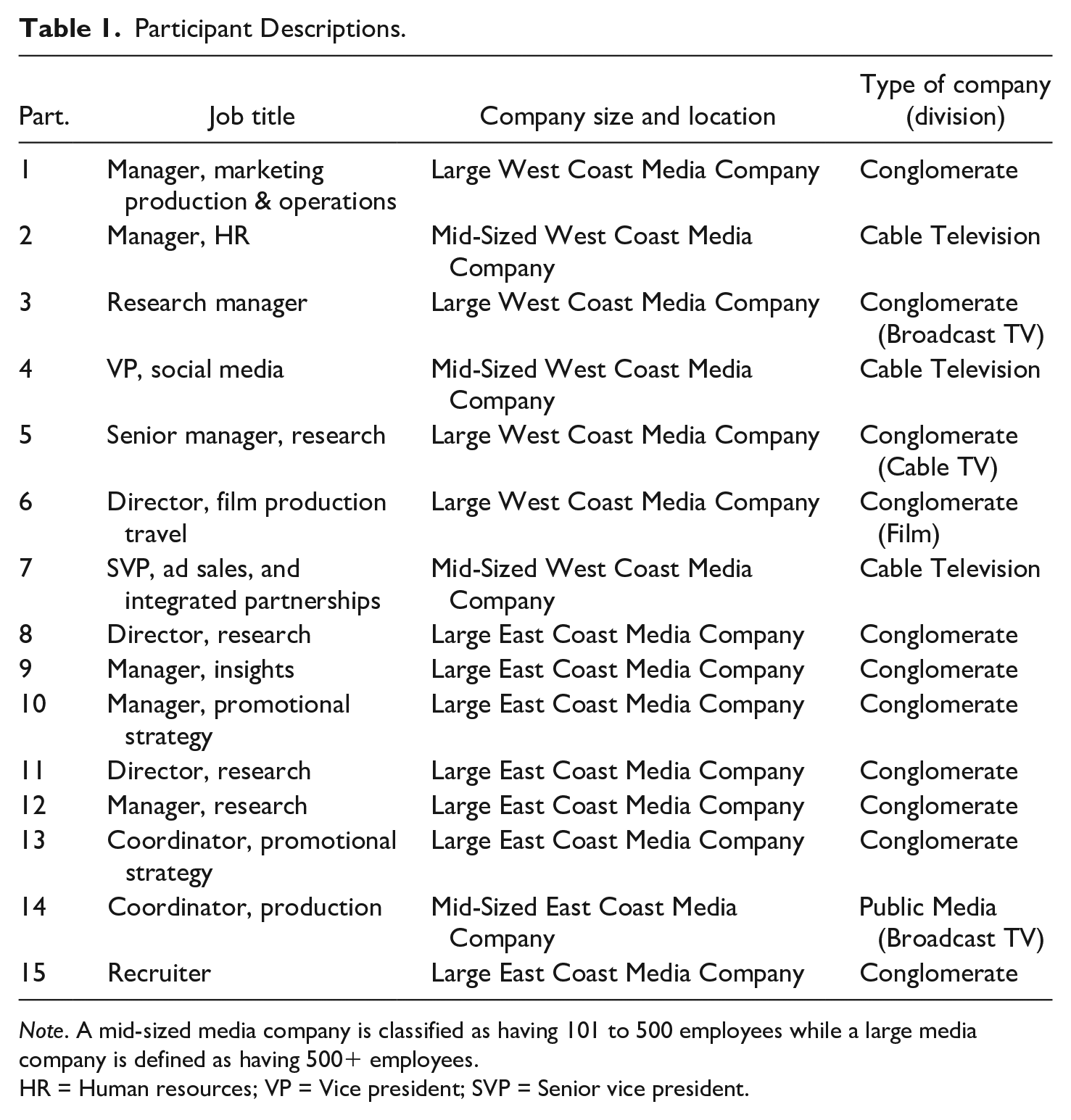
Note. A mid-sized media company is classified as having 101 to 500 employees while a large media company is defined as having 500+ employees.
HR = Human resources; VP = Vice president; SVP = Senior vice president.
The interview protocol consisted of questions regarding:
Top skills desired in job candidates
Experiences screening and hiring candidates
Advice for educators
In addition to the broad areas of exploration stated above, follow-up questions were posed as the conversations organically evolved. The research protocol was adjusted, as necessary, but generally addressed the three above topics and the study’s two RQs. The interviews were mostly around 30 min in length. Three of them were conducted in person while the remaining 12 were completed over the phone.
After the interviews were conducted, they were first transcribed using the online platform Trint. Then, transcripts were edited for accuracy and any identifying information was redacted. Next, the interviews were analyzed using thematic analysis and the constant comparative method (Strauss & Corbin, 1990). To this end, themes emerged within the data and were confirmed by comparing individual transcripts to one another. After identifying key themes, direct quotes were extracted from the transcripts that helped to capture the essence of each theme.
Findings and Discussion
The following subsections explore each of the themes that emerged during the data analysis. The major themes to be detailed are as follows: prior work experience, writing a strong resume, successful interning, showing passion, effective interviewing, professional self-branding, and advice for educators.
Prior Work Experience
An analysis of the interview transcripts revealed the importance for entry-level candidates to possess some prior work experience. Three of the managers stated that they prefer for candidates to have 1 year of work experience at a media-related company, ideally within television. Participant 4 said, “If there is no TV experience, then I look for film or subscription video-on-demand-type experience.” This finding is in line with the research of Aupperle and Grzeslo (2020), who found that 36.7% of entry-level media job postings at legacy firms require a year of experience. This implies that students should be actively pursuing internships during their studies.
Even if candidates do not have direct experience working for a media company, hiring managers are seeking applicants that have worked in environments requiring them to be detail-oriented and to have experience using certain types of software, such as Excel and PowerPoint. Participant 8, a director of research, acknowledged that PowerPoint was needed for “the ability to visualize data” and for turning “numbers into graphs and tables.” Other media managers asserted that working knowledge of Photoshop, Google Drive, Word, and Tableau are also valued hard skills within their respective companies. Thus, professors need to weave the use of these various software platforms into their syllabi and encourage students to receive additional training and certifications in their use.
However, other work experience outside of the media industry can be of value as it can speak to a candidate’s readiness for employment in a professional setting. Participant 6 affirmed, “I will look for someone who has worked in a customer service job as a teenager . . . because that’s going to show me that they understand responsibilities, and they’ve been taught customer service.” Therefore, while experience is proving to be necessary to land an entry-level media job, hiring managers see value in various experience types as they lend way to important soft and hard skills.
Writing a Strong Resume
The media managers claimed that organization, proper grammar, the absence of typos, and correct spelling are critical to the writing of a strong resume as attention to detail is expected. Strong writing skills were also found to be a key hard skill in the prior research by Eschenfelder (2019) and Brunner et al. (2018) for practitioners in television news and public relations, respectively. Furthermore, participants maintained that a clean layout is preferred as is conciseness in writing style. According to Participant 7, because the “resume is a visual experience,” it should provide for a balance of action words and whitespace and, generally, be eye-catching. Participants 1 and 14 mentioned the importance of being creative by having one’s name in red on a black-and-white resume and doing something unique with bullet points. In addition, the managers interviewed acknowledged the importance of tailoring one’s resume to the specific position to which one is applying so that it does not appear that a candidate is applying “willy nilly.” Participant 2, a human resources manager, contended that if a hiring manager states specifically what he or she is looking for, then he will look for particular words or experiences on a resume.
The media managers interviewed for this study articulated the importance of candidates communicating through their resumes just how well-rounded they are. Participant 6 shared that she looks for people who are “versatile, who have a lot of different interests, and a lot of different skill sets.” Participant 12 conveyed that having an international experience indicates a person with a strong cultural perspective, which can make them stand out from others. However, this finding reveals a preference for those who are privileged to have had such an experience as many candidates have not had this opportunity for cultural enlightenment. Once a resume and application have been submitted, candidates should be patient and avoid tracking down and contacting a hiring manager until a reasonable amount of time has passed. Impatience does not set a “good tone” with the hiring manager. Participant 2 argued, “It shows interest, but at the same time, you have to respect that person’s time.”
Successful Interning
Having an internship shows that a candidate knows how to work and be professional. Participant 4 claimed that her company will look for candidates who have had an internship in the television or film industry because they are so “lean and mean” that they “don’t have a lot of time to train.” Due to the fast-paced nature of the industry, it is important for entry-level employees to be self-sufficient. Participant 3 declared that her company seeks someone who is “a self-starter, someone who’s very flexible, and knows how to prioritize things.” As professed by Participant 4, “Go in there and wear as many hats as you can and learn as much as you can because that will set you up for your next position.” Participant 4 also discussed the expectation for candidates to have developed a certain level of corporate etiquette. It is anticipated for entry-level employees to be able to draft e-mails using complete sentences and other things that are essentially best practices for e-mail etiquette. It is also important for candidates to realize that inappropriate behavior will immediately remove them from further consideration for a full-time position.
The other major findings relating to internship success are the willingness to work hard, persevere, and be humble. Two of the managers reported that candidates must be ready to do anything and to “pick up the slack” whenever they identify a need on the job. Interns are expected to treat the internship as their first job. As stated by Participant 4, “if you’re given the janitor job, be the best janitor you can be.” If an intern or employee wants to move up in a company, then mastering whatever position or job responsibilities he or she is tasked with is critical. In addition, it is important for interns to make connections with employees and to stay in contact with their connections following their internships.
Showing Passion
Most of the managers interviewed agreed that exuding passion for the industry, company, and the specific job role is extremely important for interns and employees. Passion will help drive employees to “go the extra mile and do more than what is required of them.” Participant 5 claimed that being passionate will make it easier for you to “power through” some of the bad days one will inevitably have. Participant 8 opined that a passion for media is even more important than the skill set because skills can be taught while “passion is not something that you can teach.” Participant 10 admitted that seeing a certain level of dedication and passion is especially important and will help a candidate to be selected for a position when they are competing against someone else as equally qualified. Although passion has not been specifically examined in prior research, it appears to be a crucial trait for interns and professionals alike given its importance in helping them to secure employment.
Effective Interviewing
About half of the participants mentioned the importance of doing research on a company, the position itself, and the background of the interviewer prior to an interview. Conducting research, Participant 4 argued, is what really “puts you over the edge to get that job.” Even if a direct question is not asked of the candidate in an interview, it is still “very smart” for interviewees to drop a hint that they have done their research. In addition, candidates also need to come to the interview prepared with meaningful questions. Participant 5 stated that good questions show that a candidate has done research and that he or she has “gone above and beyond just knowing what the job position is.”
Candidates should also prepare for certain commonly asked questions. As advised by Participant 10, candidates should anticipate and formulate answers in advance for certain interview questions, such as those dealing with their top skill sets, weaknesses, and areas for self-improvement. Participants 3 and 14 suggested that entry-level applicants also bring in samples from projects completed in college classes. Moreover, it is crucial for internship and entry-level candidates to arrive “dressed to impress” for interviews and to consider the expectation for the particular role to which they are applying. According to Participant 7, “If you’re interviewing in a finance department or an ad sales environment, the expectation of how formal your attire is, might be very different than if you’re interviewing for a graphic design position or a position on the social side.” Dressing professionally shows that a candidate is putting in the effort to make it with the company.
In terms of the actual interview, candidates are expected to show up on time or reasonably early with a positive attitude, excitement, and passion. Participant 10 acknowledged that some candidates seem to believe that their resume is impressive enough that they “do not need to exert much effort into having passion for the company.” Participant 2 felt that the most important question that a candidate must be prepared to answer is “Why do you want to work here?” as it demonstrates that they have researched the company and are passionate about it. This is not new or a trick question, so findings like this suggest that this key information is not being passed to students.
In addition, candidates need to be able to “communicate effectively.” Participant 9 maintained that a candidate that really stands out is one who can “speak confidently and without a lot of verbal fillers.” In conjunction with being articulate, it is essential to be able to sell oneself in an interview. Participant 4 recalled not hiring a candidate with a great resume because she was not able to sell herself or speak to her resume. It is important to provide “concrete examples” for items listed on a resume and to mention information about oneself that is outside the norm or includes personal interests. Candidates must also be able to show their ability to adapt to changing circumstances, which is critical given the dynamic nature of the media industry. The importance of adaptability and being articulate were two of the top traits for industry success identified in the Cooper and Tang (2010) study. Communication skills were one of the top two skills listed in the entry-level job listings analyzed in Aupperle and Grzeslo’s (2020) research as well.
Furthermore, being honest is imperative both on the job (Schulz, 2008) and in an interview. Participant 2 wants honesty and to understand how a candidate has handled a problem in the workplace. He said, “I don’t want the Miss America answer that everything’s wonderful and you’ve never had any problems on a job.” In addition, a candidate should not show arrogance or entitlement when interviewing. According to Participant 6, candidates need to realize that there is a “fine line” between touting yourself and being arrogant. Participant 9 acknowledged that many entry-level candidates out of undergraduate or graduate programs are “surprised by the amount of grunt work that needs to be done.” Participant 7 added that they need to understand that although they have received a great education, there will be things, such as “language, contracts, and relationships,” which will be learned and developed on the job.
Following the interview, candidates should always send a “thank you” note. Not only does the hiring manager appreciate the acknowledgment of his or her time, but it gives the job seeker one last opportunity to sell themselves and their skill sets. Participant 11 claimed that not sending a “thank you” note “could be a near deal breaker.” As opined by Participant 8, candidates need to send a message that references specific things talked about during the interview. As can be gleaned from these findings, there are many different elements that candidates must consider to be prepared for and to deliver the best possible interview performance.
Professional Self-Branding
Most participants stated that self-branding is especially critical in the application process and on the job. Being able to effectively present and carry oneself helps entry-level employees better stand out in a room. In a work setting, there is a certain demeanor or “executive presence” that employees must have. This was a term explicitly used by some of the participants, but also embodies the responses of many of the other managers. Participant 10 explained that new employees should have a “level of professionalism and respect,” stating that individuals should know “when and how you should be acting in a corporate setting.” This description appears to encapsulate many of the soft skills identified by Schulz (2008).
Some of the managers felt that authenticity was an important element of self-branding. Recent college graduates and students need to think about their personal brand when they are entering the workforce. This includes such things as how they will present themselves in interviews and what kind of employee they will be. A candidate or employee’s personality is, naturally, one of the most important drivers of one’s personal brand. Participant 2 went so far as to say that “80% of the decision that is made in hiring somebody is personality.” Interpersonal skills may not be explicitly listed on job calls, but they are, nonetheless, important. Coming into an interview or a day on the job with a smile and having a good personality are important to Participant 6. She claimed that when hiring, “A lot of it is just personality.” Furthermore, several of the participants mentioned that it is important to not be afraid to voice your opinions or defend your position when necessary. Although confidence is imperative, an entry-level employee should not be arrogant.
Advice for Educators
Although all of the learnings gained through interviews with media managers are valuable to educations, the participants in this study were directly asked to share any advice that they have for educators of media industry and management courses to best prepare students for jobs in the entertainment industry. Three major themes emerged: the importance of teaching an overview of the media landscape, the need for more skills-based classes, and the value of having a strong connection with industry.
First, it is critical for students to obtain a broad knowledge base of the industry, including a focus on commonly used terminology. Participant 10 asserted, “I think making sure you have a well-rounded understanding of the media landscape is huge. I took a television business class that I found very invaluable.” Along the same lines, Participant 5 remarked that classes where you can learn certain functions of various departments, such as marketing and research, within media firms are of value to students. In addition to these fundamentals, Participant 3 proclaimed the importance of examining the future of the industry and how it is shifting with the adoption of new technologies, such as digital and streaming services. This finding is aligned with Ferrier’s (2013) study of courses in media entrepreneurship and how their main objective is to introduce students to the business side of media industry startups. However, the application is wider in this instance as it pertains to the full gamut of media industry courses. To supplement course concepts, it was advised for professors to encourage students to read the trade press every day. Participant 5 declared, “That’s what I had engrained in me since school.” Cynopsis, an industry e-newsletter, was cited by Participant 9 as a resource “where most media professionals get their information.”
Second, the media managers suggested including more skill-based classes or better incorporating specific software and tools into existing course curricula. Excel was mentioned by a number of participants as especially important and, to a lesser extent, PowerPoint, Photoshop, and Tableau. Nonetheless, not all suggestions dealt with training on the use of software. Participant 4, a vice president of social media, claimed that writing is the biggest skill for candidates to possess in her department as they should be skilled enough to match the tone and voice of the brand while also being entertaining. In addition, training in writing a good business email is needed. Participant 11 articulated that a good business email is one that is “very tight and informative” and does not take “too long to get to the point.” Finally, hands-on training was also cited. Participant 3 felt that the hands-on training she acquired while a college student really helped in her preparation for the industry.
Third, it is paramount for professors to have a strong connection to the media industry segments most relevant to the courses they teach. It is valuable to invite industry professionals to classes so that students can learn about the day-to-day responsibilities for different jobs. Participant 5 opined, “It’s one thing to read about it in the book. It’s another thing to hear someone talk about it.” He even suggested that that professors should arrange for students to shadow industry professionals for a day. Being able to see certain concepts in action and being able to talk to people allows for an educational experience at “a different level.” In addition, networking with industry professionals is crucial for both professors and students. Participant 8 proclaimed that “the best way to get your foot in the door anywhere in this industry.” It is good practice for professors to encourage their students to attend various networking events and to apply for summer internships.
Conclusion
In closing, as evidenced through the seven major themes identified in this study, an opportunity exists for universities to improve the readiness of students for employment in entry-level nonproduction media jobs. Given the lack of previous research centered on media management positions as well as those exclusively at the entry level, this study bridges the gap between the classroom and industry practice. A unique contribution is the emphasis on the skills and qualities most desired by media managers, particularly the all-important soft skills, as well the guidance imparted to professors of courses in television and media management. In addition, these findings are critical to professors and higher education administrators as they aim to assess the capacity of their programs to maximize students’ competencies in the areas of thinking critically and creatively, researching and evaluating information, writing effectively and clearly, and applying current tools and technologies being used in the industry (ACEJMC, n.d., 2018). Despite uncovering these key insights, this study does have several limitations and promising areas for future research. First, this research focused on the perceptions of managers based on the East and West coasts of the United States. Future research should consider interviewing a wider array of professionals hailing from areas other than these two geographic regions. Second, this research exclusively explored the views of media managers. Future studies should compare the perspectives of students or recent graduates with the views of hiring managers. Third, the increase of remote internships in the wake of the coronavirus disease 2019 lockdowns has granted students from universities located far from the East and West coasts the opportunity to intern for legacy media firms based in large markets such as New York and Los Angeles. Thus, future research examining the perceived opportunities and challenges for both interns and media managers that this new work-from-home reality provides would be of value. Fourth, this current study did not specifically examine how closely these insights from industry practitioners align with ACEJMC’s curriculum and instruction standards in addition to those outlined in the organization’s Digital Certification program (ACEJMC, n.d., 2018). Future research should explore the extent to which ACEJMC’s curricular standards and Digital Certification program requirements line up with the skills deemed by media practitioners to be most critical to future success. In conjunction with this objective, the skills and the applications of various industry tools taught in courses within existing and potential media entrepreneurship programs should be examined and compared with the needs perceived as most critical by leaders within this rapidly evolving, dynamic industry.
Footnotes
Declaration of Conflicting Interests
The author(s) declared no potential conflicts of interest with respect to the research, authorship, and/or publication of this article.
Funding
The author(s) received no financial support for the research, authorship, and/or publication of this article.
