




Abstract
This study examines how solutions journalism education translates to professional practice, through in-depth interviews with current media professionals who encountered solutions journalism when they were in college. Findings suggest that solutions journalism education resonates powerfully with students, and incorporating the practice in J-school curriculum may have the potential to reengage disenchanted students. Whereas there remain significant barriers to practicing the approach in the workplace, participants revealed that their encounters at university with solutions journalism positively affected their reporting style, interview skills, and perspective of journalism’s role in society.
Solutions journalism is reporting that covers how people are responding to social problems rather than focusing solely on the problems themselves. Amid disruptions to the news industry—shrinking revenues, declining public trust, increasing polarization—the practice has become increasingly popular (Lough & McIntyre, 2023) as practitioners and researchers continue to report its positive impact (Thier et al., 2021). The collegiate instruction of solutions journalism has also become increasingly popular, with dedicated courses, units, and workshops in universities across the United States (Thier, 2016; Wise, 2017). Research on solutions journalism focuses primarily on the professional side, however, through studying the journalists, the news itself, or the audience effects. The research on practitioners gives us valuable insight into how they conceptualize and operationalize solutions journalism (McIntyre, 2019), and the research on education gives us valuable insight into how solutions journalism is taught to journalism students (Thier, 2016). But early practitioners mostly encountered solutions journalism after they had already learned about journalism, so they incorporated it into their existing skills and beliefs.
As more college journalism majors encounter solutions journalism as part of their core journalism education, it is necessary to connect their learning to their profession. This study addresses that connection through interviews with professionals who encountered solutions journalism as part of their collegiate education. Our research questions focus on two areas: what they remember about their encounters with solutions journalism in university and what their experience is like now. From these interviews, we are able to see what students took away from their solutions journalism courses and how that developed as they transitioned into the professional world.
Literature Review
The (Dis)Connection Between Journalism Education and Industry
In 1989, Raudsepp concluded that “after 80 years of experience with university-level programs, journalism educators still find themselves caught between the often-opposing pulls of industry and the academy” (p. 1). Decades later, the same disconnect exists. Research has shown that journalism students and practitioners in multiple countries hold different beliefs about the necessary skills and qualifications needed in the industry and are dissatisfied with the journalism curriculum in universities, saying it does not line up with industry needs (Jiang & Rafeeq, 2019).
Scholars and practitioners have suggested ways to better connect journalism education and practice. Incorporating guest lectures from industry professionals is an effective active learning strategy where “the lived experiences of others can enhance the lifelong education of journalists, informing their self-understanding and encouraging an ethical approach to their craft” (Fowler-Watt, 2014, para. 1). From their focus groups of journalists, Jiang and Rafeeq (2019) found support for bringing practicing journalists into the classroom as guests and adjuncts. Along similar lines, journalists in their study said universities should offer more practical classes and assignments and facilitate more opportunities for students to get real-world exposure, for example, through internships or participating in on-campus student media. They also suggested converged media production courses, frequent curriculum updates, and good communication with the industry (Jiang & Rafeeq, 2019).
The gaps between journalism in the classroom and in the newsroom have been blamed in part on a lack of communication between the two areas coupled with rapidly changing technological advancements (Jiang & Rafeeq, 2019). In 2010, Mensing argued that journalism education was not adequately adapting to the changing realities of the industry and suggested that journalism schools shift “from an industry-centered model to a community-centered model” in an effort to better match what happens in the academy to the industry (p. 511). This aligns with the rise of solutions journalism, which calls for reporters to focus on how community members are responding to problems in an effort to reengage audiences and improve societal well-being. Schaffer (2014) echoed the sentiment that solutions journalism can help journalism schools reinvigorate their curricula to better match the evolving industry.
Solutions Journalism: Definition, University Practice, and Research
Solutions journalism “investigates and explains, in a critical and clear-eyed way, how people try to solve widely shared problems” (Solutions Journalism Network, 2023, para. 1). It can help reframe the public’s problem-solving efforts as a scalable and engaging narrative that can alter the tone of public discourse (Thier, 2016; Wenzel et al., 2016). The Solutions Journalism Network considers a story to be solution-oriented if it includes four key pillars (Table 1) and cautions against common misconceptions of the practice, such as thinking it is advocacy journalism or cheerleading (Solutions Journalism Network, n.d.).
Four Pillars of Solutions Journalism.
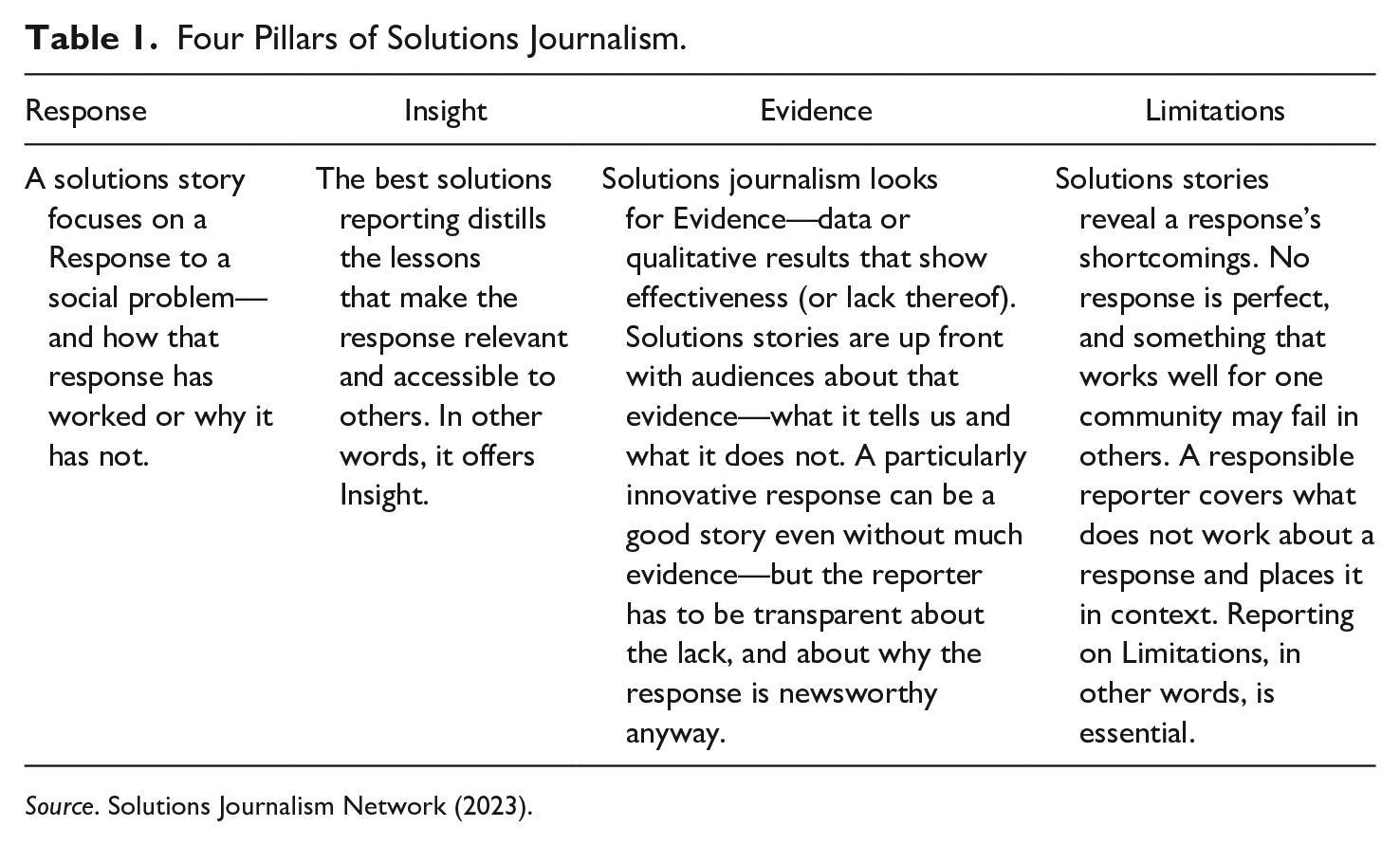
Source. Solutions Journalism Network (2023).
This type of reporting can have a positive impact on both the reporters and the community. Usery (2022) found that “relationships formed through the practice of solutions journalism can aid in building credibility, creating stronger bonds within communities, and positively impacting underrepresented communities through tangible change” (p. 1). In the context of historical distrust in media professionals, Usery (2022) asserted that media practitioners can rebuild relationships in marginalized communities through solutions-oriented reporting.
Currently, dozens of journalism schools are incorporating solutions journalism into their curricula, including the University of Oregon, Pepperdine University, Temple University, Virginia Commonwealth University, and Oakland University. In 2022, four U.S. universities were named as inaugural solutions journalism hubs, recognizing the integration of solutions journalism into core aspects of teaching, research, and service: the University of Georgia, Stony Brook University, Arizona State University, and Northwestern University (Solutions Journalism Network, 2022). University instructors outside North America teach solutions journalism as well, offering courses at Windesheim University in the Netherlands and Bennett University in India. In addition, 85 faculty members from 70 U.S. colleges and universities have attended one of six educator academies held between 2018 and 2021 (the first four were hosted by the Catalyst Journalism Project at the University of Oregon, and the SJN later developed programs for minority-serving institutions). 1
Some collegiate student media organizations have also incorporated solutions journalism. In her doctoral dissertation studying this implementation, Usery (2023) found that the practice resonated with student reporters, and they felt hopeful that this type of reporting could reinvigorate audiences. Educators found it most effective to teach solutions journalism across the curriculum and over a longer period of time rather than in one single course or semester. Usery (2023) concluded that this alternative approach did not fit neatly into the routines of traditional, problem-focused journalism but said such boundary-breaking might be necessary for innovation.
Just one published journal article has examined solutions journalism education. Thier (2016) conducted a focus group with some of the first university instructors to teach solutions journalism to discover the opportunities and challenges that came with teaching this new approach. She found that the subject inspired both instructors and their students, but it was difficult to teach an emerging practice in an established field. Thier (2016) concluded that instructors should agree on the components that define solutions journalism and figure out the best ways to integrate an alternative form of journalism into a general journalism education curriculum to more effectively teach the practice. Furthermore, she said future research should study “how initial opportunities and challenges associated with solutions journalism coursework might shift over time and whether students enrolled in these courses create change and innovation within the profession” (p. 342). This study does just that by asking,
Method
To address our research questions, we completed semi-structured qualitative interviews with 20 graduates who encountered solutions journalism in their college education and are now working in professional media industries.
After IRB approval, many of our interviewees were identified using the student journalism filter on the Solutions Journalism Network’s Story Tracker, a curated database of solutions journalism reporting. This allowed us to find individuals who had published solutions journalism stories while in university and submitted them for a vetting process by staff at the SJN. Other participants were identified by asking university professors who taught solutions journalism to share our recruitment message with their former students. Many of these professors were contacted through the Solutions Journalism Educators Google Group, created by the SJN.
The final group of participants included journalists and communications professionals working across 13 U.S. states, who studied solutions journalism at 13 tertiary institutions. About a quarter of these individuals completed a course entirely dedicated to solutions journalism; the rest completed a different course that incorporated a module on solutions journalism or exposed students to the topic in other ways, such as through guest speakers. Participants skewed female (75%) and White (70%). Their average age was 30.35 years, and 65% were in the first 5 years of their career. They mostly worked for print and online news outlets that varied from small, niche outlets to established national outlets. Their beats varied and included science, business, investigative, criminal justice, and more. Four were freelancers.
We conducted and recorded interviews virtually, using Google Meet and Zoom, from January through March of 2023. Questions addressed participants’ experiences learning about solutions journalism in college and transitioned into how they practice (or do not practice) solutions journalism in their current professional roles. The interviews were audio recorded, and we used the recording and transcribing tool Otter.ai to assist with the interview transcripts. The interviews averaged 40 min. Interviewees were reminded that they would not be identified, nor would their publications, to encourage candid and honest feedback.
To analyze the data, we generated a list of themes and subthemes from the interviews and applied codes representing those themes to the transcripts using Dedoose, a tool that allows users to code qualitative data. We ultimately applied 36 codes or subcodes to the data 634 times. The combination of analysis by both the researchers and computer-assisted software allowed us to organize the data, structure the findings, and easily identify relevant quotes while maintaining the nuance in interpreting the interviewees’ verbal cues.
Findings
Our findings suggest that solutions journalism education resonates and stays with students, both personally and professionally, and may have the potential to reengage disenchanted journalism students. Although solutions journalism education assists in résumé-building and employment applications, there remain significant barriers after entering the workforce, primarily regarding deadlines and time constraints. We found that graduates believe, overwhelmingly, in the potential for solutions journalism to have an impact on the industry and wider culture. Regardless of the extent to which they practice solutions journalism in their careers, the education had an impact on their reporting style, interview skills, and perspective of journalism’s role in society. These findings are discussed in detail.
First Encounters and Impressions
The participants first encountered solutions journalism in a variety of ways during their university studies, whether in a course dedicated to it, as an emphasis in a focused-topics course (such as business journalism or feature writing), as a small unit in a general journalism course, or in an out-of-class setting (e.g., project/program, internship).
The way the journalists talked about their first encounters provides insight toward a deeper adoption of solutions journalism into journalism programs. Because the participants encountered solutions journalism both inside and outside of the classroom, it appears that some journalism programs are successfully on board and supportive of solutions journalism regardless of if they teach it formally. Participant 5 said they heard about it from conversations with early career professors and peers, and felt like it was built into the greater journalism philosophy of their program. Participant 20, whose first encounter came from an internship, said it was a conversation with a professor that sparked their interest in solutions journalism.
The participants were asked to recall their first impressions of solutions journalism when they were introduced to it as a student. These impressions were mostly positive, but this is expected due to the nature of our sample. Thus, we asked for as much detail as possible to better understand how they engaged with the concept and related it to what they knew. Students were struck by solutions journalism’s rigor as well as its natural fit to both their personal philosophies and to journalism in general. In addition, it reinvigorated them at a time when they were hesitant to continue pursuing journalism.
As students, the participants were able to quickly move past the common misconceptions of solutions journalism due to the way they learned about it in a guided collegiate setting. For example, Participant 2 said their immediate reaction was to think of it as shallow reporting, but then things clicked once they started learning about it: “It’s not that I was expecting it to be fluffy, but I wasn’t necessarily expecting the level of granularity and the level of precision.”
When learning about the specific process of solutions journalism, participants remembered a range of emotions about the rigor required to meet the definition. Several specifically or generally mentioned the four pillars outlined by SJN. To some, such as Participants 15, 12, and 8, the grounded nature and structure of the process was a good thing because of how it added credibility and a sense of tangibility to the reporting.
I think I just really enjoyed (solutions journalism) as a fresh perspective on sharing stories . . . but then I also appreciated that you share limitations of the solution as well. So, it’s very realistic. And kind of it felt grounded in actual work. (Participant 8)
Others were intimidated by the rigor that this necessitated. One participant said while they were excited to take a dedicated solutions journalism class, they quickly realized that it was not going to be as easy as they thought: I also remember thinking this is going to be harder than, like, other journalism you’ve done before. Because you have to put in, like, a lot of extra work to make sure you’re representing all four of the pillars . . . that’s why we need it. (Participant 1)
This extended into a personal-level connection for some, mostly seen by how solutions journalism “aligned itself very easily” (Participant 18) with the participant’s individual philosophies and could be a key part of their journalistic identity or felt natural to them (Participants 4, 9, and 12). Participant 14 said it “felt like it was solving a problem I didn’t quite know I had.”
The first encounter with, and impression of, solutions journalism came at a key moment for some in their personal journey as a journalism student. Several participants admitted they were at a point in their education where they were feeling burnt out or questioning their path, but that learning about solutions journalism helped shift their perspective. Participant 2 said they had become skeptical of journalism but saw a solutions journalism class and became intrigued. “I found it because I needed a different lens on journalism, but I stuck with it because it was such a rigorous form of journalism that I was interested in” (Participant 2). Another said they had spent several years covering crime and hard news for their student newspaper, which had taken its toll on them. They always felt there could be a better way of doing journalism but said they could not articulate or realize this until they learned about solutions journalism.
Learning about solutions journalism during their education also influenced how participants thought about journalism in general. To some, it resonated immediately with how they defined journalism, like Participant 20 who said they “felt like it was something that was a long-established tradition within the news, just that idea that ‘oh, this makes sense,’” or how they think journalism should be, like Participant 17 who said their first impression was “isn’t this what journalism is supposed to be anyways?” Others said their immediate response to hearing about solutions journalism was that it was a natural, revolutionary, or cool approach to journalism.
What Resonated From Their Education
Course Content
The pillars and the framework for solutions journalism resonated with students beyond their first impressions. Ten participants brought up the pillars when asked what stuck with them from their coursework. In the classes, they remember critiquing stories according to the four pillars. Participant 15 learned about the importance of rigor and evidence in solutions journalism through examples of weak reporting provided by the instructor. They recalled a specific story where journalists failed to investigate the solution enough yet wrote about it anyway. They said the author got it wrong about how it was a solution, which was dangerous because “you’re not doing solutions journalism properly, and you’re just presenting solutions as altruistic” (Participant 15). Later in the interview, they put emphasis on how they regularly channel this lesson to make sure they think critically about the solutions they are covering.
Participants also recalled skills they learned from the content, mainly in interviewing techniques, such as looping (Participants 16 and 17), and in story writing, such as finding data for limitations and evidence (Participants 10, 11, and 18).
Projects
The participants also remembered putting these skills into practice for the experiential learning components of their classes. Although this is not a unique exercise for a solutions journalism class, six of the participants said how much they appreciated and needed the time with their instructor to learn how to report from a solutions orientation. Participant 8 said they appreciated how they got to work on their story with their professor because the “hands-on element of not just introducing it as an idea, but actually putting it into practice with a story that we were pursuing had a big impact on me.” The participants mentioned how the class format helped them spend the time they needed on longer form stories so they could dive deep, and they reiterated the importance of doing it in a setting where their instructor could connect them with resources and work alongside them.
People
Perhaps what resonated most with the participants was the influence of their instructor and guest speakers. Nearly every participant mentioned one or the other. The instructors were described as enthusiastic, knowledgeable, passionate, and supportive, and participants credited them with helping the students understand and carry out solutions journalism. Participant 16 remembered their professor as one who has “a passion for solutions journalism . . . what stuck with me the most was (that) here’s somebody who really knows what they’re talking about, but also really loves what they’re talking about.” That sentiment was reflected by several participants and directed at multiple professors.
As an extension of the instructor’s passion, nine participants also spoke highly of the guest speakers that faculty invited. These speakers included working journalists, members of the public, stakeholders involved in the story, and sometimes SJN staff. Participants 6 and 19 specifically pointed out how helpful they thought it was to hear from working journalists. They appreciated how the journalists shared their work and went behind-the-scenes in talking about how they reported. Participant 18 spoke at length about how valuable it was that the instructor brought in members of the public and how it helped them understand the topic in a deeper way, “because when you only hear from journalists about all that stuff, it’s an echo chamber.”
In the Profession
While participants agreed that their perceptions of solutions journalism did not shift significantly when they entered the workforce, many shared that their understanding of the nuances of the approach, and the practicality of implementing it, did change. Several mentioned growing a deeper understanding of the style, claiming their perceptions had become more complex, discussing how they have both expanded their understanding and refined how they think about solutions journalism. Participant 7 reported feeling more comfortable practicing solutions reporting, claiming that it had made them a better reporter.
Most of the participants (70%) reported that they were incorporating some form of solutions journalism into their current work, although the degree of incorporation varied widely. Participant 10 said they use the data/evidence skills they learned to analyze data in their other stories, while Participant 17 said their solutions journalism education motivated them to pursue an entire solutions story on a topic that they might not previously have considered. Only three participants confidently asserted that they were producing solutions stories as defined by the Solutions Journalism Network, whereas the remainder said they were incorporating solutions journalism to some extent but not necessarily meeting all four pillars.
Interestingly, solutions journalism graduates reported increased intentionality when practicing solutions journalism. Several discussed how when they purposefully produced a solutions journalism story, they did so with more consideration as to why they were producing it. Others described the approach as bringing a reflective skill to their work, with Participant 18 calling it an opportunity to create a feedback loop to think about the work and how it is presented. Even when Participant 2 was not actively practicing solutions journalism, they shared that they were still making use of the approach: “Do I use the principles in my everyday life? Probably not, but I use the mindset a lot.”
Barriers to Implementation
Participants also expressed frustration implementing the practice and disappointment when they met barriers. Participant 8 shared that their impression of “the reality of getting stories out there that are solutions journalism” changed upon beginning work, and Participant 10 said that despite their belief the approach was important they had hoped it would “catch on in a bigger way.”
More than half of the interviewees expressed time constraints and tight deadlines as the main barrier to implementing solutions journalism, lamenting limited time to interview the number of sources necessary to develop a thorough solutions journalism story and word count limitations that hindered the production. Participant 18 shared that “good solutions journalism comes with community engagement,” which is “even more work,” and Participant 20 said 1 or 2 days is not enough time for production because “you really have to talk to people, you have to listen a lot.”
The second most prevalent barrier to incorporating solutions journalism was a lack of editorial support, which again more than half (55%) of the participants mentioned. This barrier was blamed on workplace politics, high turnover, editorial ignorance or ambivalence to the practice, rigid legacy reporting styles, and skepticism of the objectivity of solutions journalism pitches. An interesting insight from Participant 18 was that questioning current practices may be causing uncomfortable experiences in an industry in which journalists identify personally with their careers and reporting style. These challenges were reduced if editors had prior experience with solutions journalism, were open to learning, or if a newsroom adopted support at a systematic level. Multiple participants asserted that smaller, niche newsrooms were better able to align their mission with solutions journalism due to their size.
Issues of implicit bias and racism were also raised as a barrier to implementation. Participant 5 said resistance to change may be because journalism has “looked the same way for so long,” especially concerning newsroom demographics. They linked the resistance to solutions journalism with its connection to issues that deeply affect communities of color, lamenting how “anything with race and ethnicity is always hard to pitch.” They added that solutions journalism deviates from a historical journalistic approach toward communities of color, which makes it frustrating “being a person of color trying to pitch these stories that are focused on your own community” because editors “can’t look past your own ethnicity, your own skin color, and think that you can’t report it objectively.” Other barriers included trouble sourcing both hyperlocal and national data for evidence, finding a good fit within a reporting beat, developing a solutions journalism angle, and limited resources to hold power accountable.
Impact on Employment Prospects and Careers
A high portion of participants indicated that their solutions journalism education helped secure employment, and 80% of participants said that the practice had an impact on their careers. Half of the participants shared that solutions journalism was discussed in the interview process for their position, was part of their hiring process or employment advertisement, and/or strengthened their résumé. Participant 9 attributed solutions journalism to being accepted into graduate school, with funding support, at a prominent university, while another described solutions journalism skills as an advantage over other graduates.
Solutions journalism education also shaped graduates’ career trajectory, the publications they targeted in job searches, and/or their level of satisfaction with their work. Most participants (90%) believe that solutions journalism is affecting the media industry. Many felt passionate about the role of the style, with Participant 18 describing solutions journalism as “essential for the entire industry” and a way to combat negativity bias in news reporting. Several mentioned the style’s ability to combat professional burnout and reenergize journalists, particularly in the wake of COVID-19 reporting. Upholding the journalistic value of informing the public was also discussed by several participants, with Participant 17 sharing that solutions journalism “keeps me motivated and focused to give people something useful that they need” and that the style “offers the opportunity to inform communities about resources that they might not know about.”
Role in Society
Ninety percent of the participants in this study expressed confidence in solutions journalism’s ability to have an important and positive impact in society, particularly in the face of climate anxiety, political and social divisions, and misinformation.
I believe solutions journalism has a huge role to play because [. . .] it feels like our communities are in crisis mode right now. There’s natural disasters, there’s human-created disasters. [. . .] And we’re not going to get anywhere if no one is telling the general public “Hey, look over here: someone is solving this problem.” (Participant 2)
Several spoke to the practice’s ability to act in the traditional watchdog sense and hold solutions initiatives accountable while providing valuable information to communities. For Participant 1, this can result in showing proven, effective results from another community with steps to implementation that other communities can use.
Several participants also pointed to the role of solutions journalism within marginalized communities. Participant 16 described the reporting style as a positive feedback loop for communities of color who were otherwise traumatized and triggered by how they were represented in news, calling on journalists’ responsibility beyond “just reporting the facts, ma’am,” and Participant 5 believed solutions journalism and diversity, equity, and inclusion work went hand in hand. Participant 9 asserted that, in their experience, solutions journalism has a positive impact for marginalized groups who “have not felt seen or heard in the media or who’ve been misrepresented.” They claimed that the practice avoided exploitative journalism in vulnerable communities and is “a way to reflect back to the community and to the best parts of themselves.”
Another area in which multiple participants pointed to solutions journalism’s continued potential for impact was in environmental and climate reporting, echoing their first impressions in university. Participant 15, who reports in this area, said the movement “comes from a lot of the younger communicators that I see on social media who are really drawn to presenting the solutions.” They asserted that for Gen Z, the response-based approach to reporting is particularly important because “we’ve heard all the problems.”
The potential for solutions journalism to reestablish public trust has been suggested in previous research (Thier et al., 2021) and was mentioned by multiple interviewees. Participant 20 described the practice as “a really, really great tool that could solve a lot of the problems industry is facing also about trust issues.” Participant 8 further claimed that solutions journalism had the potential to leak into other mediums and could spread and strengthen beyond the journalism field.
Discussion
Answering Thier’s (2016) call for further investigation into whether students enrolled in solutions journalism courses “create change and innovation within the profession” (p. 342), we found several significant insights while researching how solutions journalism education translates to professional practice. Our interviews suggest that solutions journalism education has a much deeper impact than can be measured simply in the story output in the newsrooms where graduates find employment.
As with all research, this study is limited. Most notably, the individuals who agreed to participate are likely proponents of solutions journalism, and all interview participants may succumb to social desirability bias, reporting what they think the researchers want to hear rather than being honest. To help mitigate these factors, we reminded participants that we were independent from SJN and that we encouraged honest and candid responses. Despite these limitations, this study made the important contribution of studying the bridge between solutions journalism in the classroom and in the newsroom.
Importantly, solutions journalism education came—for several participants—at a time in their student life when they were already experiencing burnout and reservations about joining the industry. Solutions journalism aligned with their worldview and reinvigorated their interest in the field. This echoes recent work by Cretser-Hartenstein and colleagues (2024) who found that having a passion for social justice is one of the largest predictors in a collegiate journalism major wanting to pursue a career in journalism. Our findings suggest that introducing solutions journalism to J-School programs may present a pathway to increase recruitment and retention, and to better engage students with the industry. This last point is particularly evident in students’ first impressions of the style and interactions with faculty and guest speakers. While these impressions may be expected from the context in which they learned about solutions journalism, it is insightful that they remember making the strong connection as part of their initial encounter with the approach as they reconciled its meaning and definition. Solutions journalism resonated strongly with many of the graduates’ personal and professional values, and findings suggest that the current generation of students, with an elevated interest in environmental reporting, may be drawn to solutions journalism as a way of balancing overly negative reporting cycles about climate issues. Solutions journalism’s ability to reengage disenchanted journalism students, or attract a wider and more diverse body of students to the profession, warrants further research.
Almost all participants in this study said they believe solutions journalism has an important role to play in both the industry and society. Participants pointed to solutions journalism’s ability to help journalists feel engaged with their work and avoid burnout, as well as holding power accountable and upholding democracy. Our findings support Thier’s (2016) observations that solutions journalism may have a key role to play in university trends to introduce courses “connected to ideas of social change and community engagement” (p. 341).
Consistent with previous research, significant barriers continue to hinder the implementation of the practice in newsrooms after graduates join the profession. Deadlines and time constraints, as well as a lack of editorial support or awareness, have led to disappointment upon entering the workforce. If solutions journalism is to continue growing, journalists in management positions should take an open-minded approach to solutions journalism and facilitate a newsroom environment that allows reporters to carry out such stories, so as to develop an informed opinion on the practice and its effects. Despite production challenges and implicit bias barriers when pitching solutions stories, it was interesting that participants in this study still believe their education in solutions journalism affects their career broadly. They are implementing the approach in some form, asserting that solutions journalism boosted their résumés, increased intentionality in their reporting, honed their interview skills, and applied a reflexive lens to their work.
Although not fully evidenced, the potential to increase public trust in media was also an interesting finding. The credibility-building that one of the journalists witnessed with marginalized members of the public supports previous findings on solutions journalism’s positive impact on reporting relationships with underrepresented communities (Usery, 2022). Further investigation and research would be beneficial, particularly around journalists’ ability to establish trust with sources from vulnerable communities.
Although many participants discussed an overwhelmingly positive potential impact of solutions journalism in wider society, it was often exactly that—the potential. Solutions journalism graduates see significant possibilities for the practice in the industry and in society but believe the evidence of its impact is still emerging as the field (and editorial knowledge and support) grows. As the approach to reporting evolves and college instruction increases, it will remain important to continue to observe the impact of solutions journalism education on practicing journalists and the media industry.
Footnotes
Declaration of Conflicting Interests
The author(s) declared no potential conflicts of interest with respect to the research, authorship, and/or publication of this article.
Funding
The author(s) received no financial support for the research, authorship, and/or publication of this article.
