




Abstract
Associations play a powerful role in socializing practitioners. The presence of public relations associations across the world is one more step toward professionalization for the entire profession. This study examines the structure of global public relations professionalization manifested through the networks among international and national public relations professional associations. The findings of a cross-national, multilevel network analysis suggest that despite the overall dominance of international public relations associations, at the regional level, local centers have also emerged. In addition, European public relations associations have developed more relationships with other national, regional, and international associations than American-based professional associations.
Public relations is undergoing a professionalization process in many countries. 1 Professionalization occurs when there is a specialized knowledge in an area that identifies who is qualified to provide a service. The professionalization of medicine, law, counseling, and journalism has helped solidify their role as valued societal functions because members are expected to provide a consistent, predictable quality of service. 2 Although professionalization in some fields creates restriction on the supply of practitioners or the reduction of productivity and competition, 3 in general, professionalization is a desirable goal for most occupations.
Professional associations, often invisible to the public, play crucial roles in the professionalization process. Associations create normative values, standardize practices, and present a unified identity to both practitioners and organizations that use their services. Consider how the American Bar Association (ABA) works across the world to strengthen the rule of law by disseminating American legal values. In public relations, associations such as the International Public Relations Association (IPRA) and the European Public Relations Education and Research Association (EUPRERA) represent some of the largest professional associations. Partnerships among organizations may influence the development of public relations.
This study explores the trend of global public relations professionalization. We understand this trend as one aspect of a larger social, economic, and political transformation often referred to as globalization. 4 The increasingly closer connections of public relations practitioners, agencies, and associations among different countries form systems or networks that cross national boundaries. Such networks may shape how public relations is defined, practiced, and theorized.
This cross-national study provides a macro understanding of professionalization that can contextualize existing individual country studies. 5 Public relations is influenced by competing internal and external influences. National social, economic, and political contexts influence practices, and external public relations values imported by international public relations associations, firms, agencies, and multinational companies also have influence. However, few studies have explored how national associations are connected with international associations or associations in other countries. Transnational connections among associations may disseminate public relations values and affect the development of national practices. This external force may impact the development of national practices in many nations that extend beyond just those who are association members.
This article applies World Polity Theory (WPT) to public relations professionalization. WPT suggests that worldwide models are formed based on widely accepted values and that these models emanate from developed nations. Interactions among national and international public relations associations exemplify a worldwide model that may create common structural, institutional, and cultural features of the profession across nations. When different regional, national, or international associations partner and build relationships, a global network emerges, and it is the structure of this network that prompts our study.
World Polity Theory
Globalization has brought considerable changes to our era. Across countries, many professions, norms, and even people’s entertainment forms are similar despite differences in their history, social, and economic environments and available resources. 6 These similarities suggest a trend of structural, institutional, and cultural isomorphism at the global level.
Mixed Models
WPT adopts a systematic theoretical perspective and emphasizes the power of institutionalization through global-level symbolic processes. 7 Worldwide models are formed based on widely accepted values (e.g., human rights, socioeconomic development, equality, and justice) and development models (e.g., the Excellence Theory developed in the United States). The concept of worldwide models explains the strikingly similar structural, institutional, and cultural features of practices across nations. Consider that certain professions in different countries are similar to each other because they follow similar professional models (e.g., journalism values objectivity, timeliness, and social responsibility). 8
The existence of worldwide models does not deny the complexity and difference among national contexts. Location still matters; however, the promotion of worldwide models causes disarticulation between the ideal and the actual reality faced by members of a local culture as they attempt to follow models that were created elsewhere. In public relations, practitioners may be told to operate one way, but their job might demand different actions. For instance, Gupta surveyed Indian practitioners and found that deception of the public remains a common practice. 9
Worldwide models are constantly negotiated among actors in different contexts. Academic conferences, professional conferences, and presentations by international experts can influence the development of practices in a nation. Participation varies widely as associations may engage in interactions at different levels, on different activities, and during different times. WPT provides a way to study competing models and actors that influence professionalism in a nation and across the world.
Multiple Actors Form Polity Networks
Non-state actors such as professional associations are the creators of common values and normative practices because they embody worldwide models. 10 They exert impact through shaping the language of contracts and codes of ethics, monitoring the accountability of states and business, mobilizing resources for problem-solving, and framing public discourse in a manner that encourages social movements and change. 11
WPT maintains that the connections among non-state actors form an international network of influence, also known as the polity network. The polity network is a highly interconnected network in which actors from different nations are densely interconnected through international actors. Some international actors emerge as well connected, central, and influential in this network, and such positions facilitate the dissemination of worldwide models. The polity network emerges as an alternative power that balances the influence of nations’ networks and commercial networks and forms an important dimension of the emerging global networked society. Furthermore, the efficiency of the adoption of a worldwide model depends on an actor’s position in the polity network.
Striving Toward Professionalization in Public Relations
Many have observed a trend of professionalization across the world. 12 The professionalization of a field allows certain occupational practices to be acknowledged by society, and it also allows for maintaining autonomy in the practice. 13 One step toward greater societal respect and recognition is the creation of strong professional associations.
Professionalization of Public Relations through Professional Associations
Professional associations revolve around occupational control and socialization. They “define professional work, establish boundaries and demarcate fields, standardize work methods, and form professional loyalties.” 14 Powell and DiMaggio noted that professional associations create “normative rules about organizational and professional behavior” that reward those who follow the rules and punish those who do not. 15
Scholars have examined the role and influence of professional associations and how they contribute to change, innovation, and technology diffusion. 16 Studies have found that professional associations, although located outside agencies and organizations, profoundly influence how members think and act. Associations often connect organizations by establishing and promoting standards and new ideas.
In public relations, professionalization is partly fostered by professional associations. There are professional associations in over sixty nations, with several countries having more than one association. Associations provide training, accreditation, and mentoring opportunities, and interface with academics, sponsor research, and socialize entrants to the field. By defining professional norms and standards, the influence of professional associations goes far beyond association members.
Identifying the Global Network of Public Relations Associations
Globalization is often illustrated through denser and closer interconnected networks among countries. 17 These rich connections bring people with different ethnicities, religions, cultures, and other backgrounds into a global system. Such a system may reflect multiple types of relationships and factors that influence the structure of the global public relations association network. One goal of this study is to illustrate the global networks of professional association relationships.
It is likely that public relations associations are connected through at least three types of predictive relationships. Membership means one organization is another organization’s member. Partnership means two organizations collaborate with each other on certain projects. Acknowledgment relationships mean one organization is aware of the existence of another organization and acknowledges the other organization in certain ways (e.g., mention the organization on its website or articles).
Predictors of the Structural Features of a Global Public Relations Associational Network
Linkages among public relations associations can show the structure of international influence on professionalization. Studies suggest that professionalization may also be conditioned by national economic, cultural, and political factors. 18 These factors may further affect the structure of professional networks. 19 A second goal of this study examines if national factors provide additional predictive insight into the structure of professional networks.
Economic divide
Studies have found that the larger the economic gap among nations, the less likely for them to collaborate on an equal basis. 20 In other words, although actors with different economic backgrounds may still build relationships, such relationships may not be reciprocal and equal.
Cultural blocks
Culture can be understood as a set of values, beliefs, norms, and practices that inform, guide, and motivate people’s behavior and shape people’s worldview. 21 Cultural factors also play an important role in influencing the structure of international networks. 22
Different political systems
Whether a country has established a democratic political system will influence an association’s ability to participate in international collaboration. Democracy encourages diverse opinions and vibrant civil participation, such as people participating in professional associations or other types of organizations. Authoritarianism or semi-authoritarianism countries regulate citizens’ civil participation and the activities of civil associations. People may be discouraged from participating in groups.
In sum, the literature suggests that both international forces and national conditions influence public relations practices in different nations. This article maps the structural features of public relations professional associations’ international networks and the factors that influence the network structure. Two research questions guide this inquiry.
Method
Sample
To identify public relations international professional associations (a form of international non-governmental and non-profit organization), the researchers consulted The Yearbook of International Organizations, a comprehensive source on INGOs (International Nonprofit and Nongovernmental Organizations). 23
To identify national professional associations, the researchers consulted four sources: World Report from International Communications Consultancy Organization (ICCO), PR Links from International Public Relations Association, The Global Public Relations Handbook, and PR Week. Since 2004, ICCO has generated an annual resource that includes data collected from twenty-four national public relations professional associations. The other sources provided information about national public relations associations, conferences, and news about the field.
Data Collection
Archival records and data-mining technology constructed the public relations associations’ transnational network. Archival records are voluminous and important sources of social network data and are less affected by human memory or perception. 24 Hyperlink analysis identifies which associations have consciously linked to others. Hyperlink analysis creates a record of perceived organizational relationships. In other words, associations do not link to each other unless they see a reason. 25 To obtain the hyperlink data, a web crawler, LexiURL Searcher, mined hyperlinks among websites. The obtained data were further processed and transformed into a directional network data matrix.
Economic context
WPT suggests that more developed economies influence less developed ones. The level of economic development of individual countries is measured by gross domestic product (GDP) per capita in 2012. Data were extracted from the World Development Indicators. 26 Following Lee et al., data were further categorized into three groups. Nations ranked in the upper third of economic wealth were coded with a score of 3 (rich). Nations ranked in the middle third received a score of 2 (medium), and the lowest third were assigned a score of 1 (poor). 27
Cultural context
In this study, cultural context is measured with dummy coded variables: African, Buddhist, Hindu, Islamic, Japanese, Latin American, Orthodox, Sinic (Chinese), and Western culture. The cultural types were adopted from Huntington. Huntington provided a map that groups countries according to their civilization types. 28 This study follows the classification list that Henderson and Tucker have elaborated from the map. 29
Political context
Countries’ democracy levels are used to measure political context. Countries’ overall democracy scores from Marshall and Jaggers’ Polity IV data were used in this study. Polity IV is a composite index of democracy with a scale from −10 to 10. 30
Data Analysis
Social network analysis
This project recognizes that public relations associations could engage in three types of networks: membership, partnership, and acknowledgment relationship networks. For the membership network, two organizations are considered as having a relationship if one is a member of another organization. This is a directional network. If A is a member of B, then there is a relationship tie sent from A to B. The partnership network is defined similarly but without the direction of relationships. If A and B are partners on activities/projects, such a relationship is mutual. Finally, the acknowledgment relationship network is developed based on hyperlink data. Two organizations share a relationship if there is a hyperlink between the two organizations’ websites. A hyperlink is conceptualized as an indicator of acknowledgment. 31 This is a directional network, and organizations may either initiate or receive hyperlinks. The three networks are constructed separately, and the relationships are not mutually exclusive (e.g., two organizations may have a membership relationship and a partnership relationship). The three relationship networks were analyzed with a network analysis software program: UCINET 6. 32 UCINET 6 was used to compute the centrality measures, fit discrete core–periphery models, and test network regression models. 33
Results
Sample Descriptives
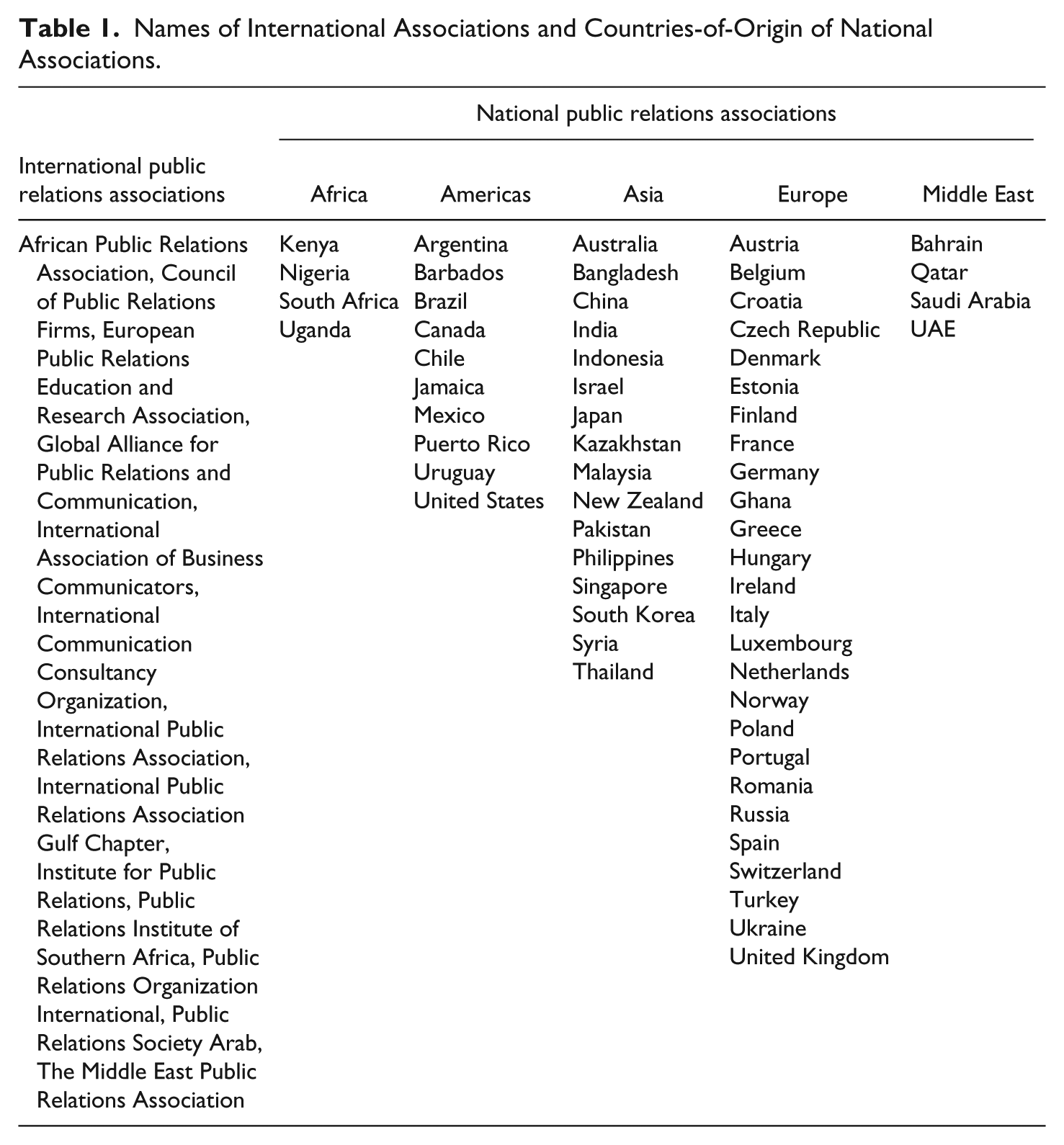
The analysis identified seventy-two national and international/regional public relations associations. There are thirteen international/regional public relations associations, four African associations, ten American associations, sixteen Asian associations, twenty-five European associations, and four Middle Eastern associations (see Table 1 for details). In terms of social contexts, most countries that have developed national public relations associations have an established democratic system (68.6% countries with polity IV ≥ 8, polity IV ranges from −10 to 10). Most countries with national associations are relatively rich (60.3%) with GDP per capita ranked among the upper third in the world; 25.9% countries have middle-level GDP per capita and only 13.8% countries with low GDP per capita (ranked among the lower third in the world). In terms of cultural context, the majority (43.1%) of countries have a Western context. Other large cultural groups represented in this sample are Islamic culture (15.5%) and Latin American culture (13.8%). Figure 1 shows that public relations is truly an international industry that involves the efforts of practitioners from around the world.
Names of International Associations and Countries-of-Origin of National Associations.
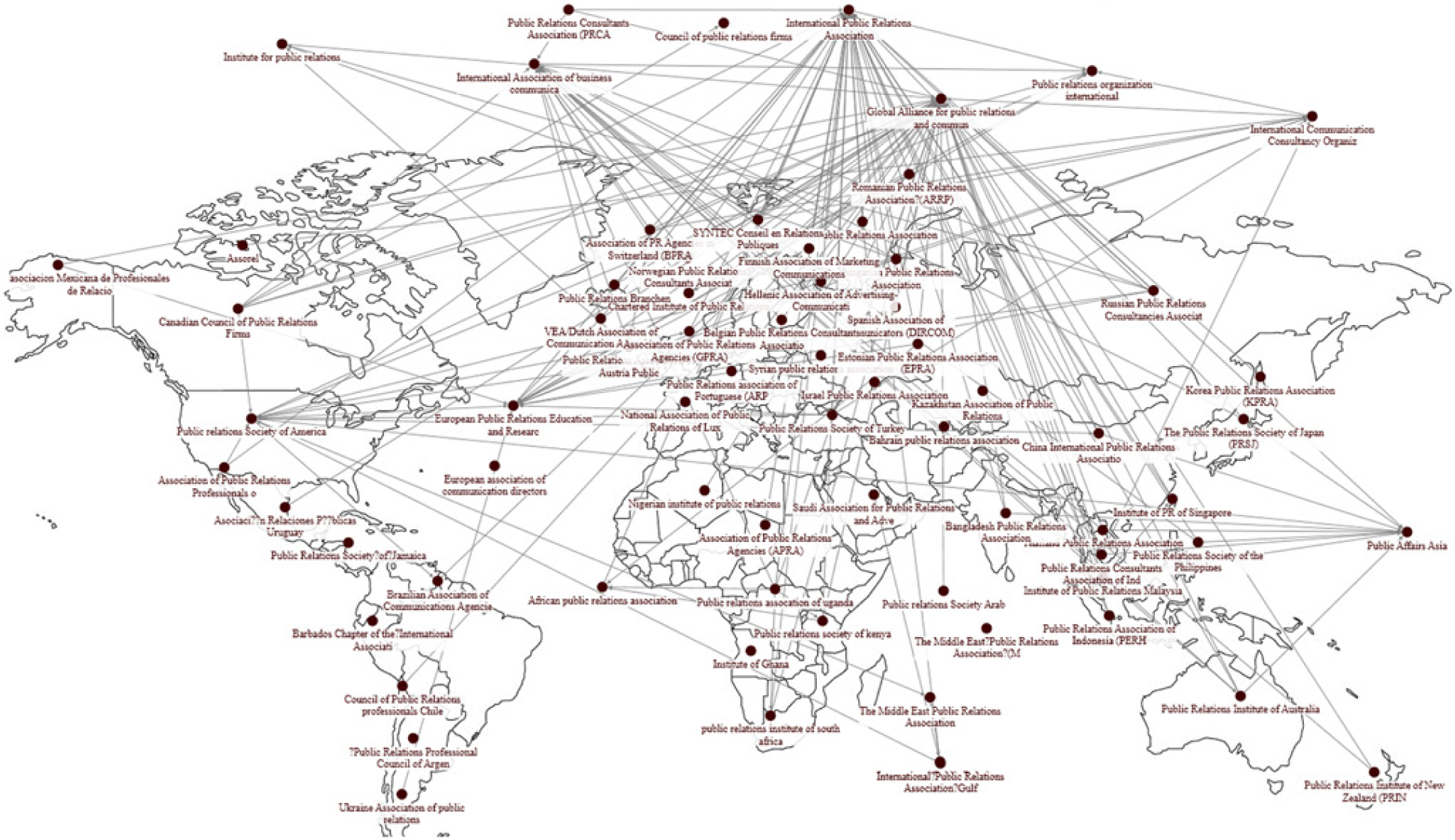
Partnership network.
RQ1: The Global Structure of Public Relations Associations’ Networks
Membership network
The membership network reveals the most formal relationship between different associations. Network centralization scores were calculated to examine the extent to which the network was integrated around one or a set of organizations. Network density reflects the proportion of all possible ties that are actually present. For the membership network, the overall density is 0.0067 (2.182% outgoing ties, 16.465% incoming ties), which is the lowest among the three networks. Given the size of this network, this finding suggests that very few national public relations associations become members of other associations. Furthermore, the direction of relationships suggests that only a handful of public relations associations (e.g., IPRA, ICCO, etc.) have high indegree centrality (calculated based on ties that a focal actor receives from others. High indegree centrality indicates that the focal actor is highly respected among its contacts). In other words, only a few associations have other national associations as members. Close examination suggests that most of those associations are international associations with members from around the world. Regional (including several countries) associations do not have national associations as members. Given that the membership network represents the most formal relationship, our findings suggest that relationships among international and national associations are more formal than connections among regional and national associations.
To further examine centrality and prominent actors, eigenvector centrality for each association was calculated (assessing actors’ centrality based on their overall importance in a network). A high score indicates an actor is central to the main pattern of connections among actors, whereas a low value suggests that the actor is peripheral in the network). The eigenvector analysis reveals that the membership network is highly centralized. The first five factors explained 93.7% of the pattern of distance among actors. The most central nodes (central by being well connected, and at the same time, connected with other central actors; see Table 2 for details), in a descending sequence, are the Global Alliance for Public Relations and Communication (GAPRC), the European Association of Communication Directors (EACD), the EUPRERA, the Chartered Institute of Public Relations (CIPR), the Public Relations Association of Austria, the Spanish Association of Communicators, the Public Relations Institute of Australia (PRIA), and the International Communication Consultancy Organization. As suggested in Table 2, the majority of these organizations have a European background (see Table 2 for additional background information). The analysis revealed a pattern of European centralization when it comes to the membership network. European associations enact greater memberships with other national and international public relations associations.
Normalized Bonacich Eigenvector Centrality Scores and Backgrounds Information of Top Five Most Influential Public Relations Associations in Each Network.
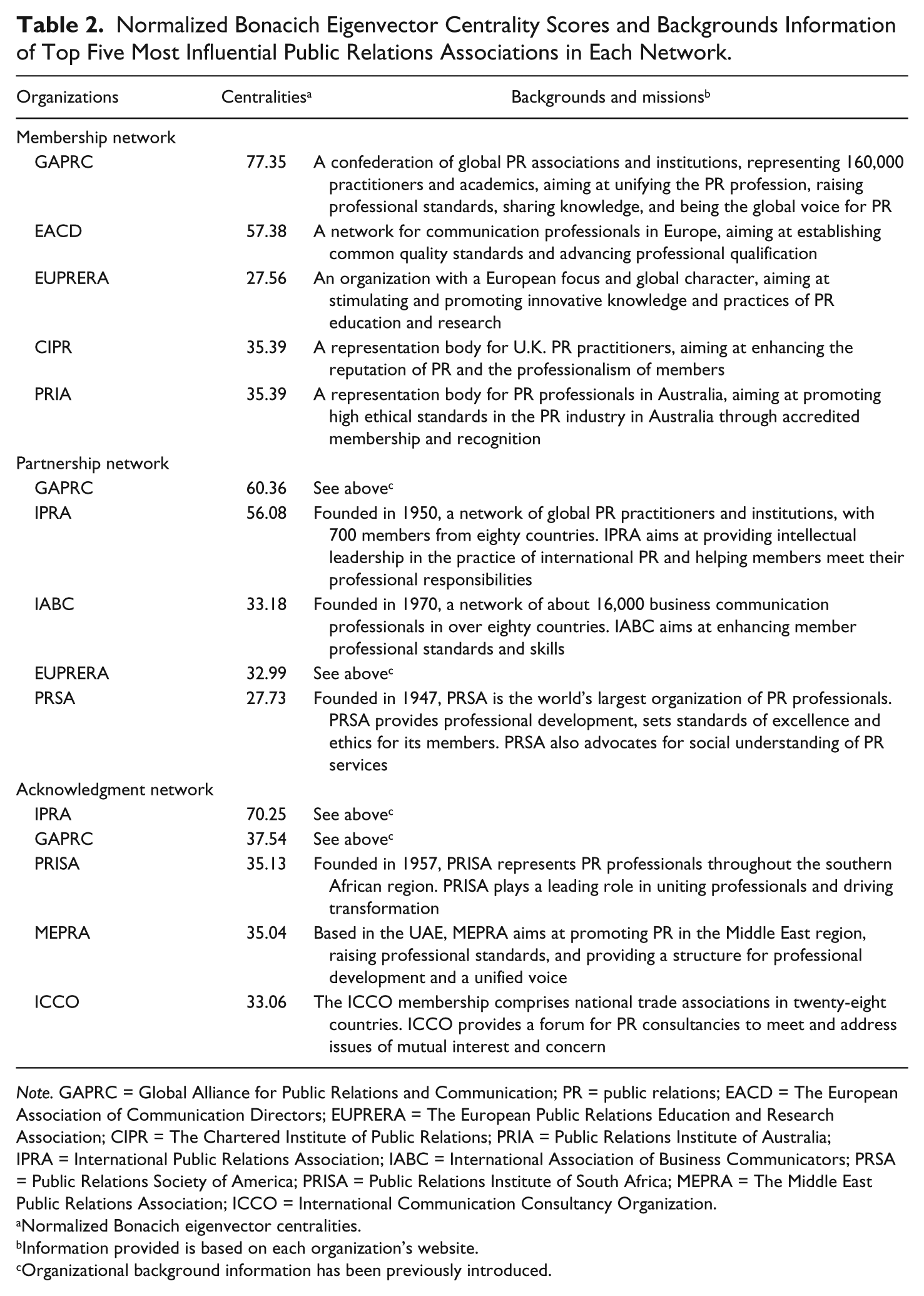
Note. GAPRC = Global Alliance for Public Relations and Communication; PR = public relations; EACD = The European Association of Communication Directors; EUPRERA = The European Public Relations Education and Research Association; CIPR = The Chartered Institute of Public Relations; PRIA = Public Relations Institute of Australia; IPRA = International Public Relations Association; IABC = International Association of Business Communicators; PRSA = Public Relations Society of America; PRISA = Public Relations Institute of South Africa; MEPRA = The Middle East Public Relations Association; ICCO = International Communication Consultancy Organization.
Normalized Bonacich eigenvector centralities.
Information provided is based on each organization’s website.
Organizational background information has been previously introduced.
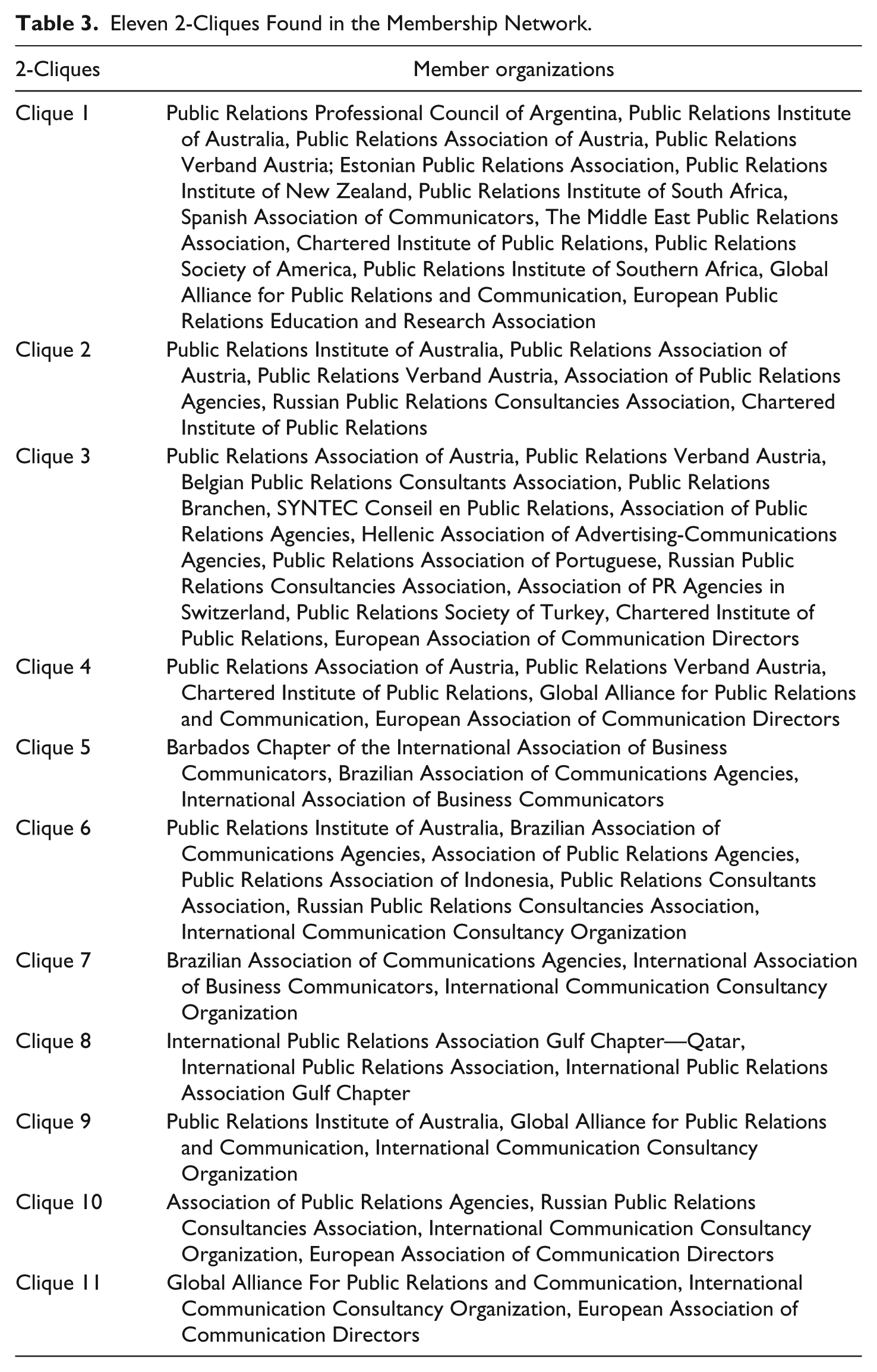
To further understand the subgroups in the membership network, an N-Cliques analysis was performed. N-Cliques analysis assumes that an actor is the member of a clique if they are connected to every other member of the clique at a distance of N (in this analysis, N = 2). For this network, eleven 2-Cliques were found, and most of those cliques were formed by European associations (see Table 3 for additional information). This confirmed earlier findings. European associations are most likely to join and become members of international public relations associations. This tendency may offer those European players disproportional presence and influence over the operation of international associations. Furthermore, the analysis fitted core–periphery models to the membership networks. UCINET produced blocked adjacency matrices by fitting the correlation between the observed data matrix and an idealized core–periphery structure matrix. The matrix shows network members that belong to the core (leaders) and the periphery (associations on the outside). The membership network structure fit poorly for a core–periphery structure matrix (model fitness = 0.019), suggesting the nodes in the membership network are disconnected, and therefore cannot form an overall structural pattern.
Eleven 2-Cliques Found in the Membership Network.
To sum up, in comparison with public relations associations from other parts of the world, European associations are participating in international collaborations as members. The active status of European associations may allow them to influence international practices. Furthermore, international associations are more likely to have national associations than regional associations as members.
Partnership network
The partnership network reveals additional information about how associations interact in the international arena. These are less formal relationships than the membership network. For the partnership network, the overall density is 0.0309 (network centralization = 51.59%, M degree = 4.389, SD = 6.800). Because this is a symmetrical network (symmetrical meaning that relationships are completely mutual), only the mean degree and standard deviation were examined. The findings suggest that around the world, far more public relations associations are engaged in partnership building than membership building. Furthermore, relationship distribution in this network is unequal. Some organizations are much more likely to develop international partnerships than others. To test if densities are indeed different between the partnership network and membership network, the researchers used a standard network inferential and bootstrap approach to test statistical significance. 34 The difference between means is 0.0243. The standard error of the difference by the standard method is 0.0027 and the estimate by bootstrap is 0.0117. The two-tailed probability is .0362, suggesting that partnership relationship is significantly more likely to exist among associations. Furthermore, a matrix correlation analysis suggests that when two associations engage in one type of relationship, there is a marginally significant chance they would also engage in another type of relationship (p = .576). In other words, when associations engage in either partnerships or memberships, they are more likely to also engage in another type of relationship, and therefore broaden the scope of their collaborations.
Eigenvector analysis revealed that the partnership network is a less centralized network in comparison with the membership network. The first four factors (the only three factors with explanatory percentage larger than 10%) explained 55.5% of the pattern of distance among actors. Although still prominent, the European actors are no longer dominant in this network. As Figure 1 shows, overall, the most central actors in the partnership network are international associations. Table 2 provides details about these organizations’ names, history, and missions. In each continent, there are regional centers. The African Public Relations Association connected with national associations from several African countries. In Asia, the regional association, Public Affairs Asia, is the most central actor. In Europe, the regional association, EUPRERA, is most prominent. In the Middle East, the International Public Relations Association Gulf Chapter is very central. In North America, although the Public Relations Society of America (PRSA) is a national association, it is exceptionally active at the regional and international level. For the partnership network (model fitness = 0.007), the network structure fit poorly for a core–periphery structure matrix, suggesting relationships involve a much broader range of associations.
Overall, the analysis reveals that the partnership network is a much more engaging network with more actors participating in relationship building. Several regional associations emerged as important actors suggesting that they may carry regional values to other public relations associations.
Acknowledgment network
The acknowledgment network has the highest overall density: 0.0312 (37.889% outdegree, 20.037% indegree), suggesting more associations used hyperlinks to acknowledge other national or international associations. Interestingly, outdegree is higher than indegree, suggesting more associations are eager to send out hyperlinks linking to other organizations. Associations show web visitors that they are linked to other associations.
The eigenvector centrality analysis revealed that the first factor only explained 11.7% of the pattern of distance among actors. This analysis suggests few actors are overwhelmingly dominant. As suggested by Table 2, both regional associations and international associations can achieve central positions. Interestingly, the GAPRC achieved high centrality across three networks. Of note, several international public relations associations (International Public Relations Association, International Communication Consultancy Organization, Public Relations Association International, and GAPRC) and regional associations (The Middle East Public Relations Association [MEPRA], African Public Relations Association, and EUPRERA) emerged with high scores on eigenvectors. Because higher scores indicate that actors are more central to the main pattern of distance among all of the actors, both international and regional associations appeared to be central in this acknowledgment network as well. Overall, partnerships and acknowledgments are much more common in terms of international relationship building, perhaps because it is easy to link to partners’ websites acknowledging them as important.
However, the acknowledgment network (model fitness = 0.451) is much closer to a core–periphery structure. 35 There are ten organizations in the core suggesting that when it comes to acknowledgment, there is a hierarchical structure among associations. A few international associations are more likely to be acknowledged than the majority.
RQ2: Determinants of the Global Structure of Public Relations Associations’ Networks
Membership network
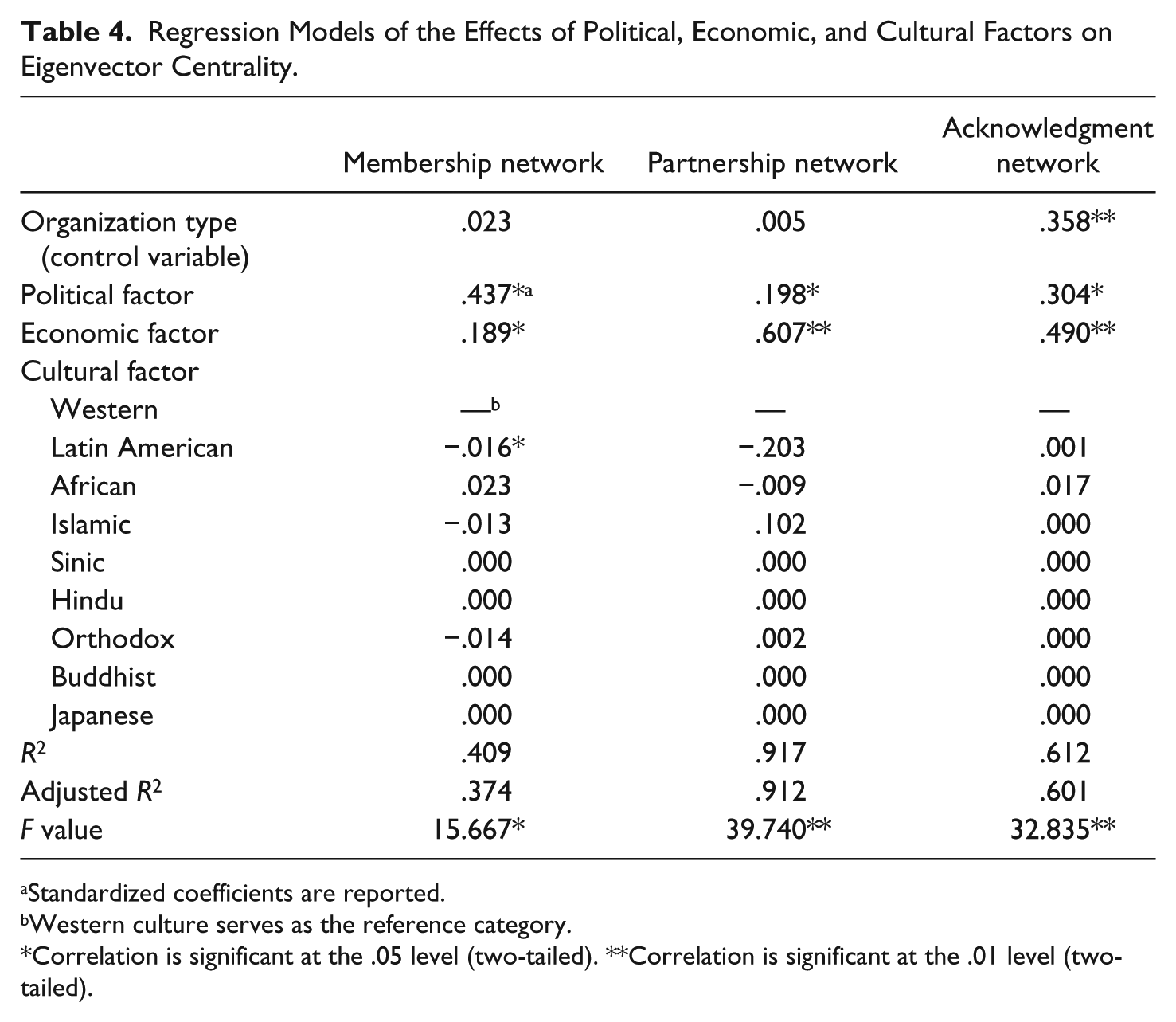
In this network, regression analyses show that political context, economic development, and cultural backgrounds are significant predictors of actors’ eigenvector centrality (R2 = .409, adjusted R2 = .374, F = 15.667, p < .05). Specifically, the standardized coefficient for political context =.639 (p < .05) suggests that a higher democracy level is associated with more chance for a country’s association to be central. For economic context, the standardized coefficient = .189 (p < .01), suggesting that national associations from richer countries are more likely to be prominent (see Table 4 for details). Finally, in terms of the cultural context, an association with a Western cultural background is more likely to be central. However, those factors do not affect how associations become members of subgroups in the membership network.
Regression Models of the Effects of Political, Economic, and Cultural Factors on Eigenvector Centrality.
Standardized coefficients are reported.
Western culture serves as the reference category.
Correlation is significant at the .05 level (two-tailed). **Correlation is significant at the .01 level (two-tailed).
Partnership network
In this network, political context, economic development, and cultural backgrounds are significant predictors for both eigenvector centrality and subgroup structure. In terms of the effects on eigenvector centrality (R2 = .917, adjusted R2 = .912, F = 39.740, p < .001), the model is significant. Economic development is the most powerful predictor (standardized coefficient = .107, p < .001), followed by culture (Western culture is again associated with higher eigenvector centrality) and political context (standardized coefficient = .198, p < .001; see Table 4). For subgroup structure, the model is also significant (R2 = .557, adjusted R2 = .531, F = 28.509, p < .05). Economic development is the most important predictor (standardized coefficient = .206, p < .05), and political context (un-standardized coefficient = .038, p < .05) is also significant. These findings suggest that associations with similar political and economic backgrounds (homophily) are more likely to join together and become members in the same clique.
Acknowledgment network
In the acknowledgment network, the overall model is significant on eigenvector centrality (R2 = .612, adjusted R2 = .602, F = 32.835, p < .01). Organization type is a prominent predictor in this model (standardized coefficient = .358, p < .01), suggesting that whether an association is an international or national one would significantly influence its chance to be central in this network. Economic level is also a significant predictor for network eigenvector centrality (standardized coefficient = .490, p < .001). Political context is also a relatively influential predictor (standardized coefficient = .304, p < .05; see Table 4). Because this network features a core–periphery structure, a set of regressions was then performed on the structure of this network. The model is significant (R2 = .540, adjusted R2 = .506, F = 21.113, p < .05). Only the variable “organizational type” achieves significance as a predictor (standardized coefficient = .071, p < .05), suggesting that international organizations are more likely to hold a position in the core group.
Discussion
The findings provide general and specific evidence about the development of global public relations networks. First, there is evidence of worldwide professional networks that may create common structural, institutional, and cultural features of the public relations profession across nations. Second, European influences and regional and global centers have emerged, and these relationships will influence future practices. Finally, economic, political, and other social factors are influencing the creation of homophilous networks of associations. These findings, and the implications of each for the development of local and global practices, are discussed below.
WPT and Public Relations Associations’ International Networks
The analysis reveals evidence of a worldwide model that may create common structural, institutional, and cultural features of the public relations profession across nations. Figure 1 depicts a globalized international public relations network. This network suggests the participation of a broad spectrum of associations with different backgrounds. It is likely that public relations associations across the world have recognized the value of international cooperation and are making efforts to expand their networks. Such an effort may continue to promote more international cooperation and the exchange of ideas, models of practices, norms, and values. As these ideas, models, practices, and values become normative, they may eventually be adapted by even those practitioners who are not members of the associations.
Consistent with WPT’s prediction, Figure 1 demonstrated that many countries are linked through their connections with international associations. Similar to Beckfield’s findings with intergovernmental organizations, this study also reveals inequality—some associations appear as more prominent in different networks, whereas others remain peripheral. 37 Associations from economically developed democracies are active participants of international professional networks. They engage in either partnerships or memberships. Because one relationship is likely to lead to the development of another, associations from the global North may continue to broaden the scope of their collaborations and deepen their influence.
This finding suggests the potential existence of hierarchy and explains the lack of broad participations in the membership network. Becoming a member of another organization suggests high levels of identification and commitment. Perhaps actors from many countries around the world still lack identification with the models and values promoted by international associations because their own culture and heritage are not adequately represented in international models. Future studies should explore how this hierarchical structure influences the public relations practice in different countries. It is likely that such structure simultaneously helps to professionalize public relations practice in a country while at the same time constraining the localization of public relations or limiting who the newly emerged public relations industries serve. Hierarchy may limit the long-term development of indigenous models of public relations in many countries (e.g., in some African countries, public relations agencies mainly serve multinational corporations rather than local business).
The Co-existence of European Influences and Regional Centers
A highly centralized membership network features the dominance of European public relations associations and a few international associations. WPT argues that more connected actors are likely to influence the norms and ideologies international associations enact. European associations frequently participate in international collaborations with other international and regional associations. The European associations are playing a leadership role in the global network and may influence many nations’ practices.
The European public relations associations’ partnering patterns may be influenced by their approaches to public relations. Europeans proceed from a broad sociological approach to public relations that examines “the relationships public relations has with respect to the societies in which it is produced and to the social systems it co-produces.” 38 Reflexivity of the role of organizations in society exemplifies European approaches. European reach is extended because of the willingness of European national associations to participate in international and regional associations as members and partners. Forging diverse relationships may be a direct outcome of their social understanding of public relations. Furthermore, it is likely that the centrality of European associations in the global network suggests that they will have a greater influence on the development of public relations in other nations.
Our data also point to the co existence of regional and global networks. Although many scholars have argued that the world is increasingly interconnected, 39 our study suggests that the world is not uniformly connected. Inequality exists at multiple levels. Some actors, such as international associations in all three networks, appear to be centers. Some regions, especially in the membership network, Europe, are more well connected than others.
The partnership network identified several regional centers. National associations behaved differently in membership and partnership networks. In the partnership network, which features much more equal collaboration than the membership network, national associations from around the world (not just European associations) are more likely to participate. Furthermore, associations from the same region are more likely to be connected through regional centers. It is likely that instead of a top-down international public relations professional model being disseminated around the world, each region may develop and create its own model that reflects regional commonality. Such models may enjoy regional popularity and even have certain levels of influence on worldwide models. Future studies should use longitudinal research designs to examine if this trend of multiple centers of the network or the European influence changes over time.
Societal Influences on the Global Network
The literature suggests political, economic, and societal culture influence public relations practice.
40
The findings of
The data suggest that an association’s societal background also affects the level of influence of that association. Associations from wealthier, democratic systems are more likely to be part of the core in international networks. When information, norms, and values are shared and exchanged through networks, it is likely that ideas and norms from those countries may also dominate the globalization process of the public relations profession. They will have disproportional influence over the trajectory of the future of the profession in many countries.
Conclusion
Public relations is an international industry that is rapidly developing across the world. This article examined if and how public relations associations form international networks that are conducive to the spreading of models of professionalization.
This study has several limitations, including the use of secondary, archive data and data-mining that do not allow us to assess the motivations behind communication patterns or observe the decision-making process. Although hyperlink analysis is a common method for ascertaining choices in interorganizational relationships, it is only one measure of acknowledgment relationships. 42 First, future researchers may conduct interviews with organizational leaders to specify factors that shaped their networking choices. Second, the network members constitute a potentially biased sample of economically developed countries (Europe) with well-institutionalized democratic systems. Public relations is more likely to flourish in those countries. 43 Future studies should identify a more diverse sample including national associations from other parts of the world.
This study is a benchmark for tracing trends in global public relations professionalization, and theories and models. Future studies should examine the changes and the evolution of public relations professional networks. In addition, although this study adopted Huntington’s culture typology and an assumption that culture and norms are similar among countries within the same cultural group, 44 we acknowledge a refined typology is needed. Finally, this study focused mainly on national and international associations. We recognize the relationship among state/province/local organizations and national ones can vary from case to case (e.g., regional PRSA chapters and the national PRSA), and much more can be learned by further exploring meso- and micro-level dynamics. Research should study multiple levels of networks to capture the rich interactions between international, national, and local associations.
Despite these limitations, this study offers a new perspective for future investigation into the impact of the globalization process in public relations professionalization. The associations that appeared most central may influence practices in other nations because they will identify which practices can count as part of the public relations profession. Through normative values and professional training, they may both consciously and unconsciously regulate other national associations members’ behaviors and thus influence how public relations is practiced and theorized.
Footnotes
Declaration of Conflicting Interests
The author(s) declared no potential conflicts of interest with respect to the research, authorship, and/or publication of this article.
Funding
The author(s) received no financial support for the research, authorship, and/or publication of this article.