




Abstract
Utilizing a 2 (race) × 2 (sex) × 3 (response strategy) factorial experiment, this study interrogates the extent to which an athlete’s race and gender impacts the image repair process, specifically within the hypermediated realm of athlete transgressions. Using a national sample of 287 participants, results supported for the effectiveness of the mortification strategy above reducing offensiveness and evading responsibility strategies. Moreover, regardless of the transgression response, Black athletes were consistently rated more positively than their White athletic counterparts, deviating from the majority of prior research. Discussion of the role of the Black athlete is offered in light of the unexpected findings, with explanations postulated based on expectancy violation theory and the principle of covariance.
On January 19, 2014, Seattle Seahawk Richard Sherman ended the National Football Conference (NFC) Championship by tipping San Francisco Quarterback Colin Kaepernick’s pass into the hands of Malcolm Smith, ensuring a chance to play in Super Bowl XLVIII. Yet, Sherman’s defensive play was overshadowed by an impassioned post-game interview discussing an ongoing rivalry with 49er wide receiver Michael Crabtree, exalting himself as “the best corner in the game.” Following the outburst, millions posted comments on Twitter calling Sherman a “thug,” a term that was also applied to Sherman over 600 times on television in the days that followed (Davidson, 2014). Many began to question the extent to which Sherman’s race impacted public evaluations of his behavior, as he was referred to as a “thug” despite his notable academic achievements and exemplary community service record (Davidson, 2014). Sherman, himself, lamented the negative, racial connotations associated with the term (Sherman, 2014), calling it “an accepted way of calling somebody the N-word nowadays” (Davidson, 2014). Clearly, Sherman’s race impacted the way this incident was perceived by the public.
However, race is not the only characteristic with the potential to influence public evaluations of an athlete’s transgressions. In 2009, New Mexico women’s soccer player Elizabeth Lambert pulled BYU’s Kassidy Shumway to the ground by her ponytail (Hays, 2009), playing in an extremely aggressive manner throughout the entire match. Her actions not only earned her a yellow card during the match, but she was also suspended in response to the public’s outrage over her rough style of play that was featured in the post-game highlights. As the YouTube video of Lambert’s forceful play garnered attention, her actions were described as a “catfight” (Hays, 2009). This characterization was certainly influenced by her gender, leaving a “reminder that some segment of the population still [found] comfort in mocking the very idea of women’s competing with [that] level of intensity” (Hays, 2009, p. 1).
The cases of Richard Sherman and Elizabeth Lambert provide excellent examples of how quickly an athlete’s image can be altered by events in sports. Once the public characterizes an action as being offensive, an athlete’s image is at stake. Although both Sherman and Lambert committed actions that some would deem offensive under any circumstances, the resulting public discourse was clearly shaped by Sherman’s race and Lambert’s gender. Of course, the notion that one’s race and gender could impact the public’s evaluation of such circumstances is not new (e.g., Brazeal, 2013; Griffin, 2013); however, scholarship has yet to examine the complex mix of race, gender, sport, and public persona.
Most early image repair studies of sports rhetorically analyzed athlete’s image repair strategies (Benoit & Hanczor, 1994; Brazeal, 2008; Kennedy, 2010). Recently, scholars have prioritized empirical examinations of image repair and related crisis and reputation management areas to increase the amount of evidence-based research to complement the rhetorical analysis and case studies that have historically dominated this area of research (Coombs, 2010). In this vein, this study utilizes a 2 × 2 × 3 factorial experiment to determine the extent to which an athlete’s race and gender impacts the image repair process, shedding light upon how social constructions of race and gender impact the evaluation of athlete transgressions.
Literature Review
Although some suggest that “image” is interchangeable with the notion of “reputation” (e.g., Botan, 1993; Coombs, 2005; Grunig, 1993), the term image can have a more negative connotation (see Coombs, 2005; Grunig, 1993), because it can be seen as masking an entity’s true identity or reputation (Botan, 1993; Grunig, 1993). From a marketing perspective, image has a more neutral connotation and is not synonymous with reputation. Rather, the term reputation is the aggregate of an entity’s images over time. Thus, an entity’s image can be actively controlled, changed, or constructed through the use of strategic communication materials, whereas reputation requires more time and effort to create and maintain (Gray & Balmer, 1998). Historically, the importance of image for athletes and sports organizations was seen as trivial, because fans were assumed to be more interested in the successes and failures of athletes/teams rather than the character issues of the people involved (Kruse, 1981). Today, the globalization of sports and increased visibility of athletes/teams through traditional and social media make it necessary for athletes and teams to manage their identity and respond to threats to their image (Billings, Butterworth, & Turman, 2012; Meyer, 2008; Troester & Johns, 2013). Simply put, although athletes have long been admired and honored as cultural heroes, the increased visibility of today’s athlete has magnified their celebrity status and cultural significance (Griffin, 2013; Smart, 2005).
The Role and Consequence of Image in Sports
From a professional athlete’s perspective, the most immediate ramification of failing to manage a public image is the financial consequence. Because an athlete’s words and actions can be directly linked to the team he or she represents (Doyle, 2011), an athlete involved in damaging activity could face being released from his or her contract with the team—as seen with football players Terrell Owens (Associated Press, 2006) and Albert Haynesworth (Reiss, 2012). In addition, athletes use their image to endorse a variety of products and services and are sometimes paid more for endorsements than for their athletic contributions (Smart, 2005). Consequently, an athlete involved in damaging activities could also suffer financially through the loss of endorsement deals, as evidenced by the fall-out associated with scandals involving Tiger Woods (McCarthy, 2010) and Lance Armstrong (Karlinsky, 2013).
Benoit’s (1995) image repair theory (IRT) provides an ideal framework for addressing questions regarding an athlete’s image in the context of a transgression or otherwise unfavorable contexts. The IRT response typology provides five strategies: denial, evading responsibility, reducing offensiveness, corrective action, and mortification (Benoit, 1995).
This study focuses on three strategies: (a) evading responsibility, (b) reducing offensiveness, and (c) mortification. First, the evading responsibility strategy and its variations seek to reduce the amount of responsibility that the offending actor faces. Literature devoted to sports image repair usually reveals these strategies to be successful (Glantz, 2013; Walsh & McAllister-Spooner, 2011); however, they are typically paired with mortification. For example, Plaxico Burress’ successful use of a combination of mortification, accident and provocation strategies painted him as a National Football League (NFL) athlete that was the target of criminals, providing a protection-based warrant for the gun he carried the night he accidentally shot himself in the thigh (Glantz, 2013). Michael Phelps also successfully used a combination of mortification and defeasibility to reduce his act to a youthful indiscretion when a photograph of him smoking marijuana circulated in a British tabloid (Walsh & McAllister-Spooner, 2011). In contrast, Serena Williams received public and media backlash when she used provocation without a mortification response after her tirade against a line judge during the 2009 U.S. Open (Brazeal, 2013).
Second, the reducing offensiveness strategy and its variations seek to mitigate negative perceptions of the offending actor. Previous studies examining athletes’ use of the reducing offensiveness strategies almost universally claim the image repair attempts were ineffective, as evidenced by examples such as Tonya Harding (Benoit & Hanczor, 1994) and Roger Clemens (Sanderson, 2008). However, Fortunato (2008) examined internal communication used during the Duke Lacrosse rape allegations, finding the university’s use of the attacking the accuser strategy was successful because of the credibility concerns from Durham District Attorney Mike Nifong—concerns that were seemingly justified when all charges were dropped.
Finally, the mortification (or apology) strategy has no variations under Benoit’s (1995) theoretical approach. Although recent experimental studies outside of the sports arena provide conflicting results regarding the effectiveness of the mortification strategy (e.g., Choi & Chung, 2013; Coombs & Holladay, 2008; Coombs & Schmidt, 2000; Dardis & Haigh, 2009; Haigh & Brubaker, 2010), the strategy is almost universally considered a successful tactic when examined in athlete image repair cases (e.g., Brown, Dickhaus, & Long, 2012; Glantz, 2013; Kennedy, 2010; Walsh & McAllister-Spooner, 2011). The mortification strategy has been considered ineffective in instances when the offender delays the apology after using other strategies (Brazeal, 2013) or when the offender is dishonest about his or her role in the transgression (Smith, 2013), both of which are less likely to occur under the glare of the heavy sports media spotlight, making immediate and honest apology more likely to be successful.
Adding Race to the Transgression and Image Repair Equation
The Black athlete is a frequent subject of scholarly investigation, seemingly because of the divisive narratives and hypermasculinized framing commonly offered in media depictions. Specifically, with regard to deviance, studies have examined how such behavior on the field is purportedly justified/normalized (see Denham & Desormeaux, 2008). However, off-field deviance is rightly denounced, yet with discourses that indicate such indiscretions are indirectly a result of racialized cultures and backgrounds. From the Duke Lacrosse rape scandal (Fortunato, 2008) to the comparatively mild antics of athletes such as Terrell Owens (Brazeal, 2008), celebrity and the modern athlete (see Smart, 2005) are frequently tinged with racial connotations. Still, most scholars contend that media enables behavior without being a direct cause of it, with Butterworth (2013) noting that the circus frequently surrounding sport is simply the manifestation of the high societal value people place on sport.
Studies have found that non-White athletes are often described by media in demonstrably different ways than White athletes (Angelini, Billings, MacArthur, Bissell, & Smith, 2014), with the most frequent discussions focusing on troubling depictions of the Black athlete. Although fairly benign transgressions have been studied as they relate to Black athletes (Brown, Dickhaus & Long, 2013; Mocarski & Billings, 2014), the majority of the established work pertains to the politics of race in sport (Banet-Weiser, 1999) and the connections between race, sport, and violence. As Lavelle (2013) notes, “If a Black athlete is accused of a crime, negative stereotypes about hip-hop culture are often used to paint him as dangerous and suggest that he must be monitored” (p. 179). Jackson (2006) seemingly concurs, suggesting that the options available to a Black male are often limited to athlete, criminal, hip-hop star—or a combination of the three.
Consequently, the lines between athlete and criminal are often blurred within societal conversations and regularly attributed to cultural differences normalized by media messages linking deviance and gun culture with the Black community (Leonard, 2010). Notably, some sports are seen as more racialized than others. For example, race and guns are “more on display in the NBA than in sports such as football, where the number of players is larger and the tattoos that signal ‘thug’ or ‘street’ to some viewers are hidden by bulky uniforms” (Sheckels, 2013, p. 172). As such, minority athletes have been characterized as “forty million dollar slaves” (Rhoden, 2006, p. 1), as they are rarely afforded the power and mediated voice to counter such stereotypes. Moreover, athletes who do not identify as White or Black are rarely—if ever—the subject of scholarly investigation within a sporting context, making cases such as professional football player Aaron Hernandez’s 2013 murder arrest ripe for investigation, as little work has focused on perceptions of deviance (and subsequent image repair) as it relates to Latino athletes.
Adding Gender to the Transgression and Image Repair Equation
Similar to media characterizations of minorities in sports, women’s sports coverage is dominated by narratives devaluing, marginalizing, and objectifying both women athletes and athleticism (e.g., Cooky, Messner, & Hextrum, 2013; Webster, 2009). Not only are descriptions of women athletes confined to gendered notions of (specifically White) femininity, but deviations from these norms are also met with criticism and disdain (Mean, 2013; Webster, 2009). Indeed, print and television news coverage of women’s sports is notable both for the striking absence of female athletes and sporting events (e.g., Turner, 2014) as well as for the gender-stereotypic (e.g., Adams & Tuggle, 2004; Davis & Tuggle, 2012) and racialized narratives associated with them (e.g., Mean, 2013). Cooky et al. (2013) found that airtime allocated to women’s sports is at its lowest proportion in over two decades (1.6%) and that when coverage of women athletes is offered, controversy, violence, rule-breaking, and scandal are frequently involved. Put simply, if women athletes perform well, nary a mention is made; if women athletes behave badly, sports media highlights it.
Indeed, coverage of women athlete’s transgressions receives considerable media attention, whereas their play on the field often remains in the periphery (e.g., Compton, 2013). As Compton (2013) argues, When a linebacker makes a big hit on a quarterback, a fight breaks out in hockey, or there is a collision on a play at home plate, the [male] athletes are cheered for their rough, aggressive play. When a female takes it too far . . . it becomes national news. (p. 263)
The earlier example of University of New Mexico soccer player Elizabeth Lambert illustrates this reality, prompting actions to repair her tarnished image. By providing an immediate expression of remorse, promoting her good qualities, minimizing the event, and finally acknowledging the corrective actions she employed to ensure the behaviors were not repeated, she only slightly minimized the impact of her behaviors.
The pronounced scrutiny associated with the controversial behaviors of women athletes is also evident in media coverage of tennis superstars Serena and Venus Williams. Although they have a sizable fan base and have received numerous, lucrative endorsement deals, many argue that they have been treated with ambivalence (at best) due in large part to their defiance of (White) idealized notions of sexuality and femininity in a sport primarily comprised of White players (Douglas, 2005; Shultz, 2005). Moreover, their transgressions on the court receive profound attention and swift retaliation. For instance, Serena Williams challenged a questionable call in her semifinal match during the 2009 U.S. Open with an aggressive verbal outburst. It received the largest fine for unsportsmanlike behavior in Grand Slam tennis history along with 2 year’s probation and the threat of suspension. Although none would excuse her behavior, such tirades, when performed by White male players, are routinely met with little (or lesser) response from officials and spectators. In fact, John McEnroe openly acknowledges his behaviors on the court were often worse than Williams’ (Cronin, 2013).
McEnroe’s admission aptly characterizes the complex challenge faced by women athletes (and women athletes of color) when forced to defend their actions—questionable or otherwise. For these athletes, attempts at image repair are defined by both sex- and race-based dominant ideologies (Mean, 2013). Because femininity and feminine performance style are used as the benchmark of the successful female athlete (Webster, 2009), displays of physical skill or strength (i.e., masculinity) are punished. Perhaps unsurprisingly then, analyses of Williams’ image repair efforts indicate that her attempts were largely unsuccessful (Brazeal, 2013).
Female athletes of color whose behavior deviates from White, normative gender roles are arguably punished to a degree exceeding their White or male counterparts. When Olympic sprinter Marion Jones (a Black, female athlete) admitted to using performance-enhancing drugs after years of denial, she was convicted of perjury and sentenced to federal prison—disgraced. White, female cyclist Tammy Thomas—also convicted of perjury in relation to doping—received no jail time. Such deviance is diminished in men’s professional circles as well. Many Major League Baseball players have avoided prosecution altogether and cyclist Lance Armstrong has yet to face criminal charges for lying under oath regarding his use of performance-enhancing drugs (though stripped of his Olympic Metals and Tour de France titles). While not excusing her actions, the media’s framing of Marion Jones as an exemplar of (White) ideals of elegant, feminine beauty, and stereotypic gender conformity (e.g., faithful wife) arguably made her transgressions even more unpalatable and deserving of punishment (Mean, 2013). Thus, women athletes of color are doubly constrained by a mediated system expecting them to present an image promoting stereotypic ideals from which they are excluded by race/ethnicity and/or gender. When deviations occur, media coverage can be unforgiving.
Research Questions
The image repair of athletes facing transgression accusations is an area worthy of study because of their cultural (Griffin, 2013; Smart, 2005) and financial (Doyle, 2011; Jones & Schumann, 2004; Smart, 2005) significance. The empirical investigation of these strategies has implications far beyond public relations, as the present study provides insight regarding intercultural, gender, and mediated communication. Rhetorical (i.e., Brazeal, 2013; Kennedy, 2010; Walsh & McAllister-Spooner, 2011) and empirical evidence (Brown et al., 2012) has examined the effectiveness of image repair strategies, yet the impact of the athlete’s race and gender on this effectiveness has not been examined. As such, the following research questions are proposed:
Method
Participants
A sample of 287 participants was recruited using an online panel company for the study. The sample consisted of 91 males (31.7%) and 196 females (68.3%). A majority of the respondents were between the ages of 18 and 24 (39%); however, participants aged 25 to 44 (33.5%) were similarly represented. The majority of the sample was Caucasian (54.4%); however, African Americans represented 28.9% of the respondents.
Research Design and Manipulations
A 2 (sex) × 2 (race) × 3 (image repair strategy) factorial experiment was designed to examine the impact of race and gender on the image repair process. The reporting of the athlete’s transgression was manipulated using a mock online news website from The Bleacher Report. The Bleacher Report was chosen because it is the second most-visited sports-exclusive website in the United States, as well as the most-visited sports blog website (Alexa.com, 2014), making it ideal for the selected manipulations.
Athlete race and sex were conveyed by providing clear mugshots of the athletes along with his or her name. Four mugshots were chosen: two women (White and Black) and two men (White and Black). The researchers pretested mugshots similar to the method used by Mastro, Seate, Blecha, and Gallegos (2012). The mugshots were chosen from www.arrests.org, and were similar in size, pose, and close-up. The photographs were rated for eight characteristics: attractiveness, seriousness, athleticism, body size, degree of facial hair, expression (angry–calm), emotion (sad–happy), and age (young–old). Analyses of variance (ANOVAs) revealed no significant differences among the four mugshots for attractiveness, seriousness, expression, emotion, and age. T tests indicated no significant differences between the two mugshots for males, and separately between the two mugshots for females, for athleticism, body size, and degree of facial hair.
Athlete response to the transgression was provided in a statement given by the athlete as presented in the online news story. The statements were manipulated as one of the three response strategies chosen from the content analysis: mortification, attacking the accuser, or bolstering. Brown (2012) found that these three response strategies were the most prevalent strategies used by athletes to respond to transgressions. Smudde and Courtright (2008) report that these three strategies were also three of the most prevalent responses present in scholarly literature devoted to image repair. The statements were embedded in a blog posting. Appendix A provides the article and statements used for the manipulation.
Measures
Dependent variables
Athlete image is conceptually defined as the perception of an athlete held by the audience, shaped by the athlete’s transgression, and the athlete’s response to that transgression. Athlete image was measured using a five-item, 7-point Likert-type scale modified from McCroskey’s (1966) scales for credibility measurement, a structure similar to what Coombs and Holladay (1996) used to measure organization reputation (α = 0.797). Higher numbers indicated more favorable responses. Although the sample had disproportionately more females, gender did not have a significant effect on the perceived image of the athlete. Appendix B provides the scale items used to measure perceived athlete image.
Preliminary measures and manipulation check items
Prior to reading the articles for the experiment, participants were asked to answer ten 7-point Likert-type scale items adapted from Mastro et al. (2012) that addressed gender-based (α = 0.82, M = 3.98, SD = 1.16) and race-based attitudes (α = 0.893, M = 3.21, SD = 1.49). These measures were included as covariates for this study because social attitudes can influence stereotyping and decision-making (Mastro et al., 2012). Appendix B provides the racial and gender attitudes scale. The success of the mugshot manipulation and comprehension of the article were determined using three multiple-choice questions asking the participant about the race and gender of the athlete, as well as what sport the athlete plays. To avoid influencing participant reaction, these manipulation check items appeared after the image and account acceptance scale items.
The success of the response strategy manipulation was assessed with three, 7-point Likert-type scale items asking whether the response strategies were present in the article. These items are provided in Appendix B.
Procedure
Participants were exposed to 1 of 18 randomly assigned questionnaires using the online mechanism, Qualtrics. The 18 conditions varied in terms of the athlete’s race/ethnicity, sex, and response to the transgression presented in the news story. After the informed consent statement, participants proceeded to the fictitious posting from The Bleacher Report. The athlete was described as a rising tennis star named Adrian (Adrienne) Thomas who was involved in a fight outside of a Cincinnati nightclub and charged with aggravated assault. In a pretest measuring perceptions and likelihood of several transgressions, non-sexual assault was identified to be a serious transgression that was not race or gender specific, but was more likely to involve younger assailants. In addition, Mastro et al. (2012) found that tennis was perceived as a sport not currently dominated by a particular race or gender.
The athlete was identified by name in the online news story, which also contained the mugshot (providing the athlete’s race and sex). In the story, the athlete offers a statement in response to the transgression, reflecting one of the three response strategies chosen in the pretest content analysis. After reading the article, participants responded to the athlete image scale and were then asked to answer the manipulation checks and the gender/racial attitudes scale items. Once the participant answers those questions, he or she was given a debriefing statement thanking the participant and explaining the purpose of the study. After the statement, participants answered demographic questions.
Results
Manipulation and Comprehension Checks
When asked to identify the athlete’s race and gender from the mugshot, 92.7% of participants correctly identified the race, and 92.3% correctly identified the gender. In addition, 88.9% correctly identified the sport.
To ensure the effectiveness of the response manipulation (i.e., athlete’s response to the transgression), it was expected that the three conditions would differ significantly, such that the mean score for the presence of the response provided in the manipulation was significantly higher than the other two response conditions. A one-way ANOVA with a Bonferroni post hoc analysis was used to analyze each manipulation check. For the mortification manipulation check, there was a significant difference between the mortification strategy (M = 5.79, SD = 1.43) and both the provocation (M = 3.72, SD = 1.82) and bolstering strategies (M = 4.59, SD = 1.59), F(2, 284) = 40.829, p < .001. For the provocation manipulation check, there was a significant difference between the provocation strategy (M = 5.91, SD = 1.01) and both the mortification (M = 3.57, SD = 1.81) and bolstering strategies (M = 3.60, SD = 1.63), F(2, 284) = 74.157, p < .001. For the bolstering manipulation check, there was a significant difference between the bolstering strategy (M = 5.87, SD = 1.25) and both the mortification (M = 4.32, SD = 1.88) and provocation strategies (M = 3.85, SD = 1.88), F(2, 284) = 35.188, p < .001.
Research Questions
Factorial analysis of covariance (ANCOVA) was used to examine the main and interaction effects of the athlete’s race, sex, and response to the transgression while controlling for racial and gender attitudes. RQ1a addressed the influence of race on the image repair process regardless of the athlete’s response to the transgression. There was a significant difference in mean perceived image scores between the Black athletes and White athletes, F(1, 285) = 8.115, p = .005,
RQ1b addressed the interaction between the athlete’s race and image repair response and its impact on perceived image. There was a main effect for response strategy—F(2, 284) = 7.143, p = .001,
Differences in Mean Perceived Image Scores After Exposure to Manipulations, Based on Race Only.

Note. Means with common alphabetical subscripts in same row differ at p < .05. Means with common numerical superscripts in same column differ at p < .05.
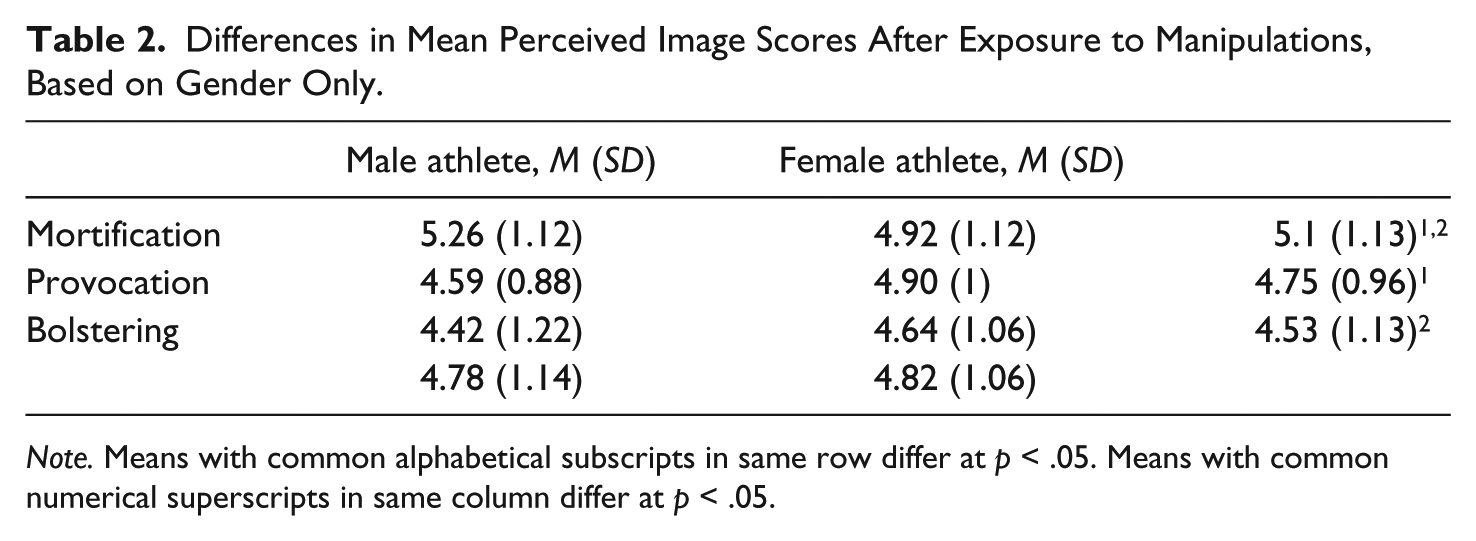
RQ2a addressed the influence of gender on the repair process regardless of the athlete’s response to the transgression. Based on the analysis, there was not a main effect for gender on the athlete’s perceived image, F(1, 285) = 0.197, p = n.s.
RQ2b addressed the interaction between the athlete’s gender and response strategy on perceived image. Based on the analysis, there was not an interaction effect present, F(3, 283) = 2.505, p = n.s. Table 2 provides the mean perceived image scores based on the influence of gender.
Differences in Mean Perceived Image Scores After Exposure to Manipulations, Based on Gender Only.
Note. Means with common alphabetical subscripts in same row differ at p < .05. Means with common numerical superscripts in same column differ at p < .05.
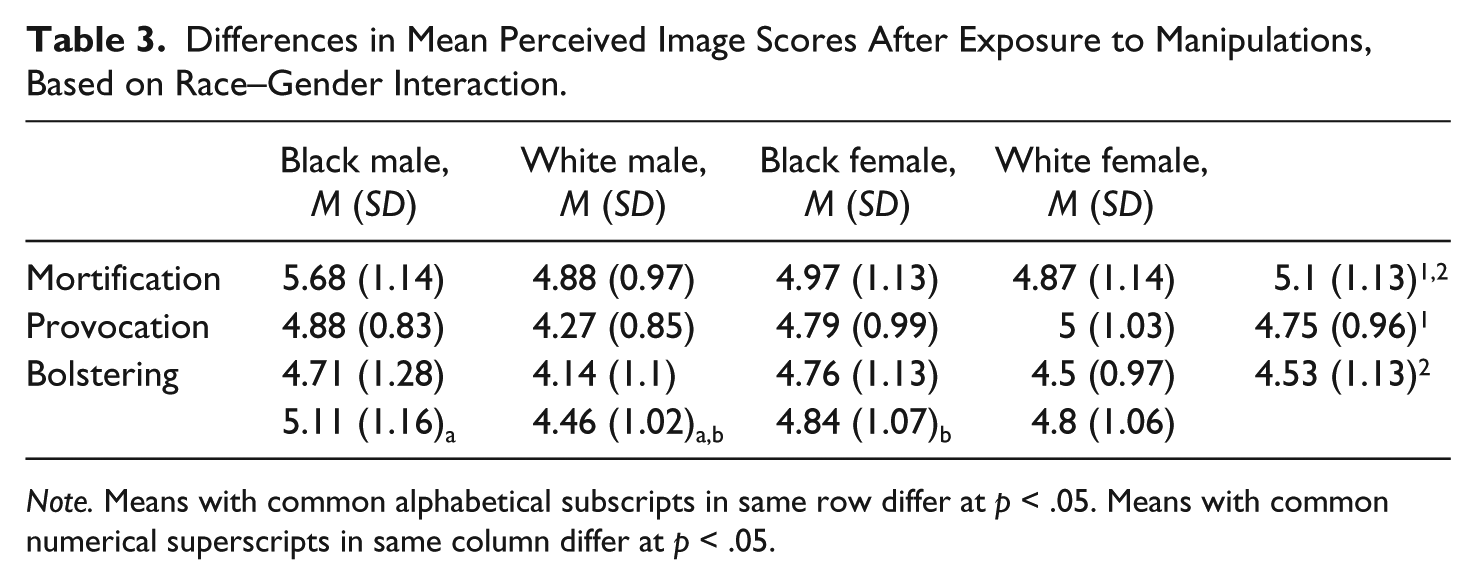
RQ3a addressed the interaction between the athlete’s race and gender on the image repair process regardless of response strategy. A significant race by gender interaction was revealed, F(3, 283) = 5.041, p = .002,
Differences in Mean Perceived Image Scores After Exposure to Manipulations, Based on Race–Gender Interaction.
Note. Means with common alphabetical subscripts in same row differ at p < .05. Means with common numerical superscripts in same column differ at p < .05.
RQ3b addressed the interaction among race, gender, and image repair strategy on the athlete’s perceived image. A significant interaction did not emerge, F(4, 282) = 0.656, p = n.s.
Discussion
The current study provides an important empirical test of the strategic devices addressed in Benoit’s IRT. Previous work (Brown et al., 2012) has found reducing offensiveness strategies (e.g., bolstering, shifting the blame) to be less effective than the mortification strategy. This study reaffirms the effectiveness of mortification over bolstering while extending our understanding of these strategies by demonstrating that mortification is also preferred to provocation. Moreover, the insertion of two crucial identity variables, race and gender, still did not negate the preference for mortification over the other two tested approaches. As Brazeal (2008) notes, showing true remorse is critical to garnering sympathetic public response. Accordingly, football player Terrell Owens ultimately failed in repairing his image because of a lack of presumed authentic mortification. Meanwhile, Sanderson (2010) found Tiger Woods passed this public test of authentic mortification, writing that, “This frailty, previously unbeknownst to fans, promoted connection and feelings of similarity to Woods, as he appeared more like them than at any other time in his career” (p. 449). As such, it appears that the general public expects some level of mortification within any athlete crisis.
Beyond Benoit’s seminal IRT, the results offer possible extensions and points of contact with other theories not previously undergirding image repair scholarship. The finding that, regardless of response, Black athletes consistently rated more positively than their White counterparts is a deviation from most prior research. Indeed, Anderson and McCormack (2010) argue, “Black athletes are perceived as thugs, masculinized by their sports space” (Anderson & McCormack, 2010, p. 145). Two streams of theoretical thought percolate within such a finding. If participants were cognizant of the stereotypes surrounding Black athletes, finding articulate, thoughtful attempts at image restoration by Black athletes could be seen as a correlate of expectancy violation theory (see Burgoon & Jones, 1976) if people were expecting less dignified or arrogant responses. Likewise, White athletes are much less likely to be ascribed negative, aggressive traits (Denham, Billings, & Halone, 2002), meaning that the indiscretions within each manipulation could have caused an expectancy violation regarding White athletes as well.
Second, from an attribution standpoint, this could also be explained by Kelley’s (1967) principle of covariance, specifically the element of consensus. When examining a situation to assess blame, the consensus factor entails investigating the responses of other people similar to the accused when faced with that particular situation. Kelley (1967) theorizes that if other people have the same reaction to the situation as the accused, then consensus is high, and the public will attribute less responsibility to the accused. There is an inverse relationship between the amount of responsibility attributed to the accused and the accused’s image (less attribution typically means a more positive image; see Coombs & Holladay, 2001). In the current circumstances, a high level of consensus could potentially result in a buffering effect when it comes to the image of Black athletes. Because Black athletes are overrepresented as criminals in the news compared with Whites (Mastro, Blecha, & Seate, 2011), through the lens of consensus, exposure to criminality in this context could be more damaging to the White athlete than the Black athlete. In other words, because this characterization is counter to consensus in the case of Whites, their image is harmed more so than Blacks, whose image is, regrettably, already aligned with such negative characterizations. That said, this interpretation is in conflict with much of the research examining the effects of exposure to media depictions of race and crime (e.g., Dixon, 2008). Certainly, additional research will be needed to help clarify the mechanisms at play here.
From a practical standpoint, this study provides evidence that, at national and international levels, race could be a more primary factor than gender on the image repair process. It could logically unfold in future research that the impact of race on the image repair process impacts other aspects of society other than the sporting arena (e.g., politics, entertainment). Thus, image repair scholars cannot treat accused parties as a monolith; there are other factors that should be accounted for when examining the image repair process. This study provides evidence that race significantly impacts the process, and that further examinations must consider the influence of other demographic factors on the success or failure of image repair efforts.
Although this study did not reveal gender differences, a single study cannot offer definitive conclusions. Nevertheless, this study may provide evidence that race is a more predominant factor in the image repair process than gender. Because this study specifically addresses athlete image repair, the visibility of Black females in the sporting arena when compared with other public positions (e.g., politicians, CEOs) could provide a rationale for the insignificant impact of gender.
While other studies were inherently limited by college student samples, this study provides a more generalizable sense of public sentiment. However, two limitations should still overtly be noted. One limitation of the work is that it only includes two racial manipulations, reducing complex issues such as race/ethnicity to a Black/White binary. Such limitations are not ideal, and future research should endeavor to include other racial/ethnic backgrounds to determine the potential attitudinal change when Latino, Asian, Middle Eastern, or Other racial/ethnic groups are part of the empirical equation. Such investigations would be logical supplemental studies, as this study provides ample evidence that race is a component in overall attitude formations surrounding portrayals of athletes, their indiscretions, and their attempts to repair their images as the behavior is amplified in the media.
A second limitation involves the use of manufactured (unknown) profiles for subjects. While such manipulations were necessary to maximize control within the macro-level variables of gender, race, and response strategy, most public/applied situations involving real athletes would inherently be influenced by preconceived dispositions in favor or against a given athlete (and their related team affiliation). No celebrity athlete lives in a vacuum for a moderate or high sports fan. So, assessing the joint roles of familiarity and level of sport fandom appear central to subsequent studies.
Continuing with directions for future research, additional studies should place greater focus on the possibility that assumptions rooted in expectancy violation theory could serve as an explanatory mechanism. Identity could still play a role within the empirical testing of image restoration strategies, but scholars can only determine the degree of that role if first discerning potential biases and differential treatment that individuals cognitively bring into a given situation. For instance, most political scandals are presumed to involve White male politicians (see Rule & Zimmerman, 1994); thus, testing image restoration strategies within this realm may produce a different type of expectancy violation effect when presented with seeming anomalies such as a non-White or woman politician in a sex scandal.
Studies should also focus on these identity factors as they unfold for organizations and not just for individuals. Despite consistent findings that people prefer the mortification response for individuals (Brown & Brown, 2014; Brown et al., 2012), other studies offer results conflicting with this linearity when an organization is attempting image repair. Specifically, Dardis and Haigh (2009) revealed that reducing offensiveness was more useful in organizational image repair than was mortification; Haigh and Brubaker (2010) corroborated the finding that mortification was not ideal in an organizational setting. Thus, future work should place increased emphasis on the individual versus organization dichotomy, as well as the potential impact of race and gender in different mediated situations.
Overall, this study provides several useful heuristics for understanding how communication strategies significantly influence public perception. Moreover, the work underscores the role of race as it impacts different microcosms of society, opening the conversation for the potential impact of other identity-oriented features both immediately visible (e.g., gender, nationality) and internal (e.g., sexual orientation, socio-economic status). While this study represents sport-specific image repair attempts, the results have impact for many domains outside of athletics, emphasizing that not all attempts at image repair are equal, not all apologies are similar, and not all respondents will respond to each strategy in the same manner.
Footnotes
Appendix A
Appendix B
Declaration of Conflicting Interests
The author(s) declared no potential conflicts of interest with respect to the research, authorship, and/or publication of this article.
Funding
The researchers were funded by the Lewis Advertising Research Fund, provided by The Department of Advertising and Public Relations at The University of Alabama.