



Abstract
Intergenerational panel data are used to test a model of youth news socialization. We hypothesize that observing parent news reading and participating in family news discussions have concurrent effects on youth news use, ultimately resulting in a propensity for news consumption that persists into adulthood. Results from a recursive path model demonstrate parent communication variables have direct and indirect effects on frequency of youth news use. Frequency of youth news use, in turn, predicts news use among the same respondents 7 years later. We also find a latent, lagged effect of parent news reading on their kids’ long-term news use.
One of most common findings in the political communication literature is the positive effect of news consumption on democratically valuable attitudes and behaviors. News use enhances political learning (Delli Carpini & Keeter, 1996; Drew & Weaver, 2006; Hardy, Gottfried, Winneg, & Jamieson, 2014; Shaker, 2009), spontaneous policy reasoning (Pingree, Scholl, & Quenette, 2012), participation in national political campaigns (Bakker & de Vreese, 2011; Kaufhold, Valenzuela, & De Zúñiga, 2010), voter turnout (Baum & Jamison, 2006; Chaffee, Zhao, & Leshner, 1994; Prior, 2005, 2007; Scholl & York, Forthcoming), and political efficacy (Kenski & Stroud, 2006; Tewksbury, Hals, & Bibart, 2008). For these reasons, news use is often perceived to be beneficial from a normative democratic perspective that emphasizes a knowledgeable and active citizenry who can sensibly self-govern. Yet, while the literature has frequently mapped the effects of news use on political outcomes, it is less clear regarding empirical antecedents to, or causes of, news use.
Early research by Steven Chaffee and colleagues established the role of family communication processes as antecedents to news media consumption and political engagement later in a young person’s life (Chaffee, Jackson-Beeck, Durall, & Wilson, 1977; Chaffee, McLeod, & Atkin, 1971; Chaffee, McLeod, & Wackman, 1973; Chaffee & Tims, 1982; Chaffee, Ward, & Tipton, 1970; Chaffee & Yang, 1989; McDevitt & Chaffee, 2000). This research theorized and empirically tested demographic and family communication factors that influence long-term news consumption patterns. However, competing socialization mechanisms underpinning these relationships—specifically, observational learning of parent news reading and family news discussions—were not examined within the same empirical framework, leaving space in the literature for an investigation of multiple communication variables that shape both concurrent news behavior among children and adolescents as well as long-term consumption patterns.
Using path analysis and intergenerational panel data, this study investigates concurrent relationships between news media behavior of parents and their children at Time 1, and levels of news use among the same kids, now young adults, 7 years later at Time 2 (e.g., Chaffee et al., 1977; Chaffee & Tims, 1982). In the presence of demographic controls, this study finds positive associations between family communication behavior and frequency of news use among young adults 7 years in the future. The novel implication is that news consumption, like entertainment TV use (Lee, Bartolic, & Vandewater, 2009), may be at least partially grounded in early parental socialization processes in addition to being motivated by mood states or psychological needs for media content at the time of selection.
Parental Socialization
Aspects of familial relationships influence cognitive, affective, and behavioral orientations later in life. For example, parental socialization shapes a young person’s conscience (Kochanska, 1993), cultivates emotions and social competence (Eisenberg, Cumberland, & Spinrad, 1998), and improves self-esteem (Gecas & Schwalbe, 1986). Children and adolescents learn how to behave based on observing the actions of others, modeling their own behavior after that of socially significant peers and role models, especially their parents (Bandura, 1986, 2009; Bandura & Huston, 1961). The more frequently a parent performs a particular behavior, the more accessible in memory and the more likely the given behavior will be emulated by youth (Bandura, 1986). Through this observational socialization process, young people develop propensities for physical activity (Pugliese & Tinsley, 2007), alcohol consumption (Barnes, Farrell, & Cairns, 1986), cigarette smoking (White, Johnson, & Buyske, 2000), and academic achievement (N. E. Hill & Tyson, 2009).
In the political domain, a wide range of political orientations and behaviors are developed during youth (Jennings, Stoker, & Bowers, 2009) through a variety of mechanisms, including parent–child observational learning and interpersonal discussion. Children and adolescents adopt political party identifications (Jennings & Niemi, 1968; Kroh & Selb, 2009; Niemi & Jennings, 1991), political participation behaviors (Beck & Jennings, 1982; Borah, Edgerly, Vraga, & Shah, 2013), and political attitudes (Chaffee et al., 1970; Tedin, 1974) by modeling parent behavior, and through give-and-take discussions with family (Austin & Pinkleton, 2001; McDevitt & Chaffee, 2000, 2002). Aspects of home life, including family communication styles (Chaffee et al., 1973) and frequency of interpersonal communication with parents (Merelman, 1973), mold each of these political orientations in the familial image. This is particularly the case among families with high socioeconomic status (SES), in which a financial and educational framework for informed political discussion has been established (McDevitt & Chaffee, 2000).
In addition to political orientations and behavior, several studies have also linked parental socialization to long-term media behavior. For example, the persistence of television viewing behavior is shaped by a number of parent-related factors, including household media rules limiting the amount of TV a young person can watch, the availability of a television set in the child’s bedroom, eating meals while watching TV, and parental co-viewing (Bleakley, Jordan, & Hennessy, 2013; Lee et al., 2009). Similarly, the frequency with which parents read or watch news media has lasting effects on the news behaviors of their offspring (Chaffee et al., 1971; Conway, Wyckoff, Feldbaum, & Ahern, 1981), although mechanisms motivating these effects are not fully understood and represent an underdeveloped area of the literature.
Early media socialization studies suggested a direct influence of parent media behavior through kids’ behavioral modeling of the “parental example” (Schramm, Lyle, & Parker, 1961). More recent studies posit a socialization mechanism involving passive modeling of parent news behavior via “opportunity” or incidental exposure to TV news: that is, “children watch television news [simply] because that is what their parents are watching” (Conway et al., 1981, p. 166). Whether actively or passively modeling parents’ media behaviors, the observational learning perspective suggests that youth adopt media behaviors that mirror media behaviors of parents.
A rival explanation is that children and adolescents are socialized to news use via frequent discussions about news and current events with family, especially parents (McDevitt & Chaffee, 2000), leading to the development of long-term news consumption patterns. Familial news discussion may pique interest in politics and current events among youth, promoting autonomous news consumption across a number of mediums including print newspapers (Atkin, 1981) and stimulating concomitant information gains (Chaffee et al., 1970) as youth perceive the utility in acquiring political information for use in future discussions with parents or peers (Drew & Reeves, 1980). Assuming that news behavior is developed during youth through either observational learning or family news discussions (or both), this behavior may then persist over time through repetition that results in non-conscious—or “habitual”—selection of news content.
Long-Term Persistence of News Behavior
Many of the behaviors individuals engage in during the formative years of childhood and adolescence continue to influence behavior over the life span (Triandis, 1977, 1980). These behaviors can be learned from parents, peers, or a variety of other influential role models, and can be advantageous or deleterious in nature. For example, youth delinquency explains a considerable amount of variation in deviant adult behavior, including alcohol abuse, economic dependency, and educational failure (Sampson & Laub, 1990).
Likewise, early news reading behaviors, once learned, have been shown to persist over time. In a study using nationally representative panel data and time-lagged correlations, Chaffee et al. (1977) discovered that print newspaper reading in May 1968 was positively related to print newspaper reading in November 1968, immediately prior to the presidential election. A similar time-lagged correlational technique revealed a positive relationship between frequency of print newspaper reading among adolescents in 1965 and frequency of print newspaper reading among the same kids in 1973—a relationship spanning an 8-year time frame. As with many other behaviors, Chaffee et al. (1977) provide evidence that, once learned, frequency of news use persists over time (see also Chaffee & Tims, 1982 for medium-specific time-lagged correlations).
Once news behavior has been established in youth, it is possible that repeated use may form a “habit” that guides future behavior. Psychologists hypothesize that human behavior generally operates via two routes: the first route involves well-practiced behaviors such as reading or watching news that become habituated through repetition, increasing the likelihood of future performance, and the second route involves behaviors that are not well-practiced and that are consciously and deliberately chosen to be performed at a given point in time (Ouellette & Wood, 1998). Habits motivate human behavior to a greater extent than does conscious decision making, with the caveat that deliberate cognitive processing about a behavior can alter the frequency with which the behavior is performed (Ajzen, 1991; Sheeran, Orbell, & Trafimow, 1999). Nevertheless, the “frequency of past behavior, a standard indicator of habit strength . . . is the best predictor of future behavior” (Ouellette & Wood, 1998, p. 54). And as LaRose (2010) suggests, past experience with media may result in “automatic” or “non-conscious” media selection in the future (p. 194), an argument that has found empirical support, with individuals routinely reading newspapers without deliberate thoughts guiding the behavior (Wood, Quinn, & Kashy, 2002).
While it is beyond the scope of this article to conduct direct tests of news media habits, this study does explore the possibility that frequency of youth news use directly predicts future levels of news consumption, which may be indicative of an underlying propensity—if not a habit—for news media use. This article also tests multiple demographic and parent communication factors that may spur youth news use, which in turn theoretically motivates news consumption over longer periods of time. To better illustrate the hypothesized relationships between variables, Figure 1 displays a conceptual model with demographic and communication variables observed during youth and their influence on future levels of news use.

Conceptual model showing hypothesized relationships between parent–youth communication variables and future levels of news media use.
Moving from left to right, the conceptual model hypothesizes that parent SES provides a framework for family communication patterns, including news discussions and parent newspaper reading (McDevitt & Chaffee, 2000). In turn, parental communication variables affect the frequency with which youth engage in independent newspaper reading (Chaffee et al., 1971; Chaffee & Yang, 1989; Conway et al., 1981). Parent media use may exert an independent, lagged effect on long-term news use among kids; however, it is more likely that observing parent news reading and participating in family news discussions have concurrent effects on youth news use, which in turn predicts news use later in the youth’s life (Chaffee et al., 1977; Chaffee & Tims, 1982; see also Ouellette & Wood, 1998; Wood et al., 2002).
Hypotheses and Research Questions
Based on our conceptual model, which is grounded in work authored primarily by Chaffee and colleagues, we test effects of demographic and communication variables on concurrent and long-term media use among kids. Formally,
A research question is also posited regarding untested interrelationships between family communication variables and kids’ future levels of news use. This question is designed to explore effects of one mechanism for long-term news use—observational learning of parent news behavior—against another: family discussions about news. Formally,
Method
Data
Publicly available data from the University of Michigan’s Panel Study of Income Dynamics (PSID) were obtained online for the analysis. 1 The PSID is a longitudinal study of a representative sample of U.S. citizens and their families used widely in the social sciences to examine long-term and intergenerational behavior (M. Hill, 1992). Since 1968, the PSID has collected data regarding the “head of household” (typically the father) in the individual-level main field interview, and the head of household’s family in the family-level main interview. Both individual- and family-level PSID main interviews were collected on an annual basis from 1968 to 1997. Since 1997, the PSID main interviews have been conducted biennially.
Starting in 1997, PSID officials also began collecting more detailed survey data on children of PSID families, who in 1997 were ages 0 to 12 years old. This information is provided in the PSID’s Child Development Supplement (CDS) survey, and focuses on child developmental outcomes within the context of family, neighborhood, and school environments. In 2002, the second wave of CDS data was collected on the same kids and their parents. 2 Seven years later, the PSID’s follow-up Transition to Adulthood (TA) survey collected data on the same kids, then considered young adults, age 18 years and above. The TA data assessed young adult psychological development, time use, financial stability, and related outcomes.
Here, data are used regarding parent demographic characteristics from the 2003 PSID main interviews, parent and youth media use variables from the 2002 CDS, and demographic and news use variables from the 2009 TA. The PSID online data center automatically merges these data using respondents’ unique identification numbers. 3 Appropriately weighted, these data provide nationally representative estimates. 4
Among the 2009 TA sample, N = 1,037 young adult respondents ages 18 to 25 years were utilized for the analysis. These respondents’ parents completed the 2003 PSID main interviews and participated in the 2002 CDS parent interview, which provides parent and child demographic variables. Data from the 2002 CDS also provides the parents’ time diary assessments of their child’s media use. Finally, the 2009 TA provides data regarding young adult demographics (education, income, etc.) and young adult (2009 levels of) news media consumption.
Measures
Control variables
Parent characteristics
Parent demographic variables were derived from the 2003 PSID individual- and family-level data and were included in subsequent statistical modeling procedures (see Table 1). Interviewers asked parents to respond to questions about demographic characteristics regarding the year 2002 (e.g., combined parent income in 2002). The variable parent education measured formal years of educational attainment for both the head of household and the spouse (M = 12.91, SD = 2.90). The PSID assesses parent income by summing both the head’s and spouse’s taxable income for the year 2002 (M = US$79,296).
Descriptive Statistics.

Note. N = 1,037. PSID = Panel Study of Income Dynamics; CDS = Child Development Supplement; TA = Transition to Adulthood.
Young adult demographics
Demographic characteristics of young adults were used in the analysis as control variables. Two young adult demographic variables—sex and race—were carried over from the 2002 CDS data. In terms of sex, the sample used in this study was 51.67% female. African American respondents comprised 14.73% of the sample and Hispanic respondents 12.72%. 5
Three media use variables observed in 2002 were used as controls in the analysis to statistically mitigate the effects of time spent using mediums other than newspapers. First, parents recorded how many hours the family TV was on in the house each day. The analysis uses this item as a measure of parent television use (M = 6.17, SD = 4.67). In addition, parents were asked to record in a diary the amount of time their kids spent watching television or using the Internet. PSID coders converted these items to seconds for purposes of precision in measurement. This analysis uses the same items, called youth television use (M = 116.77, SD = 113.15) and youth Internet use (M = 8.74, SD = 33.15), but are coded in minutes for ease of interpretation. 6
The remaining control variables were obtained from the 2009 TA survey. The average age of the sample in 2009 was approximately 21 years (M = 21.50, SD = 2.20). Young adult education measured years of formal education completed (M = 13.75, SD = 1.48). Young adult income was measured by the amount of whole dollars the young adult earned in 2008 from all taxable income, including bonuses, overtime, tips, commissions, or military pay (M = US$5,755).
A dummy variable for college student status was also included, asking respondents whether they were currently enrolled in a post-secondary institution (45.54% enrolled). Church attendance was an ordered categorical variable that assessed how frequently young adults attended religious services during the past 12 months, from not at all to more than once a week (M = 1.59, SD = 1.65). Respondents were also asked about their marital status, including whether they were currently single, married, or some other status (9.19% married). Finally, respondents were asked how many biological, adopted, or stepchildren they currently had, with most reporting having no children in their care (M = 0.22, SD = 0.62).
Independent variables
Parent newspaper use (2002)
To measure parent newspaper consumption, we used a single variable from the 2002 CDS parent interview. This variable, parent newspaper use, was an ordered categorical measure that asked parents how often they read the newspaper during the average week, from 0 to 7 days (M = 2.42, SD = 3.02).
Parent-youth news discussion (2002)
A single item called parent-youth news discussion was used to tap parental socialization of news behavior. This was an ordered categorical variable that asked parents how often they talked about current events and news with their child during the month prior to the interview, from never to everyday (M = 2.61, SD = 1.05).
Youth media use (2002)
Parents assessed the amount of time their child read the newspaper during an average weekday using a time diary. The PSID reports these time use measures in seconds, which we subsequently convert to minutes for the analysis. Notably, parents reported little youth newspaper reading, with a mean of less than 1 min of reading per day on the youth newspaper use variable (M = 0.05, SD = 1.08).
Dependent variable
Frequency of young adult news media use (2009)
One dependent variable was analyzed using data from the 2009 TA. Read/watch news frequency was an ordered categorical item that asked respondents how often during the past 12 months they watched news on television or read a newspaper or news magazine, from never to several times per week (M = 3.88, SD = 1.42). Although this measure and many like it are subject to response biases (Prior, 2009), this item represented the most suitable measure of news use in the 2009 TA data.
Statistical Procedure
A recursive path analysis was used to test relationships between the primary independent variables and effects on young adult news use, controlling for the exogenous effects of all other variables in the model. As the article’s hypotheses and research question addressed relationships between variables observed during youth, and their independent effects on future levels of news use, a path analysis was the most appropriate statistical procedure. For this procedure, we use Stata 13.0’s structural equation modeling software component and Acock’s (2013) structural equation modeling handbook for Stata.
Results
Exogenous Control Variables
First, a number of exogenous control variables were independently associated with levels of young adult news use in 2009. African American respondents compared with White respondents in the excluded baseline category (β = .12, p < .01), young adult income (β = .11, p < .01), and the number of children in the young adult’s care (β= .08, p < .05) were all positively associated with young adult news use. In addition, time spent using the Internet in 2002 (β = .06, p < .10) and frequency of young adult church attendance (β= .08, p < .10) were positively associated with young adult news use, although these latter relationships were on the borderline of traditional levels of statistical significance.
H1a to H1d : SES Hypotheses

Path model showing endogenous effects of parent SES, parent–youth news discussion, parent newspaper use, and youth news use on young adult news use.
The indirect effects of parent SES on youth newspaper use and young adult news use are summarized in Table 2. As reported in Table 2, there were no indirect effects of parent education and income on youth newspaper use, as was predicted by
Path Estimates Showing Relationships Between Parent, Youth, and Young Adult Variables.
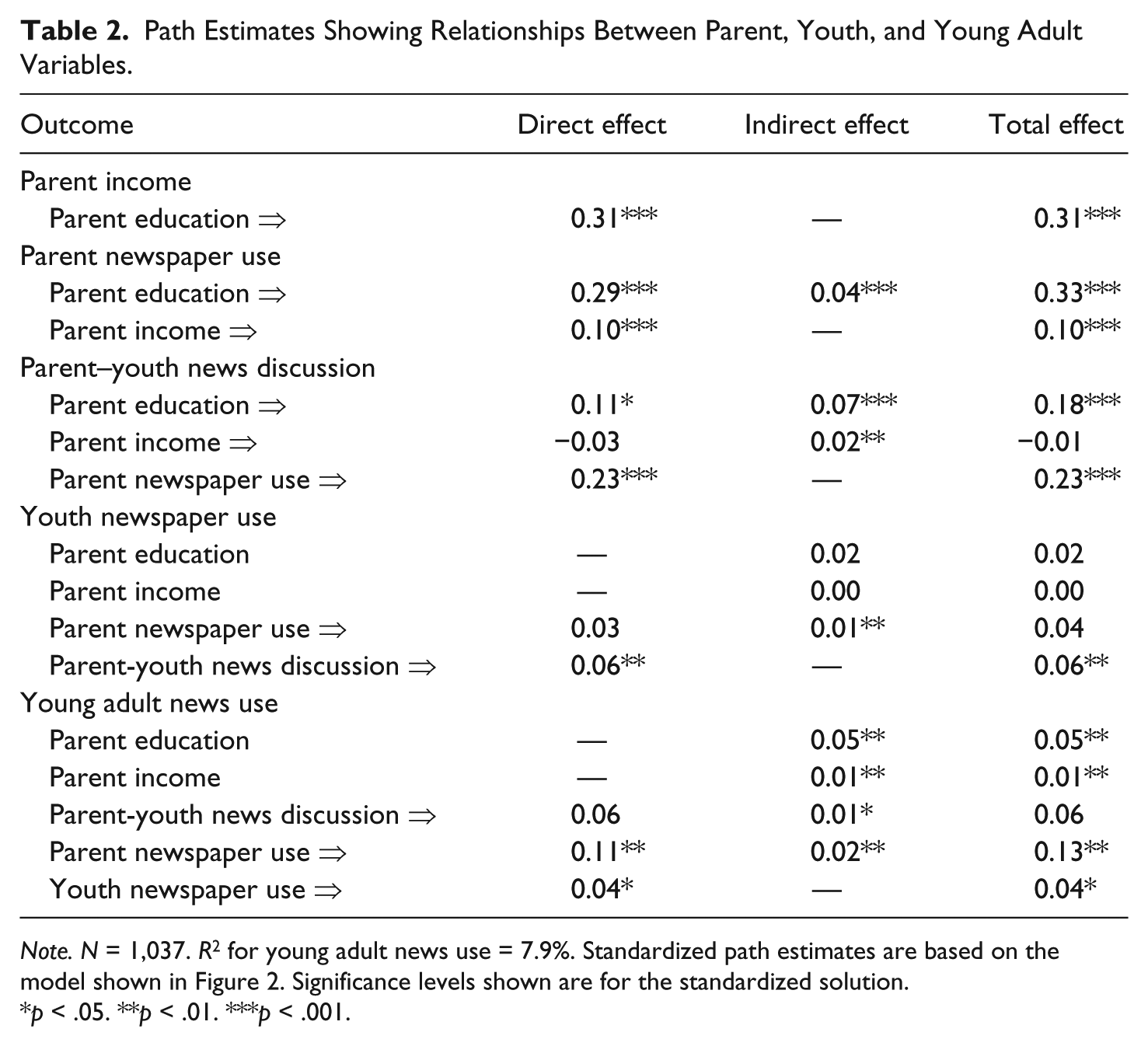
Note. N = 1,037. R2 for young adult news use = 7.9%. Standardized path estimates are based on the model shown in Figure 2. Significance levels shown are for the standardized solution.
p < .05. **p < .01. ***p < .001.
H2 : Observational Learning Hypothesis
The second hypothesis,
H3 : Direct Socialization Hypothesis
The third hypothesis stated a positive and direct effect of parent–youth news discussion on youth newspaper use. There was indeed a positive effect of discussing news with youth on frequency of youth newspaper reading (β = .06, p < .01), indicating that more frequent discussions of news and current events with youth related to higher levels of newspaper use among youth.
H4 : Propensity or “Habit” Hypothesis
The final hypothesis,
RQ1 : Modeling Versus Direct Socialization
To examine our research question, it was necessary to test the relative effect of parent newspaper reading and parent–youth news discussion on long-term news use among young adults. This question essentially asks which variable ultimately has a stronger overall effect on long-term news consumption: observing parents reading newspapers or discussing news and current events with parents.
As shown in Table 2 and Figure 2, the total effect of parent newspaper use on young adult news use (β = .13, p < .01) was positive and significant, while the total effect of parent–youth news discussion on future levels of news consumption was not significantly different from zero (β = .06, p = ns). The majority of the parent newspaper reading effect was direct (β = .11, p < .01), although the indirect effect of parent newspaper reading via youth news reading and parent–youth news discussion did explain significant variation in young adult news use (β = .02, p < .01). These findings, in combination with the null effect of parent newspaper reading on youth newspaper reading (β = .03, p = ns), suggest that parent newspaper use operates on long-term news among kids via two means: indirectly by promoting parent–youth news discussion and youth newspaper use, and directly through what could be described as a lagged observational learning effect in which parent behaviors are observed in childhood and adolescence, but are only activated later in life, as kids age and change life roles (see Min, Silverstein, & Lendon, 2012).
In response to
Discussion
As news media consumption is linked to a wide range of beneficial individual-level political outcomes, such as increased political knowledge and participation (e.g., Delli Carpini & Keeter, 1996; Kenski & Stroud, 2006; Scholl & York, Forthcoming), it is crucial to understand both the effects of news media use and its antecedents, or the factors that lead to sustained and frequent use. This study uses intergenerational panel data to test multiple, competing demographic and media socialization factors that influence news use in both the short- and long-term. We find that parent news behaviors have complex and lasting effects on kids’ news behavior.
As such, this study adds several novel contributions to the political socialization and family communication literatures. First, this study finds that only small minorities of youth begin using news early in life, between the ages of 11 and 18. Yet this early propensity for news use, measured here in the form of print newspaper reading, was a positive predictor of news use 7 years later, when the same kids were between 18 and 25 years old. These findings are consistent with research showing kids’ media use to be positively associated with long-term media consumption (Bleakley et al., 2013; Chaffee et al., 1977; Chaffee & Tims, 1982; Lee et al., 2009). Moreover, the findings are suggestive of a habit mechanism in which repeated news use in youth gradually results in a psychological preference for news content, although it is not possible to directly test this possibility with the available data.
Second, we find that parent newspaper reading exerts a stronger overall influence on kids’ long-term news behavior than does news discussion. Contrary to our expectations, the parent newspaper reading effect is mainly unmediated; that is, frequent parent newspaper reading during childhood and adolescence is directly related to frequent news use among young adults 7 years in the future. One explanation for this unmediated effect is that parent values and behaviors can be observationally learned during youth and remain dormant until the child reaches a particular developmental stage that activates the value or behavior (Min et al., 2012). That is, kids observe and emulate, or “model” parent news reading behavior (Bandura, 1986, 2009; Bandura & Huston, 1961; Schramm et al., 1961), but do not immediately adopt the behavior. Rather, the behavior is learned and remains unexpressed until the youth reaches a particular developmental stage, such as young adulthood when kids enter or exit college, marry, become homeowners, and begin to emerge as politically engaged citizens. An alternative explanation may be that news use is at least partially driven by latent genetic factors, in addition to being a learned behavior (Kirzinger, Weber, & Johnson, 2012; Shoemaker, 1996). Twin study data could be used to test the latter possibility by separating the mechanisms.
A third finding was that parent newspaper reading has a small, indirect effect on long-term news use that operates indirectly through parent–youth news discussion. That is, parents who frequently read the newspaper tended to more frequently discuss news with their kids, indirectly resulting in increased youth newspaper reading and ultimately long-term news use. It is possible that frequently reading the newspaper spurs discussion with kids simply from incidental, common exposure to the medium; in turn, children and adolescents may be motivated to read newspapers independently to fulfill an information utility function (Drew & Reeves, 1980) so they can talk about the news with mom and dad. Alternatively, news discussion may stimulate increased interest in news media, relating to increased short- and long-term use.
In summary, it appears both parent newspaper reading and news discussions with youth play roles in the development of news behavior among kids, in both the short- and long-term, and especially among kids living in high SES households (see Table 2). Surprisingly, we found that parent newspaper reading does not directly affect youth news use, and may be more closely aligned with a lagged observational learning effect in which young adults recall the normative citizenship behaviors of their parents and begin using news in similar patterns (Min et al., 2012). Future studies could use intergenerational panel data and latent growth curve modeling to explore this possibility in greater detail by examining when the direct, time-invariant effect of parent news use has the greatest influence on news consumption among kids at different stages of young adulthood: early (18 to 22 years old), middle (22 to 24 years old), or late (24 years and older). Latent growth curve modeling paired with the appropriate data could also control for time-varying life events—e.g., entering college, marrying, graduating, becoming a homeowner—that may influence how individuals reflect on parent citizenship behaviors observed in childhood and adolescence but that are perhaps not perceived as relevant or desirable to emulate at the time.
From a normative democratic perspective, the results of this study can be interpreted optimistically. Children routinely adopt their parents’ political attitudes (Chaffee et al., 1970; Tedin, 1974), political party identification and ideological orientations (Borah et al., 2013; Jennings et al., 2009), and even entertainment television-viewing behaviors (Bleakley et al., 2013; Lee et al., 2009). Similarly, this study suggests that parents can have a lasting impact on news consumption. As with the development of other behaviors, parents can take a proactive stance in encouraging kids’ future news consumption habits, a key aspect of democratic citizenship that relates to increased levels of political knowledge, participation, efficacy, and voter turnout among adults. Through modeling news behaviors and through family discussions about news, parents can play an instrumental role in the cultivation of the next generation of news consumers and democratic citizens. Kids may not observe and immediately adopt parent news behaviors, but an observational learning mechanism may eventually pay informational dividends.
As prior research has demonstrated (McDevitt & Chaffee, 2000), it may also be possible to encourage political communication among families through a variety of interventions, including middle school and high school civics curriculum or news-in-school programs (see Mindich, 2005) that prompt both bottom-up (child-to-parent) and top-down (parent-to-child) processing of political information (McDevitt & Chaffee, 2002; McLeod, 2000). This study suggests an additional strategy that could enhance political communication processes and outcomes: targeted news products that appeal to parents and youth, which may increase the possibility that parents and kids can discuss topics presented in news content. Applied experiments or quasi-experimental field studies could be used to test the effectiveness of this strategy.
The secondary survey data used in this study, while representative of the American population with proper weighting, suffers from a variety of limitations in measurement that future studies could avoid using experimental methods. In particular, the single-item parent media measure used in this study is limited to newspaper reading and cannot assess television or Internet news use. Likewise, the youth and young adult measures of news consumption are also limited. Given that newspaper reading is in decline in the United States, and that newspaper reading does not necessarily capture the full range of potential news behavior across mediums, the analysis may lack predictive power. More generally, news consumption measures such as the ones presented here are considered problematic, subject to a variety of response biases (Prior, 2009), and thus this study must acknowledge these measures as a potential caveat.
Even recognizing the limitations inherent in secondary survey data analysis, this study nevertheless presents several unique implications for family communication and political socialization research. News media use among adults appears to be, for some citizens, a holdover from previous experiences with news reading. Crucially, this behavior is driven at least in part by their family’s orientation toward news, including how often they read and discuss news with youth. Not only do these family communication behaviors influence youth news use in the short run, as was discovered previously (Conway et al., 1981), they also appear to have lasting effects on news consumption patterns over a period of several years, raising the possibility that parental news socialization at least partially informs media choice in addition to psychological factors such as mood states, psychological needs, or the avoidance of dissonant information at the time media content is selected. Future studies could delve further into these relationships by incorporating precision measures of media use across several channels, as well as measures of family communication styles (e.g., Chaffee et al., 1973), to better flesh out factors that give rise to long-term news consumption behavior and related political outcomes.
Footnotes
Acknowledgements
The authors thank the Remal Das and Lachmi Devi Bhatia Professorship at the Manship School of Mass Communication at Louisiana State University, which supported this work in 2012-2013.
Declaration of Conflicting Interests
The author(s) declared no potential conflicts of interest with respect to the research, authorship, and/or publication of this article.
Funding
The author(s) received no financial support for the research, authorship, and/or publication of this article.