




Abstract
This study considers two news ticker formats—the update ticker and the scrolling ticker—to determine the impact of ticker format on memory for news items in the tickers as well as for news program content presented in the background. Post-viewing responses between two treatment groups were compared, revealing better recognition of both types of news content when tickers updated rather than scrolled. Also, viewers report no differences in perceived clutter or program liking, suggesting there is no downside to using an update format.
Several studies conducted in the last decade demonstrate an increasing tendency, primarily among the younger generations, to use multiple media simultaneously and/or multitask while consuming media (Carrier, Cheever, Rosen, Benitez, & Chang, 2009; The Council for Research Excellence, 2009; Jeong & Fishbein, 2007; Roberts & Foehr, 2008; Rohm, Sultan, & Bardhi, 2009). Younger media users appear to welcome the opportunity to process information from various sources at one time, for example, posting an update to a social networking site while researching a paper topic online. Indeed, research about attention and information processing during multitasking and multiple media use supports the possibility that Generation Xers, and arguably successive demographic cohorts, have been conditioned to parallel process complex information in ways that earlier generations cannot (Bergen, Grimes, & Potter, 2005; Hawkins et al., 2005). A recent study suggests that there is an addictive quality to multitasking; multitaskers are rewarded with a sense of emotional gratification that can lead to habitual continuation of the behavior (Wang & Tchernev, 2012).
A growing practice in television programming that appears to capitalize on these patterns of media multitasking involves simultaneous multiple-message screen formatting. The most elaborate formats are found on cable news and sports channels such as CNN, CNBC, Bloomberg News, and ESPN. Lexical insertions, such as news scrolling along the bottom of the screen, afford networks the opportunity to present additional information to viewers (e.g., stock quotes, sports scores, headlines).
Networks introduce tickers as a means of “complement[ing] a television program without drawing a viewer’s attention completely away from it” (Hatch, 1998). According to information processing theory and research, however, this must be done with caution insofar as viewers may face difficulties in processing the profusion of information in an increasingly cluttered news environment. The simultaneous presentation of multiple auditory and visual stimuli places greater demands on (limited) cognitive resources than traditional television programming. For example, viewers who multitask or multiscreen—simultaneously use multiple media screens (e.g., television, laptop, tablet, mobile)—tend to drastically under-estimate the adverse effects multitasking behavior can have on attentional abilities (Brasel & Gips, 2011). Because tickers similarly divide viewers’ attention, information processing might become inhibited, negatively affecting their ability to remember content presented in the program and/or in the ticker (Bergen et al., 2005).
Networks have given no indication they will de-clutter. Over the last decade, however, there have been several evolutions to ticker formatting; one significant alteration has involved whether information is presented as a scrolling crawl or as a “flipper” (Stelter, 2008). Rather than scrolling news continuously along the bottom of the screen, the flipper “updates” a static line of text. CNN first trialed the “flipper” ticker in 2008, and several other networks followed suit, including MSNBC in 2009. Breaking from over 4 years of using the “flipper,” CNN reverted back to the scrolling ticker in 2013 (“The ‘Flipper’ Is Out,” 2013), though many international networks (e.g., Australia’s ABC News 24, Canada’s CTV) continue using the updating (flipper) format. The present study makes an important contribution to the media effects literature by comparing the more recent updating ticker with its cousin, the traditional scrolling ticker. To the best of our knowledge, this is the first such study. In addition to considering how ticker format impacts viewers’ memory for content presented in the news program and in the news ticker, the impact of format on perceptions of clutter and program liking is explored.
Literature Review
Brief History of the Crawl
The origins of the news crawl trace back to the horizontal “zipper” of news headlines that began lighting up the tower of the headquarters of the New York Times in 1928 (Stelter, 2008). Financial markets utilized a stock market ticker (1980s), and an early variation of the crawl was adopted on the Weather Channel in 1982 (Coffey & Cleary, 2008; Stelter, 2008).
The Fox News Network is often cited as the first-mover with the present-day news ticker (Sella, 2001), although CNN introduced a continuous news crawl in late summer 2001. However, as a result of the World Trade Center attacks soon afterward, several other networks and cable stations resorted to the feature as a means of presenting as much concurrent material and coverage as possible (Josephson & Holmes, 2006). The ticker became a permanent fixture thereafter, adopted by many local news stations and non-news programming as well, providing news on everyone from “Saddam and Bin Laden to J.Lo and Ben” (Kerschbaumer, 2002; Phan, 2003).
The ticker was soon joined by other panels of screen real estate devoted to updating information. For example, CNN Headline News at one stage divided the screen into three large information panels. This multi-message format was likely an attempt by news networks to capture the “up to the minute” nature of the Internet (Cooke, 2005), and Headline News was even criticized for looking like “an alarmingly jumbled Internet news site” (Johnson, 2001). Although the multi-message approach was initially popular with viewers, the producers of Headline News (now known as HLN) responded to later critique and lampooning by simplifying its on-screen formatting (McClellan & Kerschbaumer, 2001). Currently tickers are used only on a few specific programs.
In 2008, CNN introduced a different kind of information panel, the “flipper,” to replace the horizontally streaming news crawl. The format of this new update ticker is more abbreviated. Executives at the network explain that the move to vertically updated news is a “show of support for more digestible information,” providing viewers with headlines, but without the distraction of the scroll (Stelter, 2008). Until now, there has been no published research supporting the superiority of this new format.
Limited Resources and On-Screen Complexity
Irrespective of on-screen “enhancements,” television viewing is a complex activity. Viewers are presented with information in a variety of formats—moving and stationary images in addition to spoken and written text. A robust line of research investigates how individuals attend to and engage with information, particularly within a mediated environment. Lang’s (2006) Limited Capacity Model of Motivated Mediated Message Processing (LC4MP) provides a framework for understanding how television viewers respond to complex on-screen formatting resulting from, among other elements, a scrolling or updating ticker.
The LC4MP proposes that individuals are equipped with a limited amount of cognitive resources and that individuals must continuously allocate this finite pool of resources to the sub-processes of encoding, storage, and retrieval as they manage and make sense of messages. The quality of information processing is affected by the amount of cognitive resources allocated to the processing task at hand. What a viewer ultimately remembers from a news program, then, is a function of how much of any given message is encoded, how much of the encoded information is stored, and how easily the stored information is retrieved (Lang, Potter, & Grabe, 2003). Competing and complex information in media messages can overwhelm available capacity, so that viewers have insufficient resources to encode and store information (Lang, Park, Sanders-Jackson, Wilson, & Wang, 2007).
Particularly relevant to the TV context, the parallel processing of visual and verbal information has been widely studied in the psychology literature (e.g., Shiffrin & Schneider, 1977). Specifically, working memory can be divided for visual and verbal elements being processed (Baddeley, 1992). Of interest is how viewers (parallel) process information presented in visual and auditory channels. A range of studies support the argument that processing competing visual and auditory semantic messages, for example, during multitasking, is likely associated with a decrease in information comprehension or recall (Bowman, Levine, Waite, & Gendron, 2010; Hembrooke & Gay, 2003; Pool, Koolstra, & van der Voort, 2003; Zhang, Jeong, & Fishbein, 2010). A split-attention effect, as predicted by dual-processing theory, for example, would suggest that the simultaneous presentation of a news story and unrelated ticker content could impair viewers’ processing of the background news story.
In fact, processing competing visual and auditory semantic messages is very inefficient and taxing on the cognitive resource load, and may not even happen at all depending on the multi-message complexity (Bergen et al., 2005; Mayer & Moreno, 1998). That is, if there are too many competing messages, the viewer will focus on one and not even process the other messages.
Of additional concern are recent findings that suggest cognitive deterioration caused by chronic (media) multitasking. In a study of heavy and light media multitaskers, Ophir, Nass, and Wagner (2009) find that heavy multitaskers are more easily distracted by irrelevant stimuli and, surprisingly, less efficient at switching between tasks.
The amount of information introduced on a screen, a measure of visual complexity, reduces the amount of information that is encoded, stored, and retrieved (Lang et al., 2007). In their study of the news environment, for example, Bergen and colleagues (2005) presented participants with CNN News, either accompanied by graphics and news crawls or not, and found that the news with multiple information displays detracted from comprehension of information in both the visual and auditory channels. Memory for news presented in a visually complex format was significantly less than when the news was presented in a visually simple format. Indeed, these results supported the limited capacity of the parallel processing of audio–visual information, and, in particular, the impact of competing visual messages on information processing effectiveness. They concluded that although visually complex screens attract viewers, they do not enhance message comprehension.
It is worth noting that studies have also investigated the possibility that multiple formatting of messages encourages an alternative form of processing known as perceptual grouping. Here, viewers fuse the content of visual and auditory channels, when the information is semantically complementary, essentially creating one holistically perceived message (Grimes, 1990a, 1990b; Kahneman, 1973; Triesman, Kahneman, & Burkell, 1983). Doing so requires less attentional effort. However, this phenomenon has not been supported (Bergen et al., 2005) and, in some ways, is irrelevant insofar as the majority of ticker content does not tend to possess a sufficient degree of semantic relatedness to primary news content. Recent studies suggest that ticker content, unlike news captioning, does not necessarily reinforce the primary news story being presented by the anchor or reporter but rather tends to present new information (Blackmon, Benson, & Berhow, 2004). And according to Coffey and Cleary (2008, 2011), two out of three cable news networks routinely use their news crawls for promotional purposes.
Although the use of news tickers is abundant, research comparing updating and scrolling ticker formats is in its infancy. Intuitively, however, because the text in an updating ticker is not moving, unlike the text in a scrolling ticker (Granaas, McKay, Laham, Hurt, & Juola, 1984), reading an update ticker should require fewer processing resources, which should therefore increase the chances that updating ticker information will be remembered. However, the moving text in the scrolling ticker is more likely to attract attention (Detenber & Reeves, 1996). And since both multiple-message formats compete for viewer attention and engagement with news program content playing in the background, the memory difference between the two formats may be negligible. Because news program content very likely interferes with memory for ticker content, we test the memory effects of scrolling versus updating tickers without news program content in the background. Regardless of the differences between the two formats in memory performance, however, networks are unlikely to use a format that results in perceptions of significantly greater on-screen clutter or significantly reduces program liking. For these reasons, the following research questions were posed:
Method
Design and Procedure
The two ticker formats—update and scroll—were two treatment cells of a larger experiment investigating the effects of increasing levels of on-screen clutter. Participants viewed a news program with either (a) a scrolling ticker along the bottom (Scroll) or (b) an updating ticker that “flips” a line of static text along the bottom (Update).
Upon arrival, participants were briefed about the study procedure, signed a consent form, and were randomly assigned to a condition: Scroll (n = 59) or Update (n = 32). The Scroll condition had a larger sample size to match the other conditions in the main experiment. We use tests that do not assume equal sample sizes to compare the two conditions. Each participant sat in an individual viewing lab, designed to feel as much as possible like viewing at home: The rooms included potted plants and pictures on the wall. Participants sat in a comfortable chair and watched a 32-inch (92 cm) wide standard definition (525 lines [NTSC]) flat-screen LCD television set from a distance of approximately 80 inches (2 m). A sub-sample, about a third of our participants (n = 26), viewed their session in a special lab equipped for eye tracking using the non-intrusive faceLAB system (Version 4.2). To improve the accuracy of the eye tracking, participants in this cell sat on an upright chair at a desk, looking at a 17-inch (43 cm) wide flat-screen PC monitor (set to 800 × 600) approximately 3 feet (1 m) away. At these viewing distances, the visual angles consumed by these two screens were practically identical (23° for the TV, 24° for the PC; Bellman, Schweda, & Varan, 2009).
Prior to the news program starting, participants viewed a 2-min introductory full-screen video familiarizing them with the format of news and ad content in their assigned condition. The training video featured a 15-s preview of a news story and one of the six 30-s test ads. Participants then viewed a 15-min news program, including two ad breaks, each ad break lasting 2.5 min (five 30-s ads).
Following their viewing session, participants completed a posttest questionnaire asking questions about program and ticker content recognition, perceptions of the ticker, and program liking. At the conclusion of their participation in this study, participants completed a second lab study, if they had not completed the second study before this one (study order was randomized). After completing both studies, individuals were thanked and debriefed.
Focus groups
Two months later, to explore potential explanations for the differences we found across conditions in the two lab studies, we gathered qualitative data from two focus groups (n = 16; that is, approximately 8 in each group). Participants were selected randomly from the two studies’ participants (9 women, 7 men; age range = 20 to 70, M = 45.3 years, SD = 17.2). Participants were reminded about their viewing experience by watching short videos of each study’s conditions. The two groups were moderated by a research assistant, not by any of the authors of this study, although one of the authors prepared a set of questions for the moderator to ask. The focus group sessions lasted for about an hour, spending approximately half an hour on each of the two studies. All participants consented to having the sessions audio and video recorded, and the sessions were fully transcribed prior to thematic analysis. For this article, we report a synthesis of responses to the question, “If just one [ticker format, Scroll or Update] was to be used on television, which format would you prefer on a regular basis at home? Why would you prefer that format?”
Participants
The 91 participants were members of an Australian audience panel. Compared with census data, the study sample was representative of the population in terms of age (M = 44.51 years, SD = 17.90, range = 19 to 83) and gender (50% females, 50% males). Each participant received a AU$20 gift card in exchange for his or her participation.
Random allocation checks found only one significant difference between the two conditions on 11 individual difference variables including gender, age, education, occupation, ownership of a mobile phone, regular use of a computer at home, regular use of the Internet, having a DVD player at home, and having cable/pay TV at home. The significant difference was in average hours-per-day watching television (Scroll M = 2.97 hr vs. Update M = 2.47 hr, Mann–Whitney Z = −2.54, p = .011 [TV hours was not normally distributed]). However, because TV hours was not correlated with any of the dependent variables (highest r = .18, p = .103, with Ticker Informative), it was not used as a covariate in the analyses. After Bonferroni correction for multiple tests (k = 11; Rice, 1989), one variable had a significant two-way interaction with the experimental manipulation (scroll vs. update): owning a mobile phone, for the dependent variable Perceived Clutter (reported below).
Stimulus Materials
Participants in both conditions viewed the same news and commercial programming. News program content, representing the kind of content typically containing tickers, came from an unfamiliar U.S. program, NBC Nightly News, which aired on April 12, 2007, prior to the data collection period (May to August 2007). The 15 min of programming were shown in three segments of approximately equal length and included a variety of actual news stories (e.g., “Tour of Duty,” “Pelosi,” “Thompson: Living With Cancer,” and “What Works: Hoop Dreams”).
Scrolling ticker
A scrolling news ticker was superimposed over the news program and the ads in the ad breaks (Figure 1). The ticker presented fictionalized news stories and sports scores that, although not mentioned in the news program itself, were based on news headlines and sports scores appearing during the same time as the news program. Apart from a logo and a static background strip, there were no stationary graphics separating the news ticker from the video of the news program. Individual stories varied in length, ranging from 50 to 114 characters (e.g., UN SPONSORED TALKS ON KOSOVO END WITH NO AGREEMENT and SPORT: MAJOR LEAGUE BASEBALL REFUSES TO REVEAL THE NAMES OF 2 PLAYERS WHO TESTED POSITIVE TO STEROIDS LAST SEASON). Fourteen stories were continuously repeated (~6-7 times) during the 15-min news program. The scrolling text was created using Adobe After Effects software and adjusting the scroll rate so that the speed was consistent with actual news program scrolling tickers. Each character displayed on the screen for approximately 6 s, while scrolling from right to left. The font size was set to 22 lines on a 525-line TV set.

Scrolling ticker.
As we discussed above, the two conditions analyzed in this article were a subset of the conditions tested by a much larger study, which investigated the effects of extending news tickers from programs into ad breaks. For that reason, the measures we have of eye-tracking and ticker message recognition come from the ad breaks only, rather than from the program. Although it is unlikely that news tickers will ever be used during ad breaks, this design allowed us to isolate the memory effects of the two ticker formats, as during the ad breaks, there was no other potentially attention-directing or interfering news content in the background or in the sound track. The scroll presented 3 stories during each ad. During six of the ads in the ad breaks (the middle 3 in each break), 6 additional stories were displayed in the ticker. It was recognition of this unique ticker content, seen only once, that was measured in the posttest questionnaire. So that the correlation between unique information and individual ads was not too obvious, 3 unique, non-repeated stories were also associated with some of the news program segments (i.e., participants saw a total of 23 news stories in the ticker).
Updating ticker
The updating ticker presented the same text that was displayed in the scrolling ticker, including the unique items associated with certain ads or program segments (Figure 2). Each of the 23 news stories was limited to a single line; that is, each “update” was presented in its entirety across the screen, with stories updating at a rate that was synchronized with the beginning of each news item in the Scroll condition—approximately every 10 s. In other words, three new pieces of information were presented during each 30-s ad. As with the Scroll condition, 14 stories were continuously repeated (~6-7 times) to cover the news program and ad breaks, and there were 9 non-repeated stories, 6 in the ad breaks and 3 in the program.
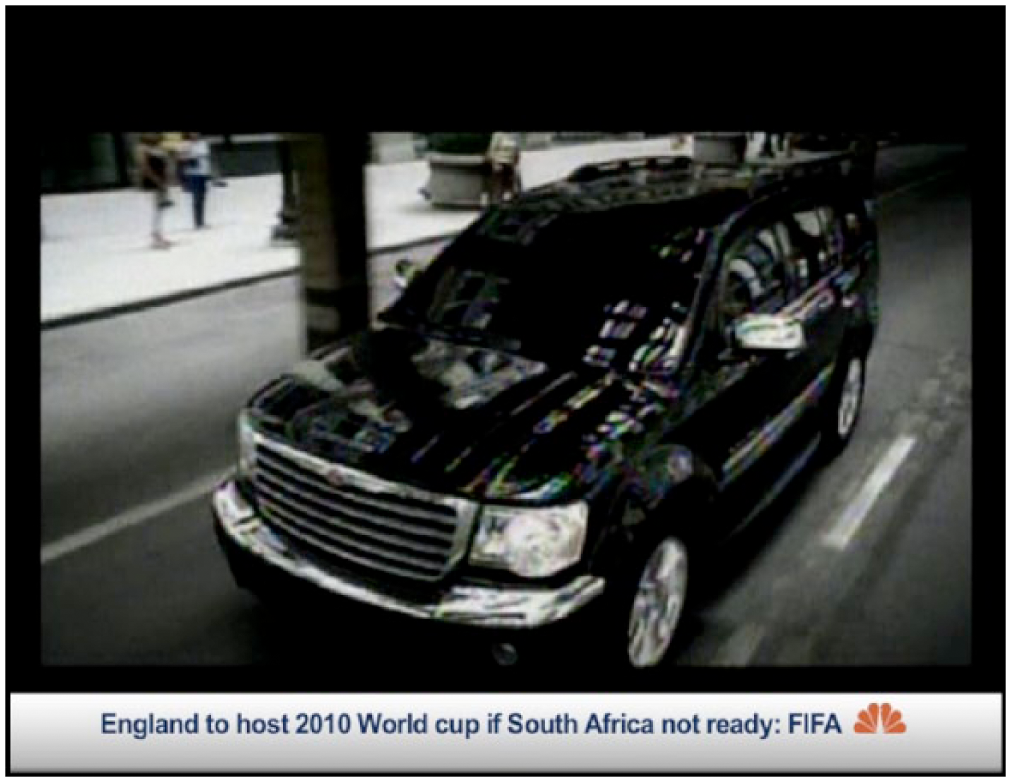
Updating ticker.
Dependent Variables
News program content recognition
Two items were averaged to measure recognition of information contained in the news program. Each item was a multiple-choice question with four options, from which participants selected the answer that best represented a news story, when only one was correct (i.e., guess rate = 25%; Lang, Bolls, Potter, & Kawahara, 1999). Participants were randomly assigned questions about two of the seven stories they viewed in the news program, above the ticker.
Ticker content recognition
Two different items were averaged to measure recognition of unique ticker content. Again, each item was a multiple-choice question with four answer options, only one of which was correct. Participants were randomly assigned questions about two of the six ticker items they saw only during the ad breaks.
Eyes on ticker
The percentage of time spent looking at the ticker was calculated using data from the eye-tracking sub-sample. Using video coding software, the location of the participant’s gaze point, superimposed over the video content, was coded on a second-by-second timeline. As explained above, only ad break time, not program time, was coded. Total time spent looking at the ticker during the two ad breaks was divided by total ad break time to calculate the percentage. There were two ad breaks, each with five 30-s ads, making a total of 300 s of ad break time. For example, if a participant looked at the ticker for a total of 30 s over the two ad breaks, then percentage of time with eyes on ticker equals 10%.
Perceived clutter
Perceived clutter was measured by the mean of three 7-point Likert-type items (strongly disagree to strongly agree) asking if the ticker content was “excessive/irritating/distracting” (Cronbach’s α = .93; Cho & Cheon, 2004). “Don’t know” responses were coded as missing data.
Ticker informative/ticker entertaining
Perceptions of the ticker content in relation to these two distinct concepts were measured by single-item 7-point semantic differential scales, anchored by “very uninformative-very informative” and “very unentertaining-very entertaining” (Woltman Elpers, Wedel, & Pieters, 2003). Again, “don’t know” responses were available and coded as missing.
Program liking
Program liking was measured by the mean of three 7-point Likert-type items (e.g., “I’m glad I had a chance to see this program”; Cronbach’s α = .91; Coulter, 1998).
Results
Manipulation Check
To rule out an alternative explanation for our results, we examined evidence about whether participants noticed the ticker at all. Self-report data suggest the ticker was noticed equally in both conditions. We did not explicitly ask our participants whether they noticed the ticker, but only one participant in each condition answered “don’t know” to any of the three perceived clutter items (Scroll: 1 of 58, 2%; vs. Update: 1 of 33, 3%; χ2(1) = .17, exact p = 1.000). However, the evidence from the eye-tracking sub-sample suggests that the updating ticker was more likely to be noticed. Two thirds of the participants in the Update condition fixated on the ticker at least once (6 of 9, 67%), compared with less than half in the Scroll condition (7 of 17, 41%). However, because of the low sample size of the eye-tracking sub-sample (n = 26), this difference was not statistically significant, χ2(1) = 1.53, exact p = .411.
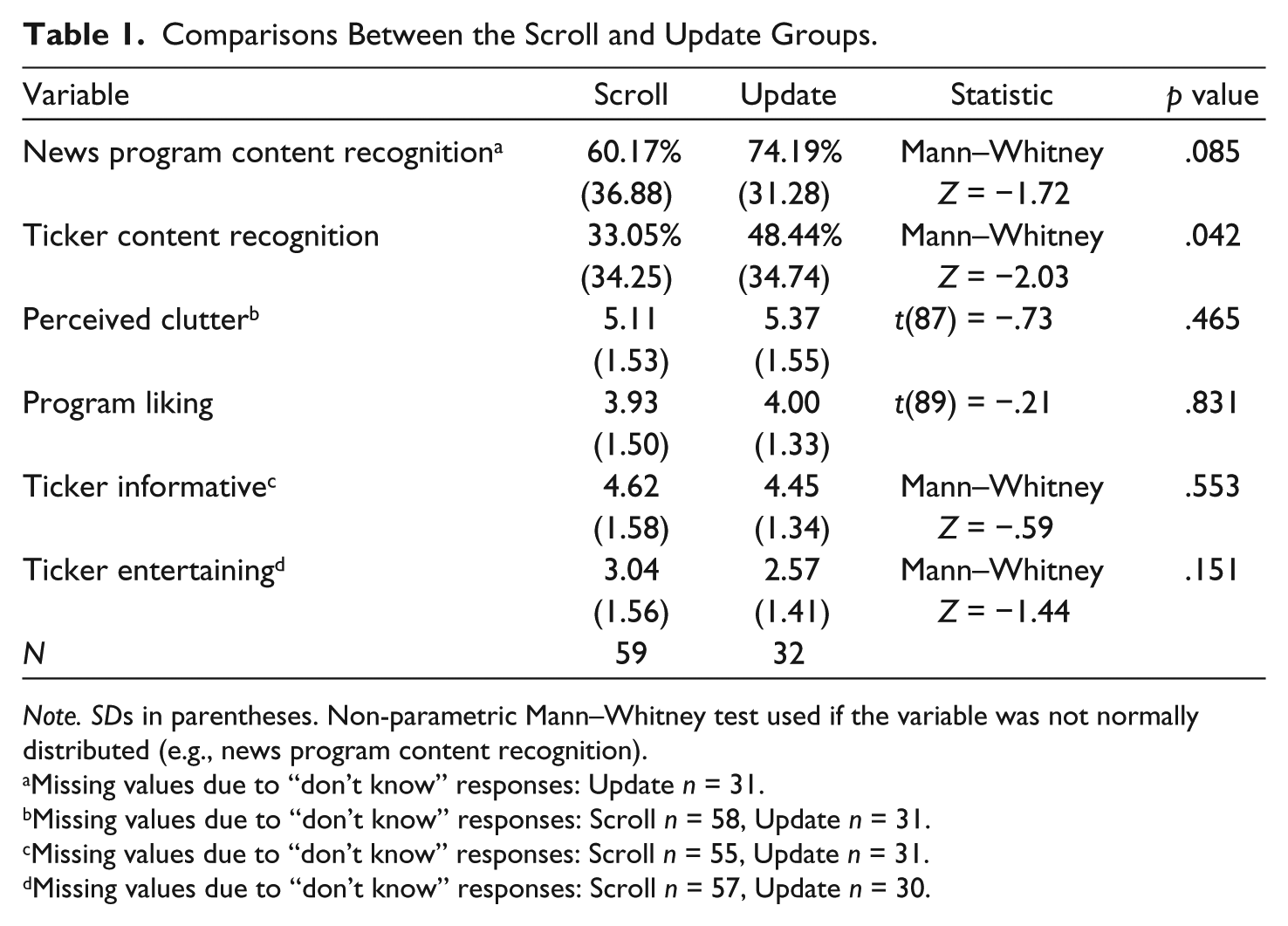
Our first research question investigated whether ticker format, scrolling versus updating, had a significant effect on memory for news items reported in the news program behind the ticker. The answer to this question was “no,” although there was a marginal tendency (p = .085) for viewers to remember more news items when updating was used (Table 1).
Comparisons Between the Scroll and Update Groups.
Note. SDs in parentheses. Non-parametric Mann–Whitney test used if the variable was not normally distributed (e.g., news program content recognition).
Missing values due to “don’t know” responses: Update n = 31.
Missing values due to “don’t know” responses: Scroll n = 58, Update n = 31.
Missing values due to “don’t know” responses: Scroll n = 55, Update n = 31.
Missing values due to “don’t know” responses: Scroll n = 57, Update n = 30.
The second research question asked whether ticker format, scrolling versus updating, had a significant effect on memory for news items reported in the ticker itself. The answer to this question was “yes.” Items were significantly more likely to be recognized later if they had been seen in an updating ticker, as opposed to a scrolling ticker (Table 1).
The data from the eye-tracking sub-sample provide some quantitative evidence suggesting why the updating ticker was better at communicating news content. The updating ticker was not only more likely to be noticed (see above), but participants in the Update condition also spent a longer time looking at the ticker (M = 6.06% of the total 300 s of ad break time, that is, 18.18 s), compared with participants in the Scroll condition (M = 2.70%, 8.10 s). Because of the small size of the eye-tracking sub-sample, however, this difference in viewing time was not statistically significant (Mann–Whitney Z = −1.41, p = .158).
Our third and final research question investigated whether ticker format, scrolling versus updating, had a significant effect on perceived on-screen clutter and program liking. The answer to this question was “yes” for perceived clutter, although this answer was qualified by a significant interaction with ownership of a mobile phone, F(1, 85) = 9.38, p = .003, partial η2 = .10. The updating ticker significantly reduced perceived clutter for the 8% of our participants who did not own a mobile phone (β = −1.04, t = −2.69, p = .009), but for the others, updating tended to increase perceived clutter, although not significantly (β = 0.19, t = 1.78, p = .079). For program liking, the answer was “no.” Although there was a tendency for viewers to like the program more when the updating format was used, the difference was not statistically significant (Table 1). We also investigated perceptions of how informative and entertaining the two formats were. Again, there was no significant difference between the two formats on these items (Table 1).
Discussion
News programs, especially on cable news networks, often deliver additional information in the form of a ticker at the bottom of the screen. The findings reported here suggest that, when presenting news content with a ticker, the updating ticker format has significant advantages over the traditional scrolling format. News items were more likely to be recognized later if they were presented in an updating ticker rather than a scrolling ticker. In addition, although not statistically significant, viewers’ memory for items reported in the news program was marginally higher when updating was used (74% recognition) rather than scrolling (60% recognition).
The eye-tracking data suggest that because the updating ticker was easier to read, participants in the update condition were attracted to spend twice as much time reading the ticker (6%) compared with participants in the scrolling condition (3%). Comments from the two focus groups suggest that the update ticker format allows viewers to form expectations about particular screen areas where change will occur and easily monitor them for new information. The scrolling ticker, in contrast, has constantly moving text, making it more difficult to monitor the beginning of a new story.
Many news programs have already adopted some form of ticker to deliver additional information. Once adopted, networks and their individual programs, continually modify ticker use and appearance. 1 The results of this study have implications for decisions about what ticker format to adopt, rather than whether to use a ticker. As audiences get used to seeing more information on TV screens, and TV screens increase their ability to show more detailed information, the decision to add a ticker might not reduce program liking, and could even increase it. Our results suggest if the decision is made to add a ticker, then there are many benefits and few downsides to adopting an updating ticker format. Viewers spend more time reading an updating ticker, but because the text does not move, and viewers are afforded more resources for encoding and storage (“The ‘Flipper’ Is Out,” 2013; Granaas et al., 1984), an updating ticker improves memory for ticker content and may be program content as well. However, because updating tickers are more likely to be noticed, they may also increase perceived clutter. We found no other differences between the scrolling and updating ticker formats in their perceived information and entertainment value, or their effects on program liking.
As with any experimental research study, this one is not without limitations. The findings reported here may be conservative given that participants viewed the news program and the two ticker formats free of the everyday distractions that would otherwise be present in the viewing environment. As multitasking and multiscreening increase, the viewing experience becomes more complex. These behaviors can impact comprehension and counter-arguing, regardless of whether content is considered a primary or secondary task (Jeong & Hwang, 2012). Future research should attempt to replicate these results in a more naturalistic, contemporary television viewing environment (e.g., in-home viewing).
We also acknowledge that, as part of a larger study, our cell sizes were limited. In particular, the eye-tracking sub-sample was too small to provide statistically conclusive evidence. Future research should attempt to replicate our findings with larger samples. Another limitation, also due to using data from a larger study, is that we tested the effects of ticker format on visual attention (via eye tracking) and ticker content recognition only during ad breaks, when there was no competing news content in the background. All studies require a trade-off between internal and external validity, and while the data we analyzed have high internal validity (the only news content was in the tickers), they have low external validity (currently, tickers appear only in program content). It seems unlikely that the superior readability of static text versus moving text (Granaas et al., 1984) would be reversed in the presence of competing news content, but future research is needed to test this possibility. It is possible that our experiment inflated memory for ticker content, by increasing the readability of the scrolling ticker. In a more realistic news context, the update ticker may be even more superior. Furthermore, our only measure of the effects of ticker format on memory for news program content may have been affected by the repetition of ticker content during the program. Our participants may have gradually acclimated to the tickers over programming, and paid little attention to them. Future studies should investigate the competition for attention that occurs when both the ticker and the news program offer different information that is not repeated.
Our measure for news program memory was limited to participants’ recognition of content. This means that our study can offer evidence only about the effects of ticker format on memory encoding (measured by recognition), but not about memory storage (measured by cued recall) or memory retrieval (measured by free recall; Lang, 2006). Each participant was randomly assigned questions about only two ticker stories and two news program stories. Thus, if the participant looked away or otherwise missed key moments of those stories, but processed everything else, our measure of their memory would not represent their true attention to the content. In this study, we do not include a direct test of viewers’ attention and/or allocation of cognitive resources. To more directly test Lang’s LC4MP, future studies should assess the amount of resources required and/or allocated to processing scrolling versus updating tickers, using, for example, a secondary task reaction time measure (Lang, Bradley, Park, Shin, & Chung, 2006).
Finally, our study is based on data collected in 2007. Our results might not apply to the current news environment, or to other genres that feature superimposed tickers, such as sports or entertainment. In these other genres, and in other news programs, the ticker content may not be as congruent with the program as it was in this study. Congruency is likely to affect interest in the ticker content, although the direction is not clear: Incongruent ticker content may attract more attention (Dahlén, Rosengren, Törn, & Öhman, 2008). Further research testing whether our results continue to replicate could compare news versus non-news content in tickers, such as program promos or even viewers’ self-selected information categories.
Despite some limitations, this study offers the first comparison of scrolling versus updating ticker formats, demonstrating superior memory, and no significant adverse effects on perceived clutter and program liking, when updating is used rather than scrolling.
Footnotes
Declaration of Conflicting Interests
The author(s) declared no potential conflicts of interest with respect to the research, authorship, and/or publication of this article.
Funding
The author(s) received no financial support for the research, authorship, and/or publication of this article.