




Abstract
This study examined the effect of social cues and interactivity in social media on journalists’ credibility based on literature of journalists’ credibility, social information processing theory (SIPT), and social presence theory. Results from a mixed-design experiment showed participants rated highly interactive journalists to be more credible than those who are less interactive in social media. Findings are discussed in terms of theoretical implications for journalists’ credibility in social media and practical applications for journalists seeking to utilize social media to engage with their audiences.
Keywords
Journalistic credibility is a much-explored topic for researchers and practitioners alike. Journalism depends on credibility (France, 1999), given that one of the reasons people turn to journalists for information is because the profession sells its product based on the notion of independence and verification. Many factors influence how and why some journalists are considered more credible over another, such as the reputation of the news organization (Lyon & Cameron, 2004), the platform (Cassidy, 2007), and the structure of the news message (Fico, Richardson, & Edwards, 2004).
Journalistic credibility also is evaluated based on an individual’s characteristics that go beyond individual stories produced. For example, female journalists often are considered less credible in covering hard news than male journalists (Balon, Philport, & Beadle, 1978; Brann & Himes, 2010; Weibel, Wissmath, & Groner, 2008). Similarly, physical attractiveness also is known to influence credibility ratings (Patzer, 1983).
The purpose of this research is to examine some of those individual factors in the context of participatory media, specifically for perceptions of a journalist’s interactivity on Twitter, one of the most popular social-networking platforms. Some argue the influence of traditional factors on credibility can change as journalists become more involved with the public via social forms of media, which offer opportunities for journalists to interact with the “former audience” (Gillmor, 2006). With the growth of social media platforms that allow for interactivity among journalists and the general public, public decision processes about who is considered as a credible journalist can change. In the current news environment, audiences might prefer a journalist who is involved with his or her audience on social media more so than the distant person sitting behind the news desk and transmitting information to inactive audiences. As an opt-in medium, Twitter differs from other platforms in that decisions to follow a person online or trust information that shows up in a reshared tweet have long-lasting impact on whether a person will receive a journalist’s message. “Snap judgment” assessments of credibility, consisting of looking at a journalist’s social media biography and feed for cues about whether a person is worth following, matter greatly in many-to-many media environments where users often run into people or information without context or prior experience. These instant assessments include credibility. A key question driving this research is how audiences evaluate the credibility of journalists who engage with news audiences on social media.
The questions in this study matter because social media has become an important channel for news delivery (Hermida, 2010). For example, during Hurricane Sandy, both government officials and the local news channels of the affected areas utilized social media to bring information on the development of the hurricane and safety to the public (Ngak, 2012). The quick and short nature of posting 140-character updates to Twitter was fully utilized by the state officials, law enforcement officers, journalists, and citizens alike to share information on surviving the inclement weather and participating in the recovery. Journalists used Twitter to report the latest information on where electricity was restored and how to stay safe in the area. The benefit of social media is that it allows journalists to constantly update and share information with numerous people at the same time, often with mobile devices that allow for instant creation and sharing of news, but the opt-in nature of Twitter means that earning a follow is built on more complex quick judgments about credibility (Farhi, 2009). At the same time, as seen in the Sandy example, the process of gaining trust when journalists compete with everyone for attention is an important issue.
The question that follows is to what extent different types of self-presentation on social media can influence perceptions of a journalist’s credibility. When journalists share local news with the public via social media, or interact with the news audience (i.e., followers on social media), is this more influential than more traditional factors such as gender, age, or attractiveness of the journalists? The main focus of this study is to examine the role of social media in changing the credibility standard of journalists. It will investigate the role of social media in changing public perception of credible journalists by emphasizing the involvement of the journalists with their followers via social media. For this purpose, this study utilized a controlled experiment to establish the causal relationship between the traditional factor (i.e., gender) and the factors suggested by theories in computer-mediated communication that influence journalists’ credibility evaluations (i.e., social cue and interactivity).
Literature Review
Social Media and Journalism
The site used in this study, Twitter, is the fourth-largest social-networking site in terms of frequency of use, with 18% of American adults reporting using it in 2013 compared with 71% for Facebook, 22% for LinkedIn, and 21% for Pinterest (Duggan & Smith, 2013). But usage is only one part of the story. The most recent State of the News Media report noted that Facebook and Twitter are the most popular social networks when it comes to finding news. Half of users on both Facebook and Twitter report finding news on the social network; comparatively, the second-most popular social network, LinkedIn, has only 15% of users finding news on the site (Project for Excellence in Journalism, 2014). This presence of news content, both in terms of sharing and consumption, makes Twitter a viable network for studying journalistic credibility on social platforms.
Twitter represents a new type of information dissemination compared with traditional media platforms. With both consumption and interactivity built into its structure, the Internet’s builders have long theorized that as it grows the Internet has the potential to merge social function with information industries such as news or advertising (Levine, Locke, Searls, & Weinberger, 2011). With a shift from one-to-many forms to many-to-many forms of communication, evaluation of authority also potentially changes as power structures become decentralized, and that has an impact on factors such as credibility assessment (Shirky, 2009). Social media, then, is a term used to describe an application of the web rather than the web itself (Kaplan & Haenlein, 2010) that creates an environment of exchange for content created by users (often termed user-generated content or UGC) built on social media profiles and hyperlinking (boyd & Ellison, 2007).
Twitter offers users a profile page that consists of a person’s biographical details, their own tweets, tools for discovering other users via hyperlinks and suggestion boxes atop the page, and the ability to navigate from page to page and also follow others in a custom-made feed on the web or mobile application. Twitter users can do one of three things on the site: post their own updates, reply to other updates in a way that creates interactive conversation, or share other users’ updates with their own followers through a process known as “retweeting” (Messner, Linke, & Eford, 2011). This makes Twitter’s connection to news prominent; news sharing is popular on Twitter in part not only because users share news but also because news organizations are active in greater numbers than perhaps any other network, including Facebook (Hermida, 2010). News organizations adopt different strategies depending on their intended audience of regional versus national followers, but in general, news agencies use Twitter to post links to stories, with crime and public affairs being two of the most common types (Armstrong & Gao, 2010). While news organizations can make use of any of the creation, replying, or retweeting features on Twitter, journalistic activity often is limited to merely posting links and not engaging with user audiences. Still, the use of conversation and retweets in news organizations is growing as journalists are learning that Twitter can be a useful tool for seeking feedback, interacting with audiences, and learning from others how to produce better and more useful news (Farhi, 2009).
The process of “retweeting,” which consists of sharing a person’s tweet with one’s own followers, causes users to encounter information to which they haven’t directly subscribed (Twitter, 2014). Given the shifts in credibility assessment in decentralized information environments, an average user is likely to run into news or information from journalists that others have reshared. How a user assesses credibility of this information is an important process to discover.
Credibility in Journalism
Credibility is examined two ways in mass communication research: the particular unit of analysis and method by which it is studied. The unit of analysis is the media object whose credibility is being judged, and that most often consists of the medium, the message being delivered, or the individual delivering the message, also known as source credibility (Flanagin & Metzger, 2000). The method used to determine credibility examines how medium, message, and source are assessed along such dimensions as accuracy, bias, fairness, or completeness (Johnson & Kaye, 2002) or source believability (Kiousis, 2001). Sundar (1999) found a complex set of considerations when looking at credibility online, saying it involved a “global evaluation” of a story’s fairness that invoked cues such as the publishing institution and individual trustworthiness, factors that go beyond the particular story at hand.
Interest in credibility has a long tradition in news media research, focusing on both the credibility of particular platforms as well as the credibility of individual journalists delivering the message (Metzger, Flanagin, Eyal, Lemus, & McCann, 2003). Medium credibility examines credibility at an institutional level for an entire platform such as television or for institutions such as a particular newspaper or television news network brand (Flanagin & Metzger, 2000). For medium credibility, individual reporters or even messages in particular news stories are less useful in determining the overall assessment of a media platform or channel’s believability (Flanagin & Metzger, 2000; Johnson & Kaye, 1998; Tseng & Fogg, 1999).
The second part of the credibility research stream is in individual-level credibility known as source credibility. In this conception, characteristics such as gender or race play a role in how a source’s credibility is judged (Etling & Young, 2007). The individual-level factors most typically sort into two dimensions: perception of the source’s expertise, and perceptions of his or her trustworthiness (Amos, Holmes, & Strutton, 2008). Still, source credibility is not often as clear as just being about individuals. Newhagen and Nass (1989) found support for the idea that even platform or news outlet credibility can depend partly on the individual delivering the news, and Metzger et al. (2003) also noted that sometimes brands can become so well known that their credibility can be assessed similar to how individuals are judged. For instance, television news is judged partly based on the believability of the person delivering the information, meaning there were individual-level characteristics factoring into the message received. This study will focus on the expertise portion of credibility to limit the manipulations in the experimental design. In addition, it is examining source at the individual level for methodological and practical reasons. The news channel or brand associated with the reporter was constructed to account for specific confounds associated with a brand, that is, some participants might know the brand and others might not, and this would be a hindrance to isolating the credibility effect.
The patterns in individual credibility assessment seen for more traditional media are mirrored on social media platforms. For example, user-generated content not formally attached to an overarching news organization is often seen as less trustworthy unless the consumer has come to primarily rely on the source for information (Johnson & Kaye, 2002, 2014). Personal characteristics such as gender also factor into source credibility in social media contexts (Armstrong & McAdams, 2009) similar to what past research on other platforms has shown, and fast-moving microblogging services such as Twitter tend to be judged more skeptically (Schmierbach & Oeldorf-Hirsch, 2012).
Social media often is built around a visual in presentation based on pictures of the person doing the posting. In addition, biographical information in a journalist’s Twitter profile can disclose personal details, or it can be more institutional in nature by merely noting the journalist’s news organization and position. Internet users normally use certain cues when evaluating the credibility of the online content (Winter & Krämer, 2012, 2014). For example, Morris, Counts, Roseway, Hoff, and Schwarz (2012) found users normally judge the credibility not always in terms of the content alone but instead influenced by heuristics such as user names or message topics. Although users may not directly participate in interacting with journalists on Twitter, visible interactivity on Twitter can be evaluated as a heuristic cue that can affect credibility evaluations.
Twitter credibility at the individual level has been assessed in several ways. The user’s photo that goes with their profile gives cues about gender, attractiveness (Patzer, 1983), and potentially ethnicity (Winter & Krämer, 2012, 2014). Others have looked at how the content itself is judged. Authority in particular feeds perceptions that the source is credible. How interesting the content is also has been shown to have an impact in some contexts, as does the credibility of the news organization the journalist represents (Pal & Counts, 2011). Profile characteristics in the form of disclosure also have an impact. Sense of topical expertise in bio disclosures, use of a personal website address, or a verification badge from Twitter that signifies the person’s credentials are verified all serve as cues about an individual’s expertise. Other characteristics include topics, how professional the username is, and the profile image (Morris et al., 2012). Recently, scholars have started to examine the specific sources of information on the Internet such as social media (Johnson & Kaye, 2014), blogs (Kim, 2012), or news sites (Chung, 2008). Interactive websites encourage users to feel stronger affinity with the source of the information, such as politicians (Sundar, Hesser, Kalyanaraman, & Brown, 2003) leading to higher credibility evaluations.
Theoretical Predictions of Journalists’ Credibility on Social Media: Social Information Processing Theory (SIPT) and Social Presence Theory
Several computer-mediated communication theories that examined impression formations in online settings can help theoretically support how a journalist’s presence on social media can influence credibility evaluations. First, SIPT examines the relationship-building strategies in computer-mediated communication settings (Walther, 2008). According to SIPT, computer-mediated communication lacks the cues available in face-to-face interactions to help make first-impression judgments. For such reasons, SIPT argues that in computer-mediated communication settings where these physical cues are absent, people utilize other remaining communication systems, such as language, response time, or written attitude, to make up for the lack of physical cues needed to build a relationship (Walther, 1993). SIPT contends that self-disclosure is an important element of online impressions and relations. Disclosure can increase the intimacy in traditional and online relationships, and studies suggest that self-disclosure in computer-mediated communication (CMC) settings was related to positive relational outcomes and conversational effectiveness (Tidwell & Walther, 2002).
While originally designed to examine how people build relationships in computer-mediated settings, SIPT can provide insights to how social media users assess a journalist’s credibility given the nature of how people communicate on social platforms. For a journalist’s Twitter account, nonverbal cues provided to other users include how responsive they are to the questions they get from their followers via replies, and also whether they provide information about themselves in places such as their biography on their Twitter page. In computer-mediated settings, Walther and Bunz (2005) were able to see how positive feelings could be delivered to communication partners without verbal statements of such positive feelings (e.g., “I like you”). They found that eagerness in interaction, greetings, and acknowledging resulted in positive feelings that could be delivered without explicitly making positive statements. Based on SIPT, active interactions with followers via Twitter and providing information about a person’s personal profile can resemble the types of attitude conveyed through physical cues available in face-to-face communication (Walther & Bunz, 2005).
SIPT is based on the premise that computer-mediated cues can affect the level of trust a user feels toward a source. Studies in impression formation from interactivity suggest how credibility judgment is formulated from the source of information (Sundar, 1999, 2008; Winter & Krämer, 2014). Based on SIPT and credibility literature, several hypotheses emerge. Personal information provided on journalists’ Twitter profiles could be perceived as social cues (i.e., self-disclosure) that indicate eagerness to interact, a sentiment that can lead to higher audience interest in engaging in online conversation with a journalist. Also, as studies in SIPT were able to demonstrate the positive effect of self-disclosure on trust toward conversation partners, a journalist’s personal information on Twitter profiles can increase the level of trust people place upon them and invite more positive attitude toward them.
In addition to SIPT, social presence was originally conceptualized as a property of a communication medium to increase the degree of salience of other people in the interaction (Shorts, Williams, & Christie, 1976). More recently, it has been used as a psychological concept reflecting the subjective experience of closeness and connectedness in mediated communication (Heeter, 1992; Lombard & Ditton, 1997). According to Biocca, Harms, and Burgoon (2003), higher levels of social presence include a sense of behavioral engagement. Similarly, Cyr, Hassanein, Head, and Ivanov (2007) stated that social presence is an important precondition for building interpersonal trust in computer-mediated communication. In other words, a journalist’s increased presence and activeness on social media can help users feel in ways that are similar to how users would feel in face-to-face communication, which results in increased trust.
Using an avatar as an indication of social presence, Bente, Rüggenberg, Krämer, and Eschenburg (2008) examined the influence of different dimensions of social presence, such as intimateness, spatial copresence, behavioral contingency, and social attentiveness. They found a significant positive relationship between social presence and trust. More specifically, their results showed that perceived closeness and attention in online environments were positively related to how competent and trustworthy the conversation partner was perceived. Considering how trust is an important component of credibility judgment (Bente, Rüggenberg, & Krämer, 2004), these results suggest journalists who decide to be active in social media environments can increase the perception of their credibility.
Interactivity
When journalists actively reply to followers, they are engaging in high interactivity. Kiousis (2001) defined interactivity as the “the degree to which a communication technology can create a mediated environment in which participants can communicate (one-to-one, one-to-many, many-to-many), both synchronously and asynchronously, and participate in reciprocal message exchanges (p. 372).” A journalist’s replies on Twitter are interactive, and such frequent interaction online was found to be both positively related to trust as a relational outcome (Liu, Ginther, & Zelhart, 2001) and also further intentions to maintain relationships (Park & Lee, 2013).
Interactivity is considered as a strongly desirable feature for online information, not only in terms of how credible the source is perceived to be, but also in terms of the impression formation of the source as well (Metzger et al., 2003; Morris et al., 2012). While users may not decide to directly participate in interacting with a journalist on Twitter, viewing replies to followers on their Twitter account can provide an impression of interaction frequency. Similarly, Metzger, Flanagin, and Medders (2010) argued that people mostly make heuristic judgments about the information found online. For example, the number of followers on Twitter (Westerman, Spence, & Van Der Heide, 2012) and the recency of tweets (Westerman, Spence, & Van Der Heide, 2014) are features on Twitter that leads to more positive perceptions of source credibility. In other words, the credibility judgment of journalists on social media will be more likely based on heuristic cues gathered from quick glances at a user’s profile such as frequency of tweets, recency, and interactions with followers. Journalists utilizing interactive features on social media can easily trigger the impression of competence in their job as a journalist, thus increasing the level of credibility.
This study will use those heuristic cues such as replies and interactions with followers, first suggested by Metzger et al. (2010) and Westerman et al. (2012), to measure interactivity. When users examine a Twitter profile for interactive elements, they often are assessing the frequency of interactions such as replies. This study duplicates that experience in experimental form. Social presence can encourage further relationships to be built between journalists and audiences in social media (Lee & Park, 2013). Twitter replies can be seen as online interaction between a user and his or her followers, which for a journalist means a stronger presence.
Technological affordances in social media can trigger cognitive heuristics that affect credibility judgments (Sundar, 2008). Journalists utilizing social media for interactions with followers can be perceived as competent in doing their job and as having stronger social presence in social media. This tendency will be stronger especially so for those utilizing social media to interact with other users (Kim, 2012). In this study, increased interactivity with followers is defined as having stronger social presence on Twitter through the process of replies and mentions of followers. In summary, the second sets of hypotheses are as follows:
Finally, two research questions will be addressing the interaction effect of social cues and interactivity on audiences’ evaluation of journalists’ Twitter use:
Method
Pretest
A pretest was conducted to select stimulus materials for the main experiment to control for attractiveness of the journalists, as it has been previously found to affect journalists’ credibility (Engstrom & Ferri, 1998, 2000; Patzer, 1983). A total of 37 participants were recruited from an introductory communication course at a Midwestern university. These participants were not allowed to participate later in the main experiment. A total of six male and six female journalists’ official profile photographs found on the Internet were selected for the pretest. None of these journalists were from the area in which the experiment took place to control for prior knowledge or experiences with the journalists.
Participants were asked to rate the 6 male and 6 female photographs on a semantic scale, responding about attractiveness (1 = unattractive, 7 = attractive) of the person in the photograph (1 = negative, 7 = positive). Of the 12 photographs, 4 male and 4 female were chosen based on their average level of attractiveness (male M = 3.78, SD = .99, female M = 3.25, SD = .70). There were no significant differences in the 4 male photographs chosen in terms of their attractiveness, F(1, 35) = 2.926, ns, and 4 female photographs, F(1, 35) = .766, ns.
Research Design
A 2 (gender: male vs. female) × 2 (social cues: high vs. low) × 2 (interactivity: high vs. low) mixed factorial design experiment was conducted to test the hypotheses. Gender was manipulated as a between-subjects factor while social cue and interactivity on social media were within-subjects factors.
Twitter accounts and tweets utilized for the experimental stimuli were written based on local journalists’ tweets from a different city from where the experiment took place. The number of followers, following, and tweets from the journalist’s constructed Twitter profile page were kept similar across all stimuli to control for the possible impact that personal information on Twitter may have on the dependent variables. These fictitious tweets were developed from local issues unknown to the participants and a few national issues to make the Twitter accounts appear realistic. The journalists’ tweets included local and national issues. Participants could see a total of eight tweets in the stimuli and the dates of the tweets were within 1 day of one another.
Independent Variables
Gender of journalist
The Twitter accounts of the journalists were either male or female. Four photographs of each gender were chosen from the pretest with similar level of age and attractiveness. In addition, four male names and four female names were created by random name generator and were used in their Twitter profile.
Social cue on Twitter
Social cue was operationalized as the amount of personal information journalists provide in their biographical information on their social media profile. For this study, a Twitter account with high social cue was manipulated to include personal information other than the journalist’s vocation in the bio. Examples included hobbies, outside-of-work activities and favorite musicians. In addition, the high social cue condition included a more personal voice to explain who the journalist is as an individual (i.e., hobby, personal anecdotes, etc.). However, the profile information of journalists in the low social cue depicted only professional information such as the news station they work at and their location.
Interactivity on Twitter
Interactivity was operationalized as the amount of interaction journalists have with their followers. The high interactivity condition included numerous replies to followers, whereas low interactivity condition only had factual news tweets from the journalists with no interactivity with the followers (see Figures 1 and 2). To control for the content, all interactions with the followers were about the same topics from the reported news, but only written in a conversational tone as Twitter replies.

Stimulus Twitter profile with low social cue and high interactivity.

Stimulus Twitter profile with high social cue and low interactivity.
Dependent Variables
Credibility
A list of semantic scale questions from standard source credibility scales (Berlo, Lemert, & Mertz, 1969; McCroskey, 1966; McCroskey, Holdridge, & Toomb, 1974) was used to assess the credibility of the journalists utilizing Twitter. Participants assessed the extent to which they found the journalists to be experienced (1 = inexperienced, 7 = experienced), skilled (1 = unskilled, 7 = skilled), active (1 = inactive, 7 = active), qualified (1 = unqualified, 7 = qualified), and competent (1 = incompetent, 7 = competent; α = .958).
Attitude
Participants’ general attitude toward the journalist was asked with a single item: “What is your overall attitude toward this journalist?” (1 = negative, 7 = positive)
Covariate
Participants’ overall Twitter use was measured as a covariate. Before exposure to the stimulus, participants were asked how often they use Twitter on a given day on a 7-point scale (1 = not at all, 7 = very much). General Twitter use was highly correlated with two main dependent variables, credibility and overall attitude (credibility r = .320, p < .01; attitude r = .181, p < .05).
Participants
A total of 156 participants were recruited from an introductory communication and psychology course in an eastern university. According to the a priori power analysis by G-Power, the minimum number of participants needed to achieve adequate statistical power was 40 (effect size f = .25, α error probability = .05, power = .8; Cohen, 1992). Participants were mostly White (83%) with a few Hispanic/Latino (9.2%) and Asian (7.9%). Most participants were female (60.5%) with slightly less male participants (39.5%). Average age of the participants was 19.8.
Procedures
An online experiment was designed and randomly distributed to participants who signed up to the study in exchange of extra credit or research credit for classes. After reading the instructions and giving consent to participate in the study, participants were first asked questions regarding their general social media use and their involvement with news and journalists on Twitter. It took approximately 14 min for the participants to complete the study.
Participants were then asked to read over the journalists’ Twitter accounts. The order of stimulus materials were randomized by the online survey website making sure no one received the same order. In addition, to ensure random assignment and account for any fatigue effects, participants were given different orders according to the last digit of their student numbers. After completing the experiment, participants were debriefed on the purpose of the study on the last page of the experiment.
Results
Manipulation Check
Manipulation check items were asked after they read through the Twitter profile pages of journalists. For social cue, participants responded to three questions: “How much personal information did this journalist provide on his or her Twitter account?” “How much can you learn about this journalist as a person from his or her Twitter account?” and “How much additional information did this journalist provide about himself or herself other than his or her job as a journalist?” (α = .90). For the interactivity manipulation, participants were asked, “How active do you think this journalist is in responding to his or her followers?” “How much attention do you think this journalist pays to his or her followers’ mentions?” and “How responsive do you think this journalist is to his followers’ mentions?” (α = .94).
Paired-sample t test results showed a significant difference between the high social cue and the low social cue conditions. That is, participants rated high social cue conditions to have more personal cues from journalists (M = 3.24, SD = 1.12) than journalists in low social cue conditions (M = 2.31, SD = .99), t(156) = 11.357, p < .001. The same pattern was found for interactivity. Participants rated journalists in the high interactivity condition to have more interactions with their followers (M = 5.31, SD = 1.28) than journalists in low interactivity condition (M = 2.38, SD = 1.13), t(156) = 20.863, p < .001. The manipulation of the independent variables was deemed successful.
Hypotheses
To test the research hypotheses of this study, a 2 (social cue) × 2 (interactivity) × 2 (gender) repeated measures of ANCOVA was utilized with general Twitter use as the covariate. Levene’s test for ANCOVA assumptions showed that the error variance of the dependent measure was not different across groups, indicating the assumption of homogeneity of variance was met (Tabachnick & Fidell, 2007).
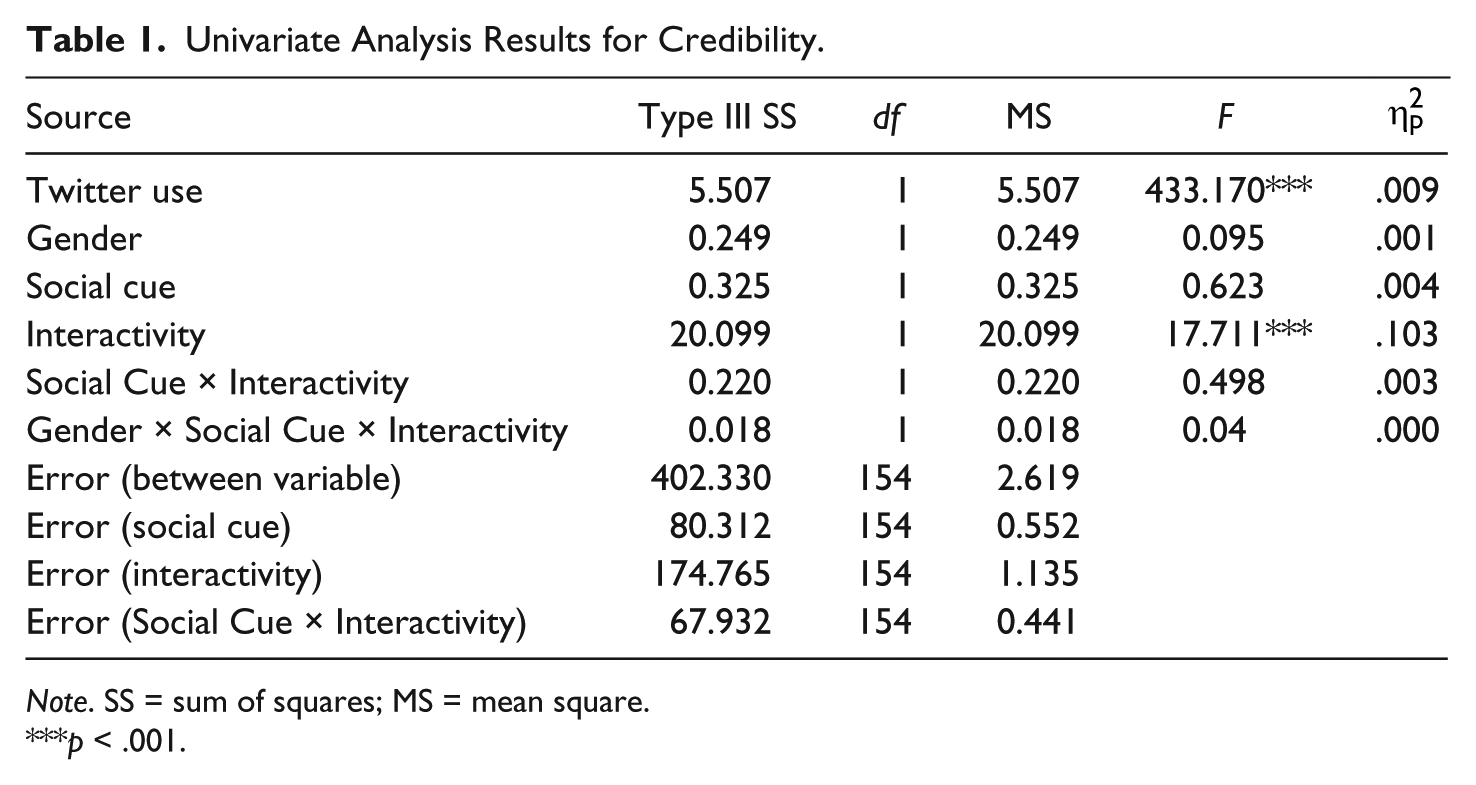
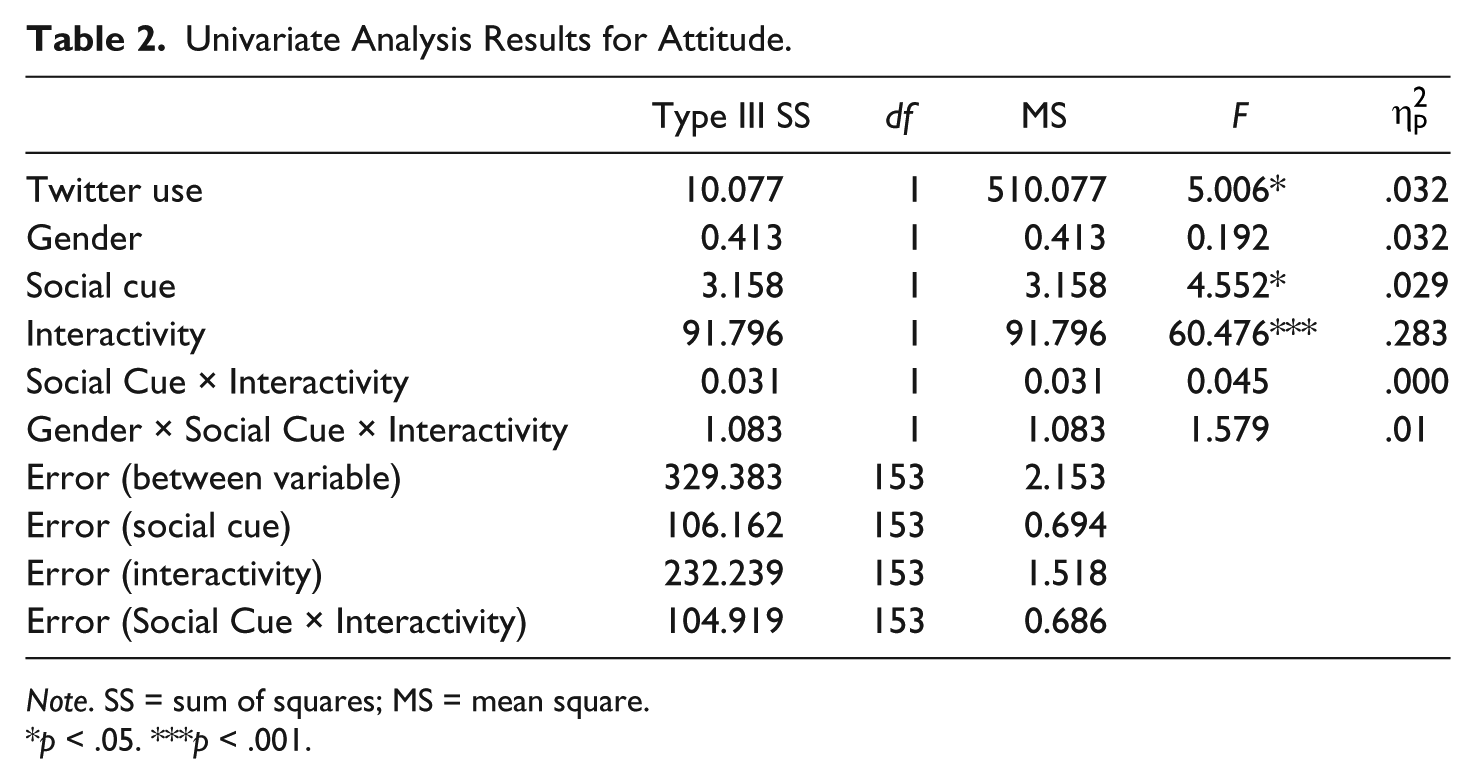
H1 stated that social cue would significantly impact the participants’ credibility evaluation of the journalists. ANCOVA results indicated that there was no significant influence of social cue on credibility, Wilks’s Λ = .996, F(1, 154) = .623, ns (H1a), but a significant influence of social cue on participants’ attitude toward the journalists on Twitter, Wilks’s Λ = .954, F(1, 154) = 7.393, p < .01,
For H2, main effect of interactivity was found on credibility, Wilks’s Λ = .897, F(1, 154) = 17.711, p < .001,
Univariate Analysis Results for Credibility.
Note. SS = sum of squares; MS = mean square.
p < .001.
Univariate Analysis Results for Attitude.
Note. SS = sum of squares; MS = mean square.
p < .05. ***p < .001.
Testing for RQ1, a 2 (social cue) × 2 (interactivity) repeated measure of ANOVA showed no significant interaction effect on any of the dependent variables. Finally, RQ2 examined the three-way interaction from social cue, interactivity, and the gender of the journalists. Repeated measure of ANOVA showed no significant interaction effect from the three independent variables.
Also, while not hypothesized, gender was not a significant predictor for the two dependent variables (see Tables 1 and 2). In addition, it was further examined whether viewing journalists with the same gender with the participants had any impact on the dependent variables. There was no significant impact of gender match between journalists and participants on credibility, t(155) = .656, ns, interaction intentions, t(155) = .93, ns, and attitude, t(155) = .612, ns.
Discussion
The main purpose of this study was to examine processes Twitter users employ to determine credibility of a source sharing a message, something that happens every day on the platform as people try to determine the value of following a person or trusting a particular retweeted post they see in their feed. The results offer insights into how people make quick judgments about credibility on a fast-moving platform such as Twitter. Previous studies in journalists’ credibility evaluation suggested variables such as gender influence audience perceptions of journalist credibility (Balon et al., 1978; Brann & Himes, 2010; Weibel et al., 2008). One conclusion from these previous studies is that older, White male journalists are considered to be more credible and trustworthy than female journalists. This study sought to reevaluate such a notion, and address what audiences are evaluating to be credible by focusing on social media use of journalists in the context of gender and credibility.
Social media provides a channel for journalists to engage with the audience by interacting, following, and showing support. It was hypothesized in this study that such interaction would be valued more than traditional factors that influenced credibility evaluation. Interestingly, participants’ evaluation of journalistic credibility and overall attitude toward the journalists did not differ between male and female journalists. Further analysis examining the impact of gender match between participants and the journalists did not render any significant difference in credibility evaluation or overall attitude.
The absence of significant difference between male and female journalists on social media can be attributable to the noted similarity in how journalists are socialized to use social media (Lasorsa, 2012), especially because female journalists adapt to the male culture in the newsroom (Armstrong & Gao, 2011). Female journalists provide more personal information on their social media accounts than male journalists (Lasorsa, 2012). However, findings from this study suggest little reason to expect differences in perceptions of credibility.
The results suggest audiences may have different expectations toward who is considered a credible and trustworthy journalist on social media and that it is built on how a journalist uses the platform. Interactivity was a strong predictor of credibility evaluations. Unlike traditional channels where only one-way communication from journalists to audiences takes place, and journalists are considered to be the sole authoritative source of information, social media enables journalists to engage with audiences and provide feedback while in competition with many voices. Because the journalist–audience relationship is not a top-down, one-way structure in social media settings, audiences may expect more frequent interactions with journalists and positively evaluate those who are active to engage with the public. In other words, instead of utilizing demographic information of the journalists as a heuristic cue for making evaluations about their credibility, followers may be utilizing a different type of heuristic cues on social media, which is the visible interaction with followers reflective of the journalists’ engagement intentions (Westerman et al., 2012, 2014).
One question that arises from this is whether the medium itself is helping set such an expectation. Twitter is built on a decentralized network approach that is based as much on posting content as it is on sharing and replying, and users who are active on this platform might bring these values of sharing and conversation to their credibility assessments. Looking at it from that perspective, it seems imperative that journalists who join Twitter should expect to do more than post their own tweets if they want to be seen as credible in the medium.
A journalist’s social cue on Twitter was found to have no influence on credibility evaluation or attitude toward journalists. Study participants did not consider the personal information provided on the Twitter account when evaluating the credibility of the journalists. Although the ability to share personal information is one of the main characteristics of social media, personal disclosure in this study was no better than professional detachment.
It is worthwhile to couch these results about social cues in terms of past research. Newhagen and Nass (1989) found newspaper journalists were judged institutionally compared with television, such that the news organization’s overall reputation had much more effect on perceptions of individual journalist’s credibility. High social cue, seemingly comparable with television, where a journalist is judged by personal qualities, is of no matter to consuming audiences. This means that it is possible that journalists are judged on Twitter more like their newspaper counterparts than their television counterparts. This leads to the question of whether institutional Twitter accounts, run by news organizations with the institution’s name and avatar, are judged the same way as the personal Twitter accounts used by journalists at that organization. Because this study looked at source credibility, such a comparison is not possible here but it serves as a useful direction for future research.
As with any study, the current study is not free of limitations that call for future studies to build upon. Because of the suggested limits in the number of factors allowed in experimental study (Smith, Levine, Lachlan, & Fediuk, 2002), the current study could not include all the known demographic factors that influence the evaluation of journalists in the design. These factors include age, race, and ethnicity. In addition, the receiver characteristics that might influence the credibility evaluation of journalists on social media, such as the reliance on social media for information, have not been the main focus of the study (Johnson & Kaye, 2014). It is left to the future studies to examine how individual characteristics of social media users, their reliance on social media for information, and other demographic factors influences credibility evaluations on social media and whether interactivity in social media can negate the influences of these factors.
In addition, there are many other technical affordances in social media that were not examined in this study, which seek scholarly attention, such as the number of followers, retweets posted, or tag indices (hashtags) on Twitter. Retweeting has different implications for interactivity compared with replying to followers, such as being seen as endorsing the content or thinking the content is interesting enough to pass on to others (Suh, Hong, Pirolli, & Chi, 2010). It is left to the future studies to examine the impact of different types of interactive affordances on social media and its relationship with journalists’ competence.
The current study has focused on source credibility specifically on the expertise of journalists (McCroskey et al., 1974). However, both expertise and trustworthiness are measures of source credibility and it is left to future research to address how different types of journalist credibility are evaluated from social media users. Finally, the level of involvement or interest in engaging with journalists via social media may be different if journalists were from the same local area as the participants. This study used distant locations from the participants to control for possible confounding influences. However, from studies emphasizing the involvement of journalists in local communities (Bradshaw, Foust, & Bernt, 2005), it is likely that local engagements and personal relationships with the journalists may have influence in credibility judgments on social media as well.
As social media becomes increasingly more prevalent and the audiences’ expectations to see journalists utilizing this channel becomes more common, it is essential for journalists to understand how they should utilize this channel for better journalism. In addition, at a time when overall trust toward journalism has been continuously in decline, this study suggests that interaction with audiences on social media can bring positive changes to journalists’ credibility evaluations.
Footnotes
Declaration of Conflicting Interests
The author(s) declared no potential conflicts of interest with respect to the research, authorship, and/or publication of this article.
Funding
The author(s) received no financial support for the research, authorship, and/or publication of this article.