



Abstract

As I write this essay, I am celebrating my first-year anniversary as the editor of Journalism & Mass Communication Quarterly (JMCQ). After talking to many people and reading the feedback from last year’s JMCQ readership survey, I found there are many incorrect perceptions about the Quarterly. Many are long-standing myths, which are incorrect. Some are true but need more clarifications. I think it is time to dispel the myths.
Myth 1: JMCQ Publishes Only Quantitative Studies
Incorrect. As much as 22% of the accepted articles under my editorship so far are qualitative studies using historical method, legal method, discourse and textual analysis, case study, and in-depth interviews. Significance of the topic, contribution to the theory and methodology in journalism and mass communication, and quality of the manuscript are the most important criteria for acceptance, not whether it is quantitative or qualitative in the methodological approach. In fact, qualitative manuscripts so far have higher odds of being accepted than quantitative manuscripts because of the large number of quantitative approach submissions (85%) and the high quality of the qualitative submissions we receive. In all our calls for papers, including special issues, we welcome both approaches. Among the manuscripts that were accepted for publication since I took on the editorship, 9 are qualitative manuscripts while 32 are quantitative manuscripts.
Myth 2: JMCQ Prefers Manuscripts on Journalism Topics Alone
Incorrect. This perception may be due to the former name of the journal which was Journalism Quarterly. But the Association for Education in Journalism and Mass Communication (AEJMC) changed the name of the association from Association of Education in Journalism (AEJ) to AEJMC in 1982, and the flagship journal also changed its name to reflect the broadened scope of the association and the many fields and specializations that it represents. It has been more than three decades since Quarterly acquired its new name, Journalism and Mass Communication Quarterly.
Indeed, an overwhelming majority of our published articles are related to news. This is more due to the topics of the submissions rather than our preference. I would like to remind our readers and the public that the second part of our journal name is about Mass Communication. We definitely welcome manuscripts that study different types of news or the journalism profession, but we are not limited to news or only favor news as a content genre. There are many divisions and interest groups of AEJMC, not all of them are news, such as Advertising, Communication Theory and Methodology, Communication Technology, Critical and Cultural Studies, Entertainment Studies, and so on. Some of the media content topics that we accepted for publication include social media postings, video games, and mobile applications. News is not the only media content genre that is covered in our journal. Any media content topics that affect society at large is of interest to our journal. There are also several journals specializing in journalism only. So, JMCQ is not an exclusive journalism journal, but a journal that brings journalism to the larger field of mass communication and media scholars to broaden the impact of journalism studies. We welcome and publish the best manuscripts on both Journalism and Mass Communication (media) topics.
Myth 3: JMCQ Only Welcomes U.S. Authors
Incorrect. JMCQ certainly welcomes U.S. authors as many media scholars are from the United States. But we do not only welcome submissions of U.S. authors. We pride ourselves in attracting 43% of our submissions from outside the United States. See Table 1 below for authors’ nationalities and affiliation in 2014. The desk rejection rate of non-U.S. authors is higher than U.S. authors. It is not because of where they are from but because many of them do not conform to the academic standards of the journal. I always encourage new non-U.S. authors who have been desk rejected to read our journal articles to learn the standards we expect from submissions. I believe through modeling and more rigorous academic training, more and more non-U.S. scholars will publish articles with significant contribution to the field in JMCQ or other leading communication journals.
Journalism & Mass Communication Quarterly (JMCQ) New Submissions by Country 2014.
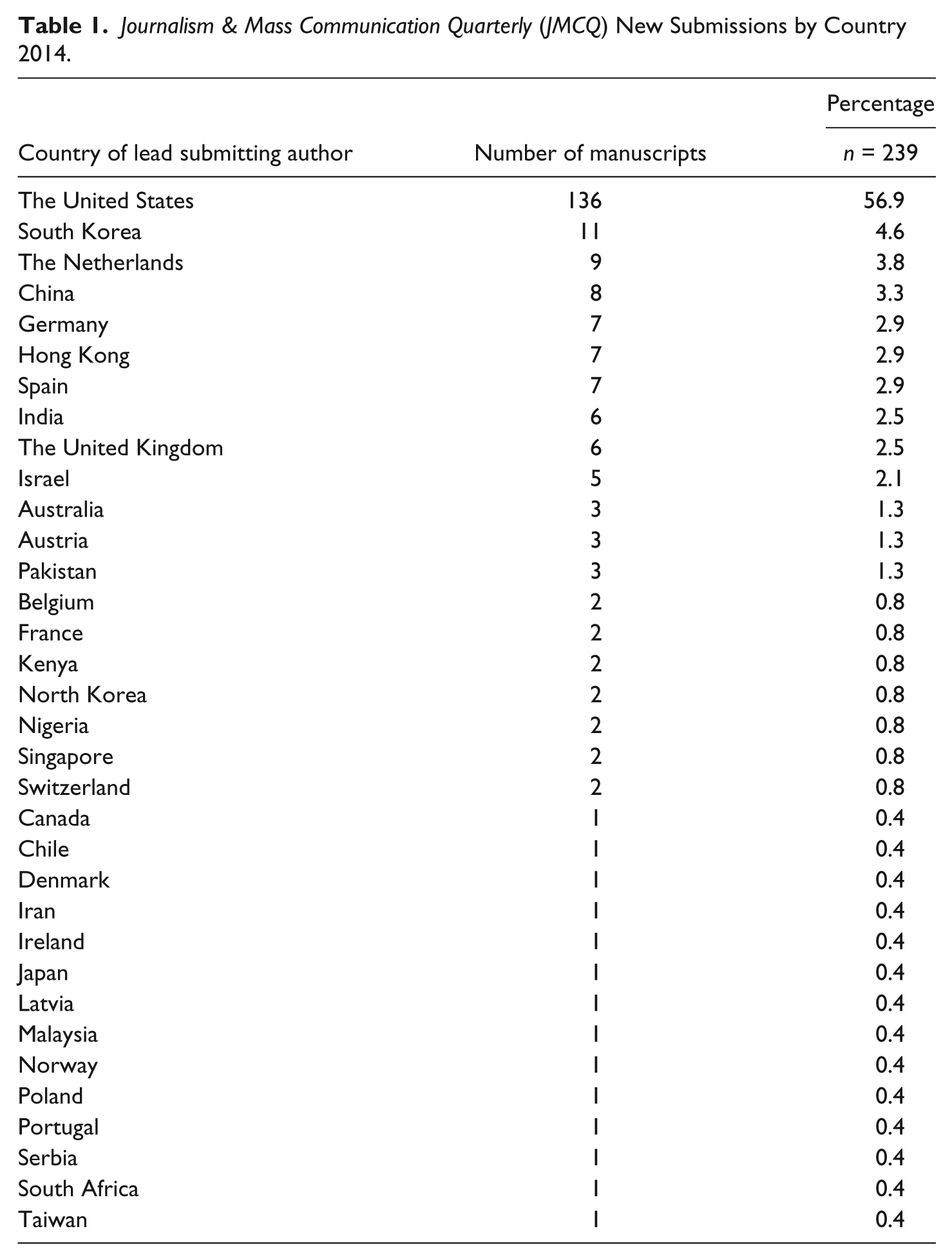
Among the 41 manuscripts that our editorial team accepted so far this past academic year, 34% (n = 14) of the lead authors are from outside the United States, and 15% (n = 6) are lead authored by foreign-born scholars in U.S. institutions. Hence, almost half of our authors have international origins.
Myth 4: JMCQ Uses Mostly U.S.-Based Reviewers
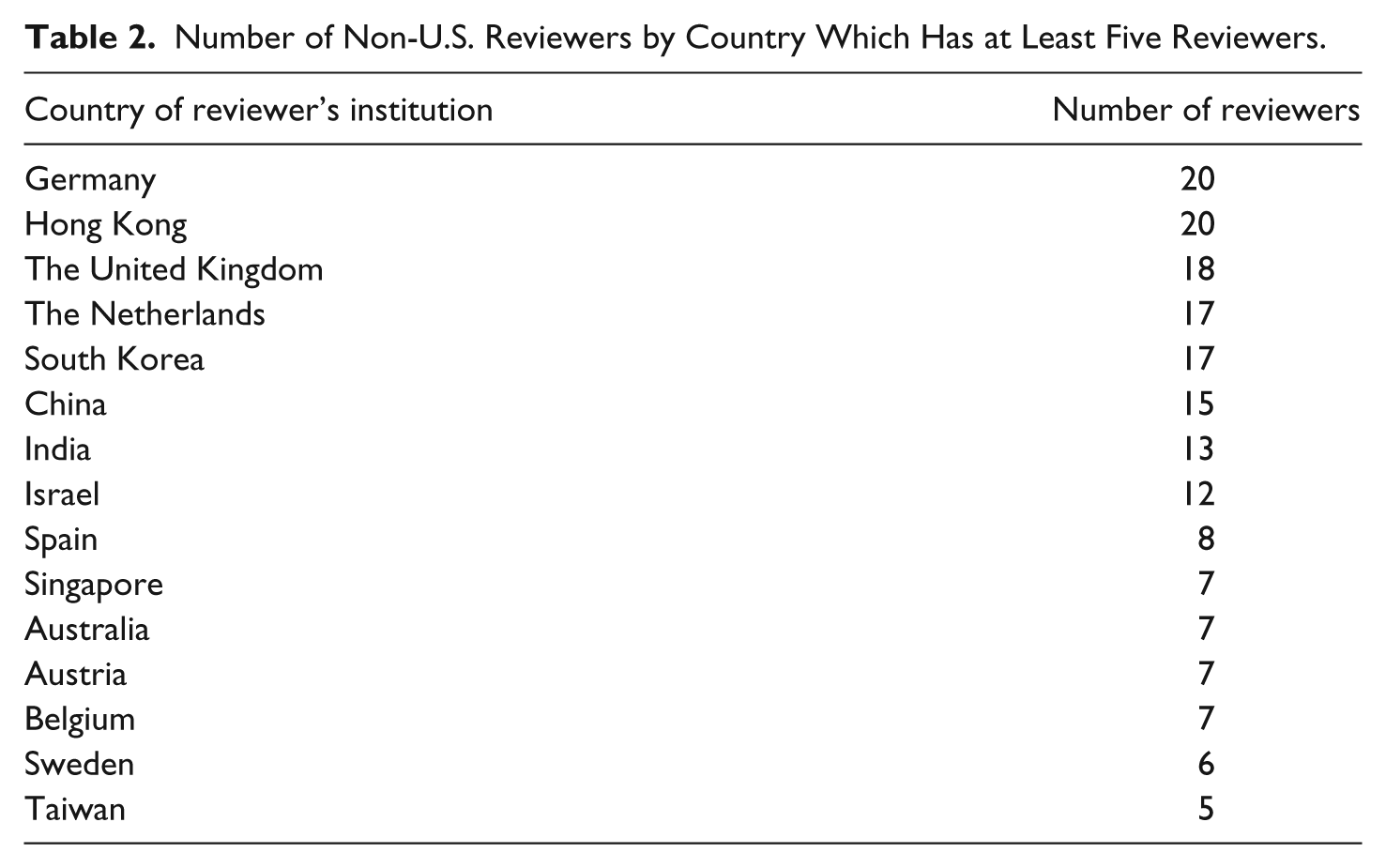
Partially Correct. A large proportion of reviewers are from U.S. institutions. Undeniably, the United States is the center of journalism and mass communication research with many academic programs and faculty. Hence, the source of the reviewers mostly comes from the United States. Yet we also have a total of 21.5% of reviewers from countries outside the United States. We also need to remember that among the U.S. reviewers, quite a number of them are foreign-born or ethnic minorities.
I noted some differences between reviewers outside the United States and U.S. reviewers. Some reviewers outside the United States are not used to the review system in U.S. journals and only provide editing suggestions or one-sentence reviews despite our instructions to reviewers that they should provide comprehensive reviews to our authors. In those cases, we need to add another reviewer for a more informative review.
Table 2 is a breakdown of countries other than the United States that have five or more JMCQ reviewers.
Number of Non-U.S. Reviewers by Country Which Has at Least Five Reviewers.
Myth 5: Non-U.S. Scholars Cannot Be Review Board Members
Incorrect. Scholars outside the United States who have a good record of English language refereed journal publications, are willing to write reviews in English with expertise in an area of need by the Quarterly, commit to review up to six manuscripts a year, and at the rank of tenured associate professor or above may be invited to be board members if vacancies arise. Currently, the Quarterly has 19 board members in institutions outside the United States and an additional 12 foreign-born board members working in U.S. institutions who are fluent in the language and knowledgeable about their home countries. In addition, our review board has two members who are African Americans.
Myth 6: JMCQ’s Acceptance Rate is Very Low
Partially correct. Acceptance rate is a very tricky metric because it varies not just by year but also by the definition of the base for calculation. For example, JMCQ’s acceptance rate is 4% for brand new manuscripts submitted between July 1, 2014 and June 30, 2015 because it takes time for a new manuscript to be vetted and completed one to several rounds of revisions to be offered an acceptance. Those submitted toward the later time period will unlikely complete the review process. But if I included both revised and resubmitted manuscripts and new manuscripts as the base of accepted manuscripts for the same time period, our acceptance rate in academic year 2014-2015 becomes 17.4%, which is on a par with many refereed journals in the field.
Highlight of Articles in This Issue
Content analysis is the most common research method used in recent JMCQ submissions (32% in 2014-2015). I am pleased to present an invited blind-refereed review essay on issues and best practices of the content analysis method by Lacy, Watson, Riffe, and Lovejoy. This essay focuses on the three issues in content analysis: sampling, reliability, and computer coding. The authors suggest standards and best practices to handle these issues with directions for future research. This is a must-read article for researchers who use content analysis as their research method.
Apart from this essay, this issue features a pair of articles on immigration, a highly controversial topic in many countries. One is in the Dutch context and one is in the U.S. context. Although both articles use framing to examine immigration coverage, Lecheler, Bos, and Vliegenthart’s survey experiment demonstrates that emancipation and multicultural frames arouse the most emotional response among readers. Positive emotions function as mediators of framing effects on immigration opinions. Chang’s article explains the news frame choices of newspapers by their community structure through a content analysis of 700 editorials of 108 newspapers in 36 states on illegal immigration.
Although many countries now have Freedom of Information laws to guarantee access to government information, Mellinger’s historical research explains how and why the American Society of Editors became disillusioned with the privilege of off-the-record briefing and advocated for freedom of information. Wouter’s research compares the protest and non-protest TV news items among three different types of advocacy groups in Belgium and finds that coverage of protest items are less frequently balanced and significantly shorter than non-protest items. Labor organizations are much likely to be featured prominently than environmental organizations, while peace organizations are much more likely to be featured prominently when they protest.
Kim’s article reports the results of two national U.S. and Korean studies, respectively, which affirm the role of interpersonal political discussion disagreement in mediating the effect of selective exposure on political polarization. Disagreement helps attenuate individuals’ polarized attitudes that are formed from like-minded media consumption in most cases across both countries. However, results from the Korean data show that those with high levels of selective exposure and disagreement within one’s discussion network have more extreme attitudes.
Ekdale, Singer, Tully, and Harmsen’s case study shows how different types of innovations are adopted in a news organization. They found that technological change is most readily adopted, and new relationship with audience is less likely to be embraced by the journalists. Changes in the professional culture of journalism are most unlikely to receive support.
You and Ju’s survey of 200 Korean journalists shows that outrage factors perceived by the reporters are influential in determining the degree of newsworthiness in all the cases across five health hazards, especially if they see the “catastrophic potential” of a news item.
News tickers are increasingly used on TV screens. Brechman, Bellman, Robinson, Treleaven-Hassard, and Varan’s experiment of two TV news ticker formats—the update ticker and the scrolling ticker—shows that update tickers perform better than scrolling tickers both on the memory for news items in the tickers as well as for news program content presented in the background.
Enjoy the articles!