




Abstract
We examined the impact of media messages about mass shootings on participants’ attitudes toward people with mental illness. In a randomized experiment, 293 college students were randomly assigned to read one of five news articles (i.e., one control article, four articles about mass shootings) and answer questions about attitudes toward people with mental illness. Groups significantly differed on attitudes related to perceived dangerousness/social distance and perceived discrimination/belief in recovery, but not insurance/treatment beliefs. The majority of news about mass shootings, even if the article does not mention mental illness or contains expert information, may contribute to negative attitudes.
Recent mass shootings by people suspected of having psychological difficulties have received extensive attention in the United States through widespread news coverage (McGinty, Webster, & Barry, 2013; McGinty, Webster, Jarlenski, & Barry, 2014). The random nature of these gruesome events in unsuspecting locations, coupled with the public’s views of individuals with mental illness as dangerous and unpredictable (Angermeyer & Dietrich, 2006), has led to growing public concerns about a potential link between mental illness and mass violence.
People with mental illness are often seen as violent, erratic, and unable to care for themselves (Angermeyer & Dietrich, 2006; Barry, McGinty, Vernick, & Webster, 2013). These views lead to fear toward and greater desired social distance from people with psychological difficulties (Angermeyer & Dietrich, 2006; Barry et al., 2013). These negative attitudes, beliefs, and behaviors are called stigma, which is one of many factors that contribute to daily challenges for individuals with mental illness (e.g., difficulties securing and maintaining adequate employment, housing, health care; Corrigan, Kosyluk, Konadu, & Park, 2014). Stigma has even been found to increase risk for symptom relapse, hospital admissions, and suicidality (Eagles, Carson, Begg, & Naji, 2003; Penn, Kohlmaier, & Corrigan, 2000). However, not all individuals report negative beliefs about people with mental illness (Angermeyer & Dietrich, 2006; Barry et al., 2013). For example, greater prior exposure to mental illness reduces negative attitudes (Angermeyer & Dietrich, 2006). In addition, women tend to report fewer negative attitudes than men (Angermeyer & Matschinger, 2003).
Mass shootings have a troubling influence on the public’s beliefs about the perpetration of violence by individuals with mental illness (Friedman & Michels, 2013). Although mass shootings are horrifying events that are salient in the minds of the general population, these incidences only account for 0.13% of homicides in the United States (Friedman & Michels, 2013). Despite being rare occurrences, mass shootings draw attention unlike other gun violence incidents due to the horrific nature of the events (McGinty et al., 2014). Research has demonstrated that in the aftermath of mass shootings, there is a spike in the number of news stories about mental illness and gun violence. McGinty and colleagues (2014) found that from 1997 to 2012, 51% of the sampled articles about mental illness and gun violence were published in 2007, 2011, and 2012, which were the years the shootings occurred in Newtown, Connecticut; Aurora, Colorado; Tucson, Arizona; and Blacksburg, Virginia.
Agenda-setting theory (McCombs, 2004; McCombs & Shaw, 1972) can be used to inform our understanding of the impact of news coverage about mass shootings on the public’s beliefs and attitudes toward individuals with mental illness. According to agenda-setting theory, the salience of messages in the media transfers to the public (McCombs, 2004; McCombs & Shaw, 1972). Said another way, people spend more time thinking about the ideas that are prominent in the news. More recently, the theory has been expanded to indicate that the media not only tells the public what topics to think about, but also influences individuals in terms of how and what to think about related to those topics (McCombs & Shaw, 1993). This has been demonstrated in relation to mass shootings, such as Park, Holody, and Zhang (2012) who found that the perpetrator’s race was a particularly prominent theme in the media coverage of the Virginia Tech shooting, and the media presented information in a way that criminal responsibility was generalized to the entire ethnic group. This prior study demonstrating the racialization of the Virginia Tech shooting provides evidence that media coverage of such events may lead to the formation and/or maintenance of stereotypes and discriminatory beliefs. Based on the agenda-setting theory, the spike in articles about mental illness that occurs in connection with mass shootings (McGinty et al., 2014) likely exacerbates the public’s perception of a link between psychological difficulties and violence and ultimately increases negative attitudes toward individuals with mental illness.
Although it appears that news about mass shootings affects the public’s attitudes toward individuals with mental illness, only one known experiment has investigated these specific effects. McGinty and colleagues (2013) randomly assigned participants to read an article about a mass shooting committed by an individual with mental illness, the same article that discussed mental illness gun restrictions, the same article that suggested a high-capacity magazine ban, or not read an article. The participants who read the news story about a perpetrator with mental illness indicated greater perceived dangerousness of and greater desired social distance from individuals with mental illness compared with participants who were in the control group. Thus, news coverage about mass shootings was found to significantly contribute to negative attitudes toward individuals with psychological difficulties.
Although McGinty et al. (2013) is the only known study to specifically focus on mass shooting media coverage, numerous studies have demonstrated that news stories about murders committed by individuals with mental illness significantly increase negative attitudes (e.g., Dietrich, Heider, Matschinger, & Angermeyer, 2006; Thornton & Wahl, 1996). Thornton and Wahl (1996) found that participants who read a newspaper article about a violent murder perpetrated by an individual with mental illness reported significantly greater negative attitudes than participants who were presented with educational information or read a control story. Furthermore, Thornton and Wahl demonstrated evidence of the mitigating effects of educational information on the perpetuation of negative attitudes.
The perpetuation of stigma through media coverage of mass shooting is particularly troubling because the public’s beliefs about a link between mental illness and mass violence are unfounded. Robust evidence has demonstrated that individuals with mental illness, on average, are not violent (Choe, Teplin, & Abram, 2008). It has been estimated that 4% of violent incidences are committed by individuals with mental illness (Fazel & Grann, 2006). Although individuals with mental illness do perpetrate more violence (7% of persons with mental illness) than the general population (2% of general public), the increase in aggression associated with psychological difficulties is small and is believed to be mostly attributable to other factors (e.g., substance abuse, medication non-compliance; Fazel, Gulati, Linsell, Geddes, & Grann, 2009; Swartz et al., 1998). Individuals with mental illness are more likely to be the victims of violence than the perpetrators of violence (Choe et al., 2008).
Although rare events, it appears that mass shootings have greatly contributed to stigma toward people with psychopathology due to the inescapable presence of powerful media messages. For example, the Associated Press’ annual poll found that mass shootings were the top news story in 2012 (Crary, 2012). Past headlines have included “Va. Tech Killer Ruled Mentally Ill by Court; Let Go After Hospital Visit” (Potter & Schoetz, 2007) and “Cut the Euphemisms, Santa Barbara Shooter Was Crazy and Belonged in Asylum” (Sanchez, 2014). Media outlets typically do not present educational information when discussing mental illness and violence (McGinty et al., 2014), which is unfortunate because some evidence suggests that educational information may mitigate the negative impact of these news stories (e.g., Thornton & Wahl, 1996). With increased media attention on mass shootings, the role of news content in the development and maintenance of stigma is an important area of investigation.
Current Study
The present study expanded on McGinty et al. (2013), with a few key differences. McGinty et al. examined the effects of news content about policy responses (e.g., gun restrictions) on people’s attitudes. We focused on the extent to which the article presented information about the perpetrator’s history of mental health (e.g., no mention of mental illness, mentioned the perpetrator had a history of mental illness). McGinty and colleagues included a control group that did not read a news article. We included a control group who read a benign news story that mirrored the mass shooting articles in paragraph structure. A control article was used to help disguise the true purpose of our study, to keep the participants’ experiences consistent, and to control for any potential effect reading an article may have on the participants’ responses. It is unclear how educational information would affect public attitudes in the context of mass shootings. Therefore, we included two news articles that presented educational information about the low risk for violence in individuals with mental illness. One of these articles quoted an expert (i.e., expert article), and the second article provided evidence cited from research studies (i.e., research article). Finally, as discussed in the introduction, many factors (e.g., gender) may impact an individual’s attitudes toward individuals with mental illness. These variables were considered as potential covariates in the current study.
It was hypothesized that all four articles about a mass shooting, regardless of the content, would be associated with greater negative attitudes than the control article. However, we expected the expert and research mass shooting articles to be associated with significantly lower negative attitudes than the factual and mental illness mass shooting articles.
Method
Participants
The sample consisted of 293 college students (M age = 19.30 years, SD age = 2.08 years) from a small public southeastern university. Out of the 293 participants, 200 (68.5 %) identified as female and 92 (31.4 %) identified as male (1 participant did not report). The participants self-identified as Caucasian/White (75.4%), African American/Black/African Origin (5.8%), Hispanic/Latino(a) (4.8%), Asian American/Asian Origin/Pacific Islander (5.1%), Middle Eastern (2.0%), and bi-racial/multi-racial (6.5%; 1 participant did not report). The sample was predominantly Caucasian/White young adult females because this is consistent with the demographic characteristics of the recruitment pool (i.e., psychology department of a small public southeastern university). In terms of the total annual income of the participants’ childhood households, 1.0% reported less than US$10,000, 4.4% reported US$10,000 to US$25,000, 14.7% reported US$25,001 to US$50,000, 22.2% reported US$50,001 to US$75,000, 23.2% reported US$75,001 to US$100,000, and 31.7% reported more than US$100,000 (8 participants did not report). Forty-eight (16.4%) participants indicated they had been diagnosed with a psychiatric disorder, 96 (32.28%) reported they had attended therapy with a mental health professional, and 51 (17.4%) reported that they had taken a psychiatric medication.
A power analysis using G*Power software (Faul, Erdfelder, Lang, & Buchner, 2007) indicated that to conduct a MANOVA when alpha is set to .05 with a desired power of .80 with five groups, three predictors (i.e., one group variable, two covariates) and three outcome variables, 295 participants would be needed to detect a small effect, 45 participants would be needed to detect a medium effect, and 25 participants would be needed to detect a large effect. The current sample of 293 participants should be sufficient to detect an effect of any size.
Measures
Demographics
The participants completed questions about their age, gender, race/ethnicity, annual income of childhood household, and mental health history. To assess mental health history, the participants indicated whether (coded as 1) or not (coded as 0) they have been diagnosed with a psychiatric disorder, attended therapy with a mental health professional, or taken a psychiatric medication. Mental health history was calculated as the sum of the participants’ responses to these three items, and scores ranged from 0 to 3. Greater scores reflected a greater history of personal exposure to mental health care.
Public attitudes about mental illness
The participants completed 11 items adapted from Barry and colleagues (2013) to assess attitudes toward persons with mental illness. This instrument contained three subscales that assessed perceived dangerousness/social distance (e.g., “Locating a group home or apartment for people with mental illness in a residential neighborhood endangers local residents”; 4 items), insurance/treatment beliefs (e.g., “I would like to see more government spending on mental health treatment”; 5 items), and perceived discrimination/belief in recovery (e.g., “Most people with serious mental illness can, with treatment, get well and return to productive lives”; 2 items). Participants were asked to respond to each item from 1 (strongly disagree) to 5 (strongly agree), and scores were calculated after appropriate items were reverse-coded. Greater scores indicated greater negative attitudes. Unlike Barry et al., we retained the Likert-type scale responses when calculating the participants’ scores rather than dichotomizing the responses. The Cronbach’s alphas were .80 for Perceived Dangerousness/Social Distance, .83 for Insurance/Treatment Beliefs, and .50 for Perceived Discrimination/Belief in Recovery. The internal consistency of the Perceived Discrimination/Belief in Recovery subscale was low, but this is not surprising given that the subscale consisted of only 2 items. See the appendix for a list of the items.
Marlow–Crowne Social Desirability (Crowne & Marlowe, 1960)
This 33-item instrument assessed the participants’ tendency to provide socially normative responses. It is the most frequently used instrument to assess social desirability (Beretvas, Meyers, & Leite, 2002). Participants responded to each item (e.g., “I’m always willing to admit it when I make a mistake”) with either true or false, and the items were summed based on Crowne and Marlowe’s (1960) scoring instructions. Higher scores reflected greater tendency to provide socially normative responses. Prior research has demonstrated high test–retest and internal consistency, and high construct, concurrent, and discriminant validity (Beretvas et al., 2002; Crowne & Marlowe, 1960). Cronbach’s alpha for the present study was .75.
Procedure
Participants were recruited through the university’s psychology research management webpage. The study was advertised as examining the impact of media use on consumer attitudes and personal views. The participants were compensated with course credit toward their general psychology class. The only requirement for inclusion was that the participants be at least 18 years old. Institutional Review Board approval was obtained, and informed consent was collected from each participant.
Numerous participants (i.e., between 8 to 30 participants) completed the protocol at the same time on individual computers in a computer lab using SurveyGizmo. Prior to the participants’ arrival, the researchers loaded the five versions of the survey on computers randomly scattered throughout the room. The only difference between the versions of the survey was the news article (Figure 1), and there was no way for the participants to discern which survey was loaded onto each computer because the opening page was the same for all versions. On arrival, participants were asked to select a computer. The informed consent was read aloud, and the participants were asked to sign the document if they were interested in participating. The participants completed baseline measures, including the Marlow–Crowne Social Desirability Scale and demographic questions. After reading their randomly assigned news story, the participants completed the Public Attitudes About Mental Illness Scale.

News articles read by each group.
The current study used five fictitious news articles to examine the impact of media content about mass shootings on attitudes (see Figure 1). Four of the articles were written to mimic the common language, format, and information seen in news articles about mass shootings. News articles about mass shootings can be characterized as event focused (i.e., details of the event) or thematic (i.e., discuss a related issue; for example, mental health history of the shooter; McGinty et al., 2014). We created one event-focused article that did not mention mental illness (i.e., factual article) and three thematic articles about the shooter having a history of mental illness (i.e., mental illness article), educational information presented by an authority figure (i.e., expert article), and educational information cited from relevant research studies (i.e., research article). A control article was included that mirrored the paragraph structure of the event-focused mass shooting article and described the opening of a new dining facility at a college.
Analytic Plan
The first step of analysis was to conduct descriptive analyses, including Pearson product–moment correlations among all continuous variables and independent-samples t tests examining gender differences on the dependent variables. Next, we examined whether the five news article groups differed on baseline measures using chi-square and ANOVA tests. Then, a one-way MANCOVA was used to test the main hypotheses. The group variable (i.e., control, factual, mental illness, expert, research) was the independent variable. Based on the initial analyses, which will be discused below, mental health history and gender (men = 0, women = 1) were entered as covariates. Perceived dangerousness/social distance, insurance/treatment beliefs, and perceived discrimination/belief in recovery were the dependent variables.
Results
As seen in Table 1, Pearson product–moment correlations revealed significant negative correlations between mental health history and perceived dangerousness/social distance and perceived discrimination/belief in recovery. The results also revealed significant positive inter-correlations between the outcome variables of perceived dangerousness/social distance, insurance/treatment beliefs, and perceived discrimination/belief in recovery. Independent-samples t tests revealed that men (M = 12.23, SD = 4.38) reported significantly greater negative attitudes about insurance/treatment than women, M = 10.76, SD = 3.63, t(151.00) = 2.80, p = .006. Because mental health history and participant gender were significantly related to the outcome variables, these two variables were entered as covariates in the primary analysis. Social desirability was not significantly related to any of the outcome variables and therefore was not included as a covariate.
Means (M), Standard Deviations (SD), Ranges, Skew, Kurtosis, and Inter-Correlations for Continuous Variables of Interest (N = 293).
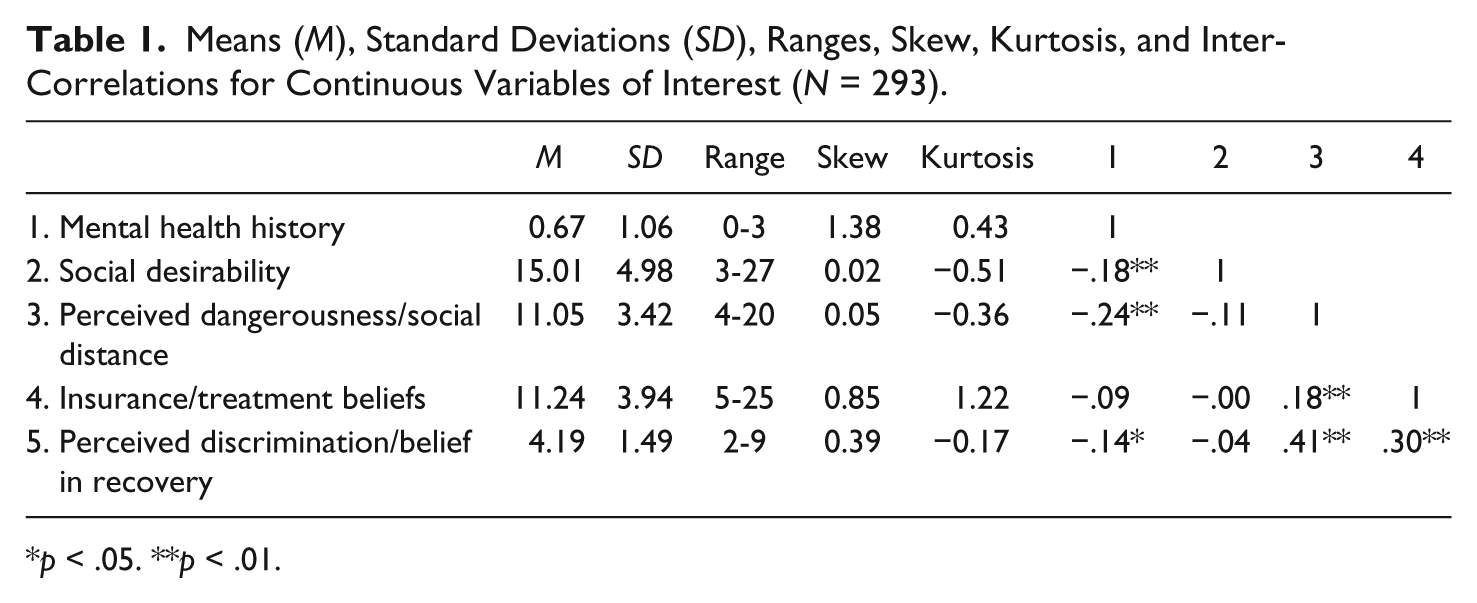
p < .05. **p < .01.
There were no significant differences between the five groups at baseline on gender, χ2(4, N = 292) = 3.38, p = .497; race/ethnicity, χ2(20, N = 292) = 19.84, p = .468; total annual income, χ2(20, N = 285) = 18.09, p = .582; mental health history, F(4, 283) = 2.01, p = .093; or social desirability, F(4, 274) = 0.83, p = .510. Because the five groups did not significantly differ at baseline on demographics or other variables of interest, it appeared that random assignment was effective. This gave us more confidence that differences observed after the media stimuli were a direct result of the experimental manipulation and not pre-existing differences in the groups.
Box’s Test of Equality of Covariance Matrices indicated that the observed covariance matrices of the dependent variables were equal across groups. Levene’s Test of Equality of Error Variance indicated that there were no significant differences among the variances of the groups across the three dependent variables. Skew and kurtosis, presented in Table 1, suggested that the variables were normally distributed. Therefore, the assumptions of normality, homogeneity of variances, and homogeneity of covariances were satisfied in the current study.
Mental health history, Wilks’s λ = .95; F(3, 277) = 5.24, p = .002; η2 = .05, and gender, Wilks’s λ = .97; F(3, 277) = 2.88, p = .036; η2 = .03, were analyzed as multivariate covariates. The five groups, after accounting for the covariates, significantly differed on the combined dependent variables, Wilks’s λ = .92; F(12, 733.17) = 1.92, p = .030; η2 = .03. Tests of between-subject effects, after accounting for the covariates, revealed that the groups significantly differed on perceived dangerousness/social distance, F(4, 279) = 2.98, p = .020; η2 = .04, and perceived discrimination/belief in recovery, F(4, 279) = 3.39, p = .010; η2 = .05. The groups did not significantly differ on insurance/treatment beliefs, F(4, 279) = 1.18, p = .319; η2 = .02. Fisher’s least significance difference (LSD) post hoc analyses were conducted to examine the group differences. As can be seen in Table 2, participants who read the factual, mental illness, or expert articles evidenced significantly greater negative attitudes about perceived dangerousness/social distance than participants who read the control or research articles. Participants who read the mental illness or expert articles evidenced significantly greater negative attitudes about perceived discrimination/belief in recovery than those who read the control or research articles.
Between-Subjects Effects and Post Hoc Analyses Comparing the Five News Article Groups on Public Attitudes About People With Mental Illness, After Accounting for Mental Health History and Gender (N = 293).
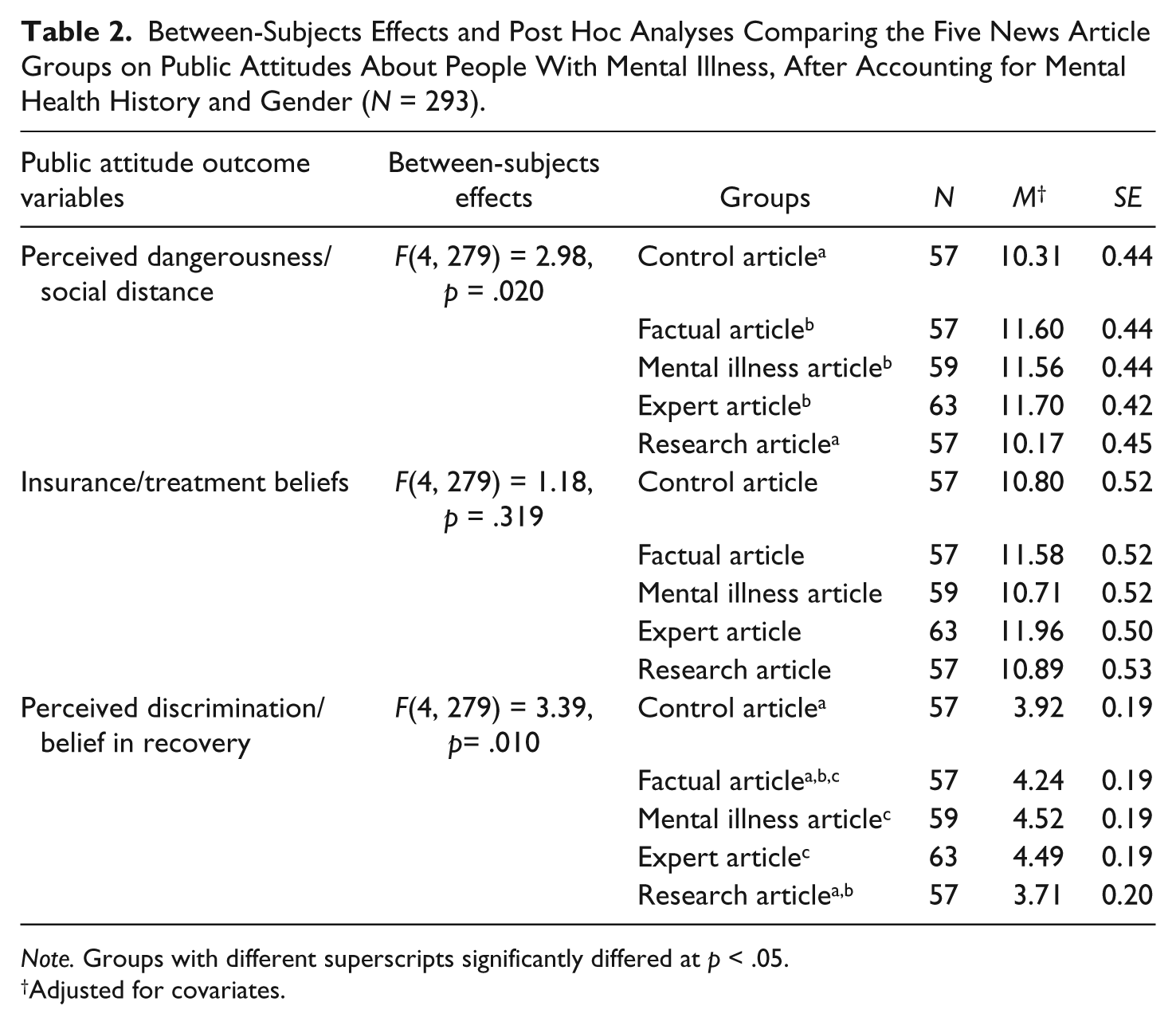
Note. Groups with different superscripts significantly differed at p < .05.
Adjusted for covariates.
Discussion
News coverage serves as a primary source of information about mental health issues for the general public (Wahl, 2003). Furthermore, the agenda-setting theory (McCombs, 2004; McCombs & Shaw, 1972) suggests that media messages can have a powerful impact on the topics individuals think about and the beliefs they have about those topics. Although it has been suggested that educational information may mitigate negative beliefs (e.g., Thornton & Wahl, 1996), news coverage primarily presents negative messages about mental illness that perpetuate fear (Bonilha Dubugras, Evans-Lacko, & de Jesus Mari, 2011; Chopra & Doody, 2007; Corrigan et al., 2005; Wahl, 2003). Mass shootings have been identified as incidents that lead to noticeable spikes in news stories about mental illness and gun violence (McGinty et al., 2014). The present study aimed to expand our knowledge of the effects of mass shooting news coverage on the public’s attitudes.
The results presented here support that news articles discussing factual information about a mass shooting, the mental health history of the shooter, or educational information from an expert were associated with significantly less positive attitudes about perceived dangerousness of and desired social distance from people with mental illness when compared with the control article and the article including educational information based on research. This suggests that the majority of news coverage about mass shootings, even if the article does not mention mental illness (i.e., mental illness article) or purports to contain educational information (i.e., expert article), may contribute to negative attitudes. It is possible that participants’ prior exposure to news coverage linking mass violence to mental illness leads them to assume the perpetrators of such events have a history of psychological difficulties and that it is a causal factor in their violent acts. This would be consistent with the agenda-setting theory (McCombs, 2004; McCombs & Shaw, 1972) given that this is a salient message in the news. In addition, because the expert article was also associated with significantly less positive attitudes, this may suggest that some forms of educational information are as detrimental as other forms of news coverage in perpetuating negative attitudes. Some articles attempting to reduce negative attitudes through the inclusion of educational information may, in fact, not have the educational effect they claim to have.
The results for the Perceived Discrimination and Belief in Recovery subscale were similar to those aforementioned for the Perceived Dangerousness of and Desired Social Distance subscale, with only one difference. The mental illness and expert articles were still associated with significantly less positive attitudes, and the control and research articles were still associated with significantly more positive attitudes. However, the participants who read the factual article did not significantly differ in their attitudes from the participants who read the other articles. This finding suggests that a factual article about a mass shooting may be associated with less positive attitudes related to dangerousness and social distance; however, it may not impact attitudes pertaining to discrimination or recovery.
The participants in the five news article groups did not significantly differ in their responses to the Insurance and Treatment Beliefs subscale. This finding may be evidence that news coverage of mass shootings affects individual’s beliefs about the dangerousness, desired social distance, perceived level of discrimination, and likelihood of recovery. However, news articles with content similar to these articles may not affect participants’ responses to questions about insurance policies or government spending on mental health care. This is particularly interesting because mass shooting incidents often initiate public support for policy responses, and many individuals view the aftermath as an opportunity to increase support for legislative changes. McGinty and colleagues (2013) found that reading an article about a mass shooting, regardless of content, was associated with increased support in gun restrictions for individuals with mental illness and a ban on high-capacity magazines. However, we found that mass shooting articles did not affect participants’ responses to questions regarding insurance policies and government spending on mental health care. This suggests that media coverage of mass shootings may increase the public’s support of gun-control measures as a means to reduce future events (McGinty et al., 2013); however, media messages about mass shootings may not affect individual’s support of policies related to the quality of mental health care. This is just one potential explanation for the results demonstrated in the current study, and future research should follow-up on how media messages about mass shootings affect individuals’ support for various policy changes.
It is noteworthy that based on the means and number of items, all four groups who read an article about a mass shooting reported relatively positive attitudes about mental illness. On average, the participants endorsed below the mid-point on all items assessing negative attitudes. This may be because the majority of the participants examined were women (68.5%) and many of them had a personal history of psychological difficulties (35.5%). Both of these factors have previously been linked to more positive attitudes toward people with mental illness.
The results are quite revealing when considered in the context that participants read one fictitious news article that ranged from 71 to 158 words in the artificial setting of a laboratory. It is quite possible that given the nature of the questions, many of the participants may have been aware of the research question. Therefore, participants may have underreported their true attitudes and beliefs, and therefore the results presented here would reflect an attenuation of the true effect. If participants’ attitudes can be influenced in this situation, it is troubling to consider the impact continual and extensive news coverage containing images and videos may have on people’s beliefs and attitudes. Based on the current study, news coverage of mass shootings, regardless of the content, appears to be a powerful mechanism in the perpetuation of stigma toward individuals with mental illness.
There are several limitations of the present study that should be considered. First, the results presented here were demonstrated in a predominantly Caucasian/White young adult female sample and therefore generalizability beyond these particular demographic characteristics is inappropriate. Second, the study examined the impact of a single news article on attitudes and therefore does not necessarily reflect the manner in which the public is typically exposed to media messages. Third, we did not include a manipulation check and therefore it is not possible to determine exactly what led to the participants’ responses on the instruments administered in the study. Fourth, we did not assess the participants’ attitudes prior to the experimental manipulation and therefore we cannot confirm whether the news article the participants read changed their beliefs. Fifth, the participants’ attitudes toward people with mental illness were measured immediately following the news stimuli, and it is unclear how beliefs are maintained over time. Finally, it should be noted that the five news articles used in the current study varied in length due to the information that was included in each. It is possible that the length of the articles had an impact on the participants’ responses to later questions and may have been a confounding variable.
Despite these limitations, there are several strengths that should be noted. First, by using a randomized experimental design, we were able to examine news content as a potential causal factor in the perpetuation of stigma. Second, we considered the role of several covariates, which allowed us to more clearly identify the role of media messages after accounting for other potential influences (e.g., gender). Third, by using a multivariate design, we were able to take into account the covariation that exists between the dependent variables. Fourth, the participants were recruited for the psychology research pool and therefore likely had more familiarity with and knowledge of mental illness than the general public, which has been found to decrease stigma (Corrigan, Backs Edwards, & Green, 2001). Therefore, the sample likely provided a more conservative test of the experimental manipulation.
The results of the current study were consistent with the only other known experiment (i.e., McGinty et al., 2013) and highlight that media coverage of mass shootings is an area of concern that needs further investigation. The results suggest that media messages are very powerful tools in the perpetuation of negative attitudes and even news that does not specifically mention mental illness may contribute to stigma. This is concerning because individuals who possess more negative attitudes are less likely to support policies (e.g., increased government funding for mental health services) that may assist individuals with mental illness (McSween, 2002). It is possible that the public’s negative beliefs about individuals with mental illness are so engrained, that any coverage of mass shootings makes individuals more entrenched in their pre-existing negative beliefs. The results presented here suggest that recommending that news articles focus solely on the details of the event or include information from an expert as a means of education may not be sufficient to counteract the public’s pre-existing negative associations.
Footnotes
Appendix
Declaration of Conflicting Interests
The author(s) declared no potential conflicts of interest with respect to the research, authorship, and/or publication of this article.
Funding
The author(s) received no financial support for the research, authorship, and/or publication of this article.