



Abstract
Using survey data with a national representative of U.S. adult women, the current study tested both the perceptual and behavioral hypotheses for the third-person effect of online advertising of cosmetic surgery (OACS) in a theoretical process model. A strong third-person perception (TPP) was observed in assessing the influence of OACS. The results of a path analysis revealed that the self–other exposure gap and social undesirability were positive predictors of the TPP. TPP had a direct impact on support for regulation (SFR) of OACS and an indirect effect on corrective actions. Both SFR and online political self-efficacy (OPSE) were the good predictors for corrective actions.
Keywords
The use of misinformation or exaggerated claims in cosmetic surgery advertising is a serious social problem in countries such as the United Kingdom (Keogh, 2013). Literature has raised concerns regarding online advertising of cosmetic surgery (OACS) in the United States due to misinformation (Liao, Taghinejadi, & Creighton, 2012), deceptive claims (Spilson, Chung, Greenfield, & Walters, 2002), exaggerated claims, and manipulated pre- and postoperation images (Wong, Camp, Camp, & Gupta, 2010) used in ads that can do harm to consumers. Studies focusing on various forms of social media advertisements of cosmetic surgery have found that most cosmetic surgeons use social media to reach out to consumers (Stevens, 2014). Social media platforms used for these marketing purposes have also diversified into mediums such as Facebook, Twitter, and Pinterest. In some instances, social media marketing strategies involve the creation or use of user-generated content by both advertisers and individuals who have had plastic surgery (Wen, Chia, & Hao, 2014). These changes have altered the way in which cosmetic surgeries have been advertised, with online ads focusing more on a layperson’s endorsement than a celebrity’s (Wen et al., 2014).
Although the ethical compliance of OACS from board-certified surgeons is relatively well-followed (Wong et al., 2010), the rise of direct-to-consumer (DTC) advertisements by unqualified physicians poses a potential deceptive threat through the use of false marketing claims. The issue of false and misleading claims in Internet ads gained considerable salience among both the general public and plastic surgeons when a 29-year-old West Virginian died of complications following a risky “butt lift” procedure at a South Florida clinic (Guarino, 2016). A growing number of researchers (e.g., Keogh, 2013; Wheeler, Said, Prucz, Rodrich, & Mathes, 2011) have raised concerns over the pervasiveness of potentially deceptive marketing claims in OACS that can influence female consumers’ perceptions, attitudes, and their behavioral intentions of having cosmetic surgery. Nonetheless, little research has examined how members of a key public (i.e., adult women) assess the perceived impact of OACS and how they evaluate the restrictive and corrective strategies to cope with perceived harmful effects. On the basis of the third-person effect (TPE), the current study aims to examine both perceptual assessment and behavioral intentions among U.S. adult women surrounding the controversial OACS. After confirming the perceptual disparity between media effects on the self and the other, referred to as the third-person perception (TPP), the current study tests a path model that shows how differential estimates of self-exposure (SE) versus other-exposure (OE) to OACS and social undesirability (SU) can cause the evaluations of TPP, followed by behavioral intentions for both restrictive and corrective actions. In doing so, the study also considers the role of online political self-efficacy (OPSE) in the form of corrective action. Although there have been a few attempts (Kim, 2016; Lee & Tamborini, 2005; Rosenthal, Detenber, & Rojas, 2015) at taking the path analytic approach, no known study has extended the model from exposure and SU to both restrictive and corrective actions through TPP.
Theoretical Background
TPP of Social Media Ads Promoting Cosmetic Surgery
The TPE is a cognitive-behavioral phenomenon that describes the perceptual gap in gauging the impact of persuasive communication on others’ behavior as opposed to one’s own behavior. In a nutshell, it is known that individuals tend to put a greater perceived impact of persuasive communications on others than themselves. The TPE phenomenon was first proposed based on Davison’s personal observations of perceptions of differential effects of persuasive communication in a number of contexts. From Japanese propaganda to West German newspaper editorials, Davison observed a recurring presumption that the effects of persuasive communications were more pronounced on others than they were on the self. The TPE of Davison’s (1983) early work focused on the potential effects of persuasive communication on one’s own behaviors as opposed to others’ behaviors. For example, in one experiment, Davison asked about the impact of a political attack message on “your vote” as opposed to “others’ vote.” In another experiment, Davison asked how television commercials you watched in your childhood had an impact on your request to “your parents” to buy commercial products as opposed to other kids’ asking “their parents” to buy them. The key of Davison’s TPE is the linkage of persuasive communication to differential behavioral outcomes for the self and the other. As the TPE was linked to potentially undesirable behavior, Davison noted that differential perceptions could potentially predict attitudes and intentions regarding censorship so as to protect vulnerable others from negative messages.
Since Davison’s seminal study, many mass communication scholars have investigated the TPE on numerous topics of socially undesirable persuasive communications. Researchers in general have looked into the perceptual disparity of the effects of persuasive communications on the self and the other and the behavioral consequences of such perceptions. The perceptual disparity for the impact of socially undesirable persuasive communications is known as the TPP (Sun, Pan, & Shen, 2008). The TPE, therefore, is a theoretical proposition that predicts both a perceptual difference of potential impact of persuasive communications and a behavioral outcome resultant from such a perceptual disparity.
Previous meta-analytic studies have demonstrated that the perceptual difference of the magnitude of influence of such persuasive attempts between self and others is robust across many different studies (Paul, Salwen, & Dupagne, 2000; Sun, Pan, & Shen, 2008). It is noteworthy that several meta-analytic studies on TPE have confirmed that the self–other disparity in the TPP is apparent when the content of such persuasive communication is socially undesirable or harmful (Eveland & McLeod, 1999; Gunther & Thorson, 1992; Jensen & Hurley, 2005).
A growing concern has been raised in recent years regarding the use of social media among plastic surgeons as a marketing and promotional tool (Keogh, 2013; Wheeler et al., 2011). In a recent survey of the American Society of Plastic Surgeons (ASPS), it was revealed that about half of the plastic surgeons currently use social media for marketing and advertising purposes and that about one fourth of the respondents raised a need for government oversight and monitoring to ensure ethical online behavior (Stevens, 2014).
A recent review of the current state of the U.K. government intervention on cosmetic surgery advertising concluded that the cosmetic procedure industry’s self-regulation effort has failed to ensure the safety of the procedure and responsible advertising (Keogh, 2013). The report also recommended additional government intervention to cope with new forms of misinformation, breaches of ethical codes, and pervasiveness of cosmetic surgery images in advertising messages found on social media.
With this rapidly changing trend of cosmetic surgery marketing, academic literature must further assess the relationship between individuals’ perception of online advertisements of cosmetic surgery and the perceived potential influence of these ads on themselves and others.
Thus, this study proposes the following hypothesis:
The Impact of the Exposure Gap on the TPP
The relationship between the exposure to persuasive communication and its perceived influence on self versus others has been well-documented in previous research (McLeod, Detenber, & Eveland, 2001; Paek, 2009; Shen & Huggins, 2013). Exposure to persuasive communication can be identified by a dichotomy between SE and perceived others’ exposure. Researchers of TPE have generally found that SE had an effect on TPP through increased perceptions of others’ exposure (Paek, 2009; Shen & Huggins, 2013). Numerous studies have addressed the importance of perceived others’ exposure in the process of TPP (Eveland, Nathanson, Detenber, & McLeod, 1999; Lambe & McLeod, 2005; McLeod et al., 2001). Previous research on the perceptual component of TPE revealed that the TPP increased as a result of more SE and perceived exposure of others to socially undesirable content (Eveland et al., 1999).
In particular, Lambe and McLeod (2005) revealed that perceived others’ exposure is far greater than SE when examining nine socially undesirable media contents. Researchers also found that perceived exposure to socially undesirable contents, such as extreme pamphlets and negative political ads (Lambe & McLeod, 2005) and violent and misogynic lyrics (Eveland et al., 1999; McLeod, Eveland, & Nathanson, 1997), was found to be a significant positive predictor of perceived impacts on others.
It is also well-researched that SE and OE are highly correlated, and that SE tends to precede the perceived others’ exposure (Shen & Huggins, 2013). Due to potential issues related to multicollinearity, TPE researchers (Golan & Lim, 2016; Rosenthal et al., 2015) in recent years have used the self–other exposure gap in a path model to test the TPE. Those studies using the self–other exposure gap found that the self–other asymmetry in exposure had a direct effect on the TPP. On the basis of previous research, the following hypothesis is posited:
Social Desirability and TPP
Along with exposure, social desirability of media content or persuasive communication is considered to be the key independent variable that affects the TPP. Several studies showed a positive correlation between SU and the perceptual disparity in assessing the presumed influence of persuasive communication, known as TPP (e.g., David & Johnson, 1998). A group of researchers examined the effects of social desirability on the TPP, comparing the impact of prosocial versus antisocial messages on self versus others (Eveland & McLeod, 1999; Gunther & Mundy, 1993; Gunther & Thorson, 1992; Jensen & Hurley, 2005; Leung & Lo, 2015). The results of the previous studies showed the consistent pattern of the perceptual disparity in assessing the influence, when the message was socially undesirable. Socially desirable or prosocial messages, however, yielded mixed results for TPP, with either reverse TPP or no difference across comparison groups or within subjects. On the basis of findings from aforementioned research, the following hypothesis is posited:
Behavioral Components of the TPE
As assumed by Davison (1983), the behavioral hypothesis of TPE predicts that the self–other gap in the presumed influence of persuasive communication would cause individuals to take some actions. Researchers of TPE have long been interested in understanding what behaviors may arise out of the self–other perceptual gap. Sun, Shen, and Pan (2008), in a meta-analysis of TPE literature, noted that most studies examining third-person behavior for potentially harmful persuasive communications or media influences have focused largely on support for either regulation or censorship (Huh, Delorme, & Reid, 2004; McLeod et al., 1997; Rojas, Shah, & Faber, 1996; Salwen, 1998).
Despite the emphasis on support for censorship, behavioral outcomes are thought to vary greatly depending on the situation. In particular, a body of research (Banning, 2006; Golan & Lim, 2016; Lim & Golan, 2011; Rojas, 2010; Sun, Shen, & Pan, 2008) has suggested that TPE research look into other behavioral consequences beyond the measure of support for censorship.
The call for extending the behavioral outcome inventory reflects both practical and theoretical limitations of the traditional measure of support for censorship in TPE research. First, many socially harmful messages, even if they are extremely harmful and undesirable such as inflammatory hate speech (Zipursky, 2010) or revenge porn (Martinez, 2014), receive some constitutional protection in the United States, which limits the efficacy of legal regulation. Second, previous research demonstrated that individuals’ intent to take certain action, in terms of restrictive actions or corrective actions or even promotional actions, could vary depending on the desirability of the message (Sun, Shen, & Pan, 2008). A dilemma emerges when the genre of media content that is a necessity for a society in terms of the free flow of information is misused by some people with malicious intent.
Third, social media has empowered citizens by removing barriers of accessibility, reach, production cost, and distribution channels. Notably, individuals’ political efficacy to rectify a social problem using newer communication technologies has drastically increased, allowing ordinary citizens to produce persuasive messages at a low cost and get those messages across to other like-minded people who are globally dispersed in a much easier, faster manner than before.
Finally, previous research has not provided a solid theoretical framework that can integrate several theoretical rationales for the perceptual and behavioral components of the TPE. The cognitive appraisal theory (Folkman, Lazarus, Dunkel-Schetter, DeLongis, & Gruen, 1986; Roseman, 1991, 1996; Scherer, 1999) can be a theoretical framework that potentially synthesizes the process-based TPE model. It suggests that individuals develop various types of coping behaviors to manage the emotions elicited by cognitive appraisal of a situation, event, or messages. The coping behaviors can include one’s support for regulation (SFR) and intentions to engage in corrective actions. Kim (2016) had taken this approach to demonstrate the TPE of polling news in predicting support for restriction and political participation mediated by discrete emotions. In this theoretical framework, two types of behavioral coping strategies are reviewed in the following sections.
The Effect of the TPP on Restrictive Actions
One way in which individuals may manifest themselves in behavior is through their SFR of socially undesirable persuasive communication. The protection motivations theory underlies individuals’ intentions to act in favor of restrictive action by which those who perceive a greater harm on others than themselves want to respond to the perceived threat with a societal level of coping strategy (Rosenthal et al., 2015; Shah, Faber, & Youn, 1999).
A large body of research has demonstrated that support for restriction had a positive correlation with the TPP of various socially undesirable content, such as sexual content in film (Rosenthal et al., 2015), online drug-encouraging messages (Leung & Lo, 2015), Internet pornography (Lee & Tamborini, 2005), video games (Schmierbach, Boyle, Xu, & McLeod, 2011), social media (Dohle & Bernhard, 2014), news about election polls (Wei, Chia, & Lo, 2011), alcohol product placement in youth-oriented films (Shin & Kim, 2011), casino advertising (Shah et al., 1999; Youn, Faber, & Shah, 2000), misogynistic rap lyrics (McLeod et al., 1997), and violence and pornography on television (Rojas et al., 1996) among others.
Two meta-analytic studies (Feng & Guo, 2012; Zu & Gonzenbach, 2008) on the behavioral component of TPE also provided evidence for the robust effect of TPP on censorship. In addition, through two experiments, Tal-Or, Cohen, Tsfati, and Gunther (2010) revealed the causal relation between the TPP and support for censorship, ruling out the possibility of a reverse causality or uncontrolled third variables.
However, there is one important research problem in incorporating the censorship intentions into TPE research, as both media content and political speech are strongly protected by the First Amendment regardless of social desirability and the perceived harm associated with them (e.g., the case of hate speech or revenge porn). Unlike media content or political speech, different types of advertising are often put up for the discussion of potential censorship as they are subject to commercial speech law. A growing body of research (e.g., Bunker & Griffiths, 2012; Taber, 2012) as well as health advocacy groups is debating over the censorship of cosmetic surgery advertising.
A body of research has tested the effect of TPP on the support for restrictive actions against socially undesirable advertising. Shah et al. (1999) showed the robust effect of TPP on the support for censorship of casino advertising while controlling for susceptibility to and severity of controversial product advertising. Youn and her colleagues (2000) revealed that the perceived impact on others and children was a strong predictor for supporting for censorship of casino advertising. Shin and Kim (2011) found that individuals who thought others were heavily influenced by alcohol ads were more supportive of regulation against those ads in films.
On the basis of TPE hypothesis and actual discussion on banning cosmetic surgery ads, the study proposes the following hypothesis:
The Impact of Social Desirability on Restrictive Actions: The Mediating Role of TPP
Although there is evidence that TPP generally leads to support for censorship, the consistency of the behavioral support and the strength of the media effect have yet to be agreed upon. In particular, the support for restrictive action needs to be interpreted with caution as the magnitude of restrictive actions tends to be affected by the message desirability (Perloff, 1999; Sun, Pan, & Shen, 2008). When desirability of advertising was not clear as was the case in Huh et al. (2004), the TPP had not made a significant effect on support for censorship of DTC advertising. This implies that, to some patients, DTC advertising may be perceived as not necessarily socially undesirable, which can affect the result of the TPP on support for restrictive actions. In general, it can be assumed that TPP is moderated by social desirability of persuasive communication and that TPP can mediate the effect of social desirability on the restrictive actions. Thus, the following hypothesis is posited:
The Effect of TPP on Corrective Actions
Although a great deal of research has examined support for censorship as a behavioral component of TPE, a growing body of studies has also identified corrective actions as another behavioral outcome of TPP (Banning, 2006; Barnidge & Rojas, 2014; Feldman, Hart, Leiserowitz, Maibach, & Roser-Renouf, 2015; Golan & Lim, 2016; Lim & Golan, 2011; Rojas, 2010; Sun, Shen, & Pan, 2008; Wei et al., 2011). Corrective actions, in contrast to restrictive actions such as censorship or regulation, refer to individuals’ engagement in reactive action against potentially harmful influence. Although it has been recently spotlighted, the corrective action hypothesis was earlier suggested from Davison’s (1983) pioneering article in which he shared his own experience of distributing campaign materials of his candidate to counteract the potential persuasive impact from a rival candidate’s quality leaflet. Recently, several researchers paid special attention to corrective actions that take place online or on social media. Taken together, the corrective actions aim to counterbalance a perceived negative influence of undesirable messages by correcting or contradicting apparent or potential bias, risks, or harms (Barnidge & Rojas, 2014; Lim & Golan, 2011); sharing countering information or opinions across social media (Bernhard & Dohle, 2015; Golan & Lim, 2016), and engaging in discursive activities to amplify one’s view in the public sphere (Feldman et al., 2015; Rojas, 2010; Wei et al., 2011).
In delineating the behavioral outcomes of TPE, Sun, Shen, and Pan (2008) discussed that different types of behavioral consequences of TPE could develop based on the appraisal of social desirability of messages and that corrective actions would be observed for the messages with more or less mixed social implications such as reality TV shows. They found that the social desirability had a negative correlation with corrective actions and that TPP had a positive effect on respondents’ willingness to engage in corrective actions. The results indicate that TPP is a significant predictor of corrective actions to the extent that the message is perceived as socially undesirable. Lim and Golan (2011) also assumed that the detection of undue manipulative intent in a persuasive attempt and perceived exposure would be a basis of corrective actions. They found that perceived influence of political parody videos was a strong predictor of the likeliness of engaging in corrective actions on social media. The findings from previous research, therefore, give support to the basic premise of corrective action hypothesis, which is that perceived influence of a persuasive message will motivate individuals to engage in corrective actions (Barnidge & Rojas, 2014) to the extent that the message is perceived as socially undesirable. Thus, the following hypothesis is proposed.
Self-Efficacy and Behavioral Outcomes
In recent years, several researchers suggested that the self-efficacy concept (Bandura, 1977), or one’s belief in his or her ability to successfully carry out the behavior to achieve an intended outcome, could broaden our understanding of behavioral outcomes of TPP (Lee & Tamborini, 2005; Rosenthal et al., 2015; Zhong, 2009). Earlier in this article, it was suggested that the cognitive appraisal theory could be a useful theoretical framework that potentially connects perceptual and behavioral components of TPE. According to Bandura (1977), perceived self-efficacy affects not only the initiation but also persistence of a coping behavior in response to a given situation. Naturally, researchers can assume that self-efficacy expectations will increase the behavioral intentions to engage in different types of TPE-related coping behaviors, such as restrictive or corrective actions.
A group of communication researchers proposed a few context-driven efficacy concepts such as Internet self-efficacy (Eastin & LaRose, 2000), OPSE (Velasquez & LaRose, 2015b), and social media political efficacy (Velasquez & LaRose, 2015a), arguing that self-efficacy is not so much “a contextless global disposition” as “the different demands of the context specific situations” (Velasquez & LaRose, 2015a, p. 457)
A body of TPE research has examined the role of Internet self-efficacy in predicting an array of behavioral outcomes, such as intentions to not disseminate the sexual content (Chia, Lu, & McLeod, 2004), parental protective behaviors (Nathanson, Eveland, Park, & Paul, 2002), and support for censorship (Lee & Tamborini, 2005), among others.
As individuals find themselves to be more capable than ever of achieving their goals using social media, they tend to take more actions online to solve the problem facing the society as well as individuals themselves. Accordingly, the classic concept of political self-efficacy (Caprara, Vecchione, Capanna, & Mebane, 2009) has entered a new stage as it meets greater-than-ever interactive and participatory media platforms online. In the consideration of the role of newer online communication technology in empowering citizens, the concept of OPSE is incorporated into the current research that predicts the behavioral component of TPE. Velasquez and LaRose’s (2015a, 2015b) OPSE builds upon the previous Internet Self-Efficacy scale. Broadly speaking, OPSE refers to the degree to which a person believes that his or her online political actions affect the political process (Velasquez & LaRose, 2015b). People with high levels of OPSE are likely to engage in more political actions online because they believe they can make a difference. In contrast, people who do not believe that their online political actions can make a difference, are not likely to engage in those actions. Recent research has demonstrated evidence of a positive correlation between OPSE and online/social media political participation (e.g., Velasquez & LaRose, 2015a).
Based on the role of OPSE in active online engagement and previous research on TPE, it is assumed that OPSE will positively predict individuals’ rectifying actions as well as their support for government regulation.
The Linkage Between Restrictive and Corrective Actions
Although a growing body of research (Banning, 2006; Golan & Lim, 2016; Kim, 2016; Lim & Golan, 2011; Rojas, 2010) considers corrective actions as a behavioral outcome of the TPE, no known study has yet attempted to reveal the causal linkage between restrictive and corrective actions. Finding from research on corrective actions, however, shows that restrictive and corrective actions are positively correlated. For instance, the correlation matrix in Kim’s (2016) study showed a positive correlation between support for restrictions and participation intentions. In the correlation matrix of Golan and Lim’s (2016) study regarding the TPE of the Islamic State of Iraq and al-Sham (ISIS) recruitment propaganda, restrictive actions and corrective actions were also positively correlated.
Previous research suggests that individuals would be more likely to engage in discursive activities (Rojas et al., 1996) and political participation (Banning, 2006) when they are in favor of restrictive actions. Banning (2006) assumed that the psychological impetus for such participatory actions is similar to those outlined in support for censorship.
If the correlations are robust across different research contexts, then there is a research need to identify a causal linkage between them. This causal linkage may shed light on the behavioral part of TPE research in that it can explain the mixed results regarding the TPP effect on corrective actions. Due to the lack of empirical evidence for the causal pathways, the following two research questions are posited:
Method
Population and Sample
The survey participants were randomly drawn from Qualtrics’s national panel of U.S. adult women. The U.S. adult women were identified as the study population as previous research has identified that women showed higher interests in cosmetic surgery compared with men (Frederick, Lever, & Peplau, 2007). In addition, according to the 2014 Plastic Surgery Statistics (ASPS, 2014) released by ASPS, 92% of all cosmetic procedures were performed for women. Female participants were drawn from the database of Qualtrics’s national panel, and they were also asked to indicate their gender in the initial filtering question to ensure accuracy.
Participants in Qualtrics’s panel system receive points for their participation in Qualtrics hosted research, which can later be redeemed for gift cards, sky miles, online credit, and so on.
After institutional review board’s approval of the protocol, the survey was conducted in mid-November 2015. Only women who were 18 years old or older were asked to participate. Considering that Hispanics are the fastest growing population in the United States and the second largest demographic segment for cosmetic surgery market (ASPS, 2014), a 30% weight was given to select a sample of Hispanics. A total of 2,154 invites were sent out, and the response rate was about 25%, with a total of 530 completed responses.
The final sample of the research was 530 women living in the United States, with a mean age of 45.20 (SD = 15.32). As for marital status, about 54% were married and about 23% were single. Of the total, participants identified their ethnicity as White or non-Hispanic (66.4%), Hispanic American (19.6%), African Americans (6.6%), Asian American (2.8%), Multiracial (2.8%) and Native American (1.3%). More than half of the sample (52.8%) reported an annual household income of more than US$40,000, and about 15% of those respondents reported more than US$85,000.
Measures
Other–self exposure gap
The other–self asymmetry in the exposure has been increasingly used in TPE research (Golan & Lim, 2016; Rosenthal et al., 2015; Shen, Palmer, Mercer Kollar, & Comer, 2015). Adopting Shen et al.’s (2015) method, the measure of other–self exposure gap was obtained by subtracting SE from OE.
SE was operationally defined as the estimated frequency of one’s exposure to online ads for cosmetic surgery. On the basis of recent research regarding the use of social media in cosmetic surgery marketing (e.g., Wen et al., 2014; Wheeler et al., 2011), participants were asked to rate how often they have encountered online ads of cosmetic surgery (a) from social media and (b) while searching the Internet on a 7-point scale, ranging from 1 (never) to 7 (very often). The mean of SE to online ads of cosmetic surgery was 3.10 (SD = 1.95), with reliability coefficient (i.e., Cronbach’s α) being .85.
Following Eveland et al.’s (1999) suggestion, perceived OE was operationally defined as the estimated frequency of other women’s exposure to online ads for cosmetic surgery. Perceived OE was measured by asking participants to estimate how often they think other women, in general, have encountered online ads of cosmetic surgery (a) from social media and (b) while searching the Internet on a 7-point scale, ranging from 1 (never) to 7 (very often). The mean of estimated OE was 4.39 (SD = 1.67). The item reliability by Cronbach’s α was .87.
SU
Adapted from Sun, Shen, and Pan (2008), SU was measured with four pairs of bipolar adjectives. Participants were asked to indicate the degree of impact online cosmetic surgery advertising has upon society on a 7-point Semantic Differential scale anchored by desirable/undesirable, positive/negative, beneficial/harmful, and benign/detrimental. The Cronbach’s α for the four items was .86 (M = 4.27, SD = 1.5).
Influence of online ads of cosmetic surgery on self versus others
To assess the influence of online ads of cosmetic surgery on self versus others, two statements were adapted from Wan, Faber, and Fung’s (2003) study of the TPE of thin female models in advertising (e.g., Online ads of cosmetic surgery have a substantial impact on me [other women in general]) and one statement from Henriksen and Flora’s (1999) study (i.e., Online ads of cosmetic surgery make me want to have a cosmetic surgery) on a 7-point Likert-type scale from 1 (strongly disagree) to 7 (strongly agree). Participants were asked to indicate their level of agreement on a 7-point Likert-type scale anchored by 1 (strongly disagree) and 7 (strongly agree). The item reliability (Cronbach’s α) for the perceived influence on self was .96 (M = 2.60, SD = 1.88) and for the perceived influence on other women in general was .91 (M = 5.03, SD = 1.25).
TPP
The TPP was obtained by subtracting the perceived effects of OACS on oneself from the perceived effects on others.
OPSE
I used four items of the Online Political Self-Efficacy scale derived from Velasquez and LaRose’s (2015b) study. These items (e.g., “I can use social media applications to express my opinions and views on social issues effectively”) operationalized through a 7-point rating scale from 1 (very uncertain) to 7 (very certain) measured participants’ assurance that they can exert a certain influence in attaining a political objective using social media and online platforms. For the measure of OPSE, item reliability (Cronbach’s α) for the present sample was .92 with the mean of 4.89 and SD of 1.53.
SFR
SFR of OACS was defined as intention to act in favor of restrictive actions (Shah et al., 1999), and measured using five items on a 7-point Likert-type scale. The five statements were selected and adapted from Huh et al.’s (2004) study: (a) OACS should carry mandatory health warnings about all of a surgery’s potential risks; (b) OACS should be banned; (c) OACS should be strongly regulated by the Federal Trade Commission (FTC); (d) All online ads of cosmetic surgery should be submitted to the government for prior approval before they are published online; and (e) I would sign an online petition calling for stronger government regulation of it. The mean and standard deviation are 4.87 and 1.15, respectively. Higher score reflected a higher degree of supports for the regulation of OACS. The Cronbach’s α for these five items was .76.
Corrective actions (COR)
Respondents were asked, on a 7-point scale anchored by 1 (very unlikely) and 7 (very likely), to indicate how likely they are to (a) leave a negative comment to warn of the potential risks, (b) submit a complaint to FTC regarding claims on online ads of cosmetic surgery, (c) share a negative experience of a patient who has been misled by OACS, (d) post a link to a news report about the problem of OACS, and (e) increase discussion with their social networking site (SNS) friends about the problem of OACS. The item reliability by Cronbach’s α for the five items yielded a high score of .92; the mean and standard deviation of the summed index were 3.40 and 1.78, respectively.
Overview of analyses
Path analysis with maximum likelihood estimation was performed using Mplus 7.0 (Muthén & Muthén, 1998-2012) to reveal the relationship between the exposure to OACS, SU of OACS, and TPP and two behavioral intentions of SFR and COR. Path analysis, a variant of structural equation model (SEM), allows researchers to test a causal model containing a series of hypotheses regarding the interrelationship of exogenous and endogenous variables with mediators (Kline, 2011). Direct and indirect effects of the exposure and social undesirability on TPP and two behavioral intentions (see Figure 1) were of primary interest. The model was proposed to demonstrate the evidence of theory testing as well as a parsimonious model based on existing models of TPE (Golan & Lim, 2016; Rosenthal et al., 2015). Taking both parsimony and the theory into account, measures for both exposure and TPP were treated as other–self asymmetry by the difference of one’s versus other’s exposure and by the influence on others versus on self, respectively. A group of fit statistics including a chi-square goodness-of-fit test, comparative fit index (CFI), and root mean square error of approximation (RMSEA) test were used to make a proper assessment of model fit (Holbert & Grill, 2015). The nonnormed fit index known as Tucker–Lewis index (TLI) was used to evaluate the parsimony of the model (Bentler, 1990).
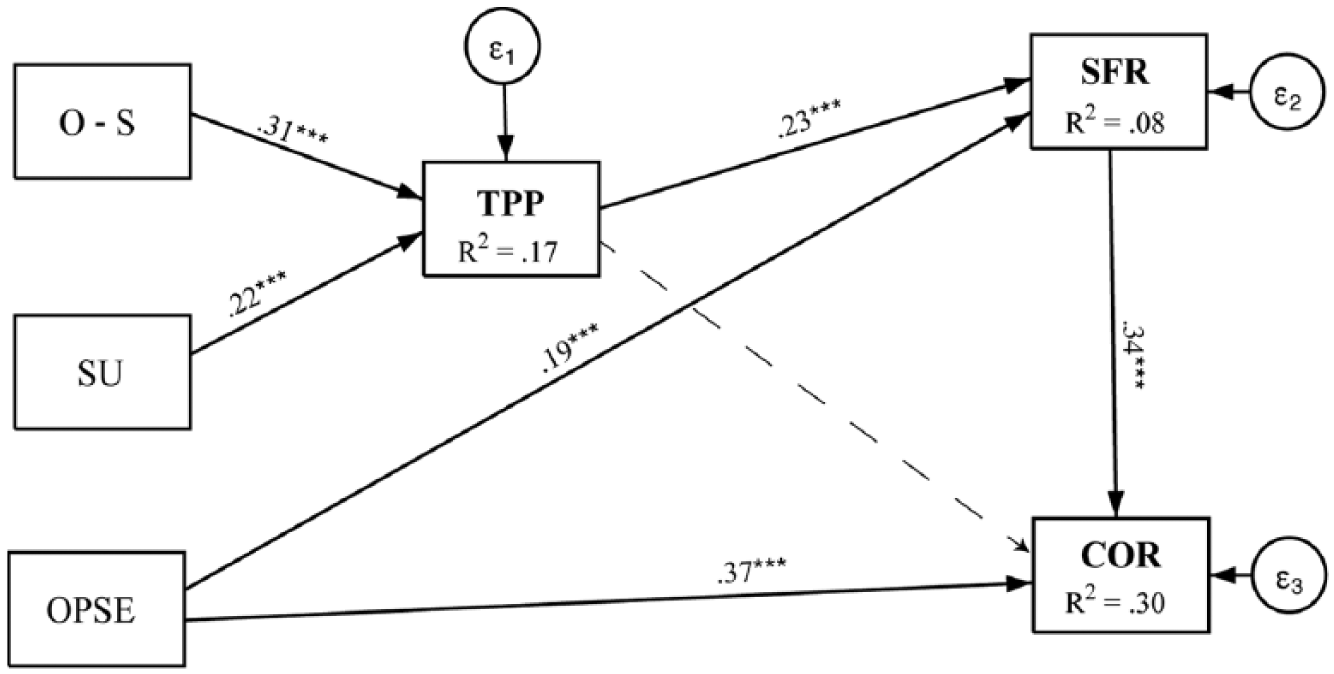
The results of path analysis.
Results
Table 1 presents the bivariate correlations among exogenous and endogenous variables used in the path analysis with their means and standard deviations. In line with empirical findings derived from the TPP, the other–self gap in exposure (O-S) was positively correlated with the TPP. SU has also a positive correlation with TPP. SU was positively correlated with restrictive actions. Finally, TPP has a positive correlation with SFR, but a meager negative correlation with COR.
Mean and Standard Deviation and Intercorrelations Among Exogenous and Endogenous Variables Used in the Path Analysis (N = 530).
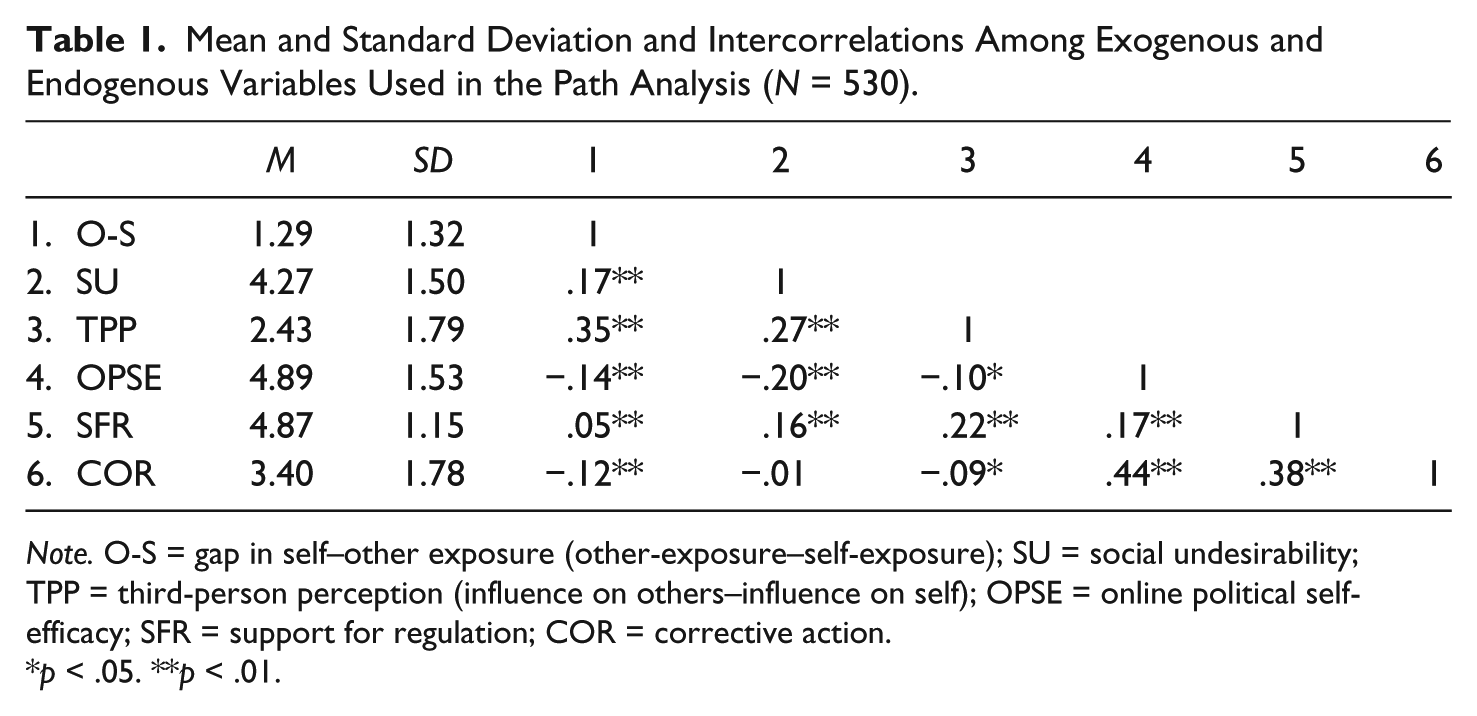
Note. O-S = gap in self–other exposure (other-exposure–self-exposure); SU = social undesirability; TPP = third-person perception (influence on others–influence on self); OPSE = online political self-efficacy; SFR = support for regulation; COR = corrective action.
p < .05. **p < .01.
Test of H1
The TPP hypothesis was tested by using a paired sample t test for perceptual self–other disparity. Overall, respondents of the survey rated higher perceived impact of OACS on others (M = 5.03, SD = 1.25) than themselves (M = 2.60, SD = 1.88). The difference between others and self was 2.43 (t = 31.23, df = 529, p < .001). Therefore, the third-person hypothesis (
Test of a Path Model for H2 to H8 and RQ1 to RQ2
To test
The proposed path model was tested using Mplus version 7. The path model (see Figure 1) for predicting two endogenous variables of behavioral components of TPE fits the data well. The ratio of the χ2 to the degrees of freedom (χ2/df) was 3.05. Overall, the model fits the data well (standardized root mean square residual [SRMR] = .03, RMSEA = .05, 90% confidence interval [CI] for RMSEA = .06, CFI = .97, TLI = .93) based on the cutoff criteria recommended by Hu and Bentler (1999).
In the proposed path model, it was hypothesized that the exposure gap would predict the TPP. As predicted, the other–self exposure gap turned out to be a significant predictor of the TPP (β = .31, SE = .04, p < .001). Therefore,
In
The behavioral component of TPE was tested by examining the path coefficients from TPP to SFR and to COR. As predicted, the greater the TPP, the greater the SFR of OACS ads (β = 22, SE = .04, p < .001), which supports
In
It was predicted that, as individuals’ OPSE increases, so does their SFR (
Finally, the potential causal linkages among SFR and COR and TPP were examined to answer
Discussion
In the increasing practice of using social media for cosmetic surgery advertising, the present study examined the current state of perceived influence of OACS among potential consumers in the United States. On the basis of the TPE, this study examined both perceptual and behavioral components of TPE in a path model. The path model extends the previous understanding of TPE by taking into consideration the SU of OACS and the role of OPSE in predicting SFR and intent to engage in corrective actions. The current path model builds on previous path models (e.g., Golan & Lim, 2016; Kim, 2016; Lee & Tamborini, 2005; McLeod et al., 2001; Rosenthal et al., 2015) that attempted to link the perceptual and behavioral components of the TPE, extending the behavioral outcomes to specific intentions to engage in corrective actions.
Consistent with the previous findings of TPE studies, this study found a strong TPP, with the mean difference of 2.43 on a 7-point rating scale. Respondents of the current study perceived the OACS to be more influential to others than to themselves.
In testing the proposed path model, this study had an interest in understanding the roles of the exposure gap and SU in predicting the TPP. As predicted, there was a significant effect of the exposure gap on the TPP. In other words, as the exposure gap increases, so does the TPP. The finding is consistent with the results from Rosenthal et al.’s (2015) path analysis. As the larger exposure gap indicates more perceived others’ exposure to OACS than oneself, the result suggests that perceived OE be a stronger predictor of TPP than SE. Therefore, people will be likely to estimate greater presumed influence of OACS on others than themselves when they believe others are exposed more to OACS.
The test of
Moving the focus of analysis to behavioral components of TPE, the current research added another piece of empirical evidence for a behavioral hypothesis—that is, support for restrictive actions increases, as the self–other perceptual disparity regarding the influence of OACS gets larger (Gunther, 1995; Leung & Lo, 2015; Schmierbach et al., 2011). In addition, the results demonstrated that the SU had an indirect effect on restrictive actions through TPP. Although the direct effect of SU on SFR was also observed, the standard error for the point estimate of the direct effect was slightly larger than that of the indirect effect, implying that the indirect pathway (SU→TPP→SFR) can be more accurate than the direct pathway (i.e., SU→SFR).
A post hoc analysis also showed a significant indirect effect of exposure (i.e., O-S) on SFR through TPP, with a point estimate of .062 (SE = .02, Z = 3.80, p < .001). The total effect, however, was slightly smaller than the indirect effect due to a negative point estimate of the direct effect (i.e., exposure→SFR). Neither the total effect nor the direct effect was significant, implying that there would exist indirect-only mediation (Zhao et al., 2010).
A test of corrective action hypothesis did not yield a significant path from TPP to COR. Although the direct effect was not observed, the mediation analysis showed a significant indirect effect of TPP on COR through SFR. This is an encouraging finding for the future of TPE research. As discussed, the pathway from support for censorship (or restrictive actions) to corrective actions has not yet been examined in previous research, despite significant bivariate correlations between them. Not only did this study show a significant path from SFR to COR, but it also demonstrated evidence of an indirect effect of TPP on COR through SFR.
Taken together, the results expand the literature of TPE in terms of the corrective action hypothesis (Rojas, 2010). Although corrective actions may not be a robust effect of TPP, they may be a conditional behavioral consequence depending on the type of persuasive communication and appraisal of SU, particularly when people are in favor of government’s active regulation on cosmetic surgery advertising. This study calls for more replication research in TPE to establish the causal relationships among social desirability, TPP, and behavioral actions.
It is also noteworthy that OPSE turned out to be a significant predictor of the corrective actions. The results are well aligned with findings from Velasquez and LaRose’s (2015a) and from Golan and Lim’s (2016) research that demonstrated the effect of OPSE on social media activism. To further evaluate the effects of self-efficacy, future TPE research needs to elaborate the role of self-efficacy in corrective actions that aim to counteract the potential risks and harms of deceptive advertising.
Despite many important findings that can shed light on the TPE process, the current study has a few limitations that should be addressed for future research. First, the TPP examined in this study is based on the impact of OACS on other women in general. The impact on others, however, is often based on perceived other referent groups’ exposure to the socially undesirable messages (Chia, 2007). With this in mind, future research can measure the impact of OACS on younger generations of consumers, as suggested by a recent review of deceptive cosmetic surgery advertising in the United Kingdom (Keogh, 2013), or between multiple referent groups. Demographics may act as useful grouping mechanisms in this regard.
Second, to develop both valid and reliable measures of OACS was a challenge as the Internet as a promotional platform is continuously changing and evolving. The dominant platform of today may not be the dominant platform of tomorrow. In addition, individuals’ preference for specific social media platforms varies by age. As a result, a reliable measure for exposure is hard to get in this rapidly changing media environment. A related challenge is how to get the accurate estimates of exposure by relying on self-reported frequency. Future research may develop a measure of the estimated amount of time of exposure to increase the validity of the exposure measure.
Third, the results of this finding are obtained through a survey of people living in the United States. The current research calls for future research that examines the TPE in different countries where consumers are more exposed to potentially harmful online ads of cosmetic surgery.
Finally, future research also needs to consider the role of social norms in TPP. For instance, injunctive and descriptive norms can have a different impact on the estimates of the impact of self versus others as well as on the level of exposure. More specifically, individuals who have a higher injunctive pressure to improve their facial or bodily parts can be more inclined to learn about cosmetic surgery. So, it is possible that those individuals can be more exposed to OACS. As a result, they may evaluate that OACS exerts more impact on them, resulting in the first-person effect.
Conclusion
The current research provides the first empirical evidence for the TPE in OACS. In doing so, the current research elaborated the process of TPE in inducing two types of behavioral outcomes in terms of a societal-level coping strategy to mitigate the potential negative impact of OACS that may have a potential health risk to patients and consumers. Findings of current research reconfirmed the robust effect of TPP on restrictive actions, but failed to find the evidence for the direct effect of TPP on corrective actions. Instead, the findings of the current study suggest that people will be more likely to engage in corrective actions when they support regulation and when their self-efficacy belief is high. The findings provide both theoretical and practical implications in that corrective actions must be encouraged to reduce or counteract the potentially harmful effects of misleading advertising claims in the age of the social media.
Footnotes
Acknowledgements
The author thanks the three anonymous reviewers for comments on an earlier version of this article.
Declaration of Conflicting Interests
The author(s) declared no potential conflicts of interest with respect to the research, authorship, and/or publication of this article.
Funding
The author(s) disclosed receipt of the following financial support for the research, authorship, and/or publication of this article: The Faculty Research Award from the S.I. Newhouse School of Public Communications at Syracuse University provided financial support for this study.