




Abstract
This study tested partisan media effects in the 2014 U.S. midterm elections. A survey was distributed to 992 residents of Georgia, Iowa, and North Carolina. A novel multigroup latent variable structural equation model tested the direct, indirect, and conditional effects of political interest, partisan media use, political information efficacy, and partisanship on affective polarization. Findings demonstrated a polarizing effect of pro-partisan media, a depolarizing effect of cross-cutting media, and an indirect effect of political interest on polarization through partisan media use. There was no evidence that the effects of partisan media were mediated through political confidence or moderated by partisanship.
The exponential rise in media choice has transformed the journalistic landscape over the course of the past few decades. Major broadcasting companies now compete with cable stations and digital streaming platforms for increasingly narrow audiences, legacy print media are read alongside countless online platforms, and political talk can now be found on AM/FM radio, satellite radio, and podcast. The dramatic rise in sources of political information has coincided with an even greater proliferation of entertainment media. The consequence of this expansion of media choice is that only a small number of highly engaged individuals regularly expose themselves to political information (Prior, 2007). The capacity to choose content has informed media theory for decades (Blumler & Katz, 1974; Eveland, 2001, 2002; McLeod, Kosicki, & McLeod, 1994) but even now the orientations that motivate political media use are rarely formally modeled in media effects research (Holbert & Stephenson, 2003). The rise in media variety has also increased the number of ideologically partisan media outlets—the effects of which are becoming increasingly clear (Garrett et al., 2014; Levendusky, 2013; Stroud, 2010). However, only a few studies have explored the mechanisms that underlie partisan media effects (Dvir Gvirsman, 2014; Knobloch-Westerwick, 2012; Tsfati & Nir, 2017). Furthermore, much existing research has focused on the effects of conservative media (Jamieson & Capella, 2008; Jones, 2002). Feldman, Myers, Hmielowski, and Leiserowitz (2014) have called for tests of the polarizing effects of partisan media using explicitly liberal sources—a task especially important given growing evidence that liberals and conservatives use and process media differently (Garrett & Stroud, 2014). Finally, the polarizing effects of partisan media have been studied in the context of national politics (Garrett et al., 2014; Stroud, 2010) and issue attitudes (Feldman et al., 2014; Levendusky, 2013; Warner, 2010), but not in the more numerous and more often ignored down-ballot races that exclusively comprise midterm elections. In general, news media do influence voter learning about midterm elections (Eveland, 2001; Wei & Lo, 2008), so it is certainly appropriate to consider possible persuasive effects of partisan media in midterm contexts.
This study contributes to scholarly understanding of the effects of partisan media in three ways: first, it calls on political communication researchers to treat political interest not as a nuisance variable to be controlled but rather as a fundamental component of the media effects process that should be explicitly modeled; second, it utilizes the unique context of a midterm election to compare intergroup competition and cognitive learning as mechanisms for polarization; third, it explicitly models the effects of liberal media to test whether media effects differ depending on ideology. In what follows, I review existing literature on partisan media and polarization to propose a theoretical model. I then present results of a study that tested the model in context of 2014 midterm senate elections in Iowa, North Carolina, and Georgia.
Political Interest, Media Choice, and Affective Polarization
Because the media landscape offers users tremendous choice in the source and content of their media diet, political media effects are contingent upon the initial decision to opt-in to news about politics and current events. The effects of political media are therefore predicated upon the initial consumption decision. Media use is thus an intermediate variable that carries the effect of the various orientations that influence media choice (Blumler & Katz, 1974; Eveland, 2001; Holbert & Stephenson, 2003; McLeod et al., 1994). To be quite direct, people consume political media because they are interested in politics. The banality of this insight is belied by the paucity of media effects models that formally account for the fundamental role of political interest. Although it is common to include political interest as a statistical covariate, scholars rarely account for the antecedent force of political interest in a mediated model of media effects (Holbert & Stephenson, 2003). This is unfortunate because political interest is not a confounding variable to be removed from the equation but rather a fundamental force in the process of media effects.
Centering political interest in a model of partisan media effects emphasizes that individuals are not passive media consumers, but rather assume an active role in selecting media (Blumler & Katz, 1974)—a condition exacerbated by the expansion of media choice (Prior, 2007). In fact, the Uses and Gratifications approach (Blumler & Katz, 1974) identifies interest as a key motive to media selection. Political interest is therefore an attitudinal orientation that acts as an antecedent to media exposure, and media effects are indirectly caused by interest. This communication mediated framework is made explicit in the O-S-O-R model of media effects (McLeod et al., 1994) in which structural and individual factors (“O”) influence exposure to communication stimulus (“S”), which in turn influence attitudinal orientations (“O”) and can yield a response (“R”). Political interest should thus function as an initial orientation that motivates the selection of political media (stimulus) and can result in subsequent attitudes (orientations) and behaviors (responses). Based on this framework, it is possible to hypothesize,
The proliferation of media choice influences media effects beyond facilitating the opting-out of politics by disinterested consumers. Media users can now select ideological content specifically tailored to their partisan predispositions. Although the extent to which people exist in ideologically curated media echo-chambers has been overstated, 1 the rise of partisan media has generated considerably more access to persuasive content that heavily emphasizes a single ideological perspective. For those who wish to consume ideologically consistent media, the effects are becoming increasingly clear. Both experimental (Levendusky, 2013; Warner, 2010) and longitudinal survey (Feldman et al., 2014; Garrett et al., 2014; Stroud, 2010) research suggests a polarizing effect of pro-partisan media on political attitudes. For those who opt into dissonant media environments (cross-partisan media), most research finds a message-consistent depolarizing effect (Feldman et al., 2014; Levendusky, 2013; Stroud, 2010).
Although there is good evidence of message-consistent effects of partisan media, less is known about the processes through which partisan media polarize users. Sunstein (2009) identified two likely mechanisms for polarization: cognitive learning (i.e., people learn more reasons to support their arguments) and intergroup competition (i.e., ideological messages increase the salience of partisanship as a social identity and thus trigger biased evaluations of members of the in-group relative to the out-group). Iyengar, Sood, and Lelkes (2012) argued that the group cuing mechanism of partisan polarization is best understood through the lens of Social Identity Theory (SIT). According to SIT (Hornsey, 2008; Tajfel & Turner, 1979), people are inclined to self-categorize into groups based on shared identity. As these group identities become salient, people become more likely to view out-groups as competitors for status and power. This intergroup competition motivates people to adopt more favorable views of the in-group and more negative views of the out-group, leading to group polarization. Iyengar and Westwood (2014) demonstrated that, in the context of U.S. politics, partisan intergroup bias has become so strong as to supersede even racial polarization.
In the context of a midterm election, partisan media use should communicate numerous partisan cues that incentivize people to view their partisan identities as especially salient, use partisanship as a heuristic to process information about local candidates running for election in the midterm, and adjust their attitudes accordingly. In support of this supposition, Baum and Groeling (2008) found that, in the 2006 midterm elections, partisan media were significantly more likely to feature stories that were detrimental to the opposition party. For users of pro-partisan media, group cuing should therefore result in polarized evaluations. Hence,
It is generally difficult to distinguish between cognitive learning and group cuing as mechanisms for the polarizing effects of pro-partisan media because messages communicate information and partisan cues simultaneously. This problem is especially persistent in political communication research because most of the research focuses on attitudes toward national, rather than regional, politicians and issues. The result is that the messages that contain partisan cues also contain information about the candidates or issues being covered. However, national media coverage of individual candidates in down-ballot races is minimal (Baum & Groeling, 2008) because the details of the campaign are generally only pertinent to the voters in that state. Hence, most cognitive learning about midterm elections should come from local media and campaign ads (Dimitrova & Hu, 2016; Eveland, 2001; Wei & Lo, 2008), not from national partisan media outlets. Instead, ideological outlets should primarily function to emphasize partisan identities and therefore polarize evaluations of the candidates by cuing intergroup competition. Down-ballot elections thus provide an ideal context to test intergroup competition as a mechanism for polarizing media effects.
However, though partisan media tend to focus more on national politics, closely contested midterm elections can become national news. It should not be ruled out that partisan media do cover individual midterms and therefore communicate information that users integrate into their attitudes. Dvir Gvirsman (2014) found that using partisan media increased political knowledge in general and that this increase in knowledge was at least part of the causal process of partisan media effects. Sunstein (2009) argued that partisan media would polarize in part because users would encounter more supportive information and more people corroborating prior beliefs. Thus, people become more confident in their political beliefs and are less likely to hedge attitudes for fear of being wrong. If pro-partisan media also communicate new information that strengthens evaluations of candidates in a midterm election, this would undermine the belief that midterms primarily polarize through group cuing. However, it is unclear to what extent any information presented in partisan media will be new for politically interested media consumers in a closely contested midterm election. It is therefore appropriate to ask,
If pro-partisan media increase polarization through group cuing and information acquisition, the effects of cross-partisan media are somewhat less clear—though what research does exist suggests a depolarizing effect (Feldman, 2011; Knobloch-Westerwick, Johnson, & Westerwick, 2015; Levendusky, 2013; Stroud, 2010). A small but nevertheless important minority of media users—roughly 16% according to Stroud (2011)—almost exclusively use media from the other side. Levendusky (2013) found that these individuals are “quite out of step with their parties, and are more likely to defect from them and feel psychologically closer to the opposing party” (p. 79). These individuals should receive cues from cross-partisan media that diminish partisanship as a salient social identity and therefore reduce intergroup bias. Hence,
Cross-partisan media can also depolarize evaluations through cognitive learning. Dilliplane (2011) offered three possible cognitive outcomes of cross-partisan media consumption: that a more balanced set of considerations generates ambivalence because not all evaluations support the same conclusion, that the introduction of competing criteria results in perplexity because people are unable to sort through contradictory information, and that cognitive elaboration about reasons for holding the opposite position increases the persuasiveness of counterarguments. People should therefore be less confident in their beliefs and more inclined to hedge their attitudes. If this is the case, there should be an indirect association between cross-partisan media use and polarization through political confidence. However, because the amount of unique information about local candidates in national outlets is likely to be minimal, it is appropriate to ask,
Although some people select cross-partisan media because they expect to encounter useful and credible information (Knobloch-Westerwick & Kleinman, 2012; Levendusky, 2013), Garrett et al. (2014) suggested some “only listen to the argument made by their counterparts with an eye toward rejecting them” (p. 324). In her survey, Stroud (2011) found that roughly 18% of people used some cross-partisan media in addition to pro-partisan media. The depolarizing effect of cross-partisan media should thus be constrained by the contemporaneous use of pro-partisan media because these people may be using media from the other side to critique them (Garrett et al., 2014). Cross-partisan media, when paired with pro-partisan content, may polarize affect if prior attitudes bias processing (Taber & Lodge, 2006) and encourage users to rehearse counterarguments. When people rehearse counterarguments, they are likely to hold them more readily in mind and believe them more strongly. Cross-partisan media would thus have different effects depending on whether partisans use them exclusively or frequently use both. Thus,
Finally, partisan media effects may also be conditioned by partisan identification. In particular, pro-partisan media may affect Republicans more strongly. Hetherington and Weiler’s (2009) work on authoritarianism suggests that Republicans are more prone to accept statements from persons of perceived authority. It may be that the effect of partisan media on affective polarization will be stronger among Republicans. Hence,
Figure 1 summarizes the hypothesized direct, indirect, and conditional effects described above. Although the figure implies a temporal order to the variables, it is likely that the relationships are more complicated than the discrete linear relationships depicted. Specifically, the relationship between interest, media use, and polarization is likely mutually reinforcing such that more interested and more polarized people use more political media and become more interested and polarized as a result (i.e., Slater, 2007). The figure should thus be interpreted as an analytic device that summarizes the relationships tested and not a comprehensive theoretical model of dynamic social processes.
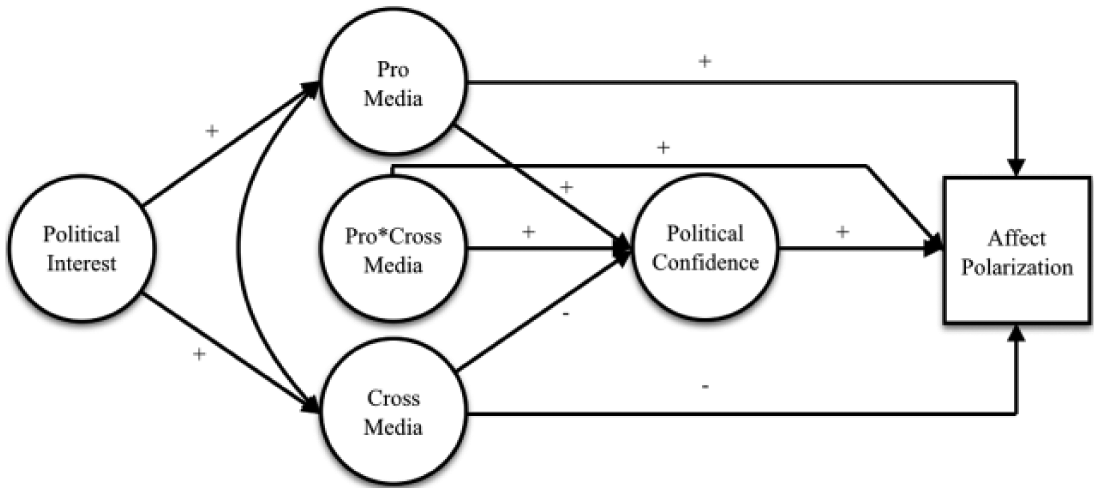
Hypothesized structural model of the direct, indirect, and conditional effects of partisan media on affective polarization.
Method
The hypothesized model of partisan media effects was tested with a survey of residents of three states with a closely contested 2014 election for the U.S. Senate. Participants were recruited from Qualtrics’s panel aggregator that includes over 20 actively managed market research panels. The elections sampled for this study were selected with two primary criteria: first, the states needed to be viable for Qualtrics’s panel partners to guarantee a sufficient sample; second, the states needed to feature a competitive election for U.S. Senate. The three states selected were Iowa, North Carolina, and Georgia. In Iowa, Democrat Bruce Braley was running against Republican Joni Ernst for the seat vacated by Democrat Tom Harkin. Ernst won the election with 52% of the vote. In North Carolina, incumbent Democratic Senator Kay Hagan lost her seat to Thom Tillis, the Republican Speaker of the North Carolina House of Representatives. Tillis won with 49% of the statewide vote. In Georgia, businessman David Purdue defeated Points of Light CEO Michelle Nunn, the daughter of former U.S. Senator Sam Nunn. The Georgia election was to fill the seat vacated by retiring Republican Senator Saxby Chambliss. Perdue won with 53% of the vote. According to Nate Silver’s election forecast, these states featured three of the four most competitive Senate races 2 weeks before the election. Participants were contacted from October 10 through October 17. Data were collected in compliance with the Institutional Review Board at the host University (approved June 10, 2014).
Participants
In total, 992 registered voters responded to the survey. Of those, 311 lived in Iowa, 290 live in North Carolina, and 391 lived in Georgia. The respondents from Iowa were predominantly White/Caucasian (n = 297, 96%), had an average age of 48.8 (SD = 17), and were more female (n = 202, 65%) than male (n = 109, 35%). In general, the Iowa respondents were highly educated, with 95 (31%) having earned a college degree and another 66 (21%) having earned a graduate degree. The respondents from North Carolina were primarily White/Caucasian (n = 236, 81%) or Black/African American (n = 40, 14%), had an average age of 50 (SD = 16.7), and were more female (n = 194, 67%) than male (n = 96, 33%). Slightly less than half of North Carolinian respondents were college educated, with 81 (28%) having earned a college degree and another 61 (21%) having earned a graduate degree. Georgians were also primarily White/Caucasian (n = 281, 72%) or Black/African American (n = 85, 22%), had an average age of 49.5 (SD = 16.3) and were more female (n = 277, 71%) than male (n = 114, 29%). A plurality (n = 150, 38%) reported attending some college, 89 (23%) reported graduating from college, and 75 (19%) earned a graduate degree. Of the respondents in Iowa, 124 (40%) identified as Democratic, 122 (39%) as Republican, and 65 (21%) expressed no partisan preference. In North Carolina, 122 (42%) identified as Democratic, 113 (39%) as Republican, and 53 (18%) expressed no partisan preference. In Georgia, 152 (39%) identified as Democratic, 179 (46%) as Republican, and 58 (15%) expressed no partisan preference.
Although the sample consisted of a diverse range of adults living in the three states, Qualtrics samples are nonprobability samples. Qualtrics provides access to individuals by partnering with market research panels who recruit participants that are proportioned to match recent U.S. census data. However, their quota-stratification occurs on a national level so there is no assurance that the participants in an individual state will demographically match the state as a whole. The representativeness of any individual sample is therefore difficult to assess. However, the effects of partisan selective exposure in online panels are remarkably consistent with those found in random digit dialing samples (Brundidge, Garrett, Rojas, & Gil de Zúñiga, 2014) and research suggests that online panels do in fact provide reliable political communication data (Hill, Lo, Vavreck, & Zaller, 2007). Ansolabehere and Schaffner (2014) conducted an extensive comparison of opt-in panel responses with random digit dialing and mail-based survey data, as well as publicly accessible data about the U.S. population, and found that “researchers will not consistently get more accurate results, nor reach substantially different conclusions, when using one mode relative to another” (p. 301).
Although research on the quality of online opt-in panels is encouraging, results from this study should not be interpreted as generalizable point estimates of population parameters in the individual states. For one, the quality of online opt-in panels is likely to vary by providers and no existing research has examined the generalizability of the panels supplied by Qualtircs. Even if these samples were representative of the individual states, they could not be generalized beyond the three states used as case studies here. It is important to remember, however, that the objective of this study is not to provide point estimates of state populations in this election—such estimates would be of questionable use beyond describing the dynamics of these particular campaigns. Instead, the objective is to investigate the plausibility of the theoretical associations hypothesized in Figure 1. If partisan media polarize voter attitudes in midterm elections, there should be evidence of this effect in the samples collected from these three states.
Measures
Affective polarization was measured by asking respondents from each state to evaluate each local senatorial candidate on a 101-point feeling thermometer. Consistent with past research on polarization (Garrett et al., 2014; Stroud, 2010), the absolute value of the difference between candidate evaluations was computed (M = 49.17, SD = 32.86, skew. = −.012, kurt. = −1.325). To ease estimation, the scale of the polarization measure was reduced by a factor of 10. Because polarization can result from in-group favor (i.e., more positive evaluations of the in-group) or out-group animus (i.e., more negative evaluations of the out-group), additional analyses were conducted in which feelings toward in-group and feelings toward out-group were treated as unique variables. These additional analyses clarify whether observed polarization resulted from more positive in-group feelings, more negative out-group feelings, or a combination of the two. For these analyses, feeling toward the in-group candidate (M = 71.74, SD = 25.49, skew. = −1.0, kurt. = 0.35) and feeling toward the out-group candidate (M = 22.26, SD = 23.88, skew. = 1.15, kurt. = 0.60) were specified as dependent variables.
Political interest was measured with three items on a 5-point agreement scale: I am interested in politics, I follow politics closely, and politics are important to me personally (M = 3.52, SD = 1.01, skew. = −.561, kurt. = −.034, α = .925).
Political confidence was operationalized using a measure of political information efficacy designed to assess a person’s confidence that she has sufficient information to participate meaningfully in politics (Kaid, McKinney, & Tedesco, 2007). Political information efficacy was measured on a 5-point agreement scale with the four items: I consider myself well qualified to participate in politics, I feel that I have a pretty good understanding of the important political issues facing our country, I think I am better informed about government and politics than most people, and if a friend asked me about the [Iowa/North Carolina/Georgia] Senate election, I feel like I would have enough information to help my friend figure out who to vote for (M = 4.80, SD = 1.41, skew. = −.543, kurt. = −.145, α = .917).
Media use was measured by asking respondents how frequently they used a variety of media on a 5-point scale with response options ranging from never (0) to all the time (4). Conservative media use was operationalized as the frequency with which respondents reported watching Fox News, listening to conservative talk radio, and reading a conservative political blog or website. Liberal media use was operationalized as the frequency with which respondents reported watching MSNBC, listening to NPR, and reading a liberal political blog or website. These media use variables were transformed into measures of pro- and cross-partisan media. Liberal media (conservative media) was coded as pro-partisan, and conservative media (liberal media) was coded as cross-partisan for those identifying as Democrats (Republicans). The measures of pro-partisan (M = 2.51, SD = 1.03, skew. = 0.32, kurt. = −0.66, α = .739), and cross-partisan (M = 1.88, SD = 0.88, skew. = 1.33, kurt. = 1.78, α = .742) media use were reliable.
Analytic Procedures
The theoretical model hypothesized in Figure 1 was tested in structural equation modeling (SEM) using the Lavaan software developed by Rosseel (2012) for the R ecosystem. SEM has two primary advantages for this analysis. First, all direct, indirect, and conditional effects can be simultaneously estimated. Second, because SEM estimates latent variables from indicators (rather than composite variables constructed from the average of scale items), measurement error is eliminated and estimates represent the true scores of latent relationships. This is beneficial for studies of partisan media because media use variables contain channel-specific information at the item level. Cable news, online media, and talk radio are all unique. Latent modeling removes channel-specific information and isolates shared ideological content across media. This distinguishes the present study from past studies that focus on a single medium (Feldman, 2011; Garrett et al., 2014 [in their U.S. Sample]; Levendusky, 2013) as well as studies of multiple media that do not utilize latent modeling (Dvir Gvirsman, 2014; Feldman et al., 2014; Garrett et al., 2014 [in their Israel sample]; Stroud, 2010).
The model was tested following the two-step procedure recommended by Kline (2005). A measurement model was first estimated to provide item-level data and overall model fit. 2 The hypothesized structural model was then estimated (Figure 1) with control variables included. Indirect effects were tested using the product of coefficients procedure (Holbert & Stephenson, 2003) by inspecting the 95% confidence interval of 1,000 bootstrapped resamples of the product of coefficients to determine whether the confidence interval contained zero. Conditional effects were tested two ways. To test the interaction of pro- and cross-partisan media use, a latent interaction term was constructed by creating three product indicators for (a) cable media, (b) online media, and (c) radio using the residual centering approach recommended by Geldhof, Pornprasertmanit, Schoemann, and Little (2012). To test whether the effects of partisan media differed by political party, a multiple-group model was specified to estimate individual paths for Democrats, Republicans, and independents. The chi-square difference test (Holbert & Grill, 2015) was used to inspect partisan differences.
The results presented here are from a single-group model that collapsed all three states into a pooled set of responses. This strategy assumes that there are not differences in the observed effects between the states. The primary benefit of merging the states is an increase in statistical power. This merger also allows more clear and parsimonious presentation of the results (rather than presenting a unique set of findings for each state). Furthermore, deviations from the overall pattern at a state-by-state level would likely result from idiosyncratic noise associated with state-level sampling error. The objective of this study is to identify general patterns in partisan media effects, not to document the specific dynamics of any individual state election.
Nevertheless, the decision to merge the three states into a single analysis may be inappropriate if the observed patterns were significantly different across the three states. To determine whether the observed relationships were invariant across states, a three-group model was specified in which individual estimates were generated for each state. This three-group unconstrained model was then compared with a nested model in which each regression path was constrained to be equal across the three states. Results demonstrated regression invariance, Δχ2(83) = 83.31, p = .47. In other words, there were no significant differences in the observed relationships between the three states.
Results
A structural model was fit to test the hypothesized paths presented in Figure 1. All variables in the model were regressed on control variables for age, sex, race, educational attainment, household income, religiosity, ideological strength, and dummy variables for state of residence. The structural model achieved acceptable fit, χ2(125) = 387.87, p < .01, root mean square error of approximation (RMSEA) = .046 (.041-.051), comparative fit index (CFI) = .974, non-normed fit index/Tucker–Lewis index (NNFI/TLI) = .960, and standardized root mean square residual (SRMR) = .024. Standardized path estimates alongside unstandardized bootstrapped confidence intervals for all paths (including controls) are presented in Table 1. Results of the structural model are presented in Figure 2.
Regression Paths for Partisan Media Use.

Note. Asterisks on β reflect results of the Wald test of significance. Confidence intervals are unstandardized regression coefficients. LLCI = lower limit confidence interval; ULCI = upper limit confidence interval
p < .05. **p < .01. ***p < .001.
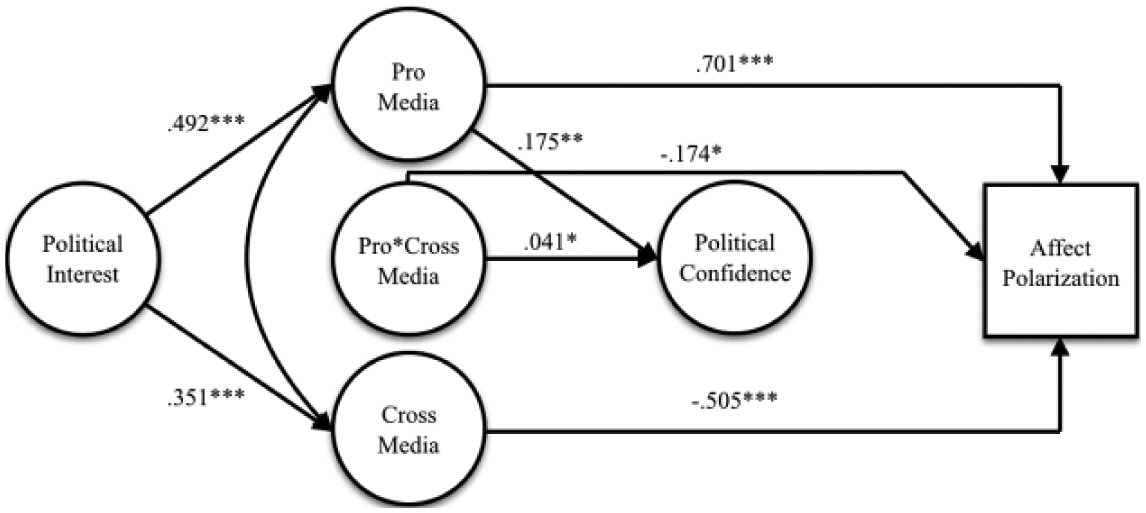
Structural model of the direct, indirect, and conditional effects of partisan media on affective polarization.
Consistent with
As predicted in
As predicted by
To determine whether the association between partisan media and affective polarization was more a result of negative feelings toward the out-group or positive feelings toward the in-group, a separate model was fit in which feeling toward the in-group candidate and feeling toward the out-group candidate were used in place of affective polarization. Aside from this substitution, the remainder of the model was unchanged. Results are presented in Table 2. Estimates were inspected for the full model but are only presented for the two dependent variables. Pro-partisan media use was associated with more positive feelings toward the in-group candidate and more negative feelings toward the out-group candidate. Similarly, cross-partisan media use was associated with more positive feelings toward the out-group candidate and more negative feelings toward the in-group candidate. This suggests that partisan media increased affective polarization not merely by influencing perceptions of the political out-group, but also by adjusting feelings toward the in-group.
Regression Paths for Alternative Path Model—In/Out Group Feeling.

Note. Asterisks on β reflect results of the Wald test of significance. Confidence intervals are unstandardized regression coefficients. LLCI = lower limit confidence interval; ULCI = upper limit confidence interval.
p < .05. **p < .01. ***p < .001.
Finally,
Discussion
This study sought to test a theoretical model of partisan media effects in three competitive campaigns for the U.S. Senate. Findings suggest that political interest is fundamental to the decision to consume both pro- and cross-partisan media (especially in the context of a midterm election), that partisan media effects can result from intergroup competition even when new information acquisition is unlikely, and that the effects of liberal media are indistinguishable from those of conservative media. The contribution of these three findings, limitations of this study, and directions for future research are discussed below.
First, the high-choice media environment elevates the significance of political interest as a precursor to political media effects (Prior, 2007). Although researchers have long known that media effects are predicated on use decisions (Blumler & Katz, 1974; Eveland, 2001; McLeod et al., 1994), political media effects research is insufficiently attentive to this reality, rarely adopting mediation models (Holbert & Stephenson, 2003). Findings from this study are consistent with the view that political interest is more than a source of nuisance variance to be controlled but instead a fundamental demographic orientation that is a precursor to the media effects process. This relationship is likely to be especially important when a presidential election is not driving broader political interest. Studies conducted when a national election is not present to stimulate interest should be even more attentive to this critical orientation. In fact, when examining the effects of news media on voter learning in the 2006 midterm elections, Wei and Lo (2008) found that surveillance motivation—a motive with a theoretical role akin to political interest—exerted significant influence on the learning process. Hence, in midterm contexts (and presumably beyond), political interest is a critical variable that should be explicitly modeled as an antecedent to media selection.
Perhaps paradoxically, political interest motivated both pro- and cross-partisan media consumption. For those who were primarily consumers of pro-partisan media, the result was polarization. However, for those who primarily consumed cross-partisan media, the result was depolarization. Political interest can therefore have one of three possible effects on polarization. First, political interest can motivate greater consumption of pro-partisan media and result in greater polarization. Because the findings demonstrated a stronger connection between interest and pro-partisan media use than cross-partisan media use, the aggregate effect of interest should be to increase polarization. Second, political interest can motivate the simultaneous consumption of both pro- and cross-partisan media. The consequences of this on polarization require further exploration, as some have found that this can also increase polarization (Garrett et al., 2014), a finding that was not replicated here. Third, in some circumstances, political interest can motivate greater cross-partisan media consumption. If this is the case, the result will be less polarization. The effect of political interest on polarization is therefore not only indirect, but also conditional on whether the user is motivated to seek affirming or challenging media.
These findings create a theoretical challenge for researchers. If political interest can result in polarization under some circumstances and depolarization under others, what motivations dictate whether a person will seek pro- or cross-partisan media? Stroud (2011) found that a small but important minority of media users prefer cross-partisan media and Levendusky (2013) identified these individuals as poorly sorted partisans. Lee (2013) found that social motivations—that is, “the need to keep up with what those around us are talking about, to appear informed to others, to be more sociable, and to follow what one’s friends are doing” (p. 305)—influenced political media consumption decisions. She did not distinguish between pro- and cross-partisan exposure but it is possible to speculate that individuals who primarily consume media from the other side select outlets for social utility. In other words, a Democrat may primarily view Fox News if it is the preferred outlet of her friends, family, and coworkers. If social utility can motivate people to seek cross-partisan media, and if cross-partisan media can reduce polarization, can interventions be created that make cross-partisan media consumption more common? Or does the increasing homogeneity of political interpersonal environments (Mutz, 2006) make this unlikely? In fact, Jennings, Galarza, and Warner (2016) found that interpersonal political communication about midterm elections were generally associated with greater political polarization. In any event, exploring the conditional nature of the relationship between political interest and polarization is a critical new frontier for research on the effects of partisan media.
Second, there is unique theoretical value to analyzing midterm elections precisely because information acquisition from partisan media about candidates in a state-level race should be low relative to a presidential election. Fox News, MSNBC, nationally syndicated radio, and online partisan media generally devote little detailed coverage to individual Senate contests. There are exceptional instances when a local race garners national attention (for example, Missouri Republican Senate candidate Todd Akin’s controversial comments about rape generated substantial national media coverage), but the dominant trend in partisan media is to cover midterm elections as national contests between the two parties (cf. Baum & Groeling, 2008). Because polarization occurred independent of changes in political confidence, knowledge acquisition is an unlikely explanation. Knowledge acquisition was not directly measured in this study but political confidence is a good proxy for knowledge acquisition because, if people learn more confirming (or disconfirming) facts about the candidates, confidence in their knowledge about the election should increase (decrease). In fact, political confidence is the mechanism often attributed to the polarizing effects of knowledge acquisition (Sunstein, 2009).
If partisan media do not polarize evaluations of midterm candidates by providing greater political confidence (presumably through information acquisition and confirmation), what mechanism might deliver this polarizing effect? The most plausible alternative explanation is that partisan media provide cues that enhance intergroup competition. Because national partisan media cannot (or do not) devote extensive coverage to each state-level election, the coverage is often framed as a national contest between the parties for supremacy in the legislative body. This should make partisanship more accessible and therefore more central to attitude formation (i.e., Knobloch-Westerwick, 2012). Furthermore, because the national competition between the parties will result in one party winning the election and the other losing, the intergroup competition frame should foster a zero-sum attitude about the election that, in other intergroup contexts, has been found to result in biased intergroup evaluations (Tajfel & Turner, 1979). Although intergroup competition has previously been identified as a cause of political polarization (Iyengar et al., 2012), the midterm context allows this thesis to be tested in a media environment in which the information acquisition processes are less of a confounding possible cause. Because political confidence did not mediate the polarizing effect, the learning and confirmation mechanisms outlined by Sunstein (2009) are less plausible than intergroup competition as an explanation for the polarizing effect of partisan media.
Thus, by leveraging an electoral context where information acquisition is an unlikely explanation of polarization (and by ruling out political confidence as a mediating mechanism), this study replicates previous findings that partisan media polarize (or depolarize) (Dvir Gvirsman, 2014; Feldman et al., 2014; Garrett et al., 2014; Knobloch-Westerwick, 2012; Levendusky, 2013; Stroud, 2010; Warner, 2010) while also identifying intergroup cuing as a likely mechanism to explain this polarization. This study thus joins a smaller set of studies that explore the mechanism of polarizing effects. For example, Dvir Gvirsman (2014) found that knowledge acquisition does generate polarization in contexts in which the content of the media is likely to result in issue-relevant learning, Knobloch-Westerwick (2012) found that partisan media polarize by increasing the accessibility of partisanship in information processing, and Tsfati and Nir (2017) found that acceptance frames mediate the polarizing effect of partisan media. This study also joins a relatively small body of research examining political communication in midterm elections (e.g., Baum & Groeling, 2008; Hendricks & Schill, 2016; Wei & Lo, 2008). Although the finding of polarizing effects of pro-partisan media largely replicate and affirm existing research, these findings have typically been demonstrated in contexts where information acquisition and partisan cuing are equally plausible explanations for polarization.
Third, this study answered Feldman and colleague’s (2014) call to examine explicitly liberal media. This study tested whether the polarizing (depolarizing) effects of conservative media on Republicans (Democrats) would be replicated by liberal media. The effects of liberal media were indistinguishable from the effects of conservative media observed here. Despite partisan differences in worldview (Hetherington & Weiler, 2009) and approaches to/avoidance of partisan media (Garrett & Stroud, 2014), even despite the differences in the content of liberal and conservative media, the polarizing effects were invariant across partisanship. The first studies of partisan media effects predate the emergence of a mature and robust liberal media environment (Jamieson & Capella, 2008; Jones, 2002). Because this is no longer the case, it is important that research on partisan media continue to account for explicitly liberal media outlets.
The above represent important contributions to the study of partisan media effects. Nevertheless, there are important limitations that bear consideration. First, the study merged data from three different states with three distinct elections. Although formal tests were conducted to demonstrate that this merger was appropriate, collapsing the data in this way forecloses opportunities to examine each state as a unique case study. Future research may consider how individual states (and the contexts of the elections within them) can condition the effects presented here. The study also focused on states with closely contested elections. If there is a bias in political communication research toward presidential elections, perhaps there is even greater bias toward competitive contests. Future research should seek to verify that these polarizing effects are not merely an artifact of a close competition and that partisan media exert similar influence in states with uncontested or lopsided contests. Eveland (2001) found that political learning from news media occurred in nonelection, midterm, and presidential election years. Similar comparisons should be made regarding the polarizing effects of partisan media.
Furthermore, political interest is not the only orientation that should influence partisan media use. Those with stronger in-group identification should be more likely to use pro-partisan media. In fact, the relationship between in-group identification and partisan media use may be mutually reinforcing. Other variables such as acceptance of authoritarianism, xenophobia, distrust of political institutions (including traditional news media), education, and political socialization should all be included in future research on the relationship between political interest, media use, and polarization.
The study is also limited by the specific states that were selected for analysis. Two of the states (North Carolina and Georgia) were Southern and one (Iowa) was Midwestern, and all three have substantial rural populations. The samples of these states do not represent the state populations, and the states themselves do not represent the national population. Furthermore, media use patterns may vary from state to state. Although cable television and radio are widely available across the United States, differences in Internet access may result in underestimates of the role of online media compared with states with more comprehensive Internet access. However, because this study utilized multiple media and used latent variables to model media effects, any idiosyncrasies in Internet access will be restricted to residual variance and will not influence the estimated latent effects reported in the results section. Nevertheless, future research on midterm elections should seek opportunities to test media effects in regions that were excluded from this analysis.
This study is also limited by its focus on television, radio, and online politics websites. An increasing number of people are finding political information through social media. The unique dynamics of social media challenge the opt-in nature of the high-choice media environment because people construct their digital social environments for reasons that transcend politics. This creates opportunities for those who are not interested in politics to experience incidental exposure to political information. Interest, however, should exert a similar but not identical effect in these contexts. Social media users must decide which conversations to follow, which links to click, which videos to watch, and so on. Furthermore, as social media platforms develop increasingly sophisticated filtering algorithms, political interest could influence exposure to political information indirectly through algorithmic adaptation. Researchers should investigate how interest might interact with the evolving information environments presented by social media platforms particularly since the effects of social media on exposure to diverse opinions may depend both on the composition of people’s networks and the filtering outcomes of content algorithms.
Finally, the cross-sectional design of this study precludes claims of temporal order. The data cannot demonstrate that media use preceded candidate evaluations or that political interest preceded media use. In fact, it is likely that affective polarization spurs further political interest and thus more partisan selectivity (Slater, 2007). Nevertheless, this study found the presence of important associations that are consistent with key theoretical predictions. This study also relied on self-reported measures of media use which can exaggerate absolute media use—though they should distinguish between heavy and light media users. Finally, this study utilized a nonprobability sample to test the hypotheses, though the objective was not to describe the electoral dynamics in Iowa, North Carolina, and Georgia. Instead, this study hypothesized theoretical relationships that, if true, should be present in a diverse sample of adults experiencing a competitive midterm election. Unless the sample systematically underrepresented a subpopulation that experience partisan media differently than those who opted into the panel, there is no reason the findings would differ from the population. Nevertheless, readers should appreciate that the point estimates reported here are not generalizable beyond the sample.
Conclusion
The findings from this study demonstrate the centrality of political interest in media effects and affirm the message-consistent effects of partisan media regardless of the ideology of the media or party affiliation of the users. Furthermore, the findings are consistent with the social identity perspective that media provide intergroup cues and therefore enhance the salience of partisanship as a social identity. The centrality of political interest suggests that, in this new media environment, not only will information gaps between interested and disinterested users continue to grow, but gaps in attitude strength will also expand. The politically interested users who opt into pro-partisan media will become more polarized while disinterested users can opt out of the conversation altogether. However, readers should not forget that an important minority of people primarily select media from the other side and that these odd partisans were significantly less polarized than others. This suggests that there is value in encouraging people to adopt diverse media environments despite our proclivity to apply a partisan lens to attitude-incongruent messages. Perhaps the value of cross-partisan media is not in persuading members of the other side to change their views but rather in illustrating that members of the out-group have legitimate reasons for disagreement. Recent political developments suggest that polarization is likely to be a feature of politics in the United States for the foreseeable future. This study demonstrates that the high-choice media environment filled with ideological content can exacerbate polarization but, to the extent that people opt for diverse information streams, can also counteract the polarizing trend.
Footnotes
Declaration of Conflicting Interests
The author(s) declared no potential conflicts of interest with respect to the research, authorship, and/or publication of this article.
Funding
The author(s) disclosed receipt of the following financial support for the research, authorship, and/or publication of this article: This work was conducted with support from the Richard Wallace Research Incentive Grant awarded by the University of Missouri Alumni Association.