




Abstract
This study examines how political cynicism and social media communications moderate the spillover effects of political scandals, that is, the extent to which a scandal surrounding one political figure may influence people’s attitudes toward other political objects. Theoretically, spillover effects are understood as grounded in how people understand the interconnections among politicians and institutions. Analysis of a representative survey in Hong Kong documents the presence of spillover effects of scandals surrounding the Chief Executive of the government. The findings also illustrate the moderating role of political cynicism and, to a lesser extent, political communications via social media.
Political scandals can be defined as publicly revealed transgressions of moral, political, or legal norms by politicians or political institutions. Many scholars have noted the increasing prominence of political scandals around the world in the past two decades (Allern & Pollack, 2012; Thompson, 2000; Tumber & Waisbord, 2004). They are significant political events partly because of their power to derail the careers of politicians, and political scientists have spent much effort in trying to understand the conditions under which scandals could impinge on public opinion (e.g., Fischle, 2000; Miller, 1999; Pattie & Johnston, 2012).
Notably, scandals may adversely influence not only public support for the politicians directly implicated; researchers have also examined whether scandals would affect people’s trust in the political parties to which the implicated politicians belong, politicians in general, the government, and the political system at large (e.g., Bowler & Karp, 2004; Kumlin & Esaiasson, 2012; Ulbig & Miller, 2012). That is, the negative impact of scandals may spillover from the involved politicians to other politicians and institutions.
This study is interested in the spillover effects of scandals. But it goes beyond merely documenting the presence or absence of such effects by trying to examine how pre-existing attitudes and communication activities may moderate the spillover effects. Premised on the theoretical understanding that spillover effects are related to how people perceive the interconnections among objects (Roehm & Tybout, 2006), this study tests, through analyzing a representative survey, the propositions that political cynicism and social media communications would strengthen the spillover effects of scandals. This study shall contribute to our understanding of the conditions for scandals to have more widespread impact on public opinion. It is, to the author’s knowledge, among the first studies to examine how social media use shapes the impact of scandals. Moreover, this article contributes to the literature by examining the notion of spillover effects in Hong Kong, generating knowledge about the impact of scandals in a hybrid regime.
The next sections review the literatures on the impact of political scandals, further explicate the concept of spillover effects, and articulate why cynicism and social media communications may moderate spillover effects. The article then describes the context and sets up the specific hypotheses. Discussions of the survey method and data analysis follow.
The Impact of Political Scandals and Scandal Spillover Effects
Although much research has demonstrated the intuitive idea that scandals could negatively affect public support for the implicated politicians (e.g., Brody & Shapiro, 1989; Praino, Stockemer, & Moscardelli, 2013), others found that not all scandals severely damaged the politicians’ reputation or that scandal’s impact can be short-lived (Mitchell, 2014). The Clinton–Lewinsky affair was a classic case, as Clinton’s approval rating rose during the scandal (Zaller, 1998). Midtho’s (2012) study of six Norwegian scandals also found a significant negative impact in only one case. One main reason for variations in the impact of scandals is that people could hold different perceptions about the factuality, seriousness, and relevance of a scandal (Fischle, 2000; Miller, 1999), that is, people may see the accusation as wrongful, trivial, or irrelevant to public duties. These perceptions are in turn likely to be partly driven by people’s pre-existing attitudes. Following the theory of motivated reasoning, several studies have shown that people tend to process scandal-related information in ways that support their pre-existing views (Anduiza, Gallego, & Munoz, 2013; Blais et al., 2010; Grover & Hasel, 2015; F. L. F. Lee, 2015a). Supporters of the implicated politician are likely to dismiss the factuality, seriousness, and/or relevance of a scandal.
Other studies have shown how other factors could condition the impact of a scandal. For example, how media frame a scandal could affect public perceptions and reactions (Joslyn, 2003; Shah, Watts, Domke, & Fan, 2002). Bhatti, Hansen, and Olsen (2013) found that people are harsher when judging politicians whose transgressions violated the values they publicly professed, that is, a scandal is particularly damaging if it reveals the politicians’ hypocrisy (McDermott, Schwartz, & Vallejo, 2015). Political and social contexts can also condition the influence of scandals. Carlin, Love, and Martinez-Gallardo (2015) examined 84 scandals from 18 Latin American countries and found that corruption scandals adversely affected presidential approval only when economic conditions are bad. They argued that people in developing countries may be willing to “trade corrupt or illicit practices for the prospect of favorable policy outcomes” (p. 113).
Although studies have shown that scandals do not always damage the reputation of even the politicians involved, it is nonetheless also possible for the negative impact of scandals to go beyond those directly implicated. Pattie and Johnston (2012), for instance, found a negative impact of scandals on people’s evaluation of politicians in general in the United Kingdom. Maier (2011) showed that a scandal could negatively impinge on people’s attitude toward both the political party to which the involved politician belongs as well as other political parties, though there is no negative impact on politicians in general and the political system at large (also see Ulbig & Miller, 2012).
Political scientists seldom elaborate the theoretical underpinnings of the above scandal spillover effects. But discussions of scandal spillover effects also exist in marketing and business studies in relation to corporate or brand scandals (Huang & Li, 2009; Yu, Zhang, & Zheng, 2015). For instance, Gao, Zhang, Zhang, and Knight (2015) found that, in China, a scandal surrounding a domestic brand has negative impact on attitude toward other domestic brands, but it has positive impact on attitude toward foreign brands. The authors argued that people see domestic brands as similar to each other and differ from foreign brands as a category. Hence, when one domestic brand is embroiled in a scandal, people also perceive other domestic brands as problematic, and yet see foreign brands more positively.
Theoretically, spillover effects can be understood through the accessibility–diagnosticity framework (Roehm & Tybout, 2006). Diagnosticity refers to people’s implicit theories about how things relate to each other in the world. According to such “implicit theories,” ideas and cognitions form into associative networks in people’s minds. When one idea or cognition is activated, others tied to the activated idea would also be activated. Hence, evaluations of the other ideas and cognitions could also be influenced depending on how people understand the interconnections among the activated items. The possible spillover effects of scandals can be understood likewise: The negative impact may spillover to other people and institutions seen as closely connected with or similar to the implicated politician, while there is also the possibility of other politicians benefitting from a scandal because of a contrast effect.
Notably, the above framework does not determine whether spillover effects are “rational.” In marketing studies, one may predict the extent of spillover effects based on how brands are typically associated with each other (Roehm & Tybout, 2006), but how things should be associated with each other is a separate question. Similarly, the “rationality” of the spillover effects of political scandals will depend on the validity of citizens’ implicit theories about the relations among politicians. This cannot be easily judged. Yet put aside the issue of rationality, the theoretical argument about the psychology of spillover effects remains the same.
Conditions of Spillover Effects
Nevertheless, the spillover effects of political scandals could also be moderated by other factors. For example, if spillover effects are based on how people connect the scandalized politicians to other politicians and institutions, such effects should be more prominent among people who are more capable of drawing such connections. Regner and Le Floch (2005) thus found that the assimilation and contrast effects of political scandals appear mainly among the politically sophisticated participants in their experimental study.
This study follows the above line of argument but posits cynicism and social media communications as moderating factors. Political cynicism is sometimes defined as “a lack of confidence in and a feeling of distrust toward the political system, including public officials and institutions” (Pinkleton & Austin, 2001, p. 324). Cynicism, under this broad definition, overlaps largely with the notions of external political inefficacy and political distrust. The present study, however, focuses on scandals surrounding politicians. Hence, more similar to Cappella and Jamieson (1997), this study is more concerned with politicians as the primary objects of distrust. The cynic tends to see politics as corrupt and all politicians “are Machiavellian partisans uninterested in the public good” (Cappella & Jamieson, 1997, p. 21). The latter is the aspect of cynicism most pertinent to this study. In this latter sense, political cynicism is not identical with negative external efficacy. Cynicism deals with people’s beliefs about the “world of politics” in general, that is, all politicians, parties, and “politics” itself is fundamentally corrupt. Cynics are likely to see the political system as irresponsive to public opinion (i.e., negative external efficacy), but the two remain different in that cynicism can have other implications, and negative external efficacy is not always generated by cynicism.
Specifically, the cynical worldview implies a “theory” about the equivalence of all politicians and political institutions. Any bad deeds committed by a politician are likely to be seen by a cynic as “typical of a politician,” whereas any good deeds are likely to be seen as “exceptional.” In political communication research, cynicism is sometimes seen as the outcome of specific types of contents, such as negative advertising or game-framed news (e.g., Cappella & Jamieson, 1997; De Vreese & Semetko, 2002; Elenbaas & De Vreese, 2008). Media contents about political scandals, as a type of negative news, may also generate or reinforce people’s cynicism through seemingly confirming the dirtiness of politicians.
The present study, however, is not concerned with cynicism as the outcome of exposure to scandals; it is concerned with whether cynicism might influence how people interpret and respond to a scandal. Dancey (2012), for instance, found that cynical people are not more attentive to scandals, but they do interpret scandal-related information in ways that confirm their existing cynical views. Extending Dancey’s finding, for people with high levels of cynicism, a scandal surrounding one politician is likely to influence their evaluations of other politicians because assimilating politicians with each other in the case of a scandal would reconfirm their “theory” about the general characteristics of “politicians.” Less cynical people, in contrast, should be relatively more likely to see a transgression as reflecting the lack of integrity of individual politicians. Negative spillover effects are less likely to arise.
Besides pre-existing political attitudes, communication activities could also influence how people interpret scandals (e.g., F. L. F. Lee, 2014). This study contends that political communication via social media may strengthen the spillover effects of scandals. This expectation is based on two premises. The first is the straightforward idea that some people may not draw broader implications of a political event by themselves, either because of a lack of expertise (Regner & Le Floch, 2005) or because their pre-existing attitudes do not encourage them to do so. Yet through communication activities, people may start seeing an event as connected to other events and objects in specific ways.
Certainly, what linkages people would draw is dependent on the contents of the communications. People can be persuaded to believe that a scandal is “representative” of what all politicians are like, but they can also be persuaded to believe the opposite. Yet this study contends that social media communications in Hong Kong are likely to strengthen the scandal spillover effects. Given political pressure under China, the mainstream news media have become more docile over the years. Media self-censorship was considered as a serious problem (F. L. F. Lee, 2015b). The scenario encouraged the growth of online alternative media (Leung & Lee, 2014), and social media became the major platforms through which oppositional messages were communicated. In a study about the Umbrella Movement in 2014, P. S. N. Lee, So, and Leung (2015) argued that social media constituted an insurgent public sphere, defined as “a public space for counterpublics to interconnect, discuss issues, construct collective identity, articulate common goals, and engage in collective actions, online or offline, in direct opposition to and confrontation against the dominant public, the state or the market” (p. 360). Empirically, social media communications have been repeatedly found to relate negatively to attitude toward the government and positively to protest participation (F. L. F. Lee, Chen, & Chan, 2017; P. S. N. Lee et al., 2015; Tang & Lee, 2013).
Based on such research, this study expects social media communications to have an “overall tone” that is critical toward the political establishment. This implies a possible main effect of social media communications on people’s attitude toward the political establishment. More important for this study, it also implies a higher likelihood that, when facing a scandal surrounding a government leader, people engaging in social media communications would “generalize” the scandal. That is, through social media communications, people are likely to articulate and circulate the critical view that the scandal is symptomatic of a broader problem involving other government leaders and even the political system.
Certainly, such claims need to be empirically examined. The next section would further describe the local context and turns the above arguments into more specific hypotheses.
Context and Hypotheses
Despite increasingly serious concerns of media self-censorship as just mentioned, the Hong Kong media remained “partly free” and could continue to report on negative news about the government and politicians, including various kinds of scandals. There has not been research documenting the frequencies of political scandals in Hong Kong. But commentators generally agree that scandals surrounding government leaders and politicians have become more commonplace in recent years. One possible reason is the worldwide trend of the increasing visibility of politicians due to transformations in media ecology and technologies, which made the concealment of misconduct more difficult (Thompson, 2000). Another possible factor is the growth of internal conflicts among the political elites. Balan (2011) has shown in the case of Chile that internal conflicts could drive elites to leak scandal-related information about their opponents to the press. A similar scenario is believed by many to be happening in Hong Kong. In fact, there has even been the rise of talks about the state machines systematically collecting scandalous information about politicians (F. L. F. Lee, in press).
In any case, prominent scandals surrounding CY Leung, the Chief Executive of the Hong Kong Special Administrative Region Government between 2012 and 2017, included the rumor that he was closely connected with gangster groups, the accusation that he had received 50 million dollars from an Australian company right before he took office, an accusation that he had forced airport staffs to violate airport security guidelines for the convenience of her daughter, among a few others. The lack of full democracy means that the existing institutional mechanisms designed to prevent corrupt behavior of top government leaders, according to one political scientist, “do not appear to have been particularly effective” (Scott, 2014, p. 983). Within the legislature, for instance, the pro-establishment (i.e., pro-government) legislators constitute the majority, and the pro-democracy legislators often had their motion to initiate investigations of controversial conduct of the government and specific government leaders voted down by the pro-establishment politicians. Therefore, scandals surrounding government officials might not create immediate threats to their positions. But this certainly does not mean that scandals could not affect public opinion.
Against this background, this study focuses on how scandals surrounding Chief Executive CY Leung may influence Hong Kong people’s evaluations of not only CY Leung himself, but also other government officials and the Hong Kong government as a whole. Methodologically, the study does not focus on one specific scandal. Instead, the survey to be analyzed asked the respondents to recall political scandals in the previous few years, and many respondents named scandals surrounding CY Leung. Our hypotheses about the basic negative impact and the spillover effects of political scandals are a matter of whether scandal recall would relate to public evaluations. They are stated as follows:
One issue in the above hypotheses, especially
Following the arguments in the previous section, this study posits political cynicism and political communications via social media as moderators of the spillover effects of scandals. Our theoretical argument centers on how cynicism and social media communication may help people draw assimilative linkages among political leaders. The argument leads to the expectation that the two variables would strengthen the spillover effects of scandals, but not the effects of scandals on the involved politicians. Nevertheless, for clarity and to avoid positing hypotheses about null findings, we simply state the hypotheses regarding how the two factors should moderate
Method and Data
Sampling
Data analyzed below were derived from a telephone survey conducted between May 23 and June 3, 2016, by the Center for Communication and Public Opinion Survey at the Chinese University of Hong Kong. The target respondents were Cantonese speaking Hong Kong residents between 18 and 70 (94.6% of local residents aged 5 or above can speak Cantonese, according to the 2016 by-census). Sampling proceeded by pooling together all telephone numbers from the most recent residential directories. The last two digits of the numbers were replaced by the full set of 100 double digits from 00 to 99. Specific numbers were selected randomly by computers during the fieldwork. The most recent birthday method was used to select the target respondent from a household. A total of 800 interviews were completed. The response rate is 40% according to American Association of Public Opinion Research (AAPOR) formula response rate 3 (RR3). The sample was weighted according to the Age × Education × Gender distribution of the population when conducting the analysis.
Operationalizations of Key Variables
Scandal recall
To solicit recall of political scandals, the survey asked the respondents the following open-ended question: “There have been quite a few scandals involving politicians or government officials in recent years, do you have impressions about any specific scandal related to the Chief Executive, government officials, or politicians?” After the respondent named a scandal, the interviewer asked for a second scandal that the respondent could remember. The respondent would be asked to name up to three scandals.
The researcher does not judge whether the events named by the respondents are scandals in the classic sense, that is, involving the revelation of an originally concealed transgression. The point is that the respondents saw the named events as scandals. But some of the aforementioned scandals, such as the accusation of CY Leung getting 50 million from an Australian company, featured prominently in the respondents’ answers. There was no sign that many respondents understood the word “scandal” as just any controversial political events (e.g., while 10 respondents named a notorious case of police violence during the Umbrella Movement, only six named the occupation campaign itself as a scandal). The respondents named on average 1.26 political scandals (SD = 1.14) and 0.68 scandals directly implicating the Chief Executive (SD = 0.76). The latter is the key independent variable for testing the hypotheses. However, to draw robust conclusions regarding scandal spillover effects, we need to ascertain whether what matters are CE-related scandals or just any scandals. Therefore, number of non-CE-related scandals was also used in the analysis as a control (M = 0.59, SD = 0.82).
Evaluations of officials and the government
The survey asked the respondents to, by means of a 0 to 10 scale (0 = very bad and 10 = very good), evaluate the performance of (a) Chief Executive CY Leung (M = 3.70, SD = 2.92), (b) Chief Secretary Carrie Lam (M = 5.34, SD = 2.62), (c) Financial Secretary John Tsang (M = 6.17, SD = 2.01), (d) Secretary of Justice Rimsky Yuen (M = 4.55, SD = 2.44), and (e) the Hong Kong government as a whole (M = 4.56, SD = 2.43). Depending on the question order, answers to the scandal recall questions and the performance evaluation questions may influence each other. The survey thus randomly assigned respondents to one of two question orders (i.e., scandal recall first or evaluation first). The findings show that question order does not significantly affect scandal recall or performance evaluation (t < 1.60. p > .10 in independent-samples t tests in all cases).
Political cynicism
As explicated, this study follows Cappella and Jamieson (1997) to focus on political leaders/politicians as the main object of distrust when considering the notion of cynicism. The respondents were asked to indicate, by means of a 5-point Likert-type scale (1 = strongly disagree, 5 = strongly agree), if they would agree that (a) most politicians are only looking after their own interests and are not sincerely serving the public and (b) the verbal promises of most politicians are not trustworthy. The two statements are highly similar to part of the measures utilized in the literature (e.g., Pinkleton & Austin, 2001). The answers were averaged to form the index of political cynicism (M = 3.55, SD = 0.99, r = .61).
Political communication via social media
The survey asked the respondents how much time they spent per day on the Internet. Those who spent at least some time online were then asked how much time per day they spent on “Facebook or other social networking sites” (1 = not at all, 5 = 181 minutes or more). Those who spent at least some time on social media were further asked if they (a) acquire public affairs or political information via Facebook or other social media sites, (b) express their own views on public opinion and politics on social media sites, (c) connect with “people from political parties, people from social movement groups, or political commentators” via social media, (d) pay attention to the actions of “people from political parties, people from social movement groups, or political commentators” via social media, and (e) join groups about public affairs or politics on social media. Answers were registered with a 5-point scale ranging from 1 = none/never to 5 = very much/very frequently. These items were developed partly based on past research in Hong Kong (e.g., Tang & Lee, 2013) and then adjusted to fit the present purpose. An exploratory factor analysis shows that the five items belonged to only one factor (eigen-value = 2.93, variance explained = 58.5%). The answers to the questions were averaged (α = .81). Those who did not use the Internet or social media were coded as 1, that is, equal to those who used social media but never for public affairs-related purposes (M = 1.67, SD = 0.78). Meanwhile, time spent on social media (M = 2.04, SD = 1.13) was used as a control variable.
Control variables used in the multivariate analysis include the four demographics of gender, age, education, and family income. Political orientation was tapped by a question asking the respondents whether they were supporters of the pro-establishment faction, supporters of the pro-democracy faction, supporters of the localists (i.e., a newly emerging faction involving people who emphasized a distinctive local identity and the priority of local interest of Hong Kong when dealing with mainland China), centrists, or having no orientation. Three dummy variables representing “pro-establishment citizens,” “pro-democracy citizens,” and “localists” were created. Internal efficacy, external efficacy, and collective efficacy were the average of two relevant statements designed following past Hong Kong research (F. L. F. Lee, 2006). The statements for external efficacy, in particular, focus on whether the respondents agreed that the government is willing to listen to the public and the political system is responsive to public opinion. Attention to mainstream news media and interpersonal political discussion were also controlled to determine the specificity of the impact of political communication via social media. Details of operationalizations are omitted due to space limitations.
Analysis and Findings
Before testing the hypotheses, we can examine what factors could predict scandal recall. This could provide us with some relevant information about the relationships between scandal recall and the key variables in the analysis. Multiple regression was conducted by treating recall of CE-related scandals as the dependent variable and the control factors plus cynicism and social media communications as the independent variables. For comparison, the regression model is also used to predict number of non-CE–related scandals.
The first column of Table 1 shows that older people, better educated people, and people with higher levels of internal and collective efficacy are more likely to remember larger numbers of scandals about Chief Executive CY Leung. Besides, political orientations also influence scandal recall—the pro-democracy citizens and people who saw the government as irresponsive to public opinion were more likely to recall more CE-related scandals.
Predictors of Scandal Recall (N = 800).

Note. Entries are standardized regression coefficients. Missing values replaced by means. CE = Chief Executive of SAR Government CY Leung.
p < .05. **p < .01. ***p < .01.
Comparing the findings in the two columns of Table 1, the regression model is much less capable of explaining recall of non-CE–related scandals. In the latter case, external efficacy and political orientation are not significant predictors. Instead, political cynicism is positively related to non-CE–related scandals. One plausible reason is that non-CE–related scandals encompass scandals about a wider range of politicians. A general distrust toward all politicians is therefore more likely to relate to scandal recall.
Most of the communication variables do not predict scandal recall (CE-related or not). This suggests that the most memorable scandals are typically highly prominent news events. Basic information about the scandals would have diffused throughout the society. Hence, it does not take a frequent news media user to know about and remember the scandals. Nonetheless, there is a significant positive relationship between political communication via social media and recall of non-CE–related scandals, suggesting that political communication via social media may aid recall of some of the less prominent scandals.
We can now turn to tackle the hypotheses. Multiple regression was conducted again with evaluations of the CE, the three top government officials, and the government as a whole as the dependent variables. The regression model is the one in Table 1 plus number of CE-related scandals recalled, number of non-CE-related scandals recalled, and three interaction terms. Specifically, “number of CE-related scandals recalled × political cynicism” and “number of CE-related scandals recalled × political communication via social media” were created to test
The first column of Table 2 shows that, after controlling for political orientations, efficacy, and demographics, number of CE-related scandals recalled indeed has a highly significant negative relationship with evaluation of the CE. It should be noted that the regression model has a large adjusted R², that is, most of the variables pertinent to predicting evaluation of the CE were included. External efficacy, in particular, is a very strong predictor of all dependent variables in Table 2. Understandably, evaluation of the government’s responsiveness to public opinion is closely related to evaluation of the top leaders and/or government performance in general. But for this study, the point to note is that the impact of CE-related scandal recall survives the stringent control of other variables.
Predictors of Performance Evaluation of Officials and the Government (N = 800).
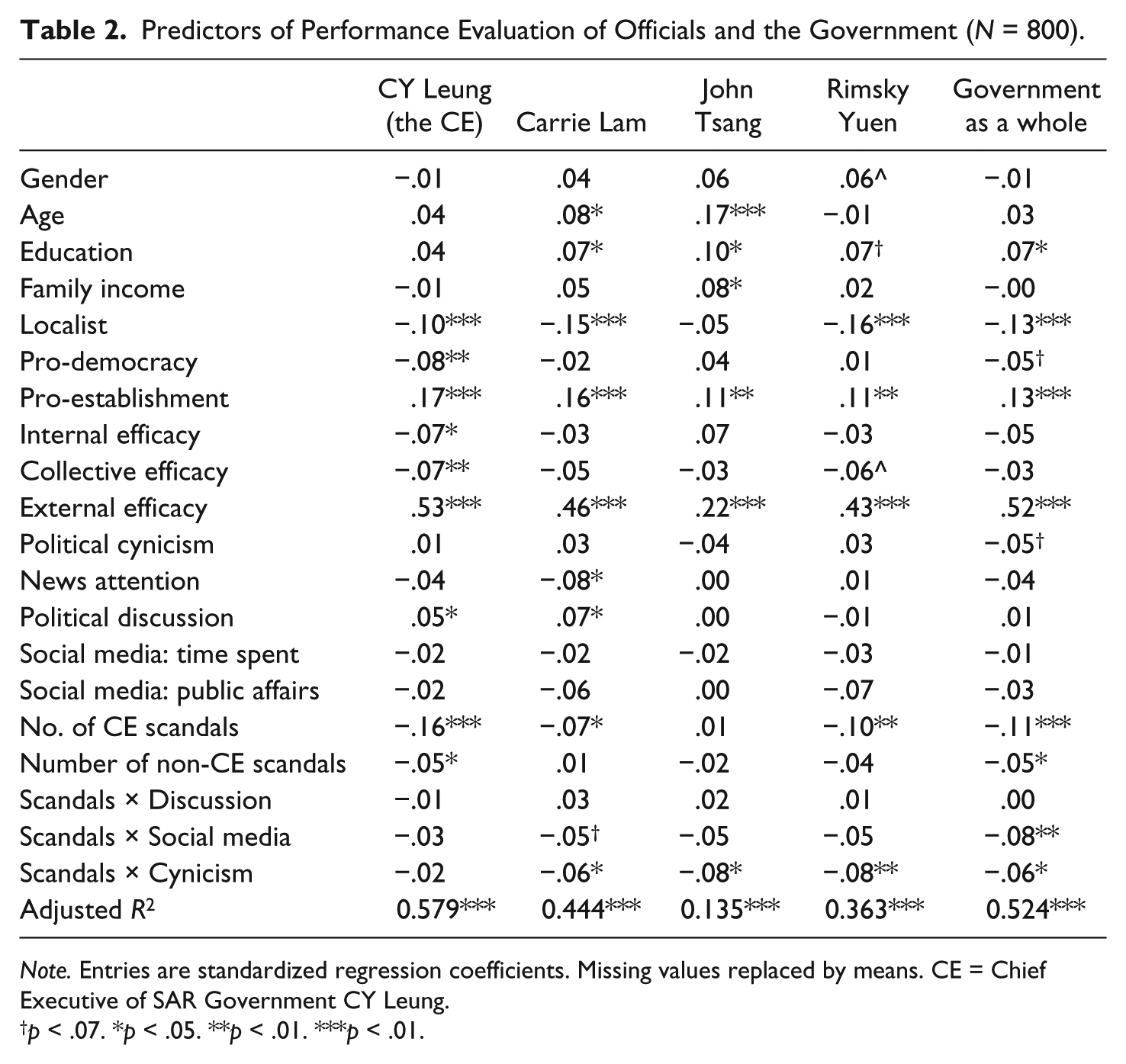
Note. Entries are standardized regression coefficients. Missing values replaced by means. CE = Chief Executive of SAR Government CY Leung.
p < .07. *p < .05. **p < .01. ***p < .01.
The second to fifth columns show the results related to scandal spillover effects. The most powerful predictors of the performance evaluation of the other top officials and the government as a whole are similar to the predictors of evaluation of the CE. More important, number of CE-related scandals indeed relate to three of the four dependent variables. The findings are consistent with
Meanwhile, number of non-CE–related scandals does not influence evaluations of the three top government officials, but it does have a weak but significant relationship with evaluation of the government as a whole. After removing the scandals surrounding the CE, some of the scandals included in the “non-CE–related scandals” may surround various lower level government officials. Hence it is not too surprising that the variable could still influence evaluation of the government as a whole. But the latter negative impact is very weak and does not spillover to evaluation of the three top-level officials.
The bottom of Table 2 gives the findings regarding

Interaction effects between scandal recall and cynicism on evaluation of government.

Interaction effects between scandal recall and public affairs communication via social media on evaluation of government.
Social media are platforms on which people can talk to each other. However, Table 2 shows that the interaction between interpersonal discussion and scandal recall does not have any significant effect on any of the dependent variables. Therefore, the moderating role of political communication via social media is based on not only the fact that people talk to each other via social media. The moderating role of social media is based on something more specific to communications and discussions occurring on social media platforms.
Discussion and Conclusion
The above analysis documents the presence of scandal spillover effects, as recall of scandals related to the Chief Executive of the government has a negative relationship with evaluations of other top officials and the government as a whole even after the inclusion of stringent controls. However, the finding also shows that the spillover effect is not applicable to all other officials under all conditions. The absence of across-the-board spillover effect does not undermine the significance of the phenomenon. Instead, it illustrates the importance of the accessibility–diagnosticity framework (Roehm & Tybout, 2006). Whether the impact of a scandal about one politician would spillover to another political figure is dependent on people’s “implicit theories” about the relationship between the scandalized politician and the other person. The exceptional case in the current analysis—the Financial Secretary John Tsang—had in the most recent years built up a reputation of being relatively willing to speak on behalf of local interests when compared with the Chief Executive CY Leung. There were even rumors in the press about internal conflicts between Tsang and Leung. As indicated in the analysis, people’s evaluations of the two are not too highly correlated. That is, Tsang and Leung are seen as rather different. Hence, scandals about the Chief Executive are less likely to have spillover effects onto Tsang.
Nonetheless, the findings show that political cynicism does lead to a tendency of people bundling all politicians and officials together into the same category, thus strengthening the spillover effects. The findings thus show that cynicism, conceptualized and operationalized as a general distrust toward all politicians (Cappella & Jamieson, 1997), has implications on how people understand the political world. Notably, the analysis shows that political cynicism does not moderate the impact of CE-related scandal recall on evaluation of the Chief Executive himself. At least in this case, cynicism did not lead to more critical interpretations of the scandals; it has a unique influence on the extent of scandal spillover.
More broadly speaking, this study suggests that cynicism contributes to more negative views about the government and the political process not only because cynical people are more likely to perceive things in a negative manner. It is also because cynical people are more likely to attribute a problem to a wider range of politicians and political institutions. To the extent that political cynicism leads people to see that “all crows under the sky are black,” when one politician or political institution is embroiled in a problem, people are more likely to see the problem as representative of the political situation or all politicians at large.
In comparison, the findings surrounding the moderating role of social media communication is less clear-cut, but the results are still generally consistent with the argument that social media constitute the counter-public spheres in Hong Kong in which people engage in critical discussions (P. S. N. Lee et al., 2015; Leung & Lee, 2014). The latter in turn may help people build assimilative linkages among political actors and institutions when negative information about a specific political actor arises. Hence, social media communication could strengthen the scandal spillover effects.
It should be noted that cynicism and social media communications could, theoretically, also have direct relationships with scandal recall. Although the direct effect of scandals on cynicism and social media communications (or vice versa) does not constitute the focus of this study, the analysis does show that both social media communications and political cynicism are related to number of non-CE scandals recalled. It shows that people can indeed become more familiar with a wider set of relatively less prominent political issues and events through political communication via social media. Nevertheless, social media communications and cynicism do not relate directly to evaluation of government officials. But the latter could be the result of the fact that external efficacy, which has very strong relationships with the dependent variables, is controlled. It is possible that social media communication and cynicism would influence evaluation of government officials only by firstly influencing people’s judgment of the responsiveness of the system.
Certainly, the empirical analysis does not deal with the question of whether the spillover effects and the assimilative linkages among the top government officials are justifiable or not. For instance, when there is a scandal surrounding a politician, other politicians may become “involved” in the scandal if they openly defend or criticize the implicated politician. The key variable in the present study does not refer to one single scandal; it refers to number of scandals about the Chief Executive recalled. There is no sign that other top government officials would consistently openly defend the Chief Executive whenever scandals about the latter occur, but it remains possible that spillover effects may arise when other politicians are perceived to be involved in a scandal through their public responses.
More generally, as noted in the conceptual discussion, the accessibility–diagnosticity framework by itself does not suggest whether the spillover effects are “rational.” However, political cynicism connotes something undesirable. The literature typically differentiates cynicism from “healthy skepticism” (Cappella & Jamieson, 1997; Pinkleton, Austin, Zhou, Willoughby, & Reiser, 2012). The latter implies a willingness to critically evaluate incoming information, whereas the former implies a tendency to “jump to conclusion.” If people see all politicians as the same due to a sense of cynicism, we may consider such assimilative linkages rather problematic and arbitrary. But in reality, it remains possible for people to have good reasons to see specific scandals as representing some broader issues and to see a specific group of politicians and government officials as the same as each other. The finding that communication activities may shape people’s understanding of the political world also points to the possibility that scandal spillover effects could be the result of meaningful deliberation among citizens. The question of the rationality of the scandal spillover effects needs to be examined through future research.
The question of causal order has already been pointed out when setting up the research hypotheses. In a cross-sectional survey, it is possible that people who evaluate a politician more negatively are more likely to remember negative information about the politician. But conceptually, positing scandal recall as the cause of evaluation of the government officials offers a more coherent and intuitive explanation of the set of findings considered together. That is, while a negative evaluation of the Chief Executive could sensibly lead to recall of more scandals about him, it is a much less straightforward idea that a negative evaluation of other top officials would lead to recall of more scandals about the Chief Executive.
Empirically, the method section has noted that the survey involved the randomization of the order between the scandal recall questions and the performance evaluation questions. Although the question order does not influence the number of scandals recalled or performance evaluation scores, it does seemingly influence the strength of the relationship between the two. When the evaluation goes first, recall of CE-related scandal correlates with evaluation of Carrie Lam, Rimsky Yuen, and the government as a whole at r = –.27, –.26 and –.36, respectively. When the scandal recall questions go first, the corresponding correlations are all somewhat stronger at –.33, –.36, and –.40, respectively. That is, asking the scandal recall questions first seemingly compel the respondents to provide “more consistent” answers when providing the performance evaluation. This is indicative of the argument that it is much more likely for scandal recall to influence evaluation than for evaluation to influence scandal recall, especially when spillover is involved.
A few other limitations of the study can be noted here. First, the study does not include a design aiming at testing a possible contrast effect of scandals about the Chief Executive of the Hong Kong Government. If performance evaluations of political parties or politicians belonging to the oppositional faction in Hong Kong were included in the survey, one would be able to interrogate into the question of whether recalling of scandals about government officials would lead to more positive evaluation of the oppositional politicians. It would also allow an examination of whether and how cynicism and social media communication would moderate the possible contrast effect.
Second, this study does not distinguish between different types of scandals and scandals of different levels of seriousness. Not all scandals would be perceived by citizens as equally pertinent to the public role of a politician or government leader (Fischle, 2000). And by extension, it is possible that different types of scandals may have different degrees of spillover effects. That is, people may perceive different degrees of “generalizability” of different types of scandals. This is another question for future research to tackle.
Finally, this study postulates social media communication as a moderator of the scandal spillover effects based on the contextualized argument of the social media serving as the basis of the counter-public sphere in Hong Kong. This is in turn grounded in the broader media and political system of the city (F. L. F. Lee, 2015b). Social media communications may not have a distinctively counter-public flavor in liberal democratic countries. Whether and how social media communications shape the impact of scandals in different political contexts remains an issue to address through comparative analysis.
As noted at the beginning of the article, political scandals do not always severely damage the reputation and career of even the accused politicians, so obviously scandals would also not always produce spillover effects. This study suggests that interrogating the conditions for (stronger) spillover effects should be a fruitful research direction. It would allow us to have a more comprehensive view of when and why certain scandals would have broad political implications beyond the career of individual politicians.
Footnotes
Declaration of Conflicting Interests
The author(s) declared no potential conflicts of interest with respect to the research, authorship, and/or publication of this article.
Funding
The author(s) declared receipt of the following financial support for the research, authorship, and/or publication of this article: The research reported in this article was supported by a General Research Fund grant offered by the Research Grant Council of the Hong Kong SAR Government (project no.: CUHK14405914).