



Abstract
A nationwide content analysis of television stations showed low levels of investigative journalism quality and quantity. Most stories introduced as “investigative” were not investigative by definition. However, in an accompanying survey, about half of respondents said investigative quality and quantity had recently increased at their stations. Utilizing Shoemaker and Reese’s hierarchical model, organizational and social-institutional variables were used to predict investigative production. Stations in competitive markets and stations owned by publicly traded corporations produced more investigative journalism and were more likely to emphasize investigations. Stations emphasizing profit were less likely to emphasize investigative reporting.
Keywords
Investigative stories help democracies function effectively because they inform citizens about abuses of power (Siebert, Peterson, & Schramm, 1956). According to Downie (2012), “There has been, ever since Watergate, an expectation that the press would hold accountable those with power and influence over the rest of us.” This “watchdog” ethos is important to consumers, journalists, and news managers (Jones, 2013; Malone, 2014; Willnat & Weaver, 2014). Television investigations, in particular, have potential for great impact because local TV is Americans’ preferred news source (see, for example, Mitchell, Gottfried, Barthel, & Shearer, 2016). But many scholars and journalists think local television investigative reporters are doing a poor job (see, for example, Higgins-Dobney & Sussman, 2013; Lewis, 2014). Some also are concerned that investigative journalism has declined across the board because of economic factors (see, for example, Coronel, 2013; Holcomb, Mitchell, & Purcell, 2015).
Despite fears about its demise, a nationwide multimethod study of U.S. investigative journalism and factors contributing to its production has not recently been conducted. Investigative reporting represents the “check” on power that framers of the Constitution sought to protect under the First Amendment (Blasi, 1977). Therefore, a comprehensive assessment of this news genre can be useful as an indicator of the state of journalism as a whole. In addition, there is a lack of empirical data showing how ownership structure and market competition affect news content more generally (Dunaway & Lawrence, 2015). This project addresses these gaps in the literature by analyzing the amount and quality of investigative journalism at U.S. local television stations, and by examining how organizational and market variables predict investigative productivity.
Hierarchy of Influences
Clearly, the presence and quality of investigative reporting at a television station is a function of, or is related to, a number of factors. In attempting to bring together these factors that operate at discrete and distinct levels of analysis, the current study utilizes Shoemaker and Reese’s (2014) “hierarchy of influences” model, which addresses the interplay between structure and agency—between “the actions people take and the conditions under which they act that are not of their own making” (pp. 10-11). The authors specifically point to five levels of influence that can affect the news production process: individual-level factors, professional routines and practices, organizational characteristics, social institutions interacting with media entities, and the larger social system. This project analyzes how variables at the organizational and social-institutional levels influence investigative production. Researchers have used the hierarchical model to examine various aspects of the news production process, including the ways in which publicly traded corporations influence journalism content, and how economic support affects investigative practices (see, for example, Beam, 2008; Dunaway & Lawrence, 2015; Relly & González de Bustamante, 2014).
Investigative Journalism and Profit Concerns
Literature indicates that investigative reporting is distinguished by three main attributes: First, it is original work (Investigative Reporters and Editors [IRE], 2016). Second, it reveals concealed information that would otherwise be hidden from the public (see, for example, Houston, 2009; Knight, 2007). This information could be deliberately suppressed, concealed by law (e.g., classified CIA documents or medical records), or available to the public, but compiled by the reporter in a way that exposes a widespread pattern (e.g., an analysis of city government expense reports revealing that legislators used taxpayer money to fund personal vacations). Third, it is in the public’s interest that the facts in the story are revealed (see, for example, De Burgh, 2008; Protess et al., 1991). Stories in the public interest almost always involve a powerful entity “harming” a citizen or citizens.
Although useful to the public, investigative reporting is often viewed by news managers as economically inefficient (see, for example, Broussard, 2015; Higgins-Dobney & Sussman, 2013). Executives at commercial news organizations must consider both journalistic and financial concerns, and the two forces are frequently at odds (Yanich, 2012). Economic factors are especially influential at television stations because news program lengths are tightly fixed, and additional time used to cover unexpected news events reduces the time left for entertainment programming (Shoemaker & Reese, 2014). Investigative workers are frequently the highest paid reporters in a newsroom (Graber & Dunaway, 2015); Malone (2014) reported that a three-person investigative team at a midsized local television station can cost more than US$500,000 annually. Investigations can also be costly in terms of time spent on “background” activities such as source generation, government information requests, and document analysis (Houston, 2009). Hamilton (2016) found that investigative stories with the highest impact (resulting in passed legislation) took an average of 218 days to produce. Because of this time commitment, investigative reporters often do not add to the daily news cycle, thus limiting their companies’ production levels (Higgins-Dobney & Sussman, 2013; McManus, 1994). Consequently, investigative work routines can conflict with organizational profit goals. Shoemaker and Reese (2014) point out that organizational constraints often override journalistic routines because media owners, or their appointed managers, have ultimate authority. It is possible that slashing resources to improve the bottom line can hurt a news organization’s investigative effectiveness (Holcomb et al., 2015; Jones, 2013). Some television stations try to solve this dilemma by applying the “investigative” label to cheaply made stories that are not truly investigative, such as those about napping security guards or the dangers of frozen yogurt (Just, Levine, Regan, & Dean, 2002; Malone, 2014). Higgins-Dobney and Sussman (2013) found that because of staff cutbacks, investigative reporting at several television stations consisted of “making a few phone calls” or simply “taking more than an hour to investigate something” (p. 857).
However, there are positive signs for local television investigative journalism. Since 2009, IRE membership has risen more than 25%, and the organization’s annual conference broke attendance records each year from 2014 to 2016 (“Job Listings,” 2017; Perri, 2016; Walton, 2010). Malone (2014) credits this IRE upsurge to local television stations “significantly” expanding their investigative presence to fill the void left by resource-depleted newspapers (p. 14). Papper (2015) reported a similar phenomenon: 60% of local television news directors in 2014 planned to increase their investigative output.
Regarding the status of local television investigative reporting and the organizational influence of profit seeking, this article considers three research questions and proposes a hypothesis derived from relevant literature:
Corporate Structure and Public Ownership
Corporations traded on public stock exchanges are owned by shareholders, who have limited ability to manage day-to-day operations of a firm (Barney & Hesterly, 2006; W. R. Scott & Davis, 2007). Absent other motives, profit is assumed to be the unifying goal of diverse shareholders. Because of this, scholars often assume that news outlets owned by publicly traded corporations will emphasize profit over journalism (see, for example, Bagdikian, 2004; Dunaway, 2008; Hamilton, 2004; McManus, 1994). Critical researchers further maintain that corporate bosses, who often do not live near the news outlets they own, will maximize profit by replacing valuable local reporting with cheaper, lower quality news that is less useful to audiences (see, for example, McChesney, 2015). These concerns are especially acute in local television because of an increase in corporate-owned stations (Matsa, 2017; Mitchell, 2014). Local TV stations owned by publicly traded corporations have been shown to feature less substantive political reporting, fewer local stories, and less local news overall, compared with privately owned stations (Dunaway, 2008; Dunaway & Lawrence, 2015; D. K. Scott, Gobetz, & Chanslor, 2008). If shareholder control hurts the quality of journalism within publicly traded news companies, it might also hurt investigative reporting, which is generally seen as high quality (De Burgh, 2008).
However, the distance between a large news corporation’s shareholder-owners and its editorial managers may actually benefit investigative journalism. Donaldson’s (2001) bureaucracy theory of organizations holds that as firms get bigger, power and decision-making become decentralized. This gives middle managers (e.g., television news directors) more authority to conduct business as they see fit, and to specialize (e.g., create an investigative news department). Demers and Merskin (2000) maintain that within large corporations, middle managers are less likely to emphasize economic goals because company profit does not determine their salaries, whereas local owner managers directly benefit from profits. Thus, news directors within large, publicly traded corporations might have more freedom to conduct time-consuming, quality investigative journalism without being closely watched by a bottom line-oriented executive. Demers (1996a) reasoned that large news companies under shareholder control with complex corporate structures emphasize profit less than smaller, “entrepreneurial” companies (owned by individuals or families) because larger corporations are usually financially secure, and thus are not as concerned with economic survival. Compared with privately owned newspapers, publicly traded newspaper companies have been shown to publish more local content and a greater number of substantive public affairs stories (Beam, 2008). Research also indicates that newspapers with more complex corporate structures publish more critical journalism (Demers, 1996b, 1998; Kim, 2009). Akhavan-Majid and Boudreau (1995) found that chain ownership (often a characteristic of large, publicly traded corporations) was associated with critical, watchdog, analytical, and activist reporting.
The preceding literature suggests that media organizations with more “corporate” characteristics, including shareholder control, might support investigative journalism more than privately held news firms. Therefore, the following hypothesis is proposed:
Effects of Television Competition
Hamilton (2004) theorized that competitive pressure to expand audiences causes a “race to the bottom,” in which local television news outlets compete to produce popular and sensational stories that often lack substance. Several scholars offer similar hypotheses (see, for example, Wang, 2012; Zaller, 1999). However, Hamilton (2004) could not find empirical evidence of a “race to the bottom” when he tested his theory. Furthermore, several researchers have contradicted Hamilton’s idea, discovering that local television stations in highly competitive markets produced more news and higher quality news (Napoli & Yan, 2007; Powers, 1993, 2001). For example, Belt and Just (2008) found that local television competition led to higher quality lead stories and had no significant effect on overall quality. Lacy’s (1989) “financial commitment theory” posits that intramarket competition causes journalism outlets to commit more resources to news, which in turn improves product quality. This theory has found support in studies of both newspaper and television competition (see, for example, St. Cyr, Lacy, & Guzman-Ortega, 2005; Lacy, Atwater, & Qin, 1989).
In addition, competition may cause stations to seek the credibility that comes with investigative journalism. Institutionalism theory proposes that in uncertain environments (such as a highly competitive news market), organizations make decisions to improve legitimacy rather than efficiency (DiMaggio & Powell, 1983; Meyer & Rowan, 1977). Indeed, news managers in competitive situations have been shown to pursue credibility by imitating reputable journalism organizations, with less regard for how their actions improve the quality or effectiveness of their journalism product (Lowrey, 2005; Lowrey & Woo, 2010). Investigative reporting, despite its presumed inefficiency, is often impactful and garners praise and awards, which can bolster a news outlet’s legitimacy (Graber & Dunaway, 2015). Furthermore, investigative news is an effective branding tool, helping television stations differentiate themselves from competitors (Hamilton, 2016; Malone, 2014). Thus, television bosses likely see investigative journalism as a valid response to the uncertainty created by intense competition.
The previous literature leads to the following hypothesis:
Market Size
Several studies suggest that smaller television markets produce higher quality news (see, for example, Riffe & Abdenour, 2016; Yanich, 2012); others found that market size had little or no effect on television news quality (Belt & Just, 2008; Reinardy & Bacon, 2014). Meanwhile, McManus (1994) found a higher demand for investigative news in larger television markets, and Hamilton (2016) theorized that journalism outlets in large markets are better able to sustain investigative production by spreading costs over more consumers. Because reporting in larger, more diverse communities is more likely to feature conflict (Berkowitz, 2007; Tichenor, Donohue, & Olien, 1980), stations in larger markets might produce more investigative journalism, a type of news that often centers on conflicts between citizens and institutions. In addition, journalists at larger organizations are more comfortable espousing a watchdog attitude (Weaver, Beam, Brownlee, Voakes, & Wilhoit, 2007) and are more likely to emphasize an “active, interpretive, investigative, and critical role” (Akhavan-Majid & Boudreau, 1995, p. 864). Therefore, the following hypothesis is proposed:
Method
A triangulation of multiple research methods is often appropriate for large-scale assessments such as this one because data from varied sources can allow for more comprehensive conclusions (Baxter & Babbie, 2004). Therefore, both a survey and content analysis were used to examine investigative productivity.
Survey
The Complete Television, Radio & Cable Industry Directory (2014) provided an initial sampling frame of network affiliates in all 210 U.S. local television markets. Two of the four major affiliates (NBC, CBS, ABC, Fox) were randomly selected from each market (Coulson, Riffe, Lacy, & St. Cyr, 2001). Calls to station employees confirmed the presence of an active newsroom. If a selected affiliate did not have a newsroom, the next station in the predetermined order of affiliates was selected. If a television market contained only one active newsroom, that station was automatically selected. This process yielded 397 stations. Phone calls generated the names of lead investigative reporters at each station, who were then targeted as key informants regarding their organizations’ work practices. Stations without investigative reporters were excluded from the study. The final sampling frame, thus, consisted of 253 investigative journalists, each representing a different station. In late 2013 and early 2014, a four-contact mail survey was used to attempt a census of all 253 informants. A paper questionnaire was mailed to reporters’ stations, followed by a postcard, replacement questionnaire, and phone call (Dillman, Christian, & Smyth, 2009). The survey contained questions about respondents’ investigative work, organizational characteristics, and demographics. Some items were modified from previous studies (Beam, 2006; Coulson et al., 2001; Protess et al., 1991). Journalists returned 165 questionnaires for a 65% response rate. Each survey item had fewer than 5% missing responses; linear interpolation was used to replace missing interval data.
Phone calls determined that nearly a third (30.3%) of the 253 stations in the final sampling frame had two or more full-time investigative reporters, and 35.8% had one full-time investigative reporter. The remaining third of stations (33.9%) had only part-time investigators (general assignment reporters who were considered most likely to produce investigative stories). The average station carried 1.21 full-time investigative journalists (SD = 1.25). All survey respondents (N = 165) confirmed on questionnaires that at least “some” of their reporting was investigative; 66% of respondents were full-time investigative reporters, and 34% were part time.
Survey measures
Profit emphasis
Respondents were asked their level of agreement (1 = strongly disagree, 5 = strongly agree) with the statement, “My news organization places a great deal of importance on earning high, above-average profits” (M = 3.80, SD = 1.09).
Investigative emphasis index
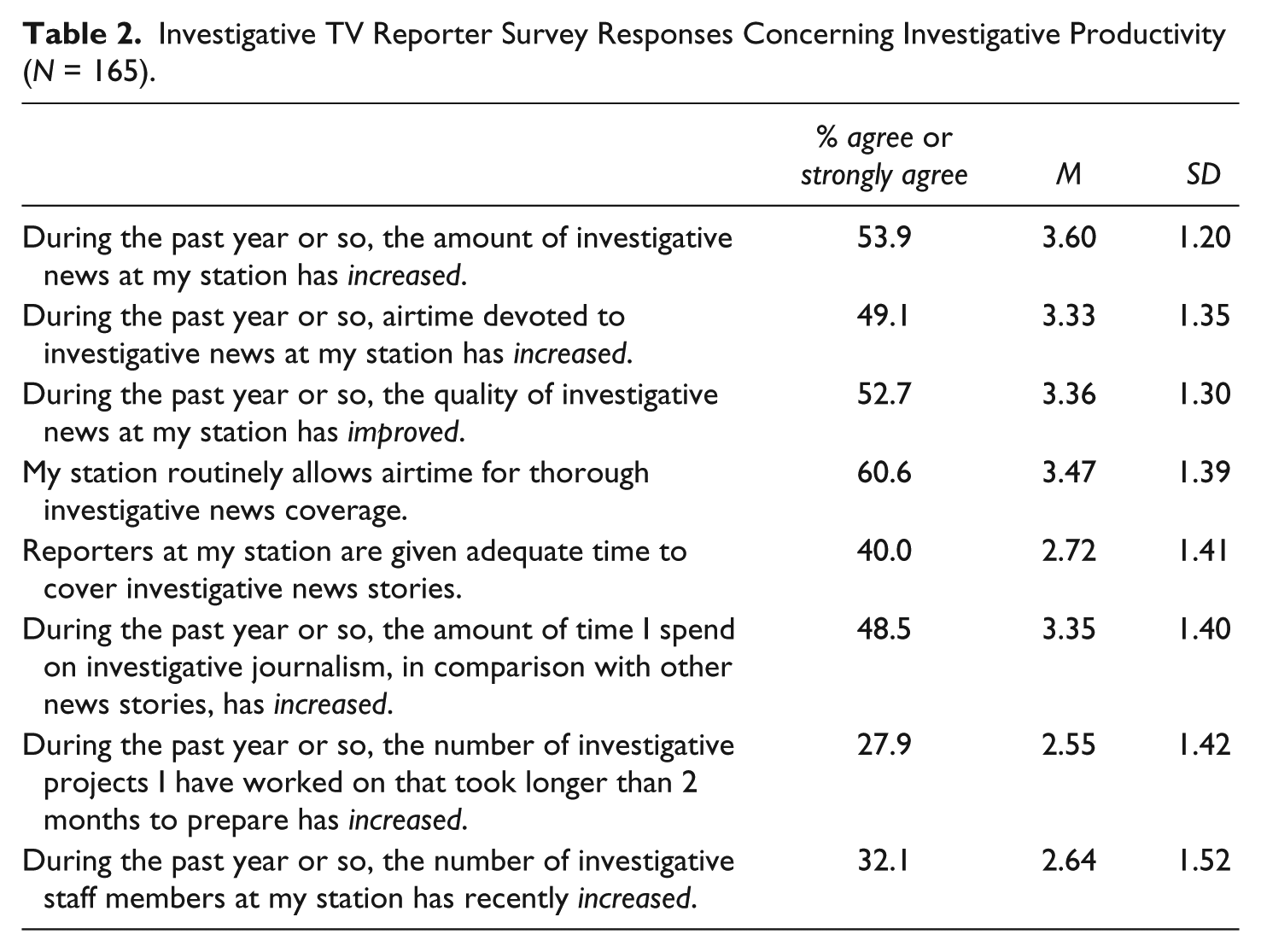
Eight survey items measured respondents’ agreement with statements measuring investigative productivity at their stations. The wording of these items, along with means, standard deviations, and agreement percentages, can be seen in Table 2. The eight items were summed and averaged to allow for further analysis, forming the investigative emphasis index (M = 3.13, SD = 1.08). An internal consistency test indicated acceptable reliability (α = .91) among the measures (Nunnally, 1978).
Content Analysis
An analysis of local television newscasts in 2014 and 2015 was conducted to help determine the quantity and quality of investigative journalism at survey respondents’ stations. Among the 165 stations from which reporters responded, 20 were randomly drawn from each of four market rank categories: 1 to 20, 21 to 50, 51 to 100, and 101 to 210 (Tuggle & Huffman, 1999). 1 This produced a total of 80 stations.
A constructed 5-day week of newscasts was selected from within the “sweeps” ratings period of October 30 to November 26, 2014. This period was chosen for analysis because investigative productivity tends to be higher during sweeps (Niederpruem, 2014), thus allowing for a larger sample of investigative work. Coders used an online service, Metro Monitor, Inc., to view each station’s latest newscast (e.g., 11 p.m.) on every day of the constructed week. Newscasts that had expired by the time of coding were replaced by newscasts from a constructed week during the subsequent sweeps period of January 29 to February 25, 2015.
Only the first 15 min of each newscast were coded because late local newscasts are structured similarly with important stories, such as investigative pieces, toward the beginning (Tuggle, Carr, & Huffman, 2014). Coders analyzed every story that began in the first 15 min, ran at least 2 min, and was original work featuring the voice of a local reporter. Coders also analyzed any story branded as “investigative” within the first 15 min, even if the story lasted fewer than 2 min. The resulting sample was 398 stories from 394 newscasts (six selected newscasts from three stations were not coded because they had expired). Of the 398 stories, 65.8% aired during November 2014 sweeps, and 34.2% aired during February 2015 sweeps.
To test intercoder reliability, a random subsample of 53 newscasts (13.5%) was drawn from the main sample (Riffe, Fico, & Lacy, 2005). The section below lists Krippendorff’s alpha and simple agreement (SA) reliability scores for each variable. After reliability testing, the principal investigator incorporated the subsample into the main coding sample by resolving disagreements among coders (Lombard, Snyder-Duch, & Campanella Bracken, 2010). The remaining newscasts were divided between the three coders.
Content analysis measures
Investigative branding
Coders indicated whether a story was introduced using any form of the word “investigate,” such as “investigation,” “I-Team,” or “Channel 6 investigates” (α = .92; SA = 97%). The greatest number of branded stories during the week for one station was six; the fewest was zero. To determine the station-level branded investigative quantity variable, the number of a station’s branded investigative stories during the sample week was divided by the number of that station’s coded newscasts (M = 0.22, SD = 0.30); recall that a full week of newscasts was not coded for each station.
Concealed information
For each story, coders indicated the presence or absence of information that was deliberately suppressed, concealed by law, or was public but compiled by the reporter in a way that exposed a widespread pattern (α = .83; SA = 93%). The greatest number of stories with concealed information during the week for one station was four; the fewest was zero. To determine the station-level concealed information quantity variable, the number of a station’s stories featuring concealed information during the sampled week was divided by the number of that station’s coded newscasts (M = 0.19, SD = 0.25).
Public interest
For each story, coders indicated whether a powerful public or private entity (e.g., government official, police officer, large corporation) had negatively affected the health, quality of life, safety, money, or property of a citizen or citizens (α = .63; SA = 75%). The greatest number of stories in the public interest during the week for one station was seven; the fewest was zero. To determine the station-level public interest quantity variable, the number of a station’s stories in the public interest during the sampled week was divided by the number of that station’s coded newscasts (M = 0.33, SD = 0.37).
True investigative quantity
The number of a station’s stories that were investigative by definition (containing both concealed information and public interest) was divided by the number of that station’s coded newscasts (M = 0.12, SD = 0.19). The greatest number of true investigative stories during the week for one station was four; the fewest was zero.
Investigative quality index
Each investigative-branded story received a quality “score” from 0 to 2, measuring the number of investigative characteristics. For instance, a score of “2” meant that a story contained concealed information and was in the public interest. The scores for each station’s investigative-branded stories were summed and divided by the number of branded stories from that station. For example, a station that aired 10 investigative-branded stories during the week and accumulated a summed quality score of “10” would receive an investigative quality index value of “1.” The highest investigative quality index value was 2; the lowest was 0 (M = 1.25, SD = 0.59).
Organizational/Market Analysis and Measures
Public ownership
Data on ownership were gathered from the Complete Television, Radio & Cable Industry Directory (2014) and cross-referenced against Google Finance and other websites. Publicly traded corporations owned 46.1% of the stations in the survey (N = 165) and 47.5% of the stations in the content analysis (N = 80).
Market size
The number of television households in each of the 210 U.S. markets (Halbrooks, 2013) was divided by 1,000. The mean market size was 762.43 (SD = 915.48) for the survey and 1,023.45 (SD = 1,159.88) for the content analysis. The largest market was New York (7,461.03); the smallest was Glendive, Montana (4.26).
Competition level
Competition was measured through similarity in market shares among television stations (see for example, Lacy & Vermeer, 1995; Powers, 1993). To determine market similarity, each station’s Nielsen market share during the November 2014 sweeps period was subtracted from the share of the market’s leading station. If a station was a market leader, the second-place station’s share was subtracted from the leader to determine share difference. If there was only one station in a market, the station’s share was used as its share difference. The largest share difference in the analysis was 63.14; the smallest was 0.10. For statistical analysis, this variable was reversed so that a higher number indicated greater competition intensity (M = −9.12, SD = 8.44).
Findings
Investigative Journalism Characteristics Present in TV Stories.
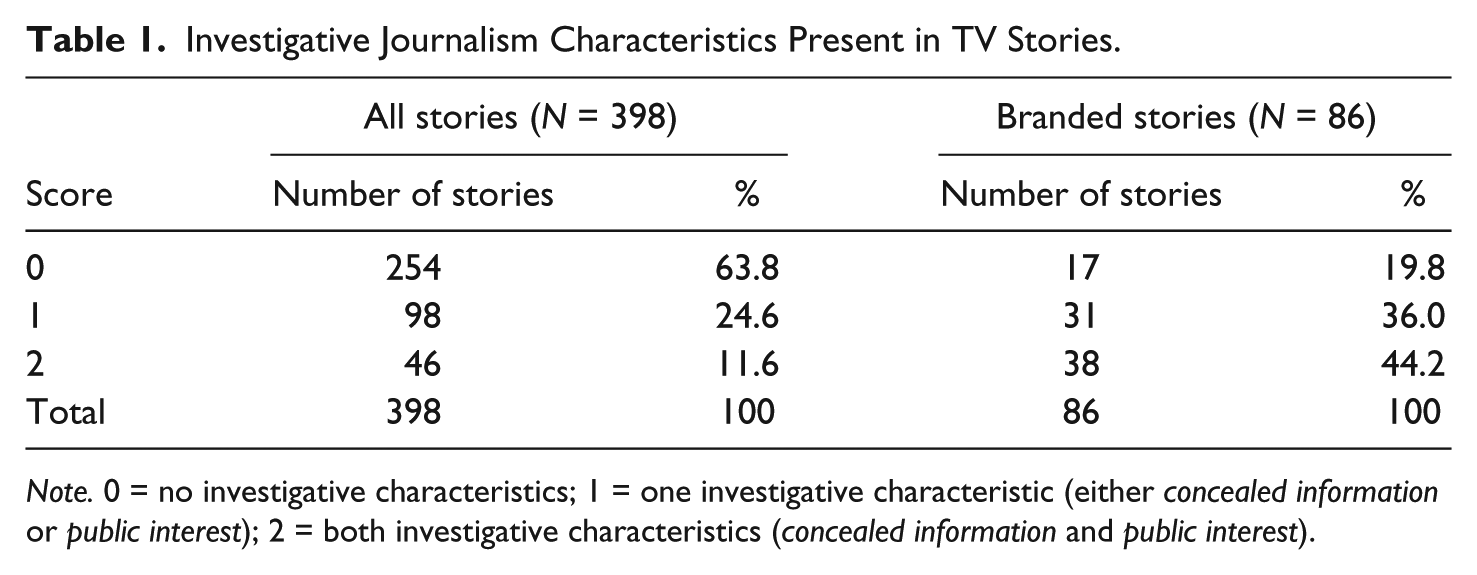
Note. 0 = no investigative characteristics; 1 = one investigative characteristic (either concealed information or public interest); 2 = both investigative characteristics (concealed information and public interest).
To answer
To answer
Investigative TV Reporter Survey Responses Concerning Investigative Productivity (N = 165).
To address
Regression of Investigative Journalism Indicators on Organizational, Market Characteristics (N = 80).
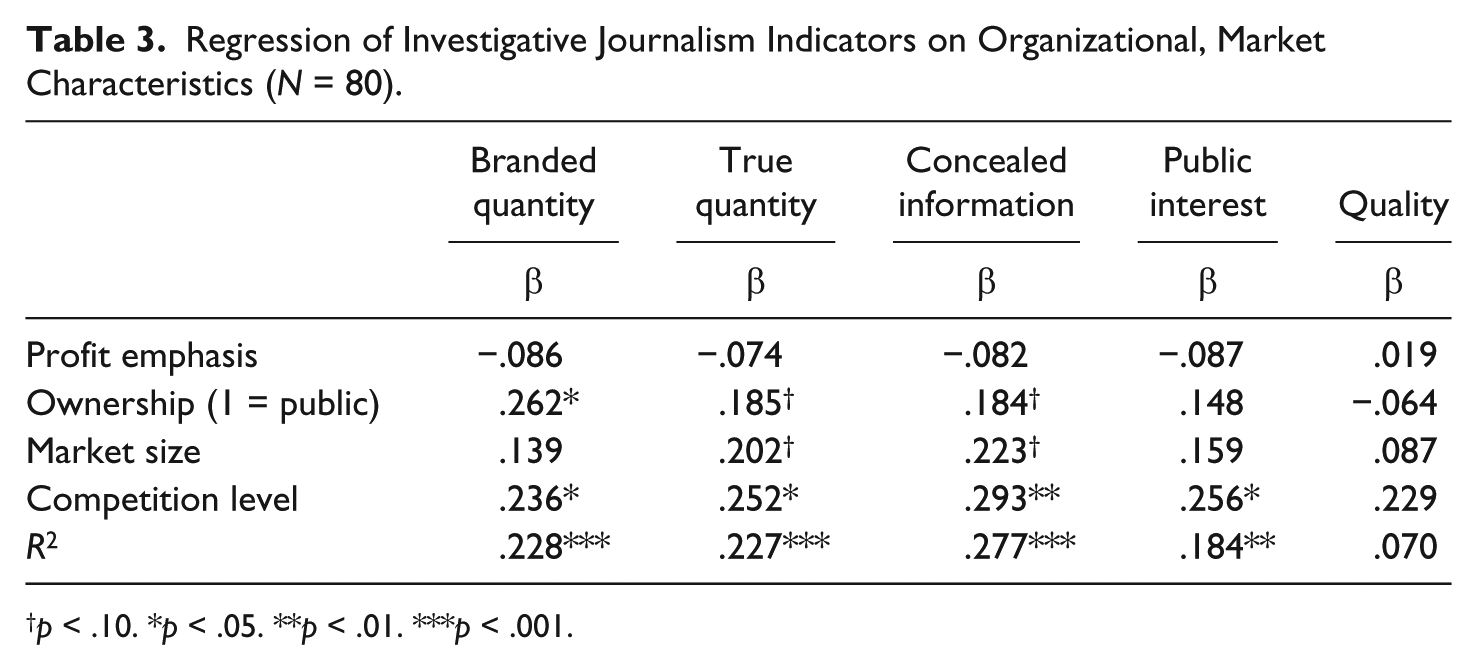
p < .10. *p < .05. **p < .01. ***p < .001.
Regression of TV Station Investigative Emphasis Index on Organizational, Market Characteristics (N = 165).
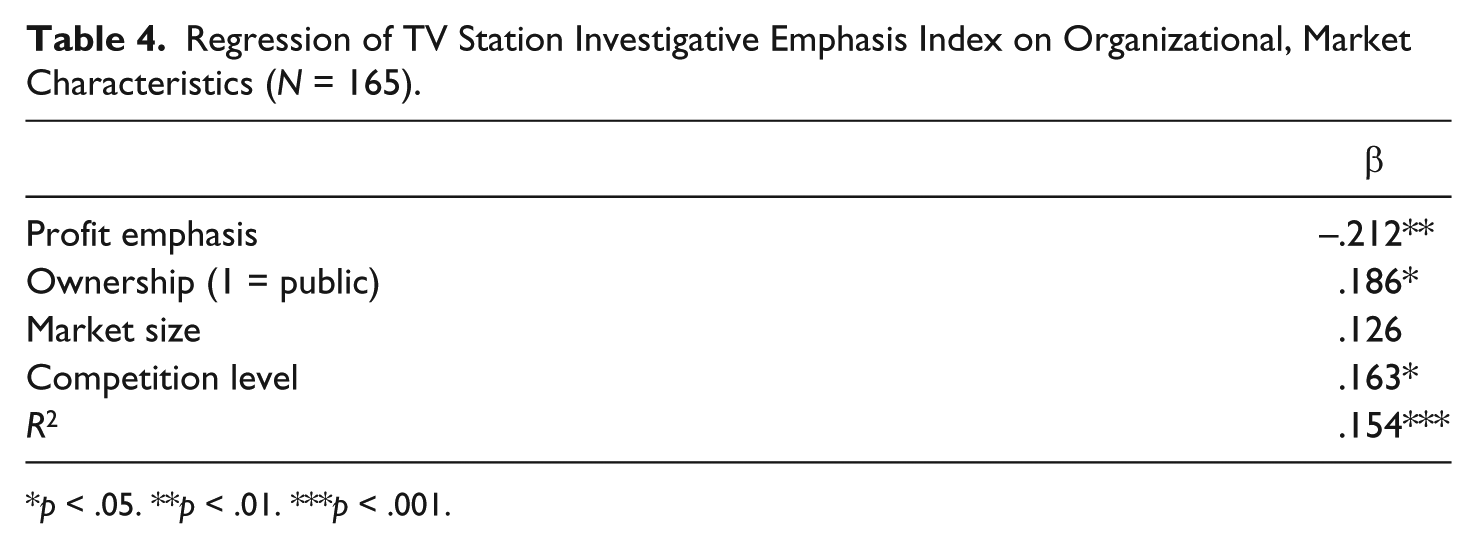
p < .05. **p < .01. ***p < .001.
Discussion
This study provided a comprehensive multimethod assessment of local television investigative journalism productivity in the United States, including factors contributing to production. Analyses suggest that overall, the quantity of investigative news at local stations is fairly low. Among the long-form stories that were coded, just one in five was branded as investigative, and only one in nine was truly investigative (centering on a topic of public interest and revealing concealed information). More than half of sampled stations presented no investigative-branded stories at all. Nearly two thirds of stories did not possess any investigative characteristics, and about a quarter had just one investigative characteristic. Overall, the public interest characteristic was nearly twice as prevalent as concealed information, but neither was overly common.
Among investigative-branded stories, most were not truly investigative, and about a third contained only one investigative characteristic. This suggests that much of the journalism that television stations consider “investigative” does not live up to its name. Nearly 20% of branded stories contained no investigative characteristics, including, for example, one story warning that families often damage plumbing by forcing food down the drain on Thanksgiving. Another branded story scoring a “0” on the investigative quality scale featured a reporter drinking expired milk on camera to demonstrate that food is still edible past its “sell by” date. The general low quality of branded investigations in this study gives weight to charges that local television has abandoned its obligation to serve the public (see, for example, Lewis, 2014). Nonetheless, several stations in the study did produce strong investigative pieces, including one showing that the defunding of mental health services in South Carolina contributed to an increase in police officers killing citizens.
Survey respondents painted a somewhat brighter picture of the state of investigative reporting. More than half of respondents thought investigative quality and quantity were increasing at their stations, and that news outlets were allowing plenty of airtime for “thorough” investigations. Nearly half indicated that airtime and personal time spent working on investigations had increased. However, journalists were more pessimistic about investigative time and resources, a common concern for watchdog reporters across all media (Holcomb et al., 2015). Just 40% of respondents agreed that reporters were given adequate time to work on investigations, and only a third had seen increases in investigative staffing. Just a quarter of respondents saw increases in long-term investigative projects (those taking 2 months or more), which, as Hamilton (2016) showed, are usually the most effective stories. Paired with content analysis results, these survey findings suggest that investigative resources, quantity, and quality are at low levels, but that stations could be ramping up investigative efforts. There is also reason to believe that, since data were collected, investigative journalism as a whole has become more prevalent (see, for example, Mullin, 2017; Perri, 2016).
The factor most strongly associated with investigative production was competition. Even when controlling for market size, organizational emphasis on profit, and ownership status, stations in competitive television markets produced more investigative-branded stories and more true investigative stories. High competition levels also predicted more production of stories in the public interest, more stories in which reporters revealed concealed information, and a greater perceived emphasis on investigative journalism at respondents’ stations. These results indicate that managers might be using investigative news to gain a competitive advantage, as some have suggested (see, for example, Malone, 2014). The findings strengthen literature touting the positive effects of news competition (Belt & Just, 2008; Lacy, 1989) and provide a counterpoint to scholars who say that competition reduces the amount of journalism useful to the public (see, for example, Dunaway, 2008; Hamilton, 2004). The project’s results also support and extend institutionalist theory, which maintains that unstable, competitive environments cause organizations to seek legitimacy (DiMaggio & Powell, 1983; Lowrey & Woo, 2010). In this case, findings showed that stations may be responding to intense competition by pursuing credibility through investigative journalism. Although competition predicted a greater number of legitimate investigative stories, it did not significantly predict the quality of investigative-branded stories. Thus, some stations in competitive markets might be more interested in appearing to conduct credible investigations rather than actually doing rigorous investigative work. This idea of a firm emphasizing appearance over performance is also in line with institutionalist thinking (see, for example, Meyer & Rowan, 1977). In addition, the strong relationship between competition and investigative work contributes to and extends literature on the hierarchy of influences (Shoemaker & Reese, 2014) by suggesting that “larger” factors at the social-institutional level, including market competition, can supersede organizational influences in the news production process.
As hypothesized, stations owned by publicly traded corporations were more likely to produce investigative-branded stories, and reporters at those stations perceived a greater amount of investigative productivity. In addition, public ownership was associated with the amount of true investigative stories and stories with concealed information, but at less strict significance levels. Although ownership status did not affect the quality of investigative-branded stories, results indicate that publicly traded news firms are at least committed to investigative journalism, providing further evidence of a connection between large corporations and news quality (see, for example, Akhavan-Majid & Boudreau, 1995; Demers & Merskin, 2000). The findings also lend support to Demers’ (1996b) idea that the so-called “corporate menace” is not so menacing.
Perceived profit emphasis was associated with a lower perceived amount of investigative journalism at journalists’ stations. This expected result lends some support to literature drawing a connection between economic concerns and investigative shortcomings (see, for example, Higgins-Dobney & Sussman, 2013). However, profit emphasis did not predict any aspects of investigative quantity or quality, indicating that a newsroom’s emphasis on profit is perhaps not as destructive as many practitioners (and scholars) believe it to be. It is also worth noting that because investigative journalists habitually face economic challenges in day-to-day work, they could be overly pessimistic about the effects of profit-seeking managers. This bias could have also affected the perceived lack of resource support shown in the present survey results.
A station’s market size was positively related to production of stories that were investigative by definition and stories with concealed information. However, these relationships were at less stringent significance levels. Otherwise, market size was not associated with investigative production or emphasis. Literature suggests that investigative journalism is more plentiful in large markets (Hamilton, 2016; McManus, 1994), but this connection did not clearly surface in the current analysis. It appears that when it comes to predicting television production of investigative journalism, market size may be less impactful than other factors, including ownership structure and market competition.
Limitations, Future Directions, and Conclusion
There are several potential limitations to this study. Survey responses measuring perceived station priorities (e.g., profit) include measurement error because individual biases can affect journalists’ judgment of organizational philosophies. In addition, one third of the survey respondents were part-time investigative journalists. A sample of only full-time reporters might have produced a fuller picture of how investigative journalists see their profession, but might have excluded reporters in smaller markets, who often divide their time between investigative and noninvestigative stories. Although the study was designed to allow for small-market representation, most of the television stations analyzed were in the top 100 markets (out of 210). The median market rank for the survey was 65, and the median for the content analysis was 51.50. As a comparison, the median rank for all U.S. markets is 105.50. It should be noted that overrepresentation of large markets is likely in this type of project because stations in more populated areas are more likely to have investigative reporters (Berkowitz, 2007). As evidence of this, the Spearman’s rank correlation between market size and number of investigative reporters at a station in this study was ρ = .60, p < .001. In addition, it is likely that this study featured a higher proportion of stations owned by publicly traded companies (47.5% in the content analysis, 46.1% in the survey) compared with a general sample of stations. Recall that the project’s final sampling frame included only stations producing investigative journalism, and the subsequent analysis found a connection between investigative news and public ownership. Furthermore, there was a 1-year time gap between survey and content analysis data. However, both data collections occurred during sweeps periods, meaning that newsroom environments and investigative productivity were likely similar despite the time gap (Gauthier, 2011; Jacobs, 1990). Finally, the public interest variable reliability coefficient (α = .63) was .20 lower than other variables in the content analysis, despite several tests and revisions of the coding protocol. Reliability scores below .70 can be appropriate for exploratory studies, such as this one, that measure complex concepts (Krippendorff, 2004a; Riffe et al., 2005). Krippendorff (2004b) recommends a .667 reliability threshold to draw conclusions from data, but also concedes that there are no “magical numbers” when determining cutoff points, and that additional factors should be considered (p. 429). Importantly, lower reliability standards are often acceptable when using conservative reliability measures, including Krippendorff’s alpha (Lombard et al., 2010; Neuendorf, 2002). Therefore, the public interest variable was seen as appropriate for the analysis.
Despite its limitations, this project provides information about the status of investigative journalism, and results indicate that it is produced infrequently at U.S. television stations. Because newscasts were analyzed during sweeps, when investigative activity is presumably above average, and because all stations in the sample presumably had investigative reporters on staff, one would expect the investigative levels in this study to be higher than a general sample of stations. Therefore, investigative productivity across the local television landscape is probably even lower than these results indicate. Downs (1957) postulated that most people are not motivated to seek out public affairs information, and will only do so if it is available through their favored means of communication. If this is the case, then low levels of accountability journalism on the nation’s most popular news platform could weaken U.S. democracy by contributing to an uninformed electorate. However, it is worth noting that investigative news has historically accounted for a small portion of overall journalistic output (Lanosga, 2014). A similar study of local television in the future could help determine whether the levels seen in this project are abnormal, and whether this type of news is trending upward or downward.
Meanwhile, the strong connection between competition and investigative journalism is both concerning and promising. If competition drives investigative production, then increasing local television news consolidation, which decreases competitors, could portend a downturn in watchdog reporting. However, it is encouraging that news managers might be recognizing the public demand for quality news, a sentiment supported by several studies (see, for example, Belt & Just, 2008; Enda & Mitchell, 2013). Similarly, results indicate that publicly traded corporations are embracing the value of investigative reporting. Large news corporations have the organizational advantage of being able to institutionalize legitimate watchdog reporting at all their outlets, thereby more effectively meeting profit demands. However, the lack of a connection between public firms and investigative quality suggests that corporate heads might simply see this type of journalism as a way to improve ratings. Future studies could explore the production of investigative journalism at publicly traded organizations and whether investing in it yields larger audiences.
Patterson (2000) claims that the best long-term strategy for building a news audience is a commitment to public affairs reporting. One reporter in the current survey echoed that sentiment in an open-ended response, writing that investigative news “is the one element of news media keeping this business alive.” If investigative reporting is indeed the lifeblood of journalism, researchers should continue to check its pulse to determine the overall health of the profession.
Footnotes
Acknowledgements
The author would like to thank Daniel Riffe and Donald Shaw for their guidance and support on this project.
Declaration of Conflicting Interests
The author(s) declared no potential conflicts of interest with respect to the research, authorship, and/or publication of this article.
Funding
The author(s) received no financial support for the research, authorship, and/or publication of this article.
Notes
Author Biography
References
Supplementary Material
Please find the following supplemental material available below.
For Open Access articles published under a Creative Commons License, all supplemental material carries the same license as the article it is associated with.
For non-Open Access articles published, all supplemental material carries a non-exclusive license, and permission requests for re-use of supplemental material or any part of supplemental material shall be sent directly to the copyright owner as specified in the copyright notice associated with the article.
