




Abstract
This study examines the process and conditions under which U.S. news coverage aligns with—or challenges—the communications of government officials, focusing on the issue of U.S. drone warfare. White House, military, congressional, and press communications during President Obama’s first 5 years in office are analyzed to assess how the policy has been framed among officials and covered within the press. Evidence indicates that news coverage was significantly more critical of the policy than what was expressed among officials. In particular, despite near consensus at home, journalists exercised considerable discretion, consistently locating and amplifying oppositional voices from abroad in news coverage.
This study engages the scholarly debate over the process and conditions under which news coverage aligns with—or challenges—the communications of U.S. government officials, particularly on issues related to national security and foreign affairs. The dominant perspective on these matters has largely portrayed the media as subservient to government: News coverage is “indexed” to the range of opinions expressed among officials, and only when disagreement arises among these officials will the press include a diversity of viewpoints in its coverage (Bennett, 1990, 1994; Zaller & Chiu, 1996). As Mermin (1999) has stated, “the media act, for the most part, as a vehicle for government officials to criticize each other” and, as a result, they make “no independent contribution (except at the margins) to foreign policy debate” (p. 143).
In contrast, Althaus (2003) and others (Althaus, Edy, Entman & Phalen, 1996; Entman, 2004; Hayes & Guardino, 2010, 2013) have suggested that the indexing model is far too limiting in its portrayal of the press. Journalists, they argue, can and often do challenge official discourse, even in the absence of elite disagreement. In particular, when official consensus exists, journalists have been shown to seek out dissenting opinions from sources outside government—including foreign sources—to establish independence, balance, and impartiality in their reporting. As Entman (2004) has argued, “Journalists have strong professional motivations to include oppositional readings of foreign policy in their stories,” which often leads them “to convey a surprising amount of dissenting news” even when official consensus exists (p. 18).
Nonetheless, within this scholarly debate, it is unclear when or why we should expect to see journalistic independence arise in the context of U.S. foreign policy. With this in mind, this study explores the U.S. political and news discourse that has surrounded the policy of drone warfare under the Obama administration. Drones have, without question, been the weapon of choice used by the Obama administration to combat terrorism. As then Central Intelligence Agency (CIA) Director, Leon Panetta, noted shortly after President Obama took office, drones are “the only game in town in terms of confronting or trying to disrupt the Al Qaeda leadership” (CNN, 2009). Since then, more than 2,200 U.S. drone strikes have occurred in at least four countries (The Bureau of Investigative Journalism, 2017). Research, however, has yet to fully examine how this issue has been framed among officials and covered within the press. Moreover, scholars have neglected to examine whether the uniquely polarizing nature of this issue—strong public support at home, staunch opposition abroad—might lead U.S. journalists to exercise more discretion and, therefore, seek out dissenting voices in their coverage of U.S. drone warfare.
We, therefore, systematically examine White House, congressional, military, and press communications to (a) explore how the Obama administration sought to frame the drone policy to the public, (b) assess the degree to which members of Congress promoted or challenged these frames, and (c) evaluate whether the press exercised independence in its coverage of this issue—specifically, whether news coverage aligned with what we expect to be relatively narrow prodrone perspectives expressed among officials, or whether oppositional voices from abroad served to meaningfully shape news coverage on this issue.
Our findings, which show that journalists exhibited far more independence in their coverage of the drone policy than a traditional indexing model would suggest, have implications both for media critics and for scholars examining the nature of U.S. press–state relations. Indeed, our findings suggest that critical news coverage was neither triggered by nor closely aligned with “official” debate among domestic political leaders. Instead, we find, it was tied to oppositional voices from abroad, which occupied considerable space and garnered much attention in the press, and, as a result, served to significantly shape news coverage on this issue.
In essence, this study serves to not only bolster the work of Hayes and Guardino (2010, 2013) and others (Althaus, 2003; Althaus et al., 1996; Entman, 2004), but it also extends it in several important ways: First, we systematically analyze and compare the public communications of officials—White House, military, and Congress—with news coverage, something previous scholarship has neglected to do. Second, we demonstrate that these dynamics apply beyond crisis moments or cases involving military invasion to broader, ongoing foreign policy such as drone warfare. Finally, we clarify and offer insight into the conditions under which journalists are likely to seek out foreign sources to achieve balance in news coverage.
Framing U.S. Drone Policy
Scholars recognize that the public communication process within the United States is hierarchical; in general, White House and military officials tend to possess the most power to shape how a particular policy issue is defined and understood among the public, followed by congressional officials, ex-government officials, academics and policy experts, and finally journalists (Bennett, 1994; Entman, 2004; Zaller & Chiu, 1996). Such issue definition is often characterized in the literature as framing. To frame, in the words of Entman (1993), “is to select some aspects of a perceived reality and make them more salient in a communicating text, in such a way as to promote a particular problem definition, causal interpretation, moral evaluation, and/or treatment recommendation” (p. 52). Put another way, a frame is a version of a text that illuminates certain aspects of an issue in lieu of others; frames, in turn, serve to shape how the public comes to understand, evaluate, and respond to that issue.
Studies suggest that political officials often employ framing strategies consistent with what Hallahan, Holtzhausen, Van Ruler, Vercic, and Sriramesh (2007) and others (Kiousis & Stromback, 2015) have referred to as “strategic communication,” in which “political leaders craft their public language and communication with the goal to create, distribute, and use mediated messages as a political resource” (Hutcheson, Domke, Billeaudeaux, & Garland, 2004, p. 28). As Manheim (2011) writes, If we think of political communication as encompassing the creation, distribution, control, use, processing, and effects of information as a political resource . . . we can characterize strategic political communication as the purposeful management of such information to achieve a stated objective. (p. 1)
Indeed, when dealing with any policy, but particularly a controversial one, it is both strategic and essential for political leaders to design a sophisticated communication strategy focused on the construction and ubiquitous use of culturally resonant frames, which serve to circumvent opposition and effectively manage the political and news environments surrounding that issue.
Numerous studies have examined both issue-specific and so-called “generic” frames in political communications and news coverage, and have focused on multiple stages of this process, from frame building, to frame spreading, to framing effects (De Vreese, 2012). Our interest here is in studying the issue-specific frames—those “pertinent to specific topics or events” (De Vreese, 2012, p. 368)—that have manifested in U.S. political and news discourse surrounding drone warfare. Sheets, Rowling, and Jones (2015) note that international news coverage of drones has largely focused on four issue-specific frames: their strategic value, international legality, technological capability, and whether drone strikes have caused collateral damage. These frames are consistent with scholarship on the legitimizing rhetoric used by officials to justify military action. To confirm their relevance for our study, we conducted a deep reading of policy speeches by the Obama administration during our sample period; this process led us ultimately to include a fifth frame in our study. We wish to elaborate each frame here.
Strategic value pertains to drones’ overall effectiveness in combatting terrorism. Previous research has shown that by highlighting the strategic necessity of a proposed military action and, in particular, emphasizing the potential security benefits that could be gained by engaging in such action (Auerbach & Bloch-Elkon, 2005; Reese & Lewis, 2009), officials are better positioned to persuade the public to come “on board” with the military intervention. Such a frame is evident, for example, in a speech given by Obama (2013) on May 23, 2013: “[O]ur actions are effective . . . Dozens of highly skilled al Qaeda commanders, trainers, bomb makers and operatives have been taken off the battlefield . . . Simply put, these strikes have saved lives.”
International legality refers to whether drone strikes comply with the laws of war. Scholars recognize that, since the Cold War, U.S. presidents are obliged to sell their military interventions as “just wars” to the international (and domestic) community (Butler, 2012; Hurd, 2007). This idea tends to resonate among Americans because it provides both a moral and legal justification for such action, even if much of the rest of the world disagrees. This frame is apparent, for example, in this statement by then Legal Adviser of the Department of State, Harold Koh (2010), on March 25, 2010: “U.S. targeting practices, including lethal operations conducted with the use of unmanned vehicles, comply with all applicable law, including the laws of war.”
Technological capability pertains to whether drones enhance U.S. military capabilities. In the case of controversial military policies, officials—and the press—often exhibit a tendency to focus on the technical details of a policy rather than its moral complexity (Entman, 1991; Wolfsfeld, Frosh, & Awabdy, 2008). Audiences are more receptive to a policy when its technological successes are emphasized; in addition, such language can distract audiences from thinking about other aspects of the policy. This frame is evident, for example, in then CIA Director John Brennan’s (2013) speech on April 30, 2013: “It’s this surgical precision—the ability with laser-like focus to eliminate the cancerous tumor called an al-Qaida terrorist, while limiting damage to the tissue around it—that makes this counterterrorism tool so essential.”
Collateral damage refers to whether drone strikes cause civilian casualties. As Tirman (2011) has shown, it has been a common tendency among U.S. policymakers to seek to limit opposition to U.S. military action both at home and abroad by minimizing the harm done to civilian populations (see also Slattery & Doremus, 2012). Such dynamics have been shown not only during large-scale U.S. aerial bombardment campaigns but also in response to on-the-ground atrocities caused by the U.S. military (Tirman, 2011; see also Slattery & Doremus, 2012). We see evidence of this frame, for example, in this statement from then Homeland Security Adviser, John Brennan (2011), on June 29, 2011: “I can say that the types of operations [drone strikes] . . . that the US has been involved in, in the counter-terrorism realm, that nearly for the past year there hasn’t been a single collateral death.”
Sheets et al. (2015) showed that these four frames occur frequently—but to varying degrees—in both domestic and international news coverage of U.S. drone policy. This included U.S. (CNN), British (BBC), and Arab (Al Jazeera, Al Arabiya) news coverage from 2009 to 2012. In the current study, we added a fifth frame—domestic legality—because of the public debate that emerged in 2013 over whether the U.S. president possesses the constitutional authority to conduct drone strikes on U.S. citizens abroad, particularly in areas where war has not been declared. Thus, this frame pertains to the constitutionality of drone strikes. Beginning with Schlesinger (1973), scholars have widely documented the extent to which U.S. presidents have sought to justify military action by citing the powers of the executive embedded within the U.S. Constitution (Fisher, 2013; Rudalevige, 2005). The drone program itself has led to vigorous (domestic) debates over this issue, from Senator Rand Paul’s nearly 13-hr filibuster in March 2013 regarding the constitutionality of drone strikes on American citizens to a (ultimately dismissed) 2012 federal lawsuit related to the death of Anwr al-Awlaki, an American killed by a drone strike in 2011. As such, the domestic legality frame was an important piece to include here, given our focus on the broad contours of debate—both domestically and internationally—surrounding the U.S. drone program. Indeed, we see evidence of this frame in this statement from Pentagon spokesman George Little (2012) on May 29, 2012: “The use of these weapons [drones] is something I’m not going to get into the particulars on. But I can tell you that . . . they’re lawful . . . they operate within the confines of American law and policy.”
Returning to the framing hierarchy, we would expect Obama administration officials—as proponents and executors of the drone program—to highlight the virtues and benefits of drone strikes throughout their public communications. We, therefore, offer our first hypothesis:
The Obama administration will emphasize these frames, we argue, because doing so will serve to simultaneously “sell” the controversial drone program to the American public as well as circumvent substantive, critical examination of the policy. As Bandura (1990) suggests, “As long as the detrimental results of one’s conduct are ignored, minimized, distorted, or disbelieved, there is little reason for self-censure to be activated” (p. 37). Moreover, as Edelman (1993) has shown, frames that resonate with the underlying values and identity of the citizenry have the power to reorient how they perceive and respond to a particular policy issue. If Americans are led to believe that drone strikes are morally, legally, and strategically justified, they will be much more likely to support the policy.
In addition, we would expect congressional officials—from both parties—to embrace and amplify these frames in their public communications. As research has indicated, Congress tends to exhibit a deferential posture toward the White House and military during times of conflict (Bennett, 1994; Zaller & Chiu, 1996). This dynamic has been particularly pronounced during the Post-9/11 era, given the persistent and unifying threat of terrorism, and a return, as some scholars have argued, of the “Imperial Presidency” (Fisher, 2013; Rudalevige, 2005). Furthermore, as Ledbetter (2011) has argued, Congress is predisposed to support the military, in general, and extol the virtues of military technology, in particular, due to the electoral benefits that come from appearing strong on defense. There is also a rather intuitive reason why members of Congress would, in general, support drones: They allow for the fight to be taken to the terrorists without posing any obvious risks to Americans.
Beyond these reasons, we believe that other partisan and electoral considerations are also relevant here for explaining why we would expect both parties to support the frames emphasized by the Obama administration. Because Republicans tend to be more hawkish than Democrats on foreign policy issues, especially terrorism, we suspect that they will be broadly supportive of the drone program (Dueck, 2010). After all, criticism of drones would put them at odds with their policy predispositions as well as the electorate that they serve. Democrats, however, we argue, will be motivated to support their president; as a result, we would expect them to also emphasize the virtues and benefits of the drone program (see Howell & Pevehouse, 2007). For these reasons, we offer our second hypothesis:
Theories of Press–State Relations and the Role of Foreign Sources
Having outlined our expectations about White House and congressional framing, we now turn our attention to the press. A prevailing framework for understanding the process and extent to which the public communications of U.S. officials and news coverage align is the “indexing hypothesis” (Bennett, 1990, 1994). At its core, this model suggests that journalists limit the range of opinions included in news columns on a particular policy issue to that expressed by official sources (Zaller & Chiu, 1996). As Bennett, Lawrence, and Livingston (2006) emphasize, news coverage is typically “constrained by the standard journalistic practice of tying, or indexing, story frames to the range of sources and viewpoints within official decision circles, reflecting levels of official conflict and consensus” (p. 468). News media are, therefore, seen as subservient to officials: rarely do they offer critical analysis or dissent in their coverage unless some within government have done so first (Mermin, 1999). In the words of Livingston and Eachus (1995), “In the absence of official debate the news media will not generate it independently” (p. 415). Thus, if congressional opponents fail to mount a coherent and coordinated effort to publicly challenge the administration’s lines of argument, news media are likely to disseminate a one-sided policy discussion in their coverage.
Notably, foreign sources tend to be marginalized or even omitted entirely from analysis within the indexing model. As Althaus (2003) notes, this is problematic because “excluding non-U.S. sources from measures of news discourse obscures whether journalists index the news only (or even primarily) to domestic officials rather than to a broader range of elite and popular voices” (p. 387). After all, inclusion of oppositional views from foreign sources, particularly when dissenting opinion is largely absent from official discourse, is one crucial way that journalists can exercise independence in their reporting. As Bruggemann (2014) contends, on any given issue, journalists are confronted with a frame repository—multiple, often competing viewpoints—from both domestic and foreign sources; thus, understanding how journalists navigate this environment—deciding which frames to include and which ones to leave out—is crucial to our understanding of the news production process as well as the agency that journalists can exercise within it.
Foreign voices, it is argued, tend to be relegated to the margins in news coverage of foreign affairs because they are perceived to lack legitimacy or credibility within the minds of most Americans. As Entman (2004) suggests, foreign sources tend to be “people whom Americans might well discount, mistrust, or ignore entirely . . . The political culture encourages Americans to disregard foreign criticism of the United States” (p. 55). But there are clear professional motivations, we argue, that might lead U.S. journalists to reach outside traditional domestic policy-making circles, even when consensus exists, to locate and amplify dissent from abroad. As studies have shown, when consensus exists among officials, journalists possess strong professional motivation to identify and amplify oppositional voices from abroad to, in the words of Tuchman (1978), “present conflicting possibilities” in news coverage (p. 665). This is consistent with what Althaus (2003) has referred to as the “narrative imperative” (p. 382) of American journalism in which journalists, following norms and routines such as objectivity, balance, and the need for conflict and drama in news coverage, seek out dissent from abroad when none seems to exist at home. Moreover, as Hayes and Guardino (2013) argue, journalists are likely to include foreign sources in news coverage when they are perceived to be “newsworthy” or relevant to the policy in question. They write, “When non-U.S. voices are viewed as important to the development or the resolution of a foreign policy debate—that is, when journalists perceive foreign actors and institutions as possessing power to affect events—these voices will receive significant media attention.” (p. 5)
For these reasons, we argue, journalists are likely to turn to foreign sources even when official consensus exists within the United States.
Several studies have provided evidence of these dynamics in U.S. news coverage. Althaus et al. (1996) found, for example, that the New York Times coverage of the U.S.–Libya crisis of 1985-1986 was incongruent with U.S. elite debate; journalists routinely sought out foreign sources to provide opinions contrary to the dominant policy positions of the U.S. government. Althaus (2003) found a similar dynamic in his analysis of U.S. television coverage of the 1990-1991 Persian Gulf War. Specifically, the level of opposition reported in news coverage was disproportionate to the level of dissent expressed among U.S. officials. This was due in large part to the prevalence of foreign oppositional voices in news coverage. And Entman (2004) found that U.S. news coverage of the 1985-1986 Libyan crisis and the U.S. invasions of Grenada in 1983 and Panama in 1989-1990 was heavily reliant upon foreign sources for critical discourse, given the lack of substantive disagreement among U.S. policymakers over these policy issues.
More recently, Hayes and Guardino (2010, 2013) examined broadcast news coverage of the 2003 U.S. invasion of Iraq. They found that officials from the Bush administration were the most frequently quoted sources, and that the overall thrust of news coverage was supportive of the invasion. Nonetheless, oppositional voices from abroad, particularly foreign leaders and United Nations (UN) officials, were still featured prominently throughout news coverage, which enabled journalists to achieve some semblance of balance in news coverage of the war, despite the lack of contested discourse among U.S. officials. As they note, “even as elites in the United States were not publicly sparring, journalists turned to foreign officials for the anti-war perspective” (Hayes and Guardino, 2010, p. 80). As is customary, Hayes and Guardino conclude their study with recommendations for future research. Specifically, they urge scholars to explore these dynamics within the context of other more contemporary U.S. foreign policy issues. In addition, they emphasize the need for scholars to systematically compare what domestic institutional elites are saying in Congress—something that was missing in their study—with the perspectives that actually make it into news coverage. Only then, they argue, can we assess whether news coverage truly reflects or, in their words, refracts the contours of debate among U.S. officials (Hayes and Guardino, 2010).
With these considerations in mind, we compare how White House, military, and congressional officials have framed U.S. drone policy to what has appeared in the press. As noted, scholarship is divided over what we should expect in terms of news coverage of official discourse on this issue: One perspective suggests that U.S. journalists will index the range of official debates, reflecting the (expected) consensus among Obama administration and congressional officials, while the other assumes that journalists will seek out foreign views to refract that debate and, therefore, challenge the dominant narrative expressed in official circles. Consistent with the latter perspective, we offer two hypotheses:
We expect news coverage to manifest in this way for two reasons: the ongoing nature of the policy and intense opposition to U.S. drone warfare abroad. First, unlike specific events that can be more readily managed by strategic communications from White House and military officials (e.g., the Abu Ghraib prison torture scandal; Bennett et al., 2006), ongoing policies are inherently more susceptible to challenges within the press. Because there is not one clear focal point or moment upon which officials can mount an aggressive communication offensive to effectively shape how that issue comes to be explained and understood within the broader discourse, policies that are ongoing create multiple openings, especially as new controversies or events occur in relation to the policy, for journalists to exhibit independence and contest the White House narrative. This is especially the case, we argue, when U.S. foreign policy—such as drone warfare—elicits fierce opposition abroad. 1 With prominent foreign officials and international organizations routinely lodging complaints and calling for investigations (e.g., Human Rights Watch, UN Human Rights Council), journalists have compelling reasons and ample sources to turn to for opposing viewpoints on drone warfare.
Method
Four content analyses were conducted to examine which frames were emphasized by White House and military officials regarding drone warfare, the extent to which these frames were promoted or challenged by members of Congress, whether the range of this discourse was reflected in the press, and which sources journalists relied upon in their reporting.
White House and Military
As an initial step, we coded speeches, interviews, press conferences, press releases, and congressional testimony by White House and military officials between January 1, 2009, and December 31, 2013—the first 5 years of the Obama presidency. As Bergen and Tiedemann (2010) have noted, 2009 was the “Year of the Drone,” in which the Obama administration took office and dramatically expanded drone strikes. We continued analysis through the first year of Obama’s second term to assess whether any changes occurred upon reelection. Using the search terms “drone” OR “UAV” OR “unmanned aerial,” 248 White House and military texts were compiled from seven sources: the American Presidency Project website; the website archives for the White House, the CIA, and the Departments of Defense, Justice, and State; and the Government Publishing Office website. 2 This was the universe of available texts. Within each text, we coded for each of the five frames previously identified—strategic value, collateral damage, domestic legality, international legality, and technological capability.
First, collateral damage refers to whether drone strikes have caused civilian casualties. Emphasis on this frame includes (a) downplaying the number of civilian casualties caused by drone strikes or (b) highlighting specific “clean drone strikes” in which only militants (no civilians) were killed. Challenges include (a) acknowledgment of civilian deaths, in general, caused by drone strikes or (b) reference to a specific drone strike in which civilians were killed.
Second, strategic value pertains to the overall effectiveness of drones in combating terrorism. Emphasis on this frame includes (a) highlighting the extent to which drones have dismantled terrorist networks or (b) saved American lives. Challenges include statements that (a) imply the futility of drones in defeating terrorism, or that (b) they cause anti-Americanism.
Third, domestic legality focuses on whether U.S. drone strikes are conducted in accordance with the U.S. Constitution. Emphasis on this frame includes statements that (a) the president has both the constitutional authority and responsibility to carry out drone strikes to protect the nation, or noting that (b) drone strikes are conducted in a manner that is consistent with the laws of the nation. Challenges include the argument that (a) the President’s execution of the drone program constitutes an abuse of power, or that (b) drone strikes violate U.S. law.
Fourth, international legality refers to whether U.S. drone strikes comply with international law. Emphasis on this frame includes the argument that (a) drone strikes are conducted in accordance with the laws of armed conflict, or that (b) such strikes are authorized by the targeted countries. Challenges include the argument that (a) drone strikes violate the laws of armed conflict, or that (b) such strikes violate the national sovereignty of targeted countries.
Finally, technological capability pertains to whether the technology associated with drone warfare enhances the ability of the United States to wage war. Emphasis on this frame includes (a) references to the accuracy, precision, or technological sophistication of drone strikes, or (b) the capacity of drones to eliminate threats in remote or treacherous areas. Challenges include (a) highlighting the inaccuracy, imprecision, or technological flaws of drones, or (b) suggesting that the technological merits of drone warfare are overstated. 3
In White House and military texts, we coded for both emphasis upon and challenges to each frame. The data provided below, however, focus on the presence or absence of each of the frames in these texts (see Footnote 6 for further explanation).
Congress
Next, we coded 598 congressional texts—this too was the universe of available texts—drawn from statements made by congressional officials—both Democratic and Republican—on the floor of Congress or during congressional hearings. The search terms and date ranges were identical to those used to gather White House and military texts. Each relevant statement on the floor of Congress was collected from the Congressional Record, and each congressional hearing was collected from the Government Publishing Office website. In addition to coding for the five frames and their challenges, we coded for the overall valence of each frame—consistent with our focus on whether Congress echoed or challenged the frames. Specifically, for each frame, we recorded an overall valence score of “1” if the frame was challenged in the text, “2” if the frame was questioned (or echoed and challenged equally), and “3” if the frame was echoed in the text. 4 In addition, we computed an overall statement valence variable, assessing the balance of frame category valences within the entire article, by summing the five frame category valence scores and dividing by the number of categories coded (thus eliminating cases in which no frames were present). This yielded an overall article valence score on the same 1-to-3 scale.
Press Coverage
Finally, using the same search terms and date range, we coded 1,293 news stories from the New York Times, 324 from ABC News, 419 from CBS News, 260 from NBC News, and 611 from Time Magazine. As Entman (2004) has suggested, “The news media of particular interest,” in terms of shaping the broader public discourse on an issue, “are the broadcast television network news operations of ABC, CBS, and NBC; the two elite newsmagazines, Time and Newsweek; and the two leading newspapers, the New York Times and the Washington Post” (p. 11).
All news stories were gathered via LexisNexis. We coded each news story in its entirety. Again, we coded for each of the five frames, accounting for the overall valence of each frame as well as the overall valence of the news story. We first coded any relevant reference to the frames, regardless to whom that reference was attributed. Thus, our focus first was on news treatment of U.S. drone policy across the five frames, regardless of the source of that information. Next, we coded for every source statement (N = 7,842) within the news stories to assess (a) what sources journalists relied upon, particularly domestic versus foreign sources, and (b) the valence of each source statement across the five frame categories. We can therefore draw conclusions about the content of news stories, in general the variety of sources included in news stories and the directionality of source statements—specifically, whether they echoed, questioned, or challenged the frames—within news coverage of U.S. drone warfare. These aspects, we argue, represent the key editorial decisions undertaken by journalists and their editors in constructing a news story.
Approximately 10% of White House, military, congressional, and press communications were randomly selected and analyzed by two coders to assess intercoder reliabilities (calculated via Scott’s π). For White House and military texts, intercoder reliabilities indicated strong beyond-chance agreement for presence/absence of all five frames: strategic value (π = .93), collateral damage (π = .92), domestic legality (π = .82), international legality (π = .92), and technological capability (.84). For congressional texts, intercoder reliabilities for the valence of the frames were as follows: strategic value (π = .86), collateral damage (π = .89), domestic legality (π = .82), international legality (π = .75), and technological capability (π = .88). For news stories, intercoder reliabilities for the valence of the frames were as follows: strategic value (π = .94), collateral damage (π = .94), domestic legality (π = .82), international legality (π = .81), and technological capability (π = .90). For source statements within news stories, the intercoder reliabilities for the valence of the frames were as follows: strategic value (π = .88), collateral damage (π = .90), domestic legality (π = .87), international legality (π = .89), and technological capability (π = .91). Finally, the intercoder reliability for source identification within news stories was π = .92.
Results
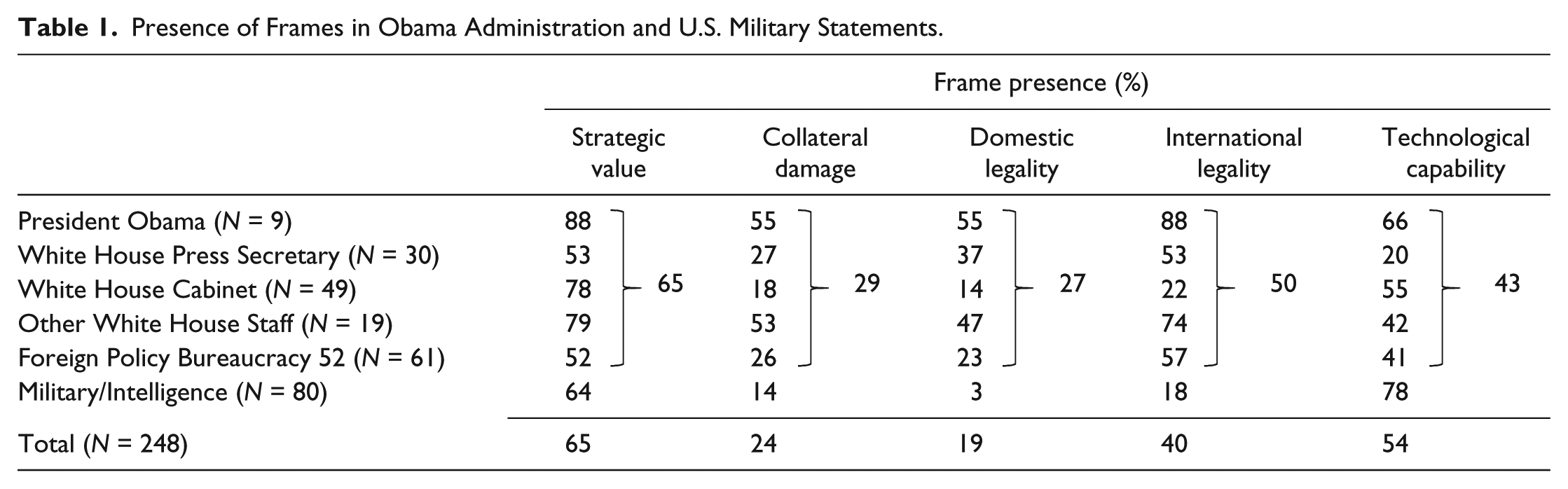
Our first hypothesis was that White House and military officials would emphasize each of the five frames in their public communications about the drone program throughout the 5 years examined. To assess this prediction, we focused on the proportion of texts in which each of these frames was communicated by these officials. 5 Table 1 indicates that, overall, each frame was consistently communicated, albeit with some variation across these sources. Among White House sources (N = 168), each frame was regularly present in these communications, with strategic value (65%) and international legality (50%) appearing most frequently. Notably, President Obama was most consistent in his usage of the frames, emphasizing each in at least 55% of his public statements. Military and intelligence sources (N = 80), however, were only particularly vocal in their emphasis on the technological capability (78%) and strategic value (64%) frames. Indeed, a couple of frames—collateral damage and domestic legality—received less attention than the others in both White House and military communications, appearing in about a quarter of all statements. Still, across the board, each of the frames appeared with considerable regularity within these communications, demonstrating that the Obama administration sought to push these frames into the broader public discourse and shape the debate surrounding U.S. drone warfare. 6 Thus, we find moderate support for H1.
Presence of Frames in Obama Administration and U.S. Military Statements.
Next, to examine our second hypothesis—that congressional officials, from both parties, would largely embrace and amplify these frames—we turned to congressional communications. Figure 1 shows the extent to which the five frames were echoed, questioned, or challenged among congressional officials. These numbers are striking and suggest overwhelming support within Congress for the drone program. In particular, when present in the discourse, the technological capability frame was echoed 86% of the time, strategic value was echoed 81%, collateral damage was echoed 70%, and international legality was echoed 68%. The domestic legality frame was echoed to a much lesser extent (55%) than the others. This is not all that surprising, though, given that this frame is, in effect, designed to limit congressional power on this issue; thus, congressional officials were perhaps not as willing to cede this policy domain entirely to the President as they were with the other frames. That said, congressional officials still echoed it more than half of the time. Overall, then, these results lend support for H2.
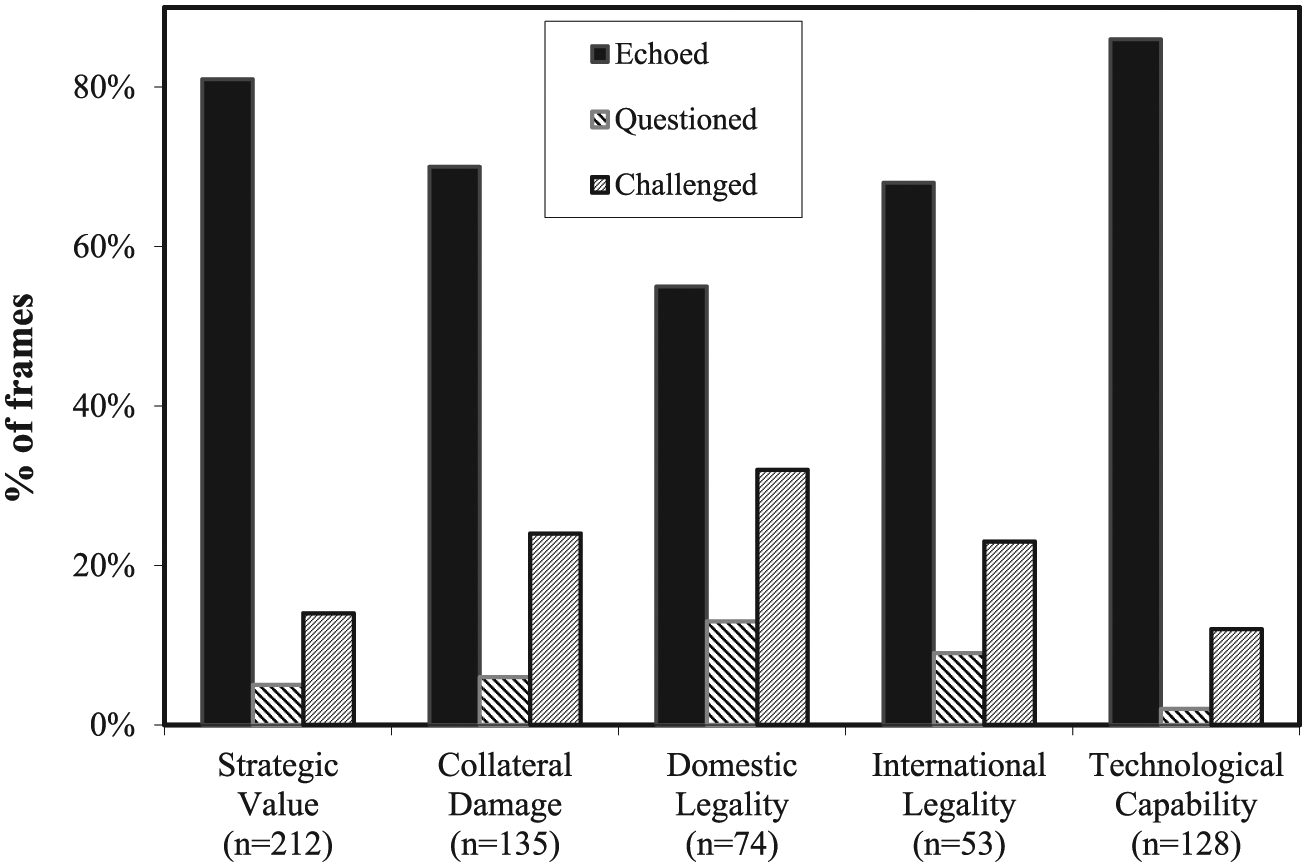
Valence of frames within congressional statements.
Within these congressional communications, some partisan differences appear at first glance. Overall, Democrats echoed the frames 65% of the time, questioned them 5%, and offered challenges 30% of the time. Republicans, in contrast, echoed the frames 83% of the time, questioned them 7%, and offered challenges 10% of the time. Remarkably, though, this partisan gap can essentially be attributed to one member of Congress—Dennis Kucinich (D-Ohio). Kucinich was responsible for more than one half (52%) of all challenges from Democrats. The rest of the Democrats echoed the frames 78% of the time, questioned them 5%, and offered challenges 17% of the time. Thus, Democrats—excluding Kucinich—and Republicans were quite comparable in their responses to the frames, further supporting H2. Across the board, then, we see very little divergence between the Obama administration and Congress regarding drones.
Next, we analyzed whether press coverage aligned with the range of discourses expressed among U.S. officials. As Figure 2 illustrates, the press deviated substantially from official discourse in its coverage. Although valence of each of the frames within the news stories was, on the whole, more positive than negative, resistance to the frames was markedly higher than what had occurred among members of Congress. Whereas Congress echoed the frames 75% of the time, questioned them 6%, and challenged them 19%, the press echoed the frames 51% of the time, questioned them 19%, and challenged them 30%. 7 In addition, when we examined the overall valence in congressional statements versus news stories, we found similar differences with press coverage significantly more critical than Congress (Mnews = 2.22, SD = 0.83, vs. Mcongress = 2.58, SD = 0.75), t(504) = −7.38, p < .001. 8 This provides strong support for H3. 9
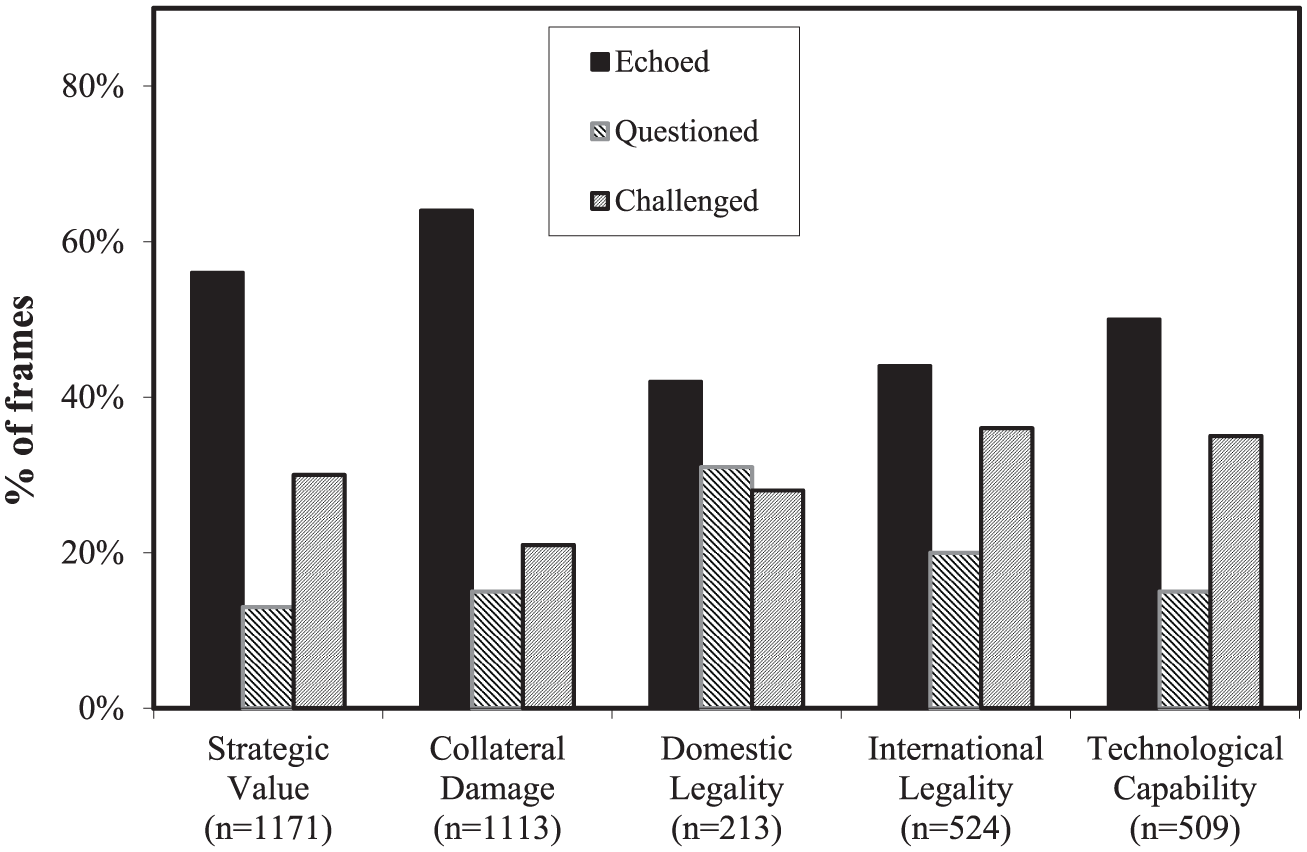
Valence of frames within news coverage.
When we measured the average valence of each frame in congressional discourse versus news coverage, we found further evidence of these differences with a couple of exceptions. On the strategic value frame, Congress was less critical (Mc = 2.67, SD = 0.71) than news coverage (Mn = 2.26, SD = 0.71), t(343) = −7.29, p < .001. We found similar results on international legality (Mc = 2.45, SD = 0.85, vs. Mn = 2.07, SD = 0.89), t(64) = −3.11, p = .003, and technological capability (Mc = 2.74, SD = 0.66, vs. Mn = 2.15, SD = 0.91), t(264) = −8.43, p < .001. For the collateral damage (Mc = 2.45, SD = 0.86, vs. Mn = 2.43, SD = 0.82), t(165) = −.33, p = .740, and domestic legality (Mc = 2.22, SD = 0.91, vs. Mn = 2.14, SD = 0.82), t(124) = −.68, p = .500, frames, however, while the mean differences were in the expected direction, they failed to reach statistical significance. Interestingly, these were also the two frames least promoted by the Obama administration. At any rate, on the whole, given the balance of the results reported above, we find broad support for H3. Indeed, the press did not simply “index” its coverage to the range of official debates; instead, it included significant challenges and presented much more balanced coverage of drone policy.
As an additional step, we explored the sources—domestic versus foreign—upon whom journalists relied in their coverage of drones. We posed a final hypothesis that journalists would turn to foreign sources to challenge how U.S. officials had sought to frame the drone program (H4). Among those sources that could be identified as either domestic or foreign, 56% were domestic (N = 4,365) and 40% were foreign (N = 3,131). 10 For clarity of visualization, this analysis recoded the 1 to 3 (challenging to echoing) valence scale into −1 to +1, with 0 as the neutral midpoint. As Figure 3 illustrates, foreign sources were significantly more likely to challenge each of the frames versus domestic sources. 11 We found a similar result when we compared the overall valence scores of foreign versus domestic sources (Mf = −0.42, SD = 0.91, vs. Md = 0.47, SD = 0.88), t(3,998) = 31.32, p < .001. Remarkably, domestic sources were responsible for 71% of all source statements in which one of the frames was echoed; in contrast, foreign sources were responsible for 73% of all statements in which one of the frames was challenged. Thus, these results make it clear: The overwhelming majority of the opposition to U.S. drone warfare contained in news coverage came from foreign sources. This evidence supports H4.

Overall valence of frames by domestic versus foreign sources within news coverage.
As a final step, we took a closer look at the specific types of sources contained in news coverage and the valence of statements made by those sources across the five frames. Figure 4 provides an overview of these data. Not surprisingly, and consistent with the previous analysis, we see a sharp contrast between domestic and foreign sources. Among the top five sources to echo the frames, four were domestic (Obama Administration: 24%; Unspecified Government Source: 20%; U.S. Military/Intelligence: 12%; Academic/Policy Expert: 8%), and only one was foreign (Pakistani: 16%). In contrast, among the top five sources to challenge the frames, four were foreign (Pakistani: 39%; Iranian: 10%; Yemeni: 7%; and Global Nongovernmental Organizations: 7%) and only one was domestic (Academic/Policy Expert: 7%). 12 These results indicate, then, that foreign sources were not only prevalent in U.S. news coverage, but that they also served as a powerful influence on the content of that coverage, providing dissenting views when few existed among U.S. officials. Together, these results provide strong support for H4.
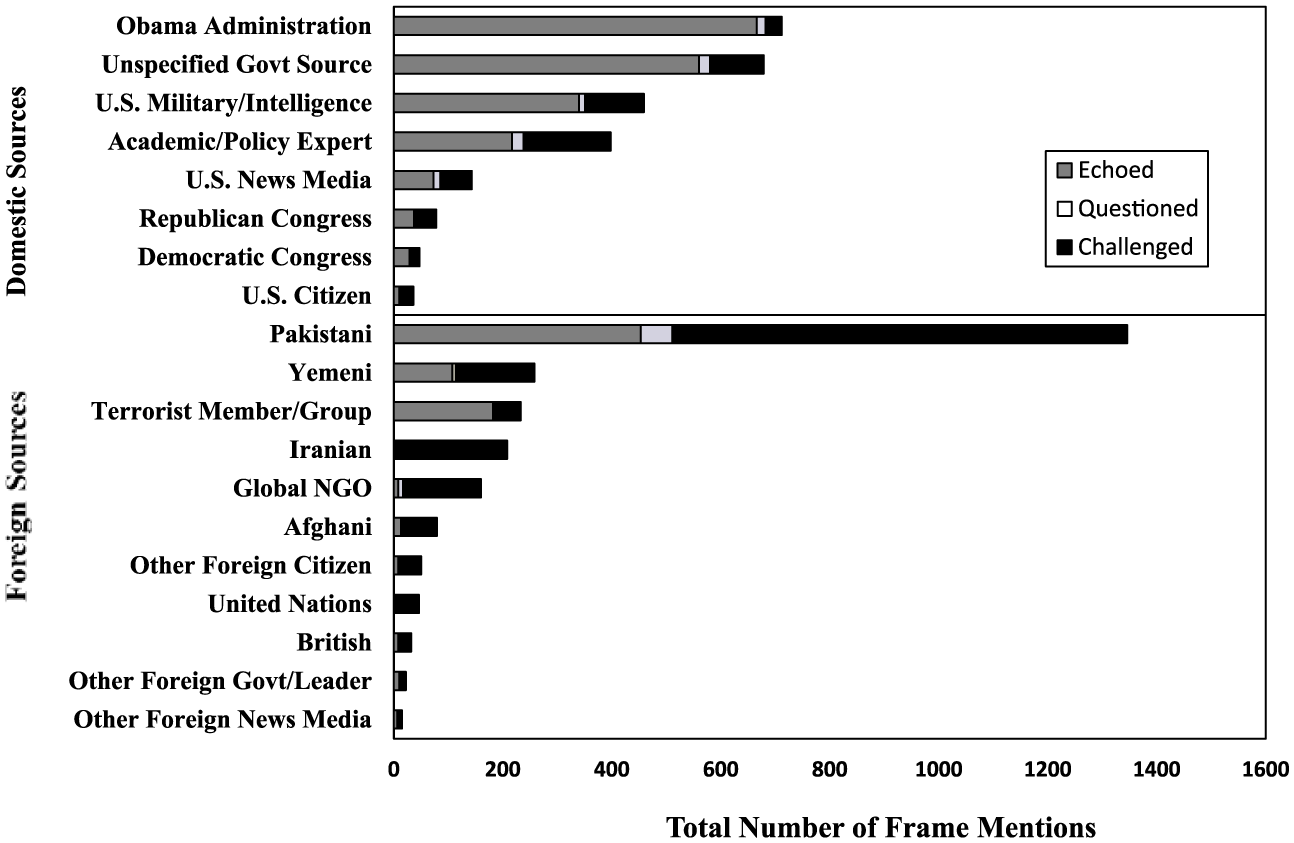
Distribution and valence of frames by source type within news coverage.
Discussion
This study examined how drone policy has been framed among U.S. officials and covered within the press. Building upon previous scholarship, we analyzed how the Obama administration framed the policy, the extent to which these frames were either promoted or challenged by Congress, and whether this debate (or lack thereof) was reflected in U.S. news coverage. Our findings reveal a number of significant patterns.
First, we found that the Obama administration—with President Obama leading the way—regularly emphasized the strategic value, domestic and international legality, and technological capability of drone strikes while downplaying the collateral damage caused by such strikes. Second, we found that Congress largely echoed these frames. With the lone exception of Congressman Dennis Kucinich, Democrats and Republicans echoed the frames in roughly four of every five of their public statements about the policy. This resounding support presented a unified official picture of drone policy across the first 5 years of Obama’s presidency. Furthermore, it lends credence to the notion that Congress tends to be deferential to the President on foreign policy and the military during times of conflict (Bennett, 1994). Nonetheless, such unified support was at odds with the highly visible and widespread opposition to drones around the world. Our critical lens, then, turned to the press to see whether it amplified these prodrone lines of argument or offered a more balanced assessment of the policy.
Consistent with Althaus (2003), Althaus et al. (1996), and Hayes and Guardino (2010, 2013), we found that journalists did seek out critical viewpoints even when few existed among U.S. officials. Not only was press coverage much more likely to include frame challenges, but such challenges were most likely to come from foreign sources—who constituted a sizable 40% of the sources in the news. Those foreign sources were responsible for almost three quarters of all critiques of the program in news coverage. Thus, relative to the domestic debate surrounding drones, U.S. journalists exercised considerable discretion not conforming to the otherwise bleak predictions of the indexing hypothesis (Bennett, 1990). When mainstream political disagreement was absent, journalists stepped outside U.S. official circles to find the conflicting opinions necessary for more responsible coverage. From a normative perspective, this paints a relatively positive picture of the U.S. news media and should not be overlooked. At the same time, the overall average tone was still relatively positive toward drones in news coverage. In other words, despite a strong presence of oppositional voices from abroad, Americans still received a prodrone picture from the news; such an imbalance may help explain why there has been continued support among a majority of Americans for the drone policy, despite intense opposition abroad.
Through this study, we attempted to follow the calls of Althaus (2003) and Hayes and Guardino (2010, 2013) for scholars to continue to expand and refine the indexing model, and to specify those conditions in which we might expect more press independence. In particular, we have contributed to the scholarly debate over this question by specifying two important conditions in which such journalistic independence should be expected: in the context of an ongoing policy (vs. specific foreign policy event), and when such a policy is broadly and significantly disputed by foreign public and governments. By including foreign sources in our analysis, and coding not only news coverage generally but also the source statements separately, our study is important, in that we are able to clearly demonstrate that it was through the inclusion of foreign sources that journalists were able to challenge the U.S. framing hierarchy.
Importantly, however, it is unclear how such foreign sources are received and interpreted by American news audiences: Do their frame challenges carry the same weight as the statements by their own domestic leaders? As Bennett and Livingston (2003) note, “The unanswered question is whether the reporting of large numbers of . . . foreign sources occurs in ways that either publics or other elites deem important for framing and interpreting the situation” (p. 361). As our data suggest, the administration was still the agenda setter for what frames were even in discussion regarding drones; we did not observe substantively new frames emerging in congressional or news discourse. As Althaus et al. (1996) note, “When it comes to foreign policy, the administration is the chief actor, and the media may allow it to determine what gets discussed” (p. 419). Thus, despite the presence of some critical news coverage of drones, we should by no means interpret our findings as an indication that U.S. press coverage sharply challenged the Obama administration. With this in mind, future studies should investigate the effects of frame challenges, focusing on whether the source of those challenges—domestic versus foreign—affects how the broader public views a particular issue.
Future research should also address a couple of limitations in our research: First, while we argue that the contested nature of drone policy, internationally, is a primary reason to predict press independence, additional policy contexts should be explored to ensure that drone policy is not simply another “unique policy context . . . that obscure[s] common patterns” (Althaus, 2003, p. 382). We also ponder the role that the time frame may have played in our research. Recall the significant censure the American media received over its largely uncritical coverage of the U.S. invasion of Iraq in 2003. Perhaps—as media critics would hope—that crisis moment helped change the way journalists exercise independence in response to U.S. foreign policy. It stands to reason that a study comparing similar policy contexts before and after that crisis moment could help shed some light on this idea. As a final suggestion, future studies should focus more on the potential role of social media and digital news in disrupting the framing hierarchy. As digital sources of news continue to flourish in popularity, especially among younger citizens, future studies should incorporate these sources, as well as a richer range of textual materials—including images and videos—into their analyses.
Overall, we believe that this study provides important insights into the scholarly debate over press independence. Despite facing a unified front from U.S. officials on this issue, journalists reached outside the domestic political arena to include critical international perspectives. Notably, these findings were not isolated to the New York Times; mainstream television news and the weekly newsmagazine Time presented comparably critical coverage. This suggests, at least in the context of drone warfare, that we can feel reassured that the American (mainstream) news-consuming public is getting at least some balanced discussion of drones from its news diet. Whether public opinion will eventually catch up to the international debate remains to be seen.
Footnotes
Declaration of Conflicting Interests
The author(s) declared no potential conflicts of interest with respect to the research, authorship, and/or publication of this article.
Funding
The author(s) received no financial support for the research, authorship, and/or publication of this article.
Notes
Author Biographies
References
Supplementary Material
Please find the following supplemental material available below.
For Open Access articles published under a Creative Commons License, all supplemental material carries the same license as the article it is associated with.
For non-Open Access articles published, all supplemental material carries a non-exclusive license, and permission requests for re-use of supplemental material or any part of supplemental material shall be sent directly to the copyright owner as specified in the copyright notice associated with the article.
