



Abstract
Analyzing 50 years’ of New York Times international news coverage (N = 20,765), this study extends research on the “shrinking international news hole,” levels of press freedom, agent (e.g., Times correspondent), and “borrowed” news—information gleaned from local media, including social media. Data show a recent, growing role for social media and an increase in news borrowing, while foreign coverage declined; slight resurgence in foreign coverage during the last quarter-century; reduced wire copy use but increased correspondent news borrowing; and increased coverage of but decreased news borrowing in news from non-free nations. Borrowing from social media was greatest in non-free nations.
Over the last half-century, observers of international news coverage warned that U.S. citizens’ “window on the world” was becoming smaller (Schorr, 1979), with news media offering less international news (Golan & Wanta, 2003; Hamilton & Jenner, 2004; Jones, Van Aelst, & Vliegenthart, 2013; Larson, 1982; Norris, 1995; Whitney, Fritzler, Jones, Mazzarella, & Rakow, 1989), primarily because of the cost of maintaining foreign correspondents (Hamilton, 2009).
Some research has explored the extent to which the window on the world provided a “secondhand” view, with news reports drawing increasingly on material disseminated by other media, both independent and government-controlled, rather than through U.S. correspondents’ on-scene reporting. Research on this “news borrowing” (Riffe, Aust, Gibson, Viall, & Yi, 1993), for example, found an overall trend toward a shrinking New York Times news hole (corroborated by Jones et al., 2013)—in terms of numbers of international items published between 1969 and 1990—but an increasing proportion of borrowed news: One in five Times international news items—and as many as half from Communist nations in some years—included secondhand information.
That study covered the 1969-1990 period and ended just before the 1991 end of the Cold War. Coverage of “First-World” (industrialized, democratic, primarily Western) nations was contrasted with coverage of “Second-World” (industrialized, communist, or “satellites” aligned with the Soviet Union) nations. “Third-World” news (by default, nations not aligned with First- or Second-World blocs) was also examined.
This study revisits the “shrinking news hole,” along with “news borrowing” in U.S. international news, extending the original study to a half-century (1966-2015), to examine whether trends discovered in the Times have continued.
Why now? Both the 1991 collapse of the Soviet Union and the September 11, 2001, terror attacks were major events that reshaped U.S. foreign affairs discourse (Jones et al., 2013). Since 1991, the environment for international news reporting has been transformed politically and technologically. Nations previously aligned with the Soviet Union are not. For example, East and West Germany have been reunified; former satellites Poland and Hungary are again democratic republics and members of the North Atlantic Treaty Organization (NATO). Observers were optimistic that “liberated” Second-World media would head the push for democratic political cultures but, in many cases, the professional journalism culture remains politicized and partisan, with journalists seeing themselves as political figures rather than reporters (e.g., Gross, 2002). A decade later, the September 11 terrorist attacks on the United States refocused the West’s attention, with acts of terror against the West continuing today; names like al-Qaida, the Taliban, and Islamic State of Iraq and Syria (ISIS) dominate the news. Such political changes occurred even as an explosion of Internet-based communication occurred. Social media channels Facebook and Twitter became available to the public in 2006 (Facebook, 2006; Picard, 2011) and would soon have a major role in events like Arab Spring (see, for example, Hamdy & Gomaa, 2012).
Indeed, the world in the 21st century is undeniably different from when the global arena was dominated by the United States, the Soviet Union, and their “spheres of influence.” In fact, nations’ internal conditions may provide a more important context for news reporting and coverage than outdated identification with such spheres. Thus, the study goes beyond the original study design by also examining the 1980-2015 level of press freedom within each country, using a well-established overall assessment published by Freedom House since 1980 and based on legal, political, and economic data which “provide(s) a picture of the entire ‘enabling environment’ in which the media operate” (Freedom House, n.d., para. 10). Although other metrics measuring nation-states’ press freedom exist, researchers have demonstrated the reliability and validity of the Freedom House measure (Becker, English, Campbell, & Vlad, 2017; Becker & Vlad, 2009; Becker, Vlad, & Nusser, 2007).
Background
Critics have long complained that international news coverage is saturated with conflict and its collateral economic, diplomatic, and humanitarian consequences (see Shoemaker, Danielian, & Brendlinger, 1991; Sobel & Riffe, 2015). To the extent that coverage of “distant events in unpronounceable places” (Kaplan, 1979) is exclusively on conflict and “bad news,” while coverage of achievement and progress is minimal, Americans’ views of the world may tend toward the stereotypical and negative (Asante, 2013; Fair, 1993; Knickmeyer, 2005; Wiley, 1991).
Such qualitative “distortion” in coverage of the world has been compounded, some say, by a decline in the quantity of coverage because of the cost of it (Hughes, 2007): A “shrinking foreign news hole” was identified in print coverage—even in leaders in international coverage like the New York Times (Jones et al., 2013; Riffe, Aust, Jones, Shoemake, & Sundar, 1994)—and in the three major television networks, ABC, CBS, and NBC (Riffe & Budianto, 2001). Pew Research Center for Journalism and Media (2008) reported that 2008 international news constituted only 11% of news coverage, with 64% of surveyed editors indicating they were covering “non-U.S. news” less.
After systematically analyzing 168 issues of three major U.S. metropolitan dailies across nearly seven decades, Allen and Hamilton (2010) concluded that, except in times of war, international coverage is fairly minimal and much of it lacks any explicit signal of events’ importance for readers. Examining international news coverage in the New York Times and NBC Nightly News for more than half a century (1950-2006), Jones et al. (2013) concluded that the “U.S. news media’s window on the world has shrunk even as the United States has become more connected politically and economically to the rest of the world” (p. 432).
Pamela Constable (2007) of the Washington Post described TV coverage of the world as, increasingly selective as well as superficial, [even though] 80 percent of the public obtains most of its foreign and national news from TV . . . Our troops are fighting in Iraq and Afghanistan, countries that we did not know enough about when we invaded them and that we are still trying to fathom. We have been victimized by foreign terrorists, yet we still cannot imagine why anyone would hate us . . . Knowing about the world is not a luxury; it is an urgent necessity. (para. 3)
Former Christian Science Monitor editor and foreign correspondent John Hughes (2007) noted the irony as follows: (In) this era of globalization, as international affairs rise to the top of the agenda, that some media companies are forsaking the responsibility to inform readers, listeners, and viewers of what is happening in the world, and (to) analyze what it means. (para. 4)
Some might argue news organizations’ neglect of the rest of the world is in response to perceived audience disinterest (see, for example, Beam, 1996, 2003; Lowrey & Woo, 2010). Former UN Secretary-General Boutros Boutros-Ghali once called such disinterest a post-Cold War phenomenon: “During the cold war years, it seemed that everything mattered—no matter how small or far away. The threat of global nuclear confrontation compelled the media’s interest” (para. 3). By the mid-1990s, foreign bureaus and correspondents were luxuries: “Editors and publishers say they cannot afford them. They say the public just isn’t very interested in what’s happening elsewhere in the world” (United Nations, 1996, para. 4).
However, recent Pew national data indicate that 65% of those surveyed follow international news “somewhat closely” or “very closely” (Mitchell, Gottfried, Barthel, & Shearer, 2016).
Still, although American news operations may have rationalized reducing international news coverage because of audience disinterest, others argue instead that the cost of overseas bureaus and staffs has simply become prohibitive. Estimates were that it cost US$50,000 annually to maintain a correspondent in the 1960s when the decline in overseas correspondents began and nearly US$100,000 by the mid-1970s (Neilan, 1975), rising to US$150,000 by the late 1970s (Cook, 1978; Kaplan, 1979; Legum & Cornwell, 1978; Rubin, 1977). More recently, Constable (2007) wrote that a bureau in a foreign capital costs more than US$250,000 annually and as much as US$1 million for “a large, security-conscious news operation” in places like Baghdad (para. 6).
Researchers have documented the decline in working correspondents: from 563 in 1969, to 524 in 1972, and 429 in 1975 (Kliesch, 1975), to Schorr’s (1979) estimate of 400. In 2003, American Journalism Review (AJR) counted 307 full-time correspondents, with 234 remaining by 2010 (Kumar, 2011). The newspaper correspondent number had shrunk to 188 in 2002 and was 141 in 2006 (Constable, 2007; Hughes, 2007). The Chicago Tribune halved its foreign correspondent corps from a high of 13 in 1970 to six by 1980 (D. Gosselin, personal communication, March 1980). The New York Times began in 1970 with 38 overseas correspondents, and maintained a staff of 33 through 1980, according to then-foreign editor Robert Semple (Personal communication, April 1980). By 2003, the Times had 27, and by 2010, its corps was 24 (Kumar, 2011). In 2009, Hamilton (2009) lamented the elimination of all foreign correspondence staff at The Baltimore Sun, Boston Globe, and Philadelphia Inquirer.
Interestingly, some argue that the numbers reported by Kumar (2011) for AJR may have been inflated by the surveyed media representatives. Mort Rosenblum (2010) has argued that “news outlets that have no foreign staff are eager to pretend that they do” (Martin, 2012, para. 2). Why? According to Martin (2012), (N)ews outfits that have slashed budgets for foreign reporting are nonetheless eager to present themselves as global news organizations. This is why NBC will at times feature a reporter in its London bureau discussing events in Athens or even Iraq. The correspondent might as well be in Hoboken. (para. 2)
Others have speculated about organizations’ efforts to offset having fewer “eyes and ears” at the scene. For example, fewer correspondents have larger areas of responsibility: Martin (2012) described a Washington Post journalist in Nairobi who is listed as the Post’s bureau chief in Africa—a “bureau of one” for the entire continent of Africa. Organizations might utilize more “parachute journalism,” by “dispatching U.S.-based reporters for short spells abroad when important news breaks,” even though they lack the background, source contacts, and cultural sensitivity of correspondents serving for extended periods (Hughes, 2007, para. 7). U.S. news organizations might increase their bylined use of indigenous journalists. Some of those local journalists may be trained professionals; others may work in nations whose laws and press norms do not conform to Western professional guidelines. (Government restrictions that limit Western correspondents’ access also affect indigenous journalists, of course.)
Hamilton (2009) has cataloged an array of correspondent types, “most of them carrying some DNA of the past” (para. 12). In addition to “the traditional American foreign correspondent” and “premium” (e.g., Bloomberg, Dow Jones) and “in-house” (e.g., corporate-employed, industry news gatherers), Hamilton described the emergence of “foreign foreign correspondents” (foreign nationals working for U.S. organizations), “parachute foreign correspondents,” “citizen foreign correspondents,” (e.g., bloggers) and “foreign local correspondents,” whose reporting might reach an Internet audience anywhere else in the world.
In addition, old-style “listening post” reporting might increase: Correspondents in Hong Kong for years monitored Radio Beijing (Hohenberg, 1964), and Radio Moscow broadcasts were combed for bits of information throughout the Cold War (see Wood, 1992). Former Time editor-in-chief Henry Grunwald (1993) described trying to crack what was happening in the Kremlin by reading “the lineup atop Lenin’s tomb and between the lines of the official press” (p. 12).
Research has identified another type of reporting, akin to the listening post: that is, “news borrowing” or “second-hand” reporting (Riffe et al., 1993). In this scenario, on-site U.S. correspondents use material already aired, posted, or published in local news media and news agencies. Although it is “easy,” the use of such sources becomes potentially very problematic, depending on local professional norms of editorial independence, objectivity, and fairness, and whether authoritarian governments have a direct hand in the content and performance of the cited media (Cho & Park, 2012; Rosenblum, 1978).
One study (Riffe et al., 1993) looked at “borrowed news” in the New York Times during a 22-year period (1969-1990). Using a representative sample, the study first confirmed the “shrinking” international news hole of the Times in terms of fewer international news items across the 22 years. Meanwhile, the researchers identified an increase in the proportion of items with secondhand information. In fact, roughly 18% of all items attributed information to such media sources. There was no difference in news borrowing by Times correspondents and items from wire services, though there was a trend toward increased news borrowing in wire copy.
Because of its explicit focus on the influence of authoritarian regimes on press or correspondent access, the study identified sampled items by the event country’s geopolitical classification, a Cold War era-“proxy” for how open or free a country was. News borrowing was most common in items from Second-World (primarily communist) countries with authoritarian press policies—some years as many as half of all items reflected secondhand information from controlled media. First-World (Western industrialized nations and Japan) news borrowing increased significantly over time, though that trend was weaker than for news from Third-World countries which showed a trend toward increased news borrowing, the strongest trend among the three geopolitical blocs.
The researchers (Riffe et al., 1993) proffered explanations for increases in news borrowing, some discussed above: decreasing numbers of correspondents assigned to cover larger numbers of increasingly important nations, acceptance by correspondents and bureau chiefs of growing professionalism of local journalists, and “reduced independent correspondent access to sources, as governments, aware both of the importance of national image and of the operations of American media, seek to control—perhaps manipulate—information through official media sources” (p. 643, emphasis added).
Again, these trends of increased news borrowing occurred within the context of a shrinking international news hole documented by researchers (Jones et al., 2013; Riffe et al., 1994; Riffe & Budianto, 2001). In a word, fewer international items were provided, but a relatively larger proportion was “pre-processed.”
Studies describing the prevalence of news borrowing, where it occurred, and who did it (correspondent, wire service, etc.) were conducted in the pre-Internet era and before the development by many governments of communication and public relations programs involving digital and social media (Cho & Park, 2012; Jansen, Zhang, Sobel, & Chowdury, 2009). Equally important, they were conducted before the breakup of the Soviet bloc, what the researchers labeled as the Second World.
The present study extends previous work on borrowed news, collecting new data on its presence in international news coverage through 2015. These new data are examined in conjunction with the previous 22-year sample, permitting an overall 50-year perspective. In lieu of the outdated Cold War typology of nations (First, Second, and Third World), the 1980-2015 data are examined in terms of levels of press freedom within individual countries, as assessed by Freedom House.
Research Questions and Hypotheses
This study seeks to extend previous research. Thus, it explores two research hypotheses based specifically in previous findings:
The original studies (Riffe, 1984; Riffe et al., 1993) utilized a then-current Cold War-era, World Bank typology which traces to the early 1950s (Ryne, 1999) because of the studies’ explicit and purposive focus on contrasting news coverage of liberal, “open” First-World societies with the authoritarian and totalitarian nations of the Second World, made up of the Soviet Union and Soviet-aligned nations. By default, “non-aligned” nations were the Third World. Of course, Worsley (1964) has argued that “Third World” has become conflated with “developing countries,” and Murphy (2007) agreed that “Third World” has come to mean underdeveloped countries: “overpopulated, backward, illiterate, malnourished, and abnormal” (p. 10). Moreover, nearly three decades after the fall of the Iron Curtain, 21st-century critics of that typology have rightfully questioned the logic of continuing to employ Cold War designations.
Therefore, as a 36-year complement to the analysis and a more direct approach to contemporary restrictions on press freedom, 1980-2015 data were also classified in terms of an event country’s level of press freedom as determined annually by Freedom House using 23 criteria covering three broad categories: the legal, political, and economic environments (Freedom House, n.d.). Countries were designated as “Free,” “Partially Free,” and “Not Free,” offering a more direct approach to the goals of the original research: that is, to contrast coverage of liberal societies with coverage of authoritarian and totalitarian nations. Thus,
Based on previous studies, we propose
The previous study also ended before the emergence early this century of social media (Facebook, 2006; Picard, 2011). Unlike Internet sources providing one-way communication, social media allow creation and exchange of user-created content via sources like Twitter, Facebook, and YouTube (Kaplan & Haenlein, 2010). Social media have also served a more significant role, as in mobilizing social and political movements that are certainly “news” (e.g., Hamdy & Gomaa, 2012). To explore the emergence of these “new(er)” media in international news coverage, we ask the following research question:
Method
Sample
An extension of the previous study by Riffe et al. (1993), this study employed the same sampling strategy and coding procedures, collecting new data (for 1966-1968 and 1991-2015) to complement 1969-1990 data from the 1993 study. Both the original and this study examined every international news article—defined simply as “news stories on events occurring outside the U.S.”—anywhere in any section of the paper in two constructed-week samples per year of the New York Times. Riffe, Lacy, and Fico (2014) have documented the efficiency and representativeness of two constructed weeks (two randomly selected Sundays, two randomly selected Mondays, etc.) to represent a year’s content for daily newspapers. Thus, the final data set involved 100 constructed weeks across the 50 years.
Although sampled articles for the 1993 study (1969-1990) were examined on microfilm, 1966-1968 articles were analyzed from microfilm archives on ProQuest and 1991-2015 articles were retrieved from LexisNexis after we compared ProQuest and LexisNexis retrieval results. Specifically, we randomly selected an issue every fifth year (a total of five from 1995, 2000, 2005, 2010, and 2015) and searched the issues in both databases. The total numbers of articles in each issue were consistent across the two databases. Sample dates were randomly assigned to coders (10 in the 1993 study, and two in the current coding). After retrieving all articles and noting the total number in each issue, items that were not international news (such as domestic stories, editorials, blog posts, paid death notices, movie listings, etc.) were manually removed. These processes yielded 10,820 international news items or stories to complement the 9,945 reported in the 1993 article; the 50-year sample size for analysis here is thus 20,765.
As a replication, this study is set in the perspective of previous research that analyzed foreign news coverage in the Times. Moreover, the Times is an agenda setter for many other American media (Jones et al., 2013; Roberts, Wanta, & Dzwo, 2002), and has long been a leader in international coverage (Hamilton & Jenner, 2004; Hawkins, 2002), making it an ideal focus for this study.
Variables and Coding Procedure
Coding began with recording of fundamental information such as date, section and page, word count, and the foreign country in which the news event took place. Although Riffe et al. (1993) used World Bank geopolitical designations of First-, Second-, or Third-World countries, use of that Cold War typology is problematic nearly three decades after the collapse of the Soviet Union and its sphere of influence. Instead, articles for 1980-2016 were assigned one of three designations for level of “Press Freedom,” as retrieved from Freedom House data: Free, Partially Free, or Not Free (Freedom House, n.d.). First reported in 1980, the press freedom index (scored 0-100) is based on 23 dimensions encompassing legal (30 points), political (40 points), and economic environments (30 points). Scores range from 0 (most free) to 100 (least free), but Freedom House ordinal categories are Free (0-30), Partially Free (31-60), and Not Free (61-100). Annual scores are calculated on the basis of events during the prior year (a country may be “Partially Free” one year but its annual index score may lower it to “Not Free” the next).
Articles were coded for presence of secondhand or borrowed news, using the same operational definition as the 1993 study: The presence of information or material attributed to media or news agencies. They were also coded for whether social media were cited as sources in instances of borrowed news. Following the classification of social media of Kaplan and Haenlein (2010) as applications that “allow the creation and exchange of user generated content” (p. 61; thus excluding one-way channels like corporate or government websites), social media sources coded in this study included personal blogs, social networking sites (e.g., Facebook, Twitter), collaborative projects like Wikipedia, and content communities (e.g., YouTube). Finally, coders identified the agent listed as producing the news report (i.e., a Times correspondent or a wire service or other reporter).
Reliability
Two coders were comprehensively trained in independently coding the 1966-1968 and 1991-2015 data. After numerous training exercises with nonsample dates, a pilot reliability test (Krippendorff’s α) was computed for 89 articles from four randomly selected nonsample issues: alpha for agent was 1.0; for focus, it was .927; for borrowed news presence, it was .819; and for social media presence, it was .843.
After all coding was finished, a subgroup of main study data was selected for reliability testing using sampling theory and guidance from Riffe et al. (2014). With 10,000 or more study units, reliability should be tested with at least 141 randomly selected main study units. Using Krippendorff’s alpha, intercoder reliability was assessed: agent (.93), country of focus (1.0), presence of borrowed news (.93), and presence of social media (1.0). Because the 1966-1968 data were from a different source (ProQuest), reliability was tested on 187 articles selected from that period, with acceptable levels of alpha: agent (.97), country of focus (1.0), and presence of borrowed news (.95). There were no social media during 1966-1968. The 1993 study reported Holsti’s (1969) “composite coefficient” of 0.96.
Results
Preliminary Analysis
As noted above, the 50-year, 100-constructed-week, 700-edition sample yielded a total of 20,765 international news articles. For each year, the 14-day sample data were aggregated to identify an annual total, and percentages were computed to determine the proportion of items that were “secondhand” or “borrowed news,” that were based on Times correspondent reporting or wire service reporting, and (for the 1980-2015 data) that came from each Freedom House press freedom category. For ease of visualization, the data reported here are presented as graphic figures.
As in the original study (Riffe et al., 1993), the primary analysis tool is a test for trend using Kendall’s tau, a nonparametric rank-order correlation coefficient. In essence, each variable of interest (e.g., annual percentage of borrowed news, or annual total items, or percentage of borrowed items from each press freedom category) receives a rank score and those ranks are correlated with the array of years, which are also assigned ranks. A “larger” year (2015 is the largest) has the largest year score. If the variable increases in presence (becomes “larger” over time), a significant positive tau value would indicate this increasing trend, while negative values suggest decreasing trends. The first three figures show increases and decreases across time, as well as trend scores (tau values) for 1966-1991, for 1992-2015, and for the full 50-year, 1966-2015 period.
Although the original news borrowing study (Riffe et al., 1993) noted a nearly monotonic decreasing trend in number of international news items published prior to 1992 (indexed by tau = –.79, p < .01), that “shrinking international news hole” trend did not continue from 1992 through 2015. For those 24 years, the correlation was almost zero (tau = –.03, ns). The 24-year period began as if continuing the original decreasing trend, but the number of international items actually began to increase in the mid- and late 1990s. Despite that resurgence, the overall 50-year pattern was one of significant decrease (tau = –.53, p < .01) as shown in Figure 1.

Number of international news items. Intl = international.
Figure 1 also shows that the first 26 years saw a decreasing role for Times correspondents (tau = –.49, p < .01), while those correspondents played an increasingly important part in news coverage in the more recent 1992-2015 period (tau = .41, p < .01), relative to the Times’s decreased reliance on wire coverage. Those two “counter-trends,” however, meant that, across all 50 years, the pattern for correspondent-produced coverage was flat (tau = –.04, ns). Across all 50 years, and in each of the two time periods, the role of wire services declined steadily (tau = –.77, p < .01). The overall, half-century “shrinkage” of the Times international news hole, then, primarily reflected the reduction in use of wire coverage.
Hypotheses and Research Questions
Based on previous research (Riffe et al., 1993),
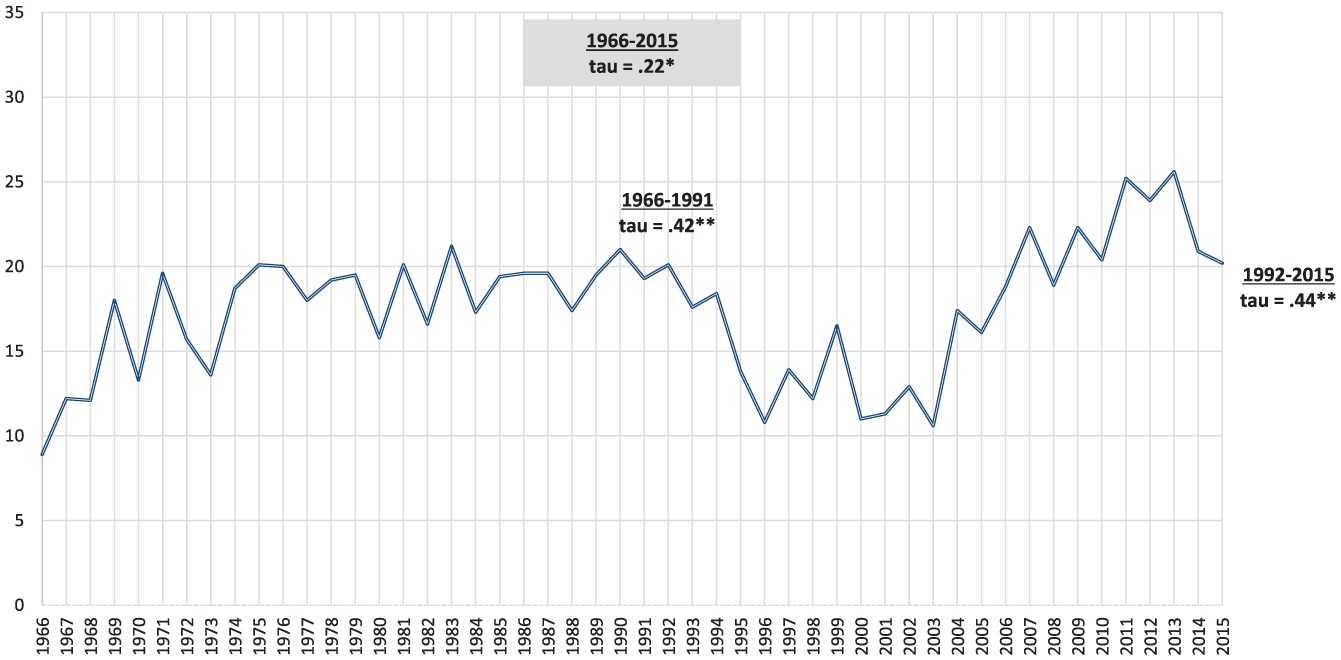
Percentage of New York Times foreign news items containing borrowed news.
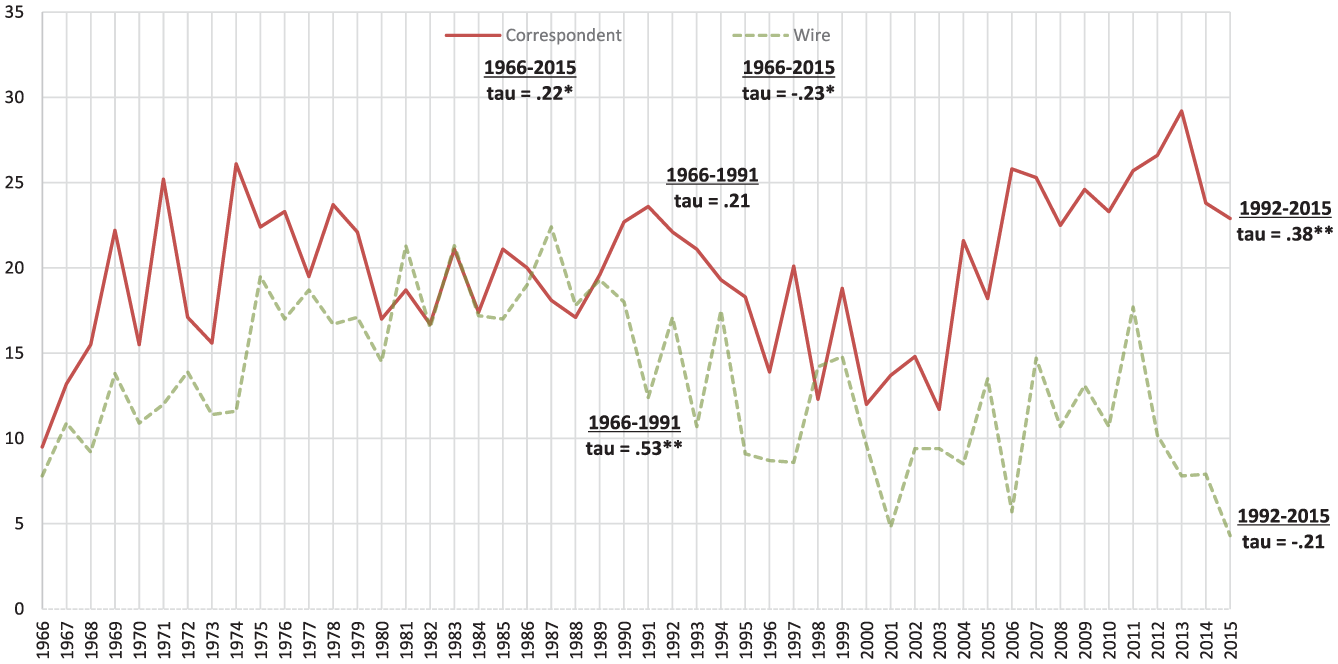
Percentage of New York Times foreign news items containing borrowed news, by originating agent.
Conversely, Times correspondent copy showed a modest but significant trend of increased news borrowing (tau = .22, p < .05). During the last 24 years of the study, in fact, the trend was for more items by correspondents (Figure 1’s tau = .41, p < .01, for 1992-2015) and for more borrowed news in those items (tau = .38, p < .01).
To address
Correspondents presumably have established greater first-person access to sources and proceedings in Free-press countries and are less likely to rely on mediated reports. Across all 36 years, borrowed news was present in 13% of news from Free countries, 19% of news from Partially Free countries, and 27% of news from Not Free countries, where media are often state-run and correspondent access restricted. Thus, to test
The data are illuminating when viewed as an aggregate for testing

Number of New York Times foreign news items, by press freedom level.
Figure 4 overall data address
But if the volume of Free Press country news items declined, Figure 5 data addressing

Percentage of New York Times foreign news items with borrowed news, by press freedom level.
In sum, the 50-year analysis showed an overall increase in news borrowing, despite a shrinking Times news hole, a shrinkage attributable mostly to declining inclusion of wire service news stories. The percentage of Times borrowed news that was conveyed by the paper’s correspondents increased significantly during the half-century studied. The 36-year Press Freedom trend analyses showed no overall increase in news borrowing, decreased Free Press country coverage but increased news borrowing in that coverage, while Not Free country coverage increased dramatically and news borrowing in those nations decreased significantly.
Finally, in the years since the original work on news borrowing, the media landscape has changed, beyond international media familiar to Times readers—the Times of London, Pravda, the BBC, Radio Hanoi, and Radio Moscow. More recently, of course, foreign correspondents have within their media repertoire various social media and websites.
Percentage of New York Times Foreign News Items Containing Social Media Sources, by Year.
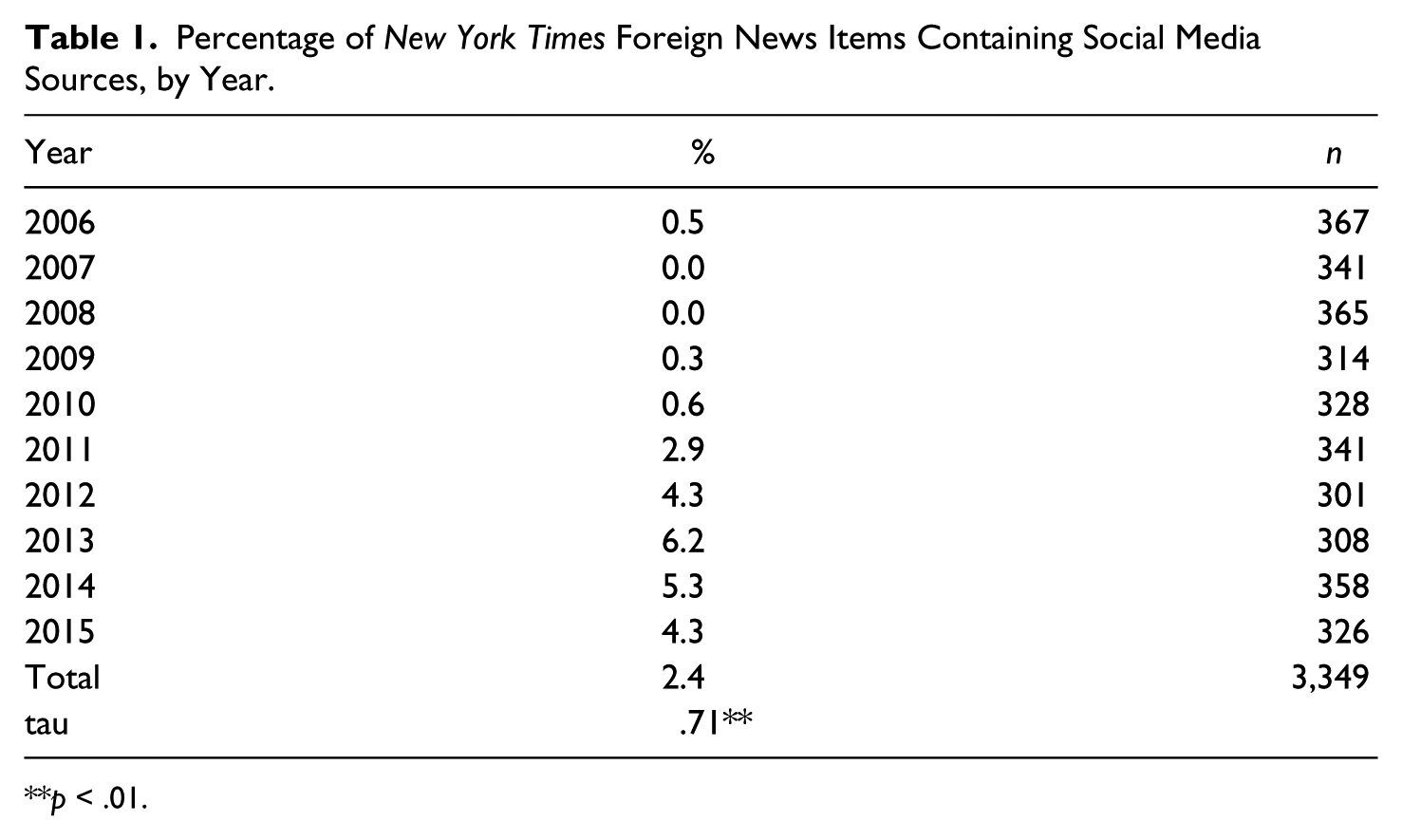
p < .01.
Moreover, the data offer a strong hint that the growth of news borrowing via social media may be greatest in coverage of Not Free countries. Simple cross-tabulation of social media news borrowing by press freedom level was significant (χ2 = 21.692, 2 df, p < .001), with 0.4% of Free Press and 0.4% of Partially Free items citing social media, compared with 1.2% of Not Free country items. Cautious interpretation is warranted, however, as those three percentages represent, collectively, only 80 items from the total 12,098; that number is certainly far too small to permit analysis of trends within three press freedom levels across the 10 years (e.g., 80 divided by 3 divided by 10). Future research, perhaps using larger samples from Not Free countries, may illuminate what these data seem to portend: Growing reliance by correspondents on social media as sources in countries where their mobility and access may be limited and resource-intensive.
Discussion and Conclusion
With its genesis in late 20th-century debates over a “shrinking foreign news hole,” the cost of maintaining foreign correspondents, and the potential impact of both on New York Times Cold War-era international news coverage, this study extends previous inquiry into how much of that coverage during the last half-century was reported “firsthand” by American correspondents on the scene or “secondhand,” borrowed from indigenous or other foreign media.
The original news borrowing research (Riffe et al., 1993) used Cold War First- and Second-World designations as proxies for a presence and absence of press freedom. “Press freedom” is, however, more complex and reflects legal, political, and economic dimensions, to name only three. This study’s reexamination of a large subset of the data, in terms of level of press freedom rather than Cold War spheres of influence, yielded intriguing results.
Two of three hypotheses based on previous research were supported: News borrowing increased across the half-century, and coverage of Not Free countries included the largest proportion of borrowed news. However, wire service coverage did not, as hypothesized, include an increasing amount of borrowed news. Meanwhile, borrowed news grew substantially in coverage of Free Press nations, and Times correspondents contributed more borrowed news than the wire services (which, overall, contributed fewer items to the shrinking international news hole),
Roughly 25% of items in the 36-year analysis were from Not Free countries. Free country items indicated declining levels of coverage but increases in news borrowing. Not Free country coverage grew dramatically but with a decreasing trend in news borrowing. Future explorations of the topics that have come to dominate international news (e.g., conflict, global economics, etc.) may shed light on some of these patterns, as might close examination of how they relate to U.S. economic and strategic interests (Sobel & Riffe, 2015).
Despite the very large data set, this study has several limitations. It focused on only a single newspaper, albeit one that enjoys a reputation as one of the world’s elite papers. Some of that status reflects the fact that the Times continues to have an overseas correspondent presence, which makes it atypical among U.S. newspapers, but which makes the relationships between amounts of coverage and borrowed news from different agents (correspondents vs. wire services) more intriguing.
Different coding teams contributed to the final data set, though all coders were extensively trained and achieved sufficient reliability using the same protocol. Ideally, all 700 sample dates would have been randomly assigned to the same team of coders.
Different archive formats were used: Times microfilms that were created each year, microfilms created later by ProQuest, and the LexisNexis database. Efforts to ensure comparability were made, but use of multiple archives and databases may create data compatibility issues (Lacy, Watson, Riffe, & Lovejoy, 2015; Riffe et al., 2014).
The study also relied on probability-based constructed-week sampling (2 weeks per year), a well-established sampling design which reveals representative annual patterns of international news coverage and news borrowing. Such sampling could, however, miss specific events that involved high levels of news borrowing during an event’s life cycle or history, such as when governments speak exclusively through state media during a finite period of crisis. Nonprobability consecutive day sampling would be useful in such a study, but such events can be missed by probability sampling.
Nonetheless, the study has provided a representative picture of a half-century of international news coverage in the New York Times, one of the world’s elite newspapers, documenting changing patterns in coverage and updating what we know about the prevalence of secondhand news. It has provided a long look at the paper’s changing news hole and its use of coverage from its own correspondents as well as wire service copy.
The original news borrowing research (Riffe, 1984; Riffe et al., 1993) noted a nearly monotonic decrease in number of international news items published prior to 1991 (a shrinking international news hole); a trend that did not, however, continue from 1992 through 2015. In fact, the number of international items began to increase in the mid- and late 1990s, a pattern that contradicts earlier findings and predictions about declining international news coverage.
Despite that “resurgence” during the 1992-2015 period, however, the overall 50-year pattern was one of significant reduction in the number of items—a shrinking foreign news hole, indeed. In addition to monitoring whether the 1992-2015 resurgence continues as the 21st century continues, future research should examine the length of international news items in the Times during this 24-year period of apparent increase. Some research has demonstrated that such increases in numbers of items sometimes means an increase in shorter items, at least when the news hole is truly finite, as is the case in broadcast news.
The original news borrowing study documented a decreasing role for Times correspondents; yet, the paper’s own reporters played an increasingly important part of news coverage in the more recent 1992-2015 period, relative to the paper’s decreasing use of wire coverage. The decrease-then-increase in Times staffers’ role, however, meant that, across all 50 years, the pattern for correspondent-produced coverage was flat or relatively steady. Across all 50 years, on the contrary, and in each of the two time periods, wire service stories declined steadily. Any “shrinkage” of the Times international news hole, then, reflected the reduction in its use of wire copy.
The hypothesis of increased news borrowing across all 50 years was supported. Nearly a quarter of items contained borrowed news in 2011 and 2013—the 2 years with the largest percentages in the 50 studied. And while the amount of wire service coverage in Times international news items decreased from 1966 to 2015, even less of that wire coverage carried borrowed news than hypothesized—only 4.3% of items in 2015, in fact. Meanwhile, Times correspondent copy showed a modest but significant half-century trend of increased news borrowing. During the last 24 years of the study, in fact, the dual trends were for more items by correspondents and more borrowed news in those items.
The first attribution of information borrowed from social media sources in this study’s sample occurred in 2006, and has been increasing ever since, though the incidence of such sources was small (under 7% of items studied), at least in 2015 when data collection ceased. That increase, however, occurred despite comparative stability of the news hole during that decade. Moreover, the data provide a hint news borrowing from social media by correspondents may be greatest in restrictive, Not Free nations, where the newsgathering climate is most difficult. Again, however, the subsample size is quite small.
Although observers of the explosion of social media in other social, cultural, and political contexts might be surprised by such small percentages, a survey of 1,080 U.S. journalists found that a majority believe social media have had a negative impact on the journalistic profession by leading to the sacrifice of accuracy for speed (Weaver & Willnat, 2016). If journalists do not believe social media can complement commitment to professional standards such as accuracy, they may use such sources sparingly. However, given that the convenience and accessibility of social media as a source for quotes, and for quick measures of public opinion, have been acknowledged (Broersma & Graham, 2012) and have been exploited by newsmakers (Barbaro, 2015), research on use of social media content in international news coverage will likely show its continued growth.
Indeed, given the half-century patterns discovered in overall international news reporting operations witnessed here, doubtless reflecting shifting changes in Times priorities and resource allocation, and the 36-year patterns relating press freedom to news coverage and news borrowing that reflect conditions where events occur, as well as the reliability of local media—traditional and social, independent and otherwise—it is tempting to speculate on how much of the future international news hole will be populated with coverage borrowed from social media, independent and otherwise.
Footnotes
Declaration of Conflicting Interests
The author(s) declared no potential conflicts of interest with respect to the research, authorship, and/or publication of this article.
Funding
The author(s) received no financial support for the research, authorship, and/or publication of this article.