




Abstract
U.S. political party genderization (Republicans as masculine; Democrats as feminine) is well-documented in research. To determine if Hillary Clinton may have disrupted these patterns as the first female major-party presidential nominee, Reddit posts during the 2016 election campaign were analyzed. Most studies focus on professional news or candidate self-presentations concocted by image handlers. We departed from this tradition, focusing on (a) gender qualities that Redditors assign to candidates on this platform and (b) statistical tracking of these patterns over time. The results provide insight into how the electorate presented the two candidates and Donald Trump’s largely unexpected victory.
Feminization of the Democratic Party in the United States, regardless of the gender of candidates, is a well-documented trend (Fahey, 2007; Huddy & Terkildsen, 1993b; Rich, 2004; Winter, 2010). The emergence of Hillary Clinton as the first female presidential candidate on the Democrat ticket in 2016 can, therefore, be expected to reaffirm the feminine qualities that are associated with this party. However, derogation aimed at Clinton often centered on her masculinity (or lack of femininity), potentially distancing her (and the Democratic Party that she represented) from its traditionally feminine frame. For example, during the third presidential debate, Trump called Clinton a “nasty woman” (Pearce, 2016). In addition to this widely criticized statement, Trump supporters (and the candidate himself) regularly drew attention to Clinton’s gender in criticizing her, whereas Clinton supporters (and the candidate herself) pointed to her gender as an indicator of sociopolitical progress. As a result, rhetoric from both camps brought gender to the forefront of the 2016 election. Furthermore, evidencing the role of gender in this election, Trump drew strong support from White males (McCormick, 2016; “The Unexpected Voters Behind,” 2016), and exit polls showed a 13-point gender gap among Clinton voters (54% of women and 41% of men) and an 11-point gender gap among Trump voters (41% of women and 52% of men), tying the largest gender gap in a half century of exit polls (Center for the American Woman and Politics, 2017). It is possible that the traditional genderization of Democrats as feminine and Republicans as masculine might have become muddled in the 2016 election. In any case, the entry of a female candidate into the presidential race offers a unique opportunity to gain insight into political party genderization.
To investigate genderization in this election, a content analysis of visuals and headlines shared by candidate supporters and opponents on Reddit was conducted using established news values and leadership qualities expected of U.S. presidents (Gans, 1979; Grabe & Bas, 2013). Reddit is a social media platform designed to facilitate communication and user interaction within communities of interests, or subreddits (e.g., r/Politics, r/Gaming, and r/Photography). During the 2016 campaign, Reddit was the ninth most visited website in the United States, and the fourth most visited social networking site behind YouTube, Facebook, and Twitter (Quantcast, 2017). Although the site’s userbase is not homogeneous, Redditors (Reddit users) are predominantly White, male, 18 to 49 years of age, at least somewhat college-educated, and are more likely to report liberal than conservative political leanings (Pew Research Center, 2016). Because of Reddit’s prominence within the contemporary social media ecology and interest-based design, individual subreddits emerged during the election for Trump and Clinton in which Redditors shared verbal and visual content about the candidates and their campaigns (e.g., sharing current information, memes, images of the candidates, etc.). As Reddit is organized into communities of interest, communication within the Trump subreddit was restricted to pro-Trump content, whereas conversation within the Clinton subreddit was restricted to pro-Clinton material. Thus, Reddit provided a unique opportunity to identify how supporters and opponents verbally and visually presented Clinton and Trump, relatively isolated from supporters of the opposing candidate, and unobstructed by campaign handlers or media professionals (e.g., journalists and editors). In addition, as contemporary presidential candidates rely heavily on social media for campaigning, both Clinton and Trump made appearances on their corresponding subreddits, thus encouraging supporters to use these subreddits and reinforcing the importance of this platform today.
To identify portrayals of the two candidates, this study focused on visuals shared through the candidate subreddits. A number of political communication scholars have made arguments that images are largely neglected in scholarship (Graber, 2001; Prior, 2014), and point to the importance of focusing on news images in understanding election frames and the impact of media images on informed citizenship (Barry, 2005; Grabe, Bas, & van Driel, 2015; Grabe & Bucy, 2010; Prior, 2014). Yet, prior analyses of election images have focused on journalistic or candidate-generated campaign content—not visual material that is shared by supporters without the oversight of candidate campaign handlers. As Reddit posts and corresponding visuals are largely unfettered by candidates and their image handlers, this study provides an opportunity to observe how the electorate engages in gender politics in comparison with how candidates and campaign handlers have utilized social media, including during this election (Faris et al., 2017; Gunn, 2017; Morris, 2017; Oates & Moe, 2016; Zhang et al., 2017). In addition to making cross-party comparative assessments of genderization, temporal changes were tracked to gain insight into Reddit user sentiments during the course of the campaign period.
The Feminization of Democrats Compared With Republicans
Wolbrecht’s (2010) historical work traces party polarization on gender back to the Equal Rights Amendment, with hardened positions developed on women’s rights in both political party camps by the 1980s. Central among these was reproductive rights, with Democrats showing more leniency to a woman’s choice than Republicans. In line with this, Shapiro and Mahajan (1986) identifies compassion-signaling issues like education, health care, and poverty, reporting that Democrats are viewed as having greater competency in managing these issues (Huddy & Terkildsen, 1993a). For example, hypothetical candidates with feminine personality traits were rated better at handling compassion issues (Huddy & Terkildsen, 1993a), which are perceived as part of the Democratic Party’s domain. In contrast, the Republican Party is perceived as more capable handling matters that require masculine force like defense, crime, and terrorism (Huddy & Terkildsen, 1993a).
Winter (2010) uses nationally representative surveys (American National Election Studies [ANES]) across three decades to track the electorate’s perceptions of Democrats and Republicans in gender-specific ways. He also conducted experiments, revealing that cognitive schemas enable gendered associations. This work suggests that the electorate unknowingly draws on concepts of femininity when they think of Democrats, whereas the Republican Party automatically elicits masculinity schemata (Winter, 2010). In addition, Huddy and Terkildsen (1993b) argue that genderization of political parties is rooted in gender stereotypes attributed to each party, and these stereotypes are extended to candidates who represent the platform. It is, thus, reasonable to conclude that the American electorate might have gendered perceptions of candidates based on their party affiliation—possibly interacting with perceptions of a candidate’s individual attributes or political positions.
Anecdotal evidence also helps to contextualize the genderization of American politics. Republican presidential candidates, perhaps through the advice of image handlers like Lee Atwater and Carl Rove, are suspected of emphasizing their masculinity as a strategy to undermine Democratic opponents (Fahey, 2007; Rich, 2004). More specifically, Republican presidential candidates perform masculine personas through tough stands on issues like crime and war. This can be a successful strategy given that voters rate masculine/instrumental leadership traits as more desirable for an ideal president than feminine/expressive traits (Butterfield & Powell, 1981; Funk, 1999). However, being associated with feminine qualities has not been a universal detriment to Democrats in presidential elections—they have won about the same number of elections in the past 60 years as Republicans.
Importantly, strategies to emphasize masculinity or femininity must take into account both verbal and visual presentation, especially in a media age that invites visual scrutiny of candidates through professional and citizen recordings that are shared almost instantaneously. Thus, examination of the visual modality (in addition to verbal information) is critical for comprehensive insight into election campaign processes. Nonverbal political communication research shows that audiovisual leader displays elicit heuristics that play a central role in political information processing and decision-making (Benjamin & Shapiro, 2009; Bucy, 2010; Gong & Bucy, 2016). In fact, a growing number of experimental studies show that voters draw on visual displays that set in motion automatic and volitional cognitive processes that afford political impression and judgment formation (Benjamin & Shapiro, 2009; Masters, 2001). Voters implement these easily processed and readily available visual displays of leaders as judgment heuristics (Bucy, 2010; Mondak, 1993), which in turn predict future political behavior (Lanzetta, Sullivan, Masters, & McHugo, 1985; Masters & Sullivan, 1989, 1993); Together, these historical, political, and media modality dimensions set the stage for gendered political theater that invites systematic examination.
Enduring News Values and Leadership Qualities
In a classic newsroom ethnography followed by content analyses, Gans (1979) concludes that on any given day, journalists select a small number of occurrences from a nearly infinite number of possibilities and call it news. The methods for culling and framing these occurrences are embedded in professional and societal values. As Gans (1979) sees it, news values cast a nation and society, not as it is, but as it ought to be by the commonly held ideals of that society. Based on American sentiments, Gans (1979) identifies a number of news values commonly used in the framing of United States presidents and leadership qualities that the American people have consistently expected of their presidents (thus far, all male). Although these news values and leadership qualities have been traditionally employed in evaluating professional journalistic framing, their application as an analytical frame for non-journalistic content is appropriate due to their rehearsal and embeddedness in American values—according to content analysis and ethnographic data (Gans, 1979—see also Schudson, 2007). Thus, using these qualities, this study examines portrayals of a rare inter-gender competition for the presidential position—Hillary Clinton versus Donald Trump—as their supporters and opponents disseminated information about them on Reddit.
News Values
In the so-called pioneer spirit of Americans, the individual is valued as an autonomous, decision-making entity, with intrinsic dignity (Sigel, 1966; Steele & Redding, 1962). Gans (1979) calls this rugged individualism, which surfaces when candidates are presented as immune to strong-arming from big government or business. Donald Trump’s uncompromising behavior, including his unwillingness to accept campaign donations from corporate lobbyists, is a classic example of the rugged individualism frame. Lacking this quality, a candidate is framed as a group thinker, needing the approval of others, or part of old political or business establishments.
Gans (1979) describes moderatism as tempering rugged individualism to fall within an acceptable range of idiosyncrasy. Moderatism frames are present when candidates are presented as balanced in policy stances and in personal life philosophy, or intolerant of extremism on political, economic, environmental, or religious fronts. Extreme positions in voting records or acquaintances with people or institutions described as extremist run counter to moderatism.
Patriotism, for Gans (1979), is a focus on what is unambiguously American, as Figure A1 (online supplement) demonstrates in the case of Donald Trump’s embrace of the American flag. Patriotism also includes frames invoking war heroism, firmness in foreign relations, or advancing the idea that American interests come first. Dodging the draft, acting unpatriotically during war, or being swayed by international pressure suggests the antithesis of patriotism.
Altruistic democracy (Gans, 1979) refers to democratic principles like equality and generosity in citizenship (e.g., during natural disasters) and governance (e.g., economic and civic humanitarianism). When a candidate is aligned with freedom, equality, prosperity, and the welfare of the people, altruistic democracy is invoked. Being short on this quality manifests through emphasis on a controlling personality, self-centeredness, elitism, or favoring some segments of society to the exclusion of others.
Material comfort is an expectation in the American way of life (Steele & Redding, 1962). Capitalism is the match for this value, yet American people are generally opposed to the hard edge of this ideology (Gans, 1979). Instead, Americans venerate responsible capitalism, where a free market is guaranteed but worker and consumer rights are protected. Being conservative in spending taxpayer money showcases this value whereas wasteful spending, misappropriation of taxpayer money, or favoring big business to the detriment of the people reveals the counter to responsible capitalism.
Related to distrust of big business and government, Gans (1979) describes small-town pastoralism as a value that links candidates to rural roots, exemplified in campaign activities in small towns rather than big cities. Big city candidates who are uncomfortable with small-town folks and their traditions evoke a shortfall in this value. In Figure A2 (online supplement) Hillary Clinton makes a play for small-town pastoralism.
Leadership Qualities
A number of personality traits have been consistently linked with qualities expected of an ideal president (Hellweg, 2004; Nimmo & Savage, 1976; Sigel, 1966). Early presidential image studies found that voters value physical appeal, personality, leadership, honesty, and intelligence (Nimmo & Savage, 1976). Other studies showed that honesty, sincerity, integrity, and warmth are important criteria in voter decisions (Kinder, 1986; Nimmo & Savage, 1976). Moreover, Gans (1979) offers nine ideal leadership traits that overlap with political communication research findings.
For Americans, honesty is a traditional pillar of morality and is expected of an ideal president (Hellweg, 2004). This trait finds expression in candor, being forthcoming, frank, or truthful. In contrast, lies, dishonesty, and deception undermine the perceived honesty of a presidential candidate. For example, the controversy surrounding Hillary Clinton’s management of e-mail produced questions about her honesty in the 2016 election. Vision (Gans, 1979; Steele & Redding, 1962) is defined in the literature as forethought, imagination, creative management, and clearly formulated ideas for policy. Lacking these qualities surfaces when a candidate is unfocused, incoherent, shortsighted, or relying on others for ideas. A candidate’s physical stamina becomes a point of focus when endurance, energy levels, physical strength, or the general state of physical fitness or health is mentioned. Physical strength, activeness, energy, and virility are ideal qualities Americans want in their presidents (Gans, 1979; Hellweg, 1979). Images of a candidate participating in sports or other outdoor activities suggest physical stamina. Clinton’s stamina, for instance, was questioned during this election after she collapsed due to pneumonia.
Courage (Gans, 1979; Hellweg, 1979) is marked by emphasis on bravery, guts, or lack of hesitation in tackling major problems or challenges. If a candidate is presented as avoiding challenges, courage deficit frames emerge. Gans (1979) and Sigel (1966) also identify intelligence as a core trait for an ideal president that manifests when candidates are celebrated as intellectual, well-educated, bright, or articulate. Low intelligence, in contrast, is marked by spoofs of a candidate as inarticulate, weak in debate, a poor student in college days, or making senseless mistakes. Americans also see their president as the guardian of social and moral order (Gans, 1979; Steele & Redding, 1962), and is, therefore, expected to be an exemplar in their own conduct and in guiding the behavior of others. Moral soundness is indicated through integritous acts, maintaining ethical standards, and being virtuous in professional and personal matters. Aligning the candidate with backstabbing, cheating, or corruption signals immorality.
Extroversion or charisma is valued in an ideal leader (Gans, 1979; Hellweg, 1979; Sigel, 1966). Being dynamic, charming, captivating, inspiring, persuasive in negotiations, effective in managing subordinates, and moving crowds are all dimensions of this frame. Lack of charisma is evidenced when a candidate is described as bland, dull, low key, uninspiring, or allowing subordinates to dominate decisions. Next, a competitive self-made male is an archetype in American folklore and the basis for why achievement through hard work is a cherished American value (Steele & Redding, 1962). Unsurprisingly, these norms fuel expectations of a president as competent, engaged, and hardworking (Gans, 1979; Hellweg, 1979; Sigel, 1966)—traits that underscore dedication. Being keen, devoted, tireless, and committed to the call of duty exemplifies this characteristic. A candidate lacking these qualities is described as taking frequent holidays, managing an uninspiring campaign, committing weakly to public life, or eager for the campaign to be over. Finally, populism is a frame that emerges when a candidate is seen as an ordinary person rather than an elite (Kazin, 1998). If a candidate is popular with the masses, visiting diners, bowling alleys, and assembly lines, populism is in play (Erickson, 2000). On the contrary, discomfort with regular people or associations with high society establishments signals elitism.
How these character dimensions, steeped in traditional American values (Nimmo & Savage, 1976), emerged in Reddit posts and images related to the two major-party presidential candidates during the 2016 presidential election campaign is the focus of the first research question:
Genderizing Enduring News Values and Leadership Qualities
In a longitudinal study of network news genderization of U.S. presidential candidates, Grabe and Bas (2013) fit enduring news values and ideal leadership qualities identified by Gans (1979) with Bem’s (1974) Sex Role Inventory (BSRI) to create a tool for studying political party genderization. Five working journalists were asked to score character traits and news values for underlying gender dimensions. Fifteen leadership qualities and news values were reliably fitted to gender dimensions. Figure 1 summarizes the process used for building masculine, feminine, and gender-neutral frames from leadership qualities.
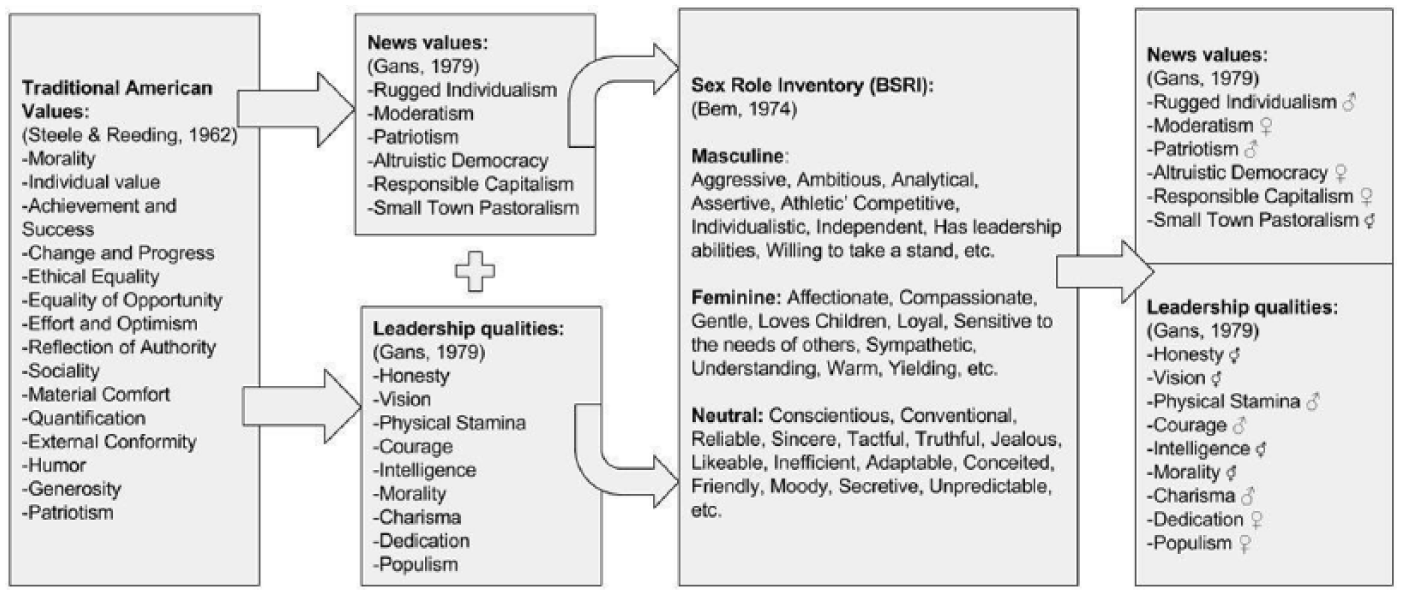
Conceptual flow for identifying gendered frames.
Grabe and Bas (2013) report full agreement on five frames as masculine: patriotism, stamina, courage, individualism, and charisma. These frames were connected to masculine attributes such as competition, aggression, activeness, athleticism, force, independence, individualism, risk-taking, defense of beliefs, feelings of superiority, and willingness to take a stand—traits used in news studies of political candidate gender (Kahn & Goldenberg, 1991). Feminine frames also received high agreement: populism, dedication, altruistic democracy, and responsible capitalism. These traits were unanimously judged as feminine, while moderatism drew consensus among four journalists (out of five). Grabe and Bas (2013) report less but still high agreement about gender-neutral frames. Honesty and morality drew full consensus whereas vision and intelligence were classified as gender-neutral by four journalists. Intelligence was evaluated as masculine by one and vision as feminine by another. Small-town pastoralism was viewed as gender-neutral by three of five journalists while two declined to evaluate this value. This instrument of genderization gives impetus for the second research question:
The evolution of leadership frames over the course of an election campaign might be associated with the ebb and flow of a candidate’s public support, heavily influenced by critical moments through the election season (e.g., Clinton’s “basket of deplorables” or Trump’s “nasty woman” comments prompting the use of particular frames—both negatively and positively). For that reason, a final research question is posed to evaluate the use of leadership frames over time:
Method
Sample
Sample data were collected daily from September 1 to November 8, 2016, following collection times used in prior content analyses of presidential elections (Bucy & Grabe, 2007; Waldman & Devitt, 1998). Although Labor Day (September 5 in 2016) is the official start of the campaign period, September 1 was selected for the start of data collection to ensure Reddit activity in the days leading up to Labor Day were also collected. Thus, the sampling frame was constructed from September 1 to Election Day. At each collection point, the primary Reddit pages (subreddits) for the leading presidential candidates were accessed (r/The_Donald and r/hillaryclinton), and posts were ranked by score accumulated during the 24 hr-period immediately prior to each collection. URLs for the top five most highly scored posts for each subreddit were recorded at each collection point in a spreadsheet, and manifest content available within the Reddit pages (e.g., post score and number of comments) was also recorded. Visuals were downloaded and stored for later analysis. A staggered sampling strategy was developed in which the collection time was increased by 1 hr (from 8 a.m. to 8 p.m.) for each daily collection. Using this strategy, data were collected at 8 a.m. on the first collection day (September 1), and collection was shifted an hour later each day until data were sampled at 8 p.m. (September 13). On the following day (September 14), the schedule began again at 8 a.m. This sampling strategy allowed us to capture highly scored content daily without introducing bias toward posts submitted at a certain time of day or day of the week. From the sampling frame, all posts that included a visual of either major presidential candidate (Hillary Clinton, Donald Trump, or both candidates), candidate spouse (Bill Clinton or Melania Trump), or vice-presidential candidate (Tim Kaine or Mike Pence) was added to the analyzed sample. Images that did not include a visual of these political actors (e.g., graphics about the candidates, images of other people, etc.) were not included in the sample to focus specifically on how the candidates and related actors were portrayed by supporters and opponents. Spouses and vice-presidential candidates were included due to their proximity to the presidential candidates, as these individuals also directly influence the election outcome. Mike Pence was visualized once, and Melania Trump and Bill Clinton each appeared twice.
Coding Procedure
A codebook was developed to capture manifest content from Reddit pages and latent content (i.e., approval, news values, and leadership qualities) from post titles and visuals. Two coders were recruited and trained using the codebook. Intercoder reliability was assessed using Krippendorff’s alpha (range = .7-1). In all, 36 posts were used in coder training (20.5% of the sample), and 18 were used in calculating Krippendorff’s alpha (10.3% of the sample). Once reliability was established, coding was equally distributed between coders. For each post, coders accessed the archived Reddit post and corresponding visual using information stored in a spreadsheet. Manifest content (e.g., subreddit, post score) was documented according to data recorded at the time of post collection. Latent content (i.e., news values and leadership qualities) was coded using post title information and the collected post visual. In cases where both major candidates were addressed in the post visual, each candidate was coded separately. In total, 175 posts were coded producing 197 cases. Twenty-two post visuals included both candidates and were, therefore, coded for each candidate.
Measures
Manifest content categories
Four categories captured content available within the Reddit page, including subreddit, target candidate, post score, and number of comments. Intercoder reliability according to Krippendorff’s alpha is reported with subreddit and target candidate, whereas post score and number of comments were simply documented by coders according to information recorded during sample collection. Coders indicated the subreddit (α = 1.00) to which the post had been submitted, coded as either Trump or Clinton. Similarly, target candidate (α = .86) was coded as either Trump, Clinton, Trump and Clinton, or neither depending on which candidate(s) was included in the visual material. Visuals that included spouses or vice-presidential candidates were coded as the corresponding presidential candidate. Post score was documented according to the recorded score at the time of collection, not the score available during the coding session. Using the score available at the time of coding could potentially bias scores, as earlier posts would have had more opportunity for voting activity than later posts. Thus, scores were recorded as part of the collection procedure, and were documented accordingly. Finally, the number of comments was documented according to the recorded number at collection, following the same logic and collection procedure as for the post score. Post score and the number of comments received by a post provided an indication of community activity in response to an individual post.
Latent content categories
Six news values and nine leadership qualities (Gans, 1979), which overlap with political science literature (Hellweg, 2004; Nimmo & Savage, 1976) and social psychology scholarship on American values (Steele & Redding, 1962), were included in the codebook as latent content categories. Summaries, intercoder reliability according to Krippendorff’s alpha, and codebook definitions for each value and trait are presented in Table 1. Each value and leadership trait was coded according to valence—positively present in instances where the category manifested in either the post title or post visual in support of a candidate (e.g., “Clinton is a dedicated candidate”), or negatively present if they manifested in opposition of a candidate (e.g., “Clinton does not have enough stamina”). If a value or trait did not manifest in the Reddit post or visual material they were coded as unaddressed. As the moderatism category scored somewhat lower in Krippendorff’s alpha (α = .7) than the other news values and leadership qualities, problem cases were flagged and resolved through consensus (group) coding for this category.
Summary of News Values and Leadership Qualities.
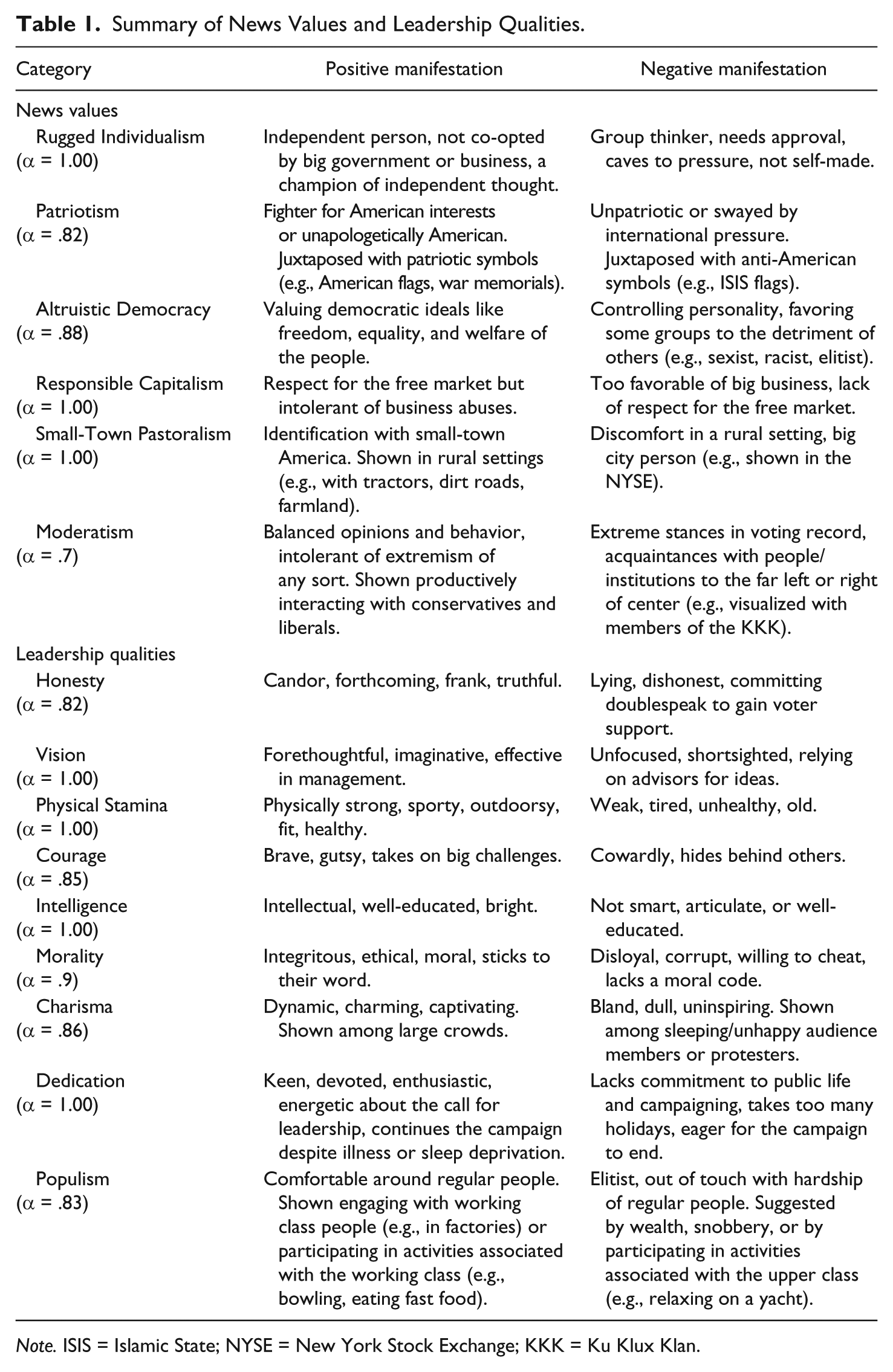
Note. ISIS = Islamic State; NYSE = New York Stock Exchange; KKK = Ku Klux Klan.
Both verbal and visual content were used in making coding decisions. For example, patriotism may manifest in instances where a candidate is captured performing a ceremonious act of patriotism, including actions with symbols of the United States (see Figure A1 in online supplement). As another example, small-town pastoralism is expressed visually when a candidate is shown in a rural setting or is captured performing an action typically associated with rural life (see Figure A2 in online supplement). However, a visual may also provide an ambiguous message about a candidate and, thus, analysis of verbal content would further elucidate visual meaning. Therefore, coders identified each news value and leadership quality using information contained within post visuals and corresponding post titles. (online supplement) provides an example of an ambiguous visual informed by the post title.
Results
Descriptives
In total, 175 Reddit posts were analyzed, producing 197 cases for analysis. Both Clinton and Trump were visualized in 22 posts. The sample included 82 posts from Trump’s subreddit, in which he was visualized in 37 and Clinton in 45 of these posts. By comparison, the sample included 115 posts from Clinton’s subreddit, in which Trump was visualized in 57 and Clinton in 58 posts. Thus, visuals of the two candidates appeared with close to equal frequency in each subreddit. Overall, posts in the Trump subreddit accumulated a higher Reddit score (M = 4,328.7, SE = 84.04) than posts in the Clinton subreddit (M = 575.75, SE = 50.5), t = 38.28, df = 137.34, p < .001, Cohen’s d = 5.68. Posts in the Trump subreddit also accumulated a higher number of comments (M = 321.71, SE = 51.15) than posts in the Clinton subreddit (M = 121.1, SE = 14.36), t = 3.78, df = 93.86, p < .001, Cohen’s d = 0.58. Together, these findings suggest a higher level of activity on the Trump subreddit.
News Values and Candidate Leadership Qualities
Our first research question asked the following: Are there patterned differences in how Hillary Clinton and Donald Trump were framed by supporters and opponents in terms of values and character traits? Prompted by
News Value and Leadership Quality Frequencies for Trump and Clinton Subreddits.

On the negative side, there was a striking difference in how often supporters of the two candidates acknowledged flaws in the opposing candidate. Trump supporters frequently questioned Clinton’s altruistic democracy, moderatism, honesty, and morality. Similarly, Clinton supporters criticized Trump’s altruistic democracy, moderatism, and morality (Figure A7 in online supplement). These were clearly characteristics that were often scrutinized during the 2016 election. Also noteworthy, Trump supporters showed unwillingness to criticize him, rarely sharing negative visuals. By comparison, Clinton supporters acknowledged her shortcomings 5 times as often. To explore possible temporal patterns in how prominent values and character traits were utilized (e.g., increased prevalence of morality after the first debate), additional exploratory analyses were conducted for values and qualities that appeared more than 40 times: patriotism, altruistic democracy, moderatism, honesty, morality, and populism. No significant patterns emerged, signaling consistency in how these values and character traits emerged through the campaign period.
Candidate Genderization
Our second research question asked the following: Are there differences in how the two candidates were framed by supporters and opponents in terms of masculinity, femininity, and gender-neutrality? See Figure 2 for gender category frequencies. To explore this question, news value and trait categories were collapsed into net scores to determine patterned differences in how Clinton and Trump were framed by supporters and opponents in terms of leadership values and character traits, including genderization. For masculine traits (i.e., patriotism, stamina, courage, individualism, and charisma), positive instances of each category were collapsed into a proportion of positivity (e.g., 0.2 for one instance of positivity in five total instances), negative instances were collapsed into a proportion of negativity, and the negative proportion was subtracted from the positive proportion to render a net masculinity score. The same procedure was replicated for feminine traits (i.e., populism, dedication, altruistic democracy, responsible capitalism, and moderatism) and gender-neutral traits (i.e., honesty, morality, vision, intelligence, and small-town pastoralism). Finally, an overall net score for candidate valence was calculated combining masculine, feminine, and gender-neutral categories. A series of independent samples t tests was used to compare net scores for Trump and Clinton within each subreddit.
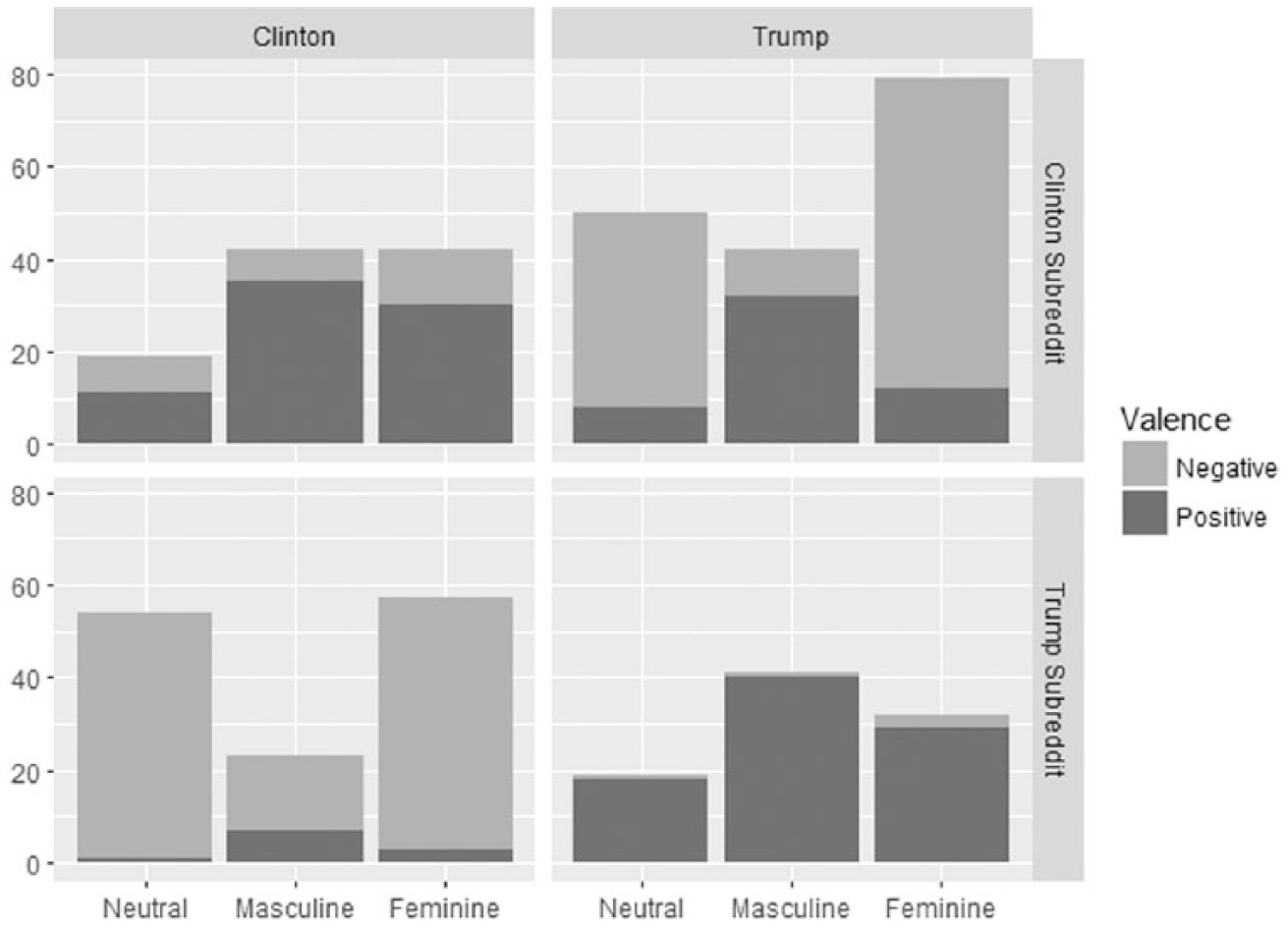
Gender category frequencies by candidate, subreddit, and valence.
Within the Trump subreddit, the candidate was rated as significantly higher in masculine characteristics (M = .21, SE = .03) than Clinton (M = −.04, SE = .02), t = 6.81, df = 80, p < .001, Cohen’s d = 1.46. Trump was also rated as higher in feminine characteristics (M = .14, SE = .03) than Clinton (M = −.23, SE = .03), t = 9.64, df = 80, p < .001, Cohen’s d = 2.17, and Trump was rated higher in neutral aspects (M = .09, SE = .02) than Clinton (M = −.23, SE = .03), t = 8.93, df = 80, p < .001, Cohen’s d = 1.98. Overall, Trump scored highest on masculinity, followed by femininity and gender-neutrality. Clinton scored only slightly negatively in masculinity, but highly negatively in femininity and gender-neutrality. This suggests that Clinton was masculinized (or defeminized) by Trump supporters, whereas Trump emerged as a multifaceted candidate with masculine, feminine, and gender-neutral leadership characteristics. In overall valence, Trump scored somewhat positively (M = .15, SE = .02), whereas Clinton scored somewhat negatively (M = −.17, SE = .02), t = 12.36, df = 80, p < .001, Cohen’s d = 2.78. Notably, although the candidates scored similarly distant from 0, they trended in opposite directions.
Within the Clinton subreddit, the candidate appeared more (yet not significantly) masculine (M = .1, SE = .02) than Trump (M = .08, SE = .03), t = −.55, df = 113, p = .59, Cohen’s d = 0.11. Yet, she did score significantly higher in feminine characteristics (M = .06, SE = .03) than Trump (M = −.19, SE = .04), t = −5.47, df = 113, p < .001, Cohen’s d = 1.0. Clinton was also rated significantly higher in having gender-neutral characteristics (M = .01, SE = .02) than Trump (M = −.12, SE = .02), t = −4.83, df = 102.92, p < .001, Cohen’s d = 0.92. Together, these findings indicate that Clinton supporters rated Trump highly negatively on feminine and gender-neutral characteristics, but more highly on masculine characteristics. Strikingly, Clinton’s scores in her own subreddit hover close to 0, indicating weak positive endorsement. Overall, Clinton is rated more positively (M = .06, SE = .02) than Trump (M = −.08, SE = .02) within her own subreddit (as would be expected), t = −5.03, df = 113, p < .001, Cohen’s d = 0.96. However, positivity toward Clinton in her subreddit was half as strong as the positivity toward Trump in his subreddit. In addition, positivity scores for Trump among Clinton supporters was double that of positivity scores for Clinton among Trump supporters.
In answering
Candidate Valence Over Time
The third research question asked the following: Will the use of leadership frames over time indicate changes in public support throughout the election season? To explore this possibility, four ordinary least squares (OLS) regression models were constructed to identify the change in candidate net scores from September 1 to Election Day. For each model, net valence scores were regressed onto the number of days passed from September 1 using a subset of the dataset (data from the Trump or Clinton subreddit). Models for candidate favorability within the Trump subreddit are visualized in Figure 3 and favorability within the Clinton subreddit is visualized in Figure 4. Although each regression in the Trump subreddit exhibits a trend toward zero over time, neither the model for Trump’s net score (F = .53, df = 1, 35, R2 = .015, p = .47, β = −.001), nor Clinton’s net score (F = .21, df = 1, 43, R2 = .005, p = .65, β = .0004) was significant. In the Clinton subreddit, the regression model for Trump is not significant (F = .21, df = 1, 55, R2 = .004, p = .65, β = .0005). The model for Clinton’s change in net score was significant (F = 4.34, df = 1, 56, R2 = .07, p < .05) as valence trends toward zero and becomes slightly negative (β = −.002, t = −2.08, p < .05). In addition, to account for possible temporal autocorrelation in this finding, a generalized least squares (GLS) model was generated that allowed for AR1 autocorrelation in the residuals. Serial correlation was relatively minor (Φ = −0.1), and the model rendered similar, though slightly less significant, results (β = −.002, t = −1.97, p = .054). This finding suggests that Clinton supporters failed to sustain positivity toward her over the course of the election campaign. Near Election Day, both candidates appeared at similar levels of negativity on the Clinton subreddit. In contrast, Trump supporters maintained a consistent valence differentiation between him and Clinton within his subreddit. Specifically, Trump’s site featured him positively and Clinton negatively at invariant levels throughout the election. Visual inspection of this data further supports this observation, as portrayals of each candidate within the Trump subreddit are delineated by the neutral zero point. Portrayals of Clinton never edged toward positivity and portrayals of Trump never approached negativity. In contrast, Clinton is occasionally portrayed negatively and Trump sometimes positively within her subreddit.

Candidate valence within posts on the Trump subreddit.
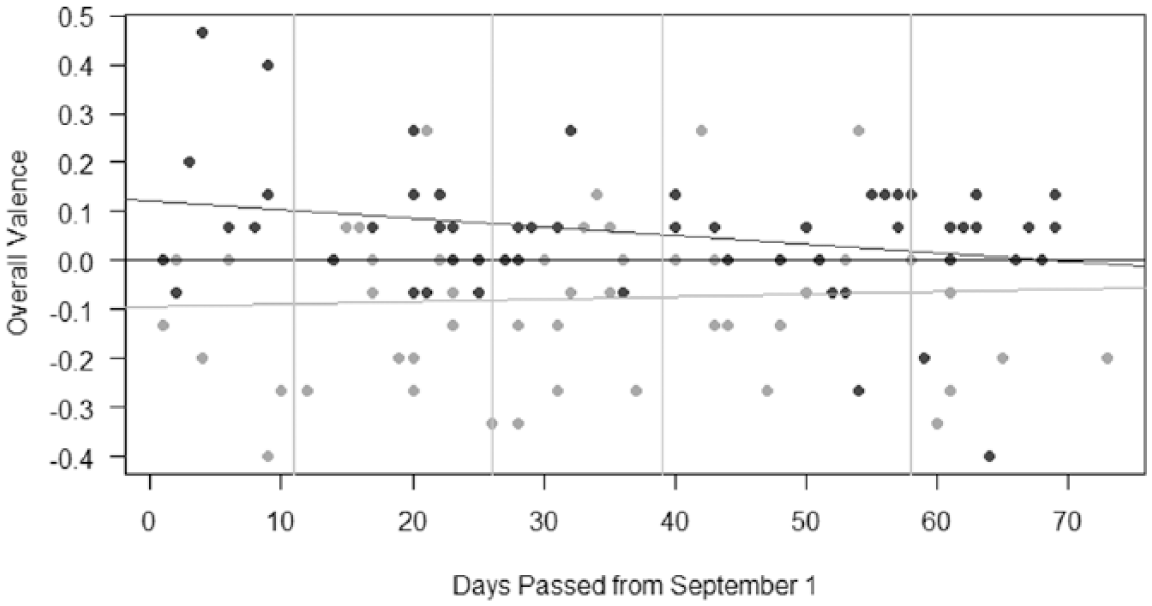
Candidate valence within posts on the Clinton subreddit.
Discussion
The 2016 presidential election unearthed notably high levels of political contention in the United States. Personally injurious attacks between the two major-party nominees (and supporters) and gender politics played a role in this friction. In some ways, the intensity of conflict and centrality of gender in this campaign was expected. For the first time in history, a female presidential nominee represented the historically feminized Democratic Party. Meanwhile, the Republican Party, with a long tradition of masculinity (Fahey, 2007; Huddy & Terkildsen, 1993b; Rich, 2004; Winter, 2010), was represented by a male candidate. The failure of well-regarded public opinion polls to predict Trump’s Electoral College victory, some by large margins (Real Clear Politics, 2016; “Who will win the presidency?” 2016), adds to the peculiarities of this election. It also invites inquiry to make sense of the unanticipated shift in the U.S. political landscape.
Through a content analysis of posts and visuals shared within the Trump and Clinton subreddits, this study explored candidate portrayals disseminated by supporters and opponents during the campaign period. The findings reported here reveal strong support for Donald Trump in a number of ways that elucidate his largely unexpected victory. First, the Trump subreddit attracted more activity than the Clinton subreddit, as posts submitted to the Trump subreddit accumulated a significantly higher score and a greater number of comments. This relative intensity of activity among Trump supporters within Reddit may have cultivated a perceived bandwagon of support for Trump among Reddit users visiting his subreddit. Second, Trump was portrayed as a multifaceted leader by supporters, scoring positively in masculine, feminine, and gender-neutral leadership characteristics. His opponents also made reference to Trump’s masculinity in positive ways. In contrast, Clinton was portrayed as somewhat unidimensional by supporters, scoring highly in masculine characteristics but only marginally positively in feminine and gender-neutral characteristics in her subreddit. Her opponents characterized Clinton as lacking in all three categories. Together, these results suggest that Trump supporters clearly delineated between their favored and disfavored candidate, whereas Clinton supporters failed to delineate favoritism between the two candidates as sharply. From the perspective of supporters, Trump emerged as a multifaceted and popular candidate, whereas Clinton’s persona was that of a unidimensional masculine leader—weak in other aspects of leadership. Third, candidate preferences remained fairly consistent across the final stretch of the election, with one exception. Overall valence toward Clinton within her subreddit trended negatively over time, whereas Trump remained consistent. In the Trump subreddit, supporters sustained positivity toward the candidate and negativity toward Clinton. This finding supports the interpretation that Trump was viewed positively by supporters, and that this positivity was sustained throughout the election season, whereas Clinton was viewed as a suboptimal candidate, with faltering support in her subreddit.
Findings from this study showed unremarkable feminization framing of Clinton compared with Trump, marking a departure from the pattern of Democratic Party feminization since the early 1970s. Although data for a single election are not enough to signal systemic changes in political genderization, models of female leadership in the Western world have historically not exemplified femininity. There are long-standing rumors that Margaret Thatcher’s voice lessons aimed at lowering and masculinizing her voice (Karpf, 2011), whereas Angela Merkel was criticized and satirized for revealing cleavage during a visit to the opera (Kutch, 2012). Perhaps, Clinton encouraged a masculine image, breaking from traditional feminization of the Democratic Party. Research on women’s behavior in traditionally masculine work environments show that they often internalize a masculine value system (often unknowingly) and adopt it as a professional work approach (Ferree, Lorber, & Hess, 2000; Loscocco, 1990). In the face of prejudice, women are not only prone to violating traditional female gender expectations, but often overcompensate in doing so. These counteractions are manifested in displays of ambition, single-mindedness, and assertiveness often described as unmatched by men (Creedon & Cramer, 2007; Phillips, 1991). Although findings from this study cannot directly address strategic framing by Clinton and her campaign handlers, supporters on her subreddit predominantly framed Clinton through masculine leadership characteristics. Continued work will be needed to determine if systemic changes in political party framing is occurring, especially as more women compete for the presidential position.
The results of this study align with the election outcome, but a couple of limitations should be noted. First, results may be hesitantly extended to other social media platforms. As social media platforms differ greatly in structure and the demography of users, findings may be particular to Reddit. Although the demographics of Redditors are not homogeneous, they are predominantly White males, 18 to 49 years of age, at least somewhat college-educated, and are more likely to report liberal than conservative political leanings (Pew Research Center, 2016). Findings could differ on sites that serve a different demographic—for example, Tumblr, which serves a more largely female userbase (Pew Research Center, 2015). Also, as Reddit facilitates topical compartmentalization through the use of subreddits, sites that are centrally structured (e.g., Imgur) may differ in their use for political conversation. Second, as visuals were restricted to only those that included the presidential candidates, spouses, or vice-presidential candidates, conversations about other political actors and current events were removed from the sample. These additional visuals were removed to focus specifically on how the candidates and closely related actors were portrayed by supporters and opponents, allowing for a directed analysis of candidate portrayals. Although inclusion of additional visuals would provide more complete information about candidate supporters, many of these conversations would be uninformative about candidate portrayals specifically. Future work concerned with identifying characteristics of candidate supporters or of topics discussed by supporters during the 2016 election should continue analysis by including visuals beyond those of candidates.
Overall, findings of this study indicate that Donald Trump was preferred more than Hillary Clinton in posts submitted to the candidate subreddits. As social media has taken a prominent role in contemporary elections, providing candidate supporters and opponents a way to vocalize opinions, shape conversations about candidates, and share visuals that present candidates in a favorable or disfavorable light, study of these platforms is likely to become a staple in political communication research. By exploring the use of Reddit among Donald Trump and Hillary Clinton supporters in the 2016 presidential election, this study extends prior work in political and visual communication into an important contemporary social media ecology. As Reddit posts and corresponding visuals are largely uninfluenced by the candidates or their image handlers, this platform offered an opportunity to observe how supporters engaged in the political process for this election. In addition, this study highlights the utility of Reddit for political communication research, as its interest-based design promotes communication within relatively isolated communities of interest, affording researchers a unique opportunity to observe relatively unobstructed communication among candidate supporters. This study also complements emerging research on how the candidates and campaign handlers utilized social media during this election (Faris et al., 2017; Gunn, 2017; Morris, 2017; Oates & Moe, 2016; Zhang et al., 2017) by identifying how citizens utilized social media for candidate promotion.
Supplemental Material
DS_10.1177_1077699018766501 – Supplemental material for Visual War: A Content Analysis of Clinton and Trump Subreddits During the 2016 Campaign
Supplemental material, DS_10.1177_1077699018766501 for Visual War: A Content Analysis of Clinton and Trump Subreddits During the 2016 Campaign by Brent J. Hale and Maria Elizabeth Grabe in Journalism & Mass Communication Quarterly
Footnotes
Declaration of Conflicting Interests
The author(s) declared no potential conflicts of interest with respect to the research, authorship, and/or publication of this article.
Funding
The author(s) received no financial support for the research, authorship, and/or publication of this article.

Author Biographies
References
Supplementary Material
Please find the following supplemental material available below.
For Open Access articles published under a Creative Commons License, all supplemental material carries the same license as the article it is associated with.
For non-Open Access articles published, all supplemental material carries a non-exclusive license, and permission requests for re-use of supplemental material or any part of supplemental material shall be sent directly to the copyright owner as specified in the copyright notice associated with the article.
