



Abstract
Partisans in mediated conflicts usually perceive hostile news media, anticipate undesired media effects, and intend to engage discursively. It is hypothesized that hostile media perceptions also encourage polarizing communication. This is tested for scientists involved in a politicized science dispute. German climate scientists (n = 131) firmly believe in anthropogenic global warming (AGW). Yet not all dismiss alternative hypotheses altogether. Results indicate that the more certain climate scientists are of AGW, the more they perceive that the news media downplay AGW and presume that the media nourish politicians’ doubts about it. This explains their justifications of overstatements of scientific findings in public.
Keywords
Many political discussions touch upon scientific or technological issues (Scheufele, 2014). Discussions of energy supply may relate to nuclear energy or fracking, discussions of environmental protection to climate change, discussions of health care to stem cell research, and so forth. In some cases, the related scientific issues are politicized—when actors pursuing political goals use scientific findings or ambiguities strategically to argue for or against particular political outcomes (Dunwoody, 1999; Jacques, Dunlap, & Freeman, 2008; Matthews, 2015; Ylönen, Litmanen, Kojo, & Lindell, 2017). Much research has been dedicated to media representations of politicized science and technology (Boykoff & Boykoff, 2004; Flipse & Ossewejer, 2013; Kepplinger & Lemke, 2016; Snyderman & Rothman, 1988) as well as to their effects on people’s knowledge, policy attitudes, or political activism (Bauer, 2005; Feldman, Hart, Leiserowitz, Maibach, & Roser-Renouf, 2017; Hart, Feldman, Leiserowitz, & Maibach, 2015). Researchers have also looked at advocates’ communication strategies (Jacques et al., 2008; Nisbet, 2014) and, more specifically, at scientists’ roles as advocates or experts in politicized science disputes (Nisbet & Markowitz, 2015; Peters, 2008; Pielke, 2004; Scheufele, 2014; Tøsse, 2013). By contrast, studies on the influences of news media coverage of politicized science issues on scientists’ justifications of partisan communication practices are lacking.
In politicized contexts, scientists’ “science communication” can be partly understood “as political communication” (Scheufele, 2014, p. 13585), that is, communication intended to influence policies (Pielke, 2004). Politicized science debates can be conceptualized as public controversies in which scientists and nonscientific actors debate the state of scientific research and its political implications (Scheufele, 2014; Ylönen et al., 2017). Scholars have argued and empirical research has shown that in such controversies, some scientists act as partisans, advocating for particular political outcomes (Pielke, 2004; Scheufele, 2014). Empirical research also shows that scientists involved in such disputes support partisan communication decisions, for example, concealing scientific uncertainties or de-emphasizing competing scientific findings when they fear opposing political interest groups might misuse that information (Post, 2016; Tøsse, 2013).
When being partisan, scientists likely perceive news coverage as hostile toward their stance (Vallone, Rosse, & Lepper, 1985). The present study tests whether this might influence the way they engage in public discourse. Recent research indicates that partisans’ hostile media perceptions stimulate their persuasive efforts (Feldman et al., 2017; Ho et al., 2011; Hwang, Pan, & Sun, 2008; Rojas, 2010) and increase their acceptance of polarizing communication styles such as uncivil remarks, an uncompromising rhetoric (Post, 2017), or violence in violent conflicts (Tsfati & Cohen, 2005). Further studies have specified this relationship, suggesting that partisans’ hostile media perceptions trigger presumptions of harmful media influences on others, thereby increasing partisans’ persuasive efforts and their acceptance of polarizing communication styles (Barnidge & Rojas, 2014; Gunther, 1998; Post, 2017; Tsfati & Cohen, 2005). The present study tests whether, in a politicized science dispute, scientists’ perceptions of hostile news coverage and their presumptions of detrimental media effects on policy makers explain their support of partisan communication decisions—more specifically, their support of overstatements of scientific findings in public.
Scientists as Partisans
The politicization of science refers to a strategy actors use to justify their arguments for or against particular policy options with scientific research (Bolsen & Druckman, 2015; Pielke, 2004). This strategy involves the use of scientific evidence and scientific uncertainty as “means of negotiating for desired political outcomes” (Pielke, 2004, p. 405; see also Dunwoody, 1999; Ylönen et al., 2017). Oftentimes, the politicization of science occurs when the proponents of a particular line of political action justify their political claims with a body of research scientists have more or less reached consensus on (Bolsen & Druckman, 2015). In such cases, political opponents often “invoke scientific uncertainty or competing scientific results to support their position” (Sarewitz, 2004, p. 386), questioning established scientific knowledge and opening up the political debate by giving the impression “that there is something to be debated” (Ylönen et al., 2017, p. 262). This happened, for example, when actors in the United States raised doubts about the heredity of intelligence in the 1970s (Snyderman & Rothman, 1988), when so-called “climate skeptics” started questioning anthropogenic climate change (Jacques et al., 2008), or when, after the nuclear power accidents in Chernobyl or Fukushima, the safety of nuclear power plants was debated in several countries (Kepplinger & Lemke, 2016; Ylönen et al., 2017). As a result of the politicization of science, scientific claims obtain an intrinsically political meaning (Scheufele, 2014), and scientists, by communicating their research in public, feed a controversy in which actors assert or question established scientific knowledge to corroborate or question related policies (Bolsen & Druckman, 2015; Dunwoody, 1999; Pielke, 2004; Stocking & Holstein, 1993).
In such disputes, some scientists can be expected to not only assert established scientific knowledge but also justify particular lines of policy with it (Pielke, 2004; Scheufele, 2014). Doing so, they often rely not only on their scientific knowledge but also on their values and political ideologies (Pielke, 2004; Sarewitz, 2004; Schmidt, 2015). For instance, liberal scientists were found significantly more likely than conservative ones to support regulation of nanotechnologies (Corley, Scheufele, & Hu, 2009). And liberal energy scientists were found significantly more likely than conservative ones to confirm anthropogenic climate change (Bolsen, Druckman, & Cook, 2015). The “blurry boundaries between science and politics” (Scheufele, 2014, p. 13585) might be particularly pronounced in environmental or climate research—areas many scientists enter with the motivation to do good to the world or society (Sharman & Howarth, 2017). All in all, existing research suggests that in politicized disputes over science or technology, some scientists become involved and act as partisans, using scientific findings to advocate for particular political outcomes.
Partisans’ Hostile Media Perceptions and Their Effects
Hostile Media Perceptions
Partisans usually perceive media coverage of their cause as biased against their views. Vallone et al. (1985) first discovered this so-called hostile media phenomenon exposing American pro-Arab and pro-Israeli students to U.S. TV news reports of the 1982 Beirut massacre when Christian militias killed Palestinian and Lebanese refugees. Although both groups watched identical news reports, they both perceived them as biased against their views. Members from the pro-Arab group perceived them as supportive of, whereas members from the pro-Israeli group perceived them as hostile toward Israelis. The hostile media phenomenon has been well established in experimental and survey research in multiple contexts, such as climate change (Feldman et al., 2017), stem cell research (Ho et al., 2011), the Gaza settlements (Tsfati & Cohen, 2005), or with regard to general political ideology (Rojas, 2010).
Since Vallone et al.’s seminal study, the hostile media phenomenon and the conditions affecting it have been specified. Hostile media perceptions occur not only when coverage is evenhanded but also when it favors one position over the other (Gunther & Chia, 2001). When coverage is evenhanded, the conflicting parties perceive it as hostile toward their stance (absolute hostile media phenomenon). When coverage favors one position over the other, the members of the advantaged party see their group as less advantaged than the members of the disadvantaged party see the advantaged group and vice versa (relative hostile media phenomenon). Perceptions of media contents also differ within conflicting parties. For example, hostile media perceptions are most pronounced when partisans hold extreme attitudes or are very certain of their positions (Hwang et al., 2008; Matthes, 2013).
As mentioned, scholars have argued that in politicized science disputes, some scientists advocate for particular policy outcomes (Pielke, 2004; Sarewitz, 2004). In general, scientists tend to expect the news media to transmit their knowledge to the news audience (Scheufele, 2014). Thus, scientists involved in politicized science disputes likely expect the news media to affirm the established scientific knowledge that scientists subscribe to and that, in their view, compels the policies they advocate for (Pielke, 2004; Scheufele, 2014). Against this backdrop and based on the hostile media phenomenon, it is expected that scientists involved in a politicized science controversy perceive news coverage of it relative to their certainty of the disputed issue—namely, that the more scientists are certain of the established scientific knowledge about a politicized science issue, the more they perceive that the news media downplay knowledge of that issue (
Effects of Hostile Media Perceptions on Partisans’ Communication
The hostile media phenomenon is established when the members of two conflicting groups perceive identical news coverage as hostile against their views. Regardless of actual media contents, “any individual’s judgment of unfairly biased media coverage might be called a hostile media perception” (Gunther, 2008, p. 2139). Recent studies looking at the consequences of hostile media perceptions implicitly follow this argument. Most of these works are based on surveys of one (Tsfati, 2007; Tsfati & Cohen, 2005) or both sides (Barnidge & Feldman et al., 2017; Ho et al., 2011; Post, 2017; Rojas, 2010) in conflicts. Without controlling for the media contents individuals used, these studies establish hostile perceptions of general media coverage and attitudinal, emotional, or behavioral correlates. Some studies suggest that hostile media perceptions of general media coverage increase partisans’ motivations to participate in the public debate by attending demonstrations, signing petitions, sharing information through social media, and other actions (Barnidge & Rojas, 2014; Feldman et al., 2017; Hart et al., 2015; Ho et al., 2011; Rojas, 2010). Rojas (2010) coined the term “corrective actions” for these findings denoting actions intended to counterbalance the perceived media bias. Hostile media perceptions have also been found to increase acceptance of polarizing communication styles, such as uncivil remarks, an uncompromising rhetoric (Post, 2017), or even the use of force in violent conflicts (Tsfati & Cohen, 2005). In some studies, these relationships were specified and found to be mediated by subjects’ presumptions of media effects on relevant others (Barnidge & Rojas, 2014; Post, 2017; Tsfati & Cohen, 2005).
Influence of Presumed Undesired Media Influences
In their seminal study of the hostile media phenomenon, Vallone et al. (1985) found that partisans not only perceived media bias but also presumed it would persuade others to adopt the hostile views. A few years before that, in another line of research, Davison (1983) had already observed that people presumed hostile or counter-attitudinal messages to persuade others. Subsequent research confirmed that people’s hostile or negative media perceptions cause them to believe that the news media make others adopt the perceived hostility (Choi, Yang, & Chang, 2009; Tsfati, 2007; Tsfati & Cohen, 2005). This is also implied in Gunther’s (1998) persuasive press inference model, which predicts that when people view news coverage, they infer others’ opinions from it, presuming the content is persuasive.
Although most studies in this context concentrated on people’s presumptions of media effects on the public at large (Barnidge & Rojas, 2014; Choi et al., 2009; Gunther, 1998), in politicized science disputes, presumed media influences on policy makers might be more relevant. From scientists’ perspectives, “certain political outcomes can be made more or less likely through shaping . . . policymaker perspectives on the science that putatively supports one agenda or another” (Pielke, 2004, p. 409). It is therefore proposed that the more scientists perceive that the news media downplay established scientific knowledge about a politicized science issue, the more they presume that the news media increase politicians’ doubts about it (
People’s presumptions of media effects on others influence their attitudes, behaviors, or behavioral intentions, as Davison (1983) observed in his seminal work on the third-person effect. Subsequent research concentrated on the discrepancies between subjects’ presumptions of media effects on selves (first persons) and others (third persons) as well as on the behavioral or attitudinal consequences of such presumptions (Perloff, 1999). Later, researchers investigated the “influence of presumed media influence” on others irrespective of the discrepancies between presumed media effects on first and third persons (Gunther & Story, 2003, p. 199).
In the context of hostile media perceptions, influences of presumed negative media effects on others are particularly relevant. Tal-Or, Tsfati, and Gunther (2009) distinguish, among others, prevention effects and normative influence. Prevention effects refer to people’s attempts to restrict the distribution of media contents, for example, by supporting censorship (e.g., Cohen & Weimann, 2008; Bernhard & Dohle, 2014). Normative influence refers to people’s attempts to comply with or defy presumed media influences on others’ norms or opinions (Tal-Or et al., 2009). Compliance occurs, for instance, when people presume that others are persuaded by media coverage and either change their own values, behaviors, or attitudes accordingly (e.g., Gunther, Bolt, Borzekowski, Liebhart, & Dillard, 2006) or fall silent on their own contrary opinions (Noelle-Neumann, 1974; Tal-Or et al., 2009). Compliance effects are likely when people have a low self-efficacy (Tal-Or et al., 2009) or when they perceive that the legitimacy of their position is questioned so widely that they fear social isolation upon defending their views (Noelle-Neumann, 1974). By contrast, when people feel politically self-efficacious, they are likely to defy presumed negative media effects on others’ norms or opinions by taking measures to hold against them (Feldman et al., 2017; Tal-Or et al., 2009), for example, as was stated above, by engaging in or intensifying their persuasive activities (Barnidge & Rojas, 2014; Rojas, 2010), or adopting polarizing communication styles (Post, 2017; see also Tsfati & Cohen, 2005).
Based on these findings, scientists can be expected to defy presumed detrimental media effects on politicians—at least as long as the established scientific knowledge they subscribe to appears as a legitimate source to refer to in public discourse (Tal-Or et al., 2009). As scientists frequently serve as news sources (Dunwoody, Brossard, & Dudo, 2009; Peters, 2008), they can be assumed to be self-efficacious in terms of their access to the public debate, which may facilitate their attempts to provide a counterpoise to the presumed detrimental news coverage (Feldman et al., 2017). Striving to maintain their authorities as public experts (Peters, 2008), scientists probably refrain from using overt partisan communication styles such as incivility. Instead, scientists have been found to consider withholding scientific findings or concealing scientific uncertainties in public controversies when they fear political interest groups could misuse that information (Holliman, 2011; Post, 2016; Tøsse, 2013). Defying the presumed detrimental effects on policy makers, they might endorse similar communication decisions. It is proposed that the more scientists presume that the news media increase politicians’ doubts about established scientific knowledge the more they justify overstatements of scientific findings in public (
The hypotheses amount to a serial mediation model (Figure 1). It predicts that scientists’ certainty of knowledge enhances their perceptions that the news media downplay established scientific knowledge. This perception, in turn, induces presumptions that the news media increase policy makers’ doubts about the established scientific knowledge, which, finally, predict their justifications of overstatements of scientific findings in public.
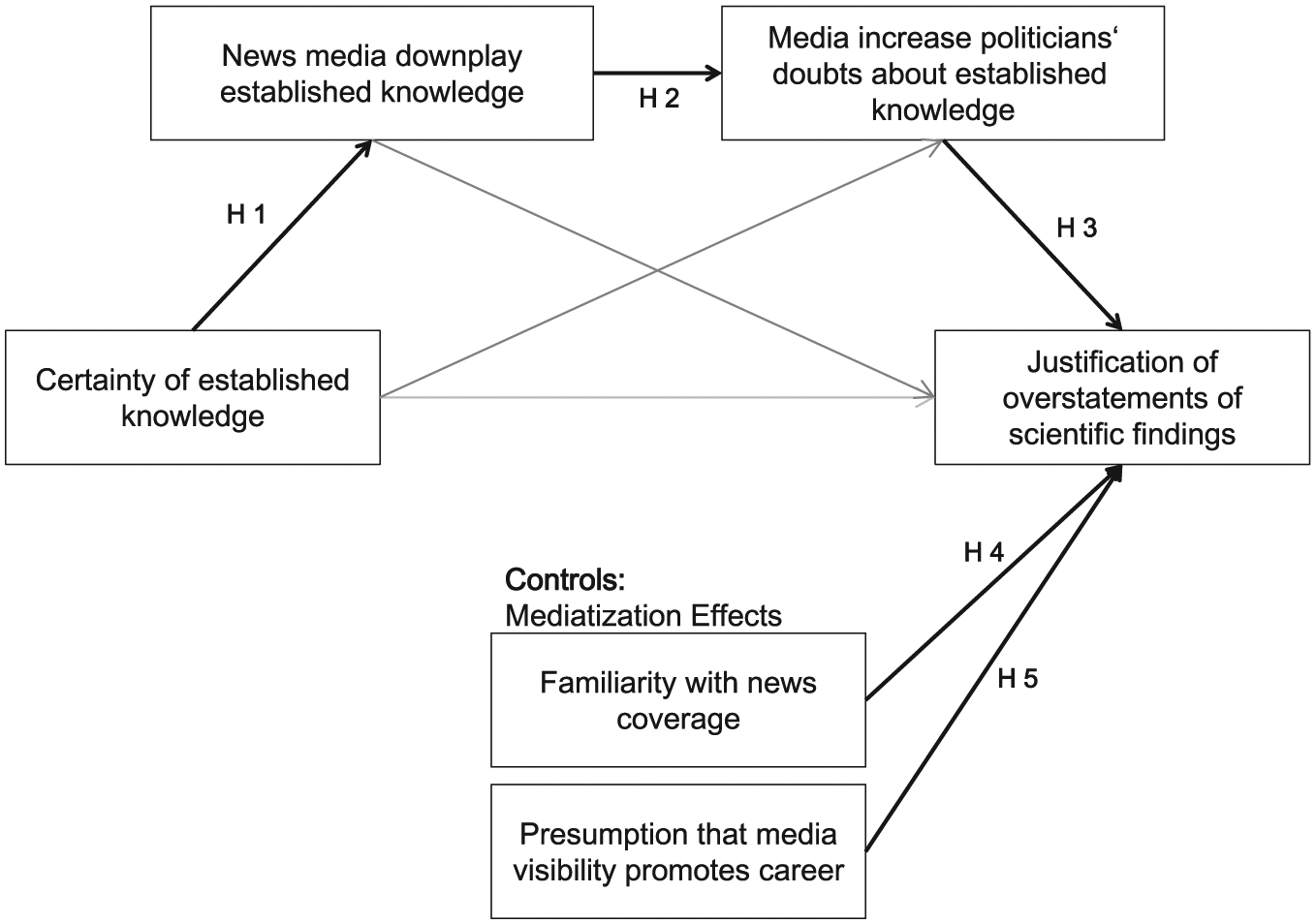
Hypothesized paths of the serially mediated effect of scientists’ certainty of knowledge on their acceptance of overstatements, controlling for mediatization effects.
Mediatization
Scientists might also consider overstatements as a means to attract journalists’ attention. In media societies, science (like other societal domains such as politics) has become increasingly interlinked with the news media as actors have increasingly sought to advocate for their agendas in the news (Strömbäck, 2008; Weingart, 1998). This process has been termed “mediatization” (Strömbäck, 2008). It entails that actors have found visibility in the news media increasingly rewarded by their peers or the public in general. Surveys of scientists show that their anticipations of rewards are a strong driver of their contacts with journalists. This applies to scientists in general (Tsfati, Cohen, & Gunther, 2011) and to scientists in politicized climates (Ivanova, Schäfer, Schlichting, & Schmidt, 2013; Nisbet & Markowitz, 2015).
According to mediatization theory, actors have become increasingly aware of journalists’ news criteria and have adapted to them in their attempts to catch journalists’ attention (Altheide & Snow, 1979; Strömbäck, 2008). There are systematic differences between journalists’ and scientists’ criteria to account for scientific issues. Scientists typically stress uncertainties or caveats of their research, whereas journalists prefer clear-cut, unambiguous, and dramatic information (Dunwoody, 1999; Singer & Endreny, 1987; Stocking & Holstein, 1993). Studies indicate that scientists are more prone to be in touch with journalists the more they meet journalists’ news criteria, for example, the more they are certain of established scientific knowledge (Post, 2016). Moreover, press officers of research institutions have been found to adopt journalists’ news criteria in their press releases by exaggerating scientific findings, for example, by making causal claims based on correlations or by omitting caveats (Sumner et al., 2014).
To control for a mediatization effect, that is, scientists’ adoption of journalists’ news criteria, two hypotheses are proposed. Mediatization theory suggests that actors are more prone to adopt journalists’ news criteria, first, the more they are aware of journalists’ news preferences and second, the more they expect rewards from being in the news (Strömbäck, 2008). Hence, the following hypotheses are proposed: the more scientists are familiar with news coverage of their topic, the more they justify overstatements of scientific findings in public (
The purpose of these hypotheses is to assess the effects of scientists’ political motivations to overstate scientific findings (i.e., a politicization effect) over and beyond their motivations to meet journalists’ news criteria (i.e., a mediatization effect). In other words, the purpose is to separate effects of scientists’ politicized from their mediatized science communication.
The German Debate on Climate Change
The context of this study is the German debate on climate change. Unlike the U.S. debate, where anthropogenic climate change has been a heavily contested issue (e.g., Boykoff & Boykoff, 2004), the German debate produced wide consensus on a threatening, dangerous, and human-induced climate change early on (Weingart, Engels, & Pansegrau, 2000). When climate scientists raised the issue and warned society in the 1980s, they drew wide attention from the media and politicians, establishing a commonly accepted view of climate change as an imminent catastrophe that required reductions in CO2 emissions (Schäfer, 2016). In contrast to the U.S. news media, the German media rarely addressed uncertainties of climate science (Maurer, 2011) or doubts about anthropogenity at least until the 2000s (Peters & Heinrich, 2005). However, recent studies indicate a slight increase of climate skepticism in the German media since the 2010s (Kaiser & Rhomberg, 2016; Schmid-Petri & Arlt, 2016).
Despite the media’s low emphasis on doubt about anthropogenic climate change, German climate scientists have been quite sensitive to it. For example, 50% of the German climate scientists surveyed in 2006 believed that “the media often cite climate skeptics who have a low reputation in the scientific community.” By contrast, despite the media’s strong emphasis on anthropogenity, only 44% of the German climate scientists believed that “the media mostly report on studies that hold humans responsible for climate change” (Post, 2009, pp. 114-122). Notably, the climate scientists’ perceptions associated with their assessments of climate change, pointing to hostile media perceptions. The more the climate scientists were convinced of human-induced, dangerous, and predictable climate change, the more they perceived citations of skeptics in the news and the less emphasis on anthropogenity. Overall, these findings suggest that the German climate scientists have perceived attempts to politicize the debate on climate change quite sensitively.
Method
Survey
An online survey of 131 full professors working on climate change at German universities was conducted in February and March 2015. There are few assistant professors in the German academia. In most cases, qualified German researchers obtain full and tenured professorships after a doctorate and considerable years of postdoctoral research. Usually, doctoral and postdoctoral researchers are employees of German full professors. As we targeted autonomous researchers, we exclusively interviewed German professors. The climate scientists were identified in view of the fact that “climate science” is not a single subject. Natural scientists from a range of disciplines are involved in studying different aspects of the climate—physicists, geologists, biologists, meteorologists, and others studying the atmosphere; the oceans; precipitation evaporation; physical, chemical, and biological processes; and past and future climate changes. Hence, climate science is a highly fragmented subject, and there is no single organization of the German climate scientists (Post, 2009). To overcome these obstacles, the climate scientists were identified in two steps. First, the most relevant German research institutes were identified by starting from the websites of two scientific associations that provided extensive lists of German university and nonuniversity research institutes related to climate science—the website of the Deutsche Meteorologische Gesellschaft (DMG [German Meteorological Society]) and the German website of the internationally coordinated long-term project Past Global Changes (PAGES). The two lists largely overlapped, with the DMG adding a few meteorological and the PAGES adding a few geological institutes. Combining both lists and eliminating duplicates, 85 research institutes were identified. In the second step, all full professors were collected from these research institutes, who, according to their publication lists or curricula vitae (CVs), had worked on natural scientific aspects of the climate system. Through this process, 349 professors were identified.
Of the 349 climate scientists, 22 were ineligible, for example, due to sabbaticals, illness, retirement, because they had moved abroad, or because they did not consider themselves climate scientists. Of the remaining 327 scientists, 131 completed the questionnaire (40%). Three climate scientists had invalid email addresses and 16 explicitly refused due to a lack of time. 156 climate scientists did not respond to the survey and 21 completed only parts of it. The present study is based on the 131 climate scientists who completed the questionnaire. Most (90%) of them are male and 7% are female. The rest did not report their sex. This corresponds largely to the population of the 327 climate scientists with 295 (90%) males and 32 (10%) females. Most of the participants’ disciplines are meteorology or climatology, geology or geography, physics, biology, or oceanography. Again, this corresponds well with the population of the 327 climate scientists whose disciplines we derived from their homepages (Table 1).
Distribution of Disciplines Among the Members of the Population and the Participants.
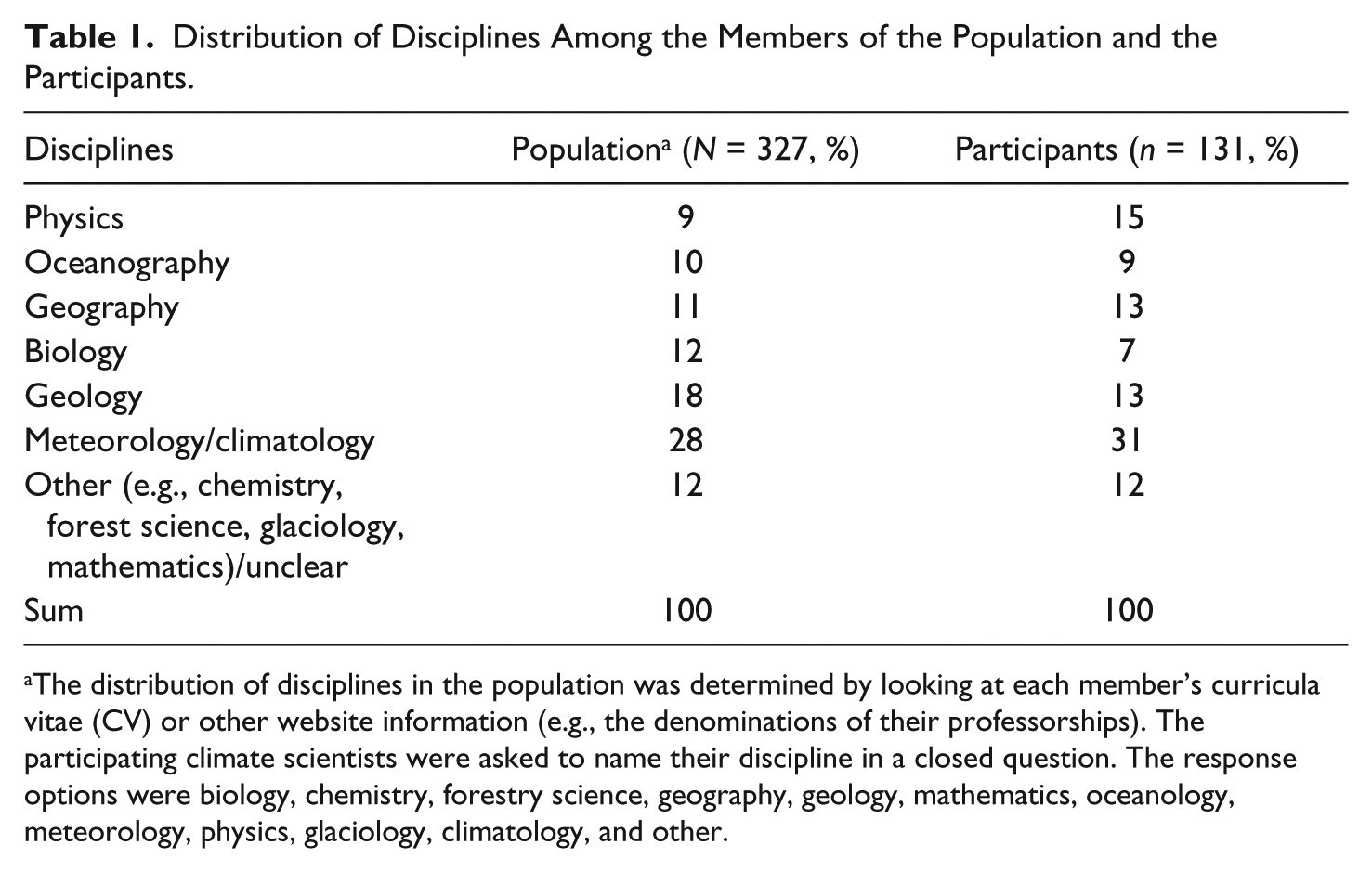
The distribution of disciplines in the population was determined by looking at each member’s curricula vitae (CV) or other website information (e.g., the denominations of their professorships). The participating climate scientists were asked to name their discipline in a closed question. The response options were biology, chemistry, forestry science, geography, geology, mathematics, oceanology, meteorology, physics, glaciology, climatology, and other.
Measures
Dependent variable
Justifications of overstatements
The climate scientists were asked, “In the past, some climate scientists were accused of overstating scientific findings, e.g., by emphasizing particular patterns or trends very strongly or by concealing uncertainties. There are several possible reasons for such decisions. To what degree do the following reasons justify overstatements of scientific findings?”
The climate scientists were asked to rate the following reasons on a 5-point scale (1 = justifies an overstatement absolutely not/5 = justifies an overstatement absolutely): warning society against wrong decisions, making clear the urgency of a problem, drawing attention to an important issue, and initiating a debate. Respondents’ ratings of these reasons were summed up yielding a scale with a very high internal consistency (Cronbach’s α = .931), ranging from 4 through 20. A confirmatory factor analysis (CFA) shows that the four items load on one factor with loadings from .765 to .931 and a good fit of the measurement model, χ2 = 3.182; df = 2; p = .204; χ2/df = 1.591; normed fit index (NFI) = .993; comparative fit index (CFI) = .997; root mean square error approximation (RMSEA) = .069; P-Close = .301. On average, the climate scientists neither clearly accept nor reject overstatements (
Independent variable
Certainty of anthropogenity
The participants were asked to assess the human influence on climate change in three questions. Their responses were recoded so that each assessment in tendency or definitively confirming anthropogenity obtained a positive value [.5; 1] and each assessment in tendency or definitively questioning anthropogenity obtained a negative value [–1; –.5]. Responses with no clear tendency were coded as zero. Nonresponses and “hard to say” responses were discarded. In the first question, they were asked about the influences on “the climatic development in the past 50 years.” They indicated whether it was “predominantly influenced by human behavior,” “equally influenced by human behavior and natural factors,” or “predominantly influenced by natural factors.” In the second question, they were asked whether “the human influence on our climate is smaller than previously assumed.” They assessed this on a 5-point scale ranging from one definitively cannot conclude this to one definitively can conclude this. In the third question, they were asked whether the recent global temperature rise could be considered “the tail of the Little Ice Age.” They rated this interpretation on a 4-point scale from absolutely valid to absolutely invalid. Added up, their recoded responses form a scale from –3 (indicating the highest degree of doubt) through +3 (indicating the highest degree of certainty). With Cronbach’s α = .775, the scale is reliable. A CFA shows that all the items load on one factor with loadings from .647 to .831. Because a CFA of one factor with three observations is not identified (df = 0), a measurement model including the independent and dependent variables as two separate factors was tested yielding a good overall fit (χ2 = 18.983; df = 13; p = .124; χ2/df = 1.460; NFI = .961; CFI = .987; RMSEA = .065; P-Close = .312). On average, the climate scientists are largely certain of the human influence on climate change (
Mediator variables
Perceptions of media coverage
In one item, the climate scientists were asked to rate their agreement with the claim that “the news media downplay climate change” on a 5-point scale (1 = do not agree at all/5 = totally agree). On average, the climate scientists tend to disagree with this claim (
Presumed media influence on politicians
In one item, the climate scientists were asked to assess the effects of climate change coverage on politicians, namely, “how strongly media coverage strengthens their doubts about or conviction of an imminent climate change?” They rated this on a 5-point scale (media coverage strengthens 1 = their doubts/5 = their convictions). On average, the climate scientists presume that the media strengthen politicians’ convictions (
Controls
Familiarity with news coverage
The climate scientists’ familiarity with climate change coverage was measured by assessing their frequency of newspaper use. On a 5-point scale, they rated how often they used newspapers for information on climate change (1 = never/5 = frequently). On average, they tended to use newspapers but not particularly frequently (
Media appearances as career advantage
Following Tsfati et al. (2011), the climate scientists were asked to rate “what kind of opportunities are associated with media appearances?” They were asked to rate four career-related items on a 5-point scale (1 = do not agree at all/5 = totally agree)—their chances of being cited by other scientists, obtaining a good job, receiving grant money, and advancing one’s career. Respondents’ ratings were summed up yielding a scale from 4 to 20. With Cronbach’s α = .861, the scale is well reliable. A CFA shows that the items load on one factor with loadings from .607 to .893 and a good fit of the measurement model (χ2 = 2.791; df = 2; p = .248; χ2/df = 1.395; NFI = .989; CFI = .997; RMSEA = .055; P-Close = .354). On average, the climate scientists neither clearly agree nor disagree that media visibility promotes scientists’ careers (
Results
Prolog on the Established Scientific Knowledge
The German climate scientists largely confirm anthropogenic climate change. Almost two-thirds (63%) believe that “the climatic development in the past 50 years was predominantly influenced by human behavior,” and about a third (30%) believe it was “equally influenced by human behavior and natural factors.” Only one (1%) of the 131 climate scientists believe that it was “predominantly influenced by natural factors.” The rest (6%) did not answer the question or thinks that “this is hard to say.” In view of the recent stagnation of the globally averaged surface temperature rise, the climate scientists were asked whether “one can conclude that the human influence on our climate is smaller than previously assumed.” A third (31%) thinks that one “definitively” and another third (32%) thinks that one “presumably cannot conclude this.” A fifth (21%) believes that “one must at least consider this possibility,” whereas only 8% believe that “one presumably” or “definitively can conclude this.” The rest (8%) found this “hard to say” or did not answer. In another question, the scientists were asked whether the recent global temperature rise could be considered “the tail of the Little Ice Age.” Almost a third (30%) considered this interpretation “absolutely invalid,” and half of them (50%) considered it “rather invalid.” Only 12% believed that it is “valid with limitations” or “totally valid.” Few (8%) thought that “one cannot say this” or did not answer.
All in all, virtually no climate scientist negates that there is a weighty human influence on the climate. Yet, as usual in science, there is variance in their degree of certainty. Some think that alternative hypotheses should be discarded altogether, whereas others are ready to at least consider them.
Mediated Influence of Climate Scientists’ Certainty on Their Justifications of Overstatements
To assess the mediated influence of the climate scientists’ certainty of knowledge on their acceptance of overstatements, a mediation analysis was calculated using Hayes’ PROCESS for SPSS (Hayes, 2017). It was conducted with 5,000 bootstrapping samples and bias-corrected estimates. The climate scientists’ certainty of anthropogenic climate change was entered as the independent variable and their justifications of overstatements as the dependent variable. Their perceptions of media coverage and presumptions of media effects on politicians were entered as two serial mediators. The climate scientists’ newspaper use as well as their impressions that media visibility promotes their careers were entered as covariates. The model is significant and explains about 17% of the total variance of scientists’ justifications of overstatements (Figure 2). Because of missing responses, the number of cases was reduced by 25 cases (19%) from 131 to 106. This is largely due to missing assessments of one or more items concerning the human influence on climate change (18 cases). Smaller amounts of missing data exist for other variables in the model. To assess bias due to missing responses, the participants were divided into two groups—those included in the model calculation and those excluded. Mean comparisons for the six variables and covariates in the model revealed no significant differences between the two groups.
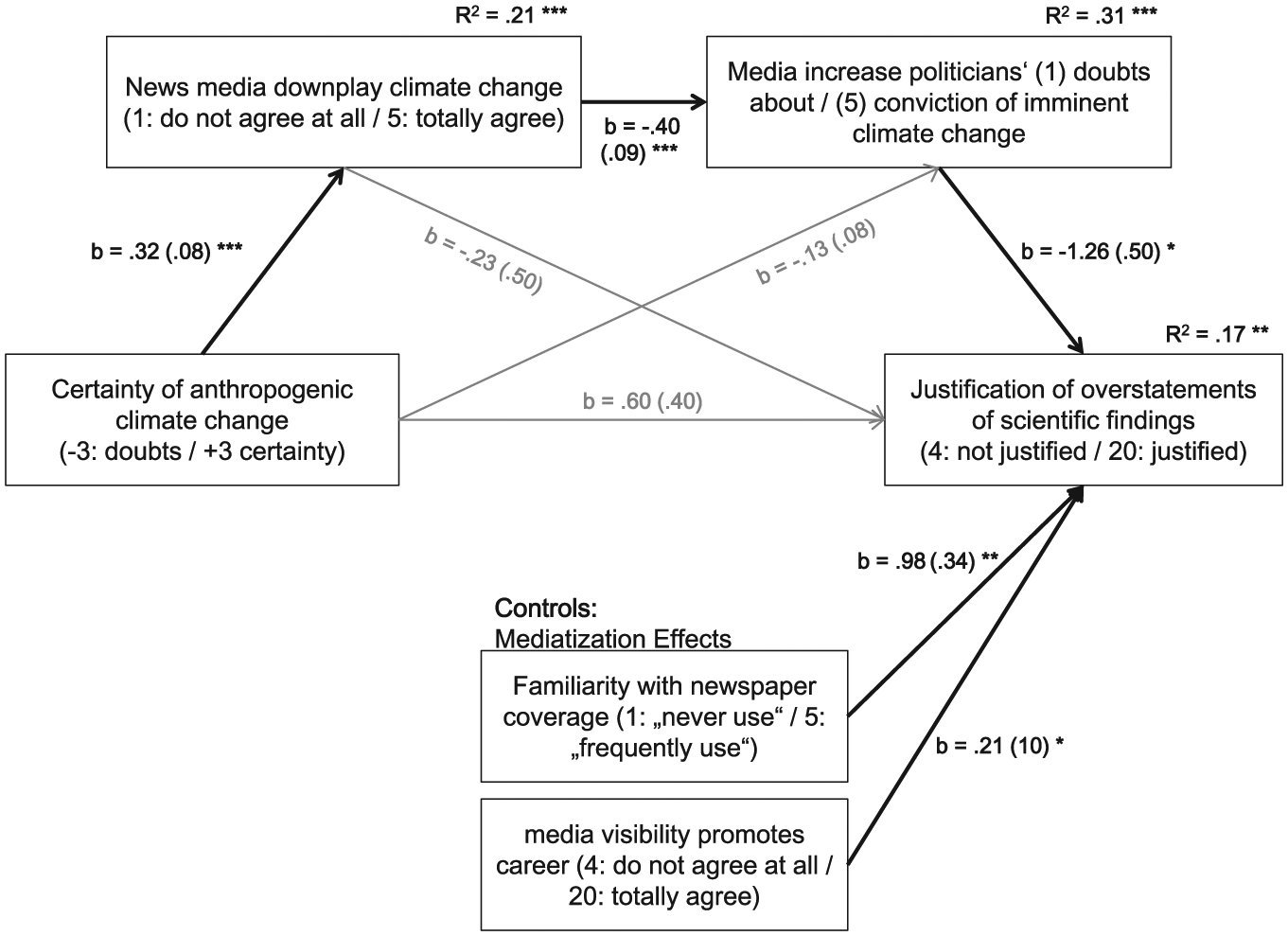
Mediated influence of climate scientists’ certainty of established scientific knowledge on their acceptance of overstatements of scientific findings, controlled for mediatization effects.
As stated above, on average, the climate scientists tend to reject the claim that the news media downplay climate change (
The bootstrapping procedure yields estimates for 95% confidence intervals (CIs) for whether there are direct or indirect effects of the climate scientists’ certainty of the established scientific knowledge. A CI is considered statistically significant if zero is not included in the estimated CI. Although there is no direct effect of the climate scientists’ certainty of knowledge on their justifications of overstatements, there is a significant indirect effect via the two serial mediators (Figure 2).
Confirming the mediatization hypotheses, the climate scientists’ justifications of overstatements also associate with their familiarity with newspaper coverage of climate change and their presumptions that media visibility promotes their careers. The more often the climate scientists read newspaper reports on climate change and the more they believe that media appearances promote their careers, the more they justify overstatements of scientific findings in public.
Discussion
The starting point of the present investigation was the assumption that as an area of scientific research is politicized, scientists become more or less involved and partisan. On average, the German climate scientists are very certain of anthropogenic climate change. Also, on average, they tend not to perceive that the news media downplay climate change. Almost two-thirds of them (60%) reject this claim more or less decidedly. This is in line with content analyses showing that the German news media have largely presented climate change as a dramatic threat (Maurer, 2011; Schäfer, 2016; Weingart et al., 2000). Yet climate scientists’ perceptions of news coverage depend not only on the actual news coverage but also on their certainty of anthropogenic climate change. This indicates a relative hostile media perception (Gunther & Chia, 2001). Although, in line with the findings from content analyses, the majority of the German climate scientists do not perceive that the news media downplay climate change, those who are very certain of anthropogenic climate change reject this claim more hesitantly than those who are less certain.
Their perceptions of news coverage relate to their presumptions of media effects on policy makers. The more the climate scientists perceive that the media downplay climate change, the more they presume that the media strengthen politicians’ doubts about an imminent climate change. Finally, the more the climate scientists presume that the media strengthen policy makers’ doubts about anthropogenic climate change, the more they justify overstatements of scientific findings in public.
There are also mediatization effects. The climate scientists’ justifications of overstatements grow with their familiarity with newspaper coverage and their impressions that media appearances can promote their careers. The findings show that the climate scientists’ certainty of knowledge, perceptions of news coverage, and presumptions of media effects on policy makers predict their justifications of overstatements beyond that, indicating a politicization effect in addition to a mediatization effect.
The findings of this study are in line with and exceed existing research on the influence of hostile media perceptions with several implications for the dynamics of conflicts in general and politicized science debates in particular. Following Rojas (2010), some of the climate scientists’ justifications of overstatements can be interpreted as a predisposition to counteract perceived harmful or to compensate for perceived insufficient media coverage. Scholars have argued that in politicized science disputes, scientists tend to blur scientific knowledge with the policies they derive from it (Pielke, 2004; Sarewitz, 2004). In such situations, scientists likely hold strong expectations toward the news media to transmit established scientific knowledge to the public (Pielke, 2004; Scheufele, 2014). Their perceptions of news coverage might thus at least in part be based on their high expectations toward the media to convince politicians or society of the policies that scientists believe their knowledge compels.
As with most studies, this study has some limitations. First, like many previous studies on the consequences of hostile media perceptions, this is a correlational study. On this basis, we cannot make causal claims. Considering previous research, however, it seems plausible that scientists’ certainty of knowledge influences their perceptions of media coverage, which influences their presumptions of media effects, which, finally, influence their behavioral attitudes or dispositions.
Second, based on the present data, it is impossible to say to what degree the climate scientists’ self-reported justifications of overstatements translate into actual behavior. However, their justifications might be conducive to overstatements in two ways. First, on an individual level, the more strongly the climate scientists justify overstatements, the more they can be expected to actually overstate—though the strength of this association cannot be specified here. Second, on an aggregate level, the number of climate scientists feeling encouraged to overstate probably grows with the number of scientists justifying it.
Third, as with most studies, the results of the present study might be biased due to participant turnout and missing responses. Although, with 40%, participant turnout in this study is satisfactory, one must acknowledge that more than every second member of the population did not participate. To test for bias in the final sample, the population and the participants were compared with respect to some key characteristics (sex and scientific disciplines). Although this provided no hints at bias in the final sample, one cannot rule out bias with respect to other characteristics. A similar problem arises from missing responses to specific items. Here, too, no hints at bias were detected when comparing the participants included in the model calculation to those not included due to their missing responses to specific items. Again, however, this does not rule out bias with respect to characteristics that could not be tested for.
Fourth, in this study, a somewhat imprecise measure of perceptions of media coverage was used. Following the approach of many previous studies on the consequences of hostile media perceptions (Barnidge & Rojas, 2014; Feldman et al., 2017; Hart et al., 2015; Hwang et al., 2008; Rojas, 2010), respondents were asked to rate their perceptions of media coverage in general. Thus, it remains unclear whether the climate scientists based their ratings on the same or different media contents. In future studies, it might be fruitful to consider the news sources subjects base their perceptions on to assess whether their ratings differ due to their use of different or due to differing perceptions of identical media contents.
Fifth, this study concentrates on only one case of a politicized science dispute. As was stated above, scientists’ reactions to their hostile media perceptions in such disputes likely depend on their impressions that the majority of the public considers their scientific judgments and implied policy preferences legitimate (Noelle-Neumann, 1974; Tal-Or et al., 2009). If, at some point in a controversy, scientists perceive that their judgments appear largely illegitimate in public, they might choose to withdraw from the public dispute rather than to defy presumed harmful media effects. This happened, for instance, in the US controversy over the heritability of intelligence in the IQ controversy when a majority of the research community believed that intelligence was heritable but refrained from stating this in public (Snyderman & Rothman, 1988). It seems desirable to investigate further cases to specify what level of (perceived) public support scientists need to defy presumed harmful media effects. It seems particularly relevant to investigate climate scientists’ perceptions of news coverage and the consequences in countries where the climate debate is much more controversial than in Germany, such as the United States. In the United States, climate scientists are frequently challenged by climate skeptics (Jacques et al., 2008). Yet many people there do acknowledge anthropogenic climate change and support mitigation policies (Leiserowitz et al., 2017). In this constellation, climate scientists’ hostile media perceptions and related justifications of partisan communication decisions might be more pronounced. However, this is just a speculation, and future research would have to test this.
In any case, scientists’ endorsements of partisan communication strategies might not be conducive in politicized science disputes. Polarizing communication styles have been found to polarize conflicting parties and to heat up debates among the involved (Gervais, 2015). Among the uninvolved, a polarizing debate might cause misperceptions (Anderson, Brossard, Scheufele, Xenos, & Ladwig, 2014), turn people off the topic, or make them lose trust in politics (Mutz & Reese, 2007) or science (Hmielowski, Feldman, Myers, Leiserowitz, & Maibach, 2014). Such consequences likely impede transparent science communication and deliberative decision-making.
Footnotes
Acknowledgements
The authors wish to thank three anonymous reviewers for their helpful comments to a previous version of this manuscript.
Declaration of Conflicting Interests
The author(s) declared no potential conflicts of interest with respect to the research, authorship, and/or publication of this article.
Funding
The author(s) received no financial support for the research, authorship, and/or publication of this article.