



Abstract
With social networking site (SNS) use now ubiquitous in American culture, researchers have started paying attention to its effects in a variety of domains. This study explores the relationships between measures of Facebook use and political knowledge levels using a pair of representative samples of U.S. adults. We find that although the mere use of Facebook was unrelated to political knowledge scores, how Facebook users report engaging with the SNS was strongly associated with knowledge levels. Importantly, the increased use of Facebook for news consumption and news sharing was negatively related to political knowledge levels. Possible explanations and implications are discussed.
As social media use began its meteoric rise in the early 2000s, the popular press was quick to take notice. News articles began linking social networking site (SNS) use to a number of psychological disorders, including instances of teen anxiety, narcissism, aggression, and depression (Knap, 2011; Tab, 2009; Tanner, 2011). Notably, journalists and media outlets (e.g., Hsu, 2009; Walsh, 2009) were also quick to jump on research linking Facebook use to declines in academic achievement (Karpinski, 2009), even though such research had yet to be considered for publication. This work helped spark debate about the role of social media in informing the public. Since that time, empirical evidence concerning social media impacts in areas of academic achievement has grown. Shortly after the Karpinski study was picked up in media, contradictory evidence emerged concerning the impacts of Facebook use on student academic performance (e.g., Pasek, More, & Hargittai, 2009), including evidence that academic performance drives Facebook use rather than the other way around (Michikyan, Subrahmanyam, & Dennis, 2015).
Today, the possible detrimental effects of social media are again a popular topic in the press. The growth of so-called “fake news” stories—the success of which is facilitated by the heavy reliance on social media for news information in the United States, and indeed, much of the world (Barthel, Mitchell, & Holcomb, 2016)—has sparked a renewed interest in how SNS use might be contributing to a misinformed electorate (e.g., O’Connor & Schneider, 2017; Rogers & Bromwich, 2016; Vis, 2014). And it is not just journalists who are concerned. Apple CEO Tim Cook has recently described fake news as “killing people’s minds” (“Apple’s Tim Cook,” 2017), while noted Internet scholar Eli Pariser has lamented the role that Facebook plays in feeding individuals “soft news” rather than the types of “hard news” that are necessary for an informed and functioning democracy (Pariser, 2015). Despite interest in the topic, empirical research linking social media use to a less (or more) politically informed citizenry remains relatively rare.
The present study aims to contribute to this under-investigate research topic by exploring the relationship between SNS use and political knowledge levels. The present analysis examines the makeup of one’s social network, and both their frequency and type of use to garner an understanding of how social media may be contributing to a more- or less-informed populace. Specifically, this work focuses on the degree to which citizens rely on Facebook, and social media more generally, for several distinct functions, including social purposes (e.g., commenting on one’s photographs, status, or wall posts), the consumption of news (e.g., reading news stories or news headlines posted by other people or news organizations) and news sharing (e.g., distributing news stories or headlines produced by other media outlets or found on other websites), and the relationship these variables have with political knowledge levels among representative samples of U.S. adults. Before elaborating on this approach, it is important to first garner an understanding of current trends in social media and Facebook use in the United States.
Literature Review
Social Media and News Use
According to Pew, half of all adult global Internet users now use SNSs (Poushter, 2016), with Facebook leading the way at close to 2 billion monthly and 1.3 billion daily active users worldwide (Facebook Newsroom, 2017). In the United States, nearly 70% of all adults now use SNSs (Pew Research Center, 2017). This is up from 5% in 2005, the first year in which Pew began recording these statistics (Madden & Zickuhr, 2011). Among American adults, nearly 70% use Facebook, a number that far exceeds the users for platforms such as Instagram (28%), Pinterest (26%), LinkedIn (25%), and Twitter (21%; Pew Research Center, 2017). Whereas teens and young adults drove much of the early popularity of online SNSs, including Facebook (Lenhart, Purcell, Smith, & Zickuhr, 2010), older audiences have since flocked to the platforms. Among U.S. online adults aged 50 to 64, 72% report using Facebook, with greater than 60% of online adults 65+ reporting use (Greenwood, Perrin, & Duggan, 2016). Perhaps one reason for this demographic shift concerns how platforms such as Facebook are being utilized.
While social use triggered Facebook’s initial popularity, the platform has since arrived as a “critical player” for news, driven in part by the ease with which people can pass along, recommend, and link to newsworthy stories (Olmstead, Mitchell, & Rosenstiel, 2011). By 2012, nearly half of American adults reported getting news through social media channels—a number that jumped to 62% in 2016 (Gottfried & Shearer, 2016) and 67% in 2017 (Shearer & Gottfried, 2017). Once again, Facebook is most popular in this respect. Two thirds of all Facebook users report receiving news through the site. Given the widespread use of the platform, this means that 45% of the entire U.S. population is receiving at least some of their news through Facebook (Shearer & Gottfried, 2017). And there is evidence to expect Facebook to grow as a place for news consumption, particularly political news. More than six-in-10 Internet-using Millennials (61%) report getting political news through Facebook, a percentage that dwarfs CNN—their next most consumed source—which sits at 44% (Mitchell, Gottfried, & Matsa, 2015). While SNSs have undeniably emerged as a place for news, we are still learning about the role of social media, and Facebook specifically, in informing the electorate.
Social Media and Political Knowledge
If the link between traditional media use and political knowledge serves as a guide (e.g., Chaffee & Kanihan, 1997; Delli Carpini & Keeter, 1996), we can expect frequent social media use—particularly for political purposes—to have a positive impact on knowledge levels. The link between media consumption and political knowledge has also been found in online spaces (e.g., Drew & Weaver, 2006; Xenos & Moy, 2007), further suggesting the viability of this relationship through social channels.
Of course, the Web 2.0 environment differs substantively from the technologies that preceded it. The information on social media often originates from other social media users rather than trained journalists (Bode, 2016), which has implications for its credibility and for the possibility of misinformation detrimental to public understanding quickly spreading across social groups (Bode & Vraga, 2015). Similarly, what arrives in our news feeds is highly dependent on those we have befriended in that online space. The information that does make it to our feeds has often been passed along from a known and trusted source (Bode & Dalrymple, 2016), which affects how likely one is to pay attention to it and to accept it at face value. These characteristics, coupled with the relative dearth of research in this space, make it difficult to pinpoint the precise role that social media usage might have on political knowledge levels.
One case against social media contributing to a more politically informed electorate comes from the research on filtering (Pariser, 2011, 2015). This work suggests that the personalized universe that we build through our online social networks ultimately narrows what we know since it privileges information that is consistent with our views. These partisan echo chambers could inhibit learning by limiting the variety of new information that reaches audiences (Stroud, 2011). Furthermore, people are less likely to scrutinize (and, therefore, systematically process) agreeable information than disagreeable information (Edwards & Smith, 1996). Information that is not processed systematically is less likely to be remembered and could contribute to lower levels of retention and understanding.
This negative by-product of a filtered media environment may also be compounded by the fact that many users may not be primarily motivated by a desire to learn about politics or stay on top of current events when they spend time on social media platforms (Kim, Chen, & Gil de Zuniga, 2013). Indeed, there is evidence that hard news is less likely to be selected and clicked on in the social media environment, with audiences typically selecting soft or entertainment news when given the choice (Pariser, 2015). If audiences are avoiding hard news information, there is little reason to believe that use of SNSs will positively affect knowledge of politics.
At the same time, there remains the possibility for incidental exposure to news information via social media channels. Incidental exposure occurs when audiences inadvertently encounter news information when they are not specifically searching for such content (Downs, 1957; Kim et al., 2013; Tewksbury, Weaver, & Maddex, 2001). Work in this area has linked incidental encounters to knowledge acquisition about public affairs issues in the online environment, suggesting the possibility of residual effects on knowledge from frequent use of social media platforms (Tewksbury et al., 2001). Thus, even if audiences are navigating through Facebook primarily for social purposes, they might reasonably be expected to encounter news about current events and politics. Frequent exposure to such information might then result in incidental learning, even if knowledge acquisition is not a primary goal for use of SNSs.
Cognitive Tuning and Information Receptivity
The literature on cognitive tuning further suggests how motivations can affect how audiences process information encountered through social media channels. This literature suggests that political learning may be highly dependent on how users generally interact in the social media environment. Cognitive tuning, first described by Zajonc (1960), describes the change in cognitive and knowledge structures depending on whether individuals intend to share or receive information. When individuals are preparing to transmit information, cognitive structures that focus on assimilating knowledge and organizing it are activated, likely because they perceive a need to know more about the information they are sharing (Mazis, 1973; Zajonc, 1960). The cognitive structures that are activated by information sharers is complex, rigid, and highly organized (Cloven & Roloff, 1995). As a result, sharers of information tend to have a narrow focus on the information they are sharing, and are more resistant to the receipt of new information (Mazis, 1973). As such, frequent sharers of news information may be less likely to learn during their time on SNSs as they are not particularly open to the reception of new facts and information.
In contrast, receiving tuning activates cognitions that are more open-minded and flexible. When one is in receiving mode, they are more likely to anticipate a possible change in their cognitions (Zajonc, 1960). As a result, they more readily embrace new, and even contradictory, information to more easily and efficiently process the incoming message (Cloven & Roloff, 1995). Thus, social media users who actively consume news and political information during their visits to SNSs might be especially open to receiving new information and to learning during their time online. Receiving and transmitting tuning are often conceptualized as dichotomous states but are more likely to be a continuum and not necessarily mutually exclusive, depending on the extent to which individuals expect to be sharing or receiving information.
Conceptualizing Knowledge
Of course, the relationship between social media use and levels of political knowledge is expected to depend on how political knowledge is operationalized. In this work, we rely on two measures of political knowledge. Our first analysis employs a measure of political knowledge, similar to that discussed by Delli Carpini and Keeter (1996). Survey respondents were asked the following five multiple choice questions: “What job or political office is currently held by John Boehner?” “Who is the current vice president of the United States?” “Who has the final responsibility to determine whether a law is constitutional or not?” “How much of a majority is required for the U.S. Senate and House to override a presidential veto?” and “Which one of the parties is more conservative than the other at the national level, the Democrats or the Republicans?” This type of measurement has been described as a form of static-general knowledge (Barabas, Jerit, Pollock, & Rainey, 2014) and has been found to correlate strongly with education levels (Delli Carpini & Keeter, 1996). At the same time, media use should affect even static-general knowledge as these types of knowledge items deal with information that gets refreshed with chronic attention to current events. For instance, a news story about the vice president working with the Speaker of the House on a political issue will refresh knowledge of who currently holds those two positions.
Our second analysis employed a measure of political knowledge based on responses to the following four items: “Do you happen to know which political party has a majority in the U.S. House of Representatives?” “Can you tell me which company Steve Jobs is the head of?” “Do you happen to know who Eric Holder is?” and “Can you name the country where a recent volcanic eruption disrupted international air travel?” These items are best described as measuring a type of surveillance-general knowledge since they are all questions about recent or current events (Barabas et al., 2014). In contrast to the largely static items noted above, these items have been found to be more directly influenced by communication and media use patterns (Barabas et al., 2014). In short, we might expect different relationships to emerge between the media use measures and political knowledge depending on which knowledge measure is being examined, with stronger media impacts for our analysis that focuses on the surveillance-general knowledge measure and weaker media impacts for the static-general measure.
Research Questions
To date, few studies have explored the possible link between SNS use and political knowledge. Lee and Oh (2013) examined the relationship between Twitter use and knowledge using a panel of South Korean respondents. They found a correlation between early adopters of Twitter and factual public affairs knowledge, although this relationship only held for users with a high need for orientation. The authors also noted null effects of Twitter use on soft news knowledge. A study in Singapore found no direct link between attention to news on social media and science knowledge levels, although social media news attention was found to indirectly affect knowledge through elaboration and discussion (Ho, Yang, Thanwarani, & Chan, 2016).
In a similar vein, Yoo and Gil de Zuniga found no direct relationship between Facebook or Twitter use on either general or issue-specific knowledge of politics, although they did uncover knowledge gaps between high and low socioeconomic status (SES) audiences based on use of Facebook (Yoo & Gil de Zúñiga, 2014). Beam, Hutchens, and Hmielowski (2016) found evidence that reading online news is linked to factual political knowledge, while sharing online news is linked to structural knowledge. However, this analysis did not look at social media directly, or any specific social media platform, and relied on a nonprobability opt-in panel of American Internet users. Finally, Bode (2016) found the potential for learning from social media use as her analysis demonstrated high levels of recall after just a single exposure to political news through social media. At the same time, her work found that social media users were no more politically informed than nonusers, possibly suggestive that short-term recall does not translate into long-term knowledge gain on social platforms.
The relative dearth of scholarship in this area highlights a clear need to better understand the role that SNSs are playing on political knowledge acquisition and leads to the following research questions:
Method
To examine the research questions, we used a primary and secondary dataset. Primary data were from a nationally representative online survey with U.S. adults aged 18 years and older. Hereafter, we refer to this dataset as the “GfK dataset.” The online survey was conducted in English by GfK Knowledge Networks (KN) and relied on their KnowledgePanel sample. KnowledgePanel members are randomly recruited through probability-based sampling that covers approximately 97% of all U.S. households. In addition, to ensure representativeness, households are provided with access to the Internet and hardware where needed. The survey was conducted between December of 2011 and January of 2012. Some 13,131 panelists were randomly drawn from the GfK KnowledgePanel®; 6,425 responded to the invitation, 1 yielding a final stage completion rate of 48.9%. The recruitment rate for this study, reported by GfK, was 15.5%, and the profile rate was 64.9%, for a cumulative response rate of 4.9% and a final sample size of 2,806. All descriptive statistics and data analysis reported from this dataset were based on weighted data using a weight supplied by GfK. Complete information concerning this weight is available on request.
Secondary data were obtained from the Pew Research Center. 2 These data were collected in June of 2010, approximately 18 months prior to the primary data. Hereafter, we refer to the secondary dataset as the “Pew dataset.” Sampling was conducted using landline telephones (n = 2,005) and cellular phones (n = 1,001). The response rate for the landline telephone sample was 16.9%; that of the cellular phone sample was 17.5%. All surveys were conducted in English. Descriptive statistics and data analysis reported here are those using weighted data using a weight provided in the Pew dataset. The Pew Research Center has used this dataset in several publications (e.g., Pew Research Center, 2010), and additional information can be found online.
Independent Variables
Age, sex, education, and income served as the primary control variables in the analyses. In both datasets, age was measured as a continuous variable (GfK dataset: M = 49.3, SD = 15.9; Pew dataset: M = 46.3, SD = 18.1). Sex was a dichotomous variable with female coded as 0 and male coded as 1 (GfK dataset: 50.4% males; Pew dataset: 47.6% males). In the GfK dataset, education was measured as a continuous variable in terms of number of years of formal education (M = 15.2, Median = 15, SD = 4.5). The median value for the education measure would correspond to some postsecondary education. In the Pew dataset, education was measured as an ordinal variable by asking respondents the last grade or class completed in school (Median = 5, SD = 1.6). The median value corresponded to “Some college, associate degree, no four-year degree.” In both datasets, household income was measured as an ordinal variable. In the GfK dataset, categories ranged from “less than US$5,000” (coded as 1) to “US$175,000 or more” (coded as 19; M = 10.6, SD = 4.5). The median value for income was 11, indicating “US$40,000 to US$49,999.” In the Pew dataset, possible responses ranged from “less than US$10,000” (coded as 1) to “US$150,000 or more” (coded as 9; Median = 5, SD = 2.4). The median value corresponded to a household income of “US$40,000 to under US$50,000.”
Political party affiliation in the GfK dataset was measured using seven categories ranging from “Strong Republican” (coded as 1) to “Strong Democrat” (coded as 7; M = 4.2, SD = 2.1). This variable had a median value of 5, indicating “Leans Democrat.” In the Pew dataset, we combined a measure of political party identification (“In politics today, do you consider yourself a Republican, Democrat, or Independent?”) with political party leaning (“As of today, do you lean more to the Republican Party or more to the Democratic Party?”). We combined political party leaning with the measure of party identification as the latter only contained three nominal categories. Our combined measure of political party affiliation in the Pew dataset consisted of five categories ranging from “Republican” (coded as 1) to “Democrat” (coded as 5; M = 3.1, SD = 1.6). The median of this variable was 3 (“Independent”).
In the GfK dataset, religiosity was measured by asking respondents, “How much guidance does religion play in your everyday life?” using a 10-point scale. The scale was anchored at “No guidance at all” (coded as 1) to “A great deal of guidance” (coded as 10; M = 6.0, SD = 3.1). The Pew dataset did not ask respondents about religious guidance. However, as an approximation, we use a measure of church attendance (not including weddings or funerals), which was measured using an ordinal variable ranging from “never” (coded as 6) to “more than once a week” (coded as 1). We reverse coded this variable and used it as a proxy for religiosity (Brenner, 2016; M = 3.6, SD = 1.6, Median = 4). The median value corresponded to “once or twice a month.”
In the primary data, attention to political news was assessed in three distinct media channels: newspapers, television, and the Internet. Attention to politics in newspapers was measured using a 5-point scale (1 = none, 5 = a lot) asking respondents how much attention they pay to the following types of stories when reading the newspaper, either in print or online: “International affairs” and “National government and politics.” The two items were averaged together (r = .83) to form an index with scores ranging from 1 to 5 (M = 2.7, SD = 1.1).
Attention to politics on television was measured using the same 5-point scale (1 = none, 5 = a lot) asking respondents how much attention they pay to news stories about the following topics when watching television news, either on a traditional television or in online sources (such as Hulu or websites of television networks, such as ABC, CBS, NBC, Fox, or CNN): “International affairs” and “National government and politics.” The two items were averaged together (r = .82) to form an index with scores ranging from 1 to 5 (M = 3.0, SD = 1.1).
Attention to politics on the Internet was measured with the same 5-point scale (1 = none, 5 = a lot) asking respondents how much attention they pay to news about the following topics when they go online for news and information: “International affairs” and “National government and politics.” Responses to the two items were averaged together (r = .88) to form an index with scores ranging from 1 to 5 (M = 2.3, SD = 1.2). For the Internet attention items, respondents were asked to exclude online versions of print newspapers or television shows and to answer these items based on their usage of blogs, websites, and online-only newspapers.
While the Pew dataset did not contain media attention measures, frequency of media use was measured. We used three ordinal measures of frequency of media use as media attention analogs. Frequency of newspaper use was measured by asking respondents, “About how much time did you spend reading a daily newspaper yesterday?” (M = 2.7, SD = 1.0, Median = 3 “30-59 minutes”). Television use was measured by asking, “About how much time did you spend watching the news or any news programs on TV yesterday?” (M = 3.4, SD = 0.8, Median = 4 “1 hr or more”). Newspaper and television news use was measured on a scale ranging from 1 (“less than 15 min”) to 4 (“1 hr or more”). Finally, the item measuring frequency of Internet use asked respondents how frequently they got news online (M = 4.3, SD = 1.7, Median = 5 “3 to 5 days a week”). The last item was measured on a scale ranging from 1 (every day) to 6 (no/never), which was reverse coded.
The GfK analysis also included several items designed to garner an understanding of the “connectedness” of the survey respondents specifically as they relate to the size and makeup of their Facebook network. In particular, the survey included measures of each respondent’s Facebook use, number of Facebook friends, and when they joined the SNS. Facebook use was measured with a single item that asked respondents how often they used Facebook. Response options ranged from “never” (coded as 1) to “several times a day” (coded as 6; all respondents: M = 2.8, SD = 1.9; Facebook users: M = 4.0, SD = 1.5). Time with Facebook account was measured with a single-item that asked those who use Facebook to report how long ago they started using the SNS. Response options ranged from “less than 6 months ago” (coded as 1) to “2 or more years ago” (coded as 4; M = 3.1, SD = 1.0). Facebook friends was measured with a single-item that asked those on Facebook to report approximately how many Facebook friends they have. Responses to this open-ended item ranged from “zero” to “8,500” (M = 194.6, Median = 100.0, SD = 455.7).
Finally, the GfK survey included several measures designed to go beyond the mere makeup of a respondent’s Facebook social network, and to tap how they use the social media platform for social and news purposes. Specifically, the survey included measures of Social Facebook use, Facebook news consumption, and Facebook news sharing. Social Facebook use was created by asking respondents how often they engage in each of the following activities while on Facebook: “Comment on other people’s status or wall posts,” “Comment on other people’s photographs or videos,” and “Post on someone’s wall (including your own).” Responses to these three items were then averaged together (Cronbach’s alpha = .95) to create an index with scores ranging from 1 to 6 (M = 2.7, SD = 1.4).
Facebook news consumption use was created by asking respondents how often they engage in each of the following activities while on Facebook: “Read news stories or news headlines posted by other people” and “Read news stories and news headlines posted by media outlets, such as the NY Times or Fox.” Responses to these two items were then averaged together (r = .63) to create an index with scores ranging from 1 to 6 (M = 2.1, SD = 1.2).
Similarly, Facebook news sharing use was created by asking respondents how often they engage in each of the following activities while on Facebook: “Share a news story, headline, or story link you have read or seen on other websites” and “Share a news story, headline, or story link originally posted to Facebook by other people.” Responses to these two items were then averaged together (r = .87) to create an index with scores ranging from 1 to 6 (M = 1.7, SD = 1.1).
Although data specific to Facebook use were not available in the Pew dataset, there were measures specific to social media. Social media news consumption was measured by asking respondents, on a scale ranging from 1 (regularly) to 4 (never), “How often, if ever, do you get news or news headlines through social networking sites?” (M = 2.2, SD = 1.1, Median = 2 “sometimes”). Social media news sharing was measured by asking respondents, “How often, if ever, do you post news or news headlines through social networking sites?” using the same 4-point ordinal scale (M = 1.7, SD = 0.9, Median = 1 “never”). Both variables were reverse coded.
Dependent Variable
The dependent variable of interest in this study is political knowledge levels (see the section titled “Conceptualizing Knowledge” for a breakdown of the two measurements). In the GfK dataset, political knowledge was measured through a series of multiple choice items dealing with a respondent’s knowledge of the major political parties, governmental positions, and the rules of political processes (Delli Carpini & Keeter, 1996). Responses to the five items were recoded such that correct responses were coded as 1 and incorrect responses were coded as 0. Then, an additive index with scores ranging from 0 to 5 was created (M = 3.6, SD = 1.5).
In the Pew dataset, four multiple choice items were used to measure the dependent variable. Correct responses were coded and summed to create an index of knowledge (M = 1.9, SD = 1.3). Although the measures of knowledge in the Pew dataset did not pertain exclusively to politics, they represent a measure of public affairs information that is more focused on current information communicated through media. It is also worth noting that these exact items have been utilized as measures of political knowledge in other published research, including recent work on political knowledge operationalizations by Barabas and colleagues (2014).
Methodological Notes
The research questions were tested using hierarchical ordinary least squares regression models (Cohen, Cohen, West, & Aiken, 2003), entering independent variables into the regression based on their assumed causal order. We used three regression models in our analysis: (a) all respondents in the GfK dataset, (b) Facebook users within the GfK dataset, and (c) social media users in the Pew dataset. In each model, the first block consisted of the demographic variables, the second block added value predispositions, and the third block included the measures of media attention or frequency of media use. In the first model that employed the GfK dataset (all respondents), the fourth block focused on the makeup of the respondent’s Facebook social network. The second regression model, isolating Facebook users within the GfK data, included a fifth block that added in measures of Social Facebook use, Facebook news consumption, and Facebook news sharing. In modeling data obtained from the Pew Research Center, the fourth block entered in the model contained measures of how respondents used SNSs for consuming and sharing news.
Although the social media variables are correlated (Table 1), we were interested in how these distinct modes of social media use were associated with the dependent variables. Therefore, in the analyses conducted using the Pew dataset and the sample of Facebook users in the GfK dataset, we report before-entry β coefficients in the last block of the models to account for collinearity between the social media variables (Cohen et al., 2003).
Zero-Order Correlations Between Social Media Use Variables in the GfK and Pew Datasets.

Note. All correlations are significant at p < .001.
Results
GfK Dataset
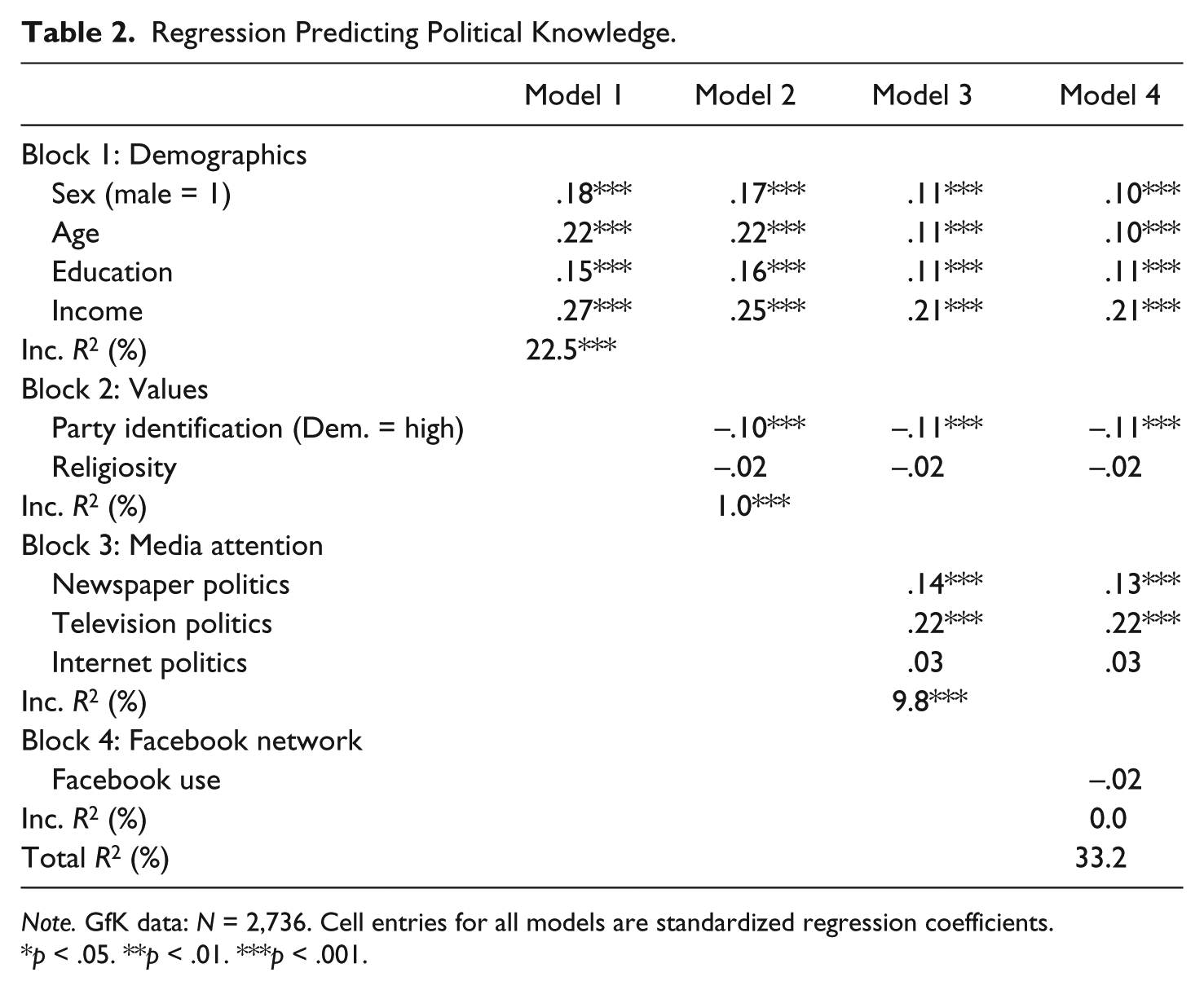
The first regression predicted political knowledge levels among the entire sample of respondents in the GfK dataset. As Table 2 shows, demographics were significant drivers of political knowledge scores. Males, older respondents, and individuals with higher levels of education and income scored higher on political knowledge. These results are largely consistent with previous work in this area (e.g., Dalrymple & Scheufele, 2007; Delli Carpini & Keeter, 1996; Neuman, Just, & Crigler, 1992).
Regression Predicting Political Knowledge.
Note. GfK data: N = 2,736. Cell entries for all models are standardized regression coefficients.
p < .05. **p < .01. ***p < .001.
In terms of value predispositions, there was only a significant impact of political party affiliation on knowledge levels, with Republicans in the sample scoring higher on the dependent variable. Religiosity was unrelated to political knowledge levels.
The third block of the model examined the impact of political media attention on political knowledge levels. There were strong positive effects of both political newspaper and television attention on knowledge levels. Although attention to political news online was not a significant predictor in the final model, further exploration revealed that the zero-order correlation between it and political knowledge was .30 (p < .001), which suggests that online news attention is positively related to knowledge. The lack of significance in the final regression model is best explained by collinearity between the different media attention measures (Cohen et al., 2003).
The fourth block of the regression looked at Facebook use and its relationship to the dependent variable. This variable failed to emerge as a significant predictor in the final regression model.
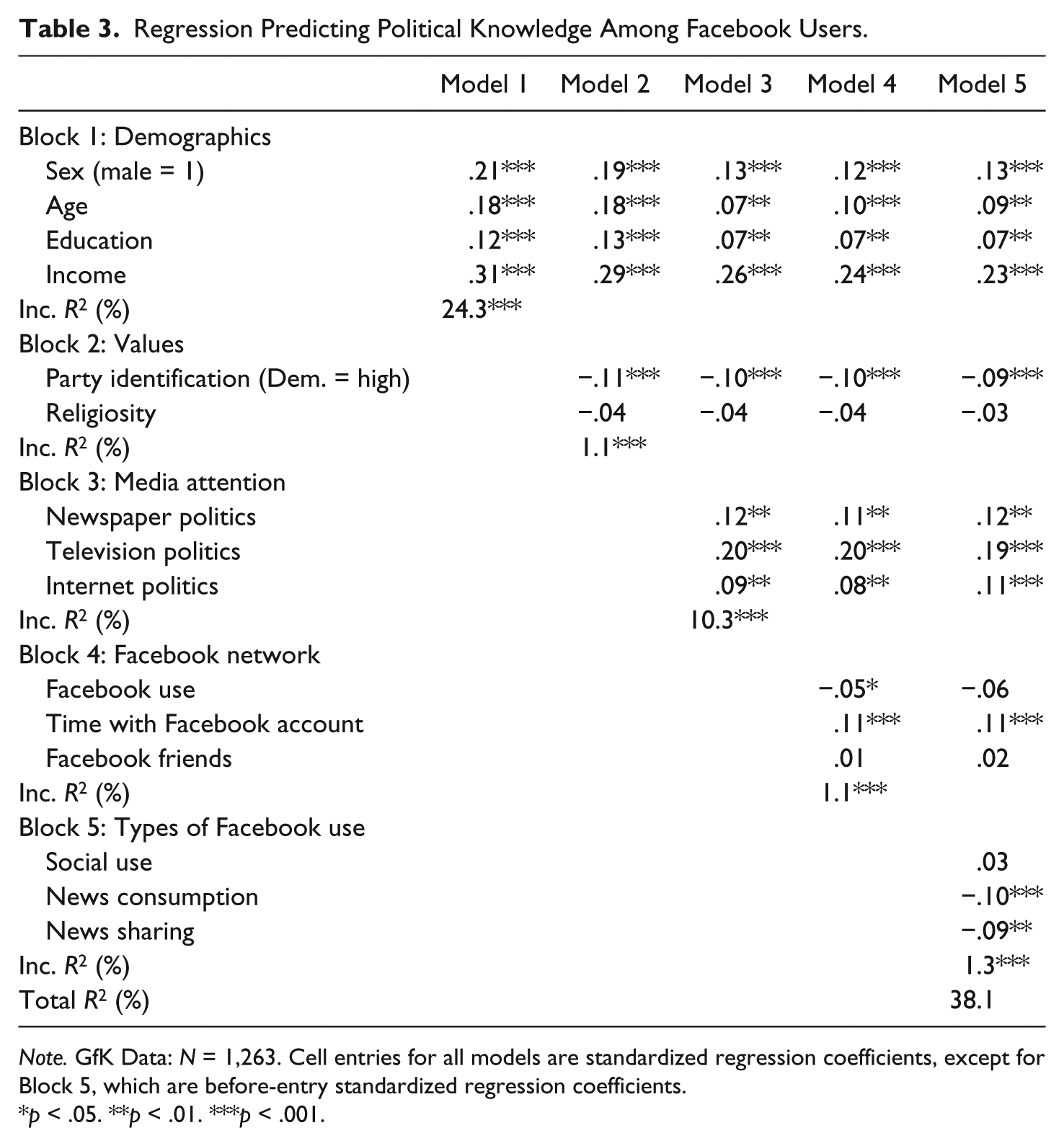
Our second regression model sought to more stringently test the potential relationship between Facebook use and political knowledge levels by focusing solely on Facebook users (Table 3). Our goal was to determine whether knowledge levels varied among users based on how they utilized the SNS. Overall, the results from this second regression very closely resemble the results just reported. For example, males, older respondents, and individuals with higher levels of education and income once again performed better on the measure of political knowledge. Similarly, Republicans better performed on the political knowledge measure than did Democrats, as did respondents who reported greater levels of attention to politics in newspapers, on television, and on the web. Yet again, general Facebook use was not related to the dependent variable in the final regression model. However, the addition of the new measures also revealed that there may be more to the story than the initial regression (and measurement of Facebook use) let on.
Regression Predicting Political Knowledge Among Facebook Users.
Note. GfK Data: N = 1,263. Cell entries for all models are standardized regression coefficients, except for Block 5, which are before-entry standardized regression coefficients.
p < .05. **p < .01. ***p < .001.
Specifically, this regression revealed that the length of time that a user has had an account (time with Facebook account) significantly predicts political knowledge. Users who had their account longer scored significantly higher on the measure of political knowledge. This may suggest that as users become more experienced with the platform, they are better able to accrue its benefits and translate that into knowledge. This is an important finding considering the explosion in Facebook users and the growth in those relying on the SNS for news information (Glynn, Huge, & Hoffman, 2012; Mitchell, Rosenstiel, & Christian, 2012; Olmstead et al., 2011; Shearer & Gottfried, 2017; Skelton, 2012).
Finally, the last block of the regression explored some of the different potential uses of Facebook and their relationship with political knowledge levels. Interestingly, Facebook news consumption and Facebook news sharing were each significantly related to our dependent variable. In each case, the relationship was negative, which suggests that the use of Facebook for news consumption and sharing may be detrimental to political understanding, points that will be addressed shortly.
Pew Dataset
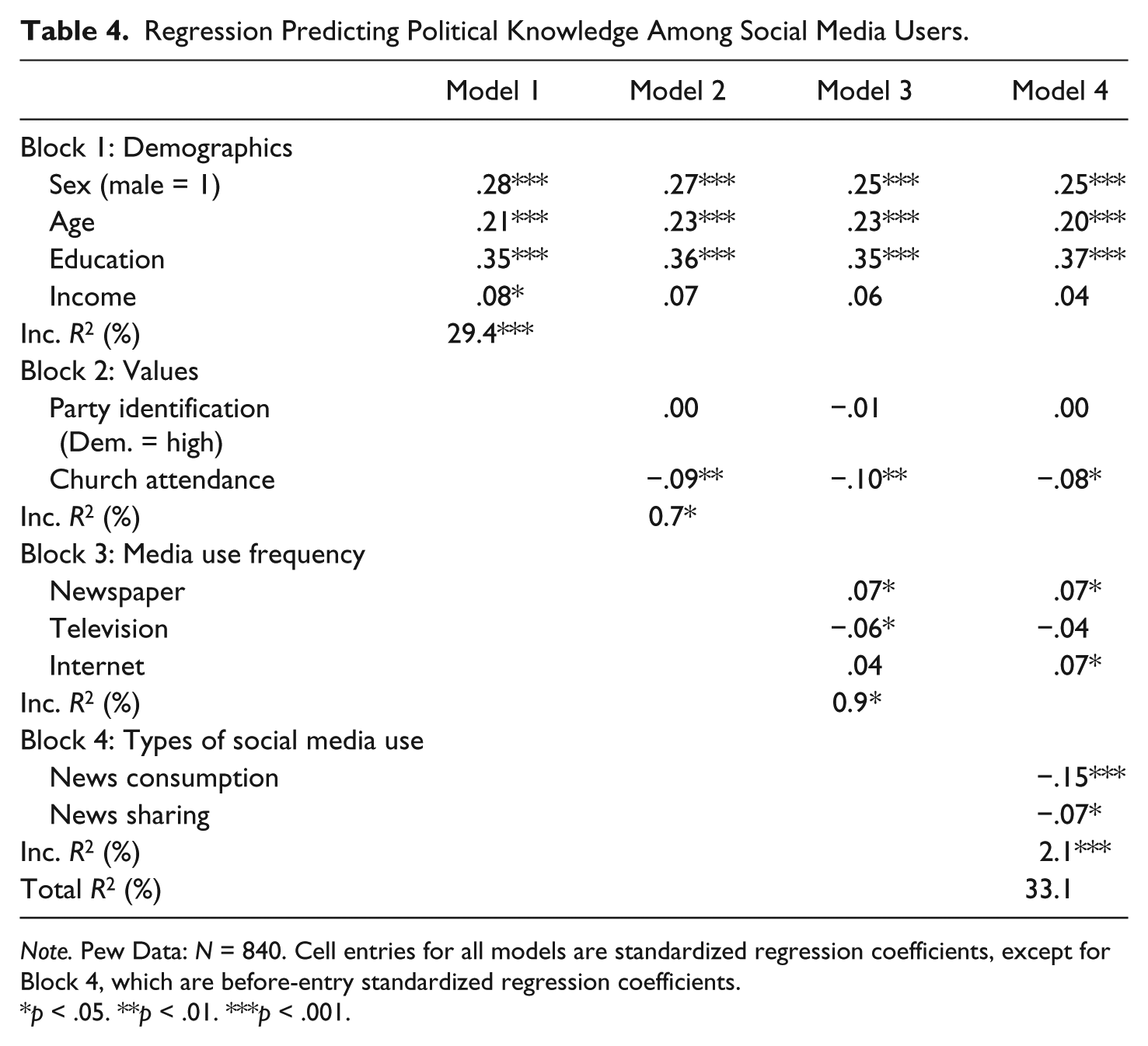
We next replicated this analysis with a secondary Pew dataset. As with the regression reported immediately above, analysis of the Pew dataset was limited to those who were asked questions about their social media use, specifically those who reported having a profile on an SNS. As Table 4 shows, males, older respondents, and individuals with higher levels of education scored higher on the political knowledge index. There was no relationship between income and knowledge or political party affiliation and knowledge in the Pew data. However, church attendance was negatively related to knowledge levels. The media use measures were weakly correlated with knowledge, with frequency of newspaper and online use positively related to the dependent variable.
Regression Predicting Political Knowledge Among Social Media Users.
Note. Pew Data: N = 840. Cell entries for all models are standardized regression coefficients, except for Block 4, which are before-entry standardized regression coefficients.
p < .05. **p < .01. ***p < .001.
Most importantly, our analysis of the Pew data provided further evidence for the detrimental effects of social media on political knowledge levels. The regression revealed negative relationships between each of the social media news measures and political knowledge levels. Overall, these findings align with our analysis of the GfK data and provide further evidence that the use of social media for news consumption and news sharing purposes may be detrimental to political understanding.
Discussion
Using a pair of nationally representative U.S. datasets, this study explored the relationship between social media use—focusing specifically on the most popular SNS, Facebook—and political knowledge. The analysis revealed that, while Facebook use itself failed to predict political knowledge scores, how Facebook users engaged with the platform was a significant predictor of knowledge, with increased use of Facebook for both news consumption and news sharing purposes associated with lower political knowledge levels. These relationships were replicated in a Pew dataset that employed more general measures of social media use. Prior to elaborating on these findings, we first discuss some limitations of the current work.
First, this analysis was hampered by the measures probing Facebook use, and social media use, more generally. Specifically, the analysis of the GfK dataset was only able to explore Facebook use in three areas: social use, news consumption, and news sharing. And the Pew dataset did not include a measure of social use at all. Additional items that looked at, for example, discussion of news, or the types of online or offline group affiliations a user has, would prove especially helpful for better understanding social media impacts on political knowledge levels. The analysis would also have benefited from more precise items across the social, news consumption, and news sharing focus areas. For example, the Social Facebook use items asked respondents about their frequency of commenting or posting, while the news items were less active, focusing instead on the reading and sharing of news. Perhaps, had items about respondents’ frequency of commenting on news stories been included, the results would have been different. Nevertheless, the available items clearly distinguished between Facebook use for social and news purposes and, therefore, make a strong contribution to the literature on social media impacts in the domain of political knowledge levels.
Second, it was proposed earlier that the makeup of one’s online social network could greatly affect the relationship between news use and knowledge levels. Unfortunately, this analysis was unable to include any measures of network homogeneity or heterogeneity. As such, it was only possible to speculate on the composition of social networks based on previous studies that have explored the issue. The precise structure of online social networks, and what this means for news sharing and consumption, remains an empirical question still to be explored.
Third, across both datasets, respondent political knowledge levels were measured with a series of multiple choice items. While this form of measurement had clear advantages in terms of ease of administration and coding, it only captures a rather narrow dimension of public information levels. In interpreting these results, therefore, it is important to keep in mind that this assessment does not capture a more abstract and in-depth understanding of a respondent’s knowledge of politics. It is possible that Facebook news sharing and consumption may have very different effects on alternative forms of knowledge, including issue-specific knowledge. However, it is also worth noting that while the GfK dataset relied on several static-general knowledge measures that might be more reasonably tied to formal education (for which we controlled in the regression models), the Pew dataset included a set of measures that were exclusively about current events. In other words, the relationships identified in this work were found to persist across both static and surveillance or recent knowledge assessments, which suggest rather robust relationships between social media use for news purposes and deficits in political knowledge.
Finally, as with any work that relies on cross-sectional data, it is impossible to be sure as to the direct causal links between variables. It may be that more politically knowledgeable respondents shun the use of social media and Facebook for news purposes, although this seems unlikely, especially given the emergence of Facebook as a place for news. Nevertheless, it is reasonable to assume that the relationship is at least reciprocal, with media use contributing to knowledge, and knowledge levels pushing people toward particular media use diets. A more stringent test of causality is warranted in future research.
Despite these limitations, this study highlights notable relationships between social media use and political knowledge. The ideal goal for citizens in a democracy is to be politically sophisticated, allowing them to participate in societal decision-making. This analysis has shown that those who are most familiar with Facebook (those who have had accounts for longer periods of time) tend to have higher levels of political knowledge. It may be that as people become more familiar with Facebook, they become better equipped to sift through the vast quantities of information available on the social networking platform, making knowledge acquisition easier. Perhaps most importantly, however, we found evidence of negative relationships between both Facebook news consumption and Facebook news sharing on political knowledge, a finding that was replicated using more general measures of social media news consumption and sharing in a Pew dataset. This suggests that a greater reliance on social media and Facebook specifically for news might serve to depress knowledge levels. This is particularly important given the growth of news sharing and consumption through social media channels (e.g., Gottfried & Shearer, 2016; Shearer & Gottfried, 2017).
Although the present study is unable to address the mechanisms behind these relationships, a few explanations are plausible. The first was discussed earlier and focuses on selective exposure. It may be that users who rely heavily on Facebook for news purposes are specifically selecting agreeable information from like-minded individuals and missing out on more balanced news or news that is more likely to expose them to alternative points of view. If so, this has unfortunate implications for the democratic process as attitude polarization can result from such confirmation biases (Taber & Lodge, 2006), and have negative implications for how society functions. Unfortunately, an explanation based on selective exposure does not immediately explain why a similar pattern of findings was not observed for the social users in the sample, although it may be that social users are less likely to surround themselves with like-minded or opinionated others because they use the platform for relatively benign purposes, that is, catching up with friends and former classmates. In this case, such users would be relatively immune to the detrimental effects on political understanding observed in the other groups. It is worth noting, however, that further analysis of the data revealed that the zero-order correlation between social Facebook use and political knowledge levels was a significant −.06 (p < .05), which suggests that social use might also be contributing negatively to public understanding of politics, but that these effects are not significant once basic demographics and media attention measures are taken into account.
The cognitive tuning literature suggested that news sharers and news consumers might differ in their openness to new information and, therefore, in their relationship to political knowledge (Zajonc, 1960). Specifically, news sharers are believed to be less receptive to new information, while news consumers are more open. Consistent with the expectations of cognitive tuning, news sharing via Facebook and social media was negatively related to political knowledge levels. However, inconsistent with that literature, news consumption was also negatively related to political knowledge levels. It may be that while news consumers are open-minded to the news they receive, they are not receiving the type of information that translates well to our assessments of political knowledge. It is also impossible to know whether the information they are encountering via social channels is accurate, complete, and providing a balanced examination of the issues.
In addition, we may be observing a displacement effect where social media is replacing more traditional outlets for information. Instead of turning to traditional media, such as print newspapers or radio, such users may perceive that they acquire sufficient news on Facebook and may thus rely less on traditional sources. An examination of the correlations between our Facebook variables and traditional political media attention variables (newspapers and television) provides mixed evidence over whether this is the case. Facebook news sharing and consumption were not strongly correlated with either political newspaper or television attention in either dataset. In the GfK dataset, Pearson’s r correlation coefficients, partialling out the effects of education, ranged from a high of .09, a significant correlation (p < .001) between Political newspaper attention and Facebook news sharing, to a low of .07, a significant correlation (p < .001) between Political TV attention and both Facebook news sharing and Facebook news consumption. In the Pew dataset, correlations ranged from a high of .05 (a nonsignificant correlation between TV use and Facebook news use) to a low of −.07, a significant (p < .05) correlation between TV use and Facebook news sharing.
Overall, the correlations suggest that those who rely heavily on social media for news purposes are not necessarily turning to traditional channels with much frequency, and in some cases, at least in the Pew data, are actually a little less likely to turn to traditional news channels than their low social media news use counterparts. This is not to suggest that social media has replaced traditional media as the place to turn for news. Indeed, the means for the media use and attention variables are consistently higher for the traditional media channels than the social ones across both of these datasets. However, it does suggest that social media use might be replacing traditional media use for at least some. Recent surveys on the subject certainly suggest this to be the case, at least among younger audiences (Mitchell et al., 2015).
Finally, some work suggests that Facebook and social media users tend only to share information on current “hot button” issues (Maier, 2010). Such issues are not heavily reflected in the battery of knowledge questions employed here, and thus, social media news consumers and sharers would not be expected to score well on the more general set of items that were explored in this analysis.
Using Facebook and other social media outlets for news is a trend that is on the rise and almost certain to continue to increase. Yet the results of the present work suggest such use can have detrimental impacts on political understanding. How should we reconcile this with our normative ideal for informed publics? Clearly, this vital question warrants further investigation. However, some of the results reported here can be read positively. The use of Facebook for news purposes is still a relatively new phenomenon, and these findings suggest that experience with the platform can have beneficial impacts. Interpreted optimistically, this suggests that as individuals become more comfortable with Facebook, the relationships between using the platform for news purposes and knowledge outcomes may become decidedly more positive. As individuals become more comfortable using Facebook for news sharing and consumption purposes, they may be able to better learn from the information they encounter, eventually becoming more knowledgeable about news issues through their social media feeds.
Footnotes
Declaration of Conflicting Interests
The author(s) declared no potential conflicts of interest with respect to the research, authorship, and/or publication of this article.
Funding
The author(s) disclosed receipt of the following financial support for the research, authorship, and/or publication of this article: This study was supported by the National Science Foundation (SES-0531194, SES-DMR-0832760).