



Abstract
Informed by the third-person effect hypothesis, this study used a survey of 1,060 Chinese university students to analyze the impact of anti-corruption news on Chinese audiences’ attitudes and political participation. This study found that university students tended to think the influence of anti-corruption news on others was greater than on themselves. In addition, issue involvement and new media attention to such news were found to reduce the self-other perceptual gap. Furthermore, the perceived effects of such news on self were positively associated with supportive attitude toward the anti-corruption policies. Meanwhile, perceived effects on others were negatively related to respondents’ political participation.
Keywords
After taking over the party leadership at the end of 2012, by allying with Wang Qishan, who headed the Communist Party’s Committees for Discipline Inspection, Chinese President Xi Jinping launched an extensive and unprecedented anti-corruption movement (Armstrong, 2015; X. Li, 2014). President Xi declared his intentions in this movement in several public platforms that he not only expected to reaffirm the political loyalty of powerful regional and sectorial leaders in provinces and ministries but also to restore public confidence in the Communist Party’s ruling ability (X. Li, 2014; H. Li, Gong, & Xiao, 2015).
The news coverage of Chinese officials’ corruption and degeneration cases and government’s anti-corruption announcements and policies were known as “anti-corruption movement news” became prevalent in the global media in recent years (Shao, Liu, & Ma, 2017), as this movement was viewed as the most influential anti-corruption movement in China since 1949 (Hualing, 2014; X. Li, 2014). In Chinese media in particular, under the tough censorship rules, the news coverage mainly reported the amount of corruption and the influence on the public, which propagated and set an agenda for the Chinese public to believe that this movements could benefit the public by constructing a transparent and democratic administrative government (Wen, 2015; Xu & Chen, 2016).
According to Davison (1983), the perceptual component Third-Person Effect (TPE) hypothesis referred to “an audience that was exposed to a persuasive communication would expect the communication to have a greater effect on others than on themselves” (p. 3). Such news thus presented a fitting context for the TPE framework because of its persuasive intention and great influence on Chinese people (Shao et al., 2017; Wen, 2015). This study then would be the first research to focus on Mainland China anti-corruption news from a TPE perspective to analyze the impact of such news on audiences’ attitudes.
Although the TPE hypothesis was widely examined with extensive empirical evidences (Paul, Salwen, & Dupagne, 2000), there were few studies assessed the impact of news on audiences from an integrated perspective that combined TPE and Elaboration Likelihood Model (ELM) of persuasion framework. The current study thus also aimed to fill this gap and proposed that how people processed the news might influence on their perceived effects of the anti-corruption news on themselves and others. Furthermore, the perceived effect on the self and others would in turn affect their subsequent participation activities and supporting the current anti-corruption policies.
Literature Review
Anti-Corruption Movement in Mainland China
The anti-corruption movement had swept across Mainland China since late 2012. Given Chinese President Xi’s promised to target both “the tigers and the flies” (Holtz, 2014), the movement went far deeper and lasted far longer than anyone could have imagined. The latest data reported that 68 high-level officials, with more than 70,000 officials, were punished for violating anti-corruption rules (Armstrong, 2015). The high-ranking officials such as Bo Xilai, the Mayor of Chong Qing, top-level politicians inside the Party and the military, such as Zhou Yongkang, the country’s security tsar for 5 years, and Xu Caihou, one of the People’s Liberation Army’s top generals until 2012, all had been investigated in recent years.
Because the movement broke a long-standing Chinese politics taboo, making it possible to investigate the Communist Party’s board of directors, which were traditionally regarded as untouchable, the political event was widely reported by China’s news media (Guo, 2014; Zeng & Shu, 2014). However, by examining news sources of such coverage on Chinese media, Shao et al. (2017) found that government official announcement accounted for 89.2% of sources in such coverage on party media and 84.2% in market-driven media. Thus, given the sustained and high-profile coverage of the event, the news media could successfully set an agenda for the Chinese public and amplify audiences’ perception of the impact (Shao et al., 2017). Even though those instances of news coverage resonated strongly with the public, some Chinese intellectuals interpreted the movement as a short-term deterrent or political purge to clear up the party’s image instead of effective policy to fix systemic problems (Holtz, 2014; Pilling, 2014).
The Perceptual Component of Third-Person Effect
TPE was proposed by Davison (1983) to articulate the linkage between intuition and the public voice. The hypothesis addressed two components: the perceptual factor revealed that people were more likely to view others as more susceptible to media content, and the behavioral factor indicated that such perceptual bias could cause people’s certain related behaviors (Liu & Lo, 2014; Lo & Cheng, 2012). This theory derived from self-enhancement bias, which assumed that people tended to look at themselves in a specified manner to ostensibly pretend to behave more superior than others (Brown, 1986). They were thus would underestimate the impact of messages on themselves (Price, Huang, & Tewksbury, 1997).
Over the past decade, several studies have extended the perceptual component of TPE to news reports, advertisements, health risks information, and social media information (e.g., Lo, Wei, Lu, & Hou, 2015; Salwen & Driscoll, 1997). This phenomenon was frequently found in certain controversial messages, such as violence and pornography (e.g., Lo & Paddon, 2001; Wei, Lo, & Lu, 2008).
Recent studies also expanded the inquiry to political persuasion effects (Banning, 2006; Paek, Pan, Sun, Abisaid, & Houden, 2005). For example, Salwen (1998) specifically examined the conceptual hypothesis in presidential election. Focusing on news coverage, Price and Stroud (2006) found that audiences perceived the effect of political news coverage to be greater on other voters than on themselves. Similar results were revealed in Taiwan Sunflower Movement news reporting. In appraising issue importance as a precondition to the process of persuasion, Wei, Lo, and Lu (2015) found that respondents judged others as more influenced by such news than they were.
As a natural combination of news reports and political propaganda, this study assumed that some people might feel that they could detect political propaganda in the news, but other people would be more likely deceived by the publicity gambit. Thus, a rationale was provided to formulate
The Behavioral Component of the Third-Person Effect
Behaviorally, Davison’s (1983) research on TPE hypothesis assumed that when people perceived less impact of mass communication information on self but others, then they were inclined to take certain actions in a way considering others’ reactions to that information (Bennur, 2008). Previous studies suggested that behavioral effects of TPE were supportive of censorship of messages with perceived negative influences in general (Gunther, 1995; Wei, Lo, & Lu, 2007). Researches on Internet pornography, violence on television, and certain types of rap music reported the relationship between TPE and support for censorship (Lo & Wei, 2002; D. M. McLeod, Eveland, & Nathanson, 1997; Rojas, Shah, & Faber, 1996).
Political issues context such as supporting or boycotting governmental policy and political participation were also found related to self-other perceptual gap (Bennur, 2008). Specifically, Wei et al. (2015) found that college students’ online discussion and offline participation in the Sunflower Movement in Taiwan could be triggered by perceived effect of such news on themselves. Golan and Day (2008) also argued that first-person effect would be a better predictor of political behaviors than TPE as individuals might be willing to act only when perceiving the impact by political messages. Because most of anti-corruption movement news in Mainland China usually emphasized the effective measures launched by the government and the hazards of political officials’ corruption, with the rationale from previous research findings, we anticipated that the more the respondents perceived such news to affect themselves, the more they would do followed actions to protect themselves. Thus, we propose the following hypotheses:
Issue Involvement and Third-Person Effect
Previous research showed that attitude changes were determined by different factors under high- and low-involvement conditions (Perloff, 1993). The concept of involvement could be divided into ego involvement and issue involvement. Ego involvement was regarded as identification with a social group and possession of extreme attitudes on issues relevant to the group that were positively related to attitude change (Perloff, 1989, 1999; Roser, 1990). Issue involvement was the individual’s connection to an issue existing prior to message exposure that determined whether the audience was active or passive to process media messages (Roser, 1990).
According to the definition of issue involvement, it was viewed as a major stimulus or the most direct determinant of the amount of persuasion produced in ELM of persuasion framework to increase the propensity to process information carefully among audiences (Petty & Cacioppo, 1979, 1981; Wei et al., 2015). In this model, processing information included two routes: When audience had the ability of critical thinking and motivated to scrutinize the true merits of the information, then the central routes would affect as it required more cognitive efforts (Tam & Ho, 2005); accordingly, the audience with low motivation and less ability of critical thinking was more likely to use the peripheral route to process information (Bhattacherjee & Sanford, 2006). Former studies concluded that highly issue-involved viewers primarily processed information central to the message, while viewers with low involvement tended to process information peripheral to the message (Aldoory & Van Dyke, 2006; Petty & Cacioppo, 1979, 1981).
ELM focused on the processes about how audiences responded to the information that was exposed to them (Petty & Cacioppo, 1986), which was also consistent with the hints in TPE to evaluate audiences’ cognitive levels. When issue involvement and TPE were put together, empirical studies showed that TPE occurred among those audiences who were more involved in negative media-conveyed issue (Huh, 2003). Mutz (1989) emphasized that in the turmoil in South Africa news, issue involvement was significantly related to respondents’ tendency to perceive others as more influenced by such news. While Wei et al. (2015) found that the higher the extent of people’s feelings that were relevant with the Taiwan Sunflower Movement, the greater the perceived effects of the news on the self than others. According to White (1995), the different results might be due to the strength of the argument that contained in the message. To be specific, audiences tended to believe that other people would be less affected than themselves by a persuasive message with strong argumentation (White, 1995, 1997).
Based on the former evidence and ELM persuasion framework (Tam & Ho, 2005; Wei et al., 2015), audiences’ perceived issue involvement with anti-corruption movements in China would motivate them to actively process related news coverage. Furthermore, with the impact of extensive anti-corruption reports, we proposed that issue involvement would result in greater perceived effects of such news on self. To test the effect of issue involvement of the anti-corruption movement affecting on self and others, a hypothesis could be raised:
In addition, considering the ELM process, Petty and Cacioppo (1979) emphasized in research that outcomes of central processing were believed to be relatively persistent and predictive of subsequent behaviors. By examining the effect of public service announcements, Flora and Maibach (1990) found that respondents had a desire to learn more about the issue in high-involvement messages, which in turn would influence on their subsequent behaviors. Although not many literatures in examining direct relationship between issue involvement and political participation, some focused on the significant impact of issues of special interests on political news consumption and different forms of political participation (J. M. McLeod et al., 1996; Vedlitz &Veblen, 1980). Similarly, Oh (2011) found that a greater level of issue involvement was more inclined to express own opinions in online communication. Based on these empirical evidences, there were reasons to believe that highly perceived issue involvement in Mainland China anti-corruption movement news would urge people to generate more related actions. Therefore, we hypothesized the following:
News Attention and Third-Person Effect
As the first stage of information processing (Bargh, 2002), news attention was a more elaborative measure than news exposure, which referred to an individual denoting mental effort, conscious awareness, and active processing of the news content (Chaffee & Schleuder, 1986; Wei, Lo, & Lu, 2011).Wei et al. (2007) found in the avian flu news, the level of attention that respondents paid to the news would be positively related to their perceived effects on themselves, resulting in a smaller self–others perceptual gap. Their followed research in Taiwan tainted food product recalls news also revealed that audiences’ attention to the news could increase their perceptions of such news on themselves (Wei, Lo, & Lu, 2010).
According to existing scholarly evidence, it was possible to believe that when audiences paid more attention to news coverage regarding Mainland China’s anti-corruption movement, they would prepare themselves to receive such news and would frequently think about this event. Consequently, the more cognitive efforts an individual took to evaluate the impact of the movement, the stronger they would perceive the influence of the news. This line of thinking led to the following hypothesis:
The subsequent behavioral intentions or actions were found in some studies, especially in political contexts. For example, Scheufele and Nisbet (2002) identified that respondents who used the traditional and new media frequently for informational or entertainment purposes were more likely to participate in democratic citizenship. Wei et al. (2011) specifically conducted the presidential election survey and demonstrated that news attention was positively related to support for restrictions on news about election polls and movement discourse engagement. Drew and Weaver’s (2006) series of research on election campaign news in the United States affirmed the relationship between news attention and involved in political process. Thus, we supposed that the attention on Mainland China anti-corruption news would trigger related actions. Then, the following hypotheses could be raised:
The general assumption concerning new attention could be differentiated for different media platforms, perceived effect, and even behavioral outcomes. Drew and Weaver (2006) examined the relationships between attention to various news media and found that attention to television news and Internet news predicted voter learning about candidates’ positions on issues and likelihood of voting. In Mainland China, because new media such as Weibo and News Apps could largely facilitate the rise of online public opinion on politically relevant topics (Stockmann & Luo, 2017), users were more likely to have more opportunities to consume anti-corruption movement news in various perspectives. Because according to E. J. Lee and Tandoc (2017), new media users could not only put out their versions of events but could browse the news comments that made by other users as well. Compared with the circulation of news on social media, on average, more than 85% of anti-corruption news sources on Chinese traditional media were official announcements (Shao et al., 2017); therefore, such media played an important role as mouthpiece for the government propaganda. In addition, because a majority of such news was released from new media such as Internet or news apps (Zhang, 2013), new media news attention would increase audience’s perceived influence of such news on self and others. We supposed the following:
Perceived Knowledge and Third-Person Effect
Previous research showed that attention to news was highly and constantly related to perceived knowledge gaining, especially to predicting political knowledge more strongly (Chaffee & Schleuder, 1986). Chaffee, Zhao, and Leshner (1994) reported that audiences’ attention to television news was a significant predictor of knowledge about candidates in the 1992 U.S. presidential election. However, this relationship might be mediated by some cognitive variables. By examining Ohio’s 2006 gubernatorial election campaign news, Lovejoy, Riffe, and Cheng (2012) suggested that attention to such news online was associated with interest in the campaign, which in turn could highly predict their perceived knowledge.
Furthermore, people’s perceived knowledge represented their assessments of own knowledge of some issue which was found as a positive predictor of TPE (Atwood, 1994), but only for certain messages (Perloff, 1999; Price & Tewksbury, 1996). The theoretical logic behind the relationship was that perceptions of self as more knowledgeable about an issue would lead to perceptions that one was better than others at defending against negative media effects and less influenced than others based on optimistic bias. For example, D. M. McLeod et al. (1997) found that respondents who believed they were more knowledgeable than others about television violence generally estimated less effects of television violence on themselves. Perloff (1999) also affirmed that self-perceived knowledge could lead individuals to believe that they were immune to message effects, whereas others were more vulnerable, which would stimulate them to have some behavioral responses.
In the anti-corruption news reporting context, such news involved numerous political issues in Mainland China. This study examined whether respondents’ beliefs about their perceived knowledge about the anti-corruption movement being relative to their perceptions of other people’s knowledge influenced TPE. Thus, the presumed importance of self-perceived knowledge suggested the following “perceived knowledge” hypothesis:
However, few studies supported the relationship between perceived knowledge and behavioral outcomes. We supposed that when people perceived themselves as having more anti-corruption movement knowledge, they tended to view the movement as a political purge instead of institutional anti-corruption measure, thus they would not support the current Chinese style anti-corruption policy instead of advocating to establish institutional anti-corruption policy. Conversely, they might play active roles in following online political participation. Thus, we supposed the following:
The Theoretical Model
To further explore the interrelationships among perceived issue involvement, news attention, perceived knowledge, TPEs, support for government anti-corruption policy, and subsequent online political participation, we developed a causal model with the method of structural equation modeling (SEM) using Amos 20.0.
As shown in Figure 1, we inferred that perceived issue involvement led to news attention, which affects perceived knowledge, which in turn shaped perceived effects on “the self” and “others.” Ultimately, the variables in information and learning processing with the perceived effects on self and others would predict support for government policies and online behaviors. The rationale for this model was discussed in the above literature review.
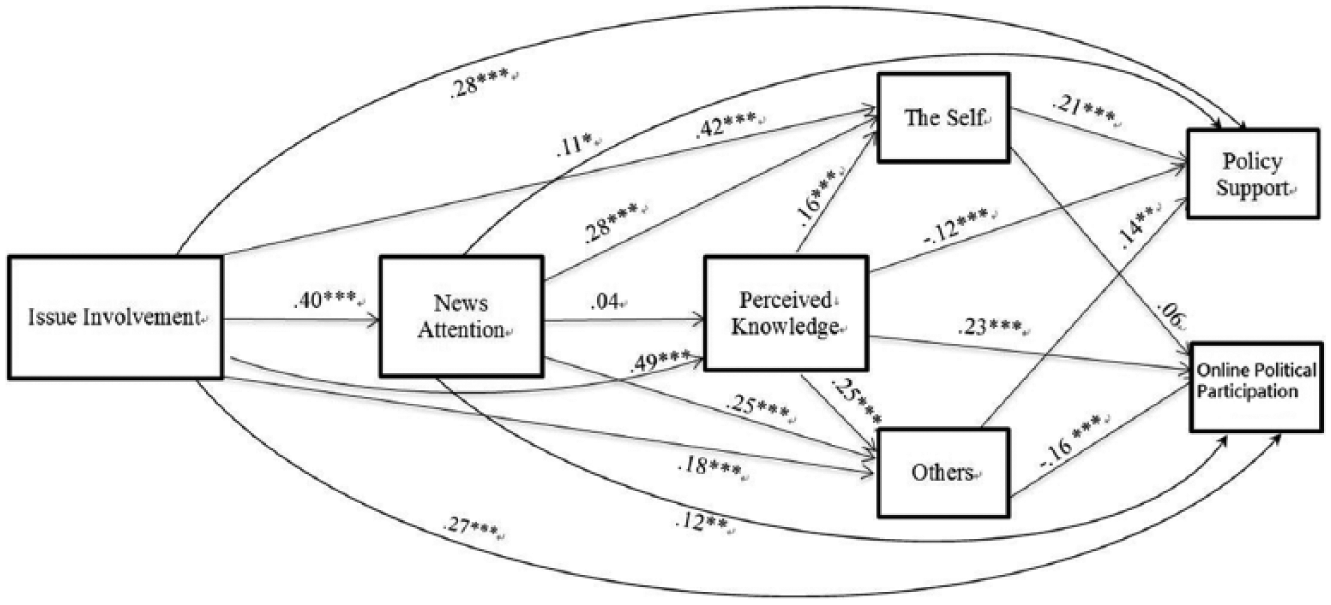
Structural equation model of variables predicting support for government policies and online political participation (N = 1,060).
Method
This study used a multistage cluster sampling strategy and respondents of this paper-based questionnaire survey were drawn from six universities in Beijing, Shanghai, and Guangzhou randomly selected from total 238 universities on the list of university catalog from the Chinese ministry of education. To draw students from a wide variety of academic majors, we randomly selected two or three general educational courses from each of the six universities in the second stage. With the permission from the instructors, the trained student helpers entered the classroom and made a clear explanation of the survey, and the survey process was under the student helpers’ administration. In total, 1,200 questionnaires were finally distributed in the selected courses during the period from September 21 to October 9, 2015.
The research sample focused on the university student based on two basic considerations. First, compared with the general population, the university students were expected to have more significant self–others discrepancy as they were well-educated and very likely to perceive themselves as more rational than others (Salwen & Dupagne, 2001). Second, in the case of anti-corruption news, as one of the active groups on the Internet, the university students were believed to have access to more media channels and platforms, which could be an important predictor about the involvement of the anti-corruption news and express their opinions about such news online (Kolbitsch & Maurer, 2006; Kushin & Yamamoto, 2010). Therefore, the university students could be treated as an appropriate sample for our research about TPE. In addition, although such a sample did not represent the general population in China, it could demonstrate to some extent the attitudes of well-educated Chinese people after the 1990s.
Finally, we collected 1,060 completed questionnaires with a response rate of 88.3%. Of the sample, 578 (54.5%) were women and 473 (44.6%) were men. The average age of the respondents was 21.2 (SD = 3.21, ranging from 16 to 45). About the respondents’ grades, 362 (34.2%) were master’s or above students, 259 (24.4%) were sophomores, 232 (21.9%) were freshmen, 118 (11.1%) were juniors, and 83 (7.8%) were seniors. For the political affiliation, 252 (23.9%) were Chinese Communist Party (CCP) or probationary CCP members, 660 (62.7%) were league members, and 140 (13.3%) were noncommunist party members and the masses or others.
Measurement
Perceived effects of news about anti-corruption on the self and others
Respondents were asked to indicate to what extent anti-corruption news influenced them in terms of (a) attitude toward the corruption issue in China and (b) understanding of current Chinese anti-corruption policy. The measure of the perceived effect on such news on others also consisted of two parallel items (replacing “you” with “others”). The response categories ranged on a 5-point scale, where 1 meant not at all and 5 meant a great deal. The two “self” items were averaged to create a measure of “perceived effects on self” (n = 1,056, M = 3.47, SD = .80, r = .48). The average of two “others” items was formed as a measure of “perceived effects on others” (n = 1,052, M = 3.54, SD = .76, r = .56). All the missing data were replaced by maximum likelihood estimation.
Self-others perceptual gap
This score was derived by subtracting the perceived effect of news about the anti-corruption controversy on the self from the perceived effect on others (n = 1,048, M = .07, SD = .73).
Issue involvement
By referring to Hu’s (1997) measurement items in his research, we asked four questions about anti-corruption movement news, such as “Do you care about governmental corruption?” and “Do you often think about the issue of governmental corruption after reading anti-corruption news?” Each item was measured by a 5-point Likert-type scale with 1 = very little, 5 = very much. These items were computed to create a measure of “issue involvement” (n = 1,054, M = 3.16, SD = .80, α = .88).
News attention
Respondents were asked to indicate how much attention they paid to consuming news about the anti-corruption movement in China in newspapers, radio, TV, news websites, cell phone news apps, and tablet news apps. The 5-point response categories ranged from 1 (no attention at all) to 5 (a great deal of attention). We combined the first three media platforms as “traditional media attention” (n = 1,049, M = 2.75, SD = .86, α = .75). Other three media, including news websites, cell phone news apps, and tablet news apps, were classified as “new media attention” (n = 1,054, M = 3.13, SD = .90, α = .75).
Perceived knowledge
We referred to previous research conducted by Driscoll and Salwen (1997) to develop four items of self-perceived. Using a 5-point scale (1 = much less informed, 5 = much more informed), the items included “Compared to most people, how well informed do you feel about the current corruption issue in China?” “Compared to most people, how well informed do you feel about current anti-corruption policies in China?” and so on. Finally, the four items were computed to form a measure of perceived knowledge (n = 1,058, M = 3.06, SD = .69, α = .83).
Support for anti-corruption policies
Support for anti-corruption policies was measured by asking respondents to indicate their agreement with four items, such as “I support the current anti-corruption policy” and “I support the continuation of the current anti-corruption policy” on a 5-point Likert-type scale from 1 (strongly disagree) to 5 (strongly agree). The four items were combined to a measure of support for current anti-corruption policies (n = 1,056, M = 3.90, SD = .76, α = .86).
Online political participation
Online political participation was measured by a set of four items. Respondents were asked about what participation they will take online regarding the anti-corruption complaint: (a) Posting a topic about anti-corruption; (b) Sharing or forwarding the anti-corruption news; (c) Commenting on the news about anti-corruption; (d) Discussing the anti-corruption news. The 5-point scale ranged from 1 (never) to 5 (frequently). A composite measure of online political participation was created by the four items (n = 1,051, M = 2.00, SD = .91, α = .87).
Media exposure
Respondents were asked how often they use media channels to access news coverage on Chinese anti-corruption movements. Using a 5-point scale (1 = never, 5 = frequently), media exposure to news coverage of the Chinese anti-corruption was measured with the statement, “How often do you read (watch) local news about anti-corruption?” from (a) newspapers, (b) magazines, (c) television, (d) the Internet, (e) cell phones, and (f) tablets. We combined the first three media platforms as “traditional media exposure” (n = 1,056, M = 2.57, SD = 0.77, α = 0.68), and the other three media were “new media exposure” (n = 1,059, M = 3.73, SD = .85, α = .65).
Control variables
Respondents were asked about their gender, age, and political party affiliation. In the question about party affiliation, we designed five items as CCP member, probationary CCP member, league member, noncommunist party member, and the masses or others. These variables were used as controls in analyses because previous studies indicated that they were related to TPEs (Gunther, 1995; Lo & Chang, 2006).
Results
The t test and hierarchical regression were first adopted to examine hypotheses, and the diagnostics of multicollinearity was conducted before the regressions (Table 3 presented the variance inflation factor [VIF]).
Mean Estimates of Perceived Effects About News of Anti-Corruption in Mainland China on Self and Others.
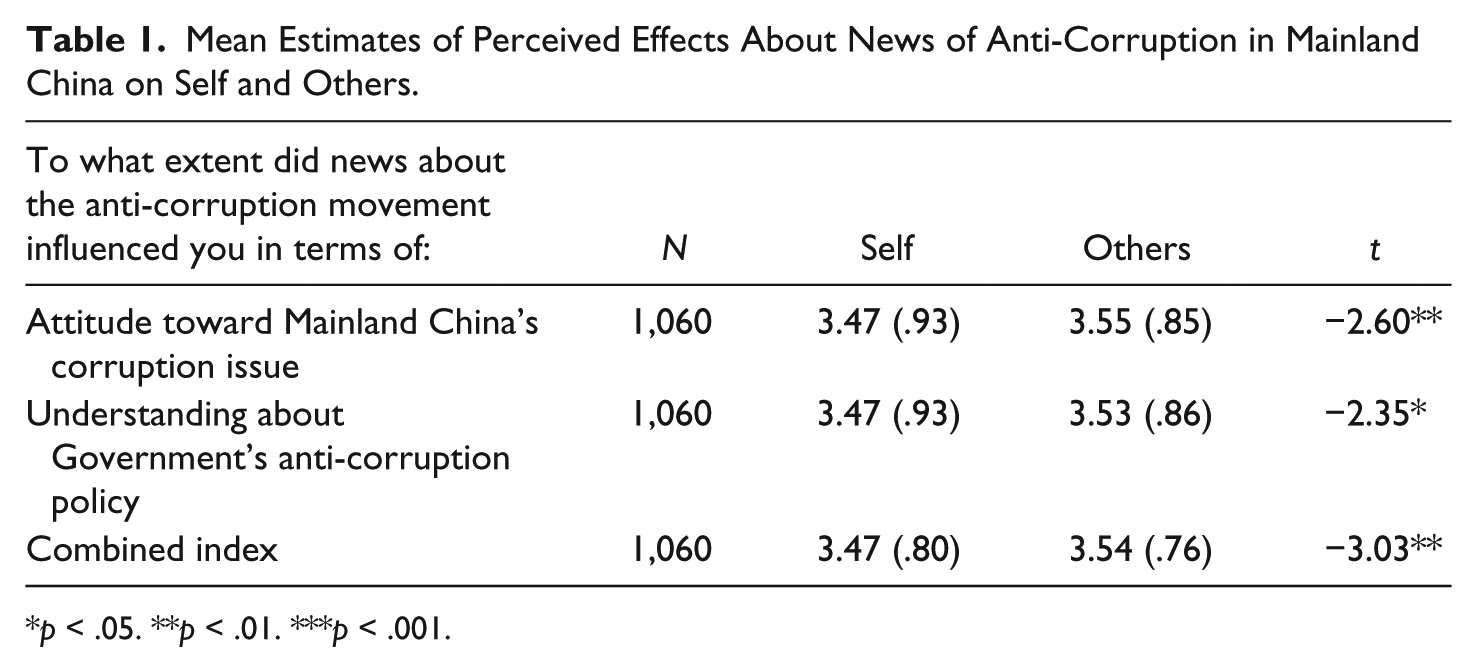
p < .05. **p < .01. ***p < .001.
Hierarchical Regression Analysis Predicting Perceived Effects on the Self, on Others, and Self–Others Perceptual Gap (N = 1,060).
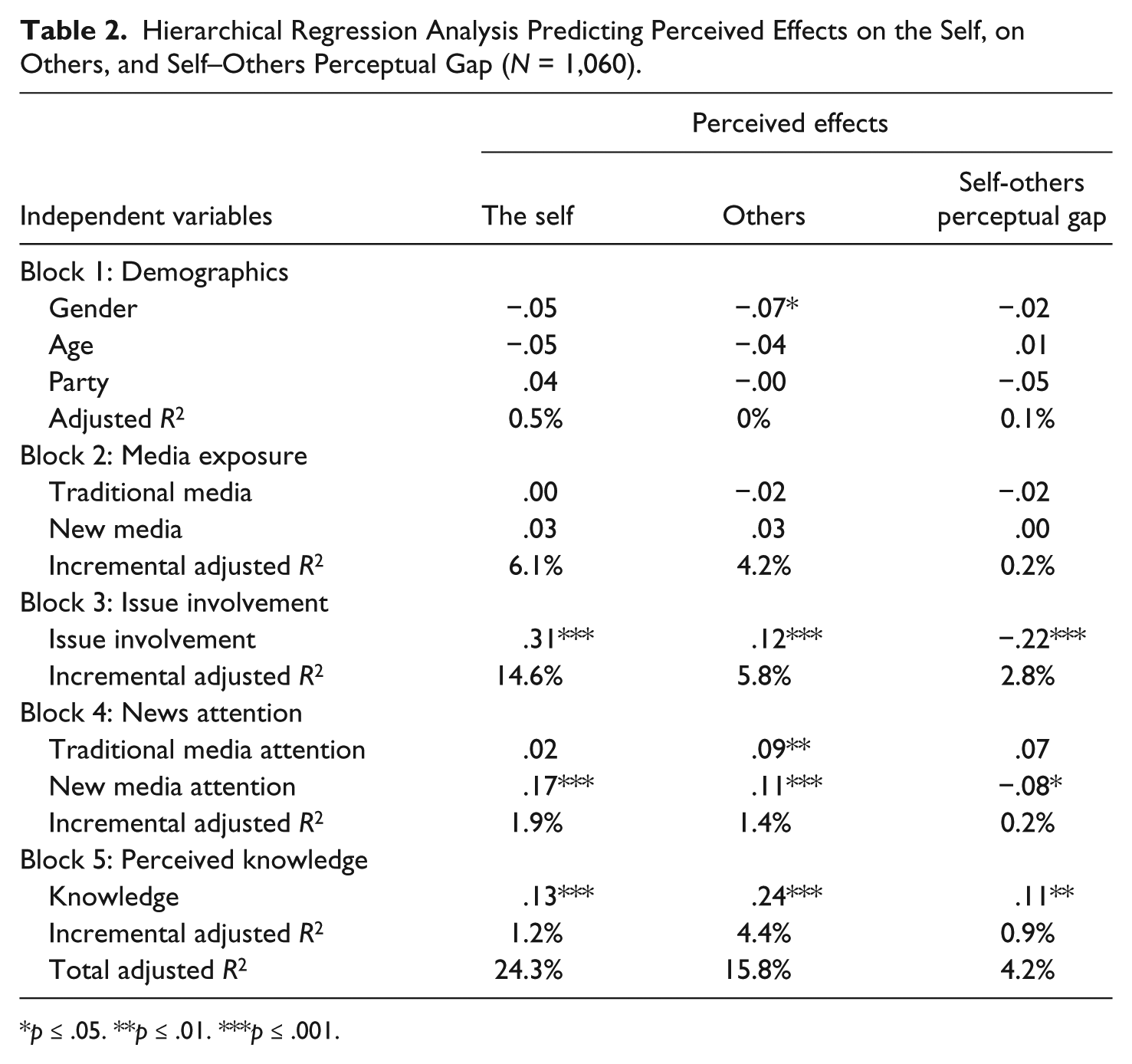
p ≤ .05. **p ≤ .01. ***p ≤ .001.
To clarify the significant predictors of support for China’s current anti-corruption policies, a hierarchical regression analysis was performed. As shown in Table 3, demographic variables and media exposure presented no significant power to predict the support of current policies. When issue involvement (β = .26, p < .001) was entered in the third block, a significant effect was demonstrated among the respondents who perceived highly issue involvement with the movement, revealing high motivation to support for current anti-corruption policies. Traditional media attention (β = .10, p = .01) was found to be a significant predictor, which showed that when audiences paid more attention to traditional media to get anti-corruption news, they tended to support the current policies, while new media attention (β = .04, p = .32) was found to have no significant power to predict the support for policies. In addition, although there was no significant result support, perceived knowledge (β = –.01, p = .67) was negatively related to policy support. Finally, perceived influence of anti-corruption news on self (β = .18, p < .001) was demonstrated as a positive predictor to presume respondents’ support of current anti-corruption policies. Thus,
Hierarchical Regression Analysis Predicting Behavioral Intention Regarding Support for Government Anti-Corruption Policy and Related Online Political Participation (N = 1,060).

Notes. When VIF is less than 2.5, there is no serious issue of collinearity.
p ≤ .05. **p ≤ .01. ***p ≤ .001.
Finally, to address online political participation hypotheses, a similar hierarchical regression analysis was conducted to find out the most significant predictor of behavioral outcomes. Gender (Female = 0, Male = 1) (β = .09, p = .002), exposure to traditional media (β = .12, p < .001), issue involvement (β = .26, p < .001), perceived knowledge (β = .17, p < .001), and perceived effect on self (β = .07, p = .04) were found as positive predictors of online participation. Thus,
To confirm the robustness of findings about specific relationships, SEM was also adopted to deliver a holistic test of the analytical model in addition to the regression analyses. The proposed model reflected a good fit, χ2 / df = 3.58, p < .001, standardized root mean square residual (SRMR) = .05, incremental fit index (IFI) = .95, Tucker–Lewis index (TLI) = .94, comparative fit index (CFI) = .95, root mean square error approximation (RMSEA) = .05. As for the explained variances, 15.7% in news attention, 25.2% in perceived knowledge, 45.7% in perceived effects on the self, 26.3% in perceived effects on others, 27.4% in support for government policy, and 21.7% for the related online political participation were explained by the model. SEM results suggested that issue involvement had a significant effect on news attention (β = .40, p < .001) and perceived knowledge (β = .49, p < .001). News attention and perceived knowledge were significantly associated with perceived effects on self (β = .28 and .16, respectively, p < .001), and on others (β = .25, p < .001, for both cases). Issue involvement also had a significant effect on perceived effect on self (β = .42, p < .001) and on others (β = .18, p < .001). Ultimately, perceived effects on self and others were positively and significantly related to support for government policies (β = .21 and .14, respectively, p < .001), although perceived effects on others had negative effects on online political participation (β = –.16, p < .001).
Discussion
The unprecedented anti-corruption movement in Mainland China that was launched in late 2012 triggered lots of concerns from news media at home and abroad. This study used the TPE hypothesis under this context by examining the effect of issue involvement, news attention, and perceived knowledge. It also examined the consequent behaviors due to the perceived influences of such news on self and others. The findings revealed that university students’ attitudes and responses toward the anti-corruption news were complex from the TPE perspective. Although a significant difference was found between the influences of anti-corruption news on others than on the self, the perceptual gap between others and self was hardly to lead to the respective differentiations among political attitudes and participations of our respondents. The results suggested that this type of news in the Chinese context was neither negative source nor positive source. It is an informative parcel of mixed messages: (a) political propaganda that the Chinese students were aware of, and (b) anti-corruption campaign that they were in favor of.
To provide a nuanced understanding about how Chinese university students perceived such controversial news and proposed a mechanism to explain such process, we also tested how the different levels of absorbing, interpreting, and involving in this specific political issue divided the Chinese university students into various groups. Importantly, in such political context, issue involvement was found as the most significant predictor of perceived effects about the news on self and others, the likelihood to support current anti-corruption policies, and subsequent online political participation. This finding was highly consistent with previous research, as Meirick (2005) and White (1997) indicated that when the self-message distance was short, the greater was perceived effects on self and others, and the smaller was the self-other perceptual discrepancy.
Instead of media exposure, news attention was found to be related to respondents’ perceived effects on self and others. Respondents who paid more attention to consume the news in traditional media would perceive less influence on self than others. Although enormous circulation of Chinese anti-corruption movement news was released from new media, China Central Television’s daily news was still an authoritative source to report corruption cases involving senior officials after the government had investigated and detained them. Regarding university respondents, few had the habit of watching television; therefore, the respondents who paid more attention to consume such news on TV were supposed to better understand the propaganda tactics of the event. Thus, they would perceive themselves as knowing more knowledge about it, and better than others to defend against such propaganda (Gunther & Mundy, 1993). While with the anti-corruption movement and governors’ scandals spreading in the new media, it seemed easy for consumers to perceive being involved in such events which would cause them to perceive greater effect on self.
Another result was to affirm the relationship between perceived effects of news about the movement affecting people’s political intention and online behavior. We found that perceived effect on self had more power to predict people’s political behaviors, which corresponds with Li’s (2016) research that long-term issues would cultivate first-person effects. This finding was also in line with previous research that the perceived effect of political news on self was an indispensable predictor of political action than perceived effect on others (Golan & Day, 2008; Wei et al., 2015). This tendency could be considered as empirical evidence of self-image protection as well, which asserted that people were stimulated to maintain the integrity of the self (Perloff, 2010). Because the anti-corruption movement was highly promoted by incumbent leaders through state-owned media, citizens would tend to support the related policies to fit in the current cultural norms. This finding was also in accordance with Mainland China’s political propaganda strategies that tended to set an agenda to present corruption issues as isolated but public interest–related cases, to cultivate citizens’ confidence regarding the party’s governing capacity and to rebuild national solidarity (Chang & Ren, 2017; Esarey, Stockmann, & Zhang, 2017).
The negative relationship between perceived effects on others and online political participation also sheds some light on the prevention effect. F. L. Lee (2009) concluded that in certain contexts, especially political issues, when people regarded others as more influenced than the self by persuasive messages, they would attempt to avoid undesirable outcomes. In anti-corruption movement context, considering the limited public opinion environment, when respondents perceived most of the others as more susceptible to the news, they might try to prevent themselves from being affected by the news. Thus, their willingness of being involved in online political participation to discuss, post, and comment on such news might decrease. This might further reveal that in TPE research, especially in controversial issues, the specific political and social conditions could influence the TPE hypotheses.
Several limitations of this study should be recognized. First, although some important concepts were introduced in this study to predict respondents’ self-others perception gap, other antecedents were also worthwhile to be tested. For example, most Chinese citizens supported the movement simply because it could improve the situation of serious corruption issues from the past decades; however, no evidence showed to what extent they cynically regard it as power struggle among stakeholders within the Chinese communist party. Future studies should take the social desirability of Chinese citizens’ attitudes toward the movement into consideration. Second, this study only relied on two items as a measure of perceived anti-corruption news effects on self and others. We highly recommended future research to use more items to evaluate the perceived effects variables. Another limitation was the possibility of creating ambiguity in the causal direction, though SEM analysis provided some clues to the possible direction of the relationships between respondents’ cognitive perceptions, perceived media effects, and online political participation. Previous findings reported that online comments had an impact on TPE (Chung, Munno, & Moritz, 2015). Future research should, on one hand, explore the causal ordering among the studied variables and, on the other hand, examine more possible mediators in the relationship. Finally, like some previous studies, we used a student sample, which might limit the external validity of the findings. Future studies should consider using representative respondents with different education levels and professions to indicate how education and social distance influence TPE and sequent political behaviors.
Footnotes
Declaration of Conflicting Interests
The author(s) declared no potential conflicts of interest with respect to the research, authorship, and/or publication of this article.
Funding
The author(s) received no financial support for the research, authorship, and/or publication of this article.
