




Abstract
This study focuses on motivators of information processing during the 2016 U.S. presidential election cycle in relation to two specific topics—the election itself and the issue of climate change. We conducted two national surveys based on the risk information seeking and processing model (RISP) in October 2016, about a month before Election Day. Results indicate that political ideology is an important determinant of people’s motivations for information processing related to both topics. These findings attest to the utility of the RISP model in explicating information processing behaviors beyond environmental and health risk issues.
The 2016 presidential election in the United States was historic for many reasons. Perhaps most notably, the final ballot featured two nontraditional candidates: Hillary Clinton, the first female major party nominee in history, and Donald Trump, a billionaire businessman with no past political experience. Another reason was the decidedly negative (and some said unprecedentedly personal) tone of both parties’ campaign strategies (Cassidy, 2016; Pew Research Center, 2016c; Wallace, 2016). Yet, another reason was the looming specter of foreign interference that permeated media coverage in the months preceding the election (S. Page, 2016). All of these likely contributed to the perception that the 2016 presidential election was fraught with risk, which potentially influenced the U.S. public’s decision-making processes. Similarly, the topic of climate change, which was also notably divisive among voters in the 2016 presidential election (Davenport, 2016; Leiserowitz, Maibach, Roser-Renouf, Feinberg, & Rosenthal, 2016), carries with it an existential risk that continues to stir up debates and controversies among the U.S. public, especially among people who closely abide by their political ideology.
Juxtaposing these two issues, the 2016 presidential election and climate change, this study examines whether a robust risk communication model—the risk information seeking and processing (RISP) model (Griffin, Dunwoody, & Neuwirth, 1999)—can explain information processing related to these two topics shortly before Election Day in 2016. Both topics carry with them risks that can be characterized as unknowable and uncontrollable, two factors central to risk perception as defined in the risk literature (Siegrist, Keller, & Kiers, 2005; Slovic, 1987). Specifically, according to the psychometric paradigm (Slovic, 1987), risk perception is shaped by the degree to which a risk topic is viewed as observable and known to science (unknowable factor) and whether it involves consequences that are involuntary and catastrophic (uncontrollable factor). Both the presidential election and climate change embody these risk characteristics. Thus, we assert that it is justifiable to examine information processing behaviors related to the two issues from a risk-centric perspective. Furthermore, there is precedent for studying information behaviors related to climate change and political elections through a risk lens (Kahlor, Yang, & Liang, 2018; O’Cass & Pecotich, 2005; Yang, Kahlor, & Griffin, 2014). In this study, we focus specifically on information processing strategies people employ to deal with relevant information related to these topics. Contributing to existing research based on the RISP model, which is largely focused on information-seeking behaviors, this study will also pay special attention to the role of discrete emotions in influencing information processing.
RISP Model
Building on the heuristic–systematic model (HSM; Eagly & Chaiken, 1993) and the theory of planned behavior (TPB; Ajzen, 1991), Griffin et al. (1999) proposed the RISP model to present a series of factors that motivate individuals to process risk information in a more in-depth, effortful, and systematic manner. At the core of the RISP model is the delineated influence of risk perception, affective responses, informational subjective norms, and information insufficiency on information processing. Other motivators include relevant channel beliefs and perceived information gathering capacity (Figure 1). The central premise of the model is based on the sufficiency principle introduced by the HSM, which states that people will exert cognitive effort to process information until they are confident that they have accomplished their processing goals. Griffin et al. (1999) used the concept of information insufficiency to denote the extent to which people desire new information, taking into account what they already know about a risk topic. The RISP model proposes that this information insufficiency is the key impetus behind information seeking and information processing. Consistent with other dual-process models, the RISP model distinguishes between active, targeted, and engaged information-processing strategies (termed as systematic processing) from passive, habitual, and superficial ways of dealing with risk information (termed as heuristic processing). Over the years, through empirical evidence accumulated in various research contexts (Griffin et al., 2008; Kahlor, 2010), the model has received general support and also validated a set of measures for information processing to be used in survey research (Schemer, Matthes, & Wirth, 2008).
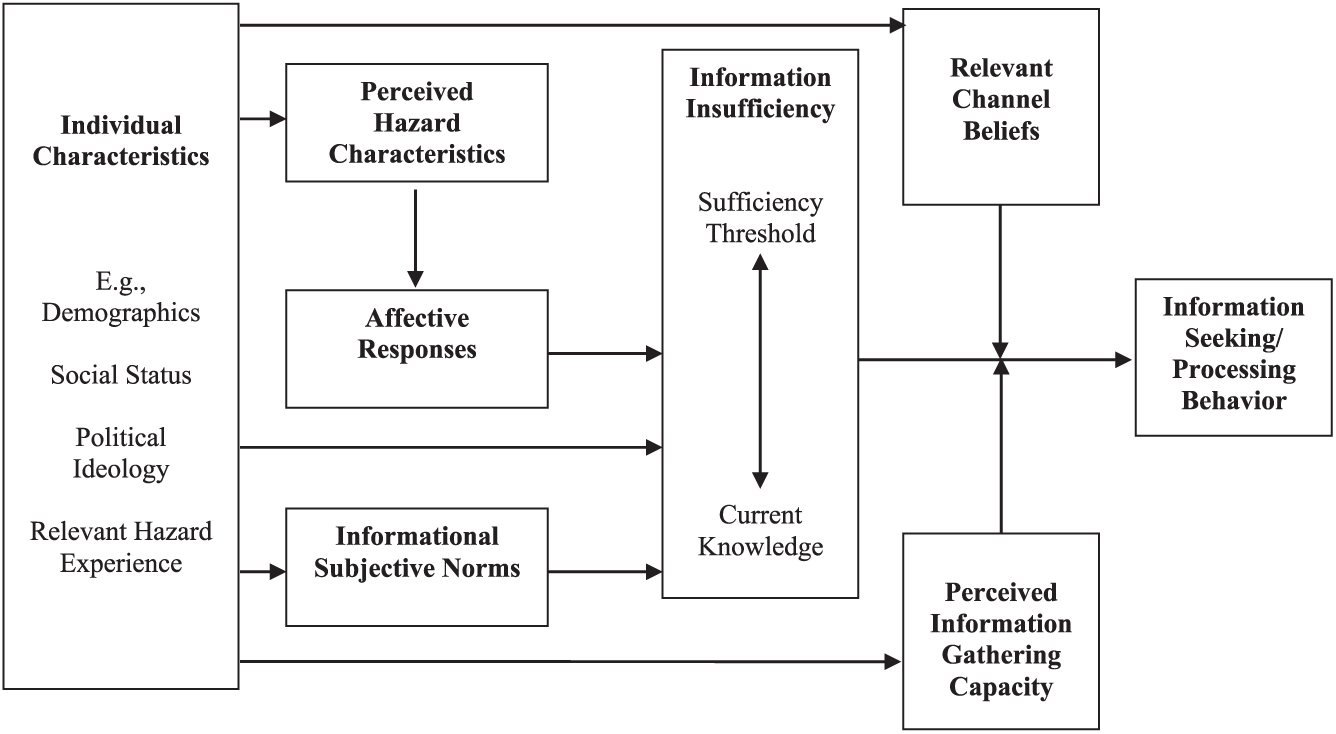
Risk information seeking and processing model (Griffin, Dunwoody, & Neuwirth, 1999).
A recent meta-analysis indicates that the RISP model accounts for about one third (34%) of the variance in systematic processing, although the range of R2 disperses from 3% to 78% (Yang, Aloe, & Feeley, 2014). Furthermore, comparing different research contexts, Yang, Aloe, and Feeley. (2014) concluded the RISP model performs better for risk topics that are familiar and important to the research participants, even when these same topics are not personally relevant. For example, in three research contexts ranging from cancer clinical trials (Yang et al., 2010) to urban flooding (Griffin et al., 2008) to climate change (Rickard, Yang, Seo, & Harrison, 2014), the amount of variance accounted for by the model in systematic processing increased from 25% to 31% to 41%. Below, key constructs from the RISP model will be reviewed briefly as their significance related to the presidential election and climate change contexts is highlighted.
Central to the RISP model is the synergistic influence of risk perception and affective responses that elevates individuals’ perceived information insufficiency and subsequently leads them to more actively seek and process relevant information. Past research has generally supported these propositions. For instance, Griffin et al. (2008) found that perceived risks from urban flooding led to more angry feelings toward management agencies, and both risk perception and anger were positively related to information insufficiency and systematic processing. Specifically related to climate change, risk perception elicits negative emotions such as worry, which subsequently influences information seeking and avoidance (Yang & Kahlor, 2013). In general, the RISP model posits that when people perceive greater risks from a specific hazard, they will sense stronger emotional responses (most likely negative in valence). These cognitive and affective reactions to the potential risk then lead them to gauge their existing information level and decide whether they need to acquire additional information or to deal with existing information more systematically.
Considering the nature of presidential campaigns, which involves rhetorical appeals toward ethos, pathos, and logos, it is reasonable to believe that voters will not only evaluate the potential risks cognitively (O’Cass & Pecotich, 2005), but also feel emotionally charged when making decisions (Kolagani, Negahban, & Witt, 2017; Valentino, Brader, Groenendyk, Gregorowicz, & Hutchings, 2011). For instance, a divided and pessimistic electorate offered sharply diverged views on the seriousness of an array of problems, ranging from illegal immigration to gun violence, in surveys conducted in the two weeks leading up to the presidential election (Pew Research Center, 2016a). Similarly, a myriad of studies has shown that in addition to perceived risk, affective responses such as fear, often shape people’s attitude toward climate change and climate change mitigation (Leiserowitz, 2006; Meijnders, Midden, & Wilke, 2001). Together, these studies support the integrative approach to studying risk perception as related to both cognitive and emotional evaluations.
In this research, we examine two discrete emotions—fear and anger, both of which are emotions the U.S. public likely associated with the 2016 presidential election (Kolagani et al., 2017) and climate change (Feldman & Hart, 2016). The rationale here is that the potential outcomes from the election and climate change could threaten individuals’ well-being or present an affront to one’s values (Nabi, 1999), although the results of the election are much more tangible than the impacts of climate change. Appraisal theories argue fear is an emotion that is charged with unpleasantness, low certainty, moderately strong situational control, and it usually involves the attribution of responsibility to others, as opposed to the self (Smith & Ellsworth, 1985). Previous research found that fearful individuals are more likely to perceive greater risks about terrorist attacks and tend to avoid further retaliation (Lerner, Gonzalez, Small, & Fischhoff, 2003; Skitka, Bauman, Aramovich, & Morgan, 2006). Fear, as an emotion that is associated with low certainty, is also linked with an elevated interest in relevant information and systematic processing (O’Cass & Pecotich, 2005; Tiedens & Linton, 2001).
In contrast, anger involves appraisals such as high certainty, strong human control, and other responsibility (Smith & Ellsworth, 1985). Although research based on the appraisal tendency framework shows that angry individuals tend to make lower estimates about unrelated risk events (Lerner & Keltner, 2001), past studies have also shown that when the risk being evaluated is consistent with the stimulus that elicited the emotion, anger may be positively related to risk perception (Griffin et al., 2008; Kahlor et al., 2018). This is particularly the case when a perceived risk is accompanied by a perceived lack of personal control over the risk situation (Griffin et al., 2008), which is likely the case for climate change and presidential elections; in both contexts people may question whether their action will affect the overall risk posed (Bliuc et al., 2015; Hasell & Weeks, 2016; Reser & Swim, 2011). Thus, based on the RISP model’s proposition and existing empirical evidence, we hypothesize that risk perception would be positively related to fear (
The RISP model proposes that information insufficiency is a key motive behind people’s information seeking and processing. Building on the HSM’s sufficiency principle, information insufficiency depicts the gap between individuals’ perceived knowledge about a pending risk and their sufficiency threshold, a factor used to describe individuals’ subjective judgment of the amount of information they need to adequately deal with the risk (Figure 1). Several studies have identified a significant, positive influence that information insufficiency has on systematic processing (Griffin et al., 2008; Kahlor, Dunwoody, Griffin, Neuwirth, & Giese, 2003). As both the presidential election and climate change are salient topics at the time of data collection, a fair proportion of the U.S. public might have felt inundated or even overwhelmed by the volume and depth of media coverage on these issues (Gottfried, 2016).
1
Therefore, it would be interesting to examine how information insufficiency influences information processing behaviors related to these two topics. In particular, we anticipate that controlling for perceived knowledge, participants who report a greater sufficiency threshold (greater need for information) would be more likely to engage in systematic processing (
Furthermore, appraisal theories suggest that fear is associated with high uncertainty, whereas anger is charged with high certainty (Smith & Ellsworth, 1985). Thus, it is possible that when people experience fear, they will feel more uncertain about their existing knowledge and thus desire more information, whereas when they feel angry, they will feel more confident about what they already know and, therefore, less likely to sense a need for more information. In the context of the election, we can anticipate that individuals who feel fearful about the potential outcome of the election will want to know more about it, whereas those who feel angry will hold on to their existing beliefs more closely and not pursue additional information (Kahlor et al., 2018). Research related to motivated reasoning has evidenced these assumptions (Bolsen, Druckman, & Cook, 2014; Slothuus & de Vreese, 2010). Similarly, when people feel fearful about climate change, they are likely to desire more information about the possible impacts of climate change. In contrast, people who feel angry about climate change are likely upset about what is or is not being done to mitigate climate change impacts and perceive themselves to know quite a bit about this topic. Linking these theoretical arguments to the RISP model’s information insufficiency concept, we further hypothesize that fear would be positively related to sufficiency threshold (greater need for information;
Incorporating the concept of social norms from the TPB, the RISP model proposes that when individuals perceive that others want them to stay on top of information about a risk topic, they will gauge how much they currently know about the issue and subsequently allocate more resources to processing relevant information as needed to meet those expectations. This concept, termed as informational subjective norms, tackles the impression management motivation and entails social expectations about one’s knowledge of a risk topic (Eagly & Chaiken, 1993). Given the divisive nature of the 2016 election and the ideological divide in the U.S. public’s attitudes toward climate change (Leiserowitz et al., 2016), it is reasonable to believe that when individuals sense that it is socially desirable to have knowledge about these controversial political topics, they would perceive greater information insufficiency (
Based on theories of media processing (Kosicki & McLeod, 1990), the RISP model suggests that individuals’ beliefs about existing information on a news topic are also likely to influence their communication behaviors (termed as relevant channel beliefs). That is, when people believe that the information available to them is unbiased and provides cues about its validity, they are more likely to process it systematically. Although there is some empirical support for the relationship between cues to validity and systematic processing (Griffin et al., 2008), this variable suffers from limited content validity and low reliability.
When the RISP model was proposed, mass media were still the dominant source of information for most people. Today, given the countless possible information sources, Kahlor (2010) reconceptualized relevant channel beliefs by incorporating the TPB’s behavioral beliefs construct and proposed to measure this variable as individuals’ general attitudes toward information seeking activities in the planned risk information seeking model (PRISM), a derivative of the RISP model. Studies have shown that this variable is a strong predictor of seeking intention across various health and environmental contexts (Ho, Detenber, Rosenthal, & Lee, 2014; Willoughby & Myrick, 2016). In this study, although the focused behavior is information processing, it is reasonable to believe that people who hold more favorable attitudes toward gathering information about the election and climate change are likely to more actively process this information. Therefore, we hypothesize that attitude toward information seeking would be positively related to systematic processing (
Finally, perceived information gathering capacity depicts one’s perceived ability to gather and process risk information systematically, which involves message comprehension and the ability to synthesize new information. This concept reflects the TPB’s perceived self-efficacy variable, as well as the notion of processing capacity as theorized in dual-process models (Petty & Cacioppo, 1986). The role of perceived information gathering capacity is increasingly marginalized in RISP studies (Yang, Aloe, & Feeley, 2014), perhaps because capacity is unlikely to be a determining factor for seeking and processing behaviors in a world saturated with information. However, considering the heated debates on the veracity of information related to the presidential election and climate change in the media (Lewandowsky, Ecker, Seifert, Schwarz, & Cook, 2012), individuals with greater perceived self-efficacy may also perceive themselves to know more accurate facts about these topics. This proposition is consistent with the knowledge gap hypothesis (Tichenor, Donohue, & Olien, 1970), which suggests that the ability to acquire information is one factor that leads certain segments of the population to have greater knowledge about social issues. Past research based on the RISP model has also shown that perceived information gathering capacity is often positively correlated with perceived knowledge (Griffin et al., 2008). Therefore, we hypothesize that individuals with higher perceived information gathering capacity would report more perceived knowledge (
Political Ideology
Although political ideology is specified in the RISP model (Figure 1) as an individual characteristic that is likely to influence people’s risk perceptions and communication behaviors, it is rarely examined specifically. Nonetheless, political ideology is likely to play an important role in this research because both the 2016 presidential election and climate change are highly politicized issues. Political psychology researchers view ideology as a system of interconnected values that play essential roles in guiding people’s personal and social lives (Jost, Federico, & Napier, 2009). Furthermore, they distinguish symbolic political ideology, which often serves as a loose guideline on attitude formation (Krantz & Monroe, 2016) from operational ideologies that usually have a stronger impact on people’s attitudes toward specific social issues. For instance, political scientists have shown repeatedly that many Americans who identify themselves as symbolic conservatives are operational liberals (B. I. Page & Shapiro, 1992; Stimson, 2004; Zaller, 1992).
Besides the mounting empirical evidence showing the impact of political ideology on risk perception and policy support related to climate change (Bolsen, Druckman, & Cook, 2015; Dunlap & McCright, 2011), there is also strong theoretical support for the role of political ideology as a moderator in the proposed theoretical model (Figure 2). For instance, shared reality theory suggests that people often express their ideological opinions to maintain relationships with in-group members (Hardin & Higgins, 1996). Research also suggests that Americans use online information sources to increase their exposure to opinions consistent with their own political views (Garrett, 2009). Therefore, we can expect the magnitude of the relationships between informational subjective norms and information insufficiency to vary depending on political ideology, especially in the climate change context, because it is more socially desirable to embrace information related to climate change among liberals.
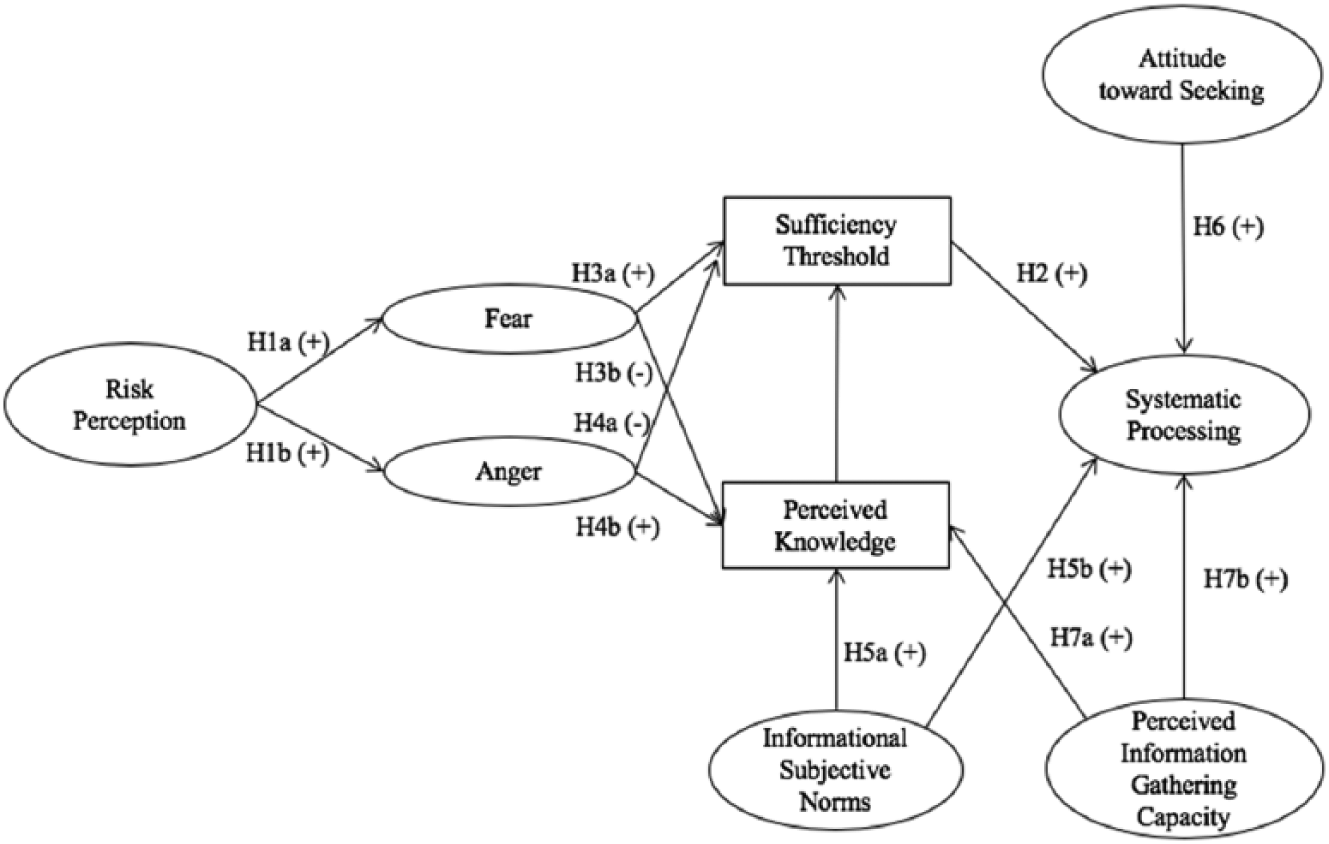
Theoretical model with hypothesized relationships.
In terms of the relationship between informational subjective norms and systematic processing, however, both conservatives and liberals may be motivated to allocate more processing resources to relevant information about the election and climate change when they sense that their in-group members want them to know something about these topics. Indeed, prior research suggests that in the context of the 2016 election, information subjective norms were positively related to information seeking intentions among both conservatives and liberals (Kahlor et al., 2018). Similarly, the impacts of perceived information gathering capacity and attitude toward seeking on systematic processing may also vary depending on whether acquiring information about these topics is considered a socially popular behavior among conservatives and liberals. That is, when people believe others in their important reference groups want them to pay attention to information about the election and climate change, they may perceive themselves to have a greater ability to deal with this information and hold more favorable attitudes toward information acquisition activities, both of which will lead to more systematic processing.
Focusing on risk perception, past research has shown that conservatives are more sensitive to threat and uncertainty (Jost & Amodio, 2012), which leads them to have a stronger negativity bias (Hibbing, Smith, & Alford, 2014) and experience stronger emotional reactions to negative outcomes (Joel, Burton, & Plaks, 2014). Political psychology studies also found that conservative thinking is motivated by the desire to maintain the certainty in one’s surroundings and avoid potential threat to existing social structure (Jost & Banaji, 1994). Therefore, it is possible that risk perception would lead to different levels of fear and anger among conservatives and liberals, which subsequently would lead them to desire more information (certainty) about the presidential election and climate change. Rather than stating specific hypotheses based on all these potential moderation effects, we will evaluate the degree to which political ideology influences the overall fit of the model and individual path loadings in these two samples as a research question (
Method
Samples
Our goals in this research are to explore the impact of risk perceptions and risk-related emotional responses (fear and anger) on systematic processing of information related to the 2016 presidential election and climate change. Because we were interested in deliberate information processing, we collected survey data in the month leading up to Election Day on November 8, 2016. From October 6 to October 23, 2016, data were collected from two national samples randomly selected from Qualtrics panels.
For the presidential election sample (n = 520), which matches the distribution of the U.S. adult population in age, gender, race, political affiliation, and household income, median survey completion time was 10 min. Participants’ ages ranged from 18 to 90 years (M = 46.61, SD = 16.53). There were slightly more females (51.5%), and the majority identified themselves as White (62.3%). The remainder consisted of Hispanics (17.3%), African Americans (13.3%), Asians (5.2%), and others (1.9%). The sample included 32.1% Republicans, 35% Democrats, and 32.9% Independents, which is close to the party affiliation statistics reported by the most recent Gallup survey (Gallup, 2016). Median household income was in the bracket from US$50,000 to US$74,999. Among the participants, 41.5% had bachelor’s degrees or higher, 13.5% had 2-year college degrees, 23.1% had some college education, 20.2% had high-school education, and 1.7% did not finish high school. On a 7-point scale from 1 (very conservative) to 7 (very liberal), political ideology was measured with two items assessing participants’ political attitude toward economic issues and social issues. Upon reliability check (α = .86), these items were averaged to create an index of political ideology (M = 3.65, SD = 1.69).
During the same time frame, we also collected data related to climate change, which is a context that has evidenced the utility of the RISP model in explicating information processing (Rickard et al., 2014). The climate change data (n = 519) was also fielded through Qualtrics. Participants who participated in one survey were not allowed to participate in the other. Median survey completion time was also about 10 min. Participants’ age ranged from 18 to 88 years (M = 46.72, SD = 17.07). There were slightly more females (51.4%), and the majority self-identified as White (62.4%). The remainder consisted of Hispanics (17.3%), African Americans (13.3%), Asians (5%), and others (1.9%). The sample included 29.9% Republicans, 35.1% Democrats, and 35.1% Independent, which is again, similar to the party affiliation statistics reported by the 2016 Gallup survey. Median household income was in the bracket from US$50,000 to US$74,999. Among the participants, 42% had bachelor’s degrees or higher, 11% had 2-year college degrees, 24.3% had some college education, 21.4% had high-school education, and 1.3% did not finish high school. Again, participants reported slightly more conservative political ideology (M = 3.77, SD = 1.63, α = .81). Overall, the two samples were comparable in terms of demographic distribution.
Measures
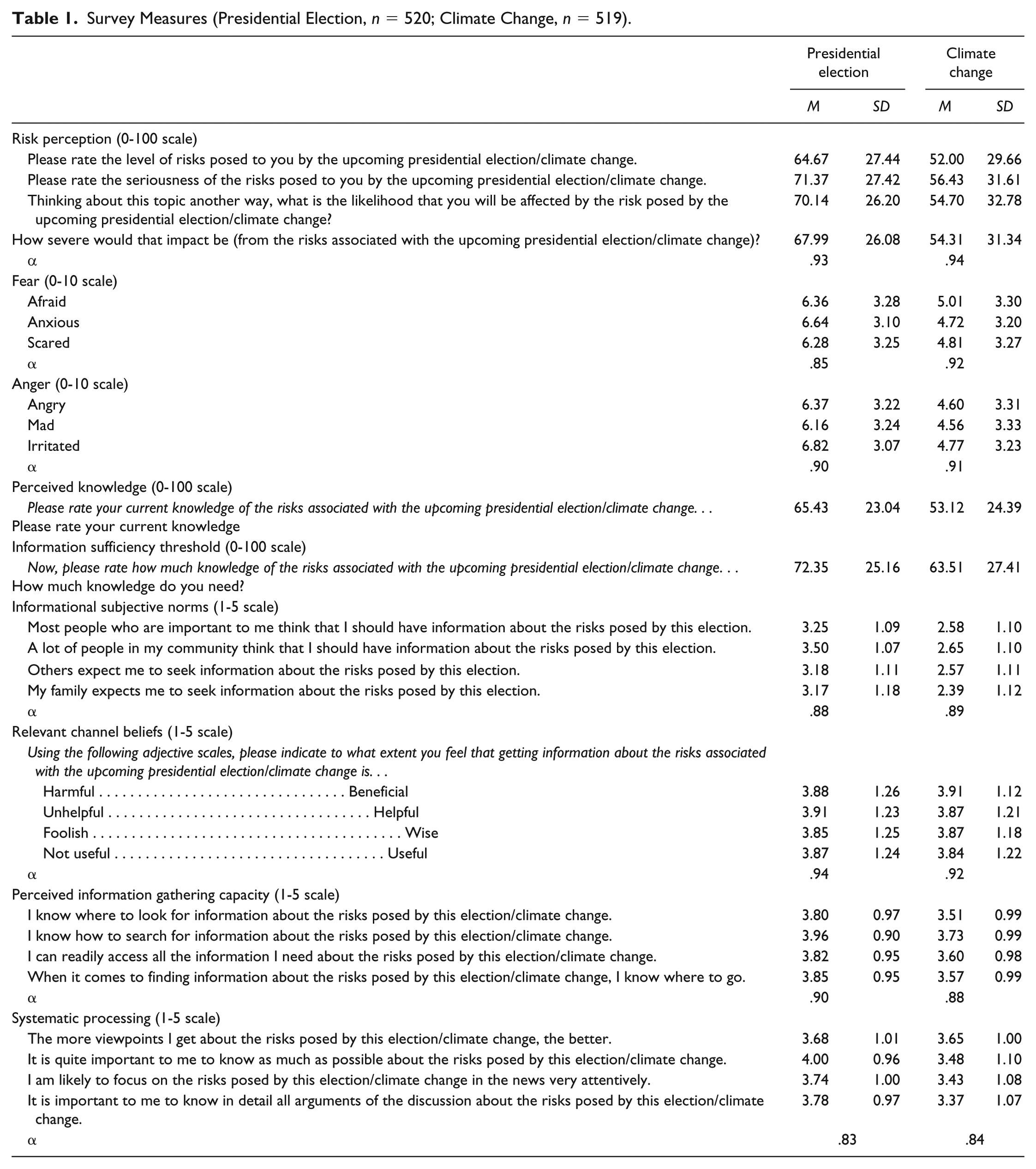
The measures used in both surveys were adopted from past research. Items were worded identically in both surveys except for the reference point, which was either the “upcoming presidential election” or “climate change.” Table 1 presents descriptive statistics and reliability scores for each survey.
Survey Measures (Presidential Election, n = 520; Climate Change, n = 519).
Analysis
Structural equation modeling was conducted with Mplus 7.3 to test hypotheses and examine model fit. A maximum likelihood estimator with robust standard errors (MLR) was employed to account for potential issue with multivariate normality, although the normality assumption was not violated for any individual observed variable. For single-indicator latent measures (perceived knowledge and sufficiency threshold), a 20% error variance was specified to account for possible measurement error. Political ideology served as the grouping variable (0 = conservatives, 1 = liberals). Two-step modeling verified the measurement model before adding proposed paths to test the structural model (Kline, 2015). Most factor loadings in the measurement model were above .70. Indicators of model fit included chi-square, comparative fit index (CFI; values close to or greater than .95), Tucker–Lewis index (TLI; values close to or greater than .95), root mean square error approximation (RMSEA; values lower than .08), and standardized root mean residual (SRMR; values lower than .08; Hu & Bentler, 1999).
Results
Table 2 shows model fit statistics for the measurement model and the final multiple-group model, all of which suggest good fit to the data. To examine whether the theoretical model was invariant between liberals and conservatives, we created two models—an unconstrained model (default model) and a model with parameters constrained. If constraining the parameters results in a significantly worse fit, we can conclude that the regression weights in the model as a whole for conservatives and liberals are different. In the presidential election sample, results from adjusted chi-square difference test indicate that the constrained model has a statistically significant worse fit than the default model, χ2(52) = 110.69, p < .001, which means the hypothesized model is not invariant between the two groups. Furthermore, the model seems to provide a better fit to the data among conservatives (this group contributes less to the total chi-square). Similarly, in the climate change sample, the model is also not invariant between the two groups, χ2(56) = 416.52, p < .001, and the model seems to provide a better fit to the data among liberals. For the ease of interpretation, Figures 3 and 4 show unstandardized regression coefficients across the two groups for paths that are significant in at least one group. Path coefficients that are not significantly different between the two groups were fixed to be equal. Overall, the proposed theoretical model accounts for about 60% of the variance in systematic processing in the election sample and about 70% of the variance in the climate change sample, which is consistent with past research (Yang, Aloe, & Feeley, 2014). 2
Summary of Fit Indices.
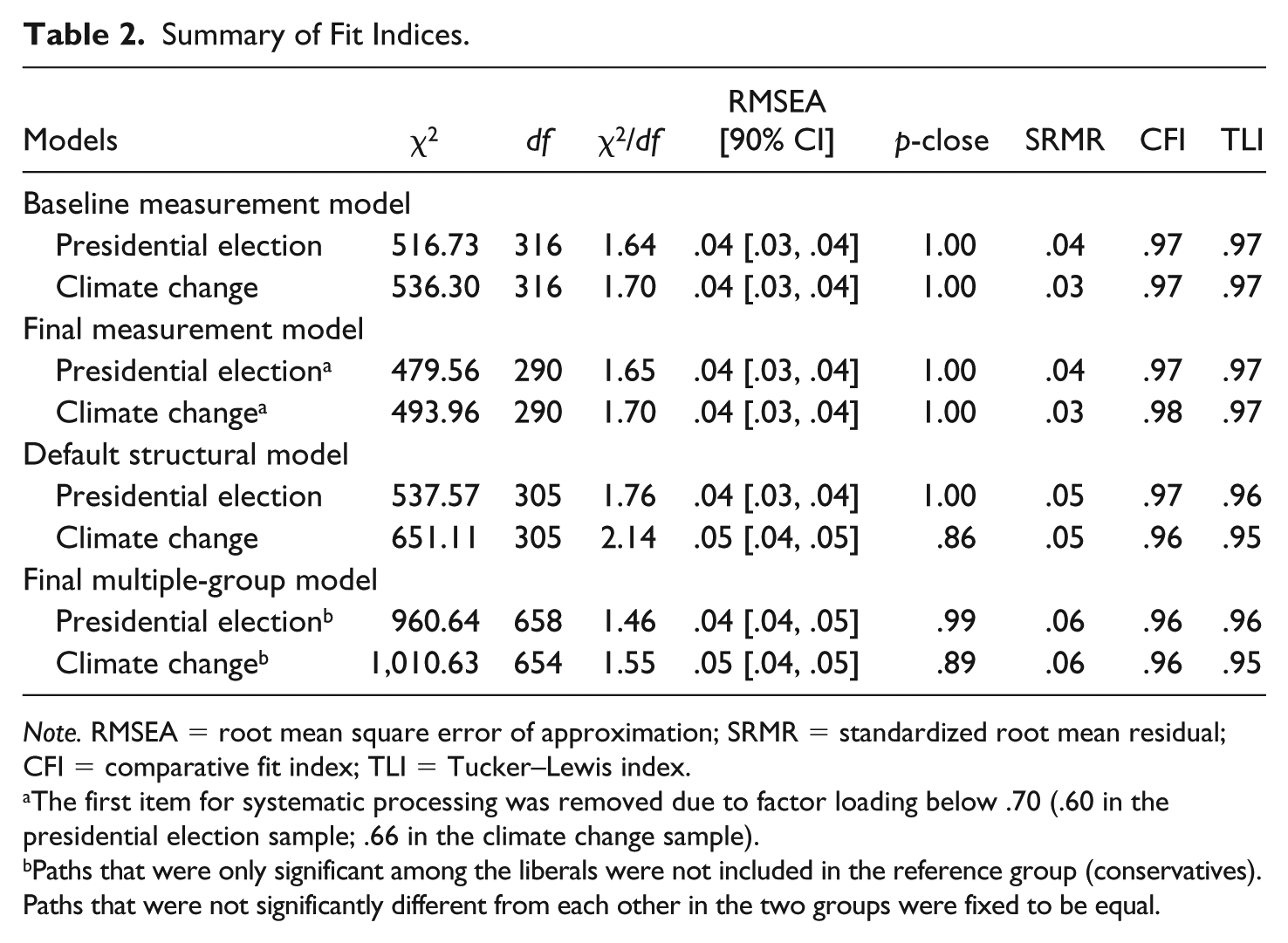
Note. RMSEA = root mean square error of approximation; SRMR = standardized root mean residual; CFI = comparative fit index; TLI = Tucker–Lewis index.
The first item for systematic processing was removed due to factor loading below .70 (.60 in the presidential election sample; .66 in the climate change sample).
Paths that were only significant among the liberals were not included in the reference group (conservatives). Paths that were not significantly different from each other in the two groups were fixed to be equal.

Results from the election sample.

Results from the climate change sample.
To address the first hypothesis, which is focused on the relationship between risk perception and discrete emotions, we found that risk perception is positively related to fear (
The second hypothesis is focused on the relationship between information insufficiency and systematic processing. Considering this relationship is central to the RISP model’s propositions, it is not surprising that information insufficiency is positively related to systematic processing (
The third hypothesis is focused on the relationship between fear and information insufficiency. In the election sample, fear is significantly related to sufficiency threshold (
The fourth hypothesis is focused on the relationship between anger and information insufficiency. In the election sample, anger is not significantly related to sufficiency threshold (
The fifth hypothesis posits that informational subjective norms will be positively related to perceived knowledge and systematic processing. In both samples, informational subjective norms are only significantly related to perceived knowledge (
The sixth hypothesis posits a positive relationship between relevant channel beliefs and systematic processing. This relationship is invariant in the election sample (B = 0.16, SE = 0.04, p < .001), but it is only significant among conservatives in the climate change sample (B = 0.47, SE = 0.08, p < .001). Thus,
The final hypothesis suggests that perceived information gathering capacity will be positively related to perceived knowledge (
As shown in Table 3, there are significant indirect effects among key variables in the models. Specifically, fear mediates the relationship between risk perception and perceived knowledge, as well as the relationship between risk perception and sufficiency threshold in both samples. In contrast, anger only mediates the relationship between risk perception and perceived knowledge among liberals in the climate change sample. In addition to the parallel mediation effects, we also examined serial mediations between risk perception and sufficiency threshold. In the election sample, the path “risk perception → fear → knowledge → threshold” was significant only among liberals. In the climate change sample, both “risk perception → fear → knowledge → threshold” and “risk perception → anger → knowledge → threshold” are significant among liberals, but only the first path is significant among conservatives.
Standardized Indirect Effects on Key Endogenous Variables.
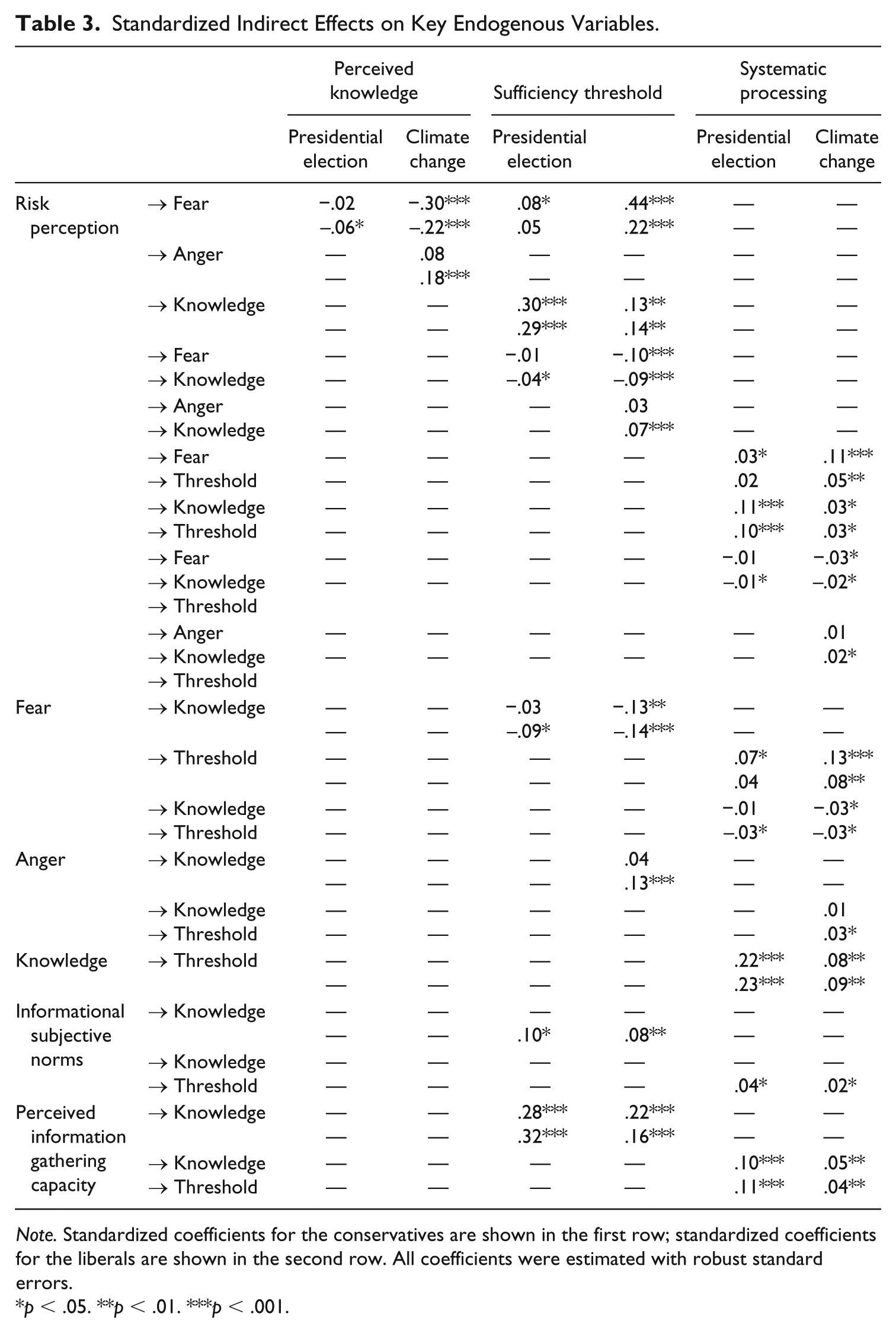
Note. Standardized coefficients for the conservatives are shown in the first row; standardized coefficients for the liberals are shown in the second row. All coefficients were estimated with robust standard errors.
p < .05. **p < .01. ***p < .001.
As for the indirect effects on systematic processing, significant mediation effects are discovered among all participants in both samples through “risk perception → knowledge → threshold → systematic processing.” Considering that this path resembles the core claims of the HSM and the RISP model, its consistent presence attests to the theoretical underpinning of these models. Furthermore, fear and anger also mediate the relationship between risk perception and systematic processing, as well as the relationship between perceived knowledge and sufficiency threshold, but these paths are more consistently observed in the climate change sample. Knowledge has significant indirect effects on systematic processing through sufficiency threshold in both samples. Finally, the indirect effects of informational subjective norms on sufficiency threshold and systematic processing are significant only among liberals, but perceived information gathering capacity has consistent, significant indirect effects on these variables in both samples.
Discussion
The main objective of this research is to apply a robust risk communication framework—the RISP model—to two controversial political issues to identify what motivated deeper processing of information about the presidential election and climate change right before Election Day in 2016. Results attest to the general explanatory power of the RISP model as it fits the data well in both samples and accounts for a large amount of variance in information insufficiency and systematic processing. Given the importance of political ideology in influencing attitudes toward these two issues, we used political ideology as a grouping variable in multiple-group structural equation modeling analysis and identified interesting differences between conservatives and liberals. We found that information insufficiency has a consistent relationship with systematic processing in both samples, which supports the central premise of the RISP model. Similarly, risk perception is significantly related to perceived knowledge in both samples. Furthermore, only among liberals are informational subjective norms significantly related to perceived knowledge. The highlight of the results is that risk perception elicits different levels of fear and anger among conservatives and liberals in the climate change context, whereas fear and anger have different impacts on information insufficiency and systematic processing across the two samples.
Informed by past research in political communication (Hibbing et al., 2014; Joel et al., 2014), we examined whether conservatives and liberals would report different levels of emotional reactions to the potential risks from the election and climate change. In support of existing research, we found that conservatives who believed that the risks from climate change would influence them personally actually reported more fear and anger as compared with liberals who shared these risk perceptions, perhaps because they are more sensitive to threat and uncertainty (Jost & Amodio, 2012) and tend to experience more emotional reactions to potential negative outcomes (Joel et al., 2014). This difference further leads to distinctive patterns of indirect effects from risk perception to other key constructs in the RISP model through emotions. In the climate change sample, liberals reported much higher risk perception, anger, and fear than conservatives, whereas both groups scored equally high on these variables in the election sample. Thus, these results suggest that regardless of political ideology, there was much uncertainty associated with the presidential election at the time of data collection. This uncertainty made many of them view the election as bearing significant risks to themselves, which elevated their fearful and angry responses to this event. Indeed, surveys conducted before the election show that majorities in both parties expressed very unfavorable views of the other party, with 70% of Democrats and 62% of Republicans saying that they were afraid of the other party (Pew Research Center, 2016b). Thus, our study, along with results from other national polls, indicate that for highly politicized issues, political ideology indeed plays a crucial role in determining people’s evaluation of information and subsequent decision-making processes.
Based on appraisal theories, we hypothesized that fear and anger would have different relationships with perceived knowledge and sufficiency threshold, the two variables that constitute information insufficiency in the RISP model. Largely in support of our hypotheses, in the climate change context, we found that fearful respondents were less confident about their existing knowledge and reported a greater desire for more information. Interestingly, this fear-induced desire to know more about climate change was also stronger among conservatives. This result might be partially explained by the fact that conservative thinking is driven by the desire to maintain certainty in one’s surroundings (Jost & Banaji, 1994). Thus, as a core appraisal dimension of fear, uncertainty indeed seems to influence how people gauge their information insufficiency related to an unfamiliar topic such as climate change.
Furthermore, among liberals, fear also had a direct, significant relationship with systematic processing, which supports past research (Tiedens & Linton, 2001). Interestingly, angry liberals were much more likely to believe that they already knew a lot about climate change, which may or may not reflect actual knowledge. In comparison, in the election context, conservatives and liberals demonstrated very different response patterns. Fear was only significantly related to sufficiency threshold among conservatives, whereas the relationship between fear and perceived knowledge was only significant among liberals. These results suggest that when facing the impending election, fearful conservatives wanted to find out more about the election, whereas fearful liberals believed that they knew very little, perhaps suggesting a sense of despair or a failure to comprehend what was going on in this country. In the election context, although both liberals and conservatives reported high levels of anger, this emotion did not seem to influence their information insufficiency, which reflects the high certainty appraisal pattern of anger (Smith & Ellsworth, 1985; Tiedens & Linton, 2001).
Regarding informational subjective norms, it appears that in general, liberals are more sensitive to social expectations when judging their existing knowledge and sufficiency threshold about these two topics. Nevertheless, informational subjective norms had significant direct and indirect impacts on processing in both samples, which supports existing empirical research (Griffin et al., 2008; Kahlor et al., 2003) and the amended RISP model (Griffin, Dunwoody, & Yang, 2012). The amended RISP model positions informational subjective norms as a central motivator of information seeking and processing, along with information insufficiency. Interestingly, in the election context, conservatives who sense that others expect them to know something about this topic are more likely to want to know in detail all arguments of the discussion about the risks posed by the election, more so than liberals. In contrast, in the climate change context, the relationship between informational subjective norms and processing is invariant between conservatives and liberals. This seemingly counterintuitive finding actually makes sense when evaluated together with results from other predictors of systematic processing.
Specifically, it is interesting to see that in the election sample, informational subjective norms exerted the strongest influence on conservatives, whereas perceived information gathering capacity was a significant predictor only among liberals. Therefore, for conservatives to actively process information about the election, in-group approval and social popularity of this behavior seem to be the most important motivational factors. In contrast, only liberals were influenced by their perceived ability to comb through news and facts when dealing with information about the election. This contrast has meaningful implications on how conservatives and liberals navigated the complicated information landscape surrounding the 2016 election in the news media (Patterson, 2016). Although conservatives were more likely to get entrenched in the talking points put forward by conservative media because of the norms they observed among their in-group members, liberals were more likely to engage in systematic processing when they believed that they had the capacity to access and understand relevant information. Thus, given the looming concern over “fake news” during the 2016 election cycle (Allcott & Gentzkow, 2017), it was possible that conservatives and liberals have taken different approaches in processing information, with liberals relying more on self-efficacy and conservatives relying more on perceived norms. In the context of climate change, a different picture has emerged. Here, only conservatives were likely to rely on attitudes toward existing information, which is essentially a heuristic cue, to decide whether or not to actively process risk information about climate change. Quite differently, fearful liberals were more likely to process climate change information systematically, and general attitudes toward information acquisition activities did not matter much in influencing their processing behaviors related to climate change.
While discussing these results, it is also important to point out limitations within this research. First and foremost, we assessed participants’ perceived risks from the election and climate change, but we were not able to pinpoint what exactly constituted these risk perceptions. As related to these two issues, risk perceptions could entail a multiplex of factors that are perhaps intertwined. That is, both the 2016 presidential election and climate change are highly politicized and polarized issues in the United States. Therefore, political ideology, as well as other individual characteristics, may exert similar impacts on risk perceptions related to these two topics. These similarities may have contributed to the overall model fit in multigroup structural equation modeling. Future research needs to include open-ended responses to more carefully tease apart what comes to mind when people consider the risks involved in these two issues. In terms of exploring the utility of the RISP model in explicating motivations for information processing, future research should also consider examining risk topics that are not as politicized as the ones covered in this research.
Second, while other discrete emotions may occur when people think about these two topics, we only examined fear and anger in this research. For instance, recent research on the role of hope in influencing information processing in the climate change context deserves more attention in the future (Chadwick, 2015). Hope also was a crucial factor in research related to prior presidential elections (Finn & Glaser, 2010). Third, information seeking is the focal attitudinal object for the items used to assess attitude and perceived information gathering capacity, which is an approximation in operationalization of these two concepts. Future research needs to design more precise measures for these two concepts when information processing is the focal behavior.
Fourth, we employed quota sampling to achieve two samples that resembled the U.S. adult population on several important demographic characteristics, but the samples were by no means representative of the general U.S. population. Fifth, one of the items designed to measure information processing (i.e., “The more viewpoints I get about the risks posed by this election/climate change, the better”) had a factor loading below .70. Considering information processing items often resulted in lower reliability (see, for example, Griffin et al., 2008), future research should continue to explore more robust measurement strategy for this concept. Finally, structural equation modeling often exudes an illusion of causality, and although the proposed model was based on theory, readers should be cautioned not to make assumptions of causality because of the nature of our cross-sectional data.
Conclusion
In sum, results from two large-scale surveys among Qualtrics panelists indicate that risk perceptions and discrete emotions (fear and anger) influenced individuals’ information insufficiency and systematic processing in different ways, depending on their political ideology. In the election sample, fearful conservatives reported a greater need for information, whereas fearful liberals perceived to know less about the election. In contrast, in the climate change context, fear was consistently related to greater information need and less perceived knowledge among both conservatives and liberals, whereas angry liberals perceived to have more knowledge. Fearful liberals were also more likely to process climate change information more systematically. In general, liberals seem more sensitive to social expectations on their knowledge level about these two topics, but these informational subjective norms had a stronger influence on conservatives’ information processing in the election context. In contrast, when it comes to climate change, conservatives seem to rely on heuristic cues such as general attitudes toward existing information when deciding whether to engage cognitive resources to deal with relevant information. Consistent with the RISP model, information insufficiency was a consistent predictor of systematic processing in both samples. These results suggest that political ideology is indeed an important determinant of the U.S. public’s general interest in these two topics. Results from this study suggest a utility of the RISP model in explicating motivations for information processing behaviors beyond traditional risk topics related to environmental and health issues.
Footnotes
Declaration of Conflicting Interests
The author(s) declared no potential conflicts of interest with respect to the research, authorship, and/or publication of this article.
Funding
The author(s) received no financial support for the research, authorship, and/or publication of this article.