




Abstract
When U.S. President Donald Trump called the press the “enemy of the American people” and “FAKE NEWS” in a February 2017 tweet, his statement inspired a robust debate about the credibility, institutional norms, and national significance of the press, which were debated on social media by both journalists and non-journalists using the popular hashtag #NotTheEnemy. Because previous research suggests that elite discourse of “fake news” decreases public trust in the press, this tweet presented a unique danger to the journalistic paradigm and public trust in American journalism. Through a mixed-method approach combining quantitative content analysis and qualitative textual analysis, this research explores the major themes and dominant sentiments of this public discourse about the press and analyzes #NotTheEnemy’s contributions to reinforcing the journalistic paradigm in the wake of the president’s attack and its impact on American public opinion of and trust in the media.
The role of the American news media is a frequent topic of public and political debate. In recent history, U.S. journalists have been plagued by attacks in public discourse by members of the political elite (Van Duyn & Collier, 2018) and accusations of bias and inaccuracy from the American public (Knight Foundation, 2018). U.S. President Donald Trump verbally attacked the Fourth Estate repeatedly during his candidacy leading up to the November 2016 U.S. presidential election, but he cemented his distaste for the press in a social media statement that immediately sparked a popular hashtag when he shared it from his Twitter account on February 17, 2017. Three months after taking office, Trump called the news media “the enemy of the American People” and “FAKE NEWS” in a tweet that derided the New York Times, NBC, ABC, CBS, and CNN by name. During his time in the Oval Office, Trump and his administration have also disallowed reporters from White House press briefings (Higgins, 2017) and leveled other insults at the news media, calling them, among other things, “partisan, distorted and fake” (Grynbaum, 2017) and “sick people,” who don’t like the United States and want “to take away our history and our heritage” (Rutenberg, 2017). Today, these presidential insults are so common that the New York Times, a frequent target of them, referred to the taunts as being part of “Washington’s white noise” (Grynbaum, 2017).
However, this particular insult—the “enemy” label—comes with a controversial and divisive history fraught with loaded meaning (Higgins, 2017). This specific choice of words and the overtly public nature of the insult, combined with the timing of the statement and its delivery via Twitter, sparked an overwhelming response from other Twitter users, who adopted the hashtag #NotTheEnemy in hundreds of thousands of tweets inspired by the President’s message and aimed largely at countering it. In their public discourse, journalists and non-journalists described the purpose of the press, cited highlights from journalism history, and remembered journalists who were injured or killed while reporting, among other key themes emphasizing the value of the U.S. press.
As the standards, tools, roles, and financial future of the industry continue to evolve, so does public opinion of journalism, which is captured repeatedly through polls, protests, social media, and other measures of public opinion. The purpose of this study is to analyze the Twitter dialogue surrounding #NotTheEnemy as one corpus of public opinion about the role and value of journalists and journalism. By exploring how the discourse surrounding this hashtag, particularly that contributed by journalists, contributes to a defense and reinforcement of the journalistic paradigm, this research applies the theory of paradigm repair.
To analyze this discourse, researchers collected more than 108,000 tweets featuring the hashtag #NotTheEnemy collected between February 18 and March 21, 2017, and completed a qualitative textual analysis and a quantitative content analysis of a sample from the corpus. These methods documented the major themes of the #NotTheEnemy movement on Twitter and explored the roles of journalists, non-journalists, hashjackers, and bots in the public discourse. The resulting analysis explores the elements of the journalistic paradigm these users invoked, inspired by the threat to the journalistic paradigm posed by Trump’s accusation. This study contributes to academic and professional understanding of how the public perceives journalism and extends journalistic paradigm research by studying how a modern public defense of the industry was mounted through Twitter via journalists united with non-journalists through a shared goal to protect American journalism from an elite threat in a polarized political climate.
Literature Review
Threats to Media Trust During the Trump Era
From calling the press the “enemy of the people,” “FAKE NEWS,” “scum,” and “slime” (Remnick, 2018) to accusing journalists of “starting wars” (Hains, 2018), U.S. President Donald Trump’s relationship with the press is publicly adversarial. In one example among many, in a speech on July 24, 2018, Trump urged listeners not to trust the media, stating, “Don’t believe the crap you see from these people, the fake news . . . What you’re seeing and what you’re reading is not what’s happening” (Cillizza, 2018). Trump’s vilification of the press encourages Americans to question, doubt, and in the most extreme cases, attack news and information that doesn’t align with a particular political viewpoint. Trump’s anti-press discourse has fueled his most ardent supporters, who have threatened and insulted journalists covering Trump’s rallies (Remnick, 2018).
And Trump’s sentiments might well be contagious. People exposed to elite discourse about the problem of “fake news” both display less trust in the media and are less likely to correctly identify what news is real (Van Duyn & Collier, 2018). These problems are further complicated when elites discuss fake news “without context and caution” (Van Duyn & Collier, 2018). According to a July 2018 Quinnipiac University poll, 75% of Republicans trusted Trump more than the media “to tell the truth on important issues,” compared to 54% of total respondents from all political backgrounds (Bump, 2018). According to a Knight Foundation (2018) study, Americans consider 62% of news they consume on TV, in newspapers, and on the radio to be biased and 44% of it to be inaccurate. The same study revealed that Americans also do not distinguish between bias and inaccuracy, generally finding news organizations they believe to be biased to also be inaccurate, and vice versa. This lack of trust also has negative implications for media literacy: For example, people with more trust in the media are more likely to be able to distinguish real news from opinion (Mitchell, Gottfried, Barthel, & Sumida, 2018). In an era when accurate news content opposing one’s political ideology is labeled “fake news,” this media sentiment from the public is especially troubling.
However, it isn’t new. Watts, Domke, Shah, and Fan (1999) documented perceived media bias during the 1988, 1992, and 1996 U.S. presidential elections and the statements of conservative political elites “who have proclaimed a liberal bias that is viewed as including the entire media industry” (p. 144). Similarly, Ladd (2010) found that elite political partisans play a powerful role in how citizens perceive the media. And who is more elite in the American political system than the President? The current relationship between the press, the public, and the President could be seen as existing in a post-truth era in which misinformation is eroding trust in communication that is critical to maintaining a functioning democracy.
Journalistic Paradigm
Like many professions, journalism subscribes to a paradigm, or a widely shared system of institutional values and priorities that can be used “to create and organize knowledge, and also to define themselves and maintain their own authority” (Coddington, 2012, p. 379). Paradigms guide the way people in a group make decisions and behave, and they structure group membership by making it clear who belongs. A key element of the journalistic paradigm is the extent to which objectivity has influenced the public perception of journalism (Bennett et al., 1985; Hindman & Thomas, 2013; Vos & Moore, 2018). Objectivity is rooted in three shared assumptions: that journalists can recognize news when they see it; that news contains “objective news values” (Cecil, 2002, p. 48); and that when journalists recognize those news values, they will cover the news in an unbiased, objective fashion. This objectivity norm comes under attack when the press is accused of being “fake news.”
Other significant values shared by journalists include their gatekeeping role and the belief that news is distinct from entertainment (Coddington, 2012). Deuze (2005) researched the ideology of journalists across the globe and discovered several values of the profession shared by all, including objectivity, autonomy, immediacy, and ethics. To maintain this status, journalists must question the world around them and rely on hard facts to prove an objective case. Accusations of “fake news” call into question journalists’ ethics, as well as their objectivity. The journalistic paradigm is self-enforced, to an extent (Cecil, 2002). When necessary, the “media enforce their own boundaries by insisting that reporters with non-mainstream values keep them out of news accounts” (Berkowitz, 2000, p. 425). These standards are also established and maintained through journalistic norms and routines spread through newsroom osmosis (Breed, 1955). To understand the way #NotTheEnemy discourse depicted the journalistic paradigm during a notably challenging period for the U.S. press, we posed the following research questions:
Paradigm Repair
The journalistic paradigm is not a permanent structure; it is a constantly adjusting narrative that shifts along with the ideology and priorities of journalists (Berkowitz, 2000; Cecil, 2002; Reese, 1990; Vos, 2017; Vos & Moore, 2018). It evolves alongside its members and structures, as well as the culture around it. When the paradigm is breached, those who value it have four means through which to respond: “ignore the threat; acknowledge the paradigm’s shortcomings; change the paradigm; or repair the paradigm” (Hindman & Thomas, 2013, p. 269).
This study, through its analysis of how journalists and members of the public responded to a threat against the Fourth Estate, focuses on how each group attempted to reinforce or defend the journalistic paradigm, if not explicitly repair it. This study posits that paradigm defense can be a key step between a threatened paradigm and a repaired paradigm. “Interlocutors are nearly always nipping at the journalistic paradigm,” according to Vos and Moore (2018, p. 13), though journalists can be prompted to perform journalistic paradigm repair by parties either in or outside of their field. Paradigm repair explains the process that the journalistic paradigm must undergo to be maintained throughout a shifting ecosystem (Berkowitz, 2000). In their historical analysis of paradigm repair work, Vos and Moore (2018) outlined five stages through which paradigm building occurs: paradigm experimentation, paradigm innovation, paradigm formalization, paradigm normalization, and paradigm reconsideration (Vos & Moore, 2018).
Much of the research dedicated to journalistic paradigm repair before this new period of paradigm reconsideration (Vos & Moore, 2018) has examined key controversies within the industry, which “raise uncomfortable questions about the contours, boundaries, and purposes of journalism” (Vos & Moore, 2018, p. 1). When journalists react to industry disruptions and contribute to paradigm repair, they perform what Bishop (1999) and others refer to as “boundary maintenance,” by distancing their roles from those who seemingly violate shared norms. Hindman and Thomas (2013) wrote that news media actors “engage in paradigm repair to ‘circle the wagons’ to protect the profession and cast aside an errant outsider” (p. 279). In doing so, they must erect an ideological wall to clearly separate their norms and values from the violation. Paradigm repair and boundary maintenance, or “maintenance work” (Berkowitz, 2000), punish outsiders who do not conform to the paradigm and bond those who do while further codifying the values shared by diverse group members (Cecil, 2002). For the purpose of this study, journalism paradigm defense is operationalized as communication strategically focused on positive values and norms of the journalistic profession, reflected through tweets with a positive valence toward journalism (quantitative data) as well as positive depictions of journalism (qualitative data), in the face of an elite threat against journalism or journalists.
Examples of journalists practicing paradigm repair by defending their paradigm against outside forces include responses to user-generated news (Tong, 2015), GamerGate (Perreault & Vos, 2018), and WikiLeaks (Eldridge, 2013). More popular, however, are studies dedicated to paradigm repair resulting from a disruption arising within the journalistic ecosystem itself. Examples of this are extensive and include such disruptions as a journalist who outed himself as a socialist (Reese, 1990), paparazzi (Berkowitz, 1997; Bishop, 1999), the demise of two large American newspapers (Carlson, 2012), a White House reporter who made anti-Semitic comments (Hindman & Thomas, 2013), a false Rolling Stone story about campus rape (McCaffrey, 2017), decisions about whether or not to republish a cartoon of Mohammed in the wake of the Charlie Hebdo terrorist attack (Eko & Hellmueller, 2018), journalistic errors (Berkowitz & Liu, 2016), media scandals in Denmark (Blach-Ørsten, Møller Hartley, & Wittchen, 2018), and infamous New York Times fabricator Jayson Blair (Hindman, 2005).
This repair work can provide key insights into the paradigm and how it is shaped and maintained over time (Coddington, 2012). These conflicts—and the professional reactions to them—are important to study because they allow researchers to understand the way standards change over time, as well as what factors remain the same despite being challenged (Vos & Moore, 2018). Paradigm repair has become a more regular practice as “news has become a more competitive, market-driven, commodified industry” (Cecil, 2002, p. 52), and research into paradigm repair practices has become important and popular (Vos & Moore, 2018).
This study, through its focus on reactions to a politically elite outsider attacking news media, provides a valuable opportunity for exploration of paradigm repair during a period of politically volatile discourse challenging the American journalistic institution. Analyzing this case through social media discourse is particularly valuable because research shows that public discourse is the realm where paradigm shifts are made possible (Vos, 2017). According to Vos (2017, p. 310), “A paradigm’s substance is ultimately ideational; hence, it will take a discursive revolution—a new way of talking about journalism—to produce true change.” To understand how such paradigmatic change occurs through public discourse, we pose the following research question:
Public Discourse on Twitter
Twitter provides a useful survey of public opinion for this research because of its “hybrid streams that blend fact, opinion, emotion and experience, outside of the field of established journalism, presenting particular dilemmas for journalism as a distinct cultural field of production” (Hermida, 2013). These elements, made both possible and complicated through the platform’s widespread accessibility and collaborative dynamics, make Twitter data particularly valuable for a big-picture content analysis and nuanced textual analysis.
However, Twitter data is not without its flaws. One popular but problematic practice on the platform is that of “hashjacking,” or co-opting a hashtag dedicated to one political stance to support an opposing stance (Bode, Hanna, Yang, & Shah, 2015). Hashjacking also allows spammers to insert junk content into social media discourse connected by a popular hashtag (Jain, Agarwal, & Pruthi, 2015). By “encroaching on opposition’s keywords to inject contrary perspectives into a discourse stream” (Bode et al., 2015, p. 159), hashtag hijackers gain easy access to public discourse, as well as the opportunity to infiltrate it and expose others to their views. In political discourse on Twitter, those who participate in hashjacking are frequently conservative (Bode et al., 2015). For this study, the researchers identified hashjacked tweets in their textual analysis of #NotTheEnemy tweets and analyzed their valence to study the resulting sentiments.
Similarly, tweets created by non-human algorithmic actors known as “bots” have become problematic for nuanced study of Twitter. Although some useful bots exist, more nefarious bots—including those documented in this dataset—can be disruptive, creating confusion and divisiveness within targeted communities (Boichak, Jackson, Hemsley, & Tanupabrungsun, 2018; Ferrara, Varol, Davis, Menczer, & Flammini, 2016). Because they can be pre-programmed to distribute messages—in this case, tweets—in rapid succession and at very particular times, bots can expose consumers to information with tremendous precision (Mønsted, Sapieżyński, Ferrara, & Lehmann, 2017; Stokel-Walker, 2018). We felt it was necessary to briefly consider the role of hashjacking and bots in this dataset, given its timeliness and politically divisive nature. To better understand the way outside parties contribute to public discourse about the journalistic paradigm, we pose the following research question:
Method
This research was conducted through a mixed-method study combining a quantitative content analysis and a qualitative textual analysis. Mixed-method approaches are highly recommended by scholars (Creswell, 2013; Creswell & Miller, 1997; Miles & Huberman, 1994) because the combination of qualitative and quantitative analysis allows researchers to examine important questions from a variety of perspectives to illuminate micro- and macrolevels of analysis (Creswell, 2013).
Data Collection
First, the researchers used the Netlytic (Gruzd, 2016) social media tool to collect 108,780 tweets using the hashtag #NotTheEnemy that were published between February 18 and March 21, 2017. This was the 31-day period after President Donald Trump tweeted his controversial statement calling the media “the enemy of the American people” (Grynbaum, 2017). To focus on the content of the messages, rather than their frequency and density, we removed all retweets (N = 87,149) and tweets written in languages other than English (N = 7,184), bringing the corpus to 14,447 tweets. Although we removed retweets from the sample, we kept quote tweets—or retweets that begin with a comment added by the retweeter—in the analysis because they include original content to be considered and analyzed. We then created a sample of approximately 20% of the remaining dataset by selecting every fifth tweet in chronological order of publication. The result was a sample of 2,874 tweets used for this analysis.
Quantitative Content Analysis
The researchers first approached the tweets quantitatively by running what Marciniak (2016, p. 1) refers to as “computational textual analysis.” This method is useful for large datasets because it involves “computational” data processing (e.g., using R programming or software such as Microsoft Excel) to narrow results, making the ensuing human coding more possible (Marciniak, 2016). We processed the text of the tweets through Ngram Analyzer (guidetodatamining.com/ngramAnalyzer/index.php), an online tool developed by Ron Zacharski and available for use under a Creative Commons (n.d.) license. This tool returned bigrams, two-word units that can be analyzed based upon their content and frequency (Marciniak, 2016, p. 2). For example, bigrams related to this research include “Trump stinks,” “believe Trump,” “brave journalists,” and “journalist killed.” The bigrams were then filtered to create “tokens,” or bigrams in which the second word is a noun (Marciniak, 2016, p. 2). These tokens allowed us to assess the most frequently occurring nouns, as well as the revealing adjectives connected to them. For the most popular bigrams that appeared in this corpus, see Table 2.
This method also enabled us to pull unigrams, or frequently occurring single words. This revealed the most frequently occurring hashtags. To function on Twitter, hashtags cannot contain spaces, so clusters of words (such as #NotTheEnemy) are identified as unigrams. Locating and analyzing duplicate and frequent hashtags (in this instance, those included in addition to #NotTheEnemy) is endorsed by many scholars because hashtags often reveal themes, emotions, valence, and other key elements of a Twitter corpus, including bots and hashjacking (Kunneman, Liebrecht, & van den Bosch, 2014; Pozzana & Ferrara, 2018; Wang, Chen, Thirunarayan, & Sheth, 2012).
Tweet Valence
Valence refers to the emotional affect an individual has in response to a given action or event (Fiske & Pavelchak, 1986). Valence is typically categorized as either positive or negative. This approach to studying emotion has been adapted by scholars studying reactions on Twitter (e.g., Himelboim et al., 2016; Shin & Thorson, 2017). Valence has been found to push policy agendas (e.g., Butler & Powell, 2014), strengthen partisan divisions (e.g., Serra, 2010; Stone & Simas, 2010), and shape election outcomes (Nyhuis, 2016). In this study, we assessed the valences—emotional reactions—specifically directed toward journalists and Trump. Each tweet was assessed during the quantitative content analysis as positive, neutral, or negative toward journalism or Trump. By coding in this manner, it was possible for single tweets to have multiple valences (e.g., a tweet may be positive toward journalists and neutral toward Trump).
Journalists Versus Non-Journalists
Using a technique similar to that applied in Molyneux, Holton, and Lewis’ (2017) content analysis of journalists’ Twitter accounts, we quantitatively coded the 1,730 unique user profiles included in the sample for words that would indicate an affiliation with journalism or media, including media outlet, job title, and so on. Those users were coded broadly as journalists, and users with none of these references were coded as non-journalists.
Tweets and Twitter profiles were coded by the study’s two authors. Two practice rounds of coder training were conducted on tweets and Twitter profiles not included in the study sample. After sufficient practice, the two coders independently coded approximately 10% of the study sample: 290 tweets for valence and 290 Twitter profiles for whether they were from journalists. Krippendorff’s (2011) alpha (α) was used as the preferred measure for inter-coder agreement. The two coders were able to achieve reliability for all variables in the study (Hayes & Krippendorff, 2007). For the variable valence toward journalists, α = .76. For the variable valence toward Trump, α = .82. Finally, for the variable measuring whether a Twitter profile was from a journalist, α = .80.
Bot Detection
To detect bot messages present in the sample, we used Botometer, an online tool created by the Indiana University Network Science Institute, which measures the likelihood that a specific account is a bot. The tool measures users on a scale from 0 (most likely human) to 1 (most likely bot). As recommended by the tool’s creators, we used a threshold bot score of 0.4 (Pozzana & Ferrara, 2018), meaning accounts scored below 0.4 were designated “likely human,” while 0.4 and above were “likely bots.” To expedite the task of checking the 1,730 unique users included in the sample, only users who shared two or more tweets using #NotTheEnemy were processed, because repeated, consecutive tweets indicate bot-like behavior (Chu, Gianvecchio, Wang, & Jajodia, 2010).
Qualitative Textual Analysis
After the quantitative analysis, the authors conducted a qualitative textual analysis of the tweets to determine dominant themes and explore more deeply the ways in which journalists and non-journalists alike attempted to publicly defend the press by defending the journalistic paradigm. This method provides the means to interpret the ideology and impact of media messages (Fürsich, 2009). Each author read the sample tweets individually with an axial approach and then collaborated to discuss common themes and connections related to the research questions (Kaal, Maks, & van Elfrinkhof, 2014).
Hashjacking
Hashjacking was coded qualitatively using Chandler and Munday’s (2016) definition: “the use of a hashtag which diverts attention away from the conversation with which it was originally associated” (n.p.). Because every tweet in the sample is connected through use of #NotTheEnemy, we paid close attention to additional hashtags used in the tweets. Tweets containing hashtags beyond #NotTheEnemy were carefully scrutinized during qualitative analysis. Hashtags were categorized as either related or unrelated to the primary topic (Jain et al., 2015). Using definitions from Bode et al. (2015) and Jain et al. (2015), we determined hashjacked tweets based on their lack of relevance to the central topic. For example, those related to the media (e.g., #FreedomOfThePress), the president (e.g., #Trump2020, #DumpTrump), or democracy (e.g., #FirstAmendment) were not coded as hashjacking. Hashtags referring to topics clearly irrelevant to #NotTheEnemy and its subtopics of media, the president, and democracy were coded as hashjacked (e.g., #BCCRSS, #Gitmo).
Results and Discussion
The results of this mixed-methods approach combined to illustrate a clear attempt on the part of journalist participants to publicly defend and reinforce classic elements of the journalistic paradigm, such as objectivity, autonomy, lack of bias, ethics, and the gatekeeping role of journalists. They reflect a united effort on the part of both journalists and non-journalists to positively influence public opinion about the American press in response to an elite attack of the industry. Overall, of the 2,874-tweet sample, most of the tweets came from non-journalists (N = 2,619), encompassing 91% of the corpus, while journalists contributed 255 tweets (9%). The results are discussed in greater detail below.
Dominant Themes of #NotTheEnemy Tweets
For
Although the hashtag was co-opted to some extent by accounts hashjacking #NotTheEnemy to attack journalists, these dominant themes displayed overwhelmingly supportive messages that presented journalists as cultural heroes of a sort by focusing on their positive contributions to society and their historical and lasting significance. Each of the five major themes pervaded tweets from both journalists and non-journalists in our sample. Although our study did not examine whether the journalists acted as opinion leaders to lead the conversation, there was some evidence that journalists prompted major points that were quote-tweeted and otherwise echoed in supportive tweets from non-journalists. Journalists banded together, and in doing so, provided evidence that defending their professional paradigm can unite journalists while simultaneously distancing them from a perceived attack of the paradigm (Coddington, 2012). They self-enforced (Cecil, 2002) the paradigm by remaining objective while praising the core tenets of the paradigm and notable journalists who upheld it. The major themes of this discourse are presented below.
Purveyors of truth and justice
Both journalists and non-journalists used #NotTheEnemy to draw attention to journalists’ roles in investigating crime and controversy, sharing truth, and contributing to justice in society. This can be seen as reinforcing the classical journalistic paradigm tenets of objectivity and fairness, as well as the idea that news is different from entertainment. Using this hashtag, they highlighted the press’ paradigmatic responsibility to hold truth to power while crying out against accusations that the press participates in another popular hashtag: #FakeNews. “We are more secure, not less, when persistent reporting delivers and the truth comes out” (Williams, 2017). Others emphasized the role of the free press in the United States and praised its gatekeeping role. “This is a big deal. Free press is the foundation of democracy #NotTheEnemy” (MrsBishopMPM, 2017). In general, the sample tweets studied in this corpus referred almost exclusively to American journalists and the American tradition of the Fourth Estate, though references to U.S. journalists covering other countries also appeared.
Twitter users attributed to the press the responsibility of keeping people in power accountable. One such tweet quoted famed Watergate journalist Bob Woodward: “On #PressFreedom @realBobWoodward: ‘Democracies die in darkness, so we are fighting against the darkness.’ #NotTheEnemy #DefendTruth” (Robertson, 2017). Others echoed that sentiment with messages such as, “The press is #NotTheEnemy. If it dies democracy goes with it . . .” (Kafka, 2017). One financial journalist reveled in this role: “It’s going to be another great week of comforting the afflicted and afflicting the comfortable. I love doing my job. #NotTheEnemy” (Jaffe, 2017). These tweets and many others like them emphasize a major function of the journalistic paradigm—autonomy and the role of an independent press.
Challengers of presidential power
One way the press continues to maintain that independent role is by challenging people who hold political power—especially political elites such as the President, according to another popular #NotTheEnemy theme. This series of tweets positioned journalists as symbols of political resistance and praised journalists at the expense of Trump and his supporters. One user praised an MSNBC journalist who “is not the Enemy. He has stood up to Trump’s lies from the beginning and before anyone else” (mariedangelo22, 2017). Others drew comparisons between Trump and another man who gained attention for criticizing the Fourth Estate while in the White House. “Richard Nixon also accused the Media to be the enemy . . . #NotTheEnemy #TheResistance #Resist #TrumpRally” (@972_834, 2017).
To emphasize the point that journalists should stand up to political leaders, users tagged President @RealDonaldTrump or named him in tweets. “Spread the word! “#NotTheEnemy @realDonaldTrump #WeKnowWhoTheRealEnemyIs,” warned one (Engelschman, 2017), while another tagged his official account: “No matter what political galaxy you’re from, @POTUS has to do better . . .” (Kelsey, 2017). Those who emphasized the role journalists play in democracy found that role to be significant to the country’s future. The “free press (that digs up truth and reports the facts) is our main hope during this shit-storm of a #DESPOTus #NotTheEnemy” (Sorenson, 2017). Another user echoed that sentiment while suggesting that publicly undermining the press benefits Trump: “A free press is what he fears. #NotTheEnemy. #NOTMYPRESIDENTSDAY” (Mariposa, 2017).
Support and encouragement of journalists
For fulfilling these roles and others, journalists were showered with praise and encouragement throughout #NotTheEnemy tweets. This category of tweets also clearly reinforced and defended the journalistic paradigm by expressing the need for journalists to continue performing the core tenets of their paradigm. As one user wrote, “Need to be reminded of the courage it takes to be a journalist, and why we need them? Check out #NotTheEnemy posts. #SeekTruth” (Anacapa, 2017). Users urged friends to support journalistic institutions financially through donations and subscriptions. “Just subscribed to the @washingtonpost to show support for the media and journalist. They are #NotTheEnemy” (Duchess, 2017). And they shared inspiring quotes about journalism attributed to world leaders and famous journalists—including Nelson Mandela, Thomas Jefferson, James Madison, and Martin Luther King, Jr. “Where the press is free, and every man able to read, all is safe ~ Jefferson” (twittingishard, 2017).
Supporters also tagged specific journalists and outlets to praise them. These tweets rooted for journalists during a time users noted is tough for their industry. One user joked, “The last line of @Wikipedia entry for Journalism is ‘Journalism is nonfiction’. One of the few ‘isms’ I can fully support” (Thompson, 2017). This support also translated into offline encounters, such as in the experience of one journalist, who tweeted that a “Woman in my running group hugged me this morning and said, ‘I love journalists!’ Wow. #NotTheEnemy” (Florio, 2017). Encouraging messages also served to humanize journalists. For example, one supporter shared, “A reminder that journalists are mostly caring people who try to get it right. (And don’t sleep well.)” (nathtyputhy, 2017).
Icons of journalism
Another common theme of #NotTheEnemy discourse was a reference to icons of journalism—journalists who accomplished a major feat in the industry’s history, won notable awards, or contributed positively to the industry’s public perception. Similar to Hindman and Thomas’ (2013) findings that journalists attempted to repair the paradigm against a negative threat by emphasizing previous excellence, in this case journalists and their supporters defended the journalistic paradigm by publicly valuing the people who most ideally embodied it in the past. These positive references functioned as defense against the accusation that the press is an “enemy.” Unsurprisingly, these references to the “glory days” of journalism and figures of its history included frequent references to famous Washington Post Watergate reporters Bob Woodward and Carl Bernstein.
In one example, @ScottWLovesYou shared an image of the longtime co-authors as portrayed by Dustin Hoffman and Robert Redford in the film All the President’s Men with the message, “This is Woodward & Bernstein. Nixon called them the enemy. They proved that no President is above the law. #NotTheEnemy” (ScottWLovesYou, 2017). Another user remembered “Marlene Sanders: 1st female TV Vietnam correspondent, 1st female anchor on TV evening news & 1st female VP @ABC” (Horn, 2017). Some journalists applied this theme to their tweets through first-person perspective by remembering their own significant memories and contributions to journalism. In one such example, an AP reporter shared a photo of, “Me and @MiltonValencia covering the Whitey Bulger case back in 2011 in Boston” (Contreras, 2017).
Violence against journalists
The sacrifices of journalists also weighed heavily on #NotTheEnemy tweets, which regularly cited accounts of violence against journalists. Special attention was given to U.S. journalists harmed or killed while reporting outside of the United States. One user remembered an American journalist who died while on assignment with a message directed at @realDonaldTrump: “This is Chris Hondros American Photojournalist. He was killed in Libya” (ShelbyBksf, 2017). Another remembered “Alison Parker, reporter, and Adam Ward, cameraman, CBS News-murdered mid-broadcast in Roanoke, VA, 2015 #NotTheEnemy” (jcrthemoviestar, 2017). Yet another user shared the stories of, “Marie Colvin, war correspondent killed in Syria in 2012 with French photog Rémi Ochlik,” taking care to point out that, “They were #NotTheEnemy” (Davis, 2017).
Supporters also spoke out against people who threaten journalists: “Protesters threatening journalists are no more noble than the state doing so” (Lascher, 2017). Users established these sacrifices as evidence of journalists’ positive impact on the public and the profession. One user quote-tweeted the story of a journalist reporting from northern Iraq and told the President on Twitter, “@realDonaldTrump this is a member of the press who is putting her life on the line and is #NotTheEnemy” (AngelaKrebs44, 2017). Highlighting and memorializing journalists served to frame their role as heroes and public servants who lost their lives in pursuit of a public good. By highlighting these sacrifices, users attempted to shield the profession from further harm.
Sentiments About the Press
For
Valence Toward Journalism and Trump by Tweet Type and Creator in #nottheenemy Corpus (Percentage).

Note. N = 2,874 tweets.
Top Bigram Tokens by Tweet Type and Creator in #nottheenemy Corpus (Number of Appearances, Frequency as Percentage of Total Bigram Tokens in Each Filtered Corpus).
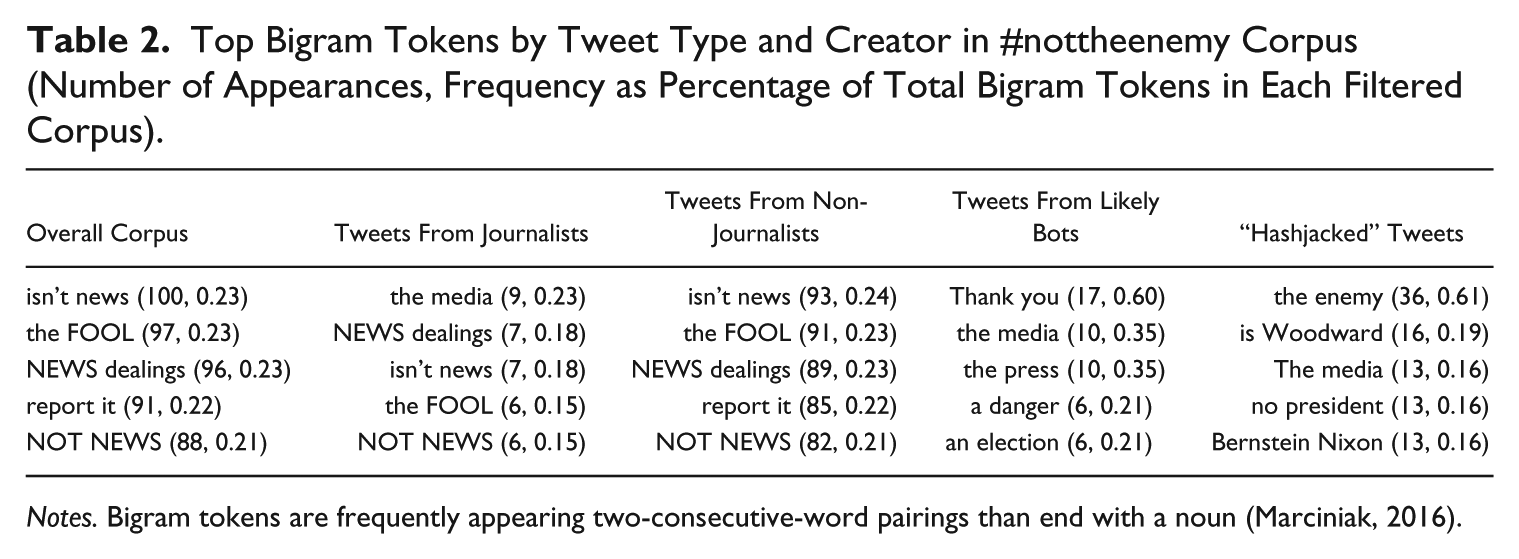
Notes. Bigram tokens are frequently appearing two-consecutive-word pairings than end with a noun (Marciniak, 2016).
Supporting the Journalistic Paradigm
Through
It is worth noting that not a single tweet from a journalist expressed positive valence toward Trump (see Table 1). That said, journalists—both in alignment with professional expectations of objectivity and with the attempted paradigm repair—largely transmitted neutral valence in tweets regarding the President 86.9% (N = 219) of the time—higher than the 78% neutrality (N = 2,044) of non-journalists (see Table 1). This could be due, in part, to journalists’ continued effort to remain objective. In total, positive valence rained down on journalists; the sample included more than three times the number of pro-journalism messages than it did pro-Trump messages, even with the presence of some hashjacking.
Through this overwhelmingly positive flood of messages that positioned the press in opposition to Trump’s enemy label, #NotTheEnemy discourse clearly contributed to a positive and supportive invocation of the journalistic paradigm, and its role in American democracy specifically. These thousands of messages, united by a single topic, shared, celebrated, and emphasized the most positive contributions of journalists to American society, both historically and in the current political climate.
Hashjacking and Bots
At the same time, those who “hashjacked” #NotTheEnemy for the purpose of co-opting the popular hashtag to express concerns about the press drew attention to their distrust of the media. Through
Most hashjacked tweets were likely produced by bots. Tweets determined to be most likely produced by bots (N = 207) frequently contained hashtags differing from those of the corpus at large. The most popular hashtags among bots included allusions to “resistance” (#TheResistance, N = 14; #Resist, N = 13) and even #Jesus (N = 5), topics seemingly unrelated to #NotTheEnemy. For a glimpse at the top hashtags that appeared in this corpus — other than #NotTheEnemy — see Table 3.
Top Hashtags by Tweet Type and Creator in #nottheenemy Corpus (Number of Appearances, Frequency Percentage of Total Unigrams in Corpus).
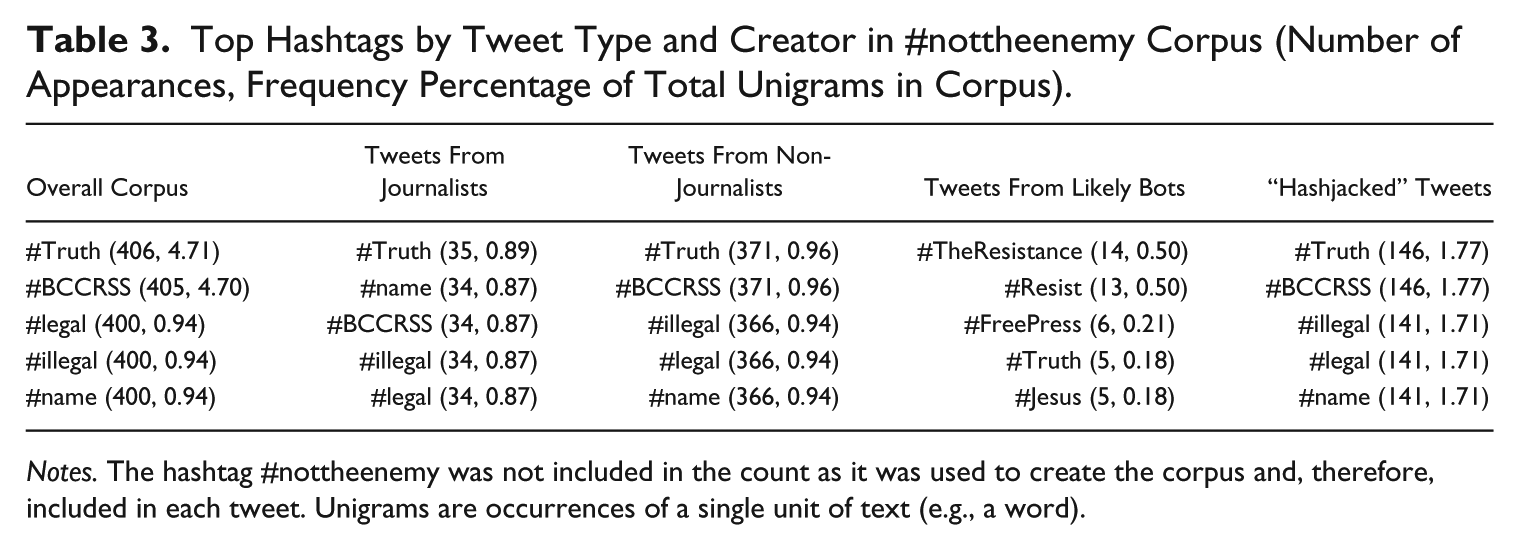
Notes. The hashtag #nottheenemy was not included in the count as it was used to create the corpus and, therefore, included in each tweet. Unigrams are occurrences of a single unit of text (e.g., a word).
The effectiveness of this tactic is best represented by the most common hashjacked hashtag in the data set: “#BCCRSS,” which appeared in 14% of #NotTheEnemy tweets. “BCCRSS” refers to a conspiracy theory perpetuated by fringe groups alleging that one’s given birth name is owned by the Crown Corporation and, therefore, using one’s legal name is considered to be fraudulent because one does not own the legal rights to one’s name (Kelly, 2016). Despite its ridiculous nature and utter irrelevance to #NotTheEnemy, journalists themselves quote-tweeted or retweeted #BCCRS tweets 34 times, proving that even those professionally trained to verify information are susceptible to hashjacking. This is important to note for future studies using similar data and methodologies.
The volume of both hashjacked and likely bot-produced tweets undoubtedly influenced the overall valence and messaging of the entire corpus, but the researchers felt it was important to keep these tweets in the analysis to demonstrate their influence on social media discourse, as well as how hashjackers and bots can fool users—including journalists, in this case—into unintentionally spreading preposterous messages.
Conclusion
#NotTheEnemy discourse on Twitter might have been sparked in response to Trump’s anti-media tweet, but its sheer popularity and thematic variance resulted in a positive and widespread public defense of the journalistic profession and its traditional paradigm. Through it, journalists expressed support for the journalistic paradigm, and non-journalists joined them to defend the American press against Trump, the media’s politically elite attacker. Four of the key themes uncovered through qualitative textual analysis—purveyors of truth and justice, challengers of presidential power, support and encouragement of journalists, and a focus on historical standard-bearers of journalism—underlined the meaningful and positive contributions to society made by journalists through paradigmatic norms and values. Even the fifth major theme, that of violence against journalists, drew attention to the potential sacrifice of health and life that many journalists face in their work and established these journalists as heroic figures who put the needs of society before their own to fulfill a service to the public and to democracy. By calling attention to violence perpetuated against journalists, this theme of tweets also pushed back against the negative implications of rhetorical attacks on the press, which under Trump’s reign have already encouraged violence against journalists.
By publicly contradicting Trump’s accusations that the media are “FAKE NEWS” and “the enemy of the American people,” both journalists and non-journalists defended against a threat of damage to public opinion about and trust in the media posed by Trump’s elite discourse. This public discourse—and the fact that it includes both journalists and non-journalists—is valuable because of its potential power in shifting public opinion about the press during a time of woefully low public trust in the media (Bump, 2018; Knight Foundation, 2018). According to a Knight Foundation (2018) study, “Counteracting perceptions of bias and inaccuracy may have a role to play in addressing the lack of trust in the news media and giving Americans more confidence in the media’s ability to carry out its democratic responsibilities.” Discourse like this takes steps to counteract concerns Americans have about the news media. And the very realm in which this dialogue occurred—through public discourse, in this case on social media—supports research that indicates public discourse makes paradigm shifts possible (Vos, 2017).
Tweets containing purely positive sentiment toward journalists expressed intense praise, placing clear value on their work and their roles in society. Especially significant are the tweets from users who said they took steps offline to support the press, such as thanking journalists in person, subscribing to news publications, and donating funds to media outlets and nonprofit organizations. This suggests a connection between online and offline action that is needed to ensure further steps toward repairing or reconsidering this paradigm, and it reflects a level of support that could lead to “true change” (Vos, 2017, p. 210) in the paradigm.
Despite the outpouring of support for journalism and journalists, the role of hashtag hijacking and bot activity in this dataset cannot be ignored. Within the #NotTheEnemy conversation, consumers were exposed to repeated messages and hashtags promoting unrelated and irrelevant causes. These tweets are an abuse of #NotTheEnemy, resulting in “noise” that distracts from and muddles the spirit of the hashtag. More importantly, the fact that journalists themselves were susceptible to hashjacking presents a professional conflict: Doing so may have violated the paradigmatic tenet of journalistic ethical standards, even as journalists shared #NotTheEnemy tweets with the goal of defending that paradigm. For this reason and others, it is important to include bots and hashjackings in this and other social media studies to more realistically understand the scope of this type of discourse and to illustrate just how quickly and powerfully a trending, politically charged topic can be commandeered by outsiders.
Finally, journalists reinforced the journalistic paradigm in their #NotTheEnemy tweets by distancing themselves from attack from an elite threat: the President of the United States. Out of 2,874 tweets, not a single journalist wrote a tweet with positive valence directed toward Trump (see Table 1). Contrast this with a majority of Trump-related tweets from journalists that are neutral (N = 219, 86%). By not responding negatively and remaining primarily neutral, journalists practiced objectivity while simultaneously defending it as a cornerstone of the paradigm. And in doing so, they upheld traditional journalistic ethical standards while speaking truth to power.
The results of this article illuminate the meaningful discourse of both journalists and non-journalists in response to an understudied threat in paradigm repair literature: elite political rhetoric. As discussed above, this threat may be heightened and more frequent during Trump’s era, but it is not new. However, the means of striking back against it—through public discourse on Twitter—and the unity of diverse viewpoints—those of both journalists and their supporters—are both relatively new, and their potential impact on public opinion is a valuable opportunity for academic exploration. This research extends prior work about the journalistic paradigm by applying it to this uniquely modern context, and by illuminating the ways in which journalistic paradigm defense, while falling short of paradigm repair, can still result in powerfully positive messages that have the potential to impact public opinion favorably by pervading public discourse. Finally, this research benefits both the practice of and research about journalism by illuminating the values both journalists and their audiences see in the journalistic profession. By understanding the public benefits of American journalism as understood by both parties, we are better able to understand the role of American journalism in the modern political era—and perhaps how to support and maintain that role moving forward.
Limitations and Future Research
This study was limited necessarily by sample size and by the parameters of the sample, for which we chose to dismiss retweets. This could limit the extent to which researchers were able to ascertain depth of shared feeling across this wide-ranging conversation. In addition, these data represent only the 31 days immediately after Trump called news media an “enemy of the people.” Finally, journalists were categorized by self-identifying as a journalist or media-related professional in their Twitter profiles. These claims were not verified, and it is possible the non-journalists group could include members of the media who did not identify that membership in their Twitter bios.
As anti-press and “fake news” sentiments continue to spread, research on the public perception of the media will remain important to gauging the reception and function of journalism in a democratic society. Future work, based on this study, should include deeper examination of journalists’ sentiments about the hostile anti-media environment perpetuated by President Trump. This may include focus groups or one-on-one interviews that cultivate more than what can be discerned from a tweet. In addition, further studies may employ methods beyond Twitter analysis to assess how the President’s perception of the press impacts that of the public.
Footnotes
Declaration of Conflicting Interests
The author(s) declared no potential conflicts of interest with respect to the research, authorship, and/or publication of this article.
Funding
The author(s) received no financial support for the research, authorship, and/or publication of this article.
