



Abstract
Recent research has adopted the network analytic approach to examine issues of audience fragmentation and selective exposure. This article extends this line of study by analyzing how newspapers’ political stance, market position, and technological platform predict readership overlap. Analyzing readership survey data in Hong Kong, the results show that market position—in terms of elite versus mass orientation and language of the newspapers—consistently predicts readership overlap. In comparison, political distance between two newspapers predicts readership overlap mainly when online readership is concerned. Different from the United States, predictors of readership overlap do not vary for news consumers of different partisanship.
The recent decade has seen renewed scholarly interests in the phenomenon of selective exposure to political information (e.g., Dvir Gvirsman, 2017; Gervais, 2014; Stroud, 2011). This concern is largely driven by changes in the media environment. The digital media arena is regarded by some as conducive to higher levels of audience selectivity (Bennett & Iyengar, 2008) and the formation of online echo chambers (Sunstein, 2017). Studies have provided ample evidence regarding the presence of selective exposure (Iyengar & Hahn, 2009; Song & Boomgaarden, 2017), but others have questioned the strength of the tendency (e.g., Garrett, 2009) and whether it can be curbed by other factors (e.g., Mummolo, 2016).
Many studies on selective exposure, however, do not take into account the fact that people typically consume multiple media outlets. In one sense, people are not so much selecting individual outlets to consume than constructing a media repertoire (Ferguson, 1992; Weimann, 1996) for themselves. When considered in the latter way, do people stick to outlets providing largely the same range of information and viewpoints? What are the factors and principles guiding people’s construction of their media repertoires? Are the media outlets’ political stances more important than their other characteristics in shaping audience choices? Do the influences of the factors vary in the online and offline media worlds?
This article tackles such questions through a network analytic approach and the concept of audience duplication (Webster & Ksiazek, 2012). Originally developed by broadcast media researchers and media economists, the approach has recently been adopted for analyzing audience fragmentation in online news consumption (e.g., Fletcher & Nielsen, 2017). This article takes the approach a step further to more directly address the issue of audience selectivity. As this article shall demonstrate, the approach can generate unique insights on the strength of political and nonpolitical factors in driving media selection. It can enrich our understanding of the implications of digital media technologies on audience selectivity.
Empirically, this article focuses on patterns of online and offline newspaper consumption in Hong Kong. We begin by further discussing the relevant literatures. Hypotheses and research questions are then set up. Discussions of methods and data analysis follow.
Selective Exposure and Principles of Selection
Partisan selective exposure is a long-established concept going back to the mid-20th century. The basic idea is that people tend to protect their existing worldviews and reduce cognitive dissonance. Therefore, people prefer ideologically consonant media materials and avoid dissonant contents (Stroud, 2011). However, in the traditional mass media system in which a few outlets dominated a market, there was not much for the consumers to select. In other words, the traditional media system did not offer the opportunity structures conducive to selective exposure (Skovsgaard, Shehata, & Stromback, 2016).
Nevertheless, the trend of media and channel proliferation has created a high-choice media environment (Prior, 2007). This environment facilitates audience selectivity not only because of the sheer number of outlets, but also because media in this hypercompetitive context tend to provide specialized contents for niche audiences (Bennett & Iyengar, 2008). Heightened levels of selectivity can widen the knowledge and participation gaps between people who are interested in the news and those who are not (Prior, 2007). More pertinent to this study, the high-choice environment can also strengthen the phenomenon of partisan selective exposure. More recently, as social media became an important news source, the operation of the social media algorithm has been regarded as an additional factor reducing people’s exposure to counterattitudinal information (Bakshy, Messing, & Adamic, 2015).
Despite people’s tendency to select consonant information and the possible influence of algorithms, numerous factors complicate the picture. Theoretically, some scholars argued that selective approaching and selective avoidance should be separated. While people have the tendency to choose consonant contents, they also have incentives to consume some dissonant contents (Garrett, 2009; Song, 2017). These incentives include the feeling of anxiety and the resulting desire to evaluate issues more objectively, intellectual curiosity, defensive confidence, and so on (Garrett & Stroud, 2014). An overall tendency to consume consonant contents, therefore, does not preclude exposure to a significant amount of counterattitudinal information (Dvir Gvirsman, Tsfati, & Menchen-Trevino, 2016).
Exposure to dissonant contents is further enhanced in the digital environment through incidental exposure (Brundidge, 2010; Kim, Chen, & Gil de Zuniga, 2013). That is, people often use digital media for purposes other than getting the news. Yet they would encounter news information incidentally because of the acts of sharing by their friends and media organizations. Although incidental exposure to counterattitudinal information may also lead to selective exposure (Weeks, Lane, Kim, Lee, & Kwak, 2017), it does mean that people are not totally insulated from counterattitudinal messages.
In addition, the strength of partisan selective exposure may vary over time (Song & Boomgaarden, 2017) and across types of media content (Knobloch-Westerwick & Lavis, 2017; Stroud & Muddiman, 2013). At the individual level, partisan selective exposure can be driven by emotions (Song, 2017) or exposure to negatively valenced counterattitudinal information (Lau, Andersen, Ditonto, Kleinberg, & Redlawsk, 2017).
This article does not aim to comprehensively examine all factors shaping selective exposure. The above only serves to highlight the complexities of the phenomenon. Political stance of the source is not the only factor shaping consumption. Topical relevance or peer endorsement can be more influential than source reputation on whether people would read a story (Messing & Westwood, 2014; Mummolo, 2016). Meanwhile, Skovsgaard et al. (2016) found that, in Sweden, interest-based selective exposure—that is, people choose to consume public affairs information or not based on levels of interest in politics—is more prevalent than partisan selective exposure.
Indeed, people have multiple motivations to consume the news (A. M. Lee, 2013), and not all news are political. News can be consumed for relaxation and entertainment as much as for information seeking (Rubin & Perse, 1987). Similarly, media outlets differ from each other not only in political stances but also in market position. Hallin and Mancini (2004) treated the development of a mass market press as an important dimension of a media system. Where the distinction between elite-oriented and mass-oriented press exists, relative preference between the two types of outlets can be driven primarily by socioeconomic status or cultural taste (Ohlsson, Lindell, & Arkhede, 2017). It would be meaningful to examine the influence of political stances and market position simultaneously.
The Network Analytic Approach and Audience Duplication
Even before Internet’s popularization, the rise of multichannel TV services and content customization have led scholars to ponder on whether the audience would be “demassified” (R. Neuman, 1991). At stake was the ability of the mass media to set a common societal agenda and organize public attention. For Katz (1996), by the 1990s, television “has ceased to offer citizens [in Western democracies] the experience of shared contemplation of matters of state that demand attention” (p. 25). The risk is that public deliberation and national integration will suffer when the public sphere disintegrates into public sphericules (Gitlin, 2007).
No matter whether audience fragmentation would have such consequences, the basic empirical question is the extent to which the audience is indeed fragmented. Webster and Ksiazek (2012) distinguished among three approaches to study audience fragmentation. The media-centric approach uses media outlet as the unit of analysis. It examines the degree to which audience attention is concentrated into a few outlets, but it does not consider the fact that people typically consume multiple outlets. The user-centric approach acknowledges people’s consumption of multiple media outlets through the concept of channel repertoire (Ferguson, 1992). But researchers were typically concerned with the width of the repertoire and seldom examined how the outlets in an individual’s repertoire are related to each other.
Webster and Ksiazek (2012) thus put forward the audience-centric approach, which “characterizes the audience by the other media they use” (p. 45). Central to the approach is the method of network analysis and the notion of audience duplication, which simply refers to the percentage of viewers who watch Program A who also watch Program B (Cooper, 1996). Through examining audience duplication, researchers can characterize the structure of media markets (Yuan & Ksiazek, 2015) and identify the factors influencing program choices. Notably, empirical studies have pointed toward how both structural factors (e.g., programming schedules) and individual preferences (e.g., program genres) can influence program choices (Webster, 1985; Yuan, 2010). In other words, examining audience duplication has long been a way for researchers to understand the principles governing individuals’ media selection.
Audience duplication is a property of the relationship between two outlets. Hence, the approach treats media outlets as forming a network: Each outlet is a node and audience duplication constitutes the links (Ksiazek, 2011). Audience fragmentation, then, can be examined as a property of the media outlet network. A network centralization score (Webster & Ksiazek, 2012) or a network density score (Fletcher & Nielsen, 2017) can be calculated as a summary indicator of the degree of centralization or fragmentation.
Several studies have used the method to analyze the news audience. Weeks, Ksiazek, and Holbert (2016) examined the U.S. news audience during the 2008 presidential election and found that both the two media outlet networks for the Democrats and Republicans, respectively, had a core–periphery structure. The authors did not find signs of people engaging in significant degrees of selective avoidance. Fletcher and Nielsen (2017) analyzed online survey data and found a significant degree of audience concentration among news users in six countries. Interestingly, the degree of audience fragmentation in online news consumption is even lower than that in offline news consumption. They argued that the ease of movement from one online outlet to another facilitates higher levels of audience duplication. Similarly, Mukerjee, Majo-Vazquez, and Gonzalez-Bailon (2018) found a core-periphery structure in U.K. and U.S. citizens’ news consumption, with legacy news brands being the mainstay of the core. They concluded that there is little evidence of selective exposure in the results.
However, the overall degree of audience fragmentation does not tell us much about how individuals select media outlets to consume. In fact, an overall low level of audience fragmentation does not entail the absence of the tendency for news outlets sharing the same political predilection to be consumed together. More importantly, a high level of audience fragmentation does not entail that the audience is fragmented along lines of political divides. Therefore, the present study takes the analysis of news audience duplication one step further to directly examine whether factors such as the political stances and market position of media outlets can indeed explain extents of audience duplication between outlets. Such an analysis would allow us to see whether partisan selective exposure is indeed the primary factor shaping individuals’ media consumption and the formation of the news audience.
Research Questions and Hypotheses
The empirical analysis focuses on newspaper reading in Hong Kong. We therefore use the term “readership overlap” to replace audience duplication in the following. Hong Kong is a media-rich society with, at the time of writing, 16 general interest newspapers. All newspapers have their websites. Many also opened their pages on Facebook, the most popular social media in the city (F. L. F. Lee et al., 2017). There are several “digital born” online news sites but, with one exception (HK01.com), the online news sites are very small operations.
This article draws upon data from a survey that examines citizens’ consumption of mainstream newspapers both online and offline. Historically, the press system in Hong Kong exhibited a significant degree of political parallelism (Chan & Lee, 1991). Despite concerns of state influence and media self-censorship (Au, 2017; F. L. F. Lee & Chan, 2009), newspapers can still be located on a political spectrum ranging from the most critical and prodemocracy (e.g., Apple Daily) to the Communist-sponsored press. Meanwhile, a distinction between elite-oriented and mass-oriented press also exists (C. C. Lee, 2000).
Research has shown that Hong Kong citizens’ political attitudes are related to the media outlets they consume (e.g., F. L. F. Lee & Chan, 2018). However, such findings may be suggesting only a tendency for people to choose a politically consonant newspaper as their first paper to read. The key issue here is how people choose when they go beyond reading one newspaper.
Hong Kong has a multiparty system. Political groups and politicians are usually categorized into prodemocracy or proestablishment. “Partisanship,” in this context, mainly refers to an inclination toward one faction and its general political stance. If partisan selective exposure is prominent and dictates citizens’ construction of media diets, people are likely to read multiple newspapers of similar political stances. Then, two newspapers having similar political stances—a small political distance—would share more readers. At the other extreme, if citizens are driven by concerns of seeing a diverse set of viewpoints, they may look for newspapers with varying political stances. In this case, two newspapers having similar political stances would share fewer readers. Although the literature has suggested that partisan selective exposure is a complicated phenomenon and not necessarily prominent when the network analytic approach is adopted, we posit a selective-exposure-based hypothesis for the sake of clarity:
Besides political stance, newspapers also vary in terms of market position, that is, the readers that they primarily aim at attracting. The distinction between the mass-oriented and elite-oriented press (C. C. Lee, 2000), for instance, resides mainly in the income and educational level of the target readers. Such market orientation in turn influences the contents and styles of the newspapers, for example, the mass-oriented press tends to exhibit a higher degree of sensationalism. As news consumption can be driven by needs other than obtaining political information, it is possible that readers would stick to media outlets with a similar market orientation (and thus similar contents and styles). Hence, readership overlap may be explained by whether two newspapers share the same market orientation.
Language is another factor related to the market position of media outlets. Newspapers in Hong Kong are mostly in Chinese, but there are also a couple of English dailies. Obviously, these newspapers target at different readers, and newspapers using the same language should have a higher degree of readership overlap.
This study examines both online and offline newspaper consumption. Although the integration of digital media into people’s everyday life has made the online/offline distinction less important, there are still differences in the affordances of print and digital newspapers that can have implications on audience consumption. For instance, recent studies have shown that degrees of audience fragmentation vary between online and offline, and the difference may be explained by the relative ease of movement between digital outlets (Fletcher & Nielsen, 2017). Here, we posit an exploratory question on whether the impact of political distance and market position vary across technological platforms:
Finally, studies in the United States have shown that the manifestation of selective exposure may not be the same for Democrats and Republicans (Knobloch-Westerwick & Lavis, 2017; Song, 2017). In the U.S. context, Republicans are often found to exhibit a stronger tendency of partisan selective exposure. This can be due to the Republicans’ tendency to criticize the mainstream media for having a liberal bias (Major, 2015). It can also be due to the different personality structures and value systems of people holding different political views (Jost & Amodio, 2012). As noted earlier, Hong Kong citizens are conventionally classified as prodemocracy or proestablishment. The former is more liberal-progressive, and the latter is more conservative. Meanwhile, many citizens would claim that they are “centrists” or have no political stance. If we follow the U.S. finding and the argument that political conservatives have a personality structure that leads them to become less open-minded, one can expect the proestablishment citizens in Hong Kong to exhibit stronger tendencies of partisan selective exposure. But the political context of Hong Kong differs from that of the United States in numerous aspects, which may impinge on the partisan behavior of individuals. Without going into further details of local politics, suffice it to put forward the following research question:
Method, Data, and Operationalization
The data came primarily from a telephone survey on newspaper readership conducted by the Centre for Communication and Public Opinion Survey at the Chinese University of Hong Kong. Target respondents are Hong Kong residents aged between 12 and 69 years who speak Cantonese, Mandarin, or English. To derive the sample, all phone numbers in the latest residential directories were collected. The last two digits were replaced by the full set of 100 double-digit figures from 00 to 99. Specific numbers were randomly drawn by computers. The most recent birthday method was used to select the target respondent from a household. 1
Survey fieldwork was conducted every day throughout the year except on several public holidays. A total of 15 to 16 interviews were completed per day. The basic questionnaire does not include perceived political stances of the newspapers, which is central to this article. The questions on perceived political stances were asked only between March 18 and June 1, 2016. However, political stances of newspapers should not fluctuate on a daily or monthly basis. The political stances of newspapers as registered in the period should represent the general political stances of the newspapers. Hence, the following examines data from January 1 to December 31, 2016. The sample size is 5,404. The response rate in the period is 40.0% according to AAPOR response rate Formula 3. The data were weighted according to the Age × Education × Sex Distribution of the equivalent population.
The questionnaire asked the respondents if they had read a total of 17 newspapers in the 12 months before the interview. For each newspaper that a respondent had read, two follow-up questions asked the respondent the most recent time point when he or she read the print version and the online version, respectively. A “12 months” criterion for defining a reader would be rather loose. Therefore, we derived five variables from the questions for analysis: (a) a reader of the newspaper in the past 12 months, regardless of platform; (b) a reader of the newspaper’s print version in the past 12 months; (c) a reader of the newspaper’s print version in the past 7 days; (d) a reader of the newspaper’s online version in the past 12 months; and (d) a reader of the newspaper’s online version in the past 7 days. Having five variables allows us to discern the robustness of the patterns of findings emerging from the data.
Based on the above operational definitions, we calculated the five corresponding matrices of readership overlap—overall overlap, past-12-months print readership overlap, past-7-days print readership overlap, past-12-months online readership overlap, and past-7-days online readership overlap. We used the “directional measure” of primary duplication (Ksiazek, 2011), which is the percentage of readers of one paper who also read the other paper. The measure is directional because “the percentage of readers of Paper A who also read Paper B” and “the percentage of readers of Paper B who also read Paper A” are not the same, as to be further explicated below. Here, suffice it to note that the directional measure is used because it can better take into account the possible asymmetricity of the relationship between two media outlets.
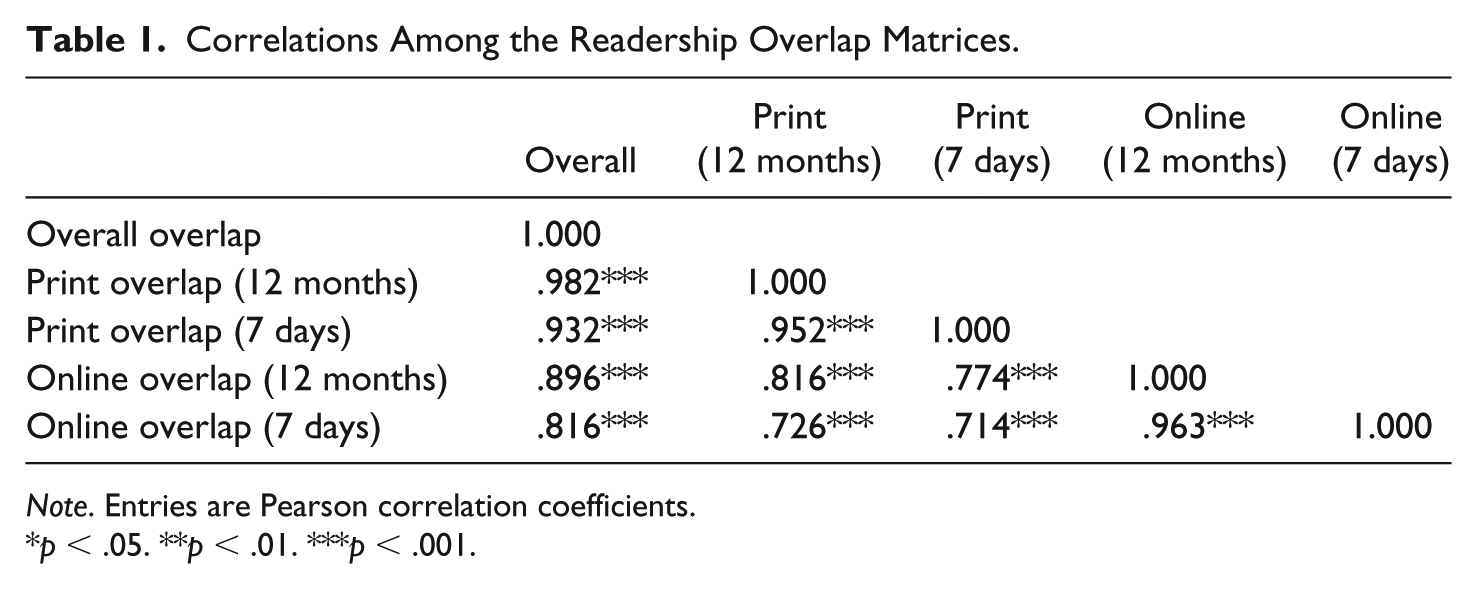
The five matrices are highly correlated. The correlation between past-12-months print and online overlap is .816, whereas the correlation between past-7-days print and online overlap is .714 (Table 1). But both correlations are still some way from being “perfect.”
Correlations Among the Readership Overlap Matrices.
Note. Entries are Pearson correlation coefficients.
p < .05. **p < .01. ***p < .001.
A past-7-day reader of either the print or online reader of a newspaper would be asked a set of questions about the characteristics of the paper. One question asked if he or she thought the paper had a political predilection. Answers were registered by a 5-point Likert-type scale ranging from 1 (very prodemocracy) to 5 (very proestablishment). The political stances of the 17 newspapers are the mean scores of their own readers’ perceptions. A matrix of political distance was created based on the scores. The matrix is nondirectional (i.e., each cell represents the absolute distance between two newspapers) because the selective exposure hypothesis expects readership overlap to relate to how distant two newspapers are from each other, instead of whether one is more prodemocracy or proestablishment than the other.
Figure 1 illustrates the groupings of the newspapers based on their political stances through a cluster analysis. Apple Daily, a strongly prodemocracy newspaper, constitutes a cluster by itself. The second cluster is formed by two of the three Communist-sponsored papers Wen Wei Po and Ta Kung Pao. A couple of relatively liberal-oriented newspapers—AM730 and Ming Pao—are grouped together with a number of centrist or somewhat politically docile newspapers to form a large group, whereas the fourth group contains the Communist-sponsored Hong Kong Commercial Daily and three other papers with a particularly strong reputation of being progovernment.
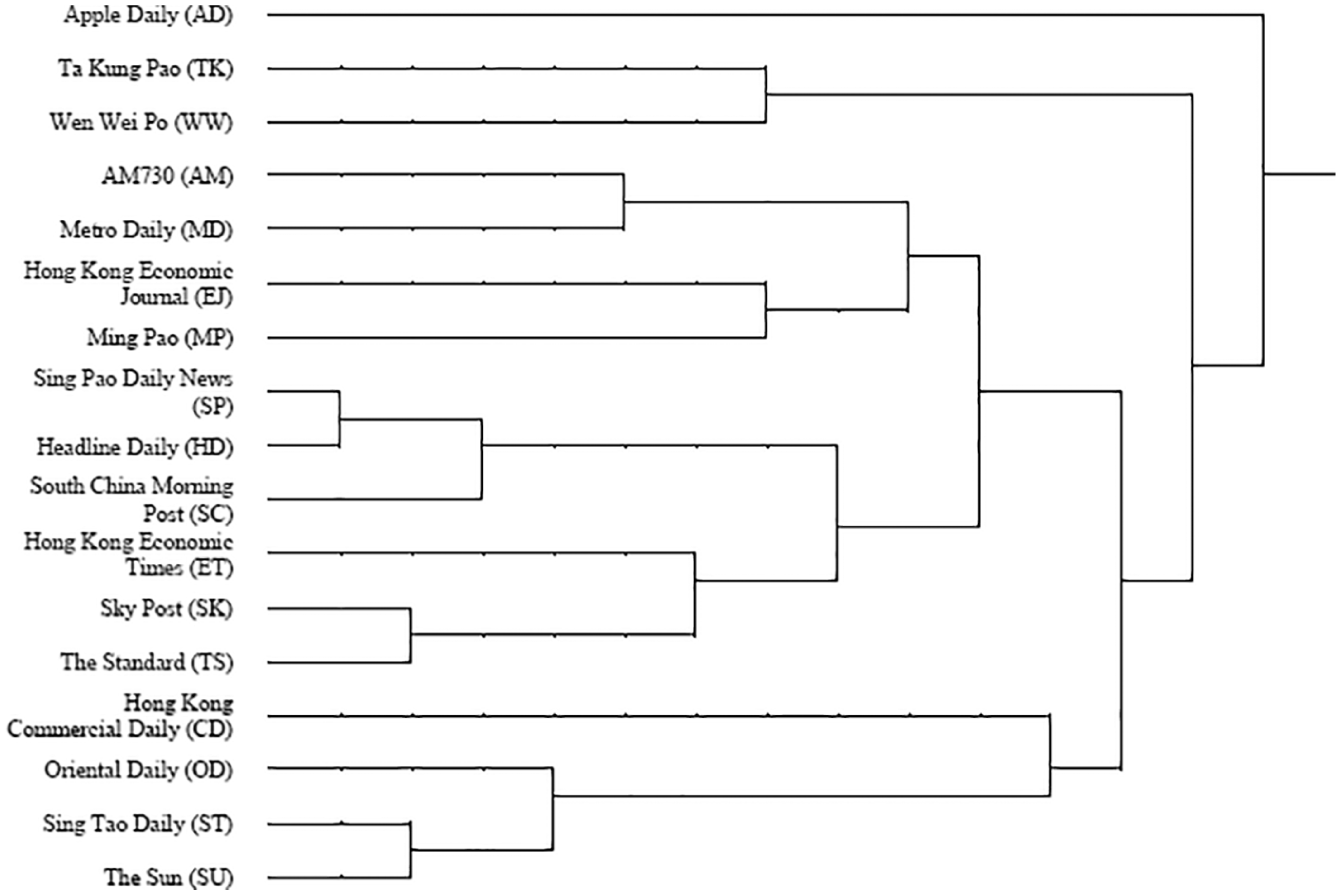
Clustering of newspapers based on political distance.
The 17 newspapers were classified into having an elite or mass market orientation based on the existing literature of Hong Kong media studies (C. C. Lee, 2000; So, 2009) and the authors’ own understanding of the media market in the city. Mass-market-oriented newspapers include Apple Daily, Oriental Daily, The Sun, Sing Pao, and three free newspapers (Headline Daily, Metro Daily, and Sky Post), whereas elite-oriented newspapers include Ming Pao, Sing Tao Daily, and AM730, the financial newspapers, the English language newspapers, and the Communist-sponsored newspapers. Further analysis of the current survey data shows that the readership profiles of the two groups of newspapers indeed differ from each other, whereas the readership profiles of newspapers within a category tend to be more similar. A binary matrix was created, with 1 meaning that both newspapers belong to the same type.
For testing
In addition, a few matrices were created for statistical control. The first represents the readership differential between two newspapers. This needs to be controlled because, as noted earlier, the measure of readership overlap is asymmetric. The scores in the primary duplication network are affected by the relative readership sizes of the two papers. For example, if Paper A has 10,000 readers, who all read Paper B, but Paper B has 100,000 readers, then 100% of A’s readers are B’s readers, but only 10% of B’s readers are A’s readers. This will lead to misinterpretation if readership size is related to political stances and market position. In a network analysis, the matrix to control is one in which each cell represents “readership size of A minus readership size of B.” The readership differentials following the five operational definitions of a reader were calculated for each pair of newspapers.
The second matrix to control relates to perceived credibility, which might influence news consumption (Ardevol-Abreu & Gil de Zuniga, 2017; Tsfati & Cappella, 2003). The credibility scores of the newspapers were derived from a separate series of surveys conducted by the same research center (So, 2016). At issue here is whether two newspapers with similar levels of credibility would share more readers. The value in each cell thus represents the absolute difference between the perceived credibility scores of the two newspapers.
Third, free newspapers constitute a distinctive type of dailies in Hong Kong. Distributed at convenient locations such as metro stations, these newspapers contain short articles—often based on what other media have reported—for quick consumption. Due to convenience and lack of cost, many people consume free newspapers together with their usual papers of choice (So, 2009). The readership of these newspapers might therefore overlap with the readership of other newspapers in distinctive ways. A binary matrix was created, with 1 indicating that at least one of the newspapers in the pair has its print version distributed for free.
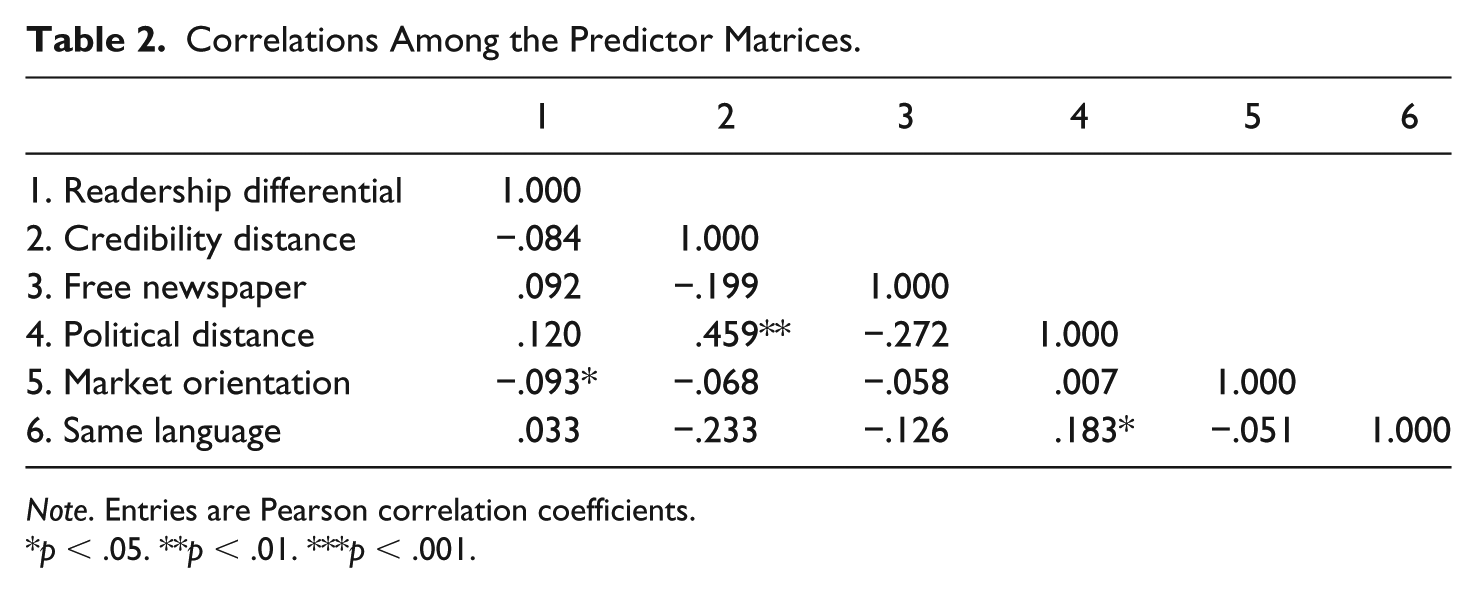
Table 2 shows the correlations among the predictor matrices. Political distance and market orientation are uncorrelated. Yet political distance correlates significantly with credibility distance and whether two newspapers share the same language. This shows the need to control for other factors when examining the impact of political distance. Yet the correlations are not strong and should not create problems of multicollinearity.
Correlations Among the Predictor Matrices.
Note. Entries are Pearson correlation coefficients.
p < .05. **p < .01. ***p < .001.
Finally, the survey asked the respondents if they considered themselves as the supporters of a political faction. Answers include specific faction labels (e.g., “proestablishment faction”) and options indicating the absence of a clear stance (e.g., “centrist”). Based on the answers, the respondents were categorized as “democrats,” “proestablishment,” or “centrist/no political stance.” A split-sample approach was adopted when tackling
Analysis and Results
The analysis is premised on the presumption that many people consume multiple news outlets. In fact, 26.8% of the respondents had read three or more print newspapers in the 7 days prior to the interview, whereas 13.2% had read three or more online newspapers in the 7 days prior to the interview. Notably, whereas Prior (2007) pointed toward how the Internet might enlarge the gap between people interested and not interested in the news, the current data do not show any sign that newspaper reading is more polarized into those who read many newspapers and those who read none in the online environment.
To examine the hypotheses about the predictors of readership overlap, quadratic assignment procedure (QAP) regression analysis was conducted with the overlap matrices as the dependent variables. The independent variables are the three controls, political distance, market orientation, and whether the two newspapers are of the same language.
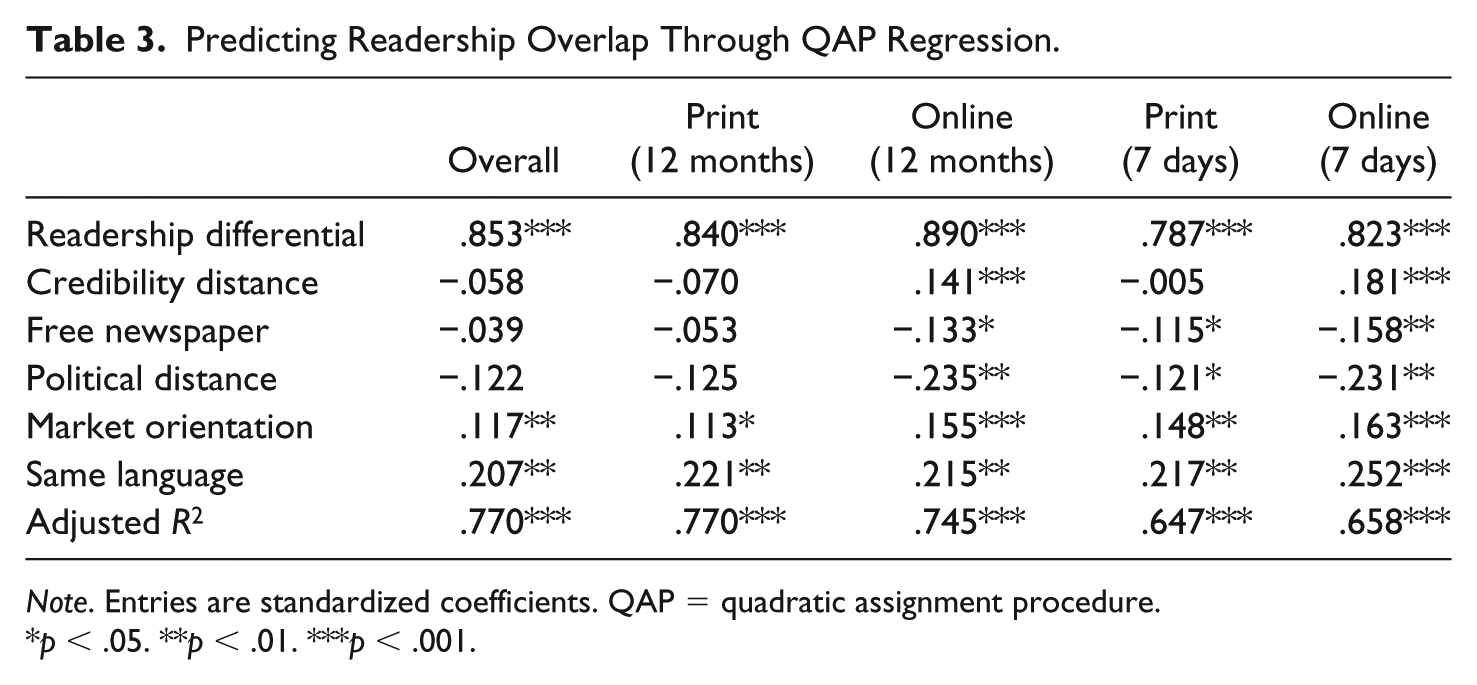
As Table 3 shows, the model explains between 63.6% and 77.0% of the variance in the dependent variables. Admittedly, the explanatory power of the model is largely due to the predictive power of the readership differential matrix. The strong relationship merely shows the aforementioned fact that the primary audience duplication scores are influenced by the relative audience sizes of the two media outlets involved.
Predicting Readership Overlap Through QAP Regression.
Note. Entries are standardized coefficients. QAP = quadratic assignment procedure.
p < .05. **p < .01. ***p < .001.
The free newspaper matrix relates negatively to the readership overlap matrices, but the coefficients are significant mainly when online readership is concerned. Interestingly, credibility distance also has a significant relationship with only online readership overlap. The positive sign of the coefficients means that newspapers more distant from each other in terms of their levels of credibility tend to have their online readership overlapping with each other to larger extents. These findings suggest that technological platforms can indeed shape how certain factors influence readership overlap.
Political distance has a negative coefficient in all five columns, even though only three of the five coefficients have attained the conventional levels of statistical significance. On one hand, we might still claim that
In contrast, the findings highly consistently support
It should be noted that adopting either a past-7-days definition of a reader or a past-12-months definition of a reader does not make any substantive difference to the pattern of findings. That is, the factors predicting print readership overlap remain the same regardless of the time frame of readership definition. This is also true when online readership is concerned.
Finally, we examined whether the impact of political distance on readership overlap would vary among people with different political stances. The QAP regression in Table 3 was reconducted for the democrats, proestablishment citizens, and centrists separately. The readership overlap matrices for the subsamples are the dependent variables. For simplicity, Table 4 shows the results for overall overlap and the two past-7-days readership overlap matrices only. As the table shows, the predictive power of readership differential is significantly weaker among the proestablishment citizens, but readership differential is the only independent variable that would predict readership overlap to significantly different extents among the three groups of citizens.
Predicting Readership Overlap Among People With Different Political Predilection.
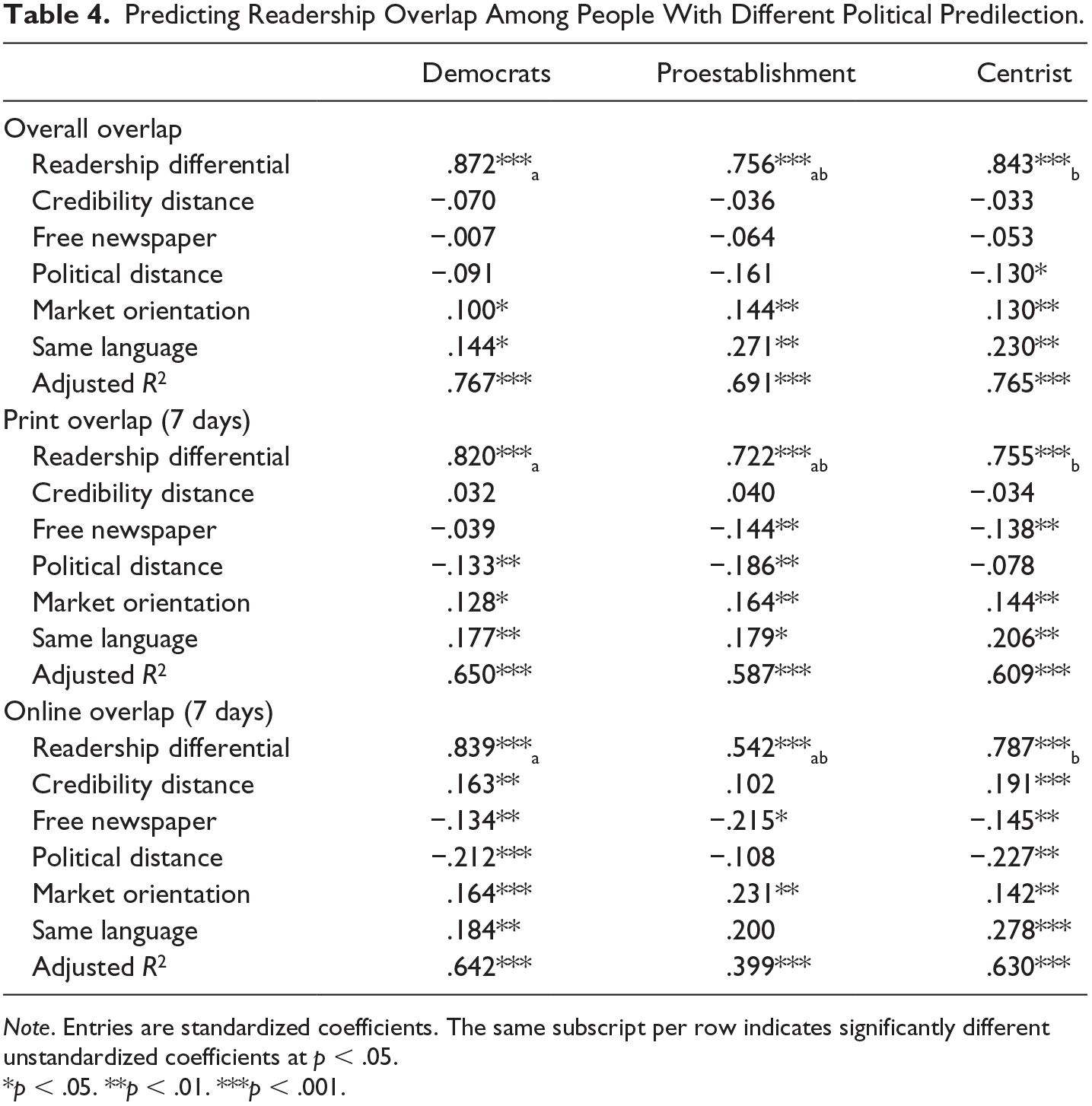
Note. Entries are standardized coefficients. The same subscript per row indicates significantly different unstandardized coefficients p < .05.
p < .05. **p < .01. ***p < .001.
Market orientation remains highly consistently related to readership overlap. The nine coefficients in Table 3 (Three Groups of Citizens × Three Readership Overlap Matrices) are all statistically significant. Language of newspapers also remains highly consistently related to readership overlap, with eight of the nine coefficients being statistically significant. In contrast, political distance remains less consistently related to the readership overlap matrices. It significantly predicts print readership overlap only among the prodemocracy citizens and the proestablishment citizens, and it significantly predicts online readership overlap only among prodemocracy citizens and the centrists. Nonetheless, the regression coefficients in the three columns do not differ from each other significantly. There is no consistent evidence suggesting that political distance is more or less important for a specific group of citizens.
Concluding Discussion
This article extends recent research using the network analytic approach to examine issues of selective exposure in the contemporary media environment. Instead of focusing on overall levels of audience fragmentation, we examined whether political stances and market position of newspapers matter when explaining readership overlap at the level of a “tie” between two newspapers. Our analysis shows some evidence about partisan selective exposure. Political distance indeed tends to relate to readership overlap negatively, suggesting that people tend to consume multiple newspapers with similar political stances. Nevertheless, similar to some recent studies (Mukerjee et al., 2018; Weeks et al., 2016) that pointed toward the limits of selective exposure, the evidence for partisan selective exposure in this study is also limited in two ways. First, the impact of political distance exists mainly when online readership overlap is concerned. Second, the impact of political distance is less consistent and robust than the impact of the two indicators of market position.
The relative weakness of partisan selective exposure should not be surprising. As noted in the conceptual discussion, “how political attitudes influence what media people consume the most frequently” and “how political attitudes influence the way people construct a media diet” are two different questions. This distinction is in turn tied to the distinction between selective approaching and selective avoidance (Garrett, 2009; Garrett & Stroud, 2014). Take Weeks et al.’s (2016) study as an example. While they concluded their study by stating that there was not much evidence of partisan selective avoidance among U.S. citizens, Fox News did feature more prominently in the audience duplication networks constructed based on Republicans’ media consumption, whereas CNN and MSNBC did feature relatively more prominently in the audience duplication networks constructed based on Democrats’ media consumption. That is, the relative importance and prominence of certain media outlets for the two groups did differ according to political stance. But having the tendency to consume ideologically consonant media outlets the most frequently does not preclude occasional consumption of media outlets “on the other side.”
The same applies to the present case. Politically driven selective exposure exists in Hong Kong (F. L. F. Lee & Chan, 2018). In the current readership survey, the prodemocracy newspaper Apple Daily did have a larger proportion of readers who classified themselves as democrats. But political distance would be an important and consistent predictor of readership overlap only if many people stick to newspapers of similar political stances when consuming additional newspapers. What the current findings suggest is that, when constructing a media repertoire, news consumers in Hong Kong are more likely to stick to newspapers of the same style and language than to newspapers of the same political stances.
Different from the United States, the strength of partisan selective exposure does not vary across people of different political predilection. Political distance is equally likely to affect readership overlap among the proestablishment citizens and the prodemocracy citizens. One possible reason for the difference between the present study and the U.S. findings is the different character of the media systems in the two places. In Hong Kong, there is no general perception of a “liberal bias” of the mainstream media. In fact, given the political economy of the city’s media system and the phenomenon of self-censorship, the mainstream media can be regarded as largely conservative (F. L. F. Lee & Chan, 2009). If the perception of a generally hostile media environment is a factor pushing people to exercise partisan selective exposure, then we could actually expect the prodemocracy citizens in Hong Kong to exhibit partisan selective exposure to larger extents. Nonetheless, there might also be a tendency for politically conservative individuals to engage in partisan selective exposure because of their personality structure (Jost & Amodio, 2012). In the Hong Kong context, the impact of media system characteristics and individuals’ personality structure may have canceled out each other.
In any case, the finding of the relative weakness of the partisan selective exposure phenomenon in people’s construction of media diets also implies that selective exposure, or cyberbalkanization where online political communication is concerned (Sunstein, 2017), may not be the most important factor driving polarization among the public. People hear the other side at least occasionally. Of course, how people respond to counterattitudinal viewpoints is another matter. Hearing the other side is not the same as listening to the other side with an open mind. This is an issue beyond the scope of the present analysis, but there are reasons to believe that selective interpretation and biased information processing can be the more important factor driving opinion polarization.
This study shows that one advantage of the network analytic approach is the possibility of simultaneous examination of multiple factors that might explain audience duplication. The finding that newspapers of the same language share readers to larger extent might seem to be somewhat trivial, but it does show that there are factors more fundamental than political stances in the organization of the readership market. Moreover, a newspaper can provide readers with not only information but also entertainment. The choice of newspapers can be based on nonpolitical preferences of contents and styles (Ohlsson et al., 2017).
In addition, this study shows that the impact of a few factors—political distance, credibility distance, and free newspapers—exists only where online readership overlap is concerned. For political distance, the pattern of findings is consistent with the line of arguments initiated by Bennett and Iyengar (2008) a decade ago: The online environment is more conducive for partisan selective exposure because of the sheer number of outlets readily available and the ease of movement from one outlet to the other.
For free newspapers, the finding needs to be understood in relation to the characteristics of those newspaper products. In the offline world, once a person buys a “broadsheet” on a certain day, he or she is unlikely to pay the price to buy another broadsheet. The free newspapers in Hong Kong often publish short stories based on materials already publicized by others. However, people may still read the free newspapers together with their own preferred broadsheet newspaper simply because the free newspapers are costless to them and are conveniently available at key locations such as Metro stations. But in the online world, most newspapers offer their online contents for free. There might be little incentive for people who are already consuming the online versions of the “broadsheets” to also consume the “free press.” If people want to consume multiple newspapers, they can easily go from one “broadsheet” to another. This could explain the negative coefficients found in Table 4. Given the specificities of free newspapers, it would be meaningful for future research to examine them more closely to understand how certain economic factors might influence media consumption and audience duplication.
The finding about the predictive power of credibility distance is more intriguing. A positive coefficient means that newspapers more different from each other in terms of perceived credibility tend to share more readers with each other. It seems that, in the online environment, many people try to consume the speculative or even “fake” contents of the less credible outlets and the more solid contents of the more credible outlets at the same time.
But no matter what explains the findings, the analysis points to the implications of technological platforms as the factors shaping readership overlap vary offline and online. This also adds to the general point that the network analytic approach can provide insights into how multiple factors combine to shape the structure of audience attention. Future studies can consider whether there are other possible factors explaining audience duplication. Studies can also examine if the determinants of audience duplication between media outlets would vary across time, especially during versus outside periods of heightened political activities.
A couple of limitations of this study need to be acknowledged. First, the measurement of elite versus mass market orientation is partly based on the authors’ own understanding of the newspaper market in Hong Kong, and it is simplified into a binary variable. Although this operationalization serves the present purpose, future studies can consider developing a more differentiating variable of elite versus mass market orientation (and hence a more differentiating market distance matrix) which might be derivable through computerized content analysis.
Second, some of the findings of this study may be context-specific. It is inevitable that contextual parameters may shape the relationships between variables. Yet there are no strong reasons to believe that findings derived from Hong Kong are inherently more or less generalizable than findings derived from any other country. The important issue is to identify the relevant contextual parameters and thus the possible scope of generalizability of specific findings. For instance, the predictive power of market orientation is premised on the presence of a clear distinction between the elite and mass market press. It means that the findings are likely to be generalizable mainly to countries with a strong mass market press.
For the impact of technological platforms and online readership overlap, it should also be noted that online news consumption may be heavily shaped by the presence of news aggregators. In several Asian countries such as Korea and Japan, aggregators such as Naver and Yahoo are the dominant news sources for many citizens, whereas in other places such as Hong Kong and Singapore, the websites of the most prominent brand name legacy media are still dominant (N. Neuman, Fletcher, Kalogeropoulos, Levy, & Nielsen, 2018). How news aggregators shape the pattern of readership overlap and how the impact of aggregators vary across context is another issue for future studies.
Nevertheless, the overall theoretical implications of this study are in line with a strand of analysis on selective exposure and audience fragmentation in recent years: Partisan or politically driven selective exposure exists, but its prominence and extent should not be exaggerated, and its impact needs to be understood together with other nuances in the phenomenon and other factors shaping news consumption.
Footnotes
Declaration of Conflicting Interests
The author(s) declared no potential conflicts of interest with respect to the research, authorship, and/or publication of this article.
Funding
The author(s) received no financial support for the research, authorship, and/or publication of this article.
