



Abstract
This study is focused on social cognitive variables that motivate information seeking and information sharing related to Hurricane Harvey. Survey results from a nationally representative sample and a quota sample of Houston residents indicate that climate change beliefs and issue salience are consistent predictors of risk perception, which increases individuals’ negative emotions and information insufficiency. This need for information subsequently motivates information seeking and information sharing. Informational subjective norms are significantly related to seeking and sharing in the Houston sample, whereas perceived information gathering capacity and trust in media are significant predictors in the national sample.
Although there is abundant research on information seeking (Afifi & Weiner, 2004; Kahlor, 2010) and information sharing (Henningsen & Henningsen, 2004; Wittenbaum, Hollingshead, & Botero, 2004) in the communication literature, few studies have examined these two behaviors simultaneously. This juxtaposition is meaningful because information seeking and information sharing activities are increasingly intertwined in the age of social media (Talja & Hansen, 2006). Both activities constitute fundamental communication behaviors that people engage in on a regular basis. As a theory development exercise, this study tests the utility of the risk information seeking and processing (RISP) model (Griffin, Dunwoody, & Neuwirth, 1999) in explicating information seeking and information sharing related to a devastating natural disaster—Hurricane Harvey. With data from a nationally representative sample and a quota sample of Houston residents, this research aims to reveal social cognitive variables that may have consistent or distinctive influence on seeking and sharing. Equipped with this knowledge, communication scholars can better explain and predict these behaviors. Risk communication practitioners can also strategically design communication messages to encourage or deter these behaviors during similar crises.
The current study explores this theoretical pursuit within the context of Harvey, a catastrophic and extremely destructive hurricane that left 108 confirmed deaths and attracted media attention nationwide (Blake & Zelinsky, 2018). According to the National Oceanic and Atmospheric Administration (NOAA), Harvey is one of the costliest natural disasters with US$125 billion in damage (NOAA, 2018). With maximum rainfall of 51.88 in., Harvey is also the wettest tropical hurricane on record in the contiguous United States (National Weather Service, 2017), which resulted in floods that inundated more than 204,000 homes and apartment buildings in Harris County, up to a million cars, displaced more than 30,000 people, and prompted more than 17,000 rescues (Allen, Osborne, Winsor, Nestel, & Jacobo, 2017; Hunn, Dempsey, & Zaveri, 2018). Since 2001, Houston’s population increased by 23% (Zaveri & Morris, 2016), but weak zoning laws failed to prevent buildings from being erected in the paths of dams constructed in the 1930s (Patterson, 2017). Exacerbating the situation, about 80% of Hurricane victims did not have flood insurance (Condon & Sweet, 2017). The entire metropolitan area of Houston faced unprecedented challenges for disaster relief, recovery, and rebuild. Therefore, there is an urgent need for research to pinpoint motivational factors that influence information seeking and information sharing, both of which can aid disaster recovery and improve resilience in communities (Huang, Chan, & Hyder, 2010; Oh, Agrawal, & Rao, 2011; Palen & Liu, 2007).
When building theory related to information sharing, it is important to point out that most of the literature to date has focused on group decision-making contexts (Mesmer-Magnus & DeChurch, 2009; Steinel, Utz, & Koning, 2010), with only a handful of studies looking at social information sharing (Liao, Yuan, & McComas, 2018; Yang, Kahlor, & Griffin, 2014). In this study, social information sharing is defined as individuals’ contribution of information to a collective pool of knowledge, either through interpersonal channels or on social media. In today’s information landscape that is largely occupied by digital and social media (Bialik & Matsa, 2017), it is crucial to examine the social cognitive variables that influence information sharing, as well as information seeking, especially at the onset of emergency or crisis situations such as natural disasters. Because shared information is a collective good that could benefit or harm others, depending on its veracity and accountability, by identifying motivators for information seeking and information sharing in a broader social context, communication researchers could potentially facilitate more effective information exchange.
Previous research has shown that both epistemic motivation and social motivation influence information seeking (Griffin et al., 2008) and information sharing (Liao et al., 2018; Yang, Kahlor, et al., 2014). Epistemic motivation represents an individual’s willingness to make an effort to achieve a personally sufficient understanding of the information at hand (De Dreu, Nijstad, & van Knippenberg, 2008), which is termed as accuracy motivation by Eagly and Chaiken (1993) in their heuristic systematic model (HSM). Social motivation, however, entails various concerns that people have in regard to their social standing (Roberts, Hann, & Slaughter, 2006) and others’ opinion of them (Yuan et al., 2005). Together, these factors align nicely with the defense motivation and impression motivation proposed by Eagly and Chaiken (1993). Specifically, defense motivation depicts an individual’s desire to form or defend his or her existing attitudes, whereas impression motivation depicts an individual’s desire to maintain socially acceptable opinions or favorable social standings.
In reviewing existing theories, the RISP model incorporates these motivations in a comprehensive framework. Proposed two decades ago, the RISP model was developed based on the HSM (Eagly & Chaiken, 1993) and the theory of planned behavior (TPB) (Ajzen, 1991) to delineate sociopsychological factors that influence individuals’ risk-related information seeking and information processing behaviors, as well as their subsequent beliefs, attitudes and behaviors toward the risk. Although information sharing was not a key variable of interest in the original RISP model, research has explored the utility of the RISP model in explicating motivational factors behind information sharing (Yang, Kahlor, et al., 2014) and found general support for RISP propositions. In particular, the amended RISP model (Griffin, Dunwoody, & Yang, 2013) positions information insufficiency and informational subjective norms (ISN) as two central motivations that influence information management behaviors. Information insufficiency depicts an individual’s need for information, which is essentially epistemic motivation. ISN describes an individual’s willingness to act according to social norms, which summarizes social motivation. Therefore, it is reasonable to believe that the RISP model will be a suitable framework to examine both information seeking and information sharing. To enable a rigorous testing of the RISP model, this research incorporates two data sets—one based on a nationally representative sample of the U.S. population and the other based on a quota sample of residents in the greater Houston area. By contrasting participants who had direct experience with Harvey and those who did not, we expect to examine whether the RISP model performs consistently in the two samples. Past research has suggested that the RISP model is “more applicable to research that examines risks that are relatively familiar or personally relevant to the respondents” (Yang, Aloe, & Feeley, 2014, p. 15). Thus, we could reasonably expect the model to show greater predictive power in the Houston sample. Nevertheless, this comparison will reveal motivational factors that are consistently related to information seeking and information sharing, regardless of disaster experience. Below, we first review key variables of the RISP model, followed by specific hypotheses as applied to the current research context.
RISP Model
The RISP model proposes that information insufficiency and ISN motivate information seeking and information processing, whereas risk perception, affective responses, and other individual characteristics contribute to these two primary motivational factors. Furthermore, perceived information gathering capacity and relevant channel beliefs also influence seeking and processing by exerting either direct or interactive effects (Figure 1).

Risk information seeking and processing model (Griffin et al., 2013).
As one of the central concepts of the RISP model, informational insufficiency is developed based on the HSM’s sufficiency principle, which states that “people will exert whatever effort is required to attain a ‘sufficient’ degree of confidence that they have satisfactorily accomplished their processing goals” (Eagly & Chaiken, 1993, p. 330). According to the sufficiency principle, three types of motivations may affect the amount of effort people make to process information—accuracy motivation, defense motivation, and impression motivation. Although accuracy motivation addresses human’s fundamental need to maintain accurate position, defense motivation and impression motivation both deal with our need to maintain a positive social image and defend our existing beliefs. All three motivations may trigger a greater need for information, which creates a sense of information insufficiency. In this research context, information insufficiency is likely to be related to information seeking and information sharing because when sensing a gap between how much they currently know about Harvey and how much they desire to know, both Harvey victims and people who are not directly affected may want to seek information to satisfy their own need for accuracy or to share information with others to achieve social approval or justify their existing beliefs. Supporting this argument, abundant research has shown a significant relationship between information insufficiency and information seeking (see, for example, Griffin et al., 2008). Yang, Kahlor, et al. (2014) also found that information insufficiency has direct, positive relationship with information sharing. The rationale here is that people who have a greater need for information themselves may be more willing to contribute to the collective information pool so that others could benefit from this information. Thus, we first hypothesize that information insufficiency will be positively related to information seeking (
ISN is adopted from the TPB’s subjective norms concept (Ajzen, 1991). Defined as an individual’s willingness to engage in communication behaviors because of expectations from important others, this variable accounts for potential influence from individuals’ social environment in which information seeking and information sharing occur. Past research has shown that ISN has direct, positive relationships with both seeking (Kahlor, 2007) and sharing (Yang, Kahlor, et al., 2014). In the current research context, since Harvey struck densely populated areas with many victims suffering from a myriad of consequences, social motivation is likely an important determinant of communication behaviors because people are likely to want to seek and share information to help themselves, as well as others, in disaster relief and recovery. Based on this rationale, we expect ISN to have a positive relationship with information insufficiency (
Both cognitive risk perceptions (termed as perceived hazard characteristics) and affective responses to risk could trigger a greater need for information. Past research has shown that risk perception could elicit strong negative emotions, which subsequently increase information insufficiency and motivate communication behaviors (Kahlor, 2007, 2010); Several other studies, however, have demonstrated that affective responses to risk, such as anger and worry, may influence information seeking directly (Griffin et al., 2008; Kahlor, Yang, & Liang, 2018). Reviewing these studies together, affective responses seem to have a more direct relationship with information seeking when the risks are better understood by the public and elicit stronger emotional reactions, such as the risks from sexual assault (Pokrywczynski, Griffin, & Calhoun, 2019). In contrast, when the risks bear greater scientific uncertainty, such as climate change (Yang & Kahlor, 2013) and consumption of contaminated fish (Fung, Griffin, & Dunwoody, 2018), affective responses are more likely to influence information seeking indirectly through information insufficiency. Hurricane Harvey’s impending, yet complex, threat is likely to evoke strong negative emotions such as fear and worry. Individuals who perceive greater risks from the hurricane and those who experience strong emotions will want to find out more information about its impact. Thus, consistent with the original proposition of the RISP model, we expect risk perception to be positively related to negative emotion (
The RISP model incorporates both the notion of capacity, which influences information processing in the HSM, and the TPB’s behavioral control concept to suggest that perceived information gathering capacity is also likely to influence communication behaviors. That is, even when people are motivated to seek or share information, those with limited access to information or limited capacity to understand information will be less likely to engage in these behaviors. In today’s information-saturated media environment, this variable may play a more marginal role in influencing information seeking (Kahlor, 2007). However, as related to information processing, one’s capacity related to critical thinking and evaluation of information may still play a crucial role. In the current research context, perceived information gathering capacity may be an important variable because people who are more aware of their own critical information gathering capacities may be more likely to seek information and share information with others. Because some of the information related to Harvey may be specialized and technical, such as information related to hurricane categories or various aids provided by different relief agencies, it is reasonable to anticipate that perceived information gathering capacity will be positively related to information seeking (
Finally, as the most under-researched concept in the RISP model, relevant channel beliefs deserve more attention from researchers. This concept is originally defined as individuals’ beliefs that a particular information channel contains information that is relevant, unbiased, and trustworthy. Kahlor (2010) reconceptualized this variable as attitude toward information seeking in the planned risk information seeking model (PRISM). Although this reconceptualization seems fruitful in empirical studies, it is less interesting or meaningful from a theoretical standpoint. Most people, when asked, will say that information seeking is a productive and beneficial behavior, but these behavioral beliefs come short in helping researchers to pinpoint the information sources that are most likely to spur information seeking and information sharing behaviors. In today’s new media world, trust in social media sources is increasingly important because much “fake news” and false information are being shared widely on social media (Allcott & Gentzkow, 2017; Silverman & Singer-Vine, 2016), and there is evidence that disinformation on social media influences the agenda-setting function of traditional media (Guo & Vargo, 2018). In this research, therefore, we use trust in media as an alternative way to conceptualize relevant channel beliefs. As related to Harvey, people may want to seek information to share it with others because this information is crucial in helping them understand the risk or recover from the disaster. Due to this altruistic motivation, people may also be more selective in seeking and sharing information from more trustworthy sources. When contemplating whether to seek and share information from a traditional or social media source related to Harvey, it is possible that individuals who have a greater trust in these media sources will be more likely to seek (
Over the years, researchers have explored various individual characteristics that contribute to the RISP model in different research contexts (Braun & Niederdeppe, 2012; Hmielowski, Wang, & Donaway, 2018). For instance, Kim and Kim (2019) found that cultural worldview is a significant moderator of the relationships between information insufficiency and information seeking and processing. In particular, the positive relationship between information insufficiency and information seeking grew stronger with increased egalitarianism. Hmielowski et al. (2018) also examined cultural cognition as an antecedent variable to risk perception and found that people who abide by egalitarian and communitarian cultural worldviews report greater risk perception regarding water quality issues. These higher levels of perceived risk then influenced information seeking by arousing negative emotional reactions and increasing information insufficiency. In general, these studies consistently support the RISP framework, and the inclusion of the individual characteristics improved the predictive power of the overall model. In this research, we explore climate change beliefs as a value-based variable that is likely to influence people’s risk perception about Hurricane Harvey.
Both the Intergovernmental Panel on Climate Change (IPCC) and NOAA have published reports indicating that climate change exacerbates extreme weather events such as hurricanes by increasing their frequency, intensity, spatial extent, and duration (Seneviratne et al., 2012). The Yale Project on Climate Change Communication also shows that a large majority of Americans believe that global warming makes severe high profile extreme weather events worse (Leiserowitz, Maibach, Roser-Renouf, & Hmielowski, 2012). Specifically related to Harvey, climate scientists have concluded that climate change made Harvey’s rainfall much worse than it otherwise would have been (Wang, Zhao, Yoon, Klotzbach, & Gillies, 2018). However, media coverage of Hurricane Harvey has largely failed to make this connection (Kalhoefer, 2017). Therefore, it is critical to examine whether climate change beliefs influence the U.S. public’s risk perception related to Harvey.
A decade of public opinion data shows that climate change beliefs reflect the American public’s political leaning (Ballew et al., 2019), with the majority of Democrats (more than 70%) expressing worry and believing in the scientific consensus that climate change is caused by human action, in contrast to the 30% among Republicans. It is possible that individuals who believe in climate change science are more likely to accept the link between climate change impacts and Harvey, whereas those who deny climate change science may be more likely to reject this claim. This said, accepting the link between climate change and Harvey may not necessarily lead to greater risk perception or a desire to seek and share more information about this topic. Thus, we pose a research question to examine whether people who believe in the science on climate change will be more likely to view Harvey as a salient issue (
Although Harvey made national news due to its disastrous impact, local residents had more reasons to seek and share Harvey-related information. Thus, it is important to also gauge whether direct experience with Harvey and sense of community also contribute to information seeking and information sharing. Liao et al. (2018) found that perceived community cohesiveness is positively associated with a favorable attitude and a perceived norm of sharing. Related to cancer risks, other scholars have also found that closeness among family members facilitates information sharing (Chopra & Kelly, 2017). Thus, in addition to the central hypotheses based on the RISP model, we also hypothesize that sense of community (
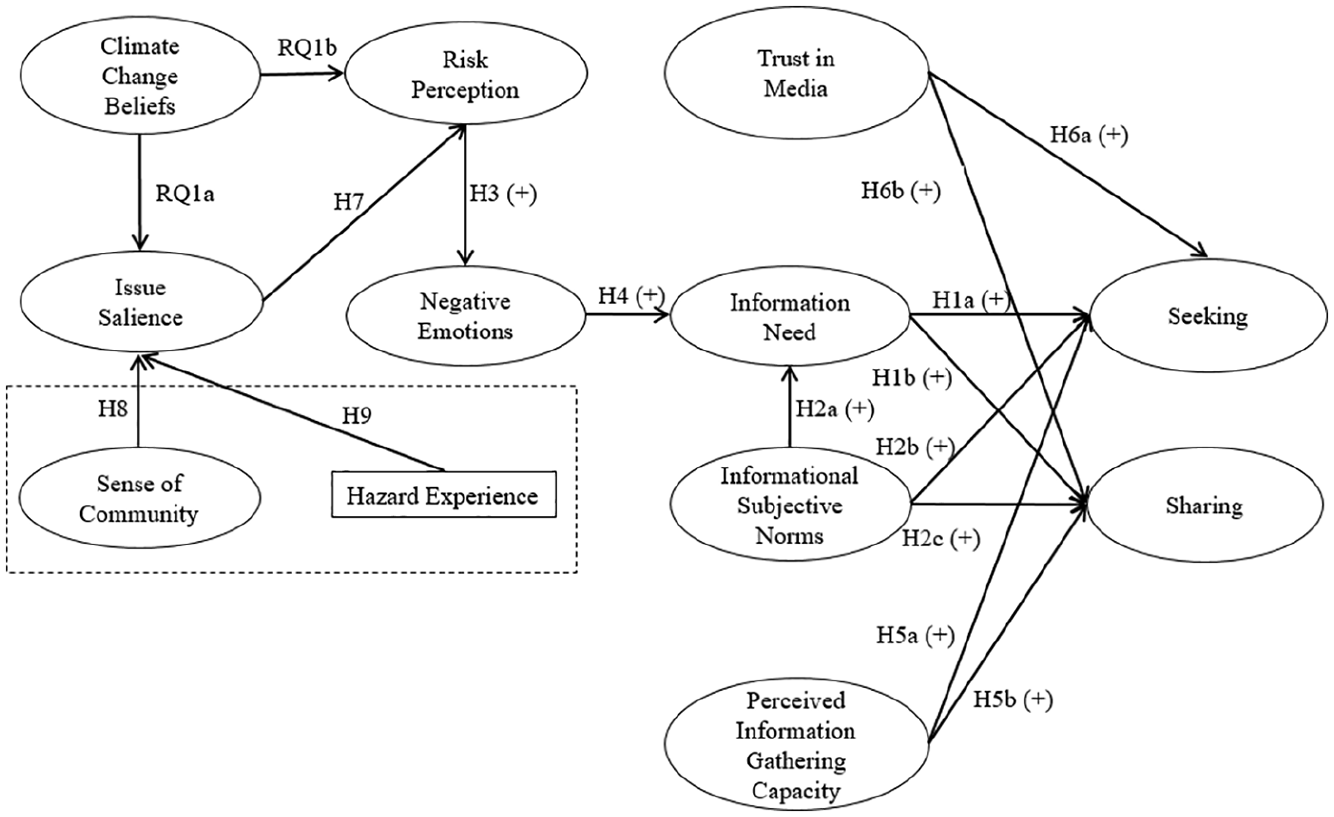
Theoretical model with hypotheses.
Method
Sample
National sample
Upon institutional review board (IRB) approval, from November 22 to December 4, 2017, data were collected through GfK’s KnowledgePanel® (N = 504). KnowledgePanel® is the largest online panel that is representative of the U.S. adult population. To increase population representativeness, GfK employs an address-based sampling methodology and provides Internet access to households without it. Median study completion time was 13.5 min, and survey completion rate was 56.9%. The majority of the national sample are homeowners (70.2%), live in single-family detached houses (71.9%), 57.8% of the sample are married, and 86.3% live in metro areas. Furthermore, geographic distribution of the sample is as follows: Northeast (17.9%), Midwest (21%), South (37.4%), and West (23.8%). The state most represented in the sample was California (13.5%), followed by Texas (9.3%) and New York (6.9%).
Houston sample
Upon IRB approval, from November 10 to December 5, 2017, a quota sample (N = 503) were recruited through Qualtrics panels to match demographic distribution of the city of Houston on age, gender, race, and income. Participants were screened through household zip codes between 77001 and 77500 to ensure residence in the areas affected by Hurricane Harvey. Medium survey completion time was 14.9 min. Table 1 shows demographic distribution of the sample as compared with the 2016 American Community Survey for the city of Houston. 1 As shown in Table 1, compared with the population in the city of Houston, our Houston sample is slightly older, less White, with higher education. The majority of the sample are homeowners (60.4%) and live in single-family detached houses (63.8%). Most of the sample have lived in the greater Houston area for more than 5 years (85.9%), and 53.3% reported that they were born in the state of Texas. The majority of the sample speak English at home (91.3%). In terms of disaster experience, 28% of our sample reported financial loss, 23.3% reported personal property loss, 21.3% reported lack of any resources (food, water, shelter, electricity) for over a week, 15.1% reported increased demands or relationship problems, 14.9% reported displaced from home, 13.3% reported self or household members have health problems, 11.7% reported family or close friends injured, 10.9% reported loss of sentimental possessions or pets, 6.8% reported death of a family member or close friends, 4.4% physical injury, and 3.4% saw dead bodies. Comparing the demographic characteristics of our two samples, the national sample was slightly older, with higher household income and more White respondents, but the Houston sample was more educated.
Demographics of Research Participants.
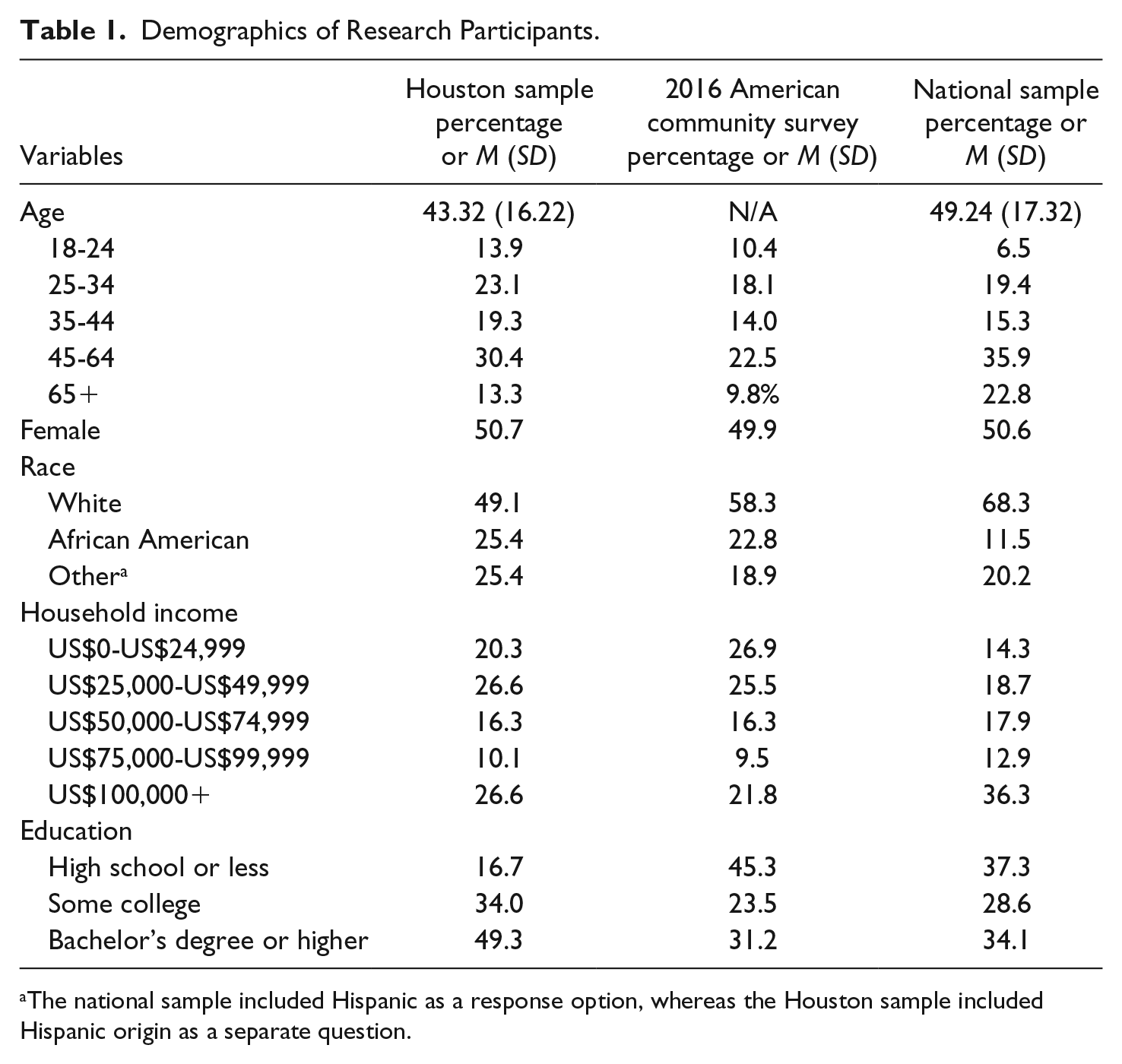
The national sample included Hispanic as a response option, whereas the Houston sample included Hispanic origin as a separate question.
Measures
All variables were measured with existing scales adopted from past research except for relevant channel beliefs, which were operationalized as participants’ trust in information from traditional and social media. In the national sample, three traditional information sources were measured individually—television news, national and local newspapers, and radio stations, while social media was assessed with the same item as in the Houston sample. In the Houston sample, two questions were included, inquiring participants’ trust in mass media and in social media. Table 2 shows descriptive statistics and sources for items included in both surveys.
Survey Measures (National Sample: N = 504; Houston Sample: N = 503).

Note. Except for otherwise noted, all items were assessed on a 5-point Likert-type scale with 1 = strongly disagree; 5 = strongly agree.
In addition, sense of community was measured only in the Houston survey. We adapted 12 true/false questions from the sense of community scale (Chipuer & Pretty, 1999) and measured these items on a 5-point Likert-type scale (1 = strongly disagree, 5 = strongly agree). Sample items include “I think my community is a good place for me to live,” and “I feel at home in my community.” 2 Hazard experience was measured with 11 binary items (0 = did not experience, 1 = experienced) ranging from financial loss to physical injury. These items were summed to create a scale (M = 1.53, SD = 1.83). About 40% of the sample indicate that they did not experience any specific loss from Harvey. However, given the geographical proximity, it is reasonable to believe that participants in the Houston sample had more vivid experience with Harvey as compared with the national sample, even if they did not suffer from direct consequences.
Analysis
Structural equation modeling was conducted with Mplus 7.3 to test hypotheses and examine model fit. A maximum likelihood estimator (MLR) with robust standard errors was employed to account for potential issue with multivariate normality, although the normality assumption was not violated for any individual observed variable except for hazard experience (skewness = 1.40). This variable was modified through square root transformation to correct for skewness (after transformation: skewness = 0.28) before it was included in model testing. For single-indicator latent measures, a 20% error variance was specified to account for possible measurement error. Two-step modeling verified the measurement model before adding proposed paths to test the structural model (Kline, 2005). All factor loadings in the measurement model were above .60. Indicators of model fit included chi-square, comparative fit index (CFI; values close to or greater than .95), Tucker–Lewis index (TLI; values close to or greater than .95), root mean square error approximation (RMSEA; values lower than .08), and standardized root mean residual (SRMR; values lower than .08) (Hu & Bentler, 1999). Due to the lack of consensus on how to include control variables in a theoretical model, we did not include demographic variables in model testing.
Results
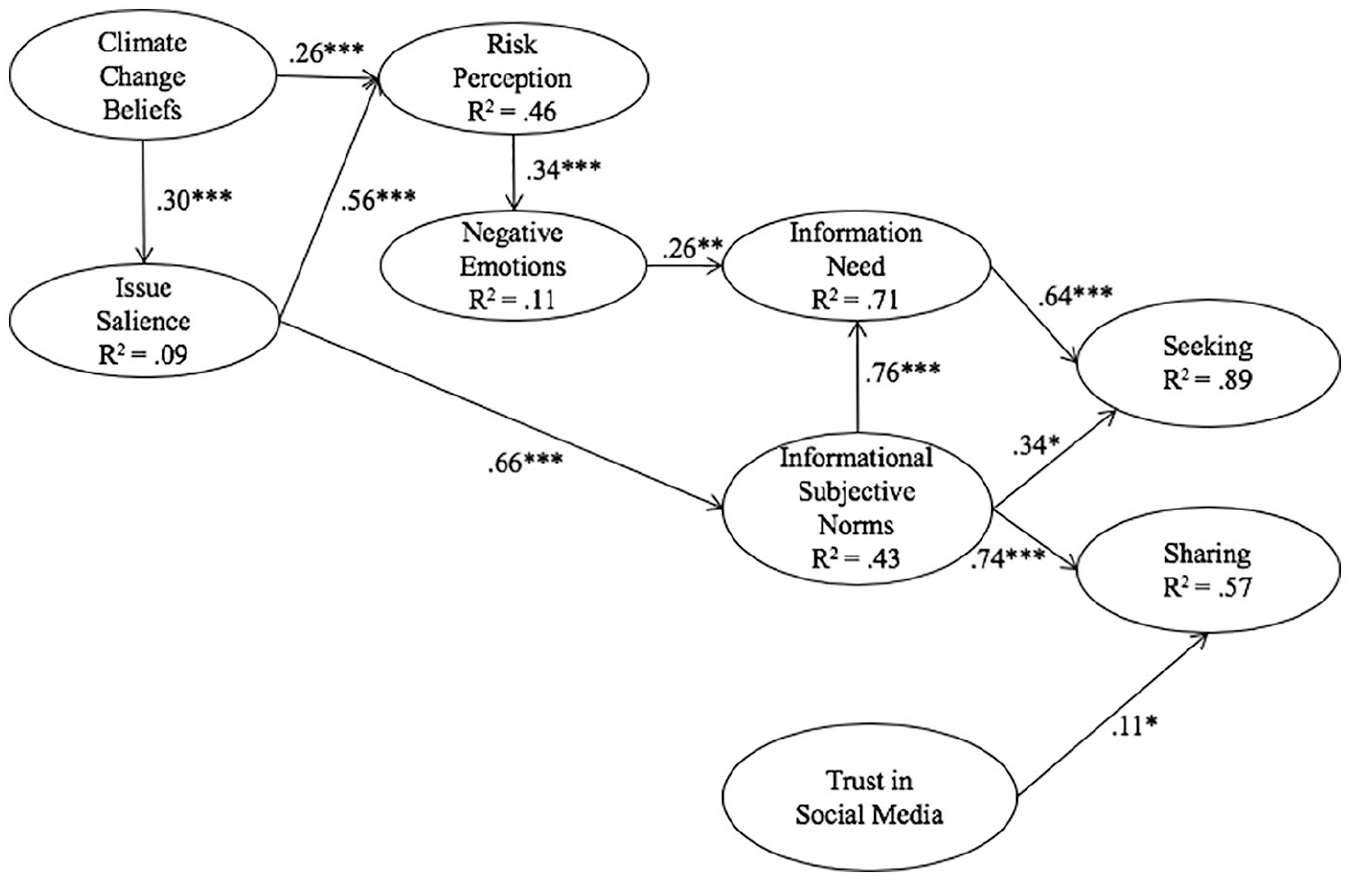
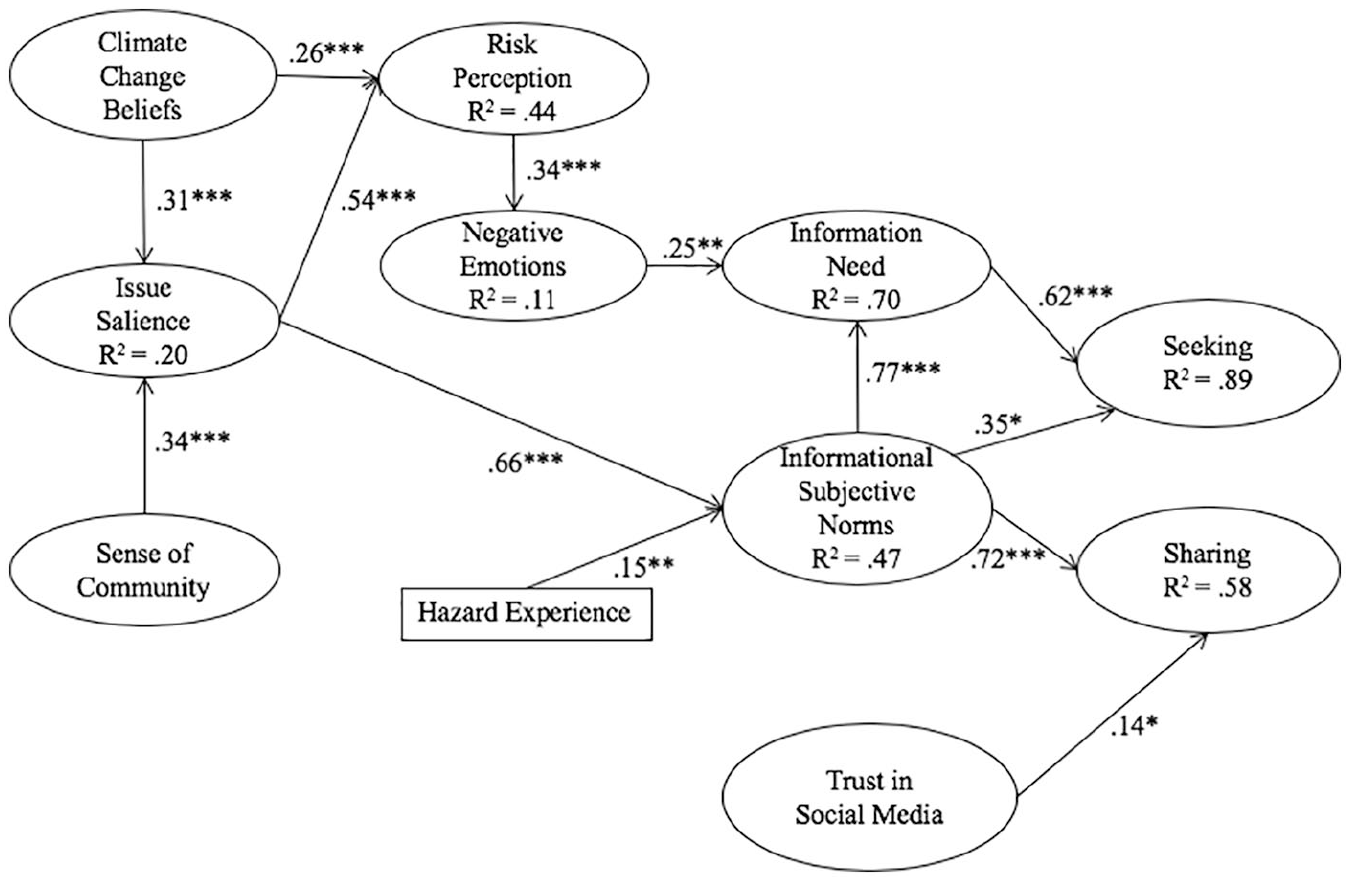
Table 3 shows model fit statistics for the final measurement model and structural model, all of which suggest good fit to the data. For the ease of interpretation, Figures 3 and 4 show standardized regression coefficients for paths that are significant in the national sample and the Houston sample. Figure 5 shows significant path coefficients for the Houston sample with sense of community and hazard experience included. Overall, the proposed theoretical model accounts for about 41% of the variance in seeking and 44% of the variance in sharing in the national sample and about 89% of the variance in seeking and 57% of the variance in sharing in the Houston sample, which is consistent with past research (Yang, Aloe, et al., 2014). The inclusion of sense of community and hazard experience improved model fit, but did not increase overall explanatory power of the model.
Summary of Fit Indices.

Note. RMSEA = root mean square error approximation; CI = confidence interval; SRMR = standardized root mean residual; CFI = comparative fit index; TLI = Tucker–Lewis index.
Items with factor loadings below .60 were removed.
Items with factor loadings below .60 were removed; Fear and worry were allowed to covary.
Sense of community and hazard experience were included in the model; Items with factor loadings below .60 were removed; Fear and worry were allowed to covary.
Sad and depressed were allowed to covary.
Two measures of sense of community were allowed to covary.

Results from the national sample.
Results from the Houston sample.
Results from the Houston sample with expanded model.
To address the first hypothesis, which was focused on information insufficiency, we found that information insufficiency was positively related to seeking (
The second hypothesis was focused on ISN. We found support for
The third hypothesis (
The fifth hypothesis posited that perceived information gathering capacity would be positively related to seeking (
The research question was focused on the relationship between climate change beliefs and risk perception. Results indicated that participants who believed that climate change was real and primarily caused by human actions were more likely to view Harvey as an important issue and perceived greater risks from hurricanes. The seventh hypothesis (
In the Houston sample only, the eighth hypothesis (
Discussion
Guided by the RISP model and information sharing theories, this study employs two large-scale surveys to examine the social cognitive variables that influence information seeking and information sharing behaviors related to Hurricane Harvey. The main objective is to identify motivational factors that are uniquely associated with seeking and sharing among Harvey victims and people who were not directly affected by the hurricane. Results indicate that across the two samples, climate change beliefs are consistently related to participants’ perceived issue salience and risk perception. Risk perception, negative emotions, and ISN consistently elevate participants’ need for information.
However, important differences also emerge from the two samples. In the national sample, information insufficiency is a significant predictor of both information seeking and information sharing, but this need for information is not significantly related to information sharing in the Houston sample. This result suggests that people who are not directly affected by Harvey are more likely to seek and share information with others when they deem this information useful to themselves. That is, these communication behaviors may occur because people in the national sample believe that the information they find useful will also benefit others. Nevertheless, it is also possible that people who are distant from Harvey may not fully understand what type of information disaster victims need the most.
In contrast, although ISN is significantly related to information seeking in both the national sample and the Houston sample, it is a significant predictor of information sharing in the Houston sample only. This result suggests that people who are not directly affected by the disaster are likely to seek information when they believe that others expect them to be knowledgeable about this topic. However, this social motivation does not lead them to share information with others, probably because they may not have friends or family in their immediate social environment who will benefit from this information. This finding relates to the notion of impersonal risks, a term coined by Kahlor, Dunwoody, Griffin, and Neuwirth (2006) to depict risks that threaten something other than the self. Consistent with Kahlor et al. (2006), ISN is a significant predictor of information seeking in both samples, even when people in the national sample are likely to view Harvey as an impersonal risk. In contrast, ISN is only significantly related to information sharing among the Houston respondents who are more likely to view Harvey as a personal risk. Future research should continue to examine how the RISP model functions differently depending on whether the risks are personal or impersonal to the research participants. In particular, when the risk topic is more impersonal, such as Harvey for respondents in the national sample, epistemic motivation seems equally important for both information seeking and information sharing. In comparison, when the risk topic is more personal, such as Harvey for our Houston respondents, social motivation seems to be a more important determinant for information seeking and information sharing behaviors.
Translating these ideas for practice, risk, and crisis communications about natural disasters such as hurricanes need to identify community residents’ specific needs for information sufficiency. Before natural disasters hit, this information insufficiency may be related to shelter locations and evacuation routes. During the disasters, this information insufficiency may be related to safety and travel bans. After the disasters, this information insufficiency may be related to relief and recovery. At the same time, it may be worthwhile to alert the public that they cannot solely rely on past experience to handle a new disaster and there may be a need for updated information. For instance, a common decision rule that disaster victims use when making evacuation decisions is their past success in circumventing the most horrendous impacts of a similar disaster. The optimistic bias resulted from this comparison based on this incorrect norm needs to be corrected. That is, crisis communication surrounding natural or man-made hazards needs to urge people to gather information that is unique to each disaster (Weinstein, 1989).
The other important cross-sample differences include the significant impact of perceived information gathering capacity on information seeking and information sharing, as well as the significant relationship between trust in mass media and seeking in the national sample, which is not identified in the Houston sample. Given the lack of immediate impact from Hurricane Harvey on participants in the national sample, one may envision the possibility that individuals who perceive themselves to have higher information gathering capacity will seek information and share this information with others because they are more confident in how this information may benefit others. The significant relationship between issue salience and capacity also supports this interpretation in that participants in the national sample who view Harvey as an important issue also perceive themselves to have a greater capacity in acquiring information on this topic. That is, national participants who view Harvey as a salient issue, even when it poses impersonal risk to themselves, seem to be more confident in their ability to gather additional information, as well as to share this information with others. It is also possible that perceived issue salience actually implies higher existing knowledge, which has been shown to be positively related to information gathering capacity in past research (see, for example, Griffin et al., 2008). Those who trust Harvey-related information in the mass media are also more likely to seek relevant information probably because mass media are their primary source of information given their lack of connection to disaster victims in close social surroundings.
In contrast, immediately after Hurricane Harvey, knowing where and how to access valuable information does not seem to be a central concern for Houston residents, likely because disaster relief information is readily available. It is also possible that local residents are more aware of the difficulty involved in obtaining useful information or in extracting truthful and valuable information from information that is less reliable. This latter possibility suggests that perceived information gathering capacity may take a secondary role in influencing communication behaviors as compared with other motivational factors, especially social motivations such as ISN. Due to these reasons, perceived information gathering capacity and trust in mass media are not important factors that influence information seeking and information sharing in the Houston sample.
In terms of theoretical implication for the RISP model, although the model demonstrates excellent explanatory power by accounting for a large amount of variance in seeking and sharing in both samples, only information insufficiency and ISN are consistent predictors of information seeking, whereas trust in social media is a significant predictor of information sharing in both samples. The predictive clout of the two main motivational factors in the RISP model supports existing literature, which suggests that a reduced model with only these two variables account for a large proportion of the variance in information seeking, at least directly (Yang, Aloe, et al., 2014). These results indicate that individuals’ cognitive needs for information and perceived social expectations on their knowledge level regarding a risk topic are important factors to consider when the goal of risk communication is to encourage more information seeking.
Regarding the consistent impact on information sharing from trust in Harvey-related information from social media, it is imperative to evaluate this finding in relation to the rest of the theoretical model. In particular, this relationship is identified at the presence of all the other social cognitive variables in the model, including risk perception, negative emotion, ISN, and trust in mass media. This result probably reflects the reliance of the U.S. public on social media to share information with others (Rainie, 2018). However, social media has also been employed to propagate misinformation and rumors during crisis events (Leberecht, 2010), which can cause large-scale panic (Richards & Lewis, 2011) and economic losses (Liu, Nourbakhsh, Li, Fang, & Shah, 2015).
During Hurricane Harvey, a rumor proclaiming “mandatory evacuations are underway in the City of Houston” caused confusion and unwarranted panic among people in the affected area. Other rumors such as “the city of Houston was checking your immigration status before allowing you into a shelter” also caused a great wave of anger or disappointment from both victims and other concerned citizens. The instant sharing nature of social media makes rumors extremely difficult to control because information from official sources released to debunk misinformation often comes one step too late (Ozturk, Li, & Sakamoto, 2015). As a result, social media users are often left to evaluate the accuracy of information on their own. In light of this, the consistent impact of trust in Harvey-related information on social media on information sharing warrants more attention from communication scholars, such as work related to the social-mediated crisis communication model (Jin, Liu, & Austin, 2014).
Finally, the addition of sense of community and hazard experience in the Houston sample improve model fit to the data, which indicates that these variables are important to consider when examining communication behaviors that occur at the community level. Houston residents’ information seeking and information sharing are influenced by the connection they feel toward others in their community (Liao et al., 2018). In particular, this sense of community contributes to their perception that Harvey is an important issue, and others expect them to stay on top of information related to disaster relief and community recovery. The positive relationship between relevant hazard experience and ISN further supports this notion. That is, when Hurricane Harvey threatens the collective well-being of Houston residents, people are more likely to share information with others when they view information sharing as a socially desirable behavior. In other words, this norm for sharing truncated individual capacity in motivating seeking and sharing activities. However, other intervening variables may also account for this relationship, which warrants future research. For instance, collective experience with hurricane Harvey may increase people’s perceived descriptive norms (i.e., everyone else is seeking and sharing information), which subsequently leads them to sense a stronger social expectation regarding their own information level (Lapinski & Rimal, 2005).
As a new addition to the theoretical model, the consistent, strong influence of climate change beliefs on perceived issue salience and risk perception suggests that future research should continue to explore individual characteristics that help us fathom risk perception related to complex social issues. For instance, within the RISP framework, past research has examined the role of cultural cognition worldview (Hmielowski et al., 2018) in shaping public risk perception about environmental issues such as water quality. This research illustrates that belief in climate science influences participants’ risk perception about hurricanes, even among a sample of participants from a largely conservative state. With cross-sectional data, however, it is also possible that increased risk perception about hurricanes may contribute to people’s perceived salience of Hurricane Harvey and lead to greater acceptance of climate science.
While discussing these results, it is also important to point out limitations. Most importantly, survey items were not completely identical across the two studies due to space limitation in the national survey, which was hosted within a larger study. We had to rely on single items to assess some key constructs in the Houston sample because pretest results indicated that survey length was a big concern among local residents, who had many other things that demanded their time and energy as they recovered from Hurricane Harvey. We had to compromise on content validity to ensure a decent completion rate. In particular, information insufficiency was measured as a single-item variable that represents participants’ perceived information need, rather than the standard two-item measure that also includes perceived knowledge. This decision was made largely due to the fact that the traditional two-item RISP measure of information insufficiency, which includes a reflective preamble, takes more time to process and may be difficult to include in a survey that is already constrained in space. However, future research should be more careful with the assessment of this construct, which is developed based on Eagly and Chaiken (1993)’s sufficiency principle. When space allows, questionnaire design should incorporate the more precise evaluation of information insufficiency, which accounts for both satisficing and efficacy (Griffin & Dunwoody, 2015). Second, although the Houston sample matched the population of Houston on most demographic characteristics, it overrepresented those with higher education. Third, hazard experience among our Houston participants was limited. This result suggests that individuals who suffered the worst impact of Hurricane Harvey were probably difficult to reach. Therefore, future research needs to adopt alternative sampling strategy or conduct field work to gather insights from disaster victims.
Other limitations within this research fall within the conceptualization domain. In particular, the RISP model proposes that motivational factors (information insufficiency and ISN), relevant channel beliefs, and perceived information gathering capacity interact with each other to influence information seeking and processing. In this study, given the complexity in the structural equation modeling analysis, we only focus on the main effects of these factors on information seeking and information sharing. Future research should explore the interactive relationships among these variables. Finally, given the theoretical connection between information sharing and information processing (De Dreu et al., 2008; Scholten, van Knippenberg, Nijstad, & De Dreu, 2007), it is possible that people who prepare to share information with others in the future will process and store information in memory in ways that make this information more retrievable later, termed as cognitive tuning (Zajonc, 1960). Therefore, future research needs to examine information processing along with information seeking and information sharing using the RISP framework. In particular, information processing serves as an important communication variable that consequentially contributes to attitude and behavioral formation, as described in Griffin et al. (1999) and partially illustrated in Griffin, Neuwirth, Giese, and Dunwoody (2002). Related to individuals’ preparations and responses to hurricanes and other natural disasters, it seems crucial to examine how information processing may affect people’s preparatory behaviors by contributing to the formation of stable behavioral beliefs.
Conclusion
Based on survey data from a nationally representative sample and a quota sample of the Houston population, this study shows that climate change beliefs and perceived issue salience are consistent predictors of risk perception about Hurricane Harvey. Risk perception increases individuals’ negative emotions and their need for more information. In the national sample, this need for information and individuals’ perceived information gathering capacity are significant predictors of information seeking and information sharing, whereas ISN are only significantly related to seeking. In the Houston sample, in contrast, ISN are significantly related to both information seeking and information sharing. Although trust in traditional media is a significant predictor of information seeking in the national sample, trust in social media is significantly related to information sharing in both samples. Furthermore, sense of community and relevant hazard experience influence Houston participants’ information seeking and information sharing through perceived issue salience and ISN.
These findings attest to the explanatory power of the RISP model and demonstrate important differences in motivators of information seeking and information sharing. Specifically, for individuals who have more direct, firsthand experience with Hurricane Harvey, information seeking and sharing behaviors are primarily driven by social motivations. In comparison, for those who view Hurricane Harvey as an important issue, but do not have direct experience with it, epistemic motivations and perceived information gathering capacity play a bigger role in influencing information seeking and information sharing. The consistent impact of trust in social media on information sharing also suggests that disaster relief agencies need to carefully monitor the information that is disseminated broadly on social media during crises such as Hurricane Harvey to reduce the propagation of rumors or false information.
Footnotes
Declaration of Conflicting Interests
The author(s) declared no potential conflicts of interest with respect to the research, authorship, and/or publication of this article.
Funding
The author(s) declared receipt of the following financial support for the research, authorship, and/or publication of this article: This research was supported by the National Science Foundation under Awards NSF#1761843 and NSF#1760586. Any opinions, findings, and conclusions or recommendations expressed in this material are those of the author(s) and do not necessarily reflect the views of the National Science Foundation.
