



Abstract
This study provides a clearer understanding of how audience members’ race influences their media choices. It finds that in today’s overwhelmingly negative media environment, people prefer reading negative stories about persons in their own racial group over stories about racial out-group members. This suggests social movements seeking to change the attitudes of people of different races using media (e.g., Black Lives Matter) might not be as successful as those in the past (e.g., Civil Rights Movement). Today, people tend to ignore such news when there is other bad news that affects people in their own racial group.
Consumers currently have a wide array of media choices at their fingertips, including television, magazines, blogs, and social media. However, media use and consumption are influenced by factors such as lifestyle, personality traits, and political beliefs (Zillman, 2000). A critical and unique factor that has been shown to influence attention to online content (Appiah, 2002), news stories (Appiah, 2003; Appiah et al., 2013), and even movie choices (Weaver, 2011) is race.
The importance of understanding media selections cannot be overstated. Increasing readership, viewership, and market share are the benchmarks for success in the fields of television, newspapers, magazines, and advertising—areas that are the cornerstone of media and communication. In addition, understanding this media effect has a carryover effect on to real-world perception. As several scholars have observed, what people know about the world today rarely comes from their firsthand experiences; instead, it comes from the media they interact with, and this shapes their perception of reality (Dixon & Azocar, 2007; Gorham, 1999; Simmons, 2017). Given the prevalence of negative news in the contemporary media landscape, and the abundance of such coverage concerning African Americans, this study uses social identity theory to examine how race-based (African American vs. White) negative news coverage affects media use and selection among audiences.
Studies examining how race influences media choices often use selective exposure to explain that people are motivated to find news that affirms the perceived specialness of their own racial group and portrays their group in a most favorable light (Appiah et al., 2013). Although these studies have provided a fruitful understanding of why readers select certain stories over others in one context, they are largely divorced from the reality of the contemporary media climate. Currently, negative news stories outnumber positive accounts by a ratio of 17 to 1 (Williams, 2014). Selective exposure analyses also rarely explain the challenge faced by African Americans when seeking positive news stories to boost their group identity. Media rarely break from their routines and often cover news from the perspective of the dominant group (Bjornstrom et al., 2010; Marchi, 2008). For example, one analysis found, when studying the opioid crisis in Canada, though there were more indigenous victims than White victims, stories on White victims outnumbered stories on indigenous victims almost 30 to 1 (Johnston, 2019). In the United States, stories about African Americans are often negative, with one account finding that nationwide, local news present a whitewashed image of America in which African Americans interrupt to cause problems or interrupt when they are in need of help (Entman & Rojecki, 2000). Hence, current scholarship has yet to answer the ecologically relevant question of “what happens when positive options are not available?” In today’s negative media climate, we theorize that people might affirm the specialness of their group by either reading negative news about an out-group to make their group look good by comparing or by reading negative news about their own racial group to know how they are perceived to stave off criticisms of their in-group.
Negative news has long impacted social movements. The negative image of African Americans being attacked by police dogs and blasted by fire hoses has long been cited as the catalyst that changed Whites’ attitudes in favor of granting African Americans civil rights (Lee, 2002; Morris, 1986). Similarly, images of unarmed African Americans being gunned down by police are fueling the Black Lives Matter Movement, which has been called the Civil Rights Movement of our time (Holt, 2017). Given the importance of such negative images in steering public sentiment, it is imperative for us to know whether audiences are paying attention to negative news stories, and if so, to what they are paying attention, and what are the factors that guide their decisions. Thus, this study has both theoretical and practical implications.
Theoretical Framework
Among the panoply of options available to consumers, the decisions they ultimately make are not entirely random. One theory that specifically deals with this aspect of human behavior is social identity theory. It holds that as social beings, people tend to cluster with like-minded individuals who coalesce around the shared importance of some shared attribute or belief. These attributes can either be arbitrary or biologically ascribed like race or gender (Tajfel, 1978). Regardless of how group membership is defined, studies show that the stronger a person’s attachment is to their in-group, the more their perception of that group will influence their sense of self-worth (Tajfel, 1978).
Often these groups serve the purpose of fostering individuals’ self-esteem, bolstering their sense of uniqueness, and act as a means of differentiating themselves from others who are unlike them (Knobloch-Westerwick & Hastall, 2010). Members affix their sense of self-worth to the group to which they belong (Tajfel & Turner, 1986). Consequently, people are motivated to view their in-group in a favorable light. Whenever possible, people self-select themselves into groups they find favorable and not only exclude, but also find others who do not align with the goals of their group, to be lesser in some way than members of their in-group (Hutchison & Abrams, 2003).
We have reason to believe this concept of in-group favoritism carries over to media preferences. Increasingly, what people choose to know about, and how they choose to know it, is self-selected. Today, audiences can choose their own news narratives based on their unique preferences, and also identify depictions that will serve as the basis for their own behavior, and beliefs about others (Knobloch-Westerwick et al., 2008; Simmons, 2017). Research shows that people most frequently choose to read stories that aggrandize their own group (Knobloch-Westerwick & Hastall, 2010; Marques et al., 1992), and/or denigrates members of out-groups (Appiah et al., 2013).
Several studies find that racial minorities are among the most clearly defined in- and out-groups (Purdie-Vaughns et al., 2008). People tend to view out-group members negatively, often evaluating them as either confirming or dis-confirming to their preexisting biases (Vescio & Biernat, 1999). In the context of media, researchers find that audiences assess the degree to which they are similar to news sources and often prefer sources that are most similar to them (Bandura, 2001). This is especially true for racial minorities who seem especially drawn to information about their own racial group compared with others (Appiah, 2003; Appiah et al., 2013; Holt, 2017; Holt & Sweitzer, 2018).
African Americans are perhaps the most visibly recognizable racial group in the United States. They have long been perceived as a permanent underclass in America, a group that—despite generations of other immigrant groups arriving subsequent to their being forcibly brought to the United States—have been made the least able to assimilate by legal and nonlegal (Jim Crow, discrimination, etc.) means (Feagin & Feagin, 2012). African Americans also have a unique history in the United States, and also seem to conjure up thoughts in the minds of Whites unlike any other group. For example, one team of researchers found that although some Whites have positive images of African Americans, as many as “one in every two openly endorses frankly negative characterizations of most Blacks” (Peffley et al., 1997, p. 35).
Scholars have theorized that highly stigmatized groups might form stronger cultural bonds and a greater sense of ethnic identity to protect themselves from an oppressive majority (Brittian et al., 2013; Smith & Silva, 2011). In service of this goal, African Americans might also be especially motivated to seek out information about their own racial group. Earlier studies have found that African Americans are more likely than Whites to use their ethnic identity to guide their preferences for health information (Phinney, 1991). They are also more likely to prefer shows featuring African Americans, compared with those featuring Whites, and are far more likely to identify with television characters who are of the same race than are Whites (Appiah, 2003). African Americans also show a greater interest in products that are pitched by African Americans than products pitched by White spokespeople (Appiah, 2003). Thus, racial group membership matters, especially to African Americans.
The Challenges of Maintaining Group Esteem in a Negative News Landscape
People tend to be extremely cognizant of how their groups are perceived. Social identity theory predicts that, in turn, they should also prefer positive news stories about their group over negative stories to bolster their group and individual self-esteem. However, finding positive news can be a particularly vexing problem for African Americans. A survey of local television news reporting in Pittsburgh, for example, found that almost 80% of all references to African Americans were negative, and outnumbers neutral or positive representations by a margin of four to one (Klein & Naccarto, 2003). In addition, research spanning local news coverage across several major American cities has consistently shown that racial minorities are disproportionately more likely than Whites to be shown as the perpetrators of criminal acts (e.g., Dixon & Azocar, 2007; Dixon & Linz, 2000; Jackson, 2013; Romer et al., 1998). Thus, even if African Americans might prefer positive representations of their group, the opportunity to do so does not appear to be a luxury afforded by news today (Dixon & Williams, 2015).
In such a news environment, social identity theory predicts that people will act in one of two ways: The first potential course is that they will read negative information about out-groups, a strategy termed out-group derogation. The logic of this is predicated on the observation that groups engage in social comparisons and focus on the negatives of out-groups to make their in-group look good by comparison (Abrams & Hogg, 1988). The second potential course is that they will engage in monitoring. Here, despite negative news threatening their own beliefs about the specialness of their group, in-group members might pay more attention to such stories to know how their group is perceived by outsiders to prepare counter-arguments to protect the image of their group if necessary (Hutchison & Abrams, 2003; Marques et al., 1988).
Persons who are highly identified as being part of the in-group can be especially hard on poor performers whose actions might not only reflect badly on the group as a whole, but on them individually (Branscombe et al., 1993). The more a person identifies with being a member of the in-group, the more undesirable they are likely to view a poor performing in-group members’ behavior as being (Branscombe et al., 1993; Hutchison & Abrams, 2003). As a result, the actions of poor performers require closer scrutiny/monitoring, if not outright expulsion from the group as a form of “sophisticated in-group favoritism” (Biernat et al., 1999, p. 524). Thus, in addition to reading negative news about the out-group to view their own group as favorable by comparison (out-group derogation), it also is possible that participants might prefer reading negative stories about poor behaving in-group members to be aware of how their group is perceived, and to see whether such members’ behavior requires further actions on their part (monitoring).
Given these dual possibilities, we present the following competing hypotheses. First if out-group derogation has a strong effect, we hypothesize that
However, if monitoring has a strong effect, then we predict that
Also, because race is so central to African Americans’ self-identity (Phinney, 1991) and media choices (Appiah, 2003; Appiah et al., 2013), we expect the influence of race to be stronger for African Americans than Whites in shaping their news preferences. The role of race, however, could play a complex role in how African Americans and Whites view news stories. Given how media can influence how African Americans are perceived (Entman & Rojecki, 2000), they perhaps rightfully may be very much attuned to how they are depicted in the media. Conversely, Whites, unencumbered by media depictions shaping public perceptions of them, might engage in different news-seeking patterns than African Americans. Because we are examining this in an exploratory context, we ask the following research question:
Method
To test these predictions, we conducted a quasi-experiment in which participants were asked to choose among a series of news stories about various crimes, which a predominant negative news topic often mentioned in media coverage. To assess how race-related considerations influenced news choices, the race of the individual associated with each story (i.e., the “suspect”) varied, so some story options showed a White suspect, others showed an African American suspect, and other stories made no reference to race whatsoever. From this task, we observed whether participants varied in their selection of and time spent reading stories based on whether the suspect was a member of study participants’ racial in- or out-group.
Sample
Participants were recruited through Qualtrics, a national survey research firm that maintains a large, diverse sample of participants for the purposes of market, opinion, and scientific research. Panelists were recruited to be as representative of the U.S. adult population as possible, with one notable exception: To make equitable comparisons across racial groups, we oversampled African Americans to ensure adequate statistical power in observing group-based differences in how participants engaged in the selection task. These sampling procedures yielded 432 participants in total, with 220 participants self-identifying as Black or African American, and 212 self-identifying as White.
Study Procedures
Upon consenting, participants were presented with a selection task for which they were asked to choose among a series of eight news stories constructed specifically for this study. Participants were told that stories were collected over the course of several months from local news organizations throughout the United States and attributed to the Associated Press. To maximize realism, each story was crafted by a former professional newspaper reporter, and additional attention was given to formatting the stories to make them appear realistic. Final stories ranged between 400 and 500 words each, and the presentation of these stories was randomized to avoid potential order effects. After reading each story, participants were asked questions to measure their reactions to the story, then redirected to the selection task where they had the option to read additional stories or proceed in the study. Upon completing the selection task, participants were asked a series of additional questions and demographic information was collected (study instructions are available in the supplemental material, available online).
In assessing the influence of race on selection behavior in negative news contexts, several features of the selection task are worth nothing. First, in making decisions about which stories they wished to read, participants were presented with a series of eight headlines with accompanying news leads and photos. Of these stories, six described a criminal act involving either a White suspect, an African American suspect, or an “unknown” suspect. Furthermore, of the six crimes described, three focused on a violent criminal act (e.g., robbery, assault, murder), whereas the others focused on “white-collar” crime (e.g., fraud, embezzlement). This decision was made to avoid potential confounds where participants’ bias caused them to associate certain persons with certain types of crimes (e.g., associating African Americans with violent crime and Whites with white-collar crime). As such, the selection task included the following combinations of suspect race and criminal act: (a) White suspect, violent crime; (b) White suspect, white-collar crime; (c) African American suspect, violent crime; (d) African American suspect, white-collar crime; (e) no race suspect, violent crime; and (f) no race suspect, white-collar crime. In an effort to mask the true purpose of the study, the remaining two stories were entertainment-oriented—one featuring novel ways of purchasing movie tickets, and the other discussing the most recognizable company logos. An example of the selection task is provided in Figure 1.
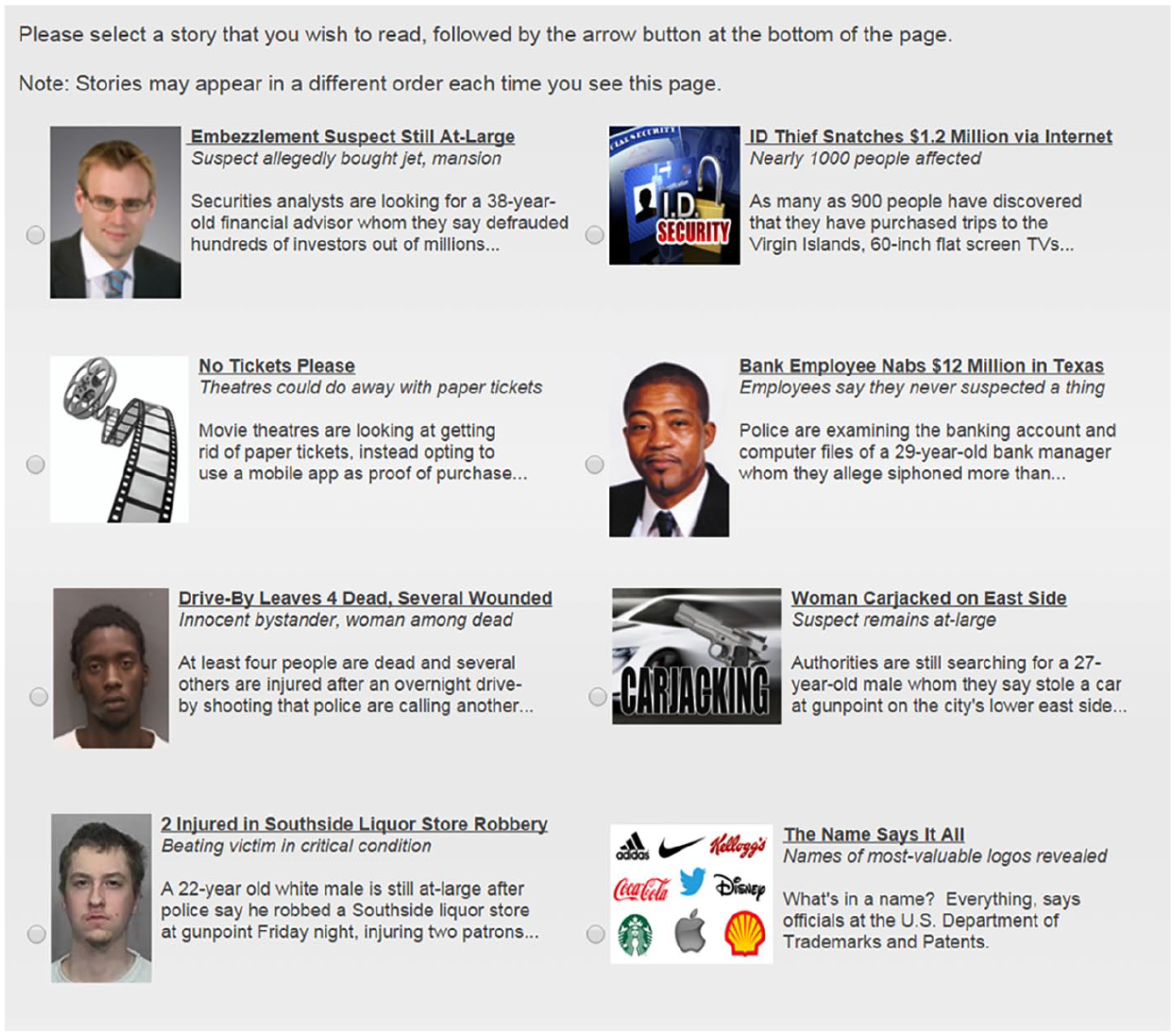
Example storyboard.
However, the use of a single selection task is insufficient in determining the influence of race on story selection in negative news contexts. It may be, for instance, that one of the stories featuring a criminal act might simply be more compelling than the others, regardless of the race of the suspect associated with the act. This scenario could result in mistakenly attributing any observed differences to race when instead such differences reflect topical interest. To account for this possibility, some participants were randomly assigned to a different selection task in which the combinations of suspect race and criminal act were reversed. For example, whereas one selection task might include a story describing an African American robbery suspect and another describing a White shooting suspect, the other selection task would feature a story describing a White robbery suspect and an African American shooting suspect. This was done to better ensure that any differences in story selections more precisely reflect race-based differences than some other factor.
Suspect Photo Pretest
Another important component to the selection task was to ensure that the photos of the suspects accompanying the headlines did not differ in ways beyond race that could affect participants’ selection behavior. To do this, we sampled a large number of photo candidates to represent African American and White suspects, and pretested them in an effort to select two pairs of photos—one pair to accompany the violent crime news stories and one to accompany the white-collar crime stories—that participants would evaluate similarly on a number of characteristics. We recruited workers from Amazon’s Mechanical Turk service (N = 100) to rate individuals featured in 20 photographs on the extent to which they were perceived as likable, attractive, friendly, threatening, or menacing. Paired sample t tests were conducted to assess any significant differences between sets of these photos. Pairs of photos were selected based on the lack of significant differences on each of these dimensions, offering additional confidence that any differences beyond race were minimal. None of the participants used in the pretest participated in the final study.
Measurement
Initial story choice
To assess participants’ story preferences, we used three different measures. First, we assessed the extent to which participants prioritized stories featuring members of their racial in-group or out-group by tracking which stories participants selected first. Specifically, the initial choice measure merges participants’ self-identified race with the race of the suspect featured in the story that they chose to read first. This technique allows for a direct comparison of the extent to which participants first read negative news about either their racial in-group or out-group.
Total selection behavior
For our second measure, we go beyond merely observing participants’ initial story choice and utilized the multi-iterative nature of the study that allowed participants to revisit the storyboard and read as many stories as they pleased. Total selection behavior was measured by tracking participants’ choices each time they selected a story to get a stronger sense of whether race-based preferences were evident throughout the study. The stories participants selected throughout the study were coded similarly to their initial story selection (e.g., suspect from the racial in-group, suspect from the racial out-group). As each selection task included two stories presenting members of the racial in-group in a negative light, and two presenting members of the racial out-group negatively, counts were computed for each that ranged from zero to two and averaged across the sample. The strength of this measure lies in providing a broader indicator of whether participants were willing or unwilling to read negative stories about the racial in-group or out-group. Whereas the initial choice might send a signal about priority, the second technique allows insight into whether certain types of negative news—especially if it threatens one’s view of their racial in-group—are preferred or avoided throughout the study.
Time spent
Whereas selection behavior is certainly important, we argue that these measures might only tell part of the story regarding what people choose to read. As another indicator of participant interest in, or preference for, particular news stories, we also observed how long participants chose to engage with each story after having chosen to read it. Time spent is an indicator designed to assess the extent to which participants read stories featuring members of the racial in-group or racial out-group, which was created by summing the amount of time participants spent reading stories of each variety. For participants who chose not to read stories featuring members of either the racial in-group or racial out-group, they were assigned a zero on the appropriate time measure. As a measure of attention, as opposed to mere selection, other work on the subject of the role of race on selective information-seeking practices have utilized time measures in their work as well (e.g., Appiah, 2003; Appiah et al., 2013), allowing for a more direct comparison between the current study and other work.
Time measures are notoriously sensitive to statistical outliers that could skew results and warp interpretations of findings (e.g., Ratcliff, 1993). This is especially true of the online survey experimental context, in which participants might step away from their computers for an extended period of time in the middle of an experimental task. Whereas no perfect strategy exists for dealing with outliers in time-based analyses, we utilized two separate approaches to improve the confidence in any observed findings for the time-spent measure. One approach involved dropping outliers from all analyses involving the time variable via a process referred to as “Windsorizing” (Barnett & Lewis, 1978). Windsorizing involves dropping all observations that fell outside of two standard deviations of the mean. Doing so sets a concrete rather than arbitrary cutoff point for assessing outliers and accounts for any potential undue influence of a few cases on statistical inferences. Using this approach, 63 cases were dropped from our analysis due to their outlier status. Due to concerns pertaining to omitting data from analyses, we used a second approach that utilized the full range of values on the time spent, but accounts for outliers using a square root transformation. Doing so condenses the scale considerably, reducing the influence of potential outliers on results and inferences. Consistency in results across both measures should only strengthen confidence in any observations from this study.
Results
Our first two hypotheses pose competing, social identity theory-based explanations for how racial group membership might influence how people engage with negative news. The first possibility is that people might prefer negative stories about members of the racial out-group (
Initial Choice for In-Group and Out-Group Stories.

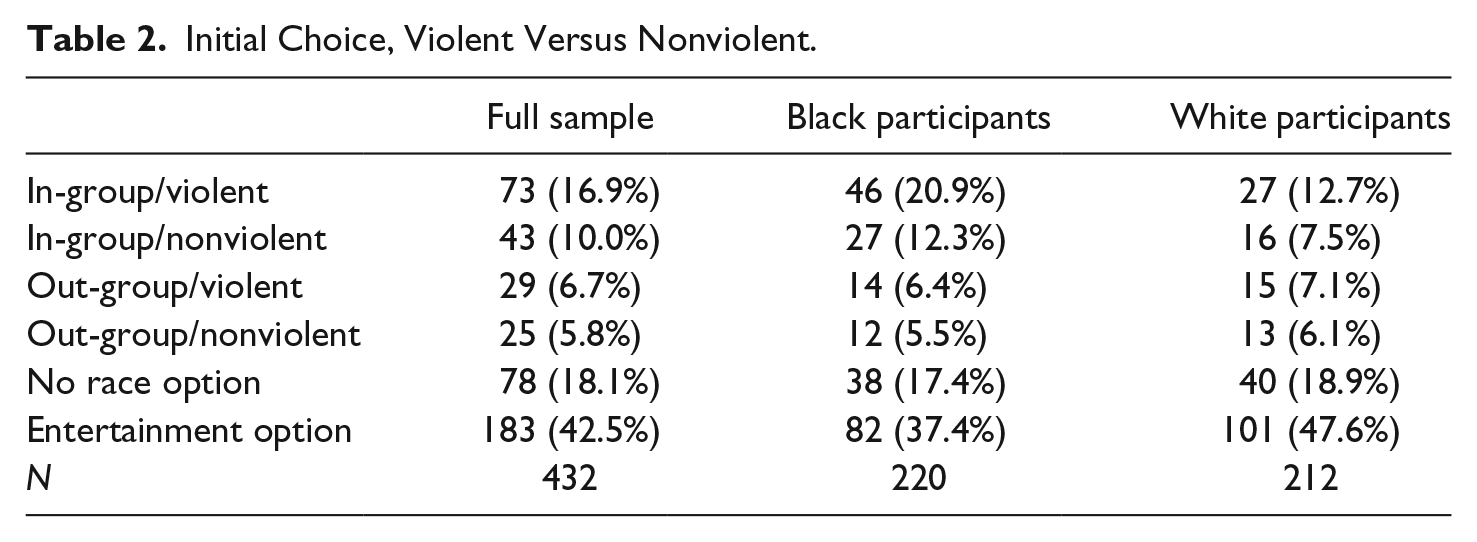
To further explore this finding, Table 2 provides a breakdown of initial story selection by participant race, and the nature of the crime being described, to assess whether certain types of deviant conducted by members of the racial in-group (violent vs. nonviolent) were of particular interest to participants. When doing so, the differences in initial story choice between African American and White participants are only marginally significant, χ2(5, N = 432) = 9.746, p < .10, Cramer’s v = .151, suggesting that on the whole, African Americans were not all that dissimilar from Whites in their initial preference for negative stories about their racial in-group based on the nature of the story. Interestingly, both African American and White participants were more interested in stories featuring members of their racial in-group accused of committing violent crimes. Among participants—whether African American or White—who chose to read stories about their racial in-group, around 63% chose to read a story depicting a violent crime. Furthermore, this finding does not appear to be solely a function of greater reader interest in violent crimes; when looking at the selection of stories about the racial out-group, both African American and White participants were no more likely to choose a story depicting a nonviolent crime than a violent crime. In sum, these results suggest that while people might prefer reading negative news about their racial in-group, the nature of this negative coverage seems to matter little in explaining the differences in initial story choice between racial groups.
Initial Choice, Violent Versus Nonviolent.
Shifting to the total selection behavior measure (see Table 3), it again appears that participants were more likely to prefer reading negative stories about members of their own racial group across the entirety of the selection task, though this difference was not as stark as was demonstrated with the initial choice measure. Using a paired samples t test, participants read more stories about their racial in-group than out-group, t(431) = 4.51, p < .01. These results are again consistent with the idea that, when confronted with negative news stories, people will choose to monitor their in-group, offering further support for
Average Number of Stories Read, by Participant Race.
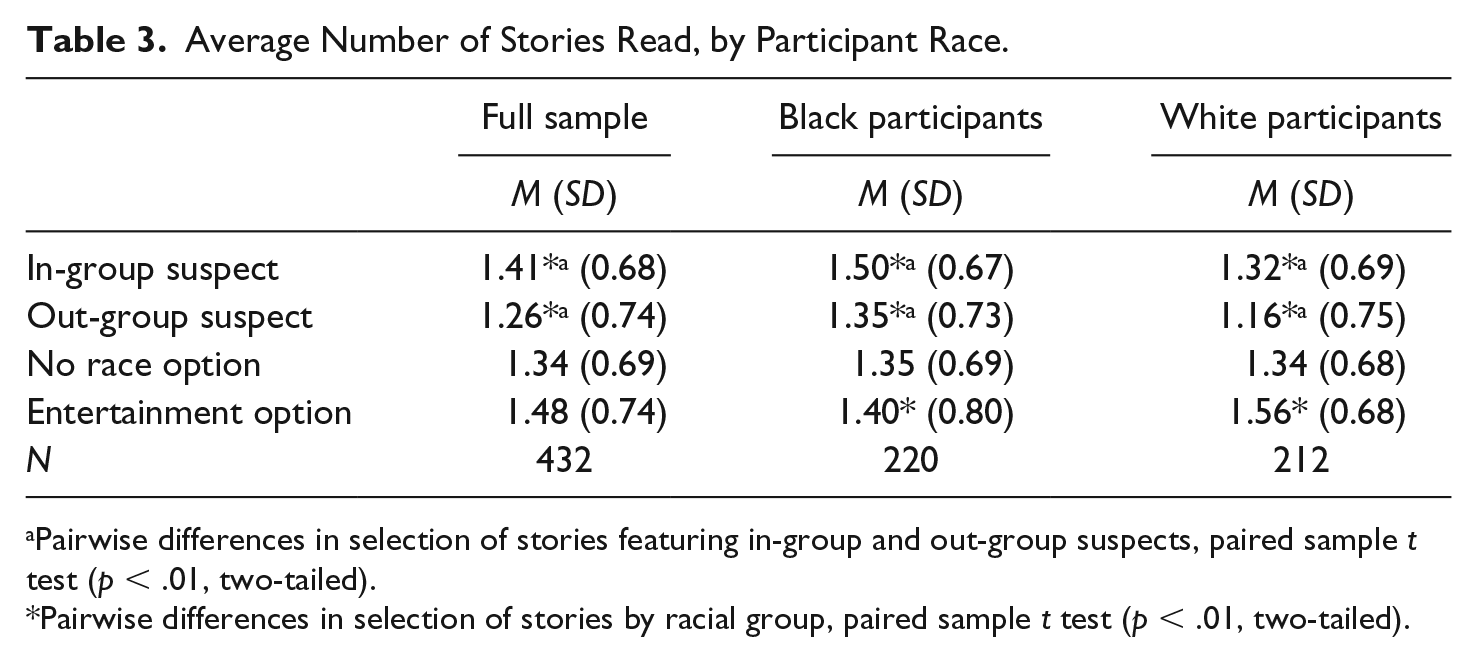
Pairwise differences in selection of stories featuring in-group and out-group suspects, paired sample t test (p < .01, two-tailed).
Pairwise differences in selection of stories by racial group, paired sample t test (p < .01, two-tailed).
The results are less straightforward regarding the potential for racial differences in selection behavior for African Americans and Whites across the duration of the study. Whereas African Americans, on average, were significantly more likely than Whites to read crime stories featuring members of their racial in-group (independent samples t test: t(430) = 2.68, p < .01), they also were significantly more likely to select stories featuring members of the racial out-group (independent samples t test: t(430) = 2.73, p < .01) than were Whites. In short, both African Americans and Whites show a relative preference for stories about the in-group, with neither group showing a stronger preference from the other. However, African Americans read more stories about both the racial in-group and racial out-group when compared with Whites. So while the differences in preference for in-group stories were indistinguishable by racial group, African Americans were both more likely to attend to the in-group and select negative stories about the out-group.
Finally, we observed the amount of time that participants spent on negative stories featuring members of both the racial in-group and out-group (see Table 4). The top panel of Table 4 presents raw timing data with outliers dropped due to their values on the timing scale measuring beyond two standard deviations from the mean (N = 369). Looking at the full sample regardless of race, evidence again suggests that participants were particularly attentive to negative news about their racial in-group. On average, participants spent more than 10 s longer reading stories about members of their racial in-group than on stories featuring members of the racial out-group, a significant difference based on a paired samples t test, t(368) = 2.83, p < .01. Furthermore, this difference was evident for both African American and White participants, offering additional evidence in support of
Total Time Spent Reading (In Seconds).
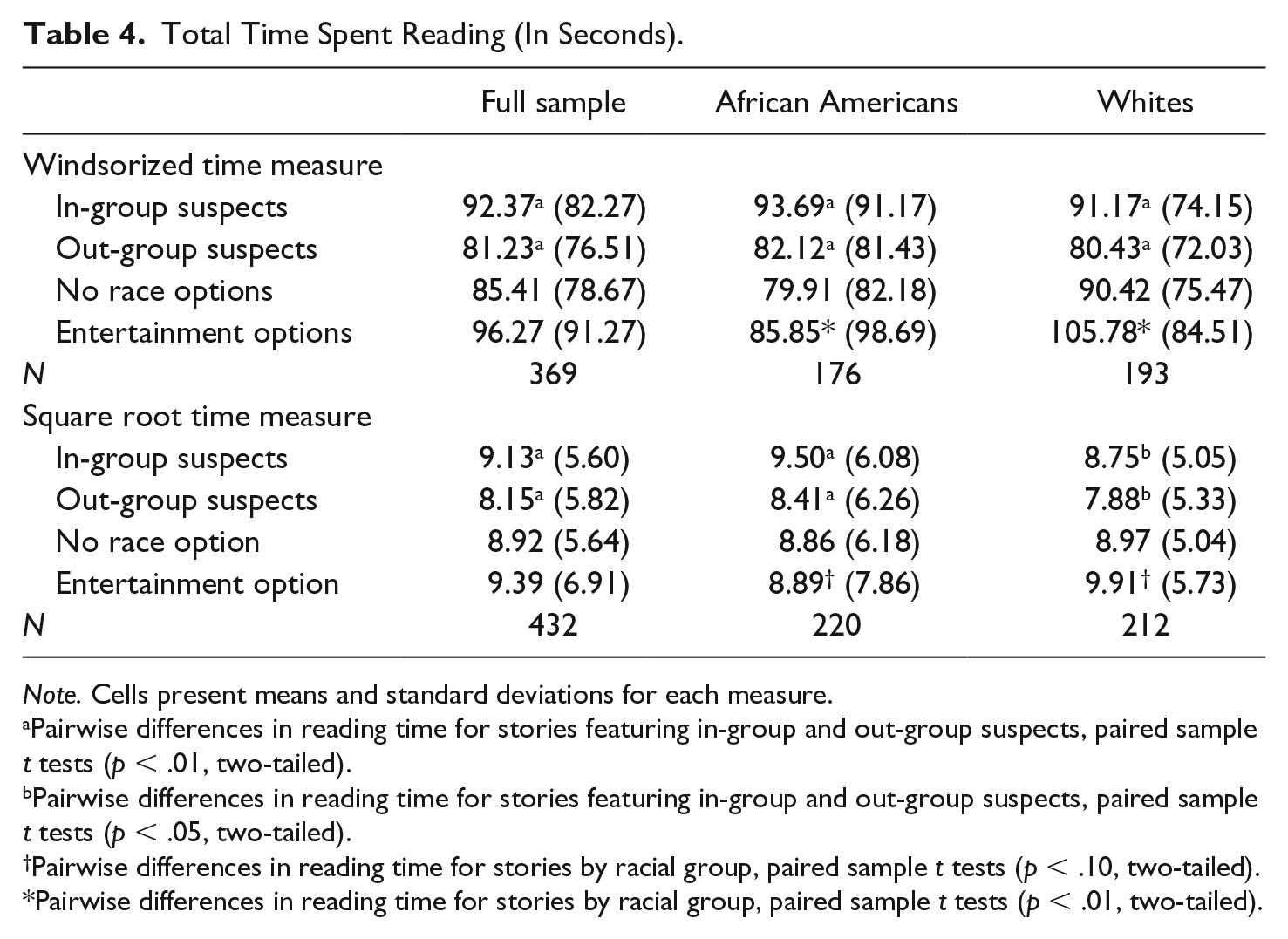
Note. Cells present means and standard deviations for each measure.
Pairwise differences in reading time for stories featuring in-group and out-group suspects, paired sample t tests (p < .01, two-tailed).
Pairwise differences in reading time for stories featuring in-group and out-group suspects, paired sample t tests (p < .05, two-tailed).
Pairwise differences in reading time for stories by racial group, paired sample t tests (p < .10, two-tailed).
Pairwise differences in reading time for stories by racial group, paired sample t tests (p < .01, two-tailed).
To address concerns resulting from the omission of statistical outliers, the bottom panel of Table 4 replicates the prior analyses using the square root of the time measure. Once again, participants on the whole spent significantly more time reading stories featuring suspects from their own racial group as opposed to the out-group according to a paired samples t test, t(424) = 4.00, p < .001, supporting
Discussion
This analysis sought to examine the effect audience members’ race had on their selection of news stories. Previous analyses of news preference have often involved both positive and negative choices, which we argue gave both researchers and participants a convenient option to pick stories that mesh with the preexisting narrative of preferring stories that portray in-group members in a positive light while ignoring others (Appiah et al., 2013; Tajfel & Turner, 1986). Such opportunities, however, are divorced from the reality of today’s news environment in which almost every news story is negative (Lengauer et al., 2011; Williams, 2014). We hypothesized that in such an environment, individuals would either seek news that disparages members of the racial out-group to make their group look better by comparison or they would be more likely to monitor news about their own group to know how their group is perceived by outsiders and possibly prepare counter-arguments to protect the image of their group. Given the power of media to shape how African Americans are perceived, we also investigated potential differences in news preferences by race to determine if African Americans and Whites deployed different strategies when selecting stories in a negative news environment.
Findings here provide a clearer understanding of social identity and shows that race has a strong influence on news preferences. Despite the potential threat such stories pose to one’s perception of their own group, racial in-group members are particularly attentive to news about people who are like themselves. However, the results are mixed on potential differences in selection behavior by race. Whereas African Americans showed a stronger tendency toward reading stories featuring members of the racial in-group than Whites in their initial choice, they also tended on average to read more negative stories about the racial out-group on the whole. This could speak to African Americans possibly being aware that people use negative news to shape what they think of them as individuals and as a group, and as such they are especially attuned negative news in general, but especially news about members of their own racial group, even more than Whites. The fact that they also read a comparable number of negative stories about Whites could reaffirm previous findings showing that not only will African Americans show in-group preference, but they will also seek out information that disparages members of the out-group perhaps as a way to reaffirm the specialness of their own group (Appiah et al., 2013). Future research should delve deeper into explaining the reasons why African Americans are more attuned to negative news than Whites.
A major implication of these findings comes from its real-world implications. As mentioned previously, social movements from the Civil Rights Movement to Black Lives Matter Movement today have used media to draw attention to their causes and change public perception (Holt, 2017). Findings from this study suggest that future movements using negative images as their catalyst might not be as successful as those in the past, because today people tend to ignore such news when there is other bad news that affects members of their own racial group.
A theoretical implication of these findings comes by way of their juxtaposition with the tenets of social identity theory and its relevance for understanding racial differences in selection behavior. If protecting and preserving the image of the racial in-group is of utmost importance, the observation that participants are actually more willing to select and attend to negative information about their own group, than the out-group, stands in stark contrast to expectations. When the image of their group is threatened, finding out what the media are saying about one’s own group supersedes all other factors. In the absence of positive news about the racial in-group, the only way to bolster the in-group’s image in today’s negative news environment is not to derogate the out-group. The fact that there was no evidence of out-group derogation is striking, suggesting that the motive to monitor the racial in-group must be particularly powerful.
At minimum, these findings could also reflect today’s increasingly polarized racial climate (Ingraham, 2014), in which opinions about racial out-groups are largely set, and thus there is little need, or interest, in finding out what’s happening in the “other” group. That being said, perhaps the implications of these findings run deeper, challenging the manner by which we apply social identity theory to understand race-based media choices. As news coverage has become more negative, studies that included positive options may have mistakenly attributed participants’ preference for positive news about the racial in-group as evidence consistent with social identity theory when these preferences may have instead resulted from the novelty and abnormality of such stories relative to their real-world experiences with news media. As we cannot say definitively from this single study, we suggest future researchers continue to take up this question to acquire a deeper understanding of the influence of race on selective exposure.
Limitations
A few limitations of this study are worth noting. Whereas we argue that the preference for negative news stories featuring members of the racial in-group is driven by the need to monitor the actions and treatment of other in-group members, other factors might also account for these observed relationships. We can only speculate on motivation. Future analyses should more directly question the rationale for why one group decides to denigrate other groups. Some analyses outside of communication suggest self-esteem might only partly explain such behavior, but it does not explicitly detail the other factors that could explain such behavior (Rubin & Hewstone, 1988). The selection of negative news stories about one’s own racial group could go beyond simply monitoring. Reading such stories might serve as a form of preemptive self-defense, providing in-group members information about how their group is perceived to counter attack against their racial in-group. In addition, despite the threat posed by negative representations, the preference for such stories could be a result of the desire to see stories about people in their own racial group, something that has been suggested by prior research (Appiah, 2002).
Relatedly, the possibility exists that the observed trends in selection behavior may in part be influenced by other differences in how participants perceived the story options beyond race. Although measures were taken to minimize this possibility—namely random assignment to one of two storyboards where the combinations of suspect race and story content varied—current data cannot rule out this possibility. However, post hoc data collection and analysis appears to mitigate such concerns. Using a sample of workers from Amazon’s Mechanical Turk service (N = 101), we asked respondents to evaluate each of the headlines for the crime stories used in this study on dimensions such as likely negativity of the story, reader interest, novelty, and excitement (full description of these analyses are available in the supplemental material, available online). Although evaluated similarly on the whole, some differences were observed in how respondents evaluated the headlines; however, these differences were both small in magnitude and ran counter to potential alternative explanations for our findings. For example, though the headlines were evaluated differently in terms of perceived novelty and excitement, it was the nonviolent stories that rated higher on these characteristics, despite these stories being selected with less regularity. Although these additional findings strengthen the conclusions of the current study, future work should still seek to rule out alternative explanations in addressing the relationship between race and selection behavior.
Finally, the observation that White participants showed a consistently stronger preference for entertainment options is an interesting one that deserves attention in future work. In speculating about the nature of this finding, we offer two potential interpretations. First, Whites—who are less likely to define themselves along racial grounds given their status in society as the majority (DiAngelo, 2011)—might simply have the luxury of turning away from negative news about the racial in-group without experiencing any threat to their self-concept. Conversely, the tendency among Whites to seek entertainment options might indicate a selection strategy where, rather than subjecting one’s self to negative representations of their racial in-group, the desired response is to avoid such stories. Although it is beyond the scope of this particular study, perhaps understanding why more Whites than African Americans select this “escapism” route in today’s negative news environment should be examined in a future study.
Conclusion
In summary, the results from this study add a more applicable explanation of the role race plays in how individuals engage with news today. As issues pertaining to race remain prominent in media and are likely to remain a staple of media coverage for years to come, the observed tendency of individuals to focus more on stories featuring members of their own racial group poses interesting questions about the potential for news media to bring about social change on matters of race. Although media might have played a vital role in promoting racial justice on civil rights in previous decades by shining a light on these matters in a way that was highly visible, our findings suggest that in an era of unprecedented media choice, this might not happen again. It is far from a given that people will even engage with messages about out-groups that are different from them as frequently as audiences did in the past. As a result, these patterns could cause problems for relationships between racial groups in society. Indeed, research has shown that individuals increasingly harbor feelings of uneasiness and distrust toward members of racial out-groups (Brewer, 2001). Thus, in addition to delving deeper into understanding patterns in race-based selectivity, future work should also consider the implications of these practices for understanding race relations in 21st century.
Supplemental Material
DS_10.1177_1077699019892632 – Supplemental material for Which Bad News to Choose? The Influence of Race and Social Identity on Story Selections Within Negative News Contexts
Supplemental material, DS_10.1177_1077699019892632 for Which Bad News to Choose? The Influence of Race and Social Identity on Story Selections Within Negative News Contexts by Lanier Frush Holt and Dustin Carnahan in Journalism & Mass Communication Quarterly
Footnotes
Declaration of Conflicting Interests
The author(s) declared no potential conflicts of interest with respect to the research, authorship, and/or publication of this article.
Funding
The author(s) received no financial support for the research, authorship, and/or publication of this article.
Supplemental Material
Supplemental material for this article is available online.
Author Biographies
References
Supplementary Material
Please find the following supplemental material available below.
For Open Access articles published under a Creative Commons License, all supplemental material carries the same license as the article it is associated with.
For non-Open Access articles published, all supplemental material carries a non-exclusive license, and permission requests for re-use of supplemental material or any part of supplemental material shall be sent directly to the copyright owner as specified in the copyright notice associated with the article.
