




Abstract
This study examines the role that group consciousness plays in driving corrective action. Drawing from an online survey of Latinos in the United States (N = 588), it tests the relationships among group consciousness, perceived media bias, proattitudinal selective exposure, and political participation. Results show support for a serial mediation model where the relationship between group consciousness and political participation runs through perceptions of media bias and proattitudinal selective exposure. Proattitudinal selective exposure also mediates the relationship between group consciousness and political participation independently. Theoretical contributions to corrective action and the role of minority groups in American politics are discussed.
Keywords
This study proposes a synthesis between the notion of group consciousness (Verba & Nie, 1987)—a group-based resource that marginalized groups draw upon to engage in political action—and the well-established mass communication theories of corrective action and selective exposure (Festinger, 1962; Knobloch-Westerwick, 2014). The goal of the study is to theoretically expand the corrective action proposition by incorporating a group dimension that has, so far, remained implicit in its conceptualization, but unobserved in its operationalization, as well as advancing our understanding of political participation.
With its focus on the dynamics of group identification, perceived discrimination, and commitment to collective action (Miller et al., 1981), the notion of group consciousness shares much in common with the theory of corrective action (Barnidge et al., 2019; Barnidge & Rojas, 2014; Rojas, 2010), which focuses on an increasingly well-established link between perceptions of media and political participation. This theory suggests that perceived media bias, which has been shown to arise from group identification and is characterized by a perception of media antagonism toward one’s in-group, is a key driver of political participation as people seek to “correct” the perceived “wrongs” they perceive in the media. Although scholarship on group consciousness and corrective action has unfolded on largely parallel tracks, they share key tenets that lend themselves to theoretical synthesis. Thus, incorporating group consciousness into corrective action is the primary theoretical innovation of this study.
In a second contribution, we also account for selective exposure to partisan media. Selective exposure has largely been overlooked by the corrective action literature, although this kind of media exposure is implied by the contemporary nature of perceived media bias (Barnidge et al., 2020). In a partisan media environment, people are more likely to select media that favors their side, which could deepen their commitment to political engagement that advances the interests of their in-group. Partisan selective exposure also shares some common features with group consciousness and perceived media. Much like these other concepts, selective exposure is thought to arise from group (party) identification. It is also defined and shaped by partisan media, and some evidence suggests it is related to political participation.
In this article, we test the relationships among these core concepts in a sample of Latinos in the United States. Our basic expectation is that Latinos’ increased group consciousness will result in perceptions that the media are biased in their coverage of the issue of immigration, holding a general anti-immigration, and therefore anti-Latino, stance. Subsequently, we argue, perceptions of media bias should contribute to proattitudinal selective exposure on the issue of immigration, whereby Latinos seek positive coverage toward their group’s stance on the issue of immigration. Finally, as they are exposed to more congruent content, their commitment to action is strengthened, leading to an increase in political engagement aimed at correcting those perceived wrongs in biased media. To test our predictions, data were collected using an online survey of Latinos in the United States in December 2017 (N = 588). Results are discussed in light of their theoretical contributions to corrective action and the role of media in driving engagement among socially marginalized groups in American politics.
Group Consciousness and Political Participation
Political participation can be understood as a function of available resources that enable individuals to engage in political activities (Brady et al., 1995). However, researchers also explain that individuals who belong to groups or segments of the population that are traditionally marginalized or disenfranchised usually lack access to individual-level resources and tend to draw upon group-based resources for political mobilization (Verba & Nie, 1987).
A well-established research tradition has identified group consciousness as one such group-based resource (Gurin et al., 1980; Shingles, 1981; Verba & Nie, 1987). The notion of group consciousness denotes a politicized group identity. Group consciousness refers to a set of political attitudes, beliefs, and behavioral orientations that stem from the awareness of similarity with other individuals in the group and from the position of the group within society (Gurin et al., 1980). Thus, in addition to perceived commonality, or group identification, group consciousness also incorporates the notion that the social and political problems faced by group members result from systemic societal causes, and, furthermore, that political action on behalf of the group is needed to resolve those problems (Miller et al., 1981). Thus, group consciousness arises not only from social identification, but also from beliefs about the social standing of one’s group and the necessity of political action to improve group status (McClain et al., 2009). In this manner, the concept of group consciousness is defined as a multidimensional construct comprised of perceived group commonality, perceived social group status, and commitment to collective action (Sanchez & Vargas, 2016).
Latinos in the United States have experienced a history of political exclusion and marginalization (DeSipio, 2006). Experiences with discriminatory hiring practices, as well as lack of opportunities to access health care and education, contribute to the emergence of group consciousness among Latinos (Masuoka, 2008). Moreover, the pan-ethnic categorization imposed on them as Hispanic or Latinos may also provide them with a sense of unity or shared identity (Valdez, 2011). In addition, although immigration policy initiatives directed toward addressing immigration of individuals from Latin American countries might lead to Latinos’ perceptions of lower social status, it can also heighten their perceptions of group commonality given their ties to immigrants or own immigration experiences.
Sanchez and Vargas (2016) developed an internally consistent and externally valid group consciousness measure that accounts for the three dimensions described above, and the present study adopts this approach to conceptualizing and measuring group consciousness. In their results, they found that for both Latinos and African Americans, the three-dimensional definition of group consciousness converge on a single factor. Likewise, they found empirical evidence that suggests that for the Latino population, this concept is different from other closely related concepts, such as “linked fate,” which have been used interchangeably.
Although the operational definition has not been consistent across studies, extant research suggests that group consciousness is related to political participation, especially to those types of actions that require higher levels of initiative and seek to influence government policy making, including campaigning and protesting (Lien, 1994; Shingles, 1981). Indeed, the concept of group consciousness has been instrumental to explain political participation among African Americans (Gurin et al., 1980; Shingles, 1981) and Asian Americans (Wong et al., 2005) in the United States. Moreover, in a study comparing factors that influence political participation among ethnic minorities in the United States, Lien (1994) found that perceptions of discrimination increased Mexican Americans’ likelihood of engaging in political activities. In another study, Stokes (2003) found evidence suggesting that when grouped together as one pan-ethnic group, a positive relationship existed between Latinos’ group consciousness perceptions and political participation. Consistent with this prior evidence, we seek to confirm that group consciousness is positively related to political participation:
Perceived Media Bias and Corrective Action
People’s previous beliefs tend to color the way they process information (Lord et al., 1979). A large body of research has shown this to be true when it comes to news media, whether it is in response to a specific news story (i.e., the “hostile media effect”; see Vallone et al., 1985) or as a generalized perception of media (i.e., “perceived media bias”; see Dalton et al., 1998). Either way, these perceptions are more of a function of individuals’ personal predispositions toward media rather than an objective assessment of media content (Perloff, 2015). Furthermore, research shows that generalized perceptions of media bias are on the rise worldwide, and that media trust is on the decline (Edelman Trust Barometer, 2017; Tsfati & Ariely, 2014; World Values Survey, 2015).
These perceptions of media bias are important because they may have consequences for political action. Some people may respond to perceived media bias by supporting censorship or adjusting their own behavior to accommodate perceived effects on others (Sun et al., 2008). Others may respond by attempting to “correct” for the influence of perceived “wrongs” they encounter in the public sphere (Rojas, 2010). This corrective action hypothesis (Barnidge & Rojas, 2014; Rojas, 2010) posits that when people perceive media to be biased and influential, they will take action geared toward correcting for the perceived consequences of media content. Corrective actions are a subset of possible collective actions that are inspired by perceived media unfairness against one’s group and that seek to counter the possible effects of said “unfairness.” This hypothesis has received a fair amount of empirical support: Research shows that perceived media bias is related to political expression (Barnidge & Rojas, 2014; Hart et al., 2015), online activism (Chung et al., 2015; Lim & Golan, 2011; Wei & Golan, 2013), and participation in political protests or campaigns (Barnidge et al., 2019; Feldman et al., 2017; Kim, 2015; Lin, 2014).
Scholars initially theorized that hostile media perceptions arise from a process of selective categorization, in which individuals exposed to media content would incorrectly categorize bits of information in news stories as negative toward their viewpoint, when in fact those bits were intended to be either neutral or in favor of their viewpoint (e.g., Schmitt et al., 2004). But more recently, other scholars have offered a different explanation for the hostile media effect, drawing from the centrality of group identity and partisanship in early hostile media research. Noting that the earliest studies included members who identified with certain groups (e.g., Vallone et al., 1985, studied Arab and Israeli student groups), these scholars theorize that perceived media hostility arises from social identity processes (e.g., Reid, 2012). According to this view, it is not biased categorization of informational snippets that results in perceived bias, but rather in-group identification that colors individuals’ perception of the story, as a whole. Subsequent research suggests that both of these mechanisms may be at play simultaneously (Gunther et al., 2017).
As previously explained, group consciousness is a politicized manifestation of group identity that is characterized by perceived in-group discrimination (Gurin et al., 1980; McClain et al., 2009). Likewise, perceived media bias is thought to arise from group identification processes (Reid, 2012), and it can be interpreted as a form of in-group discrimination or unfair treatment—in this case, by a specific social institution, the media, rather than the public at large. Indeed, as group consciousness is comprised by the belief that the different obstacles members of the group face are greatly shaped by how the group is regarded within society, it is likely that this ill regard is attributed to, in part, the media. In this sense, perceptions that one’s group has a lower social status might be intertwined with perceptions that the media are biased against the issues that are salient and valued to the in-group. Thus, not only do group consciousness and perceived media bias share a theoretical starting point (group identification), they are also characterized by similar and interrelated perceptions (in-group discrimination vs. in-group bias). Based on their shared features, the two concepts should, therefore, be positively related. In the case of Latinos in the United States, whose group consciousness is closely associated with the issue of immigration (Sanchez, 2006), the relationship should specifically arise from media coverage of that issue.
Group consciousness is also characterized by the belief that members of the group need to act together to improve the lower social status of the group (McClain et al., 2009). As a structural element of group consciousness, this dimension explains, in part, the relationship between group consciousness and political action. However, we argue that the theory of corrective action can offer an additional theoretical connection. This is because perceived media bias can be a specific form of perceived in-group discrimination, and with the theory of corrective action prediction that people will try to “correct” for “perceived wrongs” they find in the media by taking political action (Rojas, 2010), the theory of corrective action provides a theoretical connection between group consciousness and political participation through perceptions of media bias. Therefore, we predict that perceived media bias will mediate the relationship between these variables. Specifically, we hypothesize that among Latinos in the United States, group consciousness will be related to perceptions of anti-immigration media bias, which will, in turn, be related to political participation on behalf of Latinos.
Group Consciousness and Proattitudinal Selective Exposure
As with group consciousness and perceived media bias, selective exposure also arises from group-based processes. Research has consistently shown that people with stronger partisan identities and/or political ideologies prefer attitude-consistent media content (Garrett, 2009; Stroud, 2008). In addition, evidence supports the claim that individuals purposely seek out media content that will allow them to keep a positive in-group identification, particularly for members of groups with a low social status. For example, Abrams and Giles (2007) studied African Americans’ television preferences and found that individuals with stronger in-group identification avoid television shows that portray in-group members negatively. In another study that looked at media choices of Black South Africans, Schieferdecker and Wessler (2017) found that in-group identification is related to selection of media content portraying Black people. Finally, Knobloch-Westerwick and Hastall (2010) found that older adults choose content that positively portrays people of similar age.
Thus, selective exposure also shares a similar theoretical starting point to group consciousness. Because both phenomena arise from group-identification processes, we predict that they will be positively related. In the case of Latinos in the United States, we expect this positive relationship to manifest specifically in the context of media coverage of immigration, which is related with U.S. Latinos’ group consciousness perceptions (Sanchez, 2006).
Research also supports the idea that attitude-consistent selective exposure can lead to political participation. Dilliplane (2011) theorizes that such exposure can “affect the balance of considerations for supporting one candidate versus another, thus influencing one’s propensity for engaging in political activities” (p. 290). This argument is based on Zaller’s (1992) notion that people maintain various considerations about an issue or a candidate, which may become more or less salient according to the nature of media coverage. Thus, Dilliplane argues, selective exposure can systematically alter the makeup of an individual’s considerations, strengthening and stabilizing preferences and attitudes over time. Knobloch-Westerwick and Johnson (2014), as well as Feezell (2016), elaborate on this argument, explaining that people with stronger and more consistent attitudes more frequently participate in politics, because they have a clearer idea of the political outcome they would like to see for a given issue or election.
Theoretically, these finding suggest that selective exposure may facilitate the relationship between group consciousness and political participation because selective exposure may strengthen commitment to a cause or to a course of political action. As previously noted, the perceived need to act together with other members of the group is the third dimension of group consciousness, suggesting a direct effect between consciousness and political participation. But if selective exposure strengthens and stabilizes attitudes and preferences, and these individuals are more likely to participate in politics, it is likely that selective exposure partially facilitates the relationship between group consciousness and participation because attitude-consistent exposure strengthens individuals’ resolve to take action on behalf of their disadvantaged group.
Finally, recent research also shows that perceived media bias and proattitudinal selective exposure are positively related (Barnidge et al., 2020). Once again, both concepts are rooted in group identification processes, and the general perception that media are biased against one’s in-group may serve as motivation to select media content that portrays the in-group more favorably. We have also seen that both perceived media bias and selective exposure may strengthen or facilitate one or more aspects of group consciousness—perceived media bias can be viewed as a specific form of in-group discrimination, and selective exposure may strengthen commitment to political action. Therefore, both variables likely serve as catalysts that drive political action initially motivated by group consciousness, and, thus, both variables can be integrated into the theory of corrective action. Based on this logic, we expect serial a mediation, such that the relationship between group consciousness and political participation will run through both perceived media bias and selective exposure.
Context of Study
We chose Latinos in the United States as the population to test our theoretical expectations. We understand Latinos as people whose heritage can be traced back to Spanish-speaking, Latin American countries. Thus, immigrant experiences and heritage are at the core of Latino identity (Barreto et al., 2009). We chose Latinos for this study for several reasons. Although their population has increased during the last decades and now make up the largest minority group in the United States (Stepler & Brown, 2016), their engagement in politics is proportionally much lower compared with other racial subgroups. In addition, during the current presidential administration, the issue of immigration has remained at the forefront of the political debate. The administration has advanced policies such as building a southern border wall to deter immigrants from Central American countries, and it has implemented policies that separate undocumented immigrant families and harden the enforcement of deportation laws. During this time, public conversations about immigration have been characterized by overtones of ethnic discrimination that singles out Latinos as the main culprits of America’s social ills and Latino immigrants as a threat to national security.
Although this debate has been plagued with factual errors, it has nevertheless nurtured an environment in which Latinos have become more aware of their vulnerable position in society. Although Latinos’ attitudes toward immigration are not necessarily monolithic, a clear majority tend to support proimmigration policies that create a clear path to citizenship and limit the risks of deportation for illegal immigrants (Lopez et al., 2013, 2018). Latinos also tend to hold positive attitudes toward immigrants and immigration in general (Barreto, 2018; Lopez et al., 2018). These orientations situate them in opposition to the current political climate around the issue of immigration, and they have contributed to a belief among Latinos that their ethnic group occupies a disadvantaged position in U.S. society (Lopez et al., 2018). Therefore, following Gurin et al. (1980), it seems plausible that among Latinos in the United States, the political attitudes and identities have crystalized into perceptions of group consciousness that could ultimately influence their political behavior.
Method
Participants and Procedures
Data for this study were collected using an online survey in December 2017 through the research panel company Offerwise, which specializes in the Hispanic/Latino population of the United States. Their panel includes 350,000 members and resembles the population of this ethnic group living in the United States. Sampling was performed following a stratified quota sampling procedure based on U.S. region, gender, age, income, education level, and language spoken at home. The questionnaire was developed in English and then translated into Spanish by one of the researchers. Participants could choose what language they wanted to answer the survey in. Participants received compensation for their participation based on Offerwise’s incentive system. This system is based on points obtained through participation in surveys. When participants have a set number of points, they can turn them into cash. However, for this study, there was no information available from Offerwise regarding the number of points participants were awarded, as it varied not only based on the length and characteristics of the survey, but also by participants’ demographic characteristics. Typically, the rewards offered in online panels are nominal in their value and do not constitute coercion or undue inducement.
Sample Characteristics
A total of 601 participants responded the survey. Their average age was M = 38.48 years (SD = 14.42 years) and 53.2% identified as female (N = 315) and 46.8% identified as male (N = 277), whereas 1.5% (nine participants) did not indicate whether they identified as male or female. In terms of education level, 24.3% had earned a 4-year degree, 21.3% had a high school degree or general educational development (GED), 19.6% some college years, 11% a master’s degree, 7.8% a 2-year college degree, 5.5% a professional degree, 4.7% had received some years of high school, 3.2% a doctoral degree, 1.7% have completed elementary school education, and 1% had some elementary years or no education at all. With regard to income, 21.6% earned less than US$20,000, 21.3% more than US$90,000, 20% earned between US$20,000 and US$40,000, 13.2% between US$40,000 and US$60,000, and 18.3% between US$60,000 and US$90,000. The regional distribution of participants indicated that 38.9% of participants lived in the South, 36.6% in the West, 15% in the Northeast, and 8% in the Midwest. Compared with U.S. census data of the Hispanic/Latino population, these sample demographics are comparable in terms of gender and region. This sample is slightly older to the Latino population, and it has important differences in terms of educational attainment. Participants in this sample are on average more educated than the general Latino population in the United States, based on data from the Flores et al. (2017). Table 1 describes the sample demographic characteristics and compares them with the Latino population in the United States based on data from the U.S. Census Bureau (2017) and the Flores et al. (2017).
Comparison of Sample and Population Demographics.
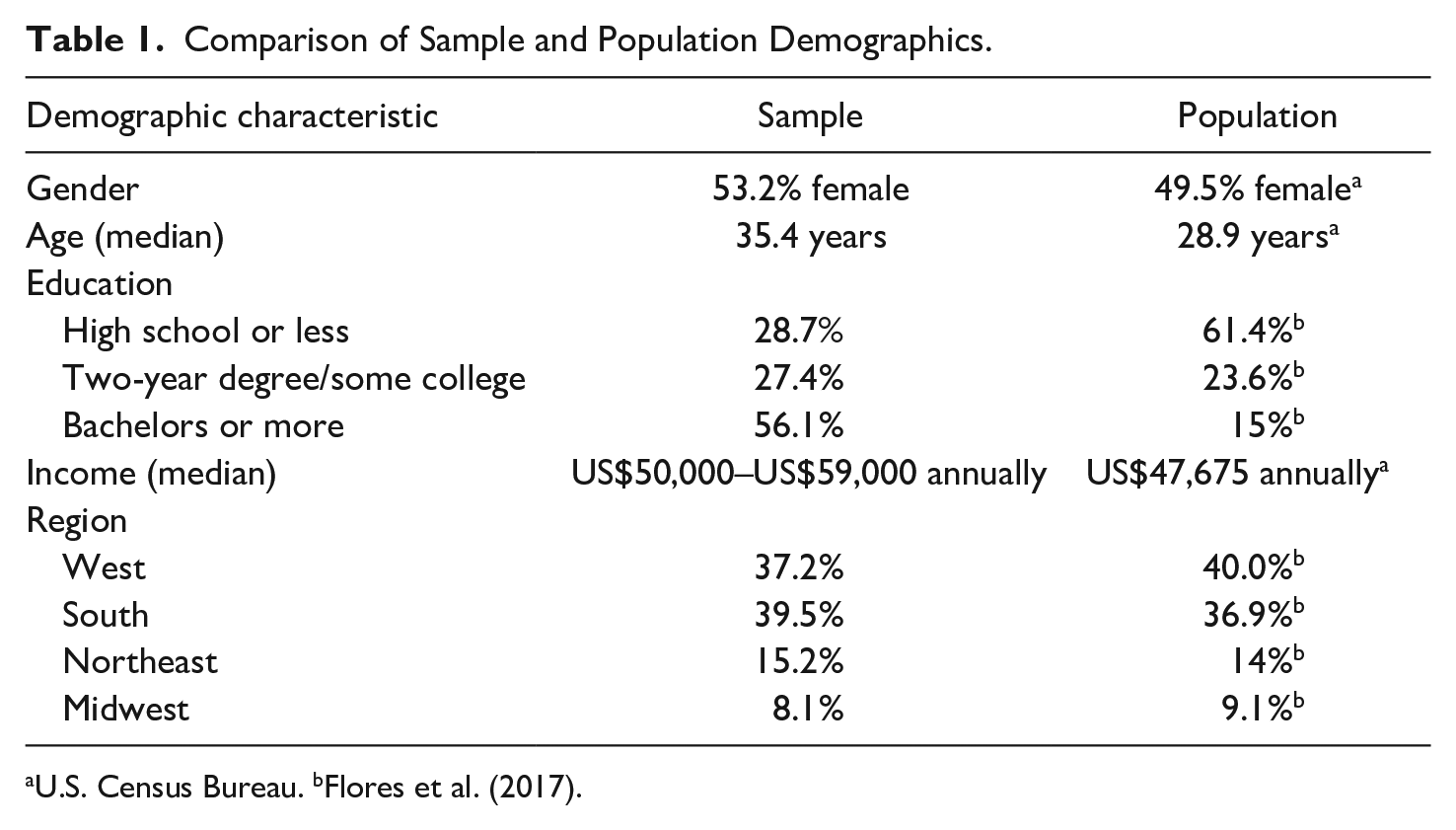
U.S. Census Bureau. bFlores et al. (2017).
Measures
Group consciousness
Group consciousness (M = 4.02, SD = 0.79, α = .65) was gauged adapting a three-dimensional measurement developed by Sanchez and Vargas (2016). The group commonality dimension was measured using a 5-point Likert-type scale that included the item “I have a lot in common with the average Hispanic/Latino person.” Out-group perceived discrimination was measured by asking participants to answer on a 1 to 5 scale (1 = none at all, 2 = a little, 3 = a moderate amount, 4 = a lot, 5 = a great deal) how much discrimination or unfair treatment they thought Hispanics/Latinos faced in the United States from Other races/ethnic groups. And, the need for collective action dimension asked participants to rate (1 = not important at all, 5 = extremely important) how important they thought it was for Hispanic/Latino people to work together to improve their position in society.
Proattitudinal selective exposure
Proattitudinal selective exposure was measured as the average of two items adapted from Weeks et al. (2017) (M = 3.50, SD = 1.64, α = .91). Participants reported how often in the past month (1 = none, 6 = every day) they intentionally searched for information online that (a) supported their views on the issue of immigration, (b) supported their views on the issue of illegal immigration.
Perceived media bias
Perceived media bias was gauged averaging the score of three items (M = 7.52, SD = 2.41, α = .79). One item asked participants to rate (−5 = anti-immigration, 0 = neutral, 5 = proimmigration) what position they thought the media in general had toward the issue of immigration. This item was reverse recoded to represent anti-immigration bias of the media as a higher score. The other two items used a common preface saying, Some believe that the solution to the issue of illegal immigration is to deport undocumented immigrants and crackdown illegal immigration. Others think that the solution is to offer illegal immigrants a path to citizenship. On the following scale, what position does
The scale for one item ranged from −5 (antideportation and anticrackdown of illegal immigration) to 5 (prodeportation and procrackdown of illegal immigration), and the other item from −5 (antipath to citizenship) to 5 (propath to citizenship). This item was reverse recoded to represent anti-immigration bias of the media as a higher score.
Political participation
Political participation was comprised of five items that focused on political behaviors participants were involved in within the previous 12 months. Behaviors participants had engaged in were scored as 1 and summed to create an overall score of political participation (see, for example, Gibson & Cantijoch, 2013, for a similar measurement strategy). Some of the political activities included were “Attended a political rally,” “Worked for a movement or political party,” and “Donated money or other objects to a political party or movement” (M = 3.04, SD = 1.57, α = .83).
Control variables
In addition to participant age, gender, education, and income, four other variables (i.e., internal political efficacy, political interest, partisanship, and news use) were also controlled. Internal political efficacy (Niemi et al., 1991), M = 3.29, SD = 1.17, α = .91, was measured using four items. Using a 5-point Likert-type scale, items asked respondents the degree to which they felt capable of participating in politics (e.g., to the extent that citizens can influence politics, my efforts to do so would be more effective than the average person). Political interest (M = 7.24, SD = 2.78) was measured using a single-item scale that asked respondents the degree to which they are interested in politics (1 = not interested at all, 10 = very interested). Partisanship (M = 1.72, SD = 0.67) was measured using a single item that asked participants the degree to which they identified as Republicans or Democrats (1 = no preference/independent, 2 = Republican/Democrat, 3 = strong Republican/Democrat). News media use (M = 3.55, SD = 1.07, α = .78) was measured by averaging the score of three items that asked participants how frequently (1 = never, 5 = frequently) they read, watched, or listened to the news either online or offline.
Analysis
A total of 13 observations (2.16% of the whole sample) that contained missing values in some of the variables included in the analyses were removed using listwise deletion. The resulting sample size was n = 588. Table 2 includes correlation coefficients for variables included in the analyses.
Correlations Among Variables in the Study.

p < .05. **p < .01.
Prior to testing all the hypotheses, the assumptions for ordinary least squares (OLS) regression were verified. Analysis focused on the direct and indirect effects of group consciousness on participants’ political participation about Latinos through proattitudinal selective exposure and perceived media bias. All results were obtained using Model 6 (with 5,000 bootstrap samples) of Hayes’ (2018) PROCESS for SPSS. This model tests a serial mediation, where the indirect effect of X on Y is examined through M1 and M2 separately and jointly, through M1 and from this to M2. Group consciousness was entered as X, political participation as Y, and perceived media bias and proattitudinal selective exposure as M1 and M2, respectively. Significant results are indicated when the 95% confidence interval (CI) does not straddle zero (Hayes, 2018). Figure 1 illustrates the level of significance and path coefficients for the direct and mediated effects for the hypothesized serial mediation model.
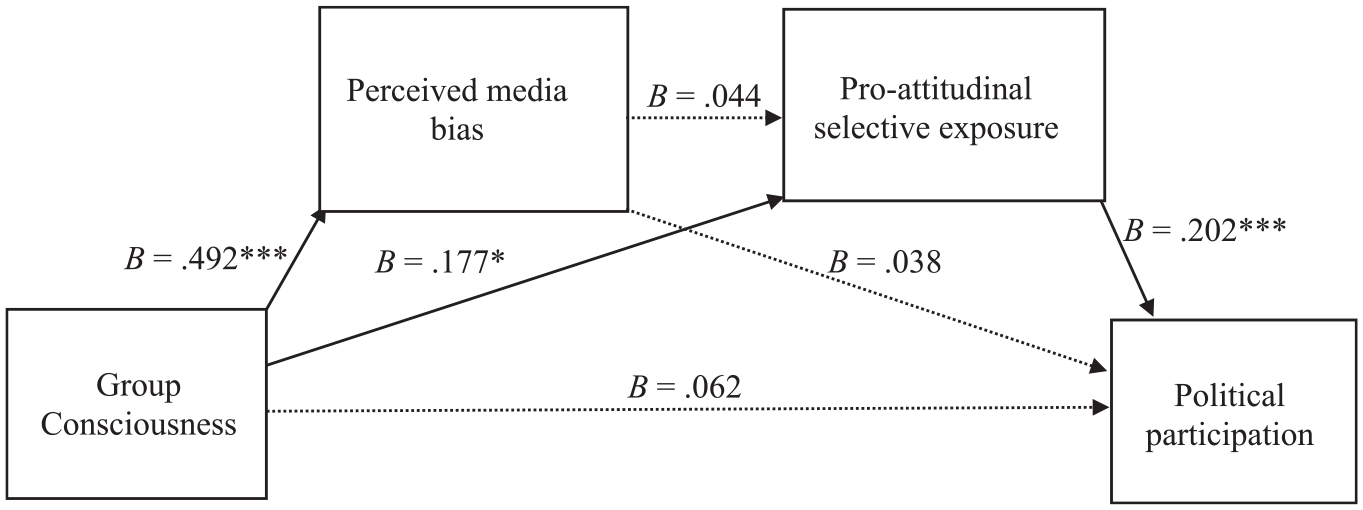
Direct and indirect path coefficients of group consciousness on political participation through proattitudinal selective exposure and perceived media bias.
Results
Table 3 includes the results for
Serial Mediation of Group Consciousness, Media Bias, Selective Exposure on Political Participation.

Note. Cell entries are unstandardized coefficients (B), standard errors (SE), and p values from Hayes’ (2018) PROCESS macro for SPSS (Model 6, with 5,000 bootstrap samples).
Indirect Effects of Group Consciousness on Political Participation.
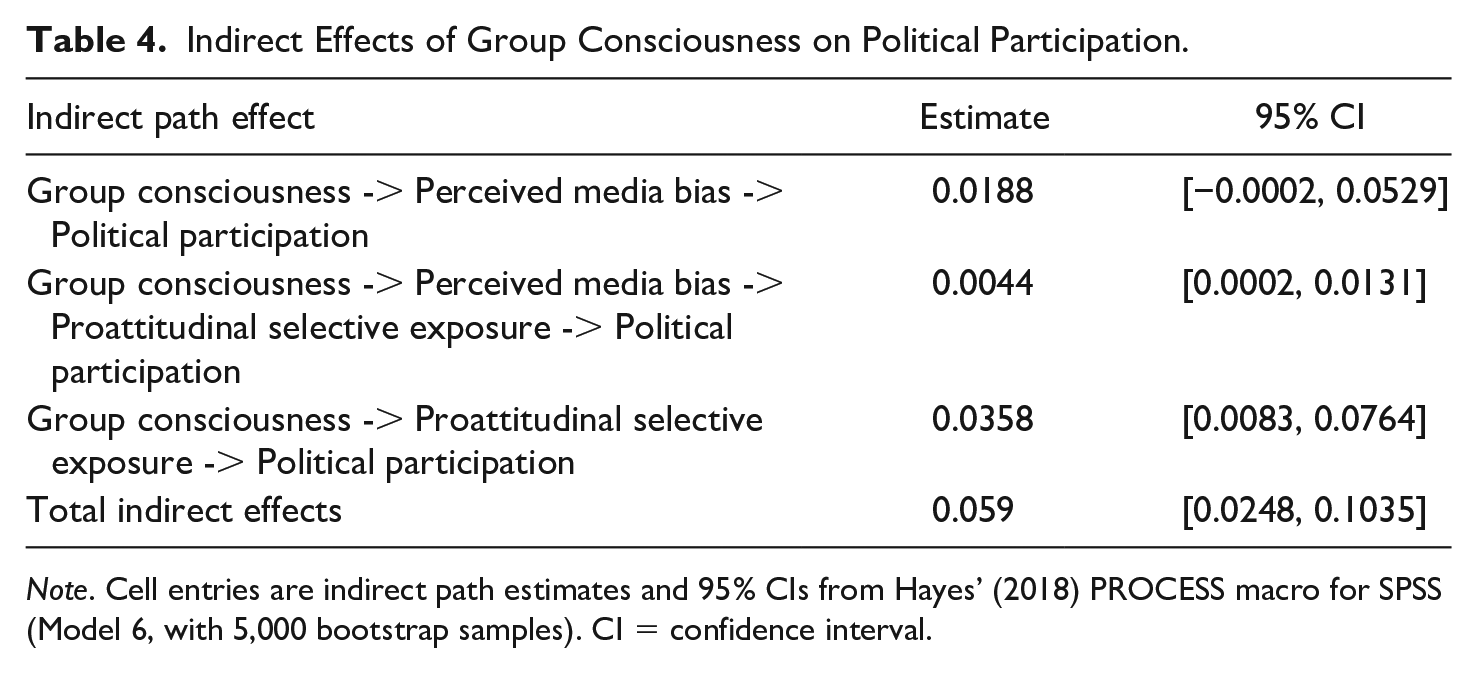
Note. Cell entries are indirect path estimates and 95% CIs from Hayes’ (2018) PROCESS macro for SPSS (Model 6, with 5,000 bootstrap samples). CI = confidence interval.
The first hypotheses (
The next two hypotheses (
The next pair of hypotheses (
Discussion
The primary theoretical contribution of this article lies in synthesizing three interrelated concepts—group consciousness, perceived media bias, and selective exposure—under the framework of corrective action. We focused on shared underlying dimensions among the three concepts, including group identification, perceived in-group discrimination, and a perceived need for collective action. This synthesis is theoretically fruitful, in that, it helps us clarify the role of perceptions of the media in driving political participation—the key relationship underscoring the theory of corrective action.
This study also highlights the dynamics of political participation among a disadvantaged group in the United States, and the role played by media perceptions in motivating that engagement. It shows how group consciousness—a form of politicized group identity—is related to Latinos’ political action through exposure to information supporting their views on this particular issue. Indeed, our findings confirm the notion that proattitudinal selective exposure is, in part, driven by in-group identification (Knobloch-Westerwick & Hastall, 2010). Moreover, it also shows how, in the case of ethnic minorities, politicized in-group identification (i.e., group consciousness) can play an important role in shaping individuals’ choice of media content. Also, consistent with evidence from other studies (Dilliplane, 2011), we found that proattitudinal selective exposure is positively related to political participation. Together, this evidence suggests that Latinos’ group consciousness is positively associated with political action, as they seek out media content that aligns with their views, in this case, about the issue of immigration. In addition, selective exposure probably reaffirms and strengthens their attitudes about immigration, leading them to take political action.
Somewhat surprisingly, we did not find a direct relationship between perceived media bias and political participation, nor did we find that perceived media bias mediates the relationship between group consciousness and political participation. This null finding does not confirm prior results (e.g., Barnidge et al., 2019; Barnidge & Rojas, 2014; Rojas, 2010), and there are four nonexclusive plausible reasons for it: (a) Latinos are different from the general population when it comes to this relationship; (b) there is a “true” relationship in the Latino population, but the sample does not reflect it; (c) the sample size is too small to uncover a small relationship; or (d) the relationship is affected by the inclusion of selective exposure in the model. It might have been that the inclusion of selective exposure, which is itself strongly related to political participation, “explained away” some of the variance that would otherwise be attributed to perceived media bias. If this is true, then the role of perceived media bias in explaining the mechanism connecting group consciousness—a politicized form of group identification—and political participation is best understood while also accounting for selective exposure.
With the goal of testing the veracity of the latter potential explanation, we performed a post hoc mediation analysis including perceptions of media bias as the mediator variable, keeping all control variables, but excluding proattitudinal selective exposure. If our explanation is true, then perceived media bias should emerge as a significant mediator in the relationship between group consciousness and political participation when excluding proattitudinal selective exposure. Results of the post hoc mediation analysis showed that perceived media bias significantly mediated the relationship between group consciousness and political participation (B = 0.023, 95% CI = [0.0004, 0.0551]), whereas its direct relationship with political participation was marginally significant (B = 0.072, SE = 0.025, p = .059). Tables S1 and S2 of the supplemental material include all regression and mediation results. Therefore, our fourth explanation, that the inclusion of selective exposure might account for the absence of a mediation of perceived media bias in the relationship between group consciousness and political participation, is plausible given the evidence of the post hoc analysis.
Still, our original findings showed that perceived media bias did not mediate the relationship between group consciousness and political participation, did not directly predict political action, and its relationship with proattitudinal selective exposure was marginally significant (p = .052). However, such evidence does not preclude the possibility of a serial mediation mechanism taking place. Indeed, following the definition of indirect effects as the product of two or more paths, and the idea that an inferential test of a mediation is the best way to find evidence of its existence (Hayes, 2018), we can assert that a serial mediation explains the relationship between group consciousness and political participation. Such serial mediation, our evidence shows, runs through both perceptions of media bias and proattitudinal selective exposure. Importantly, this finding suggests that future perceived media bias research should account for selective exposure, and represents an advancement in the theory of corrective action. More studies should be conducted exploring how perceived media bias and selective exposure operate together.
Our overall findings fit with prior literature that suggests group consciousness and political action are intimately intertwined (Sanchez & Vargas, 2016), and provide evidence suggesting that group consciousness and corrective action processes (Rojas, 2010) can be related. Because group consciousness is a politicized form of group identification (Gurin et al., 1980), and because perceived media bias is, in part, based on social identity processes and can be interpreted as a form of perceived discrimination (Reid, 2012), group consciousness may contribute to the perception that media, for the most part, are biased against one’s group. In addition, group consciousness is characterized by the shared perception that the group’s social status needs to be improved through collective action (McClain et al., 2009). Thus, group consciousness may be driving corrective action among Latinos in the United States, as perceptions of biased coverage of immigration motivates status-conscious Latinos to seek out attitude-consistent information and then mobilize for political action.
However, this conclusion could be extended to other vulnerable groups in society. Perceived negative media coverage about political issues that are closely associated with other marginalized and disadvantaged groups could galvanize those groups and motivate their members to engage with the political system to improve their sociopolitical situation. Future studies could examine how group consciousness plays a differing role among other disadvantaged groups, whether it shapes their perceptions of the media, their choice of media content, and subsequently, their political actions.
Previous studies suggest that political participation among minorities varies depending on the issues in question (Holbrook et al., 2015). Therefore, as immigration has become a central issue for both this administration and for the Latino population in general, it might be the case that Latinos will decide to engage more in the political life of the United States. This study explains Latinos’ political actions by emphasizing the role that immigration has for this ethnic group in the United States, and how group consciousness might be driving such participation through perceptions of the media and choice content around the issue of immigration.
Limitations and Future Studies
Our conclusions are limited in several ways. One set of limitations is related to the design and sampling strategy. The survey is cross-sectional, and although it has assembled a snapshot of relationships ordered by theoretical predictions, it cannot establish time order or eliminate all possible spurious factors that could potentially explain the relationships found in the study. However, this limitation leads to new questions future research should tackle. For example, it can be argued that media bias perceptions lead to group consciousness, as media bias perceptions might not only trigger perceptions of out-group discrimination, but also the belief in the need for collective action. Similarly, selective exposure could also increase group consciousness, as increased exposure to content congruent with one’s group position with regard to an issue could account for increases in group identification, perceptions of discrimation agains one’s group, and, therefore, the belief in the need for acting together. Similarly, other research has suggested that it is selective exposure that might lead to perceptions of media bias (Barnidge et al., 2020). In all likelihood, group identification and media perceptions and exposure influence each other over time in a recursive fashion. Future studies should be specifically designed to capture this recursive causal process.
Another limitation is that the measurement of political participation is based on self-reports. There might be a risk of inflated self-reports for political participation, arising from social desirability. However, our preface question for political participation includes the statement that the list of political activities were done by some people. This likely helps participants realize that it is socially acceptable to not engage in these activities. In addition, our measurement of selective exposure is valid for a measurement of perceived selective exposure to proattitudinal information on the issue of immigration. However, some researchers have argued that selective exposure should be measured using unobtrusive measures (Knobloch-Westerwick et al., 2015). Future studies could explore how observed behaviors regarding media content choices that align with one’s group consciousness perceptions mediate the relationship between group consciousness and political participation.
In addition, the opt-in, online panel survey is, strictly speaking, not a true probability sample. The sample reflects the subpopulation of Latino adults in the United States in terms of age and gender, but not in education. The sample size presents another limitation, especially given that some of the relationships were marginally significant. In all likelihood, these relationships would be statistically significant with a larger sample size, and future research could examine them in a larger sample.
The reliability for the group consciousness variable is slightly lower than .70. However, the reliability coefficient (α = .65) is close to this threshold, and the measure is based on prior research (Sanchez & Vargas, 2016). Finally, its relationship with political participation is consistent with prior studies (Lien, 1994; Sanchez & Vargas, 2016; Stokes, 2003). These considerations lead us to think that the marginal internal consistency does not represent a threat to the overall validity of the construct. The magnitude of the reliability coefficient probably results from the few items measuring each of the dimensions of the concept. Future research could improve the measurement of each of these dimensions.
Despite these limitations, this study illuminates the relationship between group consciousness and political participation among Latinos in the United States. Furthermore, the evidence shows that this relationship is largely indirect, mediated through perceived media bias and selective exposure. The study concludes that group consciousness plays a role in corrective action, and that role operates through selective exposure to likeminded content.
Supplemental Material
OnlineAppendix – Supplemental material for Group Consciousness and Corrective Action: The Mediating Role of Perceived Media Bias and of Proattitudinal Selective Exposure
Supplemental material, OnlineAppendix for Group Consciousness and Corrective Action: The Mediating Role of Perceived Media Bias and of Proattitudinal Selective Exposure by Alcides Velasquez, Matthew Barnidge and Hernando Rojas in Journalism & Mass Communication Quarterly
Footnotes
Declaration of Conflicting Interests
The author(s) declared no potential conflicts of interest with respect to the research, authorship, and/or publication of this article.
Funding
The author(s) received no financial support for the research, authorship, and/or publication of this article.

Supplemental Material
Supplemental material for this article is available online.
Author Biographies
References
Supplementary Material
Please find the following supplemental material available below.
For Open Access articles published under a Creative Commons License, all supplemental material carries the same license as the article it is associated with.
For non-Open Access articles published, all supplemental material carries a non-exclusive license, and permission requests for re-use of supplemental material or any part of supplemental material shall be sent directly to the copyright owner as specified in the copyright notice associated with the article.
