



Abstract
The current study examines the influence of press releases about scientific studies in terms of their impact on news coverage. Using an innovative approach that allowed for analysis of a large corpus of text and calculation of similarity scores, we were able to trace the uptake of press release materials into news media articles. In some cases, up to 65% of sentences in science news articles reflected high similarity to press release material—a potent indication of how powerful information subsidies can be. While our results contain some good news for public relations practitioners, they also carry a warning for consumers of journalism and for the public science agenda, which may be left vulnerable to bad actors undermining the trust that the public, and journalists, have in science. News organizations that had a history of producing award-winning science journalism were much less likely to draw on press release materials, indicating the importance of topic area expertise in producing independent science journalism.
Where journalists receive the information they report in the news is one of the fundamental questions of journalism practice, as what material and whose voices end up in news content has implications for public discourse. The question is one of power and who holds it: journalists or their sources. A primary concern is whether this relationship is adversarial or mutual, or some combination of the two (Blumler & Gurevitch, 1981; Carlson, 2009; Reich, 2006). Even in a digital media environment, traditional journalism still wields enormous power in the battle to define issues and influence public opinion (Gutsche, 2015). Tracking the flow of influence through news media content is important to our understanding of agenda setting, agenda building, and framing, and enhances our understanding of how the institution of journalism functions, particularly in an economically stressed environment for news organizations.
Sources who are especially journalism-savvy will garner more journalistic attention, and the rise of public relations (PR) as a professionalized field is evidence for the potential for sources to play an active role in shaping the news (Curtin, 1999). Just how much public relations influences news content has been a subject of inquiry for decades. Generally, this question has been addressed through surveys of journalists and PR practitioners (e.g., Avery et al., 2010; Shin & Cameron, 2004), although interview studies and content analyses have also been conducted (Jackson & Moloney, 2016; Sallot & Johnson, 2006). So how much news content is influenced by PR? Somewhere between 25% and 80% (Sweetser & Brown, 2008). It is clear that PR plays an important role in shaping the news, but how much is still surprisingly vague.
In recent years, advances in computer-assisted coding have allowed researchers to examine larger bodies of text and to track issue salience transfer across media platforms (e.g., Gruszczynski & Wagner, 2017; Vogler & Schäfer, 2020; Yang & Saffer, 2018). The current study presents the creation of similarity scores between texts to provide a more precise measure of issue salience transfer from public relations materials, namely press releases, to journalistic output. We conceptualize this transfer of information as “uptake” of public relations material by journalists. In addition, this method allows us to examine a broad swath of news organizations. Drawing on this innovative big-data approach, we examine the relationship between information subsidies in the form of press releases and their subsequent uptake in news output, using science news as our specific area of interest. Science journalism may be especially permeable to PR influence compared with other reporting areas, allowing for a robust test of this novel method for examining the flow of information through news content.
Literature Review
The Interdependent Journalism–PR Relationship
An offshoot of agenda setting theory, agenda building studies have examined the role of states, political actors, corporate public relations, and digital media platforms in influencing the news media and public agendas (e.g., Conway-Silva et al., 2018). Agenda building theory “considers the process of salience formation, transfer, and exchange to involve reciprocal and shared influence among a variety of stakeholder groups and constituencies” (Kiousis et al., 2016). Specifically, scholars often draw on agenda building to examine the role of public relations in newsmaking. In the 1990s, scholars developed models to describe the relationship between the journalism and PR fields that emphasized their co-evolution over the decades (Schönhagen & Meißner, 2016). One emergent approach was the development of the intereffication model. German scholar Günter Bentele (2002) coined the term intereffication from that Latin efficare, meaning to enable or make possible, in order to highlight the shared reliance of journalism and public relations, stressing that “the communication activities of each side are only possible if there are communication activities on the others side” (p. 17). At its core, intereffication explains “the PR-journalism-relationship as a complex of mutual influences, mutual orientation, and mutual dependence of relatively autonomous actors and organizations” (Bentele & Nothhaft, 2008, p. 35). Intereffication has primarily been used in European studies, particularly in Germany. For example, Machill et al. (2006) demonstrated how video news releases (VNRs) resulted in more frequent and in-depth coverage of science issues, using intereffication as a conceptual framework.
Based on the literature related to intereffication and its premises, Figure 1 summarizes a three-level relationship between journalism and public relations adapted from Bentele and Nothhaft (2008). At the highest level, the fields are systemically connected, best evidenced by the media relations function through which public relations funnels information to journalists. The PR system needs the journalistic system to help disseminate credible information; meanwhile, the journalistic system to some extent relies on the PR system for information to generate story ideas and content. That relationship manifests in a variety of ways at the other two levels: organizational and individual. Editorial offices and PR departments develop relationships that facilitate information transfer as do individuals that work within those departments (Bentele, 2002; Bentele & Nothhaft, 2008; Lee et al., 2018).
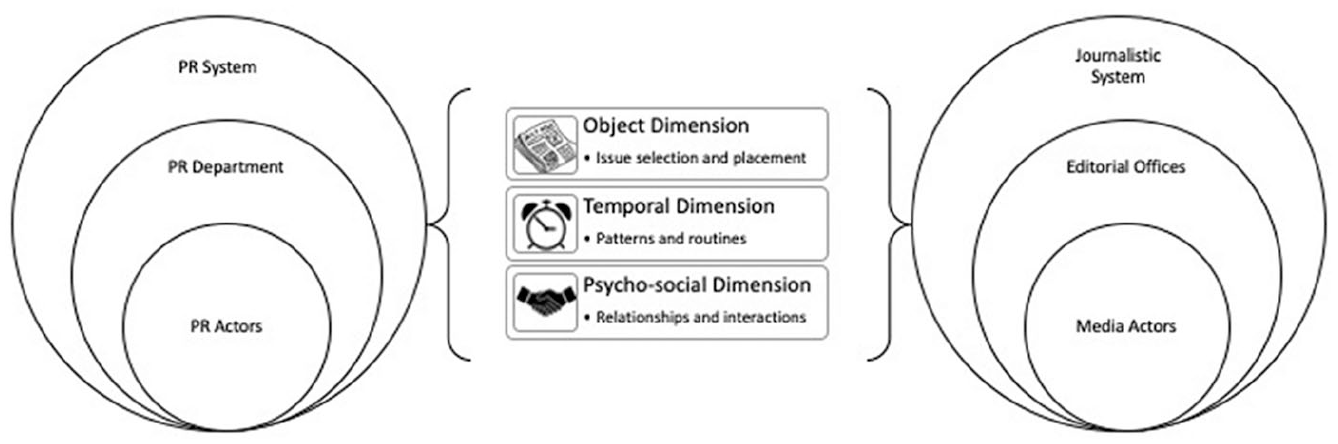
The intereffication model.
The intereffication model accounts for multidirectional influence among journalism and public relations in the form of inductions and adaptations. Inductions are “intended and directed communicative offers or stimuli, which result in resonances in the respective other system” (Bentele & Nothhaft, 2008, p. 36), such as the information subsidies described by Gandy (1982). Adaptations, on the other hand, are “actions by which actors and organizations consciously adapt themselves to changing circumstances (e.g., organizational or time routines) in order to optimize their own communicative success” (Bentele & Nothhaft, 2008, p. 36). In a sense, adaptations represent feedback loops within the relational system. For instance, PR practitioners target story pitches based on reporters’ beats, craft materials in journalistic style, highlight newsworthy elements, and time material releases based on journalistic routines. While other conceptual models draw normative conclusions about relative power, such as Reich’s (2006) process model, which argues that sources push coverage, and Bourdieu’s (1999) field analysis, which suggests that journalists set the rules of engagement and therefore hold the upper hand, the intereffication model is value-neutral. Scholars drawing on the intereffication model assert that the PR–journalism relationship is not inherently symmetrical and that one system may exert more influence over the other at different times (Bentele, 2002; Bentele & Nothhaft, 2008; Lee et al., 2018).
Science PR for Science News: An Increasing Interdependency
The relationship between scientific production and journalism is an increasingly relevant realm in which to examine the intereffication model and the PR–journalism relationship. The increased “medialization” of the scientific field has opened the door for more intensive PR efforts by research institutions, including universities and thinktanks. As described by Peters (2012, p. 217), medialization refers to the “increasing media attention for science, and second, adaptation to or even anticipation of media criteria within science as a response to the increasing necessity of legitimating science by means of public communication.” Medialization has implications for science, as expectations for scientists to engage with the public realm could result in lower-quality but headline-grabbing discoveries, ultimately undermining scientific credibility (Franzen, 2012).
Increasingly medialized scientific production meets a journalistic environment that is especially permeable to PR-provided inductions designed to influence journalistic content. Most reporters covering science news are generalists with little specific training in covering science (Dunwoody, 2014). Journalists rely more on information subsidies, or inductions to use the terms of intereffication, when reporting on complex, unfamiliar issues (Machill et al., 2006), and place a high degree in trust in expert sources, particularly scientists (Weitkamp & Eidsvaag, 2014). Collectively, these factors push reporters to a mode of passive newsmaking with “extreme reliance” on expert sources (Tanner, 2004, p. 360), even more so than when reporting on other topic areas such as education (Allgaier, 2011). Journalists seek PR materials that interpret scientific findings not only into lay terms but into newsspeak, making clear what is newsworthy about a new scientific study. PR professionals must serve as translators: Our journalists are literally starving for science news, but what they miss is an intermediate level of “scientific translation” between a specialized publication (e.g., Science, Nature, and all the specialized science journals and newsletters) and an article for the general public. (Arata, 2007, p. 177)
While journalists claim to rely on the original (often paywalled) scientific study in addition to the associated press releases, they still can fail to accurately represent a scientific study. A study of 64 news articles about 50 research studies and their associated press releases found that journalists did not provide sufficient detail for the reader to identify the study source nearly a third of the time as well as failed to contextualize non-peer-reviewed results as tentative (Weitkamp & Eidsvaag, 2014). Most news stories included a single quoted source that was almost always pulled directly from press releases, and only 14% of news articles mentioned funding—an important consideration for potential conflicts of interest—compared with 60% of the press releases and 74% of the scientific journal articles (Weitkamp & Eidsvaag, 2014). Meanwhile, Vogler and Schäfer (2020) recently demonstrated that an increasing amount of science news published in Switzerland relies on university-provided press releases with an increasingly positive tone toward the university. These findings demonstrate the power of information subsidies to work as inductions as described in the intereffication model.
The success of universities in garnering news attention for their research production likely reflects PR professionals’ adaptations to journalistic needs as also described in the intereffication model. Accessible, easy-to-follow formats are crucial for non-specialist journalists, but perhaps most important for science PR professionals’ science translation is readability (Foster et al., 2014). Jargon-heavy scientific studies written for an audience of fellow specialist scientists can be difficult to interpret for lay readers, including both journalists and their audience. At the same time, it is reasonable to conclude that not all research institutions have the same capacity to engage in professional PR science translation. Producing readable, high-quality press releases that reflect an understanding of journalists’ newsmaking needs, and especially providing much-needed multimedia content is costly and time-consuming. Multimedia contents, including photos and video, have long been a part of the PR toolkit (Broaddus et al., 2011; Harmon & White, 2001), and video news releases specifically have been shown to increase news attention to science (Machill et al., 2006).
Based in the literature that stresses the interdependence of the journalism–PR relationship, we hypothesize that science press releases that are highly readable and that come with multimedia content are indicative of research institutions that are invested in PR outreach and will therefore have more success in influencing news media content. We conceptualize success as “uptake,” meaning the transfer of specific words and phrases from PR-provided press releases into news output.
Therefore, we pose the following hypotheses:
News Organization Characteristics and Science Coverage
When PR practitioners adapt their offerings to address particularly hard-to-fulfill needs for adequate reporting, their chances of influencing the news media agenda—and therefore the public agenda—increase dramatically. For journalists, however, this presents a dilemma. As the “fourth estate,” normative expectations for journalists prioritize their ability to perform a watchdog function on powerful interests, including the state, corporations, and other institutions including universities and thinktanks. Scientists are viewed with greater trustworthiness in the eyes of the public compared to politicians, the news media, and business leaders (Funk et al., 2020), and this is no doubt reflected in journalists’ credulous treatment of science sources. However, it leaves open the possibility for unscrupulous interests to exploit the relatively uncritical reliance of journalists on scientists, and scientific studies, as sources. In the climate change issue, for example, journalists gave outsized attention to the few scientists that rejected the overwhelming scientific consensus on anthropogenic nature of climate change, and the effects on public opinion and policymaking still resonate (Boykoff & Boykoff, 2004; Brulle, 2014). Higher-quality science journalism comes from journalists with specific training or expertise in science, and there simply are not many journalists fitting that description (Dunwoody, 2014). Specialist reporters are often the first to be let go in a constrained economic environment (Joseph, 2018). In addition, science is a low-priority news beat, with just 1% to 2% of American news content devoted to the topic, ranking it well below government, politics, the economy, and crime (“The Year in News,” 2011). As a low-priority news topic related to a complex area requiring specialist knowledge, science journalism may be especially likely to rely on information subsidies. However, at the same time, news organizations that invest in science journalism may produce higher-quality material less permeable to PR influence (Dunwoody, 2014). We examined whether news organizations’ status as award-winning for science journalism had an influence on PR attention and uptake. Journalistic prestige was operationalized as news organizations that have won journalism awards from the American Association for the Advancement of Science (AAAS) in the last 10 years. With those variables in mind, we pose the following research questions:
Method
The application programming interface (API) for the Crossref database was used to gather the full population of publications in Nature and Science, the top-two ranked interdisciplinary scientific journals, from January to December 2019. 1 From these data, we pulled the DOI numbers from each scientific study, resulting in 9,096 published items (inclusive of full research articles, research notes, and “letters”). We next used the Altmetric API to access news media publications about each scientific study. As would be expected given that these are counts of news articles referencing each piece, the number of news media citations of articles in these journals were count-distributed.
We generated a random stratified sample contingent on the news coverage counts for the articles by sampling across each 10% quantile in the data, targeting a desired sample size of 600 scientific studies. From this sample, each study was hand-coded to identify full research articles. This resulted in a final sample of 414 scientific studies. We sought press releases for each of the scientific studies by searching Science Daily, a service for scientific press releases, as well as university and think tank websites for the study title, resulting in 298 press releases. We then used the Altmetric page for each scientific study to download news media links referencing each study, resulting in 678 news articles. The resulting list of news organizations covering these scientific studies was filtered for only those sources that appeared in the top 500 U.S. websites as ranked by Alexa, a leading web analytics company. This resulted in 32 news organizations, which were coded for Alexa rank and journalistic prestige, operationalized as whether the organization had won an award for science journalism from the American Association for the Advancement of Science in the last 10 years. In addition, we captured all news organizations in our population that had won AAAS awards in the last decade, resulting in 21 news organizations. We used hand coding for variables related to press releases and news organizations. Krippendorf’s alpha ranged from .87 to 1 between two coders. The body text of each news article and press release was scraped using the Newspaper3k package in the Python programming language (Ou-Yang, 2020). Because we are interested in similarities in text present between press releases and news articles, we used sentence-level embedding models offered by the Universal Sentence Encoder (USE) package within the Tensorflow library (Cer et al., 2018). Sentence-level embeddings are similar to word embeddings, which have received a large amount of attention since release of Mikolov et al.’s (2017) word2vec algorithm. The creation of word embeddings consists of training a language model of word contexts (Goldberg & Levy, 2014; Mikolov et al., 2017). Given a text, each word is embedded in some n-dimensional space based on its contextual similarity to other words (e.g., “prince” and “princess” would be found in a similar region of language space, while “bird” and “fireplace” would not). Language embeddings make use of huge corpi of text to place language within a vector space. In much the same way, the USE model projects sentence text into 512 dimensions, which can then be used to compare sentences using techniques such as cosine similarity scores (see Perone et al., 2018).
An example of a pairwise comparison of cosine similarity between two of the most highly related sentences in a media article and press release is shown below. The cosine score between the two passages is 0.93, indicating a high level of semantic similarity.
“The monkeys lost, on average, 40 to 60 percent of the antibodies that protect them from other pathogens.” 2
“Similar to the findings in people, the macaques lost an average of 40 to 60 percent of their preexisting antibodies to the viruses and bacteria they had been previously exposed to.” 3
Another article–press release pair, which showed a max similarity of 0.52, is shown below. Note that while both passages concern sargassum, a microalgae, the sentences are otherwise mostly dissimilar:
“We also found a lot of sargassum.” 4
“In the open ocean, Sargassum provides great ecological values, serving as a habitat and refuge for various marine animals.” 5
Finally, we provide an example of an almost nonexistent similarity between a pair of sentences in press release material and media coverage of research on the spread of hate speech online, with a score of 0.30.
“But it also seems incredibly challenging to do safely, and at scale.” 6
“The analogy is no matter how much weed killer you place in a yard, the problem will come back, potentially more aggressively.” 7
Table 1 presents basic descriptive statistics. There were more Nature (56%) articles than Science (44%). Of those articles, 298 (72%) had associated press releases, and 678 news articles were published about the scientific studies, with 121 (29.2%) of the scientific studies receiving coverage from the 32 news organizations. Sentences in news articles about the studies had a similarity score of 0.65 on average, indicating a relatively high level of press release uptake, though this does not control for the influence of other variables, which is tested below. In addition, these similarity scores ranged from 0.0 (no similarity) to 1.0 (a direct pull from press release materials), with 95% of observations falling between 0.16 and 0.91.
Descriptive Statistics.
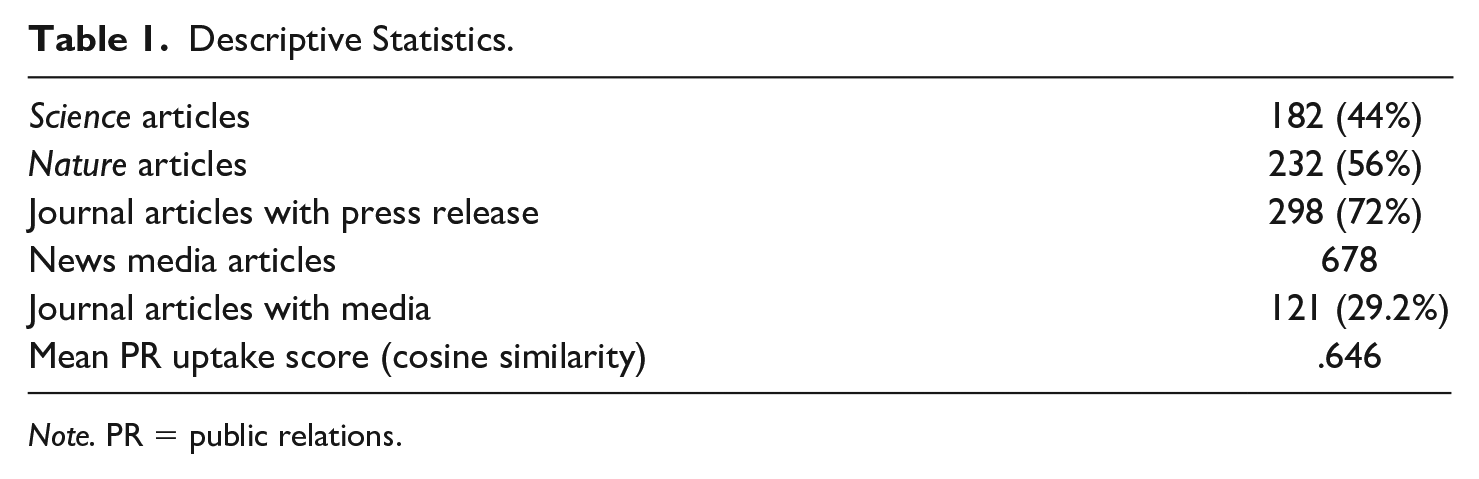
Note. PR = public relations.
Results
Effect on Media Coverage of PR Presence and Readability.
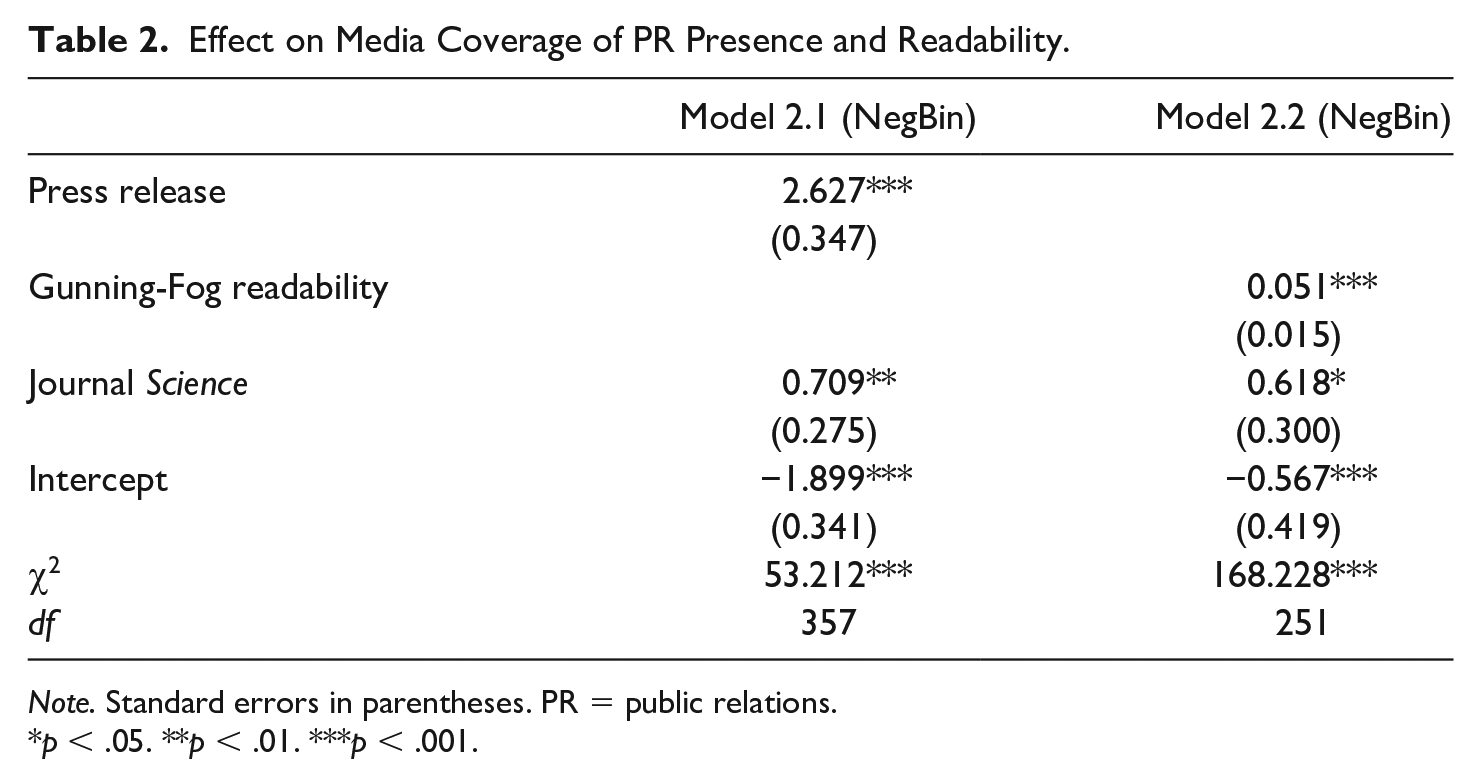
Note. Standard errors in parentheses. PR = public relations.
p < .05. **p < .01. ***p < .001.
We executed a linear multi-level model (MLM), with the similarity scores of news media–PR materials as the dependent variable (Table 3), nested by news article and scientific study, to examine the extent to which news articles uptake PR materials as a function of the readability of those articles. We find no significant relationship between readability and news media uptake of PR materials (b = 0.0001, p > .05).
Media Uptake as a Function of PR Readability.
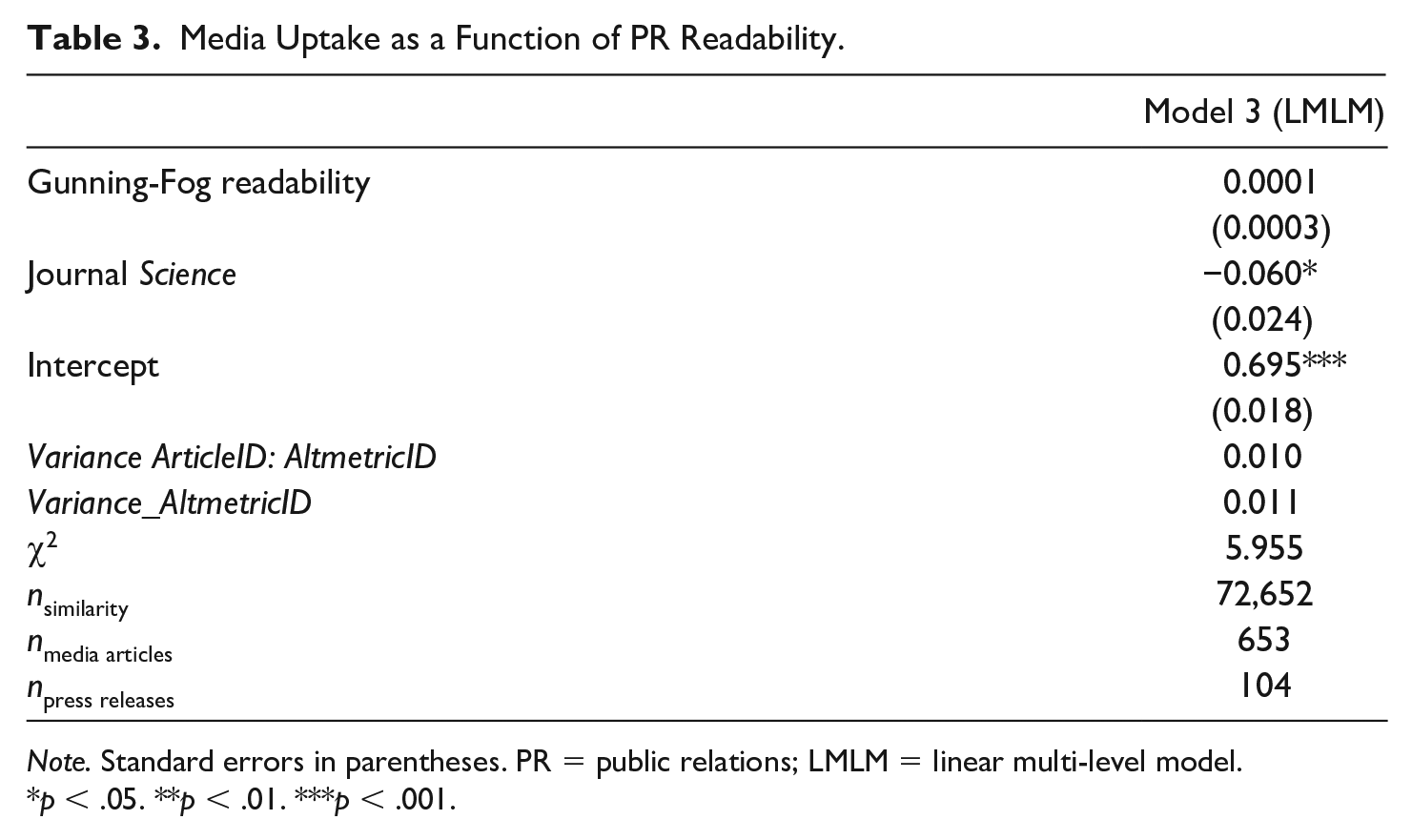
Note. Standard errors in parentheses. PR = public relations; LMLM = linear multi-level model.
p < .05. **p < .01. ***p < .001.
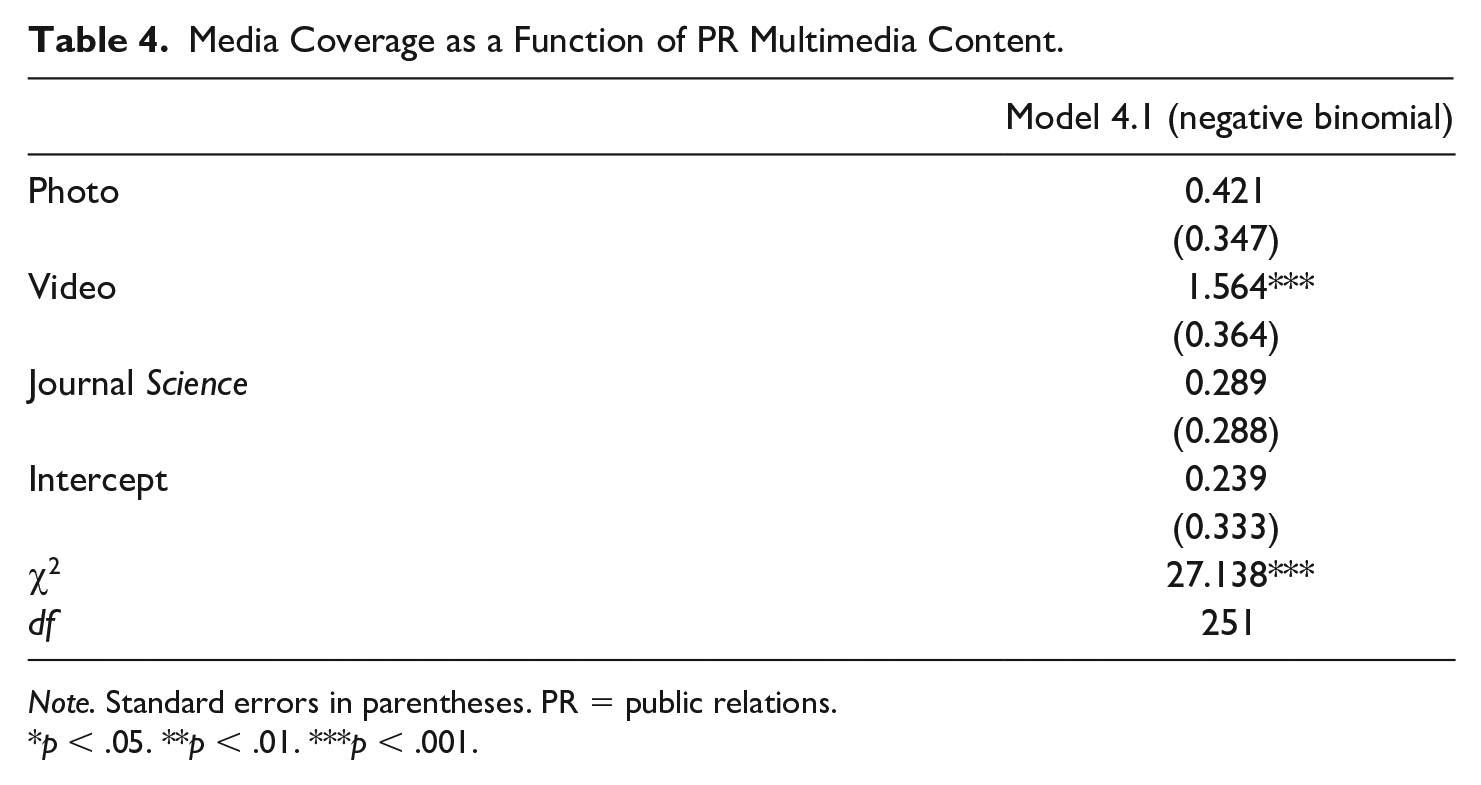
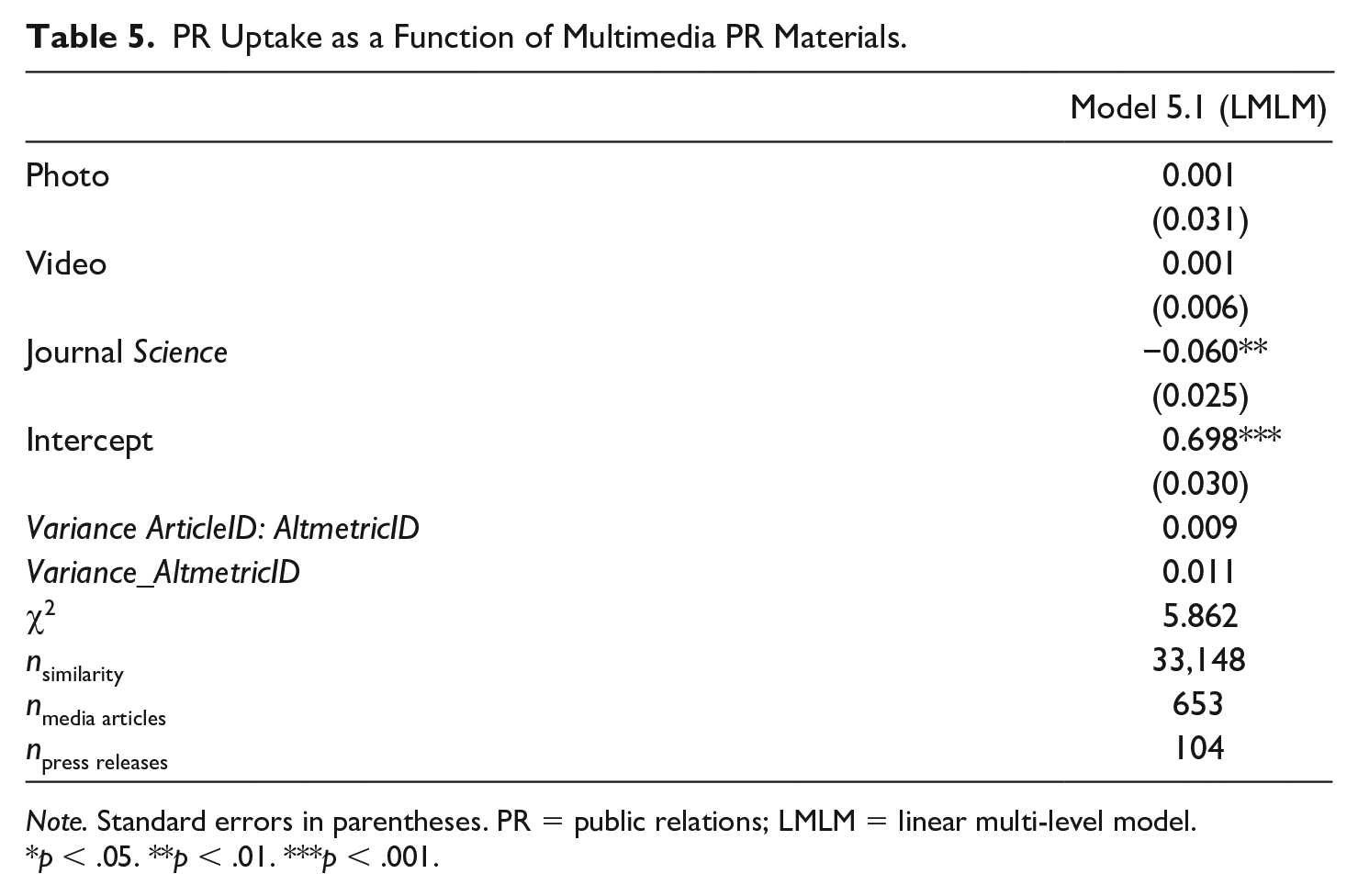
We found no relationship between the presence of images in PR materials and media coverage of the corresponding research (b = 0.421, p > .05), but there was a significant positive relationship between video content in press releases and the volume of media coverage given to scientific research (b = 1.564, p < .001). On average, PR materials that included accompanying video content received around 4.78 times as many articles as compared with those that had no video content, after controlling for the journal placement of scientific articles (Table 4). Thus,
Media Coverage as a Function of PR Multimedia Content.
Note. Standard errors in parentheses. PR = public relations.
p < .05. **p < .01. ***p < .001.
PR Uptake as a Function of Multimedia PR Materials.
Note. Standard errors in parentheses. PR = public relations; LMLM = linear multi-level model.
p < .05. **p < .01. ***p < .001.
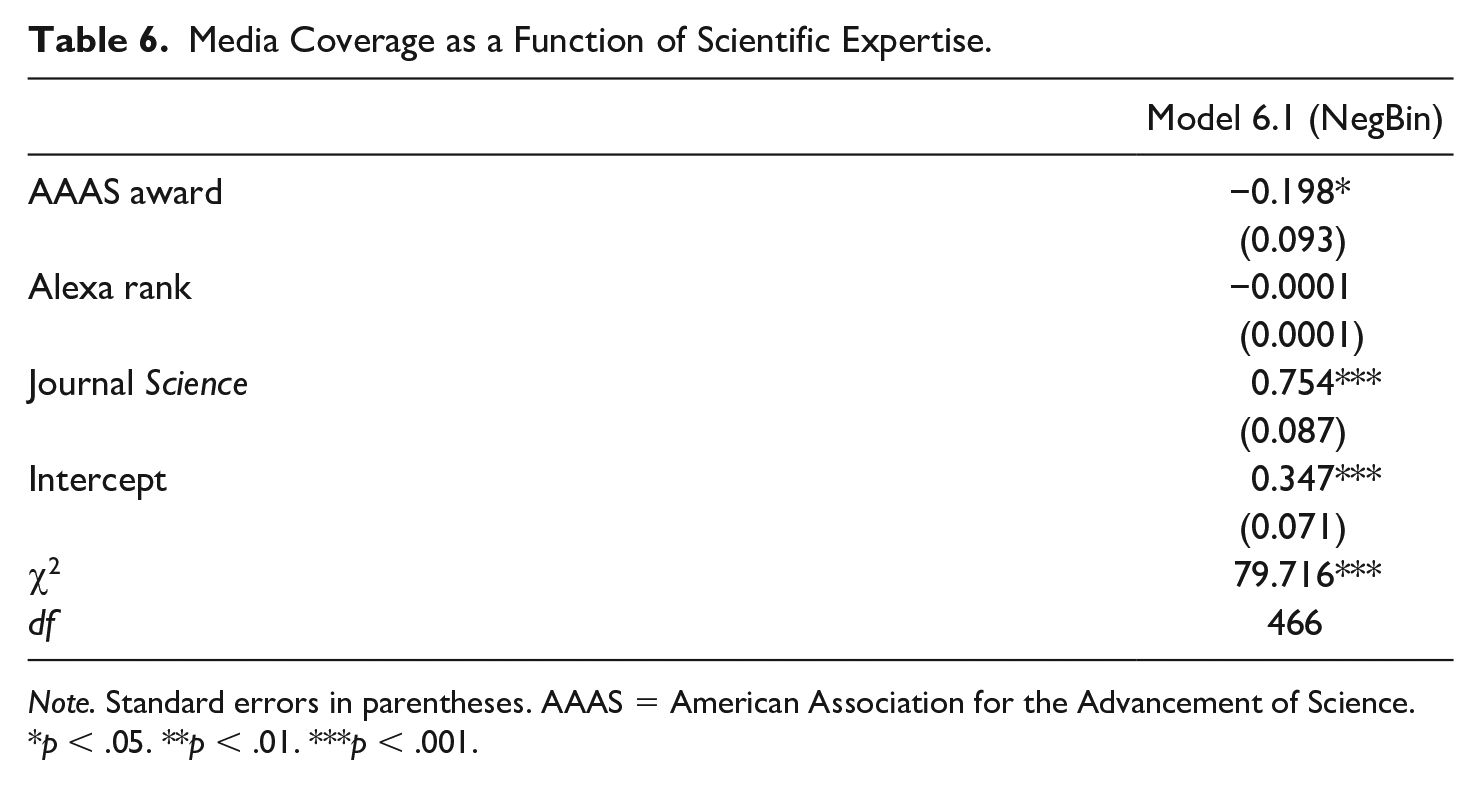
Our analyses of how characteristics of news organizations related to media coverage volume and uptake of PR materials are shown in Table 6, which presents a negative binomial model analyzing news coverage volume as a function of science journalism prestige (AAAS awards) and their rank in terms of U.S. web traffic (derived from Alexa rankings). We found a negative and significant, albeit small, relationship between award-winning news organizations and coverage of scientific publications (b = −0.198, p < .05); AAAS-winning news organizations were .82% as likely to cover scientific publications compared with their non-award winning counterparts. We found no relationship between website rank and coverage of scientific publications (b = −0.0001, p > .05) (see Table 6).
Media Coverage as a Function of Scientific Expertise.
Note. Standard errors in parentheses. AAAS = American Association for the Advancement of Science.
p < .05. **p < .01. ***p < .001.
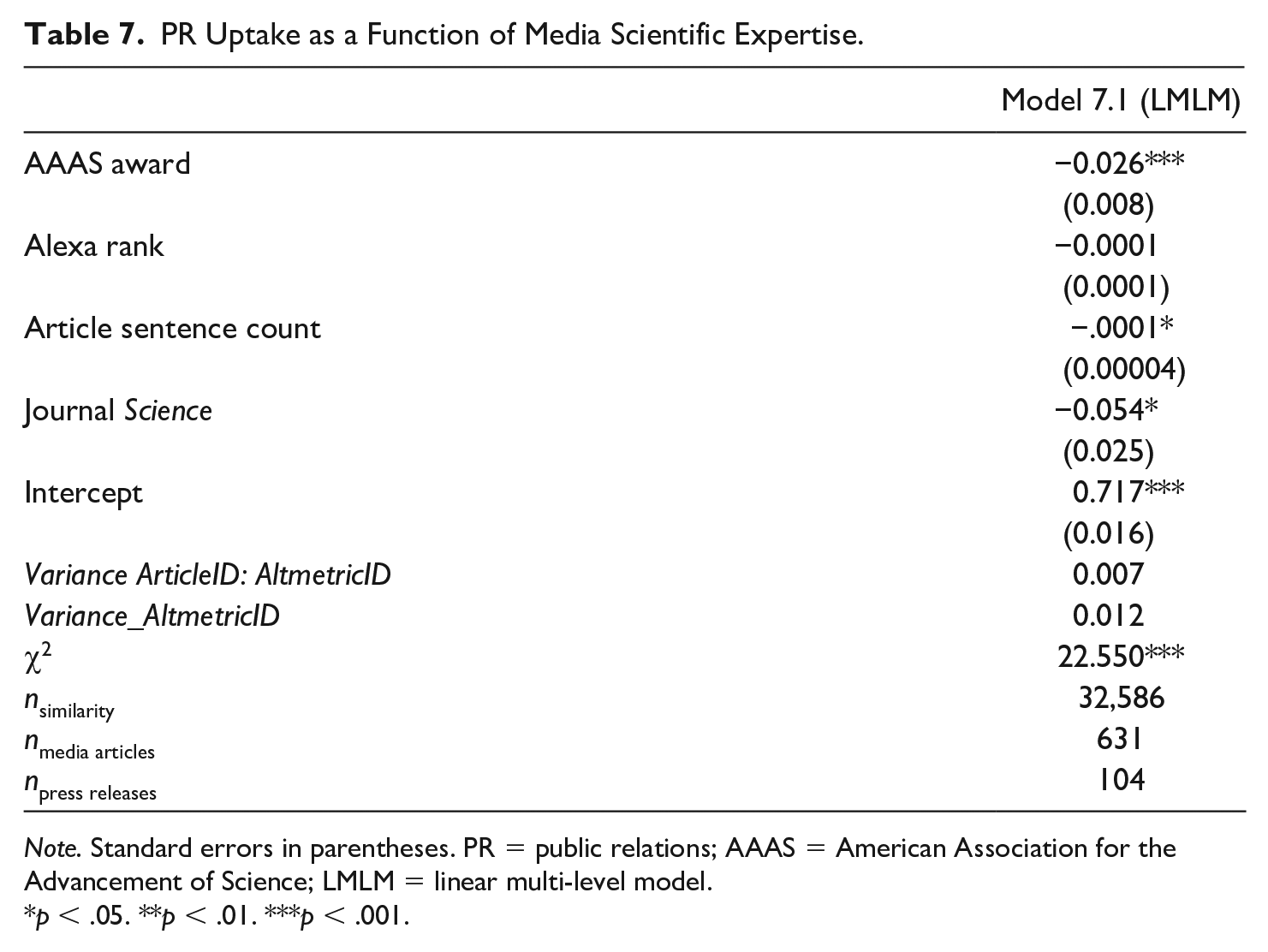
In our final multilevel model with uptake of PR materials as a function of media organizations’ science reporting prestige, we found that news organizations that had won AAAS awards for science journalism in the last decade were significantly less likely to uptake PR materials than those who were not recipients (b = −0.11, p < .01). In other words, news organizations that won AAAS awards tended to pull high-similarity sentences from press releases less frequently than their non-award winning counterparts. Of course, the likelihood exists that AAAS-winning organizations might also write more long-form science journalism, watering down text pulled from PR materials. To account for this, we included a variable of the sentence count of each article, which had a negative and significant relationship with media–PR similarity (b = −0.0001, p < .05), indicating that longer articles tended to be less similar to press releases. That AAAS award status would continue to have a relationship with decreases in media uptake of press release materials after controlling for article length lends further credence to the finding (see Table 7).
PR Uptake as a Function of Media Scientific Expertise.
Note. Standard errors in parentheses. PR = public relations; AAAS = American Association for the Advancement of Science; LMLM = linear multi-level model.
p < .05. **p < .01. ***p < .001.
To further illustrate the effect of journalistic prestige on media uptake of PR materials, we found that, on average, 3.1% of sentences appearing in AAAS award recipients’ articles were highly similar (≥0.9), as compared with 6.2% of non-AAAS recipients. Moreover, as Figure 2 shows, the range and distribution of similarity differs dramatically between media outlets that have and have not received the award. Not only did AAAS award winners exhibit much lower uptake of PR materials, they were also much less likely to feature a high proportion of sentences that were seemingly pulled directly from PR materials. For example, the maximum percentage of high-similarity sentences (cosine similarity ≥ 0.9) among AAAS winners was 50%; for non-winners, up to 67% of sentences exhibited high uptake from PR materials.
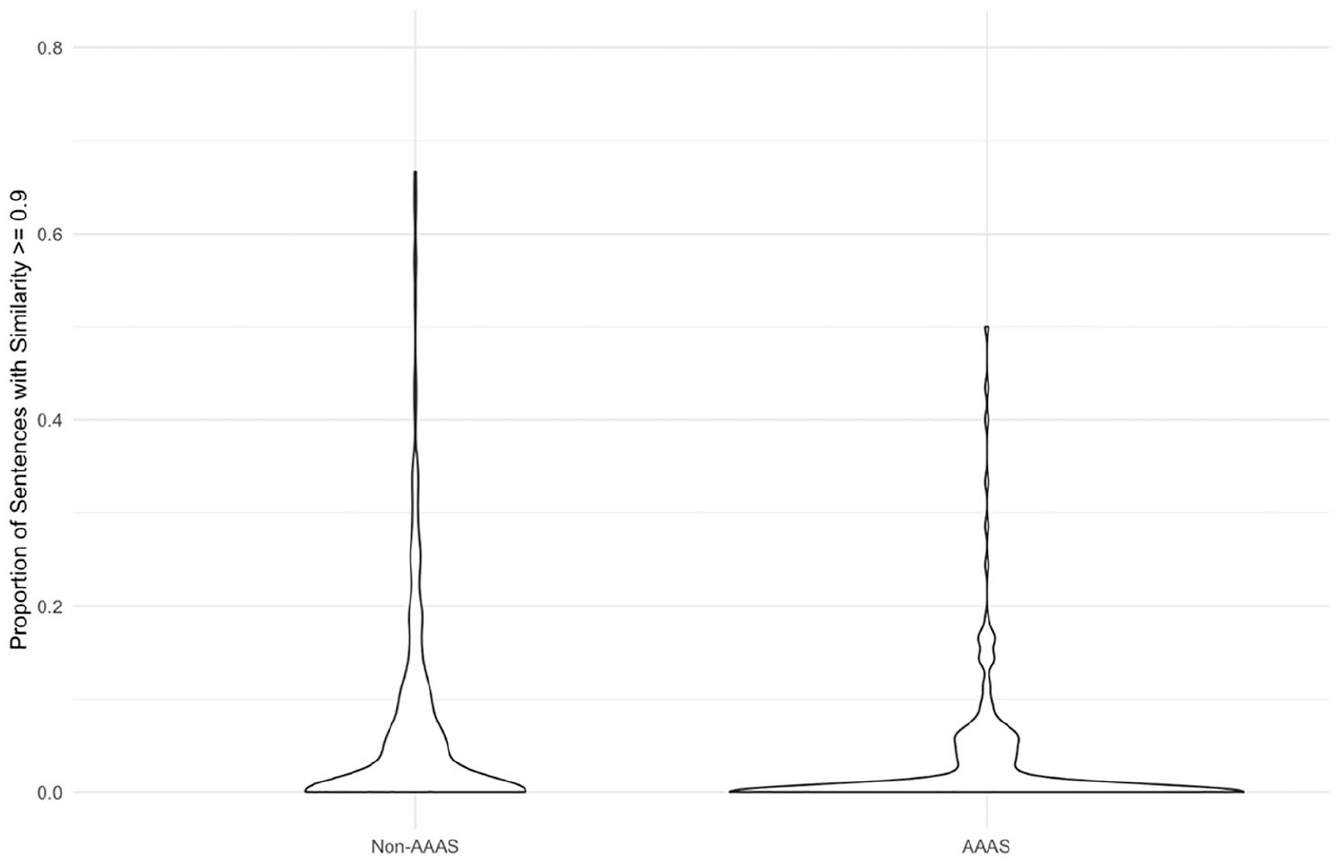
Violin plots showing range and distribution of PR uptake in media articles.
Discussion
Our results reify and challenge some commonly held assumptions about the interdependent relationship of public relations and journalism. PR materials significantly influenced scientific news attention volume and content, but news organizations’ dedication to producing award-winning science journalism reduces the likelihood of relying on press releases. These findings build on decades of research examining the PR–journalism relationship specifically, and the source–reporter relationship more generally. The calculation of similarity scores provides a more nuanced picture of PR material uptake than previous studies relying on interviews, surveys, and manual content analysis, and allowed us to include dozens of news organizations in our analysis. Press releases, as expected, predicted more news coverage of scientific studies. Higher-quality PR material with high readability and video content in particular resulted in more coverage. However, while these higher-quality releases captured more news attention, they were no more successful in terms of text uptake into news articles than the average press release in our sample. On average, news articles earned a similarity score of 0.65 to press releases, indicating significant reliance by journalists on these materials—again, regardless of the characteristics of the press releases. This suggests other variables may be at play; perhaps research institutions that can invest in high-quality PR material also have innate “brand recognition” that results in news attention regardless of the quality of the PR materials. In addition, it is important to note that our method inferred a relationship between a press release and news content based on text similarity. Some low-similarity overlaps between releases and news articles may be coincidental, and this study did not account for more informal PR contacts with journalists via networking and social media.
Shrinking newsroom resources have provided greater opportunities for PR-produced information subsidies to find their way into news content (McManus, 2009). The conventional wisdom suggests that news organizations that dedicate resources to science journalism will produce more original articles that will not be so easily influenced by public relations material (Dunwoody, 2014). Our results showed that news organizations with a history of award-winning science reporting produced more original, less PR-centric science journalism. Size of the news organization, which might indicate availability of resources for specialist science journalism, had no relationship to news attention or PR material uptake. This indicates that news organizations both large and small are capable of independent science journalism, but that other factors prevent them from investing journalists’ time to produce it. In addition, while nearly three-quarters of the studies captured in our sample had associated press releases, only a quarter received any news attention at all. News organizations coalesce their attention to certain studies. The role of intermedia agenda-setting—where news organizations mimic the coverage of their peers—should be explored in greater depth as a potential mediator of the PR–journalism relationship.
For science news in particular, we may be in an era of increased power of PR relative to journalism. This suggests that the intereffication model, which illustrates the relationship between journalism and public relations across levels from a value-neutral perspective, may need to be reimagined to account for relative power. The current study demonstrates how much journalism relies on PR inductions to produce news material, with the implication that these two areas are utterly interdependent. But we face an ever-uncertain news media environment, with American newsroom employment down nearly a quarter since 2008 (Greico, 2020). Meanwhile, PR jobs are up nearly a third in the same time period (Daniels, 2020). Models like intereffication must account for broader shifts and trends and the relative impact that follows. How can the model account for the ascendancy of PR in an era of shrinking newsroom capacities? One source of inspiration may be Bourdieu’s (1999) theory of fields, which spatially maps out social actors according to their relative power and suggests that journalism is a dominate field as it mediates the other fields, including the scientific field. While public relations scholars acknowledge that shifting power relationships are normal (Bentele, 2002; Bentele & Nothhaft, 2008; Lee et al., 2018), the very nature of media relations work sees PR professionals mimicking journalistic norms and practices to garner news attention, suggesting that the tradition of PR work is to subjugate itself to the norms of the journalistic field. As journalists’ numbers continue to shrink, however, there may be a tipping point—and we may already be past that tipping point for science news in particular, with the rare exception of news organizations angling for prestige in science journalism. As Reich’s (2006) process model proposes, sources may drive news more than journalists are comfortable to admit. Yet the medialization of science suggests that other fields will adapt to journalistic needs even as newsrooms continue to shrink. An important limitation to the current study is that it did not compare PR uptake across news topic areas, such as politics, entertainment, crime, and so on. Future research could take such a lateral approach.
This shifting power balance between journalism and PR has implications for the public science agenda. As Sharon Dunwoody (2014, p. 27) has noted, Citizens of the globe are buffeted by one issue after another—the potential impacts of GM crops; the mysterious die-off of bees; individualized medical treatment via genomics; climate disruption . . . and have few places to turn for independent, evidence-based information.
We only have to look to the climate change issue to understand the stakes. A long-running effort by the fossil fuel industry to undermine the scientific consensus on the relationship between emissions and climate change through lobbying and funding denialist scientists resulted in the overrepresentation of climate skeptic voices in the U.S. news media (Boykoff & Boykoff, 2004; McCright & Dunlap, 2003). Unsurprisingly, the United States has become a global leader in public mistrust of climate science—a classic example of successful agenda building, or a cautionary tale (Milman & Harvey, 2019). While PR for science can be used to illuminate the importance of science and discovery in the public sphere and contribute to a more science-literate citizenry, it can just as easily be a tool for misdirection and deceit. Scrupulous journalism can act as a barrier against the latter tactics, but the economic environment for such newswork is less and less friendly, resulting in more journalism that is a tissue-thin wrapper for public relations.
Conclusion
We examined the relative success of press releases about scientific studies in terms of their impact on news coverage. Using an innovative approach that allowed for analysis of a large corpus of text and calculation of similarity scores, we were able to trace the uptake of press release materials into news media articles. Indeed, PR materials can be highly influential in science journalism. In some cases, up to 65% of news article sentences displayed high similarity to press release material. We found that news organization characteristics were an important indicator of PR success. News organizations that had a history of producing award-winning science journalism were much less likely to draw on PR materials, reaffirming the importance of news organizations’ dedication to providing resources for science journalism. While our results contain some good news for public relations practitioners, they also carry a warning for consumers of journalism and for the public science agenda, which may be left vulnerable to bad actors exploiting the natural trust that the public, and journalists, have in science.
Footnotes
Declaration of Conflicting Interests
The author(s) declared no potential conflicts of interest with respect to the research, authorship, and/or publication of this article.
Funding
The author(s) received no financial support for the research, authorship, and/or publication of this article.
