




Abstract
This study explores the effects of traditional media and social media on different types of knowledge about COVID-19. We also explore how surveillance motivation moderates the relationship between media use and different types of knowledge. Based on cross-national data from Singapore and the United States, we find that news seeking via social media is negatively related to factual knowledge and positively related to subjective knowledge and knowledge miscalibration. News seeking via traditional media is not significantly related to factual knowledge. Although the main effects are highly consistent across the two countries, we find some different interaction patterns across these countries.
The disease caused by SARS_CoV-2 (hereafter, COVID-19) swept across the world in 2020, causing a massive global pandemic that has now persisted for over a year. As a new type of virus, global citizens did not initially have clear ideas about how severe it was, how easily it could spread, how to prevent it, and how long it would be until scientists found a cure. This lack of information and understanding has unequivocally played a role in exacerbating fears, as well as public concern over the virus’s severity and impact. Given these circumstances, one of the most crucial questions that media scholars have raised is whether, and to what extent, the media has improved or eroded public knowledge about COVID-19.
Studies have found that during times of uncertainty and crisis, people rely heavily on news media coverage to stay updated and connected (Houston et al., 2015). This tendency appears to be especially pronounced during COVID-19, as the pandemic has led most people to spend unusually large amounts of time at home. While people naturally look to different media sources to obtain information about COVID-19 (De Coninck et al., 2020), we know little about what types of media have proven useful (or not useful) in helping the public stay informed. Different types of media have different characteristics, from platform architecture and functionality, which in turn impart different effects on their users (Prior, 2007).
Scholars have long explored the relationship between different types of media use and knowledge in different areas, such as political communication (e.g., Delli Carpini & Keeter, 1996; Dimitrova et al., 2014), health communication (e.g., Ho et al., 2013; Salmon et al., 1996), and science communication (e.g., C. J. Lee & Scheufele, 2006; Nisbet et al., 2002). Here, knowledge has typically been conceptualized and measured as the traditional sense of an objective, “factual-type knowledge”—that is, how much respondents are aware of factual information. Yet, some research has found that factual knowledge—how much one really knows—often does not match with how much they think they know (i.e., “subjective knowledge”). To this end, recent scholarship is increasingly turning to subjective and meta-cognitive processes of knowledge, such as subjective/perceived knowledge (Feezell & Ortiz, 2019) and knowledge miscalibration (i.e., the gap between subjective and factual knowledge) (Yamamoto et al., 2018). Yet, there is still little systematic research examining how different types of media affect different types of knowledge. This question is especially important during the current COVID-19 situation because being accurately informed—as opposed to thinking one is informed, despite not actually knowing—can affect individual lives, as well as public health more broadly.
Against this background, this study explores the effects of traditional media and social media on different types of knowledge about COVID-19 (i.e., factual knowledge, subjective knowledge, and knowledge miscalibration). Our study also explores how surveillance motivation, or the need to monitor the news for potentially relevant information, moderates the relationship between news media use and different types of knowledge. To this end, our study uses cross-national data from Singapore (cross-sectional data) and the United States (two-wave panel data). By using both cross-sectional and panel data, we can draw causal inferences with greater confidence. In addition, by using two surveys from two countries, our study aims to explore the broader implications of how different types of media use affect different types of knowledge regarding COVID-19 in different contexts.
Knowledge and Miscalibration
Knowledge refers to the factual information about an issue that is stored in one’s memory (Delli Carpini & Keeter, 1996). Thus, the defining feature of knowledge is its cognitive nature. Factual knowledge is assumed to serve as a precursor to reasoned judgments and effective decision-making. In politics, knowledge about the government, elected officials, candidates, and specific issues is essential to hold those in office accountable and make well-informed electoral choices (Berelson et al., 1954). In health, factual knowledge about diseases, such as the symptoms, causes, diagnosis, and treatment, helps stay physically and mentally healthy. Indeed, when equipped with accurate facts, people can engage themselves and the people around them in healthy practices (Jensen et al., 2020).
Although the value of factual knowledge in life domains is unquestionably important, research has shown that knowledge, at times, can be more fluid and subjective based on one’s perceptions (Brucks, 1985; O’Cass & Pecotich, 2005). For example, the question of who the director of the Centers for Disease Control and Prevention is factual in nature. However, knowledge is not limited to readily verifiable facts. Indeed, when asked how knowledgeable people are about protecting themselves from COVID-19, some may say they are well-informed, even if they do not have accurate facts. Likewise, some may say they are not knowledgeable, even though they have relevant, factual information. Therefore, people’s perceptions of how erudite they are do not always correspond with how much they actually know (Yamamoto et al., 2018). Subjective knowledge is theoretically important in its own right as factual knowledge can be contested according to one’s beliefs.
The mismatch between factual and subjective knowledge draws on the concept of knowledge miscalibration (Alba & Hutchinson, 2000). People are often incapable of objectively evaluating their skills, such as their sense of humor, command of a language, and knowledge (Kruger & Dunning, 1999). This lack of self-awareness manifests itself in the miscalibration of knowledge. It typically takes the form of overconfidence, where people think they know more about a subject than they actually do (Alba & Hutchinson, 2000).
Social Media, Knowledge, and Miscalibration
In this study, we examine news seeking from varied news sources in relation to the three dimensions of knowledge in the context of COVID-19. We expect that news seeking via social media—due to content, motivational, and social reasons—promotes perceived learning but actually hinders effective learning from the news (Feezell & Ortiz, 2019; Gil de Zúñiga et al., 2017). On social media, news exposure occurs through article previews that often only include an attention-grabbing headline, image, and snippet of an article (Molyneux, 2018; Schäfer, 2020). This presentation of news, which strips factual details, may lead to an incomplete understanding of events.
Although reading an entire article contributes to more knowledge (Anspach et al., 2019), not many social media users actually do so. Indeed, research shows that about 60% of social media users share news posts without reading the full stories (Gabielkov et al., 2016). This finding seems to be tied with people’s use of social media for efficient access to news rather than for learning factual details (Pew, 2016, 2017) and with an information overload (Holton & Chyi, 2012; Pentina & Tarafdar, 2014). Indeed, as people find a vast amount of information on social media news feeds and timelines, they tend to feel submerged with information, which leads to news fatigue and avoidance (S. K. Lee et al., 2017; Pentina & Tarafdar, 2014; Song et al., 2017). Given this issue, even if people create a customized stream of information to seek specific news topics, they may end up not paying full attention to news posts they encounter on social media because processing this constant overflow of information is cognitively overwhelming (van Erkel & Van Aelst, 2020).
Given such a social media environment, overall, empirical evidence—besides a few exceptions—suggests that news exposure on social media does not particularly contribute to factual learning. Although Anspach et al.’s (2019) experimental study showed that exposure to a Facebook article preview contributed to knowledge about genetically modified foods, recent work by Schäfer (2020) found that such exposure had no significant effect on factual knowledge about the health effects of artificial sweeteners in foods. Observational studies with various data sources have shown that news consumption on social media either does not contribute (Beckers et al., 2020; Dimitrova et al., 2014; S. Lee & Xenos, 2019) or is negatively related to factual political knowledge (Cacciatore et al., 2018; S. Lee, 2019, 2020; Shehata & Strömbäck, 2018; van Erkel & Van Aelst, 2020). Such adverse pattern was consistent across cross-sectional survey data (Cacciatore et al., 2018) and longitudinal survey data (S. Lee, 2020; van Erkel & Van Aelst, 2020)—and in various countries, such as the United States (S. Lee & Xenos, 2019; Oeldorf-Hirsch, 2018), Sweden (Shehata & Strömbäck, 2018), Belgium (van Erkel & Van Aelst, 2020), and Korea (S. Lee, 2019).
Although studies tend to suggest that turning to social media for news is not conducive—and often detrimental—to political learning, it is evident that people come across news on social media. Thus, even if people do not assimilate much information from the news, they may think that they have learned something, thereby leading to subjective knowledge. Park (2001) explained that increased exposure to the news leads to issues of familiarity or the illusion of knowing, even when users do not actually learn anything. Such a tendency/phenomenon is particularly observed in a social media environment, where news is omnipresent and constantly pushed through users’ feeds. Gil de Zúñiga et al. (2017) pointed out that such a news exposure pattern can create a “news-finds-me” perception, which refers to a faulty perception that the news will reach them, and thus inform them anyway, even if they do not actively seek it.
In this sense, both observational and experimental studies have shown the role of social media use in fostering subjective political knowledge rather than factual knowledge (Schäfer, 2020; Yamamoto et al., 2018). Furthermore, the research found that exposure to an article preview on Facebook led to more overconfidence in knowledge among those with a higher need for affect. This finding seems to align with the emotional orientation of social media posts (Anspach et al., 2019). As affect tends to increase attitude certainty (Britt et al., 2009), exposure to social media news, accompanied by emotional expression, may increase perceived gains in knowledge relative to how much knowledge they actually gain. Our study contributes to this literature by employing comparative data and two-wave panel data.
COVID news seeking via social media will be
Traditional News Media, Knowledge, and Miscalibration
Although many people turn to social media for seeking news nowadays, traditional media remain a major source of information. Accumulated evidence indicates that the acquisition of news information from traditional news sources contributes to factual political knowledge (e.g., Dimitrova et al., 2014; Shehata & Strömbäck, 2018).
Besides, news media play an equally important role in health communication. As most people have limited access and understanding of complex health topics and clinical studies, they rely on sources specialized in health to get health-related information, including news media (Ho et al., 2013). Although health reporting may be simplistic at times (Dentzer, 2009), journalists attempt to provide balanced and accurate health information despite constraints encountered throughout the news production process, such as tight deadlines (Leask et al., 2010).
Research has reported the positive effects of the use of traditional news on factual knowledge about health (Ho et al., 2017; Jensen, 2011; Stryker et al., 2008). For example, Stryker et al. (2008) found that paying attention to health or medical topics in newspapers was positively associated with cancer-prevention knowledge. Ho et al. (2013) also found that paying attention to news sources including television, newspapers, and the internet was positively related to knowledge about the H1N1 pandemic.
Thus, we expect that the use of traditional news sources contributes to factual knowledge about COVID-19. In addition, much like we assume there is a correlation between social media use and subjective political knowledge, seeking factual and contextual details through traditional news sources should lead people to perceive that they have learned something. Given these expectations, we expect that news seeking via traditional media would lead to increases in both factual and subjective knowledge. Yet, as we do not know whether factual knowledge would exceed subjective knowledge or vice versa, we propose a research question focusing on the relationship between news seeking via traditional media and knowledge miscalibration. Thus,
COVID news seeking via traditional media will be
Surveillance Motivation as a Moderator
It is widely acknowledged that media effects vary across individuals (Shah et al., 2009). Media scholars have suggested that media effects especially differ depending on people’s motivations for using news media. Therefore, in this study, we consider surveillance motivation as a moderator of the relationship between news media use and knowledge about COVID-19. Mass communication scholarship has long shown the importance of considering underlying motivations audiences bring into media consumption (Shah et al., 2009). When it comes to learning from the news, surveillance motivation, or the need to monitor the news for potentially relevant information, has been shown as an important theoretical construct (Eveland, 2001). In all likelihood, those with surveillance motivation are more inclined to use news sources, both traditional and social media, to search for health-related information. Therefore, they are more likely to follow health news sources’ pages, click on health-related articles, and/or channel their attention toward health news when it pops up on their social media timelines or as part of news coverage, and carefully process it.
Our focus on surveillance motivation and news media use, in relation to knowledge, is well-grounded in the existing literature that theorizes their roles in learning from the news (e.g., Eveland, 2001, 2002; Jensen, 2011). Research rooted particularly in the cognitive mediation model has shown that surveillance motivation and news media use have independent and indirect positive influences on political and health knowledge (e.g., Eveland, 2001; Jensen et al., 2020). While Eveland (2001) found that surveillance motivation influences news media use, Jensen (2011) modified the cognitive mediation model by proposing an interactive effect of surveillance motivation and news attention and showed that those with high levels of surveillance motivation and attention to health news were more likely to process, and as a result, comprehend a news story. Following Jensen’s (2011) approach, we will test this modified model of surveillance motivation and news seeking in the context of COVID-19 by comparing data from two countries. If surveillance motivation and news media use exert an interaction effect (Jensen, 2011), those with high levels of surveillance motivation may not experience the adverse influences of using social media for seeking news, as they are more likely motivated to pay attention to news on social media and seek relevant information beyond news snippets. If such were indeed the case, it would be reasonable to state that these people acquire relevant knowledge and are thus calibrated in factual and subjective knowledge.
Surveillance motivation may amplify the hypothesized positive relationship between news seeking via traditional media and factual knowledge, such that those with higher levels of surveillance motivation learn more from traditional news than those with lower levels. The same goes for when the outcome is subjective knowledge. Yet, as we do not know whether the above-hypothesized relationship would be stronger for factual knowledge or subjective knowledge, we propose a research question regarding the relationship between news seeking via traditional media, surveillance motivation, and knowledge miscalibration (
Method
Sample
Study 1 is based on a national online survey conducted in Singapore (N = 1,000). Data collection started on August 11, 2020, and took 1 week. Participants were recruited from panels maintained by Dynata (previously known as Survey Sampling International), a survey sampling company that has online panels of survey respondents who receive various forms of compensation for participation. A quota sampling was implemented to match the population distribution in Singapore in terms of gender and race.
Study 1 was a cross-sectional survey, which presents challenges in terms of making stronger claims to causality. Thus, to validate our findings with regard to the causal relationship between media use and different types of knowledge, as well as test the generalizability of our findings across different media and political contexts, we collected panel data from the United States for Study 2. Using the same research questions and hypotheses, this study sought to replicate and expand on the findings of Study 1. Study 2 draws from a two-wave U.S. national panel survey conducted during the 2020 U.S. presidential election.
Both waves of the survey were again collected by Dynata. To match the sample to the actual U.S. population, Dynata specified a quota based on gender, age, education, and income. The first wave of the survey (W1) was conducted between September 26 and September 29, 2020 (N = 1,363). The second wave of the survey (W2) was conducted right after the 2020 U.S. presidential election (i.e., November 4 to November 10, 2020). Those who participated in the first survey (W1) were contacted again. To minimize attrition, participants were offered monetary incentives for re-engagement in Wave 2 (N = 752, retention rate of 55.2%). The sample overall mirrored the U.S. Census data on gender, income, and ethnicity, though the sample was slightly older than population parameters.
Measures
COVID factual knowledge
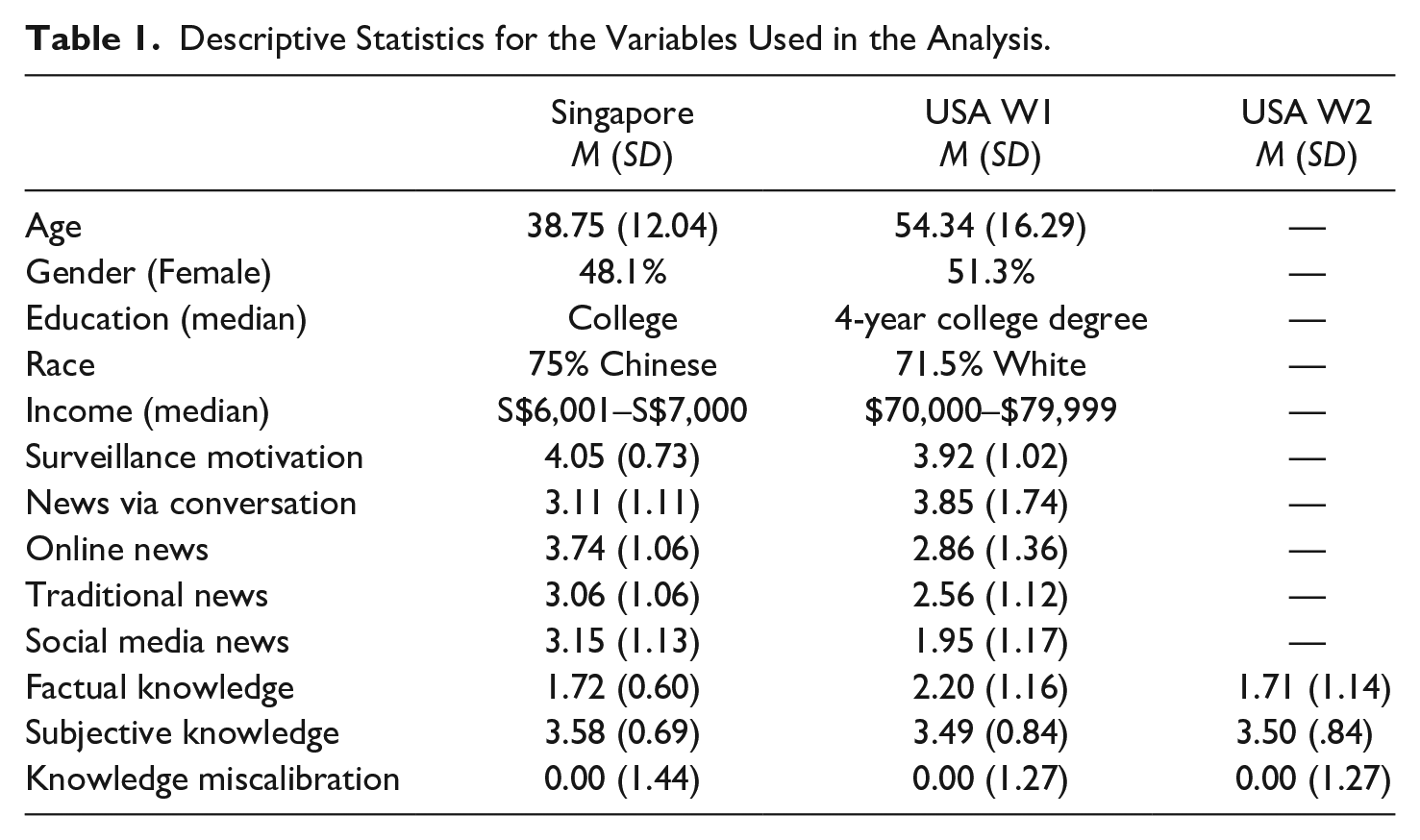
Following the previous literature on political/health knowledge (e.g., Delli Carpini & Keeter, 1996; Salmon et al., 1996), we assessed COVID factual knowledge by looking at how accurately survey respondents answered a series of factual questions about COVID-19. Correct responses were coded as 1, while incorrect responses and “Don’t know” responses were coded as 0. Correct scores were added to create an index of COVID factual knowledge. For Study 1, we asked a series of factual questions about COVID-19 (four items; see Appendix A for the full list of items; M = 1.72, SD = 0.60). As with Study 1, in Study 2, we also asked four factual questions regarding COVID-19 in Wave 1 and Wave 2, respectively (W1: M = 2.20, SD = 1.16). Notably, for Wave 2 COVID factual knowledge, respondents were only asked questions about issues and events that occurred between Wave 1 and Wave 2 to gauge the extent to which the respondents gained new information not available during Wave 1 (four items; see Appendices B and C for the full list of items; M = 1.71, SD = 1.14). When selecting knowledge items, we extracted stories that were heavily covered in the press.
COVID subjective knowledge
Building on the measurements from Yamamoto et al. (2018), respondents were asked to indicate how strongly they agreed or disagreed with the following statements (1 = strongly disagree; 5 = strongly agree): I know a lot about issues revolving around COVID-19; When it comes to COVID-19, I am quite knowledgeable; I can easily tell what is real news and what is fake news when it comes to COVID-19; and I can easily tell whether a post about COVID-19 is true or false. These four items were combined to create a composite index of COVID subjective knowledge (Study 1: Cronbach’s α = .82, M = 3.58, SD = 0.69; Study 2: W1: Cronbach’s α = .85, M = 3.49, SD = 0.84; W2: Cronbach’s α = .87, M = 3.50, SD = 0.84), with higher scores indicating greater COVID subjective knowledge.
COVID knowledge miscalibration
Conceptually, knowledge miscalibration refers to the gap between factual knowledge (i.e., how much they are actually informed) and subjective knowledge (how much they think they are informed) (Alba & Hutchinson, 2000). Following the approach from Yamamoto et al. (2018), we first standardized the terms factual and subjective knowledge. Then, we subtracted standardized factual knowledge scores from standardized subjective knowledge scores. Scores close to 0 indicate a small gap between subjective and factual political knowledge, meaning that they are accurately estimating how well informed they are about COVID-19 issues. Scores away from 0, toward the positive end, indicate that respondents overestimated how much they knew about COVID-19 issues; the greater the score, the more inaccurate their perception. Conversely, scores below 0 indicate that respondents underestimated how much they knew about COVID-19 when in fact they were actually knowledgeable about it (Study 1: M = 0.00, SD = 1.44; Study 2: W1: M = 0.00, SD = 1.27; W2: M = 0.00, SD = 1.27).
News seeking via social media
In Study 1, participants were asked on a 6-point scale (1 = never, 6 = several times a day) to indicate how often they actively sought news about COVID-19 from Facebook, YouTube, and WhatsApp. These three items were averaged to create an index of COVID news seeking via social media (Cronbach’s α = .81; M = 3.15, SD = 1.13). In Study 2, participants were asked to indicate how often they actively sought news about COVID-19 from Facebook, YouTube, Twitter, and WhatsApp, and all of the social media platforms (W1: Cronbach’s α = .92, M = 1.95, SD = 1.17). Twitter usage was not measured in Study 1 because Twitter is not popular in Singapore (see Digital News Report, 2020).
News seeking via traditional media
In both Study 1 and Study 2, participants were asked on a 6-point scale (1 = never, 6 = several times a day) to indicate how often they actively sought news about COVID-19 via (a) print newspapers, (b) radio, and (c) television. These three items were added up to create a composite index of COVID news seeking via traditional media (Study 1: Cronbach’s α = .77; M = 3.06, SD = 1.06; Study 2 W1: Cronbach’s α = .75; M = 2.56, SD = 1.12).
News seeking via online
We also took into account the influence of online news seeking in our analyses to account for news seeking from online publishers, as there are a number of high-traffic digital native news websites and news aggregators in today’s diverse media landscape (Pew, 2017). Participants were asked on a 6-point scale (1 = never, 6 = several times a day) to indicate how often they actively sought news about COVID-19 via online news (Study 1: M = 3.74, SD = 1.06; Study 2: W1: M = 2.86, SD = 1.36).
News via conversation
Given that people frequently discuss COVID-19 with other people (Pew, 2020), we also asked participants how often they actively sought news about COVID-19 via face-to-face conversations (Study 1: M = 3.11, SD = 1.11; Study 2: W1: M = 3.85, SD = 1.74).
Surveillance motivation
Based on the previous research (e.g., Eveland, 2001), participants were asked to indicate to what extent they agree with the following two statements: “It is important for me to keep up with current issues and events about COVID-19,” and “It is important for me to better understand what is going on with COVID-19” (Study 1: Spearman-Brown = .84; M = 4.05, SD = 0.73; Study 2: W1: Spearman-Brown = .91, M = 3.92, SD = 1.02.)
Party affiliation
Given that COVID issue was highly politicized in the U.S. context (Hart et al., 2020), we also controlled party affiliation. Participants were asked, “As of today, do you lean more to the Republican Party or more to the Democratic Party?” The response options were Republican/Lean Republican (34.4%), Democrat/Lean Democrat (38.8%), Independent (21.0%), and Others (5.7%). Those who identified themselves as Republicans were coded as 1, while others were coded as 0. Such a similar stark ideological schism does not exist in Singapore, where the ruling party has enjoyed the majority of government seats since the country was founded in 1965; therefore, this was not measured in Study 1.
Demographic variables
Demographic variables include age (Study 1: M = 38.75, SD = 12.04; Study 2: M = 54.34, SD = 16.29), gender (Study 1: 48.1% female; Study 2: 51.3% female), education (assessed as highest level of education completed; Study 1: Mdn = College degree; Study 2: Mdn = 4-year college degree), ethnicity (Study 1: Chinese: 75%; Study 2: White: 71.5%), and household income (Study 1: Mdn = S$6,001–S$7,000 monthly income; Study 2: Mdn = $70,000–$79,999 annual income).
Analytic Procedure
To test our set of hypotheses and research questions, a series of regression analyses were conducted. For Study 1, we specified a series of ordinary least squares (OLS) regression models. For Study 2, we estimated autoregressive OLS regressions. Although the use of a cross-sectional model limits researchers’ ability to infer causal relationships, autoregressive models provide clearer evidence of causation, because this model allows researchers to explain changes in the outcome variables from Wave 1 to Wave 2 that are not explained by individuals’ Wave 1 scores. In this way, this design can reduce problems related to reverse causation, self-selection, and omitted variable bias.
Finally, prior to analysis, media variables and surveillance motivation were mean-centered to avoid multicollinearity problems (Aiken & West, 1991). The interaction pattern was probed by testing the conditional effects of surveillance motivation at three levels: one standard deviation below the mean, at the mean, and one standard deviation above the mean.
Results
Study 1
Descriptive Statistics for the Variables Used in the Analysis.
Predicting COVID Factual Knowledge in Study 1 (Singapore) and Study 2 (USA).

Note. Entries are standardized regression coefficients.
p < .10. *p < .05. **p < .01. ***p < .001.
Predicting COVID Subjective Knowledge in Study 1 (Singapore) and Study 2 (USA).

Note. Entries are standardized regression coefficients.
p < .10. *p < .05. **p < .01. ***p < .001.
Predicting COVID Knowledge Miscalibration in Study 1 (Singapore) and Study 2 (USA).

Note. Entries are standardized regression coefficients.
p < .10. *p < .05. **p < .01. ***p < .001.
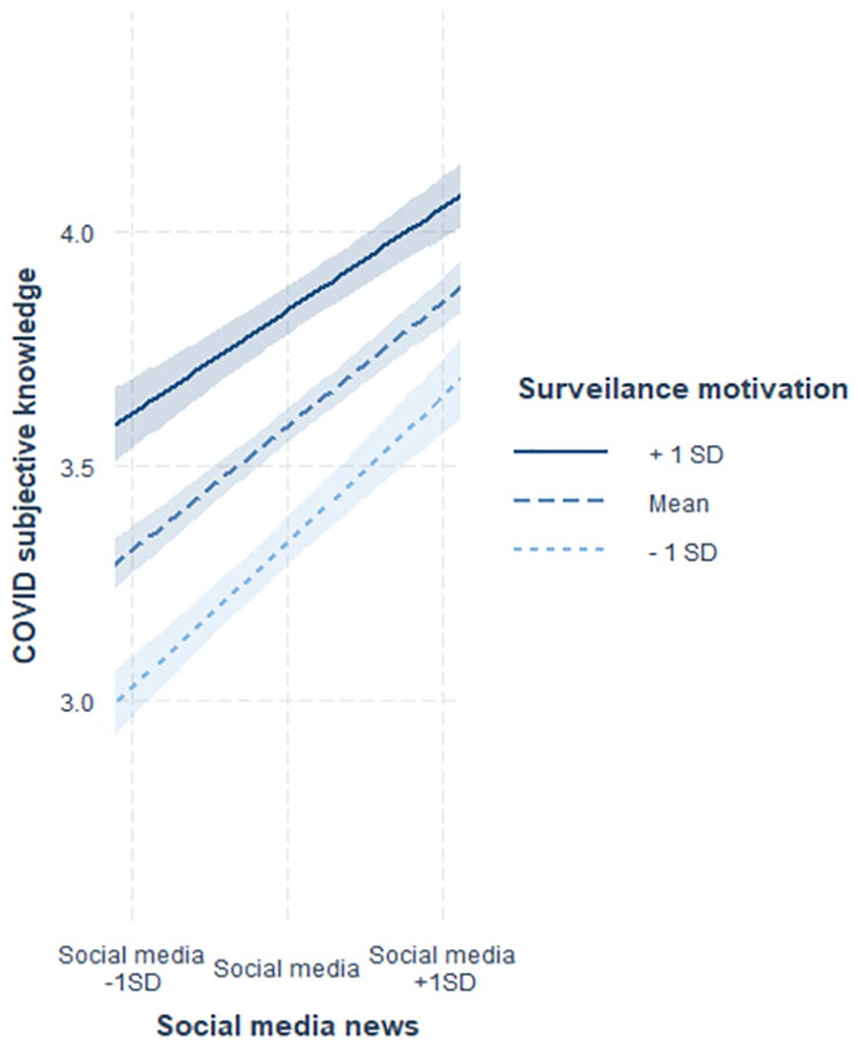
Interaction effects between social media news consumption and surveillance motivation on COVID subjective knowledge (Study 1).

Interaction effects between traditional news consumption and surveillance motivation on COVID subjective knowledge (Study 1).
Study 2
The findings from Study 2 are mostly consistent with the findings from Study 1. More specifically, the main effects were highly consistent with those from Study 1, yet we found some different interaction effects patterns across the two datasets.
As with Study 1, we found that news seeking via social media was significantly negatively associated with (a) COVID factual knowledge (β = −.17, p < .001) and positively associated with (b) COVID subjective knowledge (β = .08, p = .03) and (c) knowledge miscalibration (β = .21, p < .001), while controlling for the autoregressive terms at Wave 1 (see Tables 2 to 4). Thus,
Regarding
Moving on to the interaction effects, we first tested the interaction effect between surveillance motivation and news seeking via social media on COVID factual knowledge (

Interaction effects between social media news consumption and surveillance motivation on COVID factual knowledge (Study 2).
To test
Discussion
This study sought to examine and compare the impact of news seeking via social media and news seeking via traditional media on factual and subjective knowledge—as well as knowledge miscalibration—about COVID-19. Although earlier studies have documented the positive impact of traditional news consumption (Dimitrova et al., 2014; Shehata & Strömbäck, 2018) and the negative effects of social media news consumption (Cacciatore et al., 2018; S. Lee & Xenos, 2019) on political knowledge, these effects have rarely been directly compared, especially outside the context of political knowledge. This study fills this gap through a series of surveys conducted in Singapore and the United States, and by focusing on the context of the COVID-19 pandemic. Findings showed that news seeking via social media is a negative predictor of factual knowledge and a positive predictor of both subjective knowledge and knowledge miscalibration. This study was able to replicate these findings across two countries, as well as with both cross-sectional and panel data.
Social media have become important gateways to the news. Indeed, an increasing number of people across many countries now primarily get their news from social media. Yet, an increasing number of studies are finding adverse effects of social media news consumption in terms of political learning (e.g., Cacciatore et al., 2018; S. Lee, 2020; Shehata & Strömbäck, 2018). This study observed the same negative effect on factual knowledge about a health crisis. Consistent with previous studies, which have explained the mechanisms behind the negative link between social media use and political knowledge, this study found that consuming COVID-19-related news from social media may hinder people’s learning about the virus for several reasons, such as information overload, news-finds-me perception, and people’s vulnerability to misinformation. While consuming COVID-19-related information from social media negatively influenced people’s learning about COVID-19, it increased subjective knowledge. Indeed, those who consume COVID-19-related news via social media think they are well-informed about the virus. This, consequently, brings about knowledge miscalibration, which occurs when individuals’ perception of how much they know does not match what they actually know. A positive miscalibration—or when individuals think they know more than what they actually do—may lead to negative outcomes as one’s confidence in their knowledge, which does not match their actual knowledge, may lead to potentially harmful actions or inaction. The COVID-19 pandemic has demonstrated the importance of public knowledge based on accurate information as individual misbehavior, such as refusal to wear masks outdoors or rejecting vaccines, can endanger entire communities.
In contrast, this study did not find such results from traditional news media use, although, in Singapore, traditional news media use was found to be a significant predictor of subjective knowledge. That is, the more one seeks information about COVID-19 from traditional news media sources, the higher they estimate their knowledge about the pandemic. Traditional news media use also led to knowledge miscalibration in Singapore. In the United States, traditional news media use predicted neither factual nor subjective knowledge about COVID-19; thus, there was also no effect on knowledge miscalibration. Surprisingly, in both countries, consuming COVID-19-related news via traditional news platforms did not necessarily make people well-informed on COVID-19 issues. Yet, considering the unique context of the COVID-19 pandemic, this finding can somewhat be explained by the fact that information related to COVID-19 is likely to be highly saturated because the virus has become the predominant concern in our everyday lives (Pew, 2020). That is, unlike political knowledge, people may have learned about COVID-19 issues from various sources. Thus, traditional news may not have particularly informed people about COVID-19. Yet, unlike COVID-19 news seeking via social media, COVID-19 news seeking via traditional media did not exert a harmful effect on factual knowledge gain (and thus did not affect knowledge miscalibration either). In this sense, our findings still partly align with previous studies’ findings, which showed relative advantages of traditional news consumption over social media news consumption (Dimitrova et al., 2014; S. Lee, 2020).
This study also explored the potential moderating role of surveillance motivation on the effects of different news sources on knowledge about COVID-19. In Singapore, we found that surveillance motivation moderated the effects of social media and traditional media news seeking on subjective knowledge, that is, increases in subjective knowledge due to news-seeking behavior appears to be tempered by being motivated to be informed about COVID-19. In other words, when individuals seeking information from social media and traditional media are, to begin with, motivated to be informed, they tend to be more conservative in gauging the level of their personal knowledge about the issue. In the United States, surveillance motivation was a significant moderator of the impact of social media news seeking on factual knowledge, in that the negative impact of social media news seeking on factual knowledge is stronger among those who are motivated to stay informed. In contrast, we did not observe the same effect when traditional news media is involved. It seems that people who are motivated to learn more about COVID-19 but seek information on social media end up knowing less. A plausible explanation is that social media platforms have become breeding grounds for misinformation, which can distract, overwhelm, or misinform users. Yet, these are mere speculations; future studies should tease out the mechanisms that are at play here.
In comparing the impacts of social media and traditional media news seeking on various measures of knowledge within the context of the COVID-19 pandemic, this study conducted a series of surveys across two countries, Singapore and the United States, and using two approaches, a cross-sectional study, and a panel survey. Following a replication logic, we were able to test and retest our hypotheses, giving us more confidence in our findings.
Despite its implications, our study has several limitations. First, in spite of our interesting findings, the results do not give us the full picture regarding the underlying mechanisms behind the observed patterns. Indeed, other unexplored factors—independent of the nature of the channel our study primarily focuses on—can explain the outcomes of the study. For instance, scholars have found that the way people process messages (e.g., heuristic vs. systematic processing) influences how much knowledge people eventually gain, regardless of the channel used. Also, a group of scholars has found that the way easy science messages are being presented can also affect people’s information-seeking process, and consequently, their learning process (e.g., Scharrer et al., 2012, 2017). In this sense, future research could adopt an experimental design and test studying whether or not, and if so, how differently people process messages across different media platforms. Furthermore, as the knowledge gap literature suggests (e.g., Hargittai, 2002; Tichenor et al., 1970), the amount of knowledge people gain may also vary based on their own social media skills. Altogether, many unexplored factors may explain the outcomes of our study, which warrants further research.
Another potential limitation of our study is the measure of factual political knowledge. While this measure—which consists of selecting popular news events from media coverage during the elections, creating quiz-type questions, and testing their validity—is a fairly standard way of measuring political knowledge predominantly adopted by most political communication scholars (e.g., Delli Carpini & Keeter, 1996; Shehata & Strömbäck, 2018), such practice largely relies on subjective processes when selecting items. Future research could combine these observations with a computational approach. For instance, a researcher could extract the most popular political news stories based on salience from the internet/social media sphere (e.g., “engagements matrix” using CrowdTangle).
Finally, despite the theoretical value of our cross-national research (e.g., S. Lee et al., 2021; Rojas & Valenzuela, 2019), such an approach also poses a challenge. Singapore and the United States differ in various factors, from sheer size (i.e., Singapore is among the smallest countries in the world) to cultural, political, and media contexts. Thus, future studies should account for contextual factors and examine whether or not some of the mechanisms uncovered in this study can be explained by, or may vary based on these macrolevel variables by replicating this study across more countries, accounting for contextual factors, and using multilevel analyses.
Footnotes
Appendix A
Appendix B
Appendix C
Declaration of Conflicting Interests
The author(s) declared no potential conflicts of interest with respect to the research, authorship, and/or publication of this article.
Funding
The author(s) disclosed receipt of the following financial support for the research, authorship, and/or publication of this article: This study was supported by Singapore Social Science Research Council Thematic Grant (MOE2018-SSRTG-022).
