




Abstract
The increasing use of social media like YouTube as a news platform provides new opportunities for the public to react to news reporting. This convergence produces multi-narrative framings of police violence-related evidence that requires further attention, especially given the potential impact on state accountability processes. Using a frame analysis of news outlets and content analysis of comments on YouTube, we identify frames, responses, and the multi-narrative framing that results from this converging environment. Our findings suggest a triumvirate of competing frames around police brutality, with mistrust of media complicating the role news media plays in accountability.
On May 25, 2020, convenience store employees accused George Floyd of passing a counterfeit bill in Minneapolis. Responding officers arrested a clearly distressed Floyd and attempted to move him from his vehicle to a waiting police cruiser. Following a brief struggle where Floyd pleaded for his safety, Officer Derek Chauvin placed his knee on Floyd’s neck. He held this position for 8 min and 46 s. Officer Chauvin would kill George Floyd, age 46, on that street (“Timeline of Events Since George Floyd’s Arrest and Murder,” 2022).
Police violence in America disproportionately targets its Black community (Edwards et al., 2019; Hoekstra & Sloan, 2020; Naghavi, 2021; Nix et al., 2017). Each year, police kill about 1000 civilians (Peeples, 2020), including 1,046 in 2021 (Tate et al., 2022). Black men are 2.5 times more likely to be killed than White men (Edwards et al., 2019), Black people who are fatally shot are twice as likely to be unarmed as White people (Nix et al., 2017), and White police are also more likely to use force in Black neighborhoods than Black officers (Hoekstra & Sloan, 2020). From 1980 to 2019, the mortality rate due to police violence was highest among Black people (Naghavi, 2021).
The police killing of Floyd, an unarmed Black man, set off a chain reaction of protests against systemic racism underlying American policing. It marked the latest event highlighting the history of police brutality that has plagued Black people in the United States and has persisted throughout the country’s history (Hawkins & Thomas, 2013; Oliver, 2020), tracing back to the control that slavery afforded (Hawkins & Thomas, 2013). The history of police brutality has led to flashpoints between Black people and state institutions, fostering the explosive response to the George Floyd murder.
Visual reporting has formed a critical aspect of civil rights and social justice throughout the 20th and early 21st centuries (Bowman, 2017; Evans, 2021; Kilgo & Mourão, 2021; Lee, 2017; Wan et al., 2018). Television broadcasts and photographs of events like the police beating of Rodney King, police violence against civil rights demonstrators, and the hostile response to school desegregation weaved a visual narrative that challenged the United States claim to a superior society (Bowman, 2017). While mainstream media is in a position to expose racial oppression, it has frequently failed to do so. For instance, mainstream news minimized coverage of the beating of Rodney King to protect their commercial interests (Bowman, 2017). Even contemporary, left-leaning news outlets like the Washington Post and New York Times often fail to properly contextualize unlawful acts by Black protesters within broader civil disobedience discourse (Evans, 2021), casting protesters as mere criminals. As a result, the Black community has explored alternative media approaches to securing their bodily security and centering the Black perspective, such as through Black Twitter (Lee, 2017) and freely available video recording tools (Bowman, 2017).
Today, the social media platform YouTube has emerged as an exemplar of an alternative media channel for news consumption (Jones, 2018; Mejova & Srinivasan, 2012; Smith et al., 2018; Stocking et al., 2020). News outlets now commonly upload content to YouTube, while the commenting capabilities of the platform promote public engagement. On YouTube, broad participation in news presentations afforded by commenting follows tonal flows from the video itself (Alshamrani et al., 2020; Edgerly et al., 2013) and demographic tendencies (Stocking et al., 2020; Stroud et al., 2016), with implications for the effect on the public engagement of news reporting. However, scholarly interest in news media portrayals (Fridkin et al., 2017; Wan et al., 2018) and social media content analyses (Campbell & Valera, 2020; Carney, 2016; Clark et al., 2017; Harlow, 2019) of police violence remain largely separate.
Central to accountability is the framing of the event (Goffman, 1974), defined by (Entman, 1993) as speaking to an intended sentiment in presentation:
[. . .] to frame is to select some aspects of a perceived reality and make them more salient in a communicating text, in such a way as to promote a particular problem definition, causal interpretation, moral evaluation, and/or treatment recommendation. (p. 52)
Framing critically influences perceptions of evidence (Salet, 2017; Testa & Dietrich, 2017). The convergence of news and social media also entails that both the journalistic and broader community can attempt to frame an event. When different framings coalesce, the result is a novel, multi-narrative framing, and is an understudied phenomenon as a result of the conceptual separation of news and social media framing studies. With youth more likely to get news from social media sources (Jones, 2018), policymakers and leaders in news media and the tech industry must grasp how police accountability is portrayed through the wide-open narrative ecosystem of social media. We start filling this gap by conducting a combined frame analysis of YouTube videos shared by news media outlets in two critical periods following the George Floyd killing, and a content analysis of the top 20 comments on each of those videos. This article contributes by (a) making the case for incorporating multi-narrative framing enabled by social media platforms like YouTube, and (b) generating insights based on the multi-narrative framings that can contribute to theory building about media and state accountability.
News Media and State Accountability
Oversight is necessary for preventing and punishing police misconduct (Green & Aldebron, 2019; Hope, 2020; Losier, 2020), but centralized approaches have debatable efficacy (Green & Aldebron, 2019). Police accountability means “being answerable to audiences for performing up to certain prescribed standards” so police “behavior can be scrutinized, judged, and sanctioned” (Schlenker et al., 1994, p. 634). However, Green and Aldebron (2019) find that centralized approaches, such as civilian review boards or Department of Justice intervention, have proven ineffective as reliable sources of oversight. This pushes us to explore alternative approaches constructed on collective action. Classically, this has been the domain of the news media, described by Skolnick and Mccoy as a “powerful force for police accountability” (p. 522). A powerful institution in its own right (Skolnick & Mccoy, 1984), the media has a tradition of driving state accountability in the United States (Benson et al., 2017; Fridkin et al., 2017; Jacobs & Schillemans, 2016; Maia, 2009; Márquez-Ramírez et al., 2020; Wan et al., 2018).
The media’s role in accountability as a “public watchdog” depends on how they present critical information (Chermak & Weiss, 2005; Dowler & Zawilski, 2007; Goldsmith, 2010; Jones, 2018). Crucially, media can make visible the aspects of policing that could be hidden or dominated by a one-sided, pro-policing narrative (Goldsmith, 2010). When the news media reports on police violence, they implicitly project their own beliefs, opinions, and potential biases (Jones, 2018), which opens the discourse to alternative narratives. Thus, framing is central to media reporting: How a situation portrayed can persuade public opinion by emphasizing particular narratives. Erving Goffman (1974) first developed framing theory, which was further developed by Entman (1993) as an attempt to present a “perceived reality” that privileges a certain interpretation of an event (p. 52).
The framing of an event can, therefore, have profound impacts on police accountability (Fridkin et al., 2017; Harlow & Kilgo, 2021; Parry, 2018; Salet, 2017; Saulnier et al., 2019; Testa & Dietrich, 2017). Framing can predict the perception of police misconduct and legitimacy of an encounter (Parry, 2018) and can have a legitimizing or delegitimizing effect on subjects (Harlow & Kilgo, 2021), with framing differences between outlets stemming from particular internal social or political inclinations (Chama, 2019). The routines of reporting (such as following a certain “beat”) can affect how information is framed (Gans, 2005; Gulati, 2011; Klinenberg, 2015), hiding or undermining narratives that run counter to established majority ideologies (Larson, 2006). This can impact whether the reporting has the desired psychological and social impact and in turn drive formal accountability. While studying media framing of police brutality on a college campus, Fridkin et al. (2017) found that different frames lead to differing perceptions of excessive use of force. Testa and Dietrich (2017) showed that manipulation of the framing of a traffic stop affected the interpretation of police actions, including excessive use of force. Furthermore, the police engage in framing during investigations, influencing the criminal justice process (Salet, 2017). How a situation is framed matters insofar as framing affects interpretation, which in terms of evidence, can lead to substantially different results in criminal justice (Salet, 2017; Saulnier et al., 2019). Thus, framing underlies all roles the media plays in police accountability, a process that necessarily reflects personal and organizational orientations in the media toward the event, the people involved, and the policing system more broadly.
YouTube as a News Platform
The dispersal of video activist content across multiple social media platforms suggests a widespread interest and space for competing narratives afforded by these platforms (Askanius, 2019; Clark et al., 2017; Harlow, 2019). Clark et al. (2017) triangulated framings across multiple social media platforms, defining three broad frames of anti-police sentiment, social deviance, and racism. Harlow (2019) similarly identified news and social media framings of protesters in response to the Michael Brown killing in Ferguson, MO, emphasizing the existence of legitimizing/delegitimizing frames and suggesting that media focus on police brutality may be a delegitimizing frame as it shifts the discourse from systemic racism to only individual cop behavior. Although still contingent upon broader narratives often defined by professional news media, an increasingly networked public (boyd, 2010) can play a substantive role in accountability (Ojala et al., 2019), critically dependent on how an event is framed.
Harlow’s (2019) work also yields a critical insight: The broader public can increasingly engage in framing events through social media, alongside professional outlets. News media reports on social media are an arena of contestation for framing, where actors can promote their perspectives on social and political issues (Ryan et al., 2001) through the aggregation, sharing, and commenting by users, as well as bots that can be manipulated by interest groups (Hussain et al., 2018; Sureka, 2011). Papacharissi (2010) identified the ways online news aggregation and commenting allow users to play an active role in the news discourse. Endorsing stories that matter to the individual sends messages to news producers about the type of news that matters to them, translating preferences into gatekeeping currency by allowing users to “endorse, reject or modify news agendas, and potentially related policy and public agendas” (p. 153). Therefore, assessing the role of media in state accountability must include the role of the public in setting the news agenda and, consequently, which topics to focus on and how these topics are framed.
YouTube in particular has emerged as a critical platform for news consumption with implications for digitally supported civic engagement (Alshamrani et al., 2020; Antony & Thomas, 2010; Edgerly et al., 2013; Holton et al., 2015; Mejova & Srinivasan, 2012; Stocking et al., 2020). Traditional news media outlets have leaned heavily into the potential of the YouTube platform, as almost half of the 377 most popular YouTube news channels are affiliated with a news organization (Stocking et al., 2020). Digesting the news today is now subject to an audience that is engaged in a many-to-many broadcast of their interpretations, reflecting their values, beliefs, and attitudes (Holton et al., 2015). This directly connects with YouTube’s design that affords video uploads and comments from the broader public, which can have democratic merits through the support of an accessible public sphere (Mejova & Srinivasan, 2012), but also allows uncivil and hostile discourse (Edgerly et al., 2013). This is particularly true for videos related to crime and policing, where scholars have detected a high level of toxic responses in the comments (Alshamrani et al., 2020). How news is responded to and contested stems from asymmetries in the demographics of likely YouTube commenters, who tend to be older (Barnes et al., 2018), White males from lesser educated and lower-income backgrounds (Stroud et al., 2016), as well as individual personalities (Barnes et al., 2018). As Antony and Thomas (2010) show, the potential for individuals to express their ideologies and opinions on YouTube can overturn traditional notions of the role of the public sphere in state accountability. YouTube is, therefore, introducing new concerns into the media ecosystem, providing space for actors with varying temperaments and perspectives to not just consume but to contribute to understanding through comments (Antony & Thomas, 2010; Jacobs & Schillemans, 2016). The uncontrolled nature of YouTube signals a need to engage how citizens, through social media platforms, reframe mainstream news reports insofar as framing impacts trust, and in turn, an interested and active citizenry, which lies at the foundation of any role media can play in state accountability (Jacobs & Schillemans, 2016) given the link between negative perceptions of media and interest in news overall (Ardèvol-Abreu & Gil De Zúñiga, 2017). However, to date, there remains a need to study the convergence of news and social media, and how new frames emerge from this phenomenon. This exploration has relevance not just for understanding the evolution of media, but critically how media-driven accountability sits on shifting sands. Although as Clark et al. (2017) point out, police brutality and accountability discussions are dispersed across many platforms, studies by the Pew Research Center illustrate YouTube’s influence: It is the most used online platform among adults, much of which is for news (van Kessel, 2019), and the trend is likely still growing, as news use on YouTube doubled from 2013 to 2018 (Smith et al., 2018). To study this evolving ecosystem, we pursued the following research questions:
Method
To answer these questions, we conducted a dual qualitative frame and content analysis on relevant YouTube videos and their comments, respectively. To compose our initial sampling frame, we searched for YouTube videos using five different search terms, identified to focus on media portrayals of the George Floyd killing: “George Floyd,” “George Floyd video,” “George Floyd cellphone video,” “George Floyd security video,” and “George Floyd body camera video.” This initial search process resulted in 64 total YouTube videos, selected from the top results using the “sort by relevance” feature. We collected all videos in late January and early February 2021. Preliminary examination revealed a bimodal distribution across the time of video publishing, with a high frequency of videos published in late May to early June in line with the time immediately following the killing, and in August when additional bodycam footage from the arresting officers became available, either through leaks or official release by authorities. Given the value in analyzing the connection between a focus on different types of evidence as the basis for news and social media framing, we separated the initial video selection into two subsamples based on the time frame. From each timeframe subsample, we selected the top 10 most viewed videos, filtering out videos based on the following criteria: (a) videos not in English, (b) videos that do not use footage evidence in reporting the event, and (c) videos that have comments turned off.
This criterion identified 20 videos that formed our sample. All of the videos in our sample were from mainstream national (e.g., NBC News and CBS Evening News) or local (e.g., Fox 9 Minneapolis-St. Paul) news, with some videos coming from the same outlet (e.g., four videos in our sample were produced by NBC News). The videos varied in the use of footage, with some reports using only brief clips of the assault while others presented uninterrupted body camera or security camera footage (see Table 1). Our sample included two types of reporting: shorter-form pieces that presented the events in such a way as would be presented on television broadcasts (and likely were published across both broadcast and social media channels), and longer-form analyses or presentation of evidence, such as full breakdowns of the event or raw unedited footage.
YouTube Video Sample.
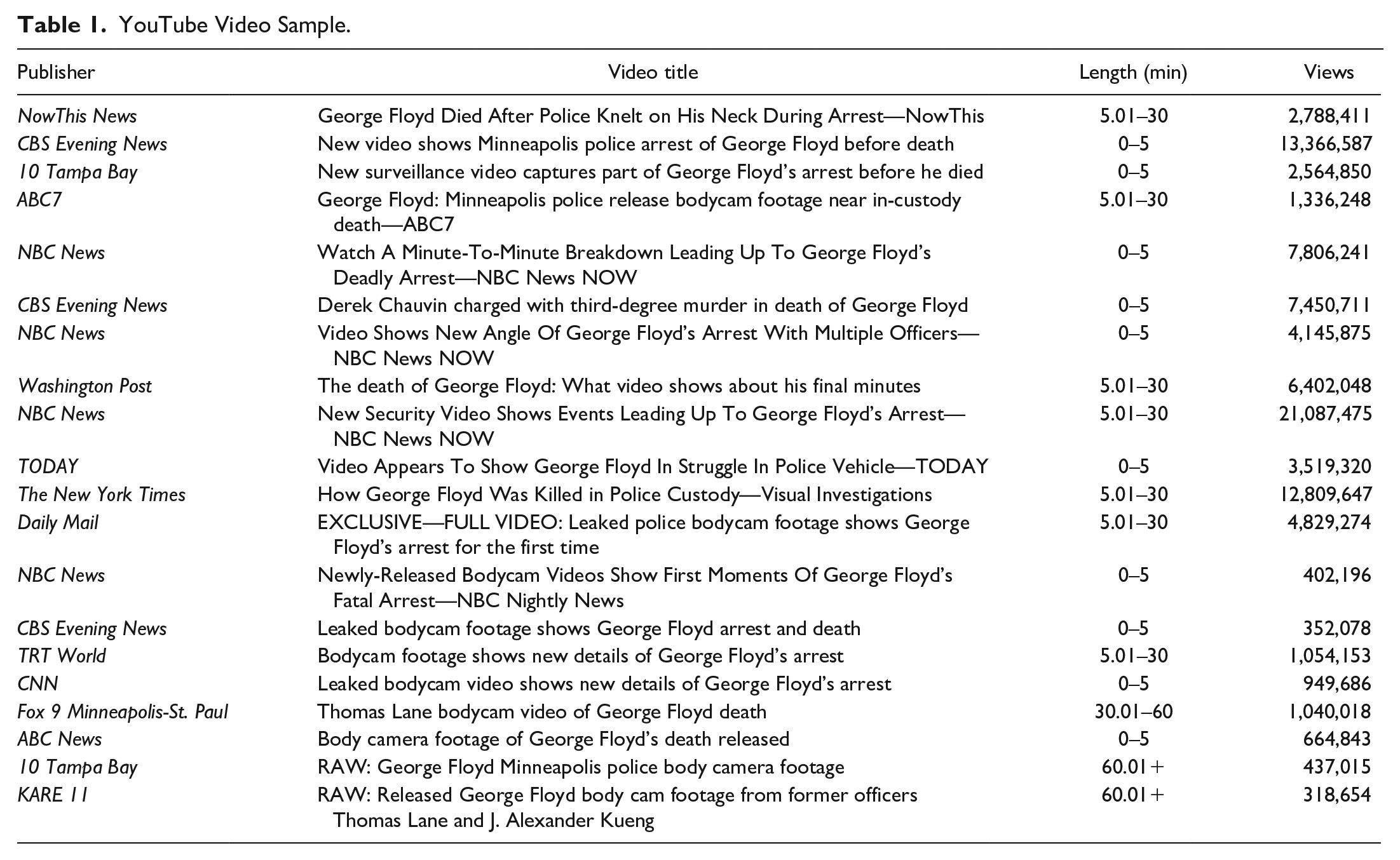
To compose our comments sample, we selected the top 20 comments from each of the videos in our sample (identified by sorting by “Top Comments”), which we scraped using the Data Miner Pro extension on the Google Chrome browser. This resulted in a preliminary comment sample size of 400, which we then filtered out those not in English. This criterion resulted in a final sample of 398 comments.
Following the method of content analysis described by Williamson et al. (2013), we analyzed the video and comment samples in tandem. Once we collected the sample, we defined the units of analysis as a single video (for analysis of frame) and a single user comment (for content analysis). The lead author then viewed all videos and read all comments, inductively iterating to develop the initial set of content categories. This interpretive process constructed the following: (a) a set of news media frames determined by the news media outlets’ evaluation of the event (Entman, 1993), and (b) through a content analysis, generated a set of themes based on comments on those videos. Since the comments can embody multiple themes, we allowed for a single unit of analysis to be multi-coded. The lead author then produced a full coding frame that served as the protocol for analysis (Williamson et al., 2013, p. 429).
To evaluate reliability before coding the full sample, we calculated Cohen’s kappa over a subsample of the video framing and comments. The lead author met with team members to discuss and clarify the protocol. This resulted in clarification in the names of framing categories and comment content themes, adjustment to the definitions of comment content themes to better delineate between cases, and updating wording in the definitions for overall clarity. Then, the lead author and one of the co-authors each independently coded (a) a randomly selected four-video subsample (20% of total videos) and (b) a randomly selected 80-comment subsample (20% of total comments). For the video framing, we had perfect reliability (Cohen’s kappa = 1.00). For the comment content analysis, our Cohen’s kappa was 0.74. Although there are no hard and fast rules with an acceptable threshold for reliability in qualitative coding, in exploratory studies (such as this one, given its inductive approach), we deemed this score adequate, especially given the conservative nature of Cohen’s kappa (Neuendorf, 2002). Then, the lead author used the protocol for analysis to code the full video and comment sample. Then, once we coded the full sample, we conducted a series of chi-square tests of independence to examine the relationships between pairs of variables in our coded comments sample. The methodological contribution of quantitative reasoning combined with qualitative analyses to framing research is motivated by the stated need to evolve related methodologies, including supplementary qualitative–quantitative approaches (D’Angelo et al., 2019, p. 12).
Results
Here, we briefly describe the results of the frame and comment content analysis, describing the frames and themes we identified. Then, we describe exploratory inferential statistical analyses to further explore the results of our qualitative coding.
Results of News Framing Analysis
Frame 1: Pro-accountability persuasive framing
We define a pro-accountability persuasive framing as one that seeks to portray the event persuasively by highlighting various aspects of the event that connect to a pro-accountability narrative. In our sample of 20 videos, we determined that new outlets used this framing in 10 of them (50%). When framing the killing, news media used excerpts from footage that highlighted the brutality of police behavior in an evocative way, presenting violence against the body in an unflinching manner from a variety of perspectives, most notably bystander footage. News media also highlighted misconduct in the individual police records, most notably the history of complaints against Officer Chauvin. They frequently presented authoritatively by drawing on multiple footage sources or 3D renderings to present a convincing picture or even explicit claims of thoroughness in their investigation. Here is one such example from our sample.
The New York Times’s “Visual Investigations” series presents an ostensibly authoritative take on the George Floyd killing, utilizing a combination of dashboard camera, body-worn camera, surveillance footage, and—most critically—bystander footage. When officers Chauvin and Tou Thao appear on surveillance footage, the video highlights their misconduct records, overlaying this information graphically. At a later point in the video, they present bystander footage of Chauvin’s knee on George Floyd’s neck, prioritizing the audio of Floyd pleading for his life. These framing choices strongly highlight the brutality of the officers’ actions in the video.
Frame 2: Raw perspective framing
We define a raw perspective framing as one that frames the event in a non-editorialized manner, presenting just shared or collected footage with minimal editing or newscaster-presented analyses (except for some body-cam footage initially sourced from the State of Minnesota with black censorship boxes obscuring certain figures in the footage). In our sample of 20 videos, we determined that media also used this framing in 10 of them (50%). In the August 2020 portion of our sample, 10 Tampa Bay news published the full leaked body-worn camera footage from former officers Thomas Lane and J. Alexander Kueng, the length totaling over 65 min of runtime. Preceded with a warning about the graphic content and language, the footage from Kueng’s body-worn camera starts while he is approaching the scene in his vehicle. The footage then shows the initial encounter with Floyd, and the attempts to restrain him that resulted in Officer Chauvin placing his knee on Floyd’s neck. Keung’s footage continues with emergency medical technicians (EMTs) placing the now unresponsive Floyd in the back of an ambulance. Keung then proceeds to speak with the other occupants of the vehicle with Floyd and employees at the convenience store that first reported the possible counterfeit $20 bill. Keung then reports back to Chauvin. The footage then shifts to the same events from Thomas Lane’s body-worn camera, ultimately resulting in Lane assisting Paramedics in the ambulance as they attempt to revive Floyd.
Although some outlets trimmed sections of footage, there was nonetheless minimal narrative editing beyond the strict display of collected footage from sources. This framing is purely informative as opposed to analytical or narrative. In addition, in our sample, raw perspective framing only used either body-worn camera (as in the case above) or surveillance footage, eschewing strict bystander footage or dashcam footage as the most viewed videos on YouTube collected by the search and inclusion criteria.
Missing framing: Anti-accountability framing, neutral framings
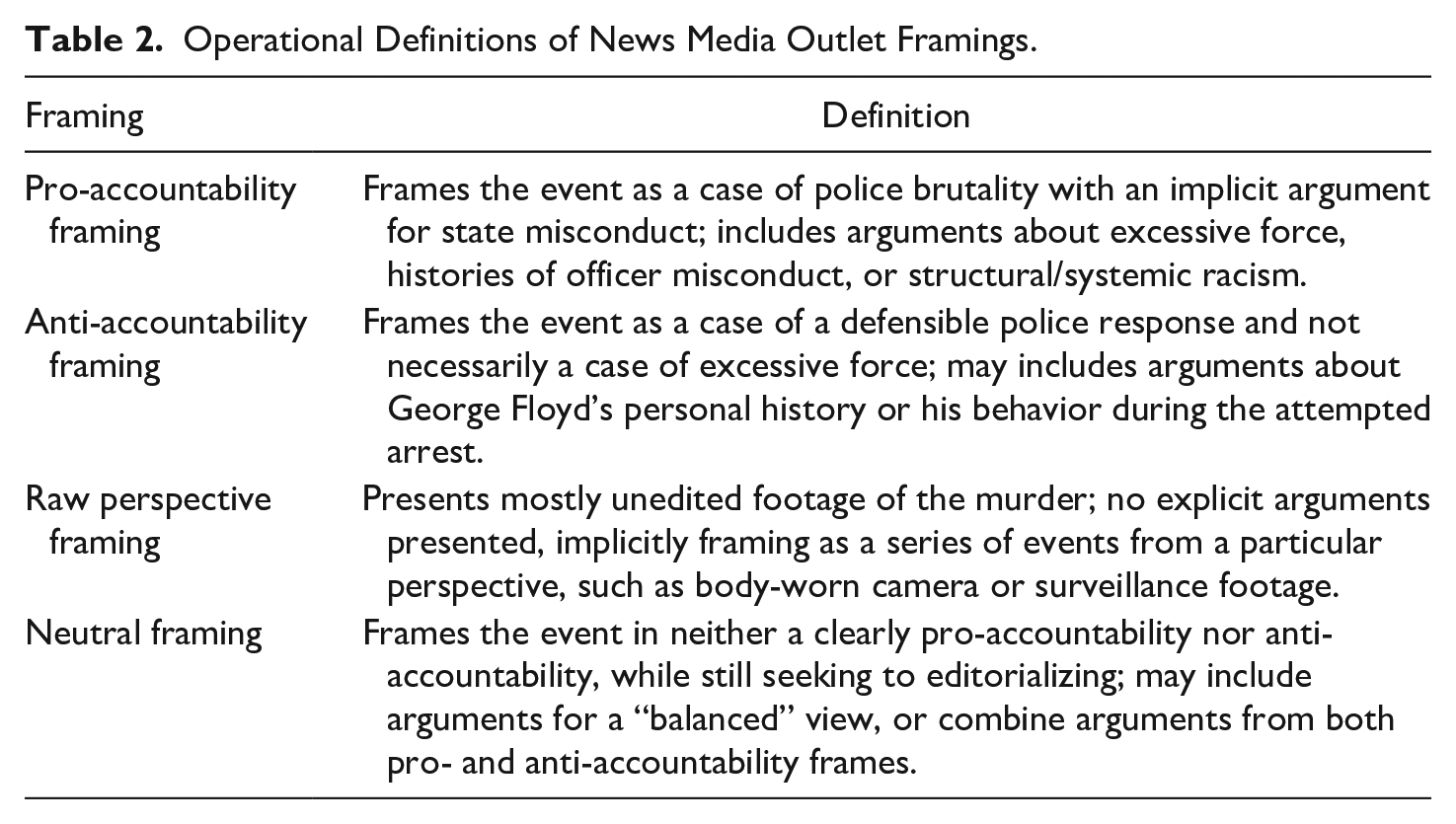
It is worth noting that we did not detect either the opposing case to the pro-accountability framing, an anti-accountability persuasive framing, nor the neutral reporting frame. The lack of viewership for outlets that are more likely to take apologist stances on the officer’s actions likely reflects a lower interest in the murder among consumers whose YouTube viewing habits reflect their political inclinations (Barnes et al., 2018; Stroud et al., 2016). In theory, this phenomenon suggests that consumers interested in learning about the case through YouTube’s search ranking algorithm may be pushed toward outlets that reflect only a subset of frames. On the contrary, the lack of viewership for neutral frames suggests that media institutions on YouTube are realizing Harlow’s (2019) suggestion that social media platforms could help the media take on less traditionally neutral stances. Furthermore, our observation that themes of systemic racism and histories of police brutality were regularly infused into the pro-accountability framing signals that media institutions may be slowly catching up with individual journalists in challenging the “protest paradigm” (on which they have traditionally lagged) (Harlow, 2019, p. 635; see Table 2 for the operational definitions of these frames).
Operational Definitions of News Media Outlet Framings.
Results of Comment Content Analysis
Themes From Comment Content Analysis.
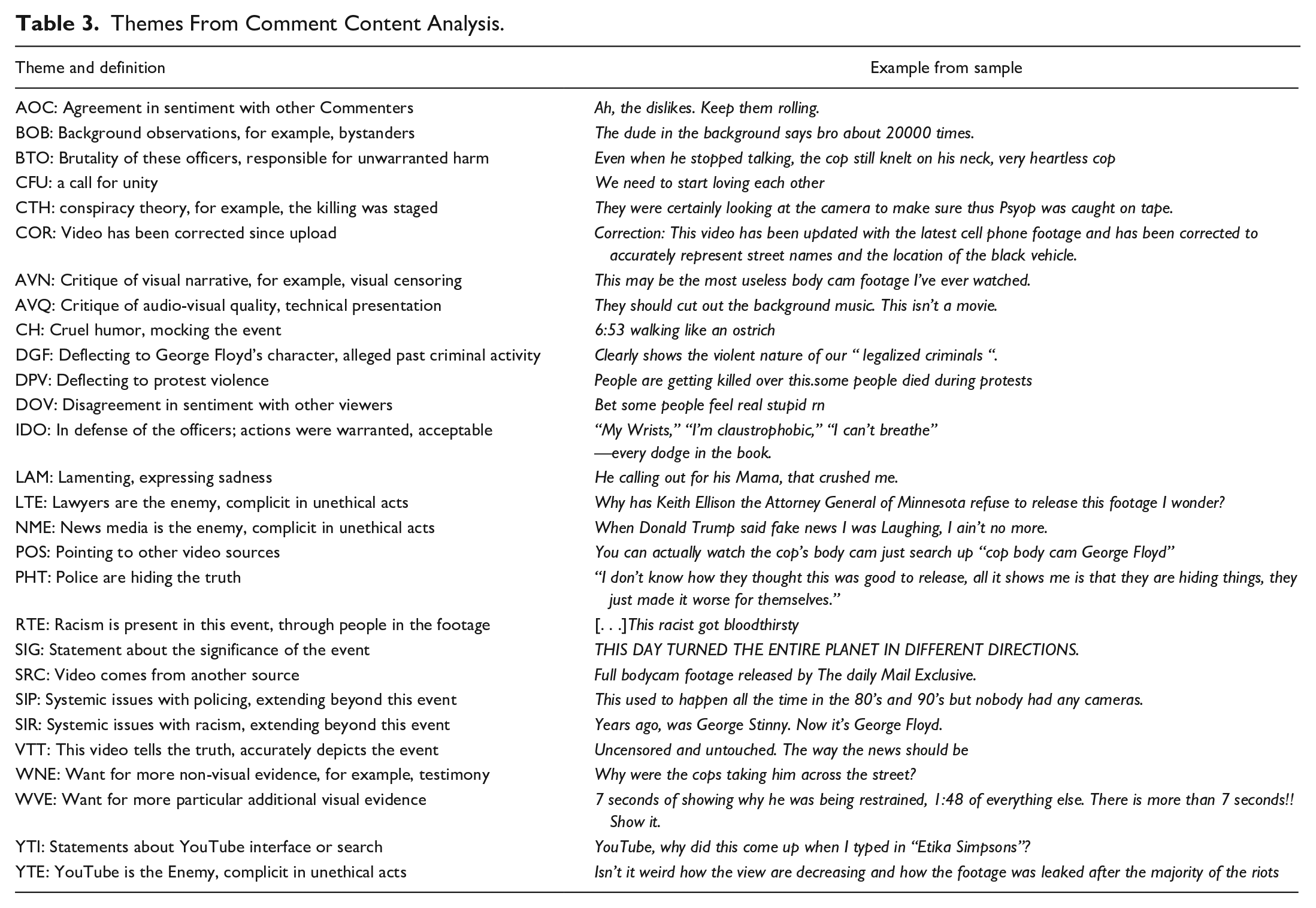
Across our sample (539 total observations), the most frequent comment theme was criticism of the news media (NME, or “News Media is the Enemy”) (112 observations), with the counter-narratives of police brutality (BTO, or “Brutality of these Officers”) (85 observations) and defenses of officer actions (IDO, or “In Defense of these Officers”) (57 observations). To help inform our thinking, we conceptualized our themes as supporting either a pro- or anti-accountability narrative. Here, News Media is the Enemy and In Defense of these Officers support an anti-accountability narrative, while Brutality of these Officers supports a pro-accountability narrative.
When we narrow the sample to just those 10 videos published in late May and early June immediately following the killing, the most frequent theme becomes Brutality of these Officers (13.8% of themes in the subsample). On the contrary, in the videos published in August immediately following the release of police body-worn camera footage, the most frequent theme is once again News Media is the Enemy (18.2% of themes in subsample) (Figures 1–3).
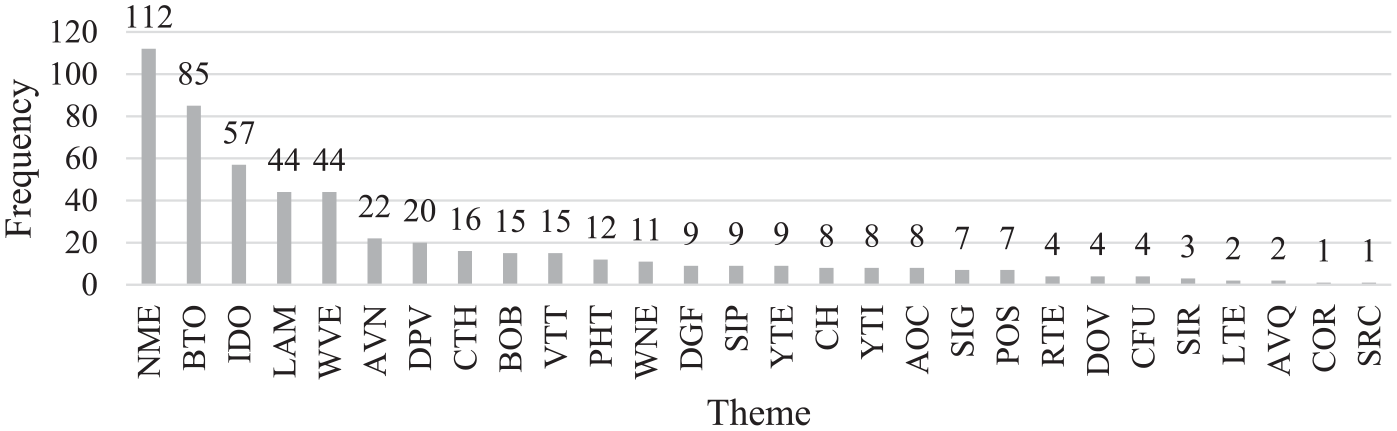
Frequency of observed themes in comments.
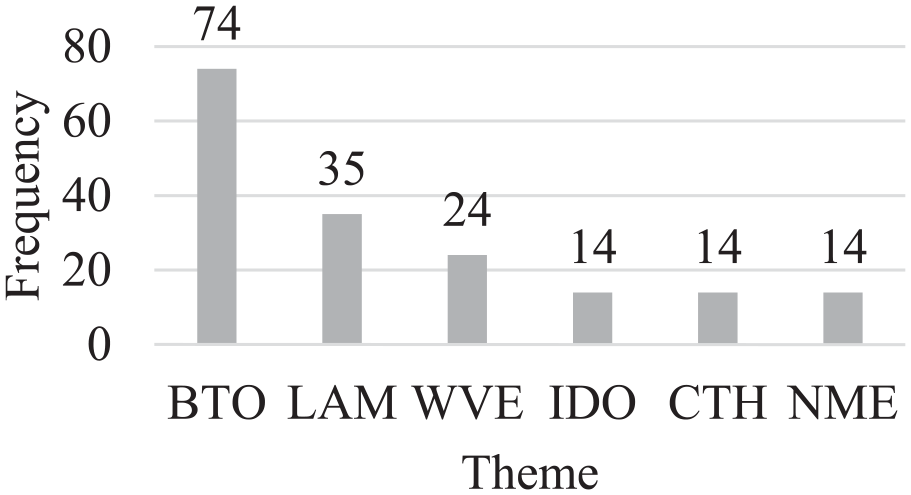
Frequency of themes (May, June).
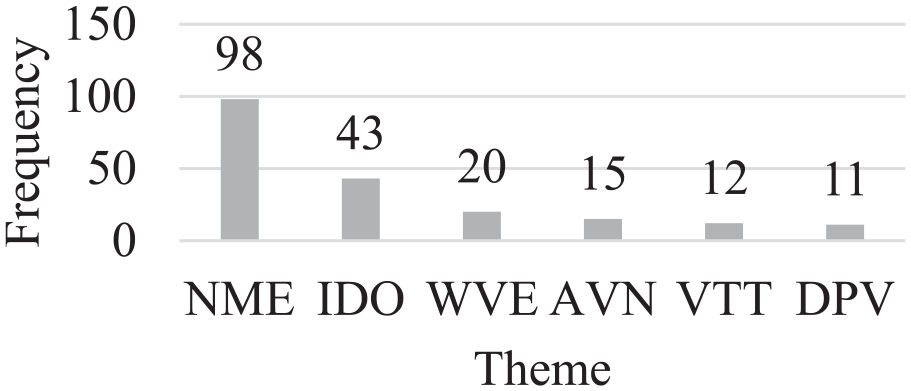
Frequency of themes (August).
Results of Exploratory Inferential Statistical Analyses
Across the sample, we detected that the most frequent theme, News Media is the Enemy, bores a statistically significant relationship with the pro-accountability framing, χ2(1, N = 398) = 6.57, p = .01. Although the effect size via a phi test of effect size was small (φ = 0.13), when we narrowed the sample to the August time frame the results were likewise significant and with a larger effect size, χ2(1, N = 398) = 14.59, p < .01, φ = .28. Indeed, the time frame of data collection was relevant to the prevalence of News Media is the Enemy, as the August time frame was positively related to its frequency, with a substantial effect size, χ2(1, N = 398) = 84.44, p < 2.20e-16, φ = 0.47.
The most fundamental pro-accountability theme, Brutality of these Officers, we likewise detected to have a statistically significant relationship with the pro-accountability framing, χ2(1, N = 398) = 4.85, p = .03, albeit with a small effect size (φ = .12). Narrowing our subsample to the May–June time frame where Brutality of these Officers is the most frequently observed theme likewise results in statistical significance and a larger effect size, χ2 (1, N = 398) = 6.24, p = .01, φ = .19. We, therefore, detected time frame as a statistically significant predictor: The May–June time frame was positively related to Brutality of these Officers’ frequency, χ2 (1, N = 398) = 58.30, p = 2.25e-14, φ = 0.39.
This led us to further consider how different themes correlate with each other, allowing us to explore the emergence of commenter-driven themes that either bind distinct narratives or detect the presence of countering narratives. We detected a negative relationship between Brutality of these Officers and News Media is the Enemy with a medium effect size, χ2 (1, N = 398) = 40.58, p = 1.89e-10, φ = −0.33, as well as a negative relationship between Brutality of these Officers and In Defense of these Officers, albeit with a smaller effect size, χ2 (1, N = 398) = 3.92, p = .05, φ = −0.11. This suggests a divergence that exists between those who focused on the brutality of the officer’s actions and redirection to the trustworthiness of the media, as well as defenses of the officer’s actions. Interestingly, the News Media is the Enemy and In Defense of these Officers themes were not correlated with each other over the full sample, suggesting that these are separate and distinct anti-accountability narratives. However, when narrowing the time frame to August, the News Media is the Enemy and In Defense of these Officers relationship were significant, with a moderate effect size, χ2 (1, N = 398) = 10.86, p < .01, φ = −0.25, illustrating that these themes were distinctive and separate ways of challenging the pro-accountability narrative that surfaced most strongly in response to the release of police body-worn camera footage.
We detected a positive relationship, albeit with a small effect size, between News Media is the Enemy and “Want Visual Evidence” (WVE), χ2 (1, N = 398) = 3.31, p = .07, φ = 0.10. This suggests the existence of a narrative challenging the trustworthiness of the media, based on perceived purposeful withholding of additional footage or evidence that the commenter believes is relevant. When we narrowed to the August time frame, the relationship remained significant, χ2 (1, N = 398) = 3.04, p = .08, but with a slightly bigger effect size (φ = 0.14). On the contrary, this relationship was not significant within the May–June time frame. This same relationship was also not significant when tested within each framing style (either raw or pro-accountability), suggesting that the time frame is the primary driver of the positive relationship, which in turn suggests the evolving nature of the discourse in light of the police body-worn camera footage release.
Discussion
Police killings cast in stark relief a broader phenomenon: that news media coverage of an event, including the event’s framing, is not separated from the efforts and interests of non-media actors, such as political interest groups or the general citizenry. This insight leads us to consider what the emergent multi-narrative framings suggest about media-led accountability with the intrusion of social media. Here, we consider what insights multi-narrative framings generate, and what this suggests about American societal discourse about police accountability.
Interpreting Multi-Narrative Framing of the George Floyd Killing Video Evidence
Narratives, counternarratives around police brutality footage reporting
Our comments sample suggested that two primary anti-accountability narratives stood in ideological and statistical opposition to the brutality narrative. The direct challenge came in the form of defenses of the officer’s actions, claiming that Floyd invited violence upon himself (most notably in response to body-worn camera footage). The indirect challenge to the accountability narrative came in the form of critiques of the media, with accusations of manipulation and evidence withholding redirecting the discussion to the trustworthiness of reporting. Although not explicitly an anti-accountability narrative, it is an anti-accountability sentiment when in response to a pro-accountability report (it was also a more frequent response to pro-accountability vs. raw framing). Furthermore, the brutality narrative’s significant negative correlation with criticism of news media implies that this is conceptualized in an anti-accountability way.
The resulting situation is one of contention: A pro-accountability news framing may promote further pro-accountability commenter framing but is countered by a pair of distinct narratives, one disagreeing with the interpretation of the event, the other focused on the trustworthiness of the source itself. Social media comments in this arena of contestation (Ryan et al., 2001) add a layer of interpretation on top of news media reporting that directly challenges news institutions.
Thus, multi-narrative framing suggests a triumvirate of competing narratives around police brutality reporting today: the evidence-focused narratives which can be either pro- or anti-accountability, and a competing trust narrative that deflects the critical discourse onto the media itself. The centering of the media within civil rights discourse suggests that legitimizing/delegitimizing frames that are paradigmatically characterized with regard to the subjects of media like protesters (Harlow, 2019; Harlow & Johnson, 2011; Kilgo & Mourão, 2021; Rinnawi, 2007) are also applicable to the media itself, here mostly in a delegitimizing way. Given Kilgo and Mourão’s (2021) findings on the effect of legitimizing/delegitimizing frames on support for civil rights protests, the delegitimization of the media may have negative trust effects that extend far beyond just this event.
Deflecting to trust and the media
Fitzpatrick (2018) perceived the impact on public trust in the news media in light of social media in terms of what changes the latter’s expanding ecosystem of citizen-reporting created in news media practices, but our sample strongly suggests a more direct role that social media plays in trust not just over particular topics, but also the trust in news media more broadly. Commenters most frequently expressed a lack of trust concerning the reporting news media. This was noteworthy when outlets employed pro-accountability framings, where attacks on media trustworthiness were statistically significant.
As previously described, the multiple user-generated narratives seeking to frame an event produce an opportunity to shift the discourse away from the message and onto a critique of the messenger. This complicates the role that news media can play today in accountability: Although an active citizenry can stem from greater overall involvement in police brutality cases (Jacobs & Schillemans, 2016), the nature of the citizenry’s activities need to be taken into account.
Under Jacobs and Schillemans’s (2016) taxonomic approach to the media’s role in state accountability, only the institution under accountability review is considered, and in turn how the event and that institution’s relation to it are framed. Social media impact on accountability framing expands the institutions under review in accountability to include the news media. Suddenly, the event serves as a place to charge the media with the need for oversight, for example, sparking pre-emptive reflections about reporting practices. Taxonomies that identify the avenues of accountability stemming from the media may also need to incorporate accountability concerns facing the media as an integral part of the state accountability discourse.
The impact of the type of video evidence reported on commenter narratives
In August 2020, body-worn camera footage became accessible to the public (either via a leak or official release). Reporting this footage sparked growth in defenses for the officer’s actions, a reduction in brutality-themed comments, and a greater number of attacks on media trust, particularly compared to reporting from May and June. Although the media framing characteristics between both time frames remained balanced (there was no detected relationship between framing and time frame), the commenting tendencies marked a tonal shift.
The differences between the two-time frames highlight the dynamic nature of framing. The observed tonal shift in comments in response to body-worn camera footage contrasts with Saulnier et al.’s (2019) findings that viewing body-worn camera footage leads to more sympathy toward victims of police violence (and being more critical of officers). This suggests that the news and social media convergence has a different set of conditions around what gains import. Simultaneously, by August the media had extensively covered rounds of intense protests (while unfortunately under-reporting the nonviolent demonstrations). This shift was possibly a backlash against the intensity of pro-accountability reporting and perceptions of the demonstrations as violent.
A critical component of the reframing phenomenon is challenging the previous narrative, through promoting disagreeing event interpretations and questioning the sources. The resulting multi-narrative framing is a pronouncement of the previously described tripartite frame of conflict that surfaced an anti-accountability pushback that grew louder in August, and a multitiered framing of institutions as central to the accountability discourse: police departments and the news media.
Limitations and Future Directions
First of all, we note that social media does not necessarily reflect the public as a whole. Prevalent opinions may reflect a few popular contributors as opposed to broad public sentiment (Papacharissi, 2010). Therefore, we do not claim that our observations constitute a truth about the public, but rather that they may reflect a relationship between narratives that are worthy of continuing study given the high stakes of the discussion.
This study focused on YouTube as a critically important piece of the media landscape today. This is not a complete picture, as other platforms such as Twitter, Facebook, and Instagram likewise shape the spread of news, and undeniably played prominent roles in the various narratives surrounding the murder of George Floyd. Furthermore, this study focuses on a single case of police violence, and cannot illuminate different news and social media environments between those cases. What is needed is comparative analyses between cases and platforms, and connecting the distinct evolution and spread of narratives.
We also do not meaningfully account for the commenting done by automatic and human-activated bots, which can manipulate the discourse to serve ideologies or interests (Hussain et al., 2018; Sureka, 2011). This could in theory compromise our assumption that comments in our sample reflect a sincere response to the news reporting. However, regardless of the source, each comment plays a role in the multi-narrative framing outcomes our study focuses on, and so we believe our broad conclusions are resilient despite this possibility.
Finally, the findings here could orient us toward a deeper look at the different types of broadcast organizations that share content related to police brutality, and the resulting different tendencies of commenters on those reports. This could further chart the different arenas of dialogue through broadcast network reporting on social media platforms like YouTube, and whether those arenas have distinct characteristics of behavior and dialogue.
Conclusion
Police violence manifests deep contentions and competing narratives to frame and reframe events to fit a personal interpretation. The multi-narrative framing process observed here surfaced three framings: a pro- and anti-accountability frame specific to the evidence footage, and framing of the media as untrustworthy. Time and different forms of evidence further pronounced these different framings. Our insights complicate pre-existing conceptions of the media’s role in police accountability, such as Jacobs and Schillemans’ (2016) taxonomy or Skolnick and Mccoy’s (1984) conception of the media as an intermediary between the government and the public. We discovered that the media as mediator role is explicitly visible and central to that event’s framing. Depicting the visibility of the news media in police brutality discourse contributes empirical angles to scholarship that perceives media as extensions of certain actors, such as the state (e.g., elite theory (López, 2013)) or with certain ideological groups (e.g., theories of media bias (Lichter, 2017)).
As the state accountability discourse evolves, the stakes remain high: With youth more likely to get news from social media than traditional media (Jones, 2018), multi-narrative framing becomes an integral process of building narratives around accountability. Even with a networked public, broader public debates shaped by institutions like news media organizations, and in turn, the frames that emerge from their media still drive state accountability (Ojala et al., 2019). Our understanding of news media in accountability processes must evolve to incorporate its convergence with the impact of social media.
Footnotes
Declaration of Conflicting Interests
The author(s) declared no potential conflicts of interest with respect to the research, authorship, and/or publication of this article.
Funding
The author(s) disclosed receipt of the following financial support for the research, authorship, and/or publication of this article: This research was funded by the Computing Innovation Fellows program through the Computing Research Association (CRA) and its Computing Community Consortium (CCC) with funding from the National Science Foundation (NSF): PTE Award No. 2030859; Subaward No. CIF2020-UHM-11.