



Abstract
Twitter activism is a powerful tool for #BlackLivesMatter, but #BlackTransLivesMatter has not seen the same success. This study examined tweets collected during 1 week in May 2020 that encompassed the deaths of George Floyd, a cisgender Black male, and Tony McDade, a transgender Black male. Using a mixed-methods approach, we analyzed semantic networks and conducted a critical discourse analysis to determine how satellite publics function within activism discourse. We found a disconnect between the discussions that a separate network, bridge tweets, filled by constructing a discourse between the two networks that focused on lack of education about trans issues.
The public murder of George Floyd in Minneapolis on May 25, 2020, sparked race riots seeking justice for individuals who fall victim to the “crime” of being Black in America. Two days later, Tony McDade, a transgender Black man, was killed by police in Tallahassee. Although there are similarities in the events—both Black men, killed by police, filmed by bystanders—one name gained national attention: George Floyd. Moments after his death, Twitter users tweeted about Floyd using #BlackLivesMatter. They shared the video of his death, expressed emotions, and demanded police reform. #BlackTransLivesMatter has never gained the amount of national outcry as #BlackLivesMatter (Brantley-Jones et al., 2020). Likewise, anti-trans violence in America has never garnered the attention it deserves. McDade’s death marked the 12th murder of a transgender individual since January 2020. By the end of 2020, 44 trans individuals were murdered, the majority of whom were Black or Latinx (Human Rights Campaign [HRC], 2020b). Black transgender women account for 66% of all gender-based fatal violence crimes in the United States (Human Rights Campaign [HRC], 2020a).
In this article, we examine Twitter communities using a mixed-methods approach to identify and analyze three networks (#BlackLivesMatter, #BlackTransLivesMatter, and individuals who use both #BlackLivesMatter and #BlackTransLivesMatter) from May 25 to May 31, 2020. We then conduct a qualitative discourse analysis on the network whose users employ both #BlackLivesMatter and #BlackTransLivesMatter and create the term “bridges” to describe their discursive language and practices. We explore how hashtag activism has been used among counterpublics and how counterpublics use Twitter as a public sphere. Through our network and discourse analysis, we demonstrate how #BlackLivesMatter and #BlackTransLivesMatter do not work synergistically to create space for Black trans lives in the larger Black Lives Matter online movement.
Literature Review
Hashtag Activism
Hashtag activism is a method to raise awareness and gather resources. Hashtags began as “a practical way of finding and grouping social media conversations about a similar topic” (McCulloch, 2019, p. 129). By creating feeds using hashtags, Twitter creates a disconnected collective dialogue on the topic. Kuo (2018) notes the feature of hashtags along with retweeting is ideal for starting trends that push racial justice “into the spotlight,” so people in and outside the community’s sphere can access information (p. 502). Many times, hashtags divert from their functional use to become movement slogans: Black Lives Matter and #BlackLivesMatter are not synonymous (Freelon et al., 2016). Black Lives Matter is an organization, even though the hashtag encaptures a larger social and political movement (Garza, 2014). Both the organization and movement, founded by Black queer women, fight for the common goal of justice for Black individuals killed in race-related violent events; however, not all #BlackLivesMatter discussions are organized by Black Lives Matter.
Counterpublics and Satellite Publics Online
Counterpublics are formed by the oppressed as a reaction to dominant discourses; dissenting voices spawn within counterpublics, creating satellites, when intersectional identities find themselves marginalized (Warner, 2002). The #BlackLivesMatter counterpublic circuit is desirable for Black individuals seeking justice. In another study on hashtag activism within the Black community, Foucault Welles and Jackson (2019) recount, Twitter has become a key resource for counterpublics—groups historically and continually excluded from representation and power in the public sphere who in turn create alternative spaces and methods of communication—to (re)frame national debates about racism and policing and offer provocation to the assumption that online political polarization is inflexible. (p. 1700)
However, Freelon et al. (2016) warn to be wary of considering the internet an “autonomous, external force” and recognize the power of Twitter is based on the community’s ability to deploy it (p. 75). We must then consider what makes some movements unsuccessful when they use Twitter as a tool for awareness.
Scholars such as Kuo (2018) noted how “there is an inherent desire to ignore race and ethnicity in virtual worlds” (p. 501). For marginalized groups, even with the ability to publicize their causes, this perceived open space is neither safe nor tolerant. During the police violence–related murders of two Black men, Freelon et al. (2016) found conservatives significantly contributed to hashtag conversations. In addition, community members use the freedom allotted by Twitter to critique movements for their inclusion or exclusion (Foucault Welles & Jackson, 2019).
Those feeling excluded or struggling for recognition, known as satellite publics, choose to orbit events by tying the conversation into their social issues. When satellite publics post narratives that disrupt the counterpublic, their statements could be viewed as critical attacks thus further alienating themselves (Kuo, 2018). Within #BlackLivesMatter, some satellite publics “engage with different social identities” (Kuo, 2018, p. 499). Trans communities emerging within the community of another marginalized identity is not unusual as multiple intersectional identities join together to form new counterpublics.
Queer Spheres on Twitter
Discussions of queer counterpublics are sparse in the abundant literature about social media mobilization. The most researched space regarding social media and sexual identity discusses the informal learning environment created by social networking sites that allow for queer identity exploration for queer youth (Fox & Ralston, 2016; Tuah & Mazlan, 2020). Furthermore, most Twitter studies examining trans communities are from a health care perspective and analyze Twitter as a space to talk about health care (Karami et al., 2018; Krueger & Young, 2015). Although research has begun to explore connections between queer spheres and other marginalized groups (Self & Hall, 2021), the research on these issues and intersections within digital spaces is minimal. Specifically, trans violence activism on Twitter is missing from scholarship. This lack of dialogue creates an “othering” and confirms queer communities’ place as a counterpublic on digital platforms. Our study sheds light on queer communities using Twitter as a space for resistance and addresses how satellite publics challenge heteronormative activism.
Theoretical Framework
Public Spheres and Networked Counterpublics
Habermas (1999) defines the public sphere as the domain where individuals conduct discourse freely and form public opinion. According to Jackson and Foucault Welles (2016), networked counterpublics are an extension of Fraser’s (1990) critique of Habermas’s foundational theory, in which she introduces the notion of counterpublics. Counterpublics are important to our research because we identified #BlackLivesMatter as a discussion centered around a counterpublic and #BlackTransLivesMatter as a counterpublic within a counterpublic: a satellite public. In addition to networked counterpublics, Trott (2020) uses “Black Twitter” as an example of the Black Public Sphere for framing. Graham and Smith’s (2016) #BlackTwitter discourse analysis applied a similar theoretical framework, so we use their revision because they draw from Fraser’s critique of Habermas and argue Black Twitter encompasses the discourse and patterns of a counterpublic space. Black Twitter, a space traditionally maintained by Black women, has been discussed extensively as an emotional outlet focused on Black identity where Black individuals can bring attention to issues regarding race and equity (Brock, 2020; Rambukkana, 2015). Although Black Twitter is a community space mediated by Black creators, allies are encouraged to support causes by retweeting and liking Black-centered conversation (Clark, 2019). Black Twitter hosts its conversations on the Twitter platform through the use of Black activism-focused hashtags, but the uniqueness of the community reveals itself in its ability to change mainstream narratives by revealing counter-narratives through the articulation of personal stories and increased visibility of Black conversation (Clark, 2015). Following a similar framework helps organize our discussions about the similarities and differences of our concept maps. Although we would like to use a “queer public sphere” as a framework, the concept is relatively understudied and inconsistent.
Bridges
In our study, we noticed a technique employed by users to bridge conversations that would otherwise remain separate in their respective counterpublics. Through the use of hashtags, the users entered different conversations while elevating those they were already part of. Thus, despite having no major players, in a network trying to raise awareness through another, users who use both #BlackLivesMatter and #BlackTransLivesMatter “bridge” the conversation. We developed the term bridges, as they connect the cause between two movements. We seek to understand bridge discourse, as well as individual network themes.
Our analysis is guided by the following research questions:
Method
Floyd and McDade were murdered by police during the last week of May 2020. Freelon et al. (2016) found, generally, the spike and fall of tweets surrounding the #BlackLivesMatter hashtag and a new event do not have consistent time frame. However, tweets spike shortly after the announcement of murder or following event. Because of this, we chose to focus our analysis on a 7-day period, May 25 to May 31, 2020, which begins the day Floyd was murdered and encompasses the date of McDade’s murder.
Network Identification
We used semantic network analysis, a method constructed through frames and connections based on meaning. The analysis provides a representation of knowledge connections between letters, words, and phrases to generate meaning maps. Following, replying, retweeting, and hashtagging are all ways to create connections within Twitter. Because we were interested in conversations around a certain topic, hashtagging serves as the best way to gather data and formulate a network since it connects the content rather than individuals. Although we refer to the tweets by the respective users, we focus on words for analysis based on their overall connectedness and clusters in conjunction with others.
We generated three separate networks based on1 individuals using #BlackLivesMatter, individuals using #BlackTransLivesMatter, and individuals using both #BlackLivesMatter and #BlackTransLivesMatter. We used a crawler, ScrapeHero, to scrape and collect tweets. Because #BlackLivesMatter is a larger discourse than #BlackTransLivesMatter, we narrowed our #BlackLivesMatter collection to tweets that received five or more retweets and favorites. We pulled all tweets containing #BTLM hashtag. To gather data for our third “bridge” network, we hand coded #BlackTransLivesMatter tweets and pulled those that also included #BlackLivesMatter, thus creating a separate network with only both hashtags. In total, we analyzed 52,874 #BlackLivesMatter tweets, 979 #BlackTransLivesMatter tweets, and 110 “bridge” tweets.
Concept map creation
To create networks, we input tweets collected from #BlackLivesMatter, #BlackTransLivesMatter, and bridges into Leximancer, a semantic analysis program. Each data set was uploaded individually, which created three network analysis maps for interpretation.2 Leximancer generated a topical thematic map where each bubble represents a theme. We chose to rename themes to create consistency and readability across networks. Within each theme were a set of word clusters; these smaller words represent a relationship to the larger theme. Each word has a connection to another word, representing a co-occurrence relationship.3
Fairclough’s Critical Discourse Analysis
To conduct a qualitative analysis of our bridge network tweets, we used Fairclough’s (2010) critical discourse analysis (CDA). Jackson and Foucault Welles (2016) emphasize “meaning-making during crisis and around tense social issues is particularly important because of the power of language to create, legitimize, and/or undermine certain interpretations of the world” (p. 403). CDA analyzes language as a tool of power for social change. Although there have been several modifications to Fairclough’s original model, this framework is beneficial to a study focusing on platform use by counterpublics. The process analyzes text, production and consumption, and events as socio-cultural practice. After a close reading, we formed conclusions about the discursive and social practices that constitute the bridge tweets as senders of information who are seeking out recipients. The bridge tweets are from members inside and outside of the counterpublics and satellite publics, so they provide an interesting collective for understanding how a variety of individuals are amplifying the topic through similar language choices.
Analysis
In what follows, we discuss the results of each network from Leximancer, the clusters within each theme, and the possible implications of those connections. This is followed by a summary of differences between #BlackLivesMatter and #BlackTransLivesMatter networks. Then, we analyze the bridge network in a similar way before discussing our discourse analysis of the bridge tweets, determining the key features and strategies of the bridges. We use these data to respond to our two research questions.
RQ1: Themes of the #BlackLivesMatter and #BlackTransLivesMatter Networks
Black Lives Matter network
Six themes emerged in the #BlackLivesMatter network: Call to Action, Blackness, Identifying Actors, Police, George Floyd, and Pathways to Justice (See Figure 1). Given our data collection dates were set around Floyd’s murder, these themes are not surprising. The “Call to Action” theme includes specific directions for individuals to take both online and offline. For example, there is a call to spread the word online through “reply,” “tag,” “retweet,” and “share.” In addition, calls to participate in offline action are equally present: “voice,” “speak,” “petitions,” and “donate.” This theme emphasizes taking specific action to raise awareness. It is important to note the network is dominated by action verbs. “Blackness” as a theme has the least amount of concepts such as “people,” “all,” “we,” and “racist,” which brings attention to the struggles the Black community faces with issues of systemic racism.
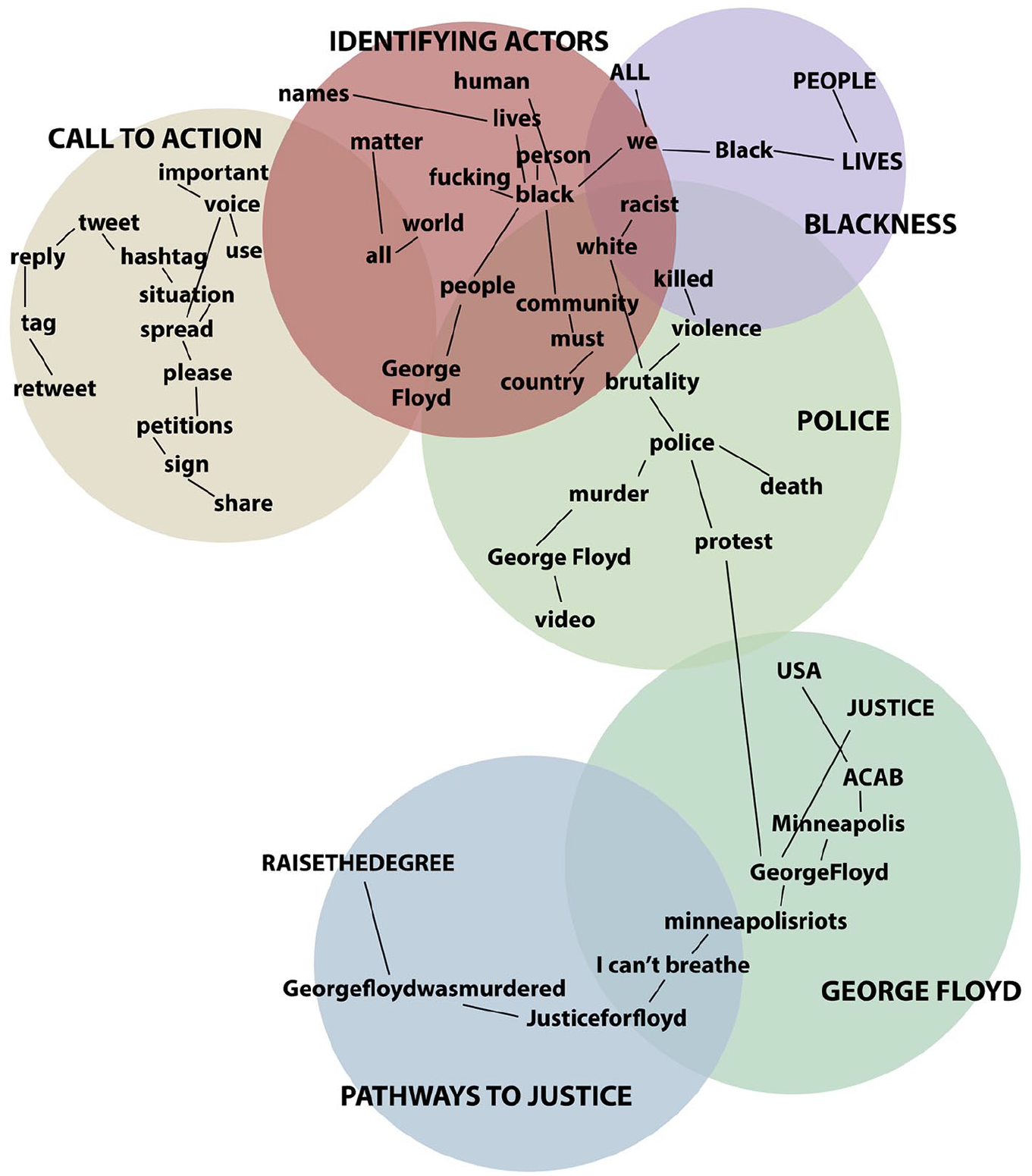
Reconstructed #BlackLivesMatter semantic network analysis from Leximancer.
The “Identifying Actors” theme centers on multiple identities and communities with concepts like “names,” “Black,” “white,” “George Floyd,” “world,” “human,” “person,” and “country.” Indicated by the dark red color of the theme and overlap with three other concepts, it is evident that Leximancer determined “identifying actors” was the most salient concept in this network. The concept clusters also indicate anger at certain identities and lack of community: “racist,” “need,” “fucking,” and “brutality.” Although “privilege” was not directly connected to “white,” it was connected to “support” and “movement,” indicating calls for individuals with privilege to support the #BlackLivesMatter movement. “White” connected words like “racist” and “brutality,” which then served as a connection to the theme “Police.”
The “Police” theme encompassed expressions of anger and wrong-doing. For example, words like “killed,” “violence,” and “murdered” express outrage at police brutality in general. In a separate cluster of words, “protest,” “violence,” and “murder” demonstrate the urge for retaliation against this system of brutality. There is a specific focus on police geographically with words like “America,” “country,” and “US,” which implies tweeters recognize the issue of police brutality disproportionately affects Black individuals in the United States. The concepts “George Floyd,” “video,” and “George” refer to a specific incident in the #BlackLivesMatter movement.
The “George Floyd” theme centers on the event that led to this uprising of #BlackLivesMatter. This theme uses citizen journalism-type phrases to accurately portray what happened. Words like “Minneapolis” and “USA” describe location, while “I can’t breathe” and “GeorgeFloydWasMurdered” describe the events. In addition, concepts like “ACAB,” “JUSTICE,” and “MinneapolisRiots” express anger.
The last theme is “Pathways to Justice,” which centers on a very specific call to “RAISETHEDEGREE.” Shortly after Floyd’s video went viral, a petition circulated to raise the degree of murder charges against the officers involved in his death. This theme includes “justiceforgeorgefloyd” and “georgefloydwasmurdered,” both of which emphasize the death was murder and to achieve justice for Floyd was to charge the officers with murder.
Equally as important as examining each theme is examining which themes overlap and how they are connected. The themes “Pathway to Justice” and “George Floyd” are connected to the rest of the map through “protests.” “Identifying Actors” has the most overlap with other themes (“Blackness,” “Police,” and “Call to Action”). Each overlapped area also includes action-oriented discourse in addition to descriptions of identities, such as “Black,” “white,” and “color.” The “Identifying Actors” and “Call to Action” themes are joined together by “speak,” “silent,” “stop,” “now,” and “challenge,” encouraging various groups of individuals to act.
Within “Identifying Actors” and “Police,” “brutality,” “justice,” “Floyd,” “killed,” and “racist” overlap. “Racism” is a significant connector between the themes “Police” and “People,” which represents the discussion of conflict happening throughout the tweets. The meaning of “Identifying Actors” being separate from “Police” indicates two sides at war over this issue—those in support of police, and those not in support of police. “Police” is the only theme overlapping “George Floyd.” In this network, it was evident “Identifying Actors” were called upon to create action.
Black Trans Lives Matter network
The network #BlackTransLivesMatter had eight themes: Community, Trans Marginalization, Call to Action, Life, Victim Identification, Piggybacking, #BlackLivesMatter, and Gender (See Figure 2).
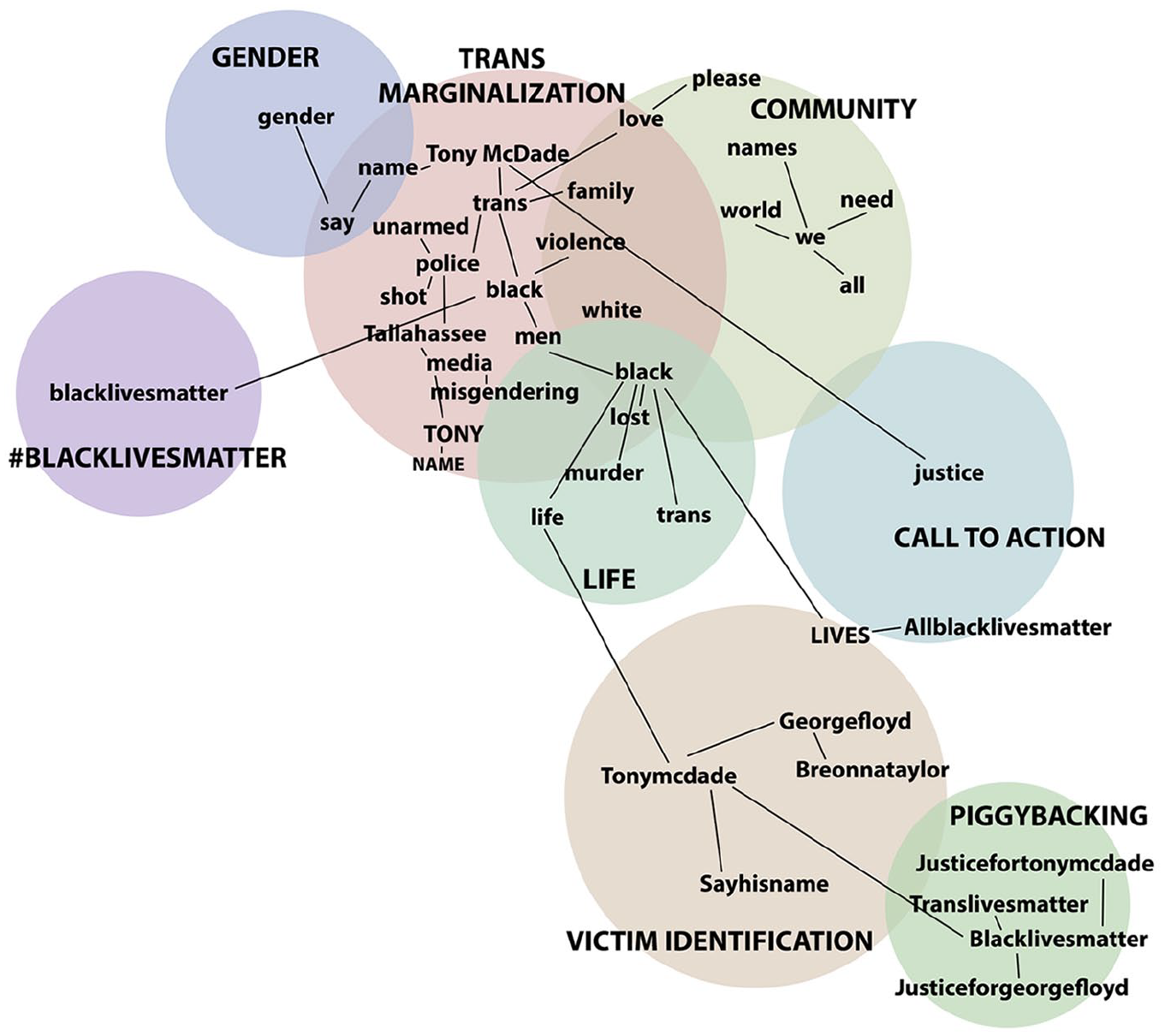
Reconstructed #BlackTransLivesMatter semantic network analysis from Leximancer.
The “Community” theme centers on calls for unity among supporters and toward the trans community. “Family,” “love,” and “please” indicate the lack of support many trans individuals face from their birth families and encourage online communities to be “families” to trans victims. The cluster connected through “all” includes “world,” “need,” and “names.” In addition, larger communities are mentioned, like “Black,” “white,” and “men.”
The “Trans Marginalization” theme is most important with its warm, red coloring. It has the most overlap and connections as well. The tweets in this map used #BlackTransLivesMatter, which indicates a transgender focus. There are a few clusters of concepts that discuss the marginalization the trans community faces daily. “Black,” “violence,” and “murdered” represent the disproportionate levels of violence trans people of color face. Connected concepts such as “Tallahassee,” “misgendering,” and “TONY” speak to the misgendering McDade and other trans victims experience in local newspapers after their deaths.4 A separate cluster, “police,” “unarmed,” and “shot,” describes McDade’s death from a citizen-journalist perspective.
The “Call to Action” theme is marked least important by its cool, blue color and has very few concepts. “Justice” is in “Call to Action” but is only connected to the “Trans Marginalization” theme through the concept “Tony McDade,” and “Allblacklivesmatter” is connected to “LIVES” in the “Victim Identification” theme. Although seeking justice was pertinent, it was more important to link these calls to action to other larger discussions of trans identities and victim naming.
The “Life” theme centered on loss and heavily overlapped with “Trans Marginalization” and “Community.” Concepts such as “lost,” “murder,” and “life” served as connecting words between the themes of “Trans Marginalization” and “Victim Identification.”
“Victim Identification” identified victims in both movements. “Tonymcdade” appears as the most common and connects the concept “sayhisname.” In addition, “Tonymcdade” connects to “Georgefloyd” and “Breonnataylor.” The grouping indicates individuals tweeting about trans deaths are more likely to tweet about cisgender individuals in #BlackLivesMatter discussions.
Similarly, the “Piggybacking” theme includes language used in #BlackLivesMatter discourse. “Blacklivesmatter” and “justiceforgeorgefloyd” show individuals utilized phrases that would place their tweets in feeds associated with #BlackLivesMatter. A small cluster of concepts “justicefortonymcdade” and “translivesmatter” confirms individuals were using both hashtags to enter #BlackLivesMatter discussions. Piggybacking was deployed through hashtags to enter the conversation, but most of the tweets recognized trans lives as a separate, but equally important, matter.
In another form of piggybacking, the “#BlackLivesMatter” theme connects to “Trans Marginalization” through the smaller concept “black” (located within the “Trans Marginalization” theme). It is separate from the “Piggybacking” theme because users only used the #BlackLivesMatter hashtag and not other discourse like “George Floyd.”
The “Gender” theme overlaps with “Trans Marginalization.” Within “Gender,” there are “say” and “name.” This theme and concepts imply there must be an educational component before activism and calls to action can happen. Because of its overlap with “Trans Marginalization,” “Gender” must first be addressed in how we identify trans victims. Individuals must “say” their correct “name” before advocacy can begin.
“Trans Marginalization” is clearly the most important and connected theme. For the #BlackLivesMatter network, #BlackTransLivesMatter did not appear as a thematic concept; however, “#BlackLivesMatter” and “Piggybacking” did appear as two separate themes on the #BlackTransLivesMatter network. As expected, a greater number of #BlackTransLivesMatter tweets used #BlackLivesMatter. This proves Kuo’s (2018) point that “links also demonstrate inclusion and exclusion and show what is or isn’t important to an individual” (p. 497). As trans is part of someone’s identity in addition to being Black, it is more likely tweets including #BlackTransLivesMatter would also include #BlackLivesMatter. Thus, #BlackTransLivesMatter is a satellite network of the #BlackLivesMatter counterpublic and acknowledges the importance of referencing the latter network. In addition, “George Floyd” and “Breonna Taylor” are linked to McDade’s name, which reinstates the fact “Piggybacking” as a network theme connects to the unjustified murder of all Black individuals.
“Call to Action” connects through “Community.” Signaling a sense of community around justice, “all Black lives matter” is listed as a concept within “Call to Action.” The #BlackTransLivesMatter movement is generally more inclusive of all Black murders. The theme “Community” also overlaps with the “Life” and “Trans Marginalization” themes, and the smaller concepts of “Black,” “say,” and “justice” overlap those three categories. These overlapping concepts demonstrate how these communities recognize the intersectional nature of the crimes, which aligns with our earlier discussion of most trans violence being racially and gender motivated. Overall, the themes present in the #BlackTransLivesMatter network are geared toward education, change, and intersectionality.
Network comparison
#BlackLivesMatter and #BlackTransLivesMatter networks had a strong emphasis on the most recognized murder for their respective identities during our data collection time frame: Floyd and McDade. Both men appear as frequently mentioned topics within their respective networks. Overall, #BlackLivesMatter has a stronger emphasis on outreach and action than #BlackTransLivesMatter. The differences in these networks’ focus can be equated to the level of awareness of the issues nationwide. Many Americans, due to media coverage, are aware of the struggles Black people face from police and other areas of life. The #BlackTransLivesMatter network, conversely, is dominated by themes of gender and sexual identity because users must first establish and educate the public about trans identities. Trans people of color still fight for recognition at the level of legitimacy and understanding of what their identity is. They face marginalization in more than one aspect of their identity, and this intersectionality draws their tweets in different directions, creating a more stratified, less unified, approach to Black trans lives mattering. This education approach is consistent with the network being a satellite public rather than an equal counterpublic to #BlackLivesMatter.
Because trans violence is a lesser recognized issue, users want this issue to be mainstreamed. However, “Call to Action” is an outlier in the #BlackTransLivesMatter network, and the conversation seems to be more focused on the community itself rather than inviting others in, with concepts like “we” and “trans” and “gender.” #BlackLivesMatter on the other hand has “Blackness,” “Identifying Actors,” and a much more well-defined and specific “Call to Action” theme. Although the themes in the #BlackLivesMatter network appear inclusive at first glance, they are more generalized in a way that ignores other voices when paired with the overwhelming presence of Floyd.
RQ2: The Purpose and Function of Bridge Tweets in a Satellite Public on Twitter
The bridge network was created by users utilizing #BlackLivesMatter and #BlackTransLivesMatter and had six themes emerge: Police, Support, Acknowledgment, Call to Action, Pathways to Justice, and Inclusion (See Figure 3). It should be noted all themes are only connected through concepts; none of the themes overlap with each other like the previous two networks. The lack of overlap implies a disconnect between themes and overall discourse and a more unorganized approach to unified movement-style narratives in the bridge tweets. Surprisingly, these results also did not include piggybacking as a major theme despite connecting two hashtags.
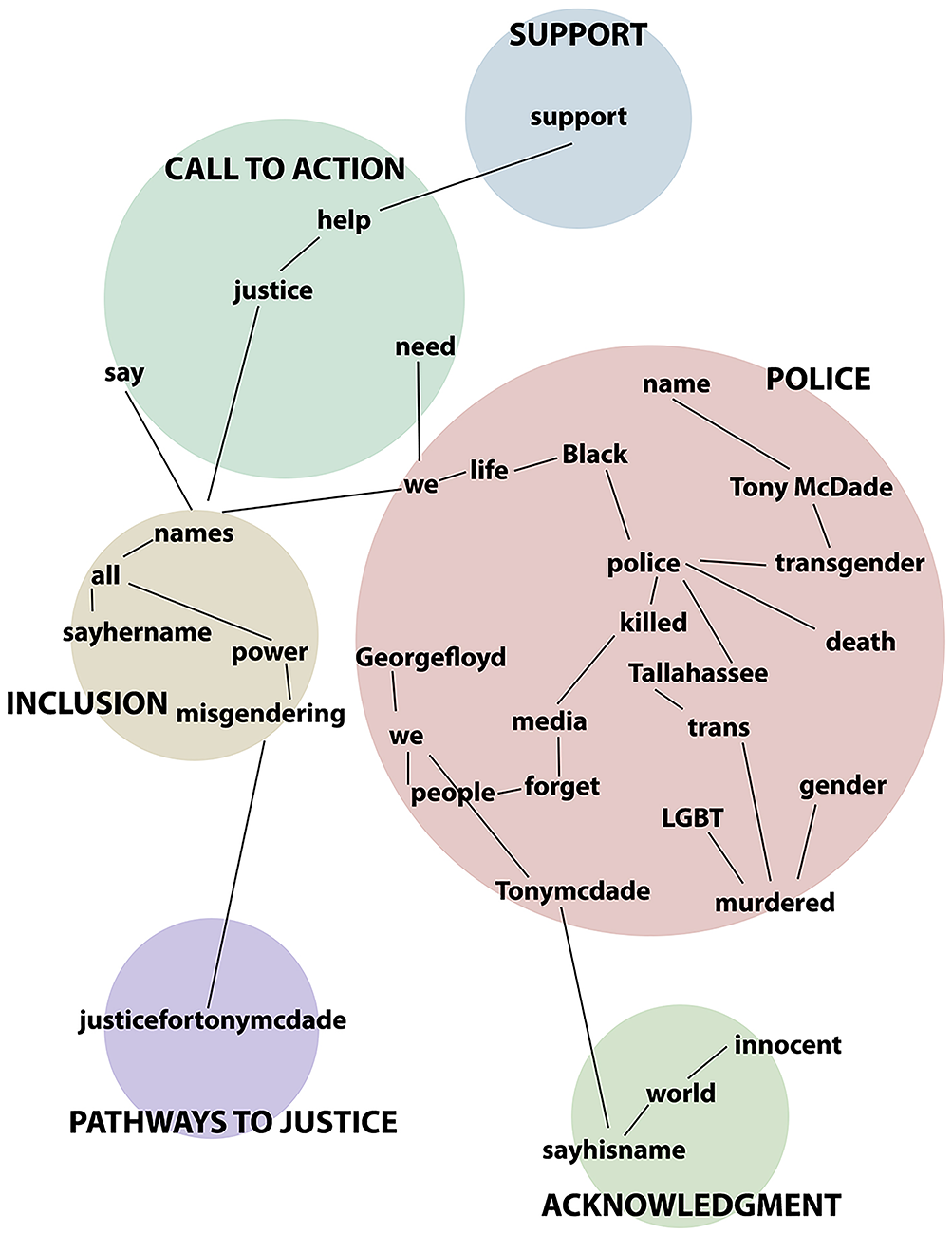
Reconstructed bridge tweets semantic network analysis from Leximancer.
Indicated by its red color, the “Police” theme is marked as the most important and takes up the most space in the network, which could be because both Floyd and McDade were killed by police during the week tweets were collected: Concepts “Tony McDade” and “George Floyd” are specifically mentioned within the “Police” theme. In addition to highlighting the murders of Floyd and McDade at the hands of police, the “Police” theme also brings attention to the disproportionate number of trans individuals of color who suffer discrimination from police. The cluster of words connected through “trans,” “murdered,” “gender,” and “LGBT” all emerge as concepts dealing with trans violence and police. Clustered concepts “black,” “death,” and “mourning” when connected under the theme “Police” indicate the constant emotional draining the Black community faces from police brutality. Also important to note, the concepts “LGBTQ,” “killed,” “media,” “forget,” and “people” are all linked together (respectively). This confirms the narrative that trans violence and trans individuals are often left out of larger mainstream media coverage.
The “Support” theme is blue and removed from the network. It is connected to “Call to Action” through the concept “help.” The “Call to Action” theme is green in color, also indicating it is not as important or connected to the map. Both themes are similar in their core desires. “Support” is focused on broad support for the #BlackTransLivesMatter movement, where “Justice” is more specific with concepts such as “help,” “say,” and “need.”
The “Acknowledgment” theme centers on concepts “sayhisname,” “world,” and “innocent.” These concepts indicate a plea for recognition (“sayhisname,” “world”) and accuracy in reporting and removal of criminal narratives and victim-blaming (“innocent”).
In the “Pathways to Justice” theme, concepts emerge like “justicefortonymcdade” which is connected to “misgendering” in the “Inclusion” theme. This indicates bridge tweets see justice as the proper identification of an individual’s gender and as inclusion in the larger #BlackLivesMatter discourse.
The “Inclusion” theme is marked as the second most important theme in the map by its warm gold tone. This is not surprising because bridge tweeters inherently believe in a more inclusive movement by using both #BlackLivesMatter and #BlackTransLivesMatter in their discourse. This is confirmed by the concepts “names,” “Sayhername,” “power,” and “misgendering.” Bridges want to shift focus from the cisgender male focus of #BlackLivesMatter to all Black individuals regardless of gender. The presence of “Sayhername” indicates although the current discussion centers on two men, bridges are contextualizing discussions with larger race and sexual identity issues. “Misgendering” is also included under “all.” The inclusive and intersectional environment created by bridge users emphasizes identifying McDade as a trans-masculine male.
Bridge summary
The bridge network is a representation of the intersection of the #BlackLivesMatter and #BlackTransLivesMatter networks. Instead of encouraging action or educating about trans identities, the bridge network focuses on bringing attention to the intersectional issue of police brutality that the Black LGBTQ+ community faces. Users strategically speak to #BlackLivesMatter supporters by discussing racially motivated police violence, while also creating an inclusive space for the queer community by using specific names like McDade. In addition, where the #BlackLivesMatter network saw justice as a higher murder conviction, bridges see justice as inclusion in the larger #BlackLivesMatter narrative.
Bridge tweets create more ties between the two movements to communicate to a wider yet still marginalized audience. At first glance, the bridge users seem incredibly detached from one another. These weak ties give the illusion of wider dissemination of information, but the conversation did not go far with only 110 tweets using both hashtags. Although the bridge tweets focus on broadcasting a message, it is obvious from the low levels of interaction that there was a small number of influential users.
Although network analysis of concepts between the hashtags and the bridges provides us with an idea of what the major themes of conversations are, our discourse analysis of both the hashtags and the content of the bridge tweets elaborates on the arguments, motives, and incentives to better understand the discursive practices of this satellite network’s attempts to amplify their cause.
Critical Discourse Analysis
Leximancer can discern certain topics that have a strong association, but we found the most frequent topics did not correlate to the messages or intent of the tweets. The software accurately depicted the most used words and pairing, but closer analysis of the complete tweets provides greater depth of how these words and phrases were used. Although “police” and “killed,” the most frequent pairing according to Leximancer, are commonly mentioned in the bridge tweets, the greater goal of the discourse including these topics seems to be drawing attention to Black trans injustice rather than police violence. The same goes for “Tony” and “LGBT,” as these are keywords in statements that cross a variety of messages from calls to action to hopelessness to outrage without discussing McDade’s legitimacy as an LGBT community member. Although Leximancer helped find major concepts of tweets for comparison, it was not as assistive in deciphering the social and discursive practices of the network. Because of this, we pursued the bridge tweets on a deeper level of analysis with a secondary qualitative approach to understand why both hashtags were being used.
To do conduct the deeper analysis, we initially coded the 110 bridge tweets into categories based on content to determine the themes invoked by the network. The tweets fell into several categories which were forgotten, misgendering, informal news reporting, calls to action, hashtag spamming, call outs, and hopelessness. Our analysis and identification of terms and emotions was guided by previous research on responses to racism and qualitative interviews with Black trans victims of violence (Lorde, 1981; Sherman et al., 2021).
There were three common placements for hashtags: at the beginning, within a sentence, and at the end. Hashtags at the end or beginning serve to categorize or amplify information (Freelon et al., 2016). These strategies are not specific to the network, as many users follow this structure. What is unique to the bridge tweets is the order in which the hashtags are listed. The content itself was rarely unrelated to trans-specific concerns. As can be seen throughout the examples later listed, #BlackLivesMatter almost always comes before #BlackTransLivesMatter. The order demonstrates the user’s acknowledgment or inherent recognition that one network has more power than the other. This point is further proven by the fact that all tweets within the bridge network are focused on trans-specific issues, meaning no one talking about #BlackLivesMatter outside of trans discussions was using the #BlackTransLivesMatter tag as a route for further dissemination.
The continuity of first tagging #BlackLivesMatter reifies this movement as having greater status than #BlackTransLivesMatter. This can be seen in the tweets that are purely hashtags. This is a form of “spamming,” as the main goal of hashtags is to draw connections to or enter conversations. Although hashtag spamming takes many forms including derailing a conversation, hashtag spamming also increases the number of tweets related to a topic, which can assist in trending (Najafabadi, 2017; Twitter).
Tweeting a mass list of hashtags adds to the mass of a conversation without adding anything worthwhile, but it increases the likelihood of individuals in and outside a user’s network encountering the content. Within these hashtags spams, #BlackLivesMatter is first.
One aspect of spamming and multiple hashtags is to combat being forgotten. Many tweets discussed the idea of being forgotten because the media was not talking about trans violence. Although some of these tweets are similar to call outs, there is a more explicit declaration of a lack of attention or awareness by the general public. There is a sense of needing to stand up for the victims.
Many of those tweeting about being forgotten condemn those who are letting Black trans victims go unnoticed by stating some people never encounter information about the victims. In actuality, their tweets confirm the very reason users take it upon themselves to recount and spread information about Black trans violence.
Several of the themes show Black trans lives are not being recognized the same way as other Black murders. To counteract the lack of recognition, a collection of tweets function as informal news reports. The users recognize the limited information on the issue at hand and take up the role of a news reporter to fill a gap. This is consistent with other themes of standing up and speaking out.
Typically, news reports use passive construction to draw attention away from the initiator of action. However, the informal news reports seen here use passive construction to bring the victim to the forefront because getting the names of these individuals into the public eye is difficult. In addition, they always include the active agents, the police, despite using passive construction. The blame is not removed, but the attention is shifted.
In addition to forming their news announcements, users frequently tweeted about how the minimal news coverage consistently misgendered, thus misrepresented, the victims. Users who tweeted about misgendering used strategies such as capitalizing the pronouns to signify the issue. They also used repetition to emphasize what they were implicitly addressing.
Others chose to be more direct, questioning the audience and demanding justice through appropriate representation. There is always a heightened level of anger and distress associated with misrepresentation, which signals the commonality of misgendering in most trans people’s everyday lives.
The commentary on misgendering is about resituating social reality and taking control of the social practices that oppress trans individuals. These situations of oppression often lead to emotions like anger and distress. Similarly, we identified strong emotional language such as feelings of exhaustion with injustice, tired of fighting against oppressive powers, and lack of optimism toward achieving a more equitable society and were identified as Hopelessness.
Some chose to express condolences for McDade and other trans victims. The In Memoriam tweets included language like “rest in peace” or “rest in power.” These tweets functioned as another device to gain attention and to promote the statistics of violence against trans individuals.
Some In Memoriam tweets indicated a loss for words among users who were experiencing grief about the amount of injustice users observed. However, some individuals chose to turn their grief into motivation.
Those who did not experience feelings of hopelessness were able to redirect their emotions into action. The tweets that included calls to action were not specifically oriented toward one cause; although the actions were often specific (donate here, sign this petition), the language did not indicate which cause they were supporting—#BlackLivesMatter or #BlackTransLivesMatter.
As what can be interpreted as an afterthought, user @glocmcstuffins included trans lives after first addressing Black lives and all Black lives. However, some users chose to include more trans-specific hashtags while still not identifying which cause they support.
User @kumquatkaylaa does not specifically indicate what the aims of the petition are she is encouraging individuals to sign, but because she included #JusticeForTonyMcDade, it is possible it was more oriented toward supporting #BlackTransLivesMatter specifically.
The lack of clarity about who the petitions, donations, and protests are meant for may be intentional. Bridge tweets are trying to connect two networks to form a more inclusive community. By using both hashtags on tweets about support, they are trying to join the #BlackLivesMatter network while simultaneously requesting assistance. However, there is not an indication of uniting the two causes, #BlackLivesMatter and #BlackTransLivesMatter, through the language used. Most tweets contain imperative sentences, reading more like demands. Moreover, other tweet themes we identified also do not include language that references uniting or coming together. These calls to actions end up appearing as a one-way street, demanding action from both networks without furthering the conversation of how the two hashtag networks could mutually benefit from each other. Bridge tweets also noted this disconnect and the lack of response or resources from the #BlackLivesMatter network.
An overwhelming theme within the network was demanding accountability and recognition from their audience by calling out silence, inaction, and misinformation, a theme we refer to as call outs. Twitter has been a space that can be highly combative due to the number of controversial topics, burrows, and anonymity. The expected conduct within the social media site allows for more aggressive or confrontational tweets directed at a large, frequently unknown audience. The Bridge network utilizes this option to provoke action through strategies that imitate guilting rather than the motivational language of calls to action. Moreover, calls to action tend to be imperative sentences or phrases while call outs are statements or implicitly directed at the audience. For example, quotes in bridge tweets call out inaction by citing activists or other notable figures who may hold more ethos than the user.
The more explicit approaches, while sometimes still imperatives, utilized language such as “exclude,” “ignore,” “don’t let,” which projects assumptions that those who are not acting or “doing enough” have the specific intent to hurt the Black trans community.
This assumption is not baseless because there is a long history of queer people being marginalized and not receiving media attention well before McDade’s death. In fact, during the summer of 2020, news media outlets referenced the Stonewall Riots repeatedly as though it was the only injustice committed against the LGBTQ+ community in recent years. Their attitudes of disdain and neglect are present in their language choices, including trends from previous discussions of Black trans injustice such as “say his/her name.”
“Say his name” and “say her name” are hashtag trends geared toward combating the misgendering of trans individuals. The phrase is a call out, demanding people speak rather than stay silent. Both the correction of misgendering and the need to “fight” for McDade appear in Supplemental Figure 15 and 16.
Similar to misgendering, the capitalization of entire phrases appears with “say his name” and “say her name” as a hashtag and a statement, adding a sense of urgency and the feeling of shouting into the emptiness, a sense that was also expressed through the themes of hopelessness and informal news reporting.
Within calls to action and call outs, inclusive pronouns indicate the diversity, values, and attitudes of the bridge network. “We” is used as a collective for non-Black people, Black people, and trans-specific communities.
Users have varying ideas of who might be encountering their tweets. To counteract that, some users choose to state their affiliation outright, such as “white,” while others do not. This indicates a level of membership the users feel toward the Black trans community. Those who realize they are not members clarify who the “we” is to present a clear audience. Pronouns used to talk to the audience have an interesting difference in grammatical choice. “You” is always directed at those outside the community and is paired with active verbs that either condemn or demand something from the audience.
“Y’all” was seen as a community reference. There is the accompaniment of modal verbs for politeness and a more conversational tone. These tweets rarely have the aggression seen with “you” nor do they include imperative structures.
The colloquial “y’all” suggests a more neutral or compassionate engagement with the audience. However, “y’all” and “we” tweets were much less frequent than those that used “you.” The higher use of “you” suggests much of the network’s purpose is directed at outsiders rather than those within the network. Thus, the choice in pronouns to associate or dissociate from the community also determines the emotions and values expressed within the tweet.
Conclusion
This study used a mixed-methods approach of semantic network analysis and critical discourse analysis to determine the successes and struggles of counterpublics and satellite publics on Twitter during moments of crisis. These results contribute to current studies of the public sphere and recent findings on how Twitter communities promote and create change. We established the term bridge tweet to be used for future scholarship analyzing hashtag movements. Given the unique relationship between the counterpublics and satellite publics on Twitter, the analysis of bridge tweets reveals the contentions that exist when a satellite public does not feel appropriately supported by other marginalized counterpublics. While the strategy of using both hashtags could have bolstered support for Black trans lives, especially as Black Twitter, Black Lives Matter and #BlackLivesMatter were started by Black queer women, the results demonstrate that #BlackTransLivesMatter as a Twitter movement is still in the early stages of demanding acknowledgment rather than calls to action. The number of weak ties and stratification of participation on the surface demonstrates a substantial body for a satellite public, but they are not intertwined with mainstream discourse to create change through piggybacking on Twitter’s platform. In this vein, satellite publics become distanced from the counterpublic when they do not respond or build community with the satellite, disrupting their attempt at joining the larger public sphere.
Thus, the more marginalized identities a community associates with, the more complex their activist discourse must be. The most marginalized communities must approach activism and social issues differently than dominant counterpublics. Twitter remains a space that is not welcoming or functional for all, and we focused solely on Twitter’s capabilities for the publics functioning therein. Despite the limitations of our data scraper and the time frame for data collection, we identified trends and themes pointing to the success and failure of Twitter movements for intersectional identities. More research such as ours needs to investigate the strategies, limitations, and future possibilities for activism on Twitter and other social platforms about intersectional identities. If #BlackTransLivesMatter can ever truly matter, it must be established as a dominant discourse rather than a satellite public orbiting a larger narrative.
Supplemental Material
sj-docx-1-jmq-10.1177_10776990221109236 – Supplemental material for “Where’s the Outrage??”: An Analysis of #BlackLivesMatter and #BlackTransLivesMatter Twitter Counterpublics
Supplemental material, sj-docx-1-jmq-10.1177_10776990221109236 for “Where’s the Outrage??”: An Analysis of #BlackLivesMatter and #BlackTransLivesMatter Twitter Counterpublics by Macy Dunklin and Paige Jennings in Journalism & Mass Communication Quarterly
Footnotes
Acknowledgements
We thank Dr. Lu Tang for her guidance and assistance in funding for the project. In addition, we are grateful for the reviewers and editors for their thoughtful and enthusiastic feedback. Finally, we acknowledge the more than 600 recorded murders of trans individuals around the globe since the beginning of 2020.
Declaration of Conflicting Interests
The author(s) declared no potential conflicts of interest with respect to the research, authorship, and/or publication of this article.
Funding
The author(s) disclosed receipt of the following financial support for the research, authorship, and/or publication of this article: Texas A&M University, Department of Communication provided funding for the software used to collect data.
Supplemental Material
Supplemental material for this article is available online.
Notes
Author Biographies
References
Supplementary Material
Please find the following supplemental material available below.
For Open Access articles published under a Creative Commons License, all supplemental material carries the same license as the article it is associated with.
For non-Open Access articles published, all supplemental material carries a non-exclusive license, and permission requests for re-use of supplemental material or any part of supplemental material shall be sent directly to the copyright owner as specified in the copyright notice associated with the article.
