




Abstract
Although advocacy and activism have been discussed in communication literature, are important in society, and often aid in organizational success, conceptual definitions and valid measurement of the concepts are lacking. By searching the literature, seeking two rounds of expert feedback, and employing two surveys (N = 1,300) for scale development, this study advances a new measurement model of behavior that may be useful for future research and practice. The findings support six distinct factors of behavioral advocacy and activism, three representing advocacy and three representing activism. The behaviors are communicative, collective, and combative in nature. Implications are discussed, along with suggestions for future research.
People speak up, protest, or otherwise get involved with numerous social issues, and much of this activity makes its way into social media and media coverage. The use of social and mobile technologies and policy debates surrounding controversial issues (e.g., abortion, racial discrimination, immigration, gun control) have led many members of the public to communicate, gather, and further activate around these issues. In tandem with everyday citizens, various organizations (e.g., nonprofit, corporate) also participate in, initiate, and communicate opportunities for advocacy and activism with the public. Journalists have noted that we are living in a golden age of citizen activism (Gage, 2018), and numerous communication scholars have written about the communicative nature of collective action (see, e.g., Bimber et al., 2005, 2012; Flanagin et al., 2006).
Strategic communication scholars have long sought to identify what motivates people to participate in advocacy and activism related to various political and social issues (Chen et al., 2017; Chon & Park, 2020; Kim et al., 2012; Pressgrove et al., 2021). While this existing research has focused on motivations that influence behavioral outcomes related to advocacy and activism, there has been little research focusing on the behaviors that constitute advocacy and activism. Considering that (a) individuals actively communicate about social issues through a wide range of media platforms, (b) organizations have become increasingly active on social justice issues and also communicate accordingly, and (c) the terms advocacy and activism still seem to be used interchangeably, this study asks the following question: What is the difference between advocacy and activism, and how can we recognize and communicate about these concepts accordingly?
Understanding individuals’ motivations and behaviors cannot be achieved without distinctive conceptual definitions among similar concepts. Considering the various forms of collective action and civic engagement and the lack of scholarly attention to defining the foundational concepts and related behaviors, the purpose of this research is to define and develop valid measures for behaviors that constitute advocacy and activism. First, to better understand the conceptual differences between advocacy and activism, a comprehensive review of relevant literature was conducted. While our focus is on helping communication scholars, we acknowledge advocacy and activism span many fields, so our review includes communication as well as other literature that focuses on these concepts. Based on this literature review, behavioral items were gathered and expert feedback was provided by communication practitioners as well as academics versed in scale development. The measures were then empirically tested and validated across two studies employing survey methods. Finally, an additional round of feedback was sought on the titles of resulting factors. The results of this research help fill a significant gap in the literature by (a) providing conceptual differences between advocacy and activism in various forms, (b) identifying which behaviors constitute different types of advocacy and activism, and (c) providing practical measurement tools to facilitate future communication research or aid organizations attempting to understand and communicate better with various publics. The resulting scales can be used in full or separately and should be helpful in future research attempting to build theory and understand the motivations for various types of advocacy and activism. In addition, this research may help scholars studying when and how organizations should be involved in such efforts.
Literature Review
Within the past two decades, advocacy and activism have grown as themes in strategic communication research, including in public relations. For example, scholars have noted that terms like advocacy and activism were once viewed as part of “fringe public relations” (Coombs & Holladay, 2012, p. 880), but they have emerged as legitimate topics of research. Others see advocacy as an essential part of democracy (Auger, 2013; Mundy, 2013), and activism has been examined by focusing on communication strategies from activist groups and nonprofit organizations (e.g., Jahng et al., 2014; M. Li, 2022; Reber & Kim, 2006). However, these concepts have been defined inconsistently and discussed almost interchangeably. In an effort to develop better definitions of the concepts and differentiate the actions that fall under each, with the idea that practitioners and scholars alike might then be able to better understand the behaviors, communicate more consistently about them, and further research motivations and outcomes, this study searched communication and related literature to see how advocacy and activism have been defined. The researchers also looked at popular sources, such as blogs, and consulted experts familiar with the concepts from their work.
Several theories in communication and related fields have been and can be applied to study advocacy and activism. For instance, Flanagin et al. (2006) and Bimber et al. (2005, 2012) have written extensively about collective action as being communicative in nature and proposed a two-dimensional model of collective action space based on modes of interpersonal interaction and engagement. Within this model, they situate several organizations, such as the Sierra Club and MoveOn, and discuss many of the behaviors included in this study, such as signing petitions, making monetary contributions, attending events, and protests. Similarly, strain theory has been used to study organizations and stakeholders who have behaved badly (unethically, illegally or combatively) based on issues of power, control, or status—or lack thereof (see, e.g., Cox & Davis, 2011; Greve et al., 2010). Because this study is interested in behaviors that are communicative, collective, and sometimes combative in nature, both of these theories, as well as others, could be useful for exploring advocacy and activism. In public relations literature, McKeever and colleagues (2016) have written about a theory of situational support in which the resulting behavioral intentions could be precursors to the forms of behavioral advocacy and activism discussed in this study.
The scales resulting from this study should be useful in future research and theory building. To advance and expand theories in our field, it is critical to have valid and comprehensive measures that can be employed in empirical research. This study aimed to develop measures for that purpose; the resulting measures can be employed in a variety of studies to help build theory. As scholars in our field have noted: “Not all science consists of hypothesis testing; science can also consist of the theoretical development of measures” (Carpenter, 2018, p. 41). Before developing the behavioral measures, this study attempts to further conceptualize advocacy and activism based on existing literature, including the theoretical literature outlined above. After describing the methods and resulting scales, we discuss how future research can use the measures developed from this study to build theory in communication and related fields.
Conceptualizing Advocacy and Activism
While numerous definitions for advocacy and activism exist (e.g., Jenkins, 1987; Nilsson et al., 2011; Poorisat et al., 2019; Schmid et al., 2008), this study attempts to summarize the similarities and differences between the two concepts. One definition of advocacy is, “any attempt to influence the decisions of an institutional elite on behalf of a collective interest” (Jenkins, 1987, p. 297). Others describe advocacy as, “activities aimed at influencing the social and civic agenda and at gaining access to the arena where decisions that affect the social and civil life are made” (Schmid et al., 2008, p. 582). According to Edgett (2002), advocacy is defined as, “the act of publicly representing an individual, organization, or idea with the object of persuading target audiences to look favorably on—or accept the point of view of—the individual, the organization, or the idea” (Edgett, 2002, p. 1).
Meanwhile, activism has been defined as, “the use of direct and often vigorous action to challenge oppressive power relations or ideologies” (Ophélie, 2016, pp. 757–758). Some scholars have suggested that activism goes beyond conventional political activities, and it has evolved over time to include broader social participation, civic engagement, and movements that arose from the general public (Poorisat et al., 2019). Activism has also been defined as a “process by which groups of people exert pressure on organizations or other institutions to change policies, practices or conditions the activists find problematic” (Smith, 2005, p. 5).
Definitions from existing literature provide two conceptual similarities between advocacy and activism. First, both advocacy and activism seek to involve multiple people and groups to draw attention to an issue. Second, in doing so, both advocacy and activism aim to influence the decision-making process to initiate or support change. These conceptual similarities highlight commonalities in advocacy and activism; namely, there is a common desire to focus attention on an issue, to draw people in to engage with the issue in some way, and to influence decision-making, policies and/or to create long-term change.
Perhaps more importantly for this study, existing definitions also imply some differences between the two concepts. First, as noted, advocacy often focuses on persuasion, shifting attitudes, and working to get others to support ideas, while activism often focuses on more direct or vigorous action, problematic conditions, and challenging ideas. Thus, the nature of the goal or motivation for the behavior may be a key factor in differentiating these two concepts. Activism has been attributed for bringing about larger-scale or longer-term changes, such as influencing social norms and values (Smith & Ferguson, 2010). For instance, Smith (2013) mentions movements such as women’s rights, civil rights, and environmentalism as examples of how activism has changed norms and values over time and at large scale; however, it could be argued that both advocacy and activism have been involved in these movements. Advocacy is often thought of as working inside a system, with or in support of organizations, individuals or policies that might help an issue or group (see, for example, De Moya & Bravo, 2016; Taylor & Das, 2010; Toledano, 2016), while activism is often thought of as working from the outside to influence a system, which sometimes means working against organizations or individuals that have power (see, for example, Carragee & Frey, 2016; Ciszek, 2017; Poell & Rajagopalan, 2015).
Second, because existing definitions of activism include phrases like, “direct and often vigorous action,” “oppressive power relations,” (Ophélie, 2016, pp. 757–758), “exert pressure” and “change policies, practices or conditions the activists find problematic,” (Smith, 2005, p. 5), the actions or behaviors involved in activism are often higher risk or higher cost. In contrast, existing definitions of advocacy include phrases such as, “influence the decisions,” (Jenkins, 1987, p. 297), “influencing the social and civic agenda” (Schmid et al., 2008, p. 582), and “persuading target audiences” (Edgett, 2002, p. 1). One can see in these definitions that the behaviors involved in advocacy might be lower risk or lower cost, perhaps softer or more subtle than the behaviors involved in activism. Both are important and help achieve important ends, but the processes, goals, the impetus or motivations, and the behaviors or actions involved are different.
In their research on predicting activism for a social cause, Poorisat et al. (2019) noted that one of the key indicators that differentiates involvement in various activities is cost. Cost can refer to time, money, effort (McAdam, 1986), or even risk (Corning & Myers, 2002). Psychology literature discusses risk as a factor that influences individual orientation toward engaging in social action (Corning & Myers, 2002). Woods (2017) noted that some activist behaviors go so far as being illegal, which could lead to great cost in terms of time, money, or risk for the individuals or organizations involved. Some actions don’t go as far as being illegal but may involve confrontation (Oliver, 1984)—with organizations (e.g., a company being protested or boycotted) or with other individuals (e.g., fellow protestors). Based on these ideas, and in an effort to parse out behaviors that represent the concepts of advocacy and activism, cost became a key factor in determining the dimensions of each concept. In other words, the various behaviors that represent advocacy and activism could be classified depending on a spectrum or a hierarchy of cost related to individuals’ time, money, effort, and/or risk.
Looking beyond academic literature, advocacy has been described as focusing on amplifying, while activism focuses on execution (Lewis, 2018). Both are necessary and can be helpful to advance or support various issues, groups, or organizations, but they seem to differ in the level of action or type of commitment one makes to that cause. Commitment is another form of cost. Some say advocacy lays the foundation for activism (Lewis, 2018). Behaviors associated with activism may be viewed as more committed actions aimed at achieving large-scale change, while advocacy may be more focused on amplifying, supporting, influencing, or persuading others, which also helps lead to long-term or large-scale change. Table 1 summarizes similarities and differences between advocacy and activism based on this literature.
Summary of Similarities and Differences Between Advocacy and Activism.
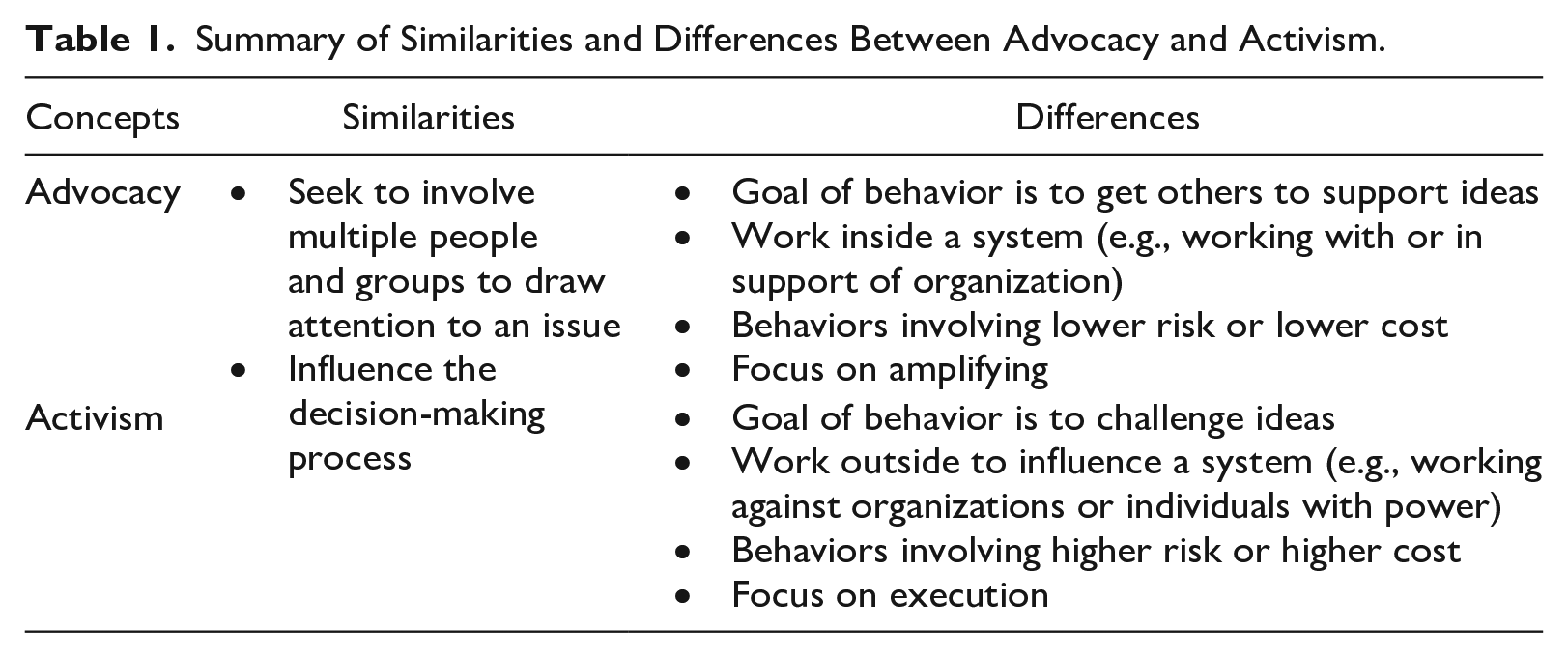
With these ideas in mind, we searched communications and related literature for existing scales, factors, and measures that might constitute behavioral advocacy and activism. After reviewing the literature, we identified six prominent types of behavior. We initially proposed three factors that seemed to constitute advocacy and three that met the criteria of being called activism. Specifically, advocacy included communicative (e.g., Dookhoo & Dodd, 2019; Kim et al., 2010), symbolic (e.g., Busby, 2002; Penney, 2015), and political behaviors (e.g., Leroux & Goerdel, 2009; Nilsson et al., 2011), while activism involved collective (e.g., Deaux et al., 2006; Yankah et al., 2017), financial (e.g., McKeever, 2013; Pressgrove & McKeever, 2016), and adversarial behaviors (e.g., Chon & Park, 2020; Corning & Myers, 2002). These factors were developed based on the literature, considering the similarities and differences highlighted in Table 1, and are described more below. After developing the initial list of factors and items, we gathered expert feedback to generate and validate dimensions and items (Carpenter, 2018).
Communicative Advocacy
As some scholars have noted, many forms of advocacy and activism are a form of communication (Flanagin et al., 2006). After all, communicative actions such as information seeking and sharing seem to be the basis for many forms of advocacy and activism. Taylor and Das (2010) referred to “internet advocacy” in their look at how organizations involved in the stem cell research debate used their websites to communicate with various publics. In communication research, information-related behaviors are often a focus of inquiry and many theories include communicative behaviors as an important variable. Communicative action is a concept that developed in situational theory of problem-solving (STOPS) research. According to STOPS research, people engage in communicative actions to solve problems (Kim & Grunig, 2011). Depending on individuals’ level of engagement, they engage in either active or passive communication, including information seeking, forwarding, attending, and sharing. STOPS indicates that higher levels of problem recognition and involvement lead to more active communication behaviors. Numerous studies have found support for the STOPS model over the years, including a recent study that found connections between communicative action and other forms of advocacy and activism, such as providing financial or political support (McKeever et al., 2019).
Dookhoo and Dodd (2019) explored how millennials are engaging in “social media activism,” such as liking, sharing, or commenting on another’s post, and whether online communication behaviors drive activist behaviors offline as well. While such behaviors have been referred to by academic and popular press as “slacktivism,” others see communicating on social media as a way of giving a voice to underrepresented groups (M. Anderson et al., 2018) or as an important first step to other forms of advocacy and activism. The initial list of communicative behaviors came from the literature outlined above. New items were added, and some items were modified or deleted based on expert feedback (described more in methods).
Symbolic Advocacy
While communicative actions include various ways of seeking and sharing information, symbolic advocacy includes behaviors utilizing symbols or public displays of support (Busby, 2002). Symbolic advocacy can be shown both online and offline. For instance, individuals changing a profile photo on their social media platform to show support for a cause could be considered a form of symbolic advocacy, as could displaying a poster, yard sign or bumper sticker, or wearing buttons or t-shirts supporting an issue or organization.
Penney (2015) noted that symbolic actions don’t lead to direct influence over policy or social outcomes. However, they empower individuals who have like minds and contribute to broader advocacy and activism efforts based on collective identity. Although there has been criticism that such symbolic efforts discourage broader civic participation by privileging self-expression over organized action, Bakardjieva (2015) noted that building collective identity provides a strong foundation for future social movement. Through in-depth interviews with participants in LGBTQ campaigns, Penney (2015) found that individuals participating in symbolic efforts expect to change public perceptions and raise awareness by increasing visibility about the issue. Through symbolic advocacy, individuals and organizations attempt to reach new supporters while strengthening commitment among existing supporters.
Political Advocacy
Political advocacy includes activities within the political realm such as voting and trying to influence legislation (Nilsson et al., 2011). In their scale development research, Nilsson et al. (2011) included political advocacy as part of their social issues advocacy scale. This factor included efforts to influence the political or legislative process such as making telephone calls to policymakers, volunteering for political causes and candidates, and meeting with policymakers to advocate for issues. MoveOn is an example of a group involved in political advocacy efforts, which has had an influence on Congress and presidential elections (Flanagin et al., 2006).
Leroux and Goerdel (2009) identified two dimensions of political advocacy by nonprofit organizations: grass-roots advocacy and “standing in decision making” (p. 516). Grassroots advocacy occurs through efforts by organizations to mobilize constituencies to take political action, while “standing in decision making” refers to organizations actively participating in policy communities comprised of legislators, bureaucrats, civic group leaders, and others to influence the agenda and outcomes of the political process. Some nonprofit and other types of organizations are more involved than others in such efforts. If/when organizations participate in these types of efforts, individual participation and support are an important part of organizational efforts. This study included politically-oriented behaviors, such as calling or otherwise contacting policymakers, as forms of political advocacy. Thanks to technology, many of these behaviors can be accomplished virtually, such as by signing online petitions or sending emails to Congresspeople. As such, these actions are often relatively low-risk or “impersonal” as some scholars have noted (Flanagin et al., 2006), which is why they were deemed to be forms of advocacy rather than activism.
Collective Activism
In a social movement, collective actions are a core part of social change. Yankah et al. (2017) defined a social movement as “a collective effort to enact or prevent some form of social, political, economic, or environmental change” (p. 58). Through collective action, a social movement aims to “improve status, power, or influence of an entire group” (van Zomeren & Iyer, 2009, p. 646). According to strain theory, “actors resort to misconduct when they are unable to achieve their goals through legitimate means” (Greve et al., 2010, p. 64). Under such strain, behaviors may involve more risk and, thus, become more activist in nature. Corning and Myers (2002) indicated that collective actions are a crucial part of activist behaviors. As noted earlier, collective actions are alluded to in existing definitions for both advocacy and activism, but joining a group or collective seems to indicate greater commitment and a certain level or type of behavioral cost that is more in line with activism.
When people perceive social injustice and are high in self-efficacy, they are more likely to engage in collective action (Deaux et al., 2006). In their development of an activism orientation scale, Corning and Myers (2002) noted that the level of propensity for collective action is an indicator of activism. Liss et al. (2004) also found that one’s belief in collective action is a predictor of collective advocacy and activism among feminists. These collective efforts lead to organizational ties, which become critical determinants of further activism (Corning & Myers, 2002). For collective activism, this study included items such as joining a committee or serving as an officer in an organization. Because these activities take time and commitment, they are higher cost and can be considered forms of activism.
Financial Activism
As mentioned, one of the key considerations that differentiates activism from advocacy is cost, and that can refer to time, effort, or actual cost, that is, money (McAdam, 1986; Poorisat et al., 2019). Resource mobilization theory explains the necessity of resources for nonprofit and social movement organizations (Corning & Myers, 2002; McCarthy & Zald, 1977). Social movement organizations must act to achieve their goals. In doing so, individual participation such as donating, volunteering, or becoming a member are key resources for the organization (Corning & Myers, 2002). Individuals are necessary to the organizations involved and to the social movement as a whole; thus, relationship building with these individuals is imperative.
Researchers in public relations have studied effective communication from advocacy groups building relationships with individuals, and these relationships often lead to financial support (L. B. Anderson, 2015; Bortree & Seltzer, 2009; Waters & Lord, 2009). Researchers have also discussed the importance of donations for nonprofit organizations and how communication and relationship building might move stakeholders from one action or type of stakeholder (e.g., donor, volunteer or both) to another (McKeever, 2013; Pressgrove & McKeever, 2016). In this study, financial activism was proposed to include behaviors such as making monetary contributions, raising money for an issue or organization, and buying or boycotting a product or company related to an issue or cause. These behaviors involve financial cost; thus, they are considered a form of activism. Corporate activism is often financial in nature, and corporations contribute to nonprofit organizations to show support for or against various issues. Thus, financial activism can be performed by individuals or by corporations or other organizations.
Adversarial Activism
From a behavioral perspective, risk is a form of cost. In their discussion of activism, Corning and Myers (2002) noted that activism can encompass what may be considered more conventional behaviors (e.g., protesting) to more extreme behaviors (e.g., damaging public property), and high-risk behavior is considered high cost. In discussing low- versus high-cost activities (Hensby, 2014; McAdam, 1986; Poorisat et al., 2019), digital behaviors such as signing an online petition are considered low-cost while offline behaviors such as attending a protest are more likely to be considered high-cost. These ideas are reflected in communication and management theories and literature (see, for example, Flanagin et al., 2006; Greve et al., 2010).
In terms of behavioral hierarchy, activities can range from “low-risk, passive, and institutionalized acts to high-risk, active, and unconventional behaviors” (Corning & Myers, 2002, p. 704). The most extreme, high-cost or high-risk behaviors are typically of an adversarial or contentious nature; these behaviors are often brought about by particularly controversial or contentious issues, such as abortion, gun control, immigration, and police use of power (Chon & Park, 2020; Corning & Myers, 2002). Ekman and Amnå (2012) indicated that political participation and civic engagement can include illegal acts such as destroying property, and these acts of civil disobedience and confrontation are central to some activists’ identity (Oliver, 1984). Similarly, such forms of activism can be carried out by organizations, either because they are under strain (Greve et al., 2010) or because it is part of their organizational identity or brand. From a public relations perspective, such groups have gained attention through forms of adversarial activism, which sometimes results in further support from individuals. Groups such as Greenpeace and People for the Ethical Treatment of Animals (PETA) are known for such radical activism (Derville, 2005). Accordingly, behaviors that are particularly high-risk were included in this study to capture this extreme end of activism.
In sum, the literature outlines numerous types of behaviors (highlighted above) that seem to constitute advocacy and activism. In an attempt to help clarify concepts, fill gaps in existing literature, and develop a more consistent measurement instrument that can be used in future research, this study sought to develop reliable and valid scales for behaviors individuals and/or organizations are likely to engage in related to advocacy and activism. As such, and following the work of other scale development research in communication (see, for example, Lee & Jin, 2019; Pressgrove, 2017), this study sought to answer one broad research question:
Methods
The steps in scale development have been clearly laid out by communication scholars and social scientists (Carpenter, 2018; DeVellis, 2016). Following those guidelines, this research began with a thorough literature review to develop initial items. These items were shared with professionals who work in public relations, most of whom work for or have worked for nonprofit organizations that are involved in advocacy and/or activism, as well as with scholars who have expertise in scale development methods. These ten experts provided qualitative feedback on the initial item pool. Some suggested adding new or deleting items, some helped modify wording of certain items, and others suggested modified titles for the factors we proposed initially.
After finalizing the scale items, a pretest (n = 70) was conducted by working with Qualtrics to recruit participants. Following the pre-test, a full survey was launched including 70 items; 880 responses were collected to conduct split-half exploratory and confirmatory factor analyses. Based on the exploratory factor analysis (EFA) results using a randomly split subsample of the data (n=440), 33 items were retained, and a confirmatory factor analysis (CFA) was performed on the remainder sample. A second survey (n = 420) was then conducted to conduct both confirmatory analyses and scale refinement using a validation sample. These two rounds of survey data helped determine the reliability and validity of the scale, which is described more below. Following the data collection and analyses, the final list of items was shared with some of the experts who provided feedback initially; this time, the researchers asked for feedback on the names of factors, based on what the data revealed to be the final factors from our analyses.
In both rounds of survey data collection, participants were instructed to do the following regarding the behavioral items in this study: “Think about an issue or organization that is important to you and keep that in mind as you move forward. Please indicate how likely you are to participate in the following behaviors.” Response options ranged from 1 = very unlikely to 5 = very likely. This study specified “issue or organization” partially based on previous research, which acknowledges that collective action takes place on a spectrum with some behaviors being specific to an issue while others are specific to organizations (Flanagin et al., 2006). In addition, most nonprofit or advocacy groups have missions based on certain issues, so in some cases the issue and organization are tied together in people’s minds (e.g., the National Rifle Association (NRA) and gun rights or PETA and animal rights).
Demographic variables including age, gender, race and ethnicity, education, and income were also collected at each round of data collection. The researchers worked with Qualtrics to match participants to U.S. census data in terms of age, gender, and race/ethnicity. The researchers followed best practices for scale development put forth by Carpenter (2018) and DeVellis (2016), and data collection and analyses were completed by spring of 2020. The university’s institutional review board approved all research practices. SPSS 25 was used to perform the EFA; both CFAs were conducted using Mplus.
Results From Study 1
Among the 880 participants in the first study, 440 (50%) were male and 440 (50%) were female. The majority of participants were self-identified Caucasians (n = 544, 61.8%), while 153 participants were self-identified Hispanics or Latinos (17.4%), 108 were African Americans (12.3%), 47 were Asians (5.3%), six were American Indians or Alaska natives (.7%), and six were native Hawaiian or Pacific Islander (0.6%). Seventeen (1.9%) participants self-identified as multi-racial. The average age of the participants was 46.01 years (SD = 17.18).
After cleaning, inspecting, and splitting the data into equal samples, we took several steps to determine the factorability of the data from the first split-half sample. First, we inspected the correlation matrix to ensure our values exceeded .30. The coefficients in our matrix ranged from .30 to .71 indicating moderate to strong relationships among the study variables. Having met this criterion, we then assessed the statistical significance of Bartlett’s chi-square test of sphericity and also whether the Kaiser–Meyer–Olkin (KMO) test of sampling adequacy exceeded the recommended cutoff value of .60. Results of the tests indicated the data were suitable for exploratory factor analysis (Kaiser–Meyer–Olkin Measure of Sampling Adequacy = .95; Bartlett’s Test of Sphericity = 10,803.42, p < .001). For identification of scale factors, we used an oblique rotation method to allow the factors to correlate. Specifically, we used Promax rotation, as it is considered the most robust among the oblique rotation methods (Carpenter, 2018). Because there is considerable scrutiny over the practice of determining factors using the eigenvalues greater than one rule, we instead compared the eigenvalues produced by the data to those generated through parallel analysis. Using this approach, in order for any of our factors to be retained, their respective eigenvalues must be larger than 1.09. Also, in conducting our analysis of the split-half sample, items with loadings <.5 or with significant cross loadings were removed resulting in a final scale length of 33 items. Finally, all factors were assessed for internal consistency. As shown in Table 2, six factors emerged from this analysis, and each factor demonstrated acceptable levels of internal consistency (α = .84 to .94).
Exploratory Factor Analysis of Long-Form Scale of Behavioral Advocacy and Activism.
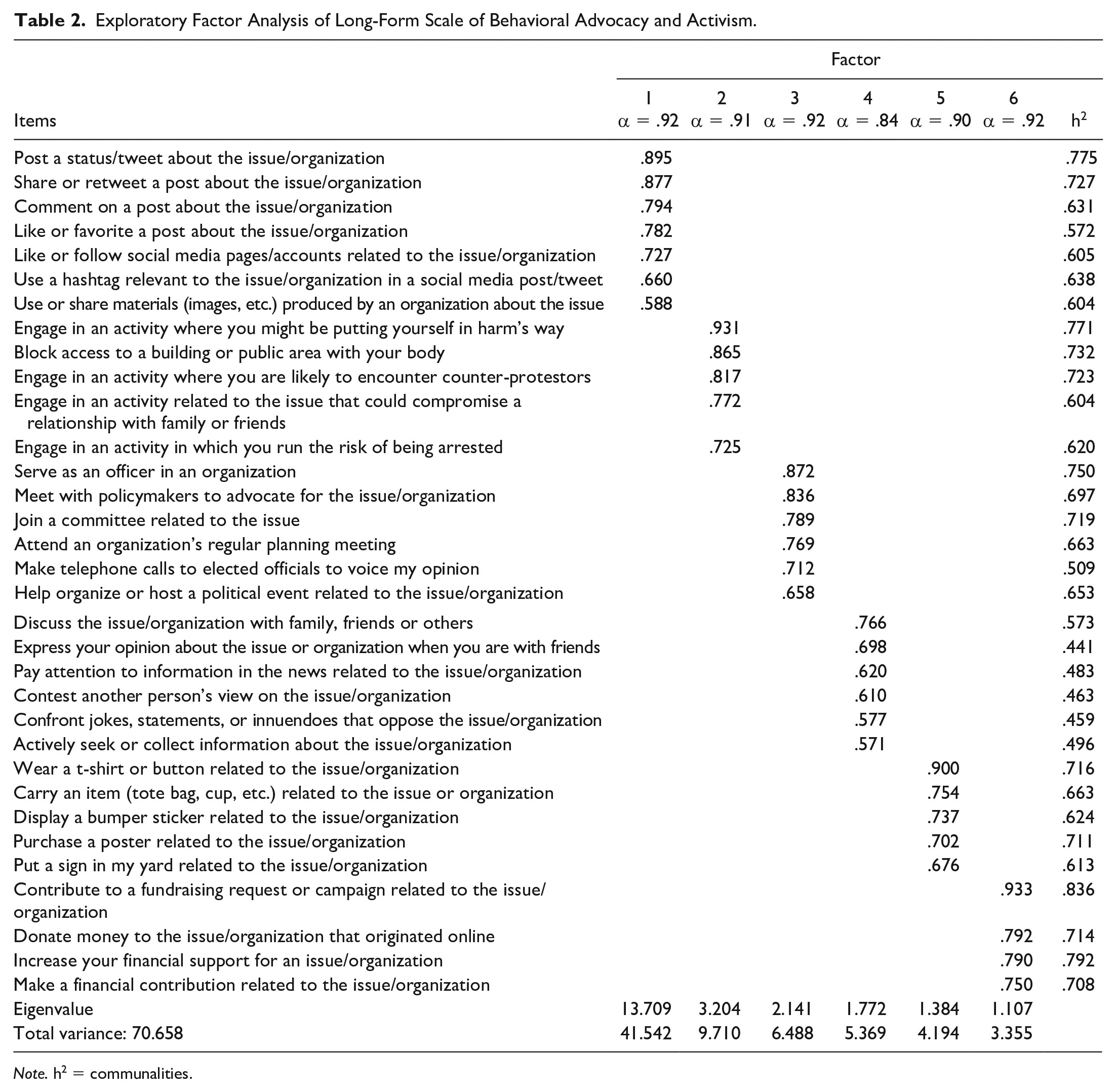
Note. h2 = communalities.
Next, we conducted a confirmatory factor analysis (CFA) on these 33 items using the data from the second split-half sample. Several fit indices were consulted in assessing how well the specified CFA model fit the data. Specifically, we applied guidance from Hu and Bentler (1999). Based on the recommendations for assessing model fit, we judged the model’s incremental fit to be acceptable if the Comparative Fit Index (CFI) and Tucker–Lewis Index (TLI) were above ≥.90. We assessed absolute fit as having values for both the root mean square error approximation (RMSEA) and standardized root mean square residual (SRMR) ≥.08. In addition, we also examined the χ2/df ratio as a complementary goodness of fit measure. Results from the model testing indicated an acceptable level of fit to the data: χ2(309) = 852.69, p < .001, CFI =.95, TLI =.94, SRMR = .04, RMSEA = .06 (90% CI [.06, .07]), and the items in the model all significantly loaded onto their respective factors with standardized estimates ranging from .68 to .92 (all ps< .001).
Although findings from the first survey offer support for a six-factor model, a potential limitation of the split-half samples derived from the first survey is that participants in each subsample were likely to possess similar characteristics. Furthermore, model validation and refinement procedures are best accomplished through the use of a validation sample. Thus, to provide a more robust test of the model, and to potentially hone our scale to be more parsimonious (i.e., 4–5 items per variable), we conducted a second survey (N = 420) with participants from a new sample.
Results From Study 2
Of the 420 participants in Study 2, 210 (50%) were female, 208 (49.5%) were male, and 2 (.5%) identified as a gender other than male or female. The majority of participants were self-identified Caucasians (n = 259, 61.7%), while 73 participants were self-identified Hispanics or Latinos (17.4%), 42 were African Americans (12.4%), 22 were Asians (5.2%), three were American Indians or Alaska natives (0.7%), and 11 (2.6%) self-identified as multi-racial. The average age of the participants was 45.95 years (SD = 16.82).
After cleaning and inspecting the data, we specified and assessed the fit of the original six-factor model from Study 1. After assessing the full measurement model, we then proceeded to use model trimming procedures to assess whether a well-fitting and reliable instrument could be constructed using a subset of the 33 items from the initial model. Analysis of the full measurement model again provided an overall good fit to the data, χ2(480) = 1,169.82, p < .001, CFI =.94, TLI =.94, SRMR = .04, RMSEA = .06 (90% CI [.05, .06]), with standardized factor loadings ranging from .52 to .94 (all ps <.005).
To explore whether a viable short-form scale measuring the six factors could be derived from the full-length scale, we trimmed measures from the initial model in accordance with suggestions from the modification indices specific to the removal of indicators. A total of five items were suggested for removal on the basis of the modification indices. In an effort to keep each scale below five items, two additional items were removed on the basis of their respective factor loadings. Using this method, we were able to produce an acceptable fit to the hypothesized model derived from the first sample after trimming seven items from the initial 33 items, χ2(284) = 772.72, p < .001, CFI =.94, TLI =.94, SRMR = .05, RMSEA = .06 (90% CI [.06, .07]). As shown in Table 3, all items significantly loaded onto their respective factor.
Factor Loadings From Confirmatory Factor Analysis of the Short-Form Scale of Behavioral Advocacy and Activism.
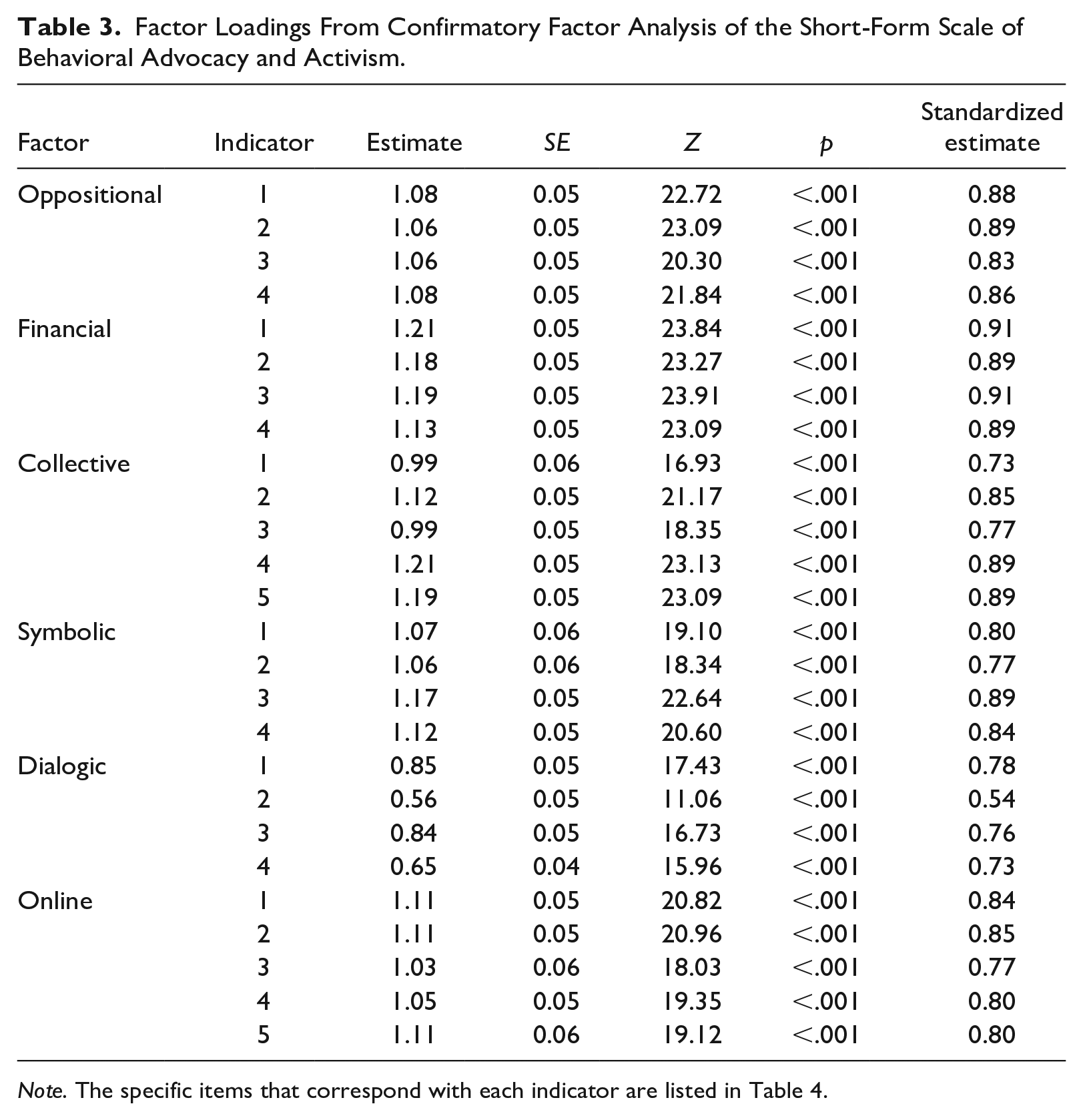
Note. The specific items that correspond with each indicator are listed in Table 4.
In addition to producing an acceptable model fit based on confirmatory factor analysis, all of the measures were internally consistent with Cronbach’s alphas ranging from .81 to .94. Table 4 presents the full list of items included in each short-form scale.
Items Included in the Short-Form Scale of Behavioral Advocacy and Activism.
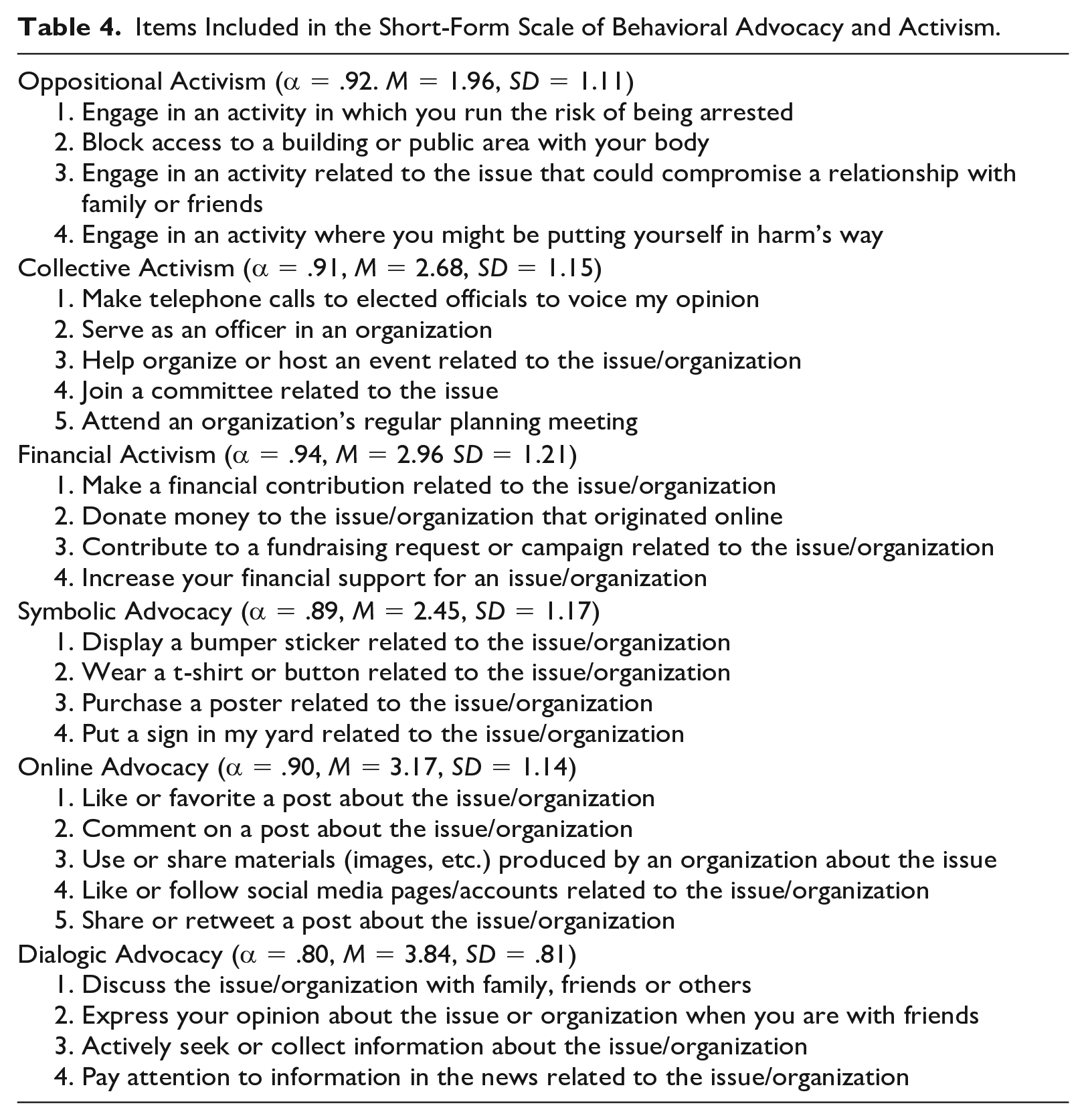
This study’s overarching research question asked, “What factors and items constitute valid and reliable scales of behaviors representing advocacy and activism?” CFA findings indicate six factors consisting of 26 behaviors. After consulting with experts, the researchers settled on the following names for the six factors or types of advocacy and activism that emerged from this research: dialogic advocacy, online advocacy, symbolic advocacy, financial activism, collective activism, and oppositional activism. A list of the final scale items appears in Table 4. Discussion of the items, naming, implications and more follows.
Discussion
This study provides a valid and reliable measurement model and helps explain behavioral advocacy and activism in a way that does not seem to exist in communication literature currently. It builds on theories related to collective action (Bimber et al., 2005, 2012; Flanagin et al., 2006), situational support (J. Y. Li, 2020; McKeever et al., 2016; Zheng et al., 2016), strain theory (Cox & Davis, 2011; Greve et al., 2010) and can be applied in these and other contexts to understand and explore advocacy and activism related to issues and organizations. The scales should be especially useful for future theory building. For example, to continue to build theory related to situational support (J. Y. Li, 2020; McKeever et al., 2016; Zheng et al., 2016), the scales from this study could replace the behavioral intentions variable in that model, or the behaviors could be subsequent to the intentions, as in other research. Similarly, the collective activism scale could be useful in building on existing theory related to collective action (Bimber et al., 2005, 2012; Flanagin et al., 2006), and the oppositional activism scale could be useful in future research on strain theory (Cox & Davis, 2011; Greve et al., 2010). The scales can be used together or separately, which should aid in various attempts to build theory, even beyond the theories mentioned here.
For strategic communication scholars, whether organizations engage in advocacy or activism may positively or negatively influence stakeholders’ attitudes, purchase intentions, or public opinion more broadly. Using the scales established in this research may help with organization-public relationship (OPR) research, advertising studies, research on political, health and crisis communication, and more. Such research can help advance knowledge and practical applications for public relations, advertising, journalism, and other types of strategic and mass communication professionals as well. For example, applying the scales to study news coverage of various social movements or instances of advocacy and activism as they play out in the future could yield interesting insights about the success of certain organizations, strategies, or tactics. Testing the scales in the context of existing theories may provide information on the potential effectiveness of campaign messaging in political, corporate, or nonprofit contexts. This research is needed not only for building theory in strategic and mass communication but also for yielding practical insights. Public relations theories, in particular, including STOPS, the related theory of situational support, relationship management research, and emerging studies on corporate social responsibility (CSR), corporate social advocacy (CSA), and corporate activism (e.g., Choi et al., 2018; Jin et al., 2022) could employ these scales to continue building theory and benefiting practice. A recent study on social movements discussed the importance of identification related to advocacy and activism (Edrington, 2022), revealing another opportunity to help build theory.
Both the full-length and short-form scales of behavioral advocacy and activism (Tables 2 and 4) provide viable measures for future research. Based on the conceptualizations put forth in this paper, the factors we’re calling dialogic advocacy, online advocacy, and symbolic advocacy reflect behaviors that focus on listening, amplifying, and promoting an issue, cause or organization; these are also the more low-cost or low-risk behaviors, which is a key differentiating factor outlined in the literature (Corning & Myers, 2002; Poorisat et al., 2019). Meanwhile, financial activism, collective activism, and oppositional activism reflect the more direct, committed, and vigorous behaviors typically associated with activism; these are also the more high-cost and high-risk behaviors that rely on more time, money, or effort. These scales should be useful for scholars moving forward, as well as for practitioners working in nonprofit organizations, health communication, political, corporate, or related areas of strategic communication.
While we originally proposed six factors and ended up with six factors, some changes took place throughout data collection and analyses. First, political advocacy did not remain its own factor, and in fact, many of the originally proposed political items washed out in the data analyses. The items that remain consist of more collective actions, such as “help organize or host an event related to the issue/organization.” Perhaps political was too narrow of a title when most of these behaviors are actually performed as part of a collective or larger organization. In future research, if scholars are interested in political actions, specifically, they may want to use the scales that resulted from the first round of data collection (Table 2) as those results retained more political actions such as, “meet with policymakers to advocate for the issue/organization.” Such items reflect high levels of engagement and interaction, according to the collective action model proposed by some communication scholars (Bimber et al., 2012; Flanagin et al., 2006).
In addition, while we originally proposed numerous items related to communication (more than any other category), we included them all under one broad dimension. However, following data collection and analyses, two clear separate factors emerged: items that must be performed online or in digital or social spaces, such as sharing or retweeting a post about an issue/organization; and items more focused on individuals being able to engage in conversations or dialogue with others, including not only seeking and paying attention to information related to an issue or organization but also expressing an opinion or discussing the issue with others. Because of this clear distinction, we named these two factors dialogic advocacy and online advocacy. “Conversational” was also mentioned by one of our professional experts for the factor we titled “dialogic,” but we chose dialogic in part because of existing literature on dialogic communication (e.g., Bortree & Seltzer, 2009; Edrington, 2022; Kent & Taylor, 1998). Some of the communicative actions that might be considered more adversarial, such as “contest another person’s view on the issue/organization” or “confront jokes, statements or innuendoes . . .” (see Table 2) did not remain after the second round of data collection and analysis. Again, researchers can use either set of resulting scales, and some of the items from Table 2 may be valuable for future research on more controversial topics.
Symbolic advocacy was one of the most consistent dimensions from the beginning to the end of this research. This factor is aptly named and consists of behaviors such as “put a sign in my yard related to the issue/organization.” Such behaviors are truly representative of the definition of the word symbolic, that is, “serving as a symbol” of one’s devotion to a cause, issue, candidate, party, or organization (Dictionary.com, 2020). Similarly, financial activism and the items that fall under this dimension remained stable throughout this scale development process. This dimension was narrow in scope from the beginning and includes items such as making a contribution toward an issue or organization. Items related to buying products that support an organization or boycotting a product or company because of an issue or organization did not remain through the multiple rounds of data collection and analysis. However, the financial actions that remain (in Tables 2 and 4) still reflect a cost, which indicates higher levels of commitment than behaviors such as sharing information online or discussing an issue with friends, which is why financial behaviors were deemed a form of activism rather than advocacy. It could be argued that because financial contributions can be given impersonally online or via mobile technologies that financial activism is more of a form of advocacy; financial activism could also further be parsed by attempting to understand the motivation for the behavior. Perhaps in the cases of donations, this could be deemed financial advocacy because it could be seen as a form of amplifying an issue or case, while in the case of a boycott or a “rage donation” (Austin et al., 2020) perhaps this is more aptly named activism. Again, more research is needed here.
There are many various motivations for people and organizations conducting some of the behaviors specified in the current research. These motivations, including cognitive, affective, and/or situational factors, are an important area of future research related to advocacy and activism. The scales resulting from this research should be helpful in future theory building aimed at examining the antecedents to these behaviors. For example, online and dialogic advocacy are related to an array of communication activities, including information sharing and elaboration. Future research can apply these scales to further explore potential theoretical connections. In addition, because of the potential for each of these advocacy and activism behaviors to be elicited in varying degrees based on interindividual factors such as motivation, abilities, knowledge, and resources, future studies could help elucidate the different conditions that can lead people to engage in these various forms of advocacy and activism.
Some of the items in the factor initially called adversarial activism were adapted from Corning and Myers’ (2002) activism orientation scale and fell under what these authors called “high-risk activism.” However, during our requests for feedback, additional items such as, “Engage in an activity related to the issue that could compromise a relationship with family or friends,” were suggested as was the term “adversarial.” After data collection and analysis, the researchers looked at the items again, sent them to some of our original experts for a second round of review, and it was determined that “oppositional” might be a more clear and specific name for this factor. “Confrontational” was also suggested, but both “adversarial” and “confrontational” seem to indicate conflict and have negative connotations, while “oppositional” seems to more truly reflect the behaviors included in this factor. After all, one can oppose an issue, cause, candidate, party, or organization without getting adversarial or confrontational, and items such as the one noted above seem to be reflective of having an opposing view, but not necessarily being adversarial or confrontational about it. It is acknowledged, however, that some activism behaviors are adversarial or confrontational, as noted in the literature review, and the items in this factor are certainly higher cost, which is why they are forms of activism rather than advocacy. In all naming efforts, specificity was sought in an effort to best describe and represent not only the factor as a whole but also the various items that are part of each factor.
Limitations and Future Research
This study is limited in that it used Qualtrics panels to collect data, and while efforts were made, participants may not be representative of the U.S. population. In addition, while this study delineates behavioral advocacy and activism from a conceptual standpoint prior to their empirical assessment, future researchers may wish to assess whether these constructs comprise second-order factor models of advocacy and activism. This study is also narrowly focused on behavioral advocacy and activism and did not focus on the cognitive or affective aspects of the concepts.
Using the scales that resulted from this research, future research should consider and explore the various cognitive, affective, and situational motivations that may influence these behaviors. For example, do stronger emotions elicit or result in activism (rather than advocacy)? Do either, both or all types of behaviors require the same level or types of knowledge (objective or subjective) or involvement? Do crises, such as natural disasters or health emergencies, motivate one or more types of behaviors over others? From a strategic communication standpoint, do different types of organizations (corporate, nonprofit, government) inspire certain types of behaviors more than others? And from an organizational standpoint, is it better to engage in or encourage some forms of advocacy or activism from stakeholders over others? These are just a few of the questions future research can seek to answer. There are also ethical questions, of course, in terms of individual and organizational behaviors related to advocacy and activism. While these scales were measured from an individual perspective with participants responding to surveys, experimental research could test how stakeholders might react based on actions organizations take related to advocacy and activism.
Future research should test various antecedents for the proposed behavioral scales. As noted, the nature of the goal or motivation for the behavior may be a key factor in differentiating advocacy and activism; more research is needed on other aspects of these concepts. Experimental research could use these scales to determine what behaviors people are likely to do as a result of different communication strategies. CSR and CSA or brand activism research could utilize these scales not only to build theory but also to yield practical recommendations for corporate entities as well as their nonprofit partners. For example, are certain organizational behaviors more appropriate in some instances than others? Or do some communication tactics result in different individual behavioral outcomes? In terms of individual behaviors, additional qualitative research such as interviews or focus groups could help determine what moves people from one factor or form of advocacy or activism to the next. Future research should explore these elements and also attempt to validate these scales in various international contexts to help us continue to understand these important concepts, particularly as they relate to strategic and mass communication and broader social movements on a global scale.
Conclusion
This scale development project sought to conceptually distinguish advocacy and activism and to delineate various behavioral factors, including scale items, in a thorough yet parsimonious way. While this was a large undertaking, the researchers made every effort to follow the proper steps involved in scale development, as outlined by communication and social science researchers who have expertise in these methods (Carpenter, 2018; DeVellis, 2016). The six factors that emerged: dialogic, online, and symbolic advocacy, as well as financial, collective, and oppositional activism seem to represent a valid, reliable, and parsimonious way of measuring behavioral advocacy and activism. The scales may be taken together and used by future researchers in communication and other fields, or parts of it may be used by scholars or practitioners looking to better understand advocacy and activism, and possibly how to better communicate with or engage stakeholders in such actions. As noted, advocacy and activism are important components of progress and have played a part in some of the world’s largest social movements. Such collective actions are communicative in nature and reflect shifting priorities within societies. Understanding these concepts better through research will help organizations and societies advance at a larger scale and possibly at a faster pace. Communication research and practice are part of that progress, and this research aims to be a helpful component in future theory-building related to the many important forms of behavioral advocacy and activism.
Footnotes
Declaration of Conflicting Interests
The author(s) declared no potential conflicts of interest with respect to the research, authorship, and/or publication of this article.
Funding
The author(s) disclosed receipt of the following financial support for the research, authorship, and/or publication of this article: This project was supported by a Page Legacy Scholar Grant from The Arthur W. Page Center at The Pennsylvania State University’s College of Communications. Any opinions, findings, and conclusions or recommendations expressed in this material are those of the authors and do not necessarily reflect the views of The Pennsylvania State University.
