



Abstract
Two online experimental studies (nstudy1 = 318, nstudy2 = 462) were conducted to examine whether social media informant type (celebrity influencer vs. expert) and presentation type (numeric vs. generic information) influenced behavioral intentions. Results from Study 1 found that expert-authored posts with numeric information were more persuasive for credibility assessments and, in turn, intentions to obtain the COVID-19 booster vaccine. In Study 2, we retest our hypotheses in the context of support for police reform. Contrary to expectations, neither message manipulation persuaded individuals. Partisanship, however, played a key role in behavioral intentions.
From advocating for political candidates to promoting health behaviors, celebrity influencers engage with their vast audiences beyond their traditional entertainment roles, thanks to the affordances of social media platforms. Celebrity influencers leverage their platforms to raise awareness of social issues, promote health campaigns, and advocate for political candidates (Wheeler, 2014). This expression of activism raises important questions about whether celebrity influencers are viewed as credible sources for health and political issues and whether their presentation of information about these topics influences persuasion.
Celebrity influencers typically use Instagram to share their perspectives on a wide variety of issues, from their favorite beauty products to their positions on political issues. Indeed, a great deal of research has been dedicated to understanding the role that celebrity influencers exert on consumer behavior (e.g., product purchasing behavior; Apejoye, 2013). However, less research has examined their influence on public perceptions of polarizing topics, such as health behaviors and political advocacy. This is especially salient because celebrity influencers dabble in health and political advocacy roles. For example, during the height of the COVID-19 pandemic, the World Health Organization solicited celebrities to take part in a handwashing campaign called the #SafeHand challenge (Harris, 2020). To participate in this campaign, celebrities posted videos of themselves washing their hands to their Instagram accounts, often adding their own flairs. Yet, questions remain on whether celebrity influencers are influential in changing attitudes and behaviors relative to important social and health issues, or if traditional experts and sources are better suited. It is possible that individuals might find a medical doctor, for example, more persuasive in the context of a COVID-19 vaccination than a celebrity source. Given that traditional expert sources, such as medical doctors, are also turning to social media to reach a wider audience, we explore whether celebrity influencers should be used in future public campaigns or if tapping into expert sources on social media is more effective for motivating the public to comply with targeted behaviors.
Although there are many types of celebrities, such as singers, actors, and athletes, we focus on individuals who rose to fame by acting on long-standing television shows (Gräve, 2017). One intriguing aspect of these celebrities is their strong association with the characters they portray. When these actors endorse a product or behavior, it is unclear whether their followers perceive the endorsement as coming from the celebrity themselves or from the character they play. For example, if an actor from the medical drama Gray’s Anatomy posts about a health behavior, do followers view the message as originating from a celebrity with no medical background or do they attribute the technical expertise of the actor’s fictional character to the endorsement? The association between a celebrity and a role assumed to have expertise on a topic is particularly alluring in the context of celebrity influencers, as it has implications for how individuals perceive and process a persuasive appeal.
The effectiveness of influencers is likely dependent on both the issue and the personal characteristics of the influencer. Recently, Druckman (2022) proposed a general framework to study persuasion, noting that discrepant results from political persuasion studies are likely a result of different variables (i.e., medium, source, receiver motivation, and setting). Druckman (2022) called for researchers to consider differences across variables to gain a better understanding of persuasive messaging. To account for the potential differences in persuasion across contexts, we conduct two studies. In Study 1, we examine how the celebrity influencer Ellen Pompeo—the protagonist of the medical drama Gray’s Anatomy—is viewed when she uses an Instagram post to encourage her followers to obtain a COVID-19 booster. In Study 2, we retest these same mechanisms in a political context, specifically examining a celebrity’s advocacy for police reform. Given that both contexts have become politically charged messages that might evoke reactance, we investigate whether a celebrity-authored post is perceived as credible and whether this credibility rating would reduce counterarguing. In both studies, we compare a post by an actor associated with an expert role (medical doctor, detective) to those that are topic matter experts to examine which source type is more credible.
Study 1
For more than 50 years, researchers have examined the influence of celebrity endorsements in marketing, seeking to understand the specific traits that make these endorsements so effective (Schimmelpfennig & Hunt, 2019). Evidence shows that celebrity endorsements affect a variety of consumer behaviors, including product purchasing (Apejoye, 2013; Osei-Frimpong et al., 2019), travel intentions (Yang, 2018), and voting (Austin et al., 2008; Nownes, 2017, 2019). Although multiple theories explain the success of celebrity endorsements (Schimmelpfennig & Hunt, 2019; Yang, 2018), the source credibility model is among the most studied (Choi & Rifon, 2007).
Originating from the work of Carl Hovland and colleagues, the source credibility model posits that the persuasiveness of a message depends on the credibility of its source (Hovland & Weiss, 1951). Credibility evaluations are based on two dimensions: trustworthiness and expertise. Expertise encompasses the source’s relevant knowledge, experience, and skills while trustworthiness reflects their honesty, objectivity, and integrity (Pornpitakpan, 2004).
Although the source credibility model suggests both dimensions are equally influential, research on celebrity endorsements reveals that perceived expertise, rather than trustworthiness, primarily drives evaluations of a celebrity’s credibility (Fink et al., 2012; Koernig & Boyd, 2009; Schimmelpfennig & Hunt, 2019; Weiner & Mowen, 1986). This may seem counterintuitive since expertise is typically assessed by examining the source’s credentials or experience (Bromme & Thomm, 2016) and celebrities typically lack the qualifications expected of traditional experts (Hendriks et al., 2015). Nonetheless, they are often seen as experts due to their relevant experience with products closely related to their celebrity. For instance, athletes are perceived as experts on sports-related products (Fink et al., 2012), while actors are viewed as experts on beauty-related products (Bhatt et al., 2013).
Beyond consumer-related endorsements, celebrities also endorse health-related behaviors on social media, such as vaccination (MacKay et al., 2022), staying at home during COVID-19 (Lookadoo et al., 2022), and breast cancer screening (Evans et al., 2014). This raises important questions about their perceived credibility in health contexts. Celebrities typically do not have advanced degrees that confer with medical expertise. However, their fame often stems from playing fictional roles, such as doctors or surgeons, in long-running television medical dramas like Gray’s Anatomy. For example, one actor from the show, Jesse Williams, has been asked for medical advice despite lacking medical credentials (Blake, 2023). Ellen Pompeo, known for her role as Dr. Meredith Gray, even humorously acknowledges this in her Instagram bio, quipping, “Not a real doctor, but a really good fake one” (@ellenpompeo, n.d.).
Actors from such shows often advocate for health issues related to their fictional personas. Ellen Pompeo, for example, launched her health care company, Betr Remedies (Bevan, 2022), while Patrick Dempsey founded The Dempsey Center, a medical nonprofit for cancer care (Dempsey Center, n.d.). Given that these actors engage in health-related advocacy, it is crucial to examine if their fictional roles influence their perceived expertise.
It is plausible that these actors are seen as credible spokespeople for health behaviors because their messages align with their personal brand as fictional doctors (Becker, 2013; Nisbett & DeWalt, 2016). Grey’s Anatomy frequently integrates health public service announcements (PSAs) into its plotlines, advocating behaviors, such as organ donation registration (Quick et al., 2014) and COVID-19 vaccination (Cambra-Badii et al., 2022). The actors themselves reinforce these messages on social media. During COVID-19, they posted themed announcements on Instagram encouraging vaccination, staying home, and handwashing (Chung, 2021). The Centers for Disease Control and Prevention (CDC) even included celebrity social media endorsements in their campaign to encourage young people to get vaccinated (Lovelace, 2021), suggesting that the public would respond favorably toward celebrities as a messenger for vaccination behaviors.
Given the CDC’s use of celebrity endorsements and the actor’s social media advocacy, it is important to compare the perceived credibility of celebrities against actual medical experts. On Instagram, users encounter a range of sources, from celebrity influencers to subject matter experts who use their platforms to share health information (PatientPop, 2021). These experts often have medical degrees and the credentials to be perceived as authorities on health issues. However, they may not be as well known as celebrities, potentially making them seem less trustworthy and credible. Taken together, we hypothesize the following:
Although a celebrity endorsement from an individual who is perceived as an expert might be persuasive overall to individuals, it is important to recognize that not all messages are accepted without resistance. Often individuals encounter messages that they are predisposed to resist, particularly when the content challenges their existing beliefs or attitudes. This resistance often manifests as counterarguing, which refers to the refutation or derogation of a persuasive appeal (Festinger & Maccoby, 1964) and often comprises the cognitive component of psychological reactance (e.g., Clayton et al., 2020). In exposure to persuasive messages, counterarguing is associated with negative attitudes or failure to comply with message-consistent attitudes or desired behaviors (e.g., Petty & Briñol, 2011). Thus, preventing or reducing counterarguing is of utmost importance in persuasive messages.
One strategy to prevent the generation of counterarguments is to provide heuristic cues that could lead to the acceptance of a persuasive appeal. As mentioned, celebrities are often used to serve as spokespersons for consumer products, social campaigns, and political endorsements. Celebrities can be advantageous in persuasive messaging due to their likability and imagined relationships (i.e., parasocial relationships) audiences have attached to them. Therefore, if a celebrity is successful in increasing the credibility of an advocated position, credibility, in turn, will reduce counterarguing of an advocated behavior. Therefore, we hypothesize the following:
Celebrity endorsements, due to the high credibility attributed to the endorser, might have a unique ability to mitigate resistance by reducing counterarguing. By enhancing the perceived credibility of the message, celebrity endorsements can lessen counterarguing, thereby increasing the likelihood of message acceptance and behavioral intention. Behavioral intention, defined as the willingness to perform a targeted behavior (e.g., comply with social distancing measures or get a COVID-19 vaccination or booster), results from favorable attitudes and subjective norms (Fishbein & Ajzen, 1975).
Previous research has shown that celebrity endorsements lead to intentions to purchase beauty products (Andita et al., 2021), visit new tourist locations (Xu & Pratt, 2018), and vote in presidential elections (Pease & Brewer, 2008). The success of celebrity endorsements largely depends on the perceived credibility of the endorser (Keel & Nataraajan, 2012; Zeren & Gökdagli, 2020). In addition, individuals are likely to counterargue less when a message originates from a credible source, leading to a higher intention to perform the advocated behavior. The negative relationship between counterarguing and behavioral intentions is well established (e.g., ELM, Petty & Cacioppo, 1986; EORM, Moyer-Gusé, 2008). Messengers who suppress counterarguments likely increase behavioral intentions due to their perceived credibility. Thus, we hypothesize the following (Figure 1):
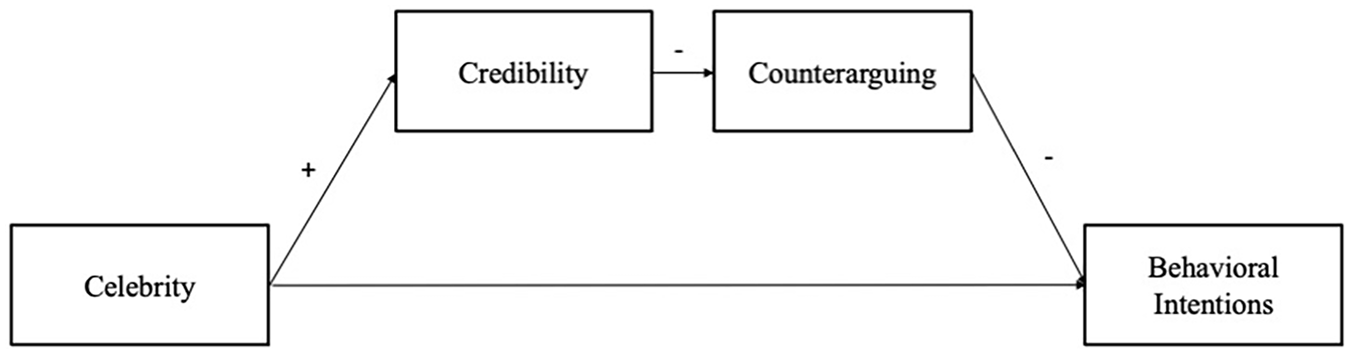
Theoretical Model of Predicted Relationships (Study 1, Study 2).
Beyond examining whether and how a celebrity endorsement influences behavioral intention, it is also important to consider how characteristics of the social media post itself might influence perceptions of credibility and subsequent behavioral intentions.
Message Factors and Credibility
Although the credibility of the source is a crucial factor in the effectiveness of a message, it is equally important to consider the content of the message itself. The type of content used within a social media post can significantly influence how the message is perceived, and consequently, the credibility attributed to the celebrity endorser. Indeed, content that is well aligned with the celebrity’s persona or expertise can enhance their perceived credibility, whereas content that appears inauthentic or irrelevant can undermine it. We explore this by examining whether the celebrity can enhance their credibility by including numeric information within their social media posts.
Although individuals can post either videos or graphics to their Instagram account, we focus here on the original purpose of the platform: static pictures with a text caption. When an individual crafts their post, stylistic decisions affect the way information is presented to their audience, which either enhances or minimizes the credibility of the information. Indeed, the way that information is presented influences how an individual evaluates a message. For example, complex information, such as the use of technical jargon or using numbers to emphasize a point, serve as a heuristic cue for the message’s credibility (Zimmermann & Jucks, 2018). Furthermore, individuals who use numeric probabilities in their messages are judged as more credible than individuals who use a verbal description of a probability (Collins & Mandel, 2019). Chinn and Weeks (2021) experimentally tested the influence of a layperson using statistics in a debate about a scientific topic and found that the use of statistical evidence in the layperson’s argument enhanced their credibility. Although using numeric information could enhance the celebrity’s credibility, it is also possible that this type of information might backfire and undermine their credibility as it might not match with expectations about the celebrity’s brand and expected communication style. Therefore, we pose the following research question:
Study 1 Context
In the first study, we examine how the celebrity influencer Ellen Pompeo, the protagonist of the medical drama Grey’s Anatomy, is viewed on Instagram when she encourages her followers to obtain a booster shot for COVID-19. In March 2020, COVID-19 was declared a pandemic, leading to worldwide stay-at-home orders. Consequently, the entertainment industry halted filming, and popular television shows, including Grey’s Anatomy, went on hiatus. When the show resumed, the producers and actors focused a season on COVID-19 and its impact on the medical industry (Kirkland, 2020). Although the fictional characters battled COVID-19 in the hospital, the actors issued PSAs on social media, urging followers to stay at home and get vaccinated (Chung, 2021). Given that COVID-19 was a central theme of an entire season and that the actors, including Ellen Pompeo, issued personal PSAs on Instagram, we use Pompeo as a case study to explore the credibility of celebrity health-related endorsements. Specifically, we examine the influence of her urging followers to get a COVID-19 booster shot.
Study 1 Method
Participants
Participants (n = 338) were recruited using the Connect platform via CloudResearch. However, 16 participants were removed who failed one or both attention checks (i.e., failure to select a response embedded in a multi-item question), resulting in a final sample of 318. The sample predominantly identified as men (50.2%), followed by women (47.6%), non-binary (1.3%), transgender man (.3%), transgender woman (.3%), and other (.3%). Participants were allowed to select as many racial/ethnic identities as desired. The sample consisted of mostly White (70.1%) participants, followed by Black (10.7%), Asian (9.7%), Hispanic (6.8%), other (1.6%), and Native American (1%) individuals. In addition, many individuals reported receiving a bachelor’s degree (44%). Finally, the sample was predominantly Democrat (56.6%), followed by Republican (23.5%), and Independent (19.8%).
Procedure
The online experiment used a 2 (author: celebrity or expert) by 2 (presentation: numeric or generic) factorial design, exposing participants to celebrity + numeric condition (n = 82), celebrity + generic condition (n = 78), expert + numeric condition (n = 80), or the expert + generic condition (n = 78). After providing informed consent, participants were randomly assigned to either a celebrity or expert-authored Instagram post containing either numeric or generic presented content. After exposure to the stimulus material, participants completed a post-test questionnaire.
Stimuli Material
Social media mock-up posts with a photograph and text were created to mimic Instagram posts. For the celebrity condition, a photo of Ellen Pompeo was used, and for the expert condition, a stock image of a medical doctor was used. Both posts contained information about the efficacy of vaccine boosters and arguments in favor of receiving the COVID-19 booster. The numeric presentation posts contained numerical information (i.e., “the updated booster shots are 37% more effective at preventing severe COVID-19 than the original booster”). Meanwhile, the generic presentation posts contained similar arguments without numerical data (i.e., “the updated booster shots are considerably more effective at preventing severe COVID-19 than the original booster”).
Measures
Manipulation Check
A one-item question asked participants to rate the extent the message they read contained statistical information about the COVID-19 booster. Participants rated the item on a scale of 1 (strongly disagree) to 7 (strongly agree), M = 5.55, SD = 1.65. Results of the manipulation check are below.
Credibility
An adapted measure from McCroskey and colleagues (1974) was used. The measure included three items with a semantic differential scale with seven bubbles between the options. The items were knowledgeable—uninformed (reverse scored), deceptive—trustworthy, and unlikeable—likable. Although there are other measures of credibility, this scale taps into the three core components of credibility: Expertise, Trustworthiness (otherwise known as benevolence), and perceived likability. A mean of the score was used in the analyses (M = 5.54, SD = 1.51, α = .92).
Behavioral Intentions
A one-item measure was created to measure intentions to obtain the COVID-19 vaccine booster. Participants were asked to respond on a scale of 1 (extremely unlikely) to 7 (extremely likely) to the likelihood of receiving the booster for COVID-19 (M = 4.90, SD = 2.32).
Counterarguing
Counterarguing was measured by asking individuals to respond to three statements on a scale of 1 (strongly disagree) to 7 (strongly agree). Each of the items were designed to tap into counterarguing the content of the message as opposed to the source or message presentation (for a review of the measure, see Watts et al., 2023). The statements were as follows: “I sometimes felt like I wanted to ‘argue back’ with what was being said in the post,” “This post did not line up with my beliefs about COVID-19,” and “While I was reading this post, I found myself disputing with the author had to say about COVID-19” (M = 2.28, SD = 1.84, α = .95).
Prior Behavior
A one-item measure asked participants whether they had ever received the COVID-19 vaccine. Participants were allowed to select yes (1), no (2), and prefer not to state (designated as missing values). The majority of the sample had received the vaccine (received vaccine 80.5%, n = 256; never received 16.4%, n = 52; prefer not to state 0%).
Familiarity
Participants were asked to rate their familiarity with Grey’s Anatomy on a scale of 1 (not familiar at all) to 5 (extremely familiar), M = 3.00, SD = 1.29. The item Grey’s Anatomy was embedded with other TV shows (i.e., SVU, Scandal, Ted Lasso).
Results
A manipulation check was conducted to determine whether the presentation of numeric information differed from the generic presentation of information in the social media post. The manipulation was successful, t(239.10) = −9.22, p < .001. In the following analyses, we control for familiarity with Grey’s Anatomy and filtered our participants who had never received the vaccine (n = 52).
Per
Per
Per
Finally, we examined whether numerically presented social media posts moderated the indirect effect of the celebrity-authored posts on behavioral intentions via credibility and counterarguing (
Study 1 Discussion
In Study 1, we tested whether social media posts encouraging COVID-19 booster appointments were more persuasive if they originated from a celebrity influencer or a subject matter expert. Specifically, we examined whether a celebrity known for her role as an onscreen doctor might be perceived as a credible source of health information, thereby reducing counterarguing and increasing intentions to get a booster. Contrary to our expectations, we found that the celebrity-authored post decreased credibility perceptions, which led to an increase in counterarguing and subsequently decreased intentions to get a booster. The medical expert, however, was viewed as a more credible source of information about the COVID-19 vaccination than the celebrity. In addition, credibility evaluations did not change even when the post included numeric information, which typically boosts the perceived credibility of a message.
Interestingly, many of our predicted outcomes were significant in the opposite direction than hypothesized. We posited that a celebrity post would be perceived as more credible than a post authored by a traditional expert (an individual with subject matter expertise). We based this on previous research suggesting that celebrity influencers are often seen as credible sources of information and speculated that an actor’s fictional persona might lend them perceptions of expertise. According to a meta-analysis on the effectiveness of celebrity endorsements, they are most successful when the advocated behavior closely matches the celebrity’s personal brand (Knoll & Matthes, 2017). Thus, we expected that a celebrity well known for their role as a medical doctor might be a credible source of health information. This hypothesis was further supported by real-life campaigns, such as the #GetVaxxed campaign, that made the decision to rely on actors to endorse and spread their message.
However, our findings suggest that in the context of health, a medical expert is perceived as more credible than a celebrity. This indicates that the context in which the influencer is advocating might interact with the influencer’s perceived credibility. It raises questions about whether celebrities are the best choice for health campaigns or if it would be more effective to use influencers who are actual experts, such as medical doctors, with a social media presence.
This study only examined one actor’s influence on behaviors in a single context. It is possible that while a celebrity might not be influential in a health context, they could be influential in a different social context, such as advocating for a political issue. Therefore, we replicate Study 1 in a new context: police reform.
Study 2
Given the findings of Study 1, we sought to further understand how individuals evaluate celebrity advocacy when the context is a political issue rather than a health one. In Study 2, we situate our research in the context of police reform, a highly polarized issue that calls for systemic changes within police forces and higher levels of accountability within the justice system for abuses of power. This issue has garnered significant media attention and has become polarized along party lines, with conservatives increasingly associated with pro-police attitudes and liberals with advocacy for reform (Vitro et al., 2022).
As with many socially relevant discussions, the long-standing show Law & Order: SVU has incorporated discussions about police reform into its plots. The show’s female lead, Mariska Hargitay—who plays lead detective Olivia Benson—has advocated for various issues that align with her character, such as advocating for ending the nation’s rape kit backlog (Hargitay, 2018). Because the topic of police reform coincides with Hargitay’s onscreen role as a police detective, we use Hargitay and the issue of police reform as the context of our second study. Here, we retest our hypotheses (Figure 1) and research questions from the first study to see if the findings hold true in this different context.
Study 2 Method
Participants
Participants (n = 478) were recruited on the Connect platform via Cloud Research. During the process of data cleaning, 16 participants were removed for failing one or both attention checks (i.e., failure to select a response embedded in a multi-item question), resulting in a final sample of 462 participants. The sample was almost evenly split between those who identified as men (50.6%) and women (48.1%), with the remainder of the sample identifying as transgender man (.4%), transgender woman (.4%) or preferring not to disclose a gender identity (.4%). Participants were allowed to select as many racial/ethnic identities as desired. The sample consisted of mostly White (79.2%) participants, followed by Black (11.7%), Hispanic (6.1%), Asian (4.5%), Native American (1.5%), and individuals who identified as other (1.6%). In addition, most individuals reported receiving a bachelor’s degree (41.6%). Finally, most of the sample identified as Democrat (57.8%), followed by Republican (39.4%), and Independent (2.8%). Data collection for Study 2 occurred after data collection for Study 1.
Procedure
Study 2 followed the same experimental manipulation as the previous study with participants exposed to celebrity + numeric condition (n = 112), celebrity + generic condition (n = 120), expert + numeric condition (n = 115), or the expert + generic condition (n = 115).
Stimuli Material
Social media mock-up posts with photographs and text were created to mimic Instagram posts. For the celebrity condition, a photo of actress Mariska Hargitay from Law & Order: SVU was used, and for the expert condition, a stock image of an attorney was used. Both posts contained information about trends regarding the impact of police brutality on the Black community and arguments in favor of police reform. The numeric presentation posts contained numerical information (i.e., “Roughly 1000 people are shot by police each year, and Black Americans were estimated to be 3.5 times more likely to experience fatal police violence”). Meanwhile, the generic presentation posts contained similar arguments without numerical data (i.e., “Of the numerous police killings that occur each year, Black Americans were more likely to experience fatal police violence”).
Measures
All of the previous measures used in Study 1 were used in Study 2, except that the behavioral intentions measure included more items to increase reliability.
Manipulation Check
As measured in Study 1, participants were asked to rate the extent the message contained statistical information about police reform (M = 3.21, SD = 1.08).
Credibility
Credibility was measured in the same way as Study 1 (M = 4.99, SD = 1.64, α = .90).
Behavioral Intentions
Six items were created for this study to measure intentions to support police reform. Participants were asked to respond on a scale of 1 (not at all likely) to 7 (very likely) the likelihood of supporting police reform (i.e., “Educate myself about police reform,” “Speak to friends/family members about police reform,” “Reach out to city council members to voice support for police reform,” “Donate to organizations that support police reform,” “Sign a petition to support policies related to police reform,” and “Attend a protest to support police reform,”) (M = 3.25, SD = 1.77, α = .95).
Counterarguing
The same procedure for measuring counterarguing was used as in Study 1 (M =3.11, SD = 3.25, α = .95).
Familiarity
Participants rated their familiarity with SVU using the same procedure as Study 1 (M = 2.82, SD = 1.30).
Results
A manipulation check was conducted to determine whether the presentation of numeric information (M = 3.52, SD = .99) differed from the generic presentation (M = 2.92, SD = 1.08) of information in the social media post. The manipulation was successful, t(460) = 6.12, p < .001. In the following analyses, we control for familiarity with SVU.
Per
Per
Per
Finally, our research question posed whether numerical presented information would moderate the indirect effect of the celebrity-authored post on behavioral intentions to support police reform via serial mediators credibility and counterarguing. A moderated mediation was analyzed in PROCESS (Model 83) with 5,000 bootstraps. The index of moderated mediation was not significant, index = .02, Boot SE = .03, [LLCI: −.02, ULCI: .09].
Study 2 Discussion
In Study 2, we sought to replicate the results from Study 1 using a new, politically charged topic: Police reform. Contrary to expectations, neither the numeric presentation nor a social media post authored by an expert influenced behavioral outcomes relevant to police reform. These findings point to the nuanced effectiveness of celebrity endorsement when it strays from consumer-related behavior. Indeed, there was no difference in the credibility ratings of a celebrity as compared to that of an expert source. Given that there was no effect of source type on credibility ratings, the remainder of our hypotheses failed to replicate as well. This finding might suggest that for more controversial topics, it might not matter who is delivering the message, as individuals will engage in higher levels of counterarguing. Future research should examine how individual factors, such as an individual’s partisanship, might influence this relationship.
General Discussion
Across two studies, we investigated whether informant type (celebrity influencer vs. traditional expert) and presentation style (inclusion or exclusion of numeric information) influenced intentions to perform behaviors in a health and political context. In Study 1, we found that contrary to expectations, the celebrity-authored posts decreased credibility, and generic-presented information was counterargued more. Overall, participants in Study 1 were more persuaded by a professional medical expert, regardless of numeric or generic presented information, about the efficacy of a COVID-19 booster.
Accordingly, we replicated our expectations and presumed participants in Study 2 to be persuaded by social media posts authored by a celebrity influencer. Contrary to expectations, neither message information (celebrity or topic matter expert) or message presentation (numeric or generic information) influenced participants’ counterarguing or intentions to support police reform. The results across our two studies suggest that the context and content of persuasive social media messages matter. Although both topics (COVID-19 and police reform) are considered political topics by many, police reform might be more highly polarizing for individuals as inferred by the presence of more counterarguing in Study 2.
This also points to an interesting paradox in how individuals consume information on social media (for a recent review, see Chan, 2024). Indeed, for a health topic, individuals found a traditional medical expert to be more credible than a celebrity influencer, which in turn influenced their attitudes and behavioral intentions. This suggests that in terms of health issues, public health campaigns might be more impactful if they tap into the expert community to deliver their messages. This also raises an important direction for future research. Within this study, we focused on perceived credibility as a mechanism driving a reduction in counterarguing. We found that individuals counterargued the information presented by the celebrity source more than that presented by the medical expert. Future research should explore other mechanisms, such as parasocial interactions, to understand whether there are other mechanisms that might make celebrity-authored content more persuasive than content authored by other influencer types.
Contrarily, when we attempted to investigate this finding in the context of police reform—a more politically charged issue—we found that the source of the message did not impact persuasion nor did the type of information presented in the message. Indeed, none of our hypotheses replicated within the political context. This finding echoes Druckman’s (2022) call that persuasive communication scholars should investigate persuasive mechanisms across contexts to ensure that findings are not context-specific. Although the conflicting results in our study might seem disparate at first, it creates a new avenue for research on celebrity endorsement. Our findings suggest that the influence of celebrities is limited when it comes to health and political contexts. One explanation for this finding could be because there are other factors, such as individual differences, that influence how individuals process messages about politically charged topics. It is possible, therefore, that one’s partisanship might have influenced the persuasiveness of the message.
Our study used two celebrities versus fictitious professional experts. Because the fictitious expert was unknown, this lack of familiarity might have affected the results. However, we controlled for familiarity with the entertainment program across both studies. Future studies should consider the impact of demographics and target-specific subpopulations. In future research, prior knowledge about the topic should be assessed to determine whether the influence of message source and topic vary per prior knowledge. A third and important limitation of our study is we used an abbreviated scale to measure perceived credibility. Future research should incorporate a more recent measure to ensure that our results are reproducible. Specifically, the scale should include measures about the perceived attractiveness of the source as this likely influences the persuasiveness of the celebrity influencer. Finally, future research should match between influencers who are followed within a specific demographic and celebrities who are popular within that demographic.
Conclusion
Celebrity influencers will continue to endorse products and advocate for social issues on SNS platforms. Although brief social media posts by a professional expert were found to persuade individuals on a health topic, context and content affect how individuals mentally process and engage with social media posts intended to influence audiences. Future research should continue to examine under what contexts and with which audiences, celebrity influencers are most effective.
Supplemental Material
sj-docx-1-jmq-10.1177_10776990241297653 – Supplemental material for Agents of Change or Counterarguing? Investigating the Source Credibility of Celebrity Versus Traditional Experts on Health and Political Behaviors
Supplemental material, sj-docx-1-jmq-10.1177_10776990241297653 for Agents of Change or Counterarguing? Investigating the Source Credibility of Celebrity Versus Traditional Experts on Health and Political Behaviors by Austin Y. Hubner and Judy Watts in Journalism & Mass Communication Quarterly
Footnotes
Declaration of Conflicting Interests
The author(s) declared no potential conflicts of interest with respect to the research, authorship, and/or publication of this article.
Funding
The author(s) received no financial support for the research, authorship, and/or publication of this article.
Supplemental Material
Supplemental material for this article is available online.
Author Biographies
References
Supplementary Material
Please find the following supplemental material available below.
For Open Access articles published under a Creative Commons License, all supplemental material carries the same license as the article it is associated with.
For non-Open Access articles published, all supplemental material carries a non-exclusive license, and permission requests for re-use of supplemental material or any part of supplemental material shall be sent directly to the copyright owner as specified in the copyright notice associated with the article.
