




Abstract
Invasive species are a threat to ecosystems around the world. In public discourse, however, the topic is marginalized and occluded. This article explores that marginality in terms of identity and positioning work in specialist journalists’ tweets. Two countries with high incursion risks, Aotearoa New Zealand and the United States, are studied. The article finds that invasive species are largely left in the realm of the technical and excluded from politics. Using field theory, the article proposes that the topic lacks symbolic power. Journalists are oriented to norms in both countries that give them limited power to name an environmental crisis.
Introduction
From pandemics to agricultural pests and species that disrupt local ecology, invasive species are a major problem in an interconnected world and a key case of how humanity is altering planetary systems. In the North American Great Lakes region, for example, the ecosystem has been significantly modified by an estimated 64 different aquatic invasive species (State of the Great Lakes, 2022). In Aotearoa New Zealand, 1 non-native species have displaced most native species from their habitats, with 75% of indigenous animals either threatened with extinction or at risk (Statistics New Zealand, 2023). In both cases, changes that people have made to the environment are the main causes. However, outside moments of crisis, these ecological issues are not given prominence or in-depth treatment in news journalism (Ballari & Barrios-García, 2022; Geraldi et al., 2019; Ricciardi & Ryan, 2018).
This article contributes to explaining that marginalization in two countries with major invasive species problems. It seeks to understand the ways that journalists situate the topic of invasives, through studying how invasive species reporting contributes to their habitus or “socially constituted dispositions” (Bourdieu, 1991, p. 11). Specifically, we study the ways that journalists talk about the topic in the promotional or reflective work they do on Twitter/X, theorizing that they perform key aspects of their professional selves in such metadiscourse (their talk about their work) on the platform, thus giving insight into the topic’s marginalization. This discourse formed a very small proportion of each journalist’s tweeting and therefore a close textual analysis of the marginal discursive labor by these journalists on Twitter was performed.
A case can be made that invasive species should be a key topic for environmental and other specialist areas of journalism. Incursions of pests and diseases pose threats to biodiversity, to agriculture, to human health, and to matters of cultural value. A major inter-governmental stocktake in 2019 ranked invasive species as one of five direct drivers of biodiversity loss globally, alongside well-known drivers such as human modification of the environment and climate change (Intergovernmental Science-Policy Platform on Biodiversity and Ecosystem Services [IPBES], 2019). Biodiversity loss represents the current extinction risk, the stocktake estimated, of a million species worldwide, and the rapid deterioration of many of the ecosystems on which humans depend. These issues are of recent origin: a third of the recorded first introductions of species come after 1970 (Seebens et al., 2017). They are also acute issues in the places studied in this article, Aotearoa and the United States. Turbelin et al. (2017) calculated the mainland United States (plus Hawaii) and Aotearoa as the two land masses affected by the largest number of incursions of plants, animals, and other organisms. Trade, colonialism, economic development, climate change, and other human activities are the major causes of unwanted and damaging species moving between habitats (Turbelin et al., 2017).
As with climate change, the science suggests the need for “transformative change” (IPBES, 2019) in how people live their lives, including societal goals and values, to make these risks manageable. The article adds to the understanding of that challenge through identifying ways in which the topic is marginal to the professional-public habitus deployed by journalists on Twitter in two highly impacted countries, decoupling the topic from public debate on the platform.
Literature Review
Journalism and Environmental Science
Science communication research has long emphasized journalism’s role in enabling citizens to make judgments about risks surrounding them (Secko et al., 2013). That knowledge must therefore be widely accessible (Boykoff & Boykoff, 2004) and to that end scholars have traced journalistic techniques such as local news hooks, a focus on explanation of complex science and links to health, economic, or geographic impact that enable science to become public knowledge (Clatworthy & Jones, 2003; Dunwoody, 2021; Hinnant et al., 2012; Jerit, 2009; Smith & Norton, 2013). Underpinning this research is the understanding that journalism’s focus on audience engagement can deepen public engagement with science in ways that scientific research outputs themselves fail to do (Dunwoody, 2021; Friedman, 1999). At the same time, a key theme in studies of environmental media is the risk that the news on science will be narrowed according to what is easier to explain or understand. The status of science may be contested within journalism, with a scientific habitus devalued within the field as inaccessible to the general public (Møller Hartley, 2017). Very little of this research has focused on invasive species communication, including the risks to biodiversity, agriculture, and people’s lives. Saydı (2022) found the New York Times devoted space to the topic in its science section, framing it predominantly as a threat, with emphasis on human causes of incursions and on conservation responses. There is some research suggesting that invasive species have become more mainstream in the wake of growing public awareness of anthropogenic climate change (Otieno et al., 2014). However, most extant work finds coverage to be scarce (Geraldi et al., 2019) and limited in its engagement with the science. In a case study on boars in Spain, Ballari and Barrios-García (2022) critique news media for marginalizing ecological science, echoing Raghu et al.’s (2006) concerns over the quality of science in reporting of invasive species. Ricciardi and Ryan (2018) and Russell and Blackburn (2017) identify reactionism and denialism around invasive species issues in parts of public debate, based on a denial of invasion biology.
Recent research on environmental communication focuses more on how journalists foster public engagement with the questions being raised within science, and less on the quality of their transmission of scientific findings. Brüggemann and Engesser (2017), for example, critique coverage of sustainability that fails to link topics together and instead treats the environment as external to human life. There are calls for greater reflexivity within journalism and the development of norms in which science is treated as a social and political matter to be debated as much as scientific advances to be reported (Gunster, 2017). Weder et al. (2021) call for public communication rooted in an ethic of sustainability, in which public conversation around complex risks and difficult political choices is guided by a commitment to societal change. These critiques ask journalists to revisit established approaches to scientific knowledge and in particular for them to take a leadership role in foregrounding the science on human impacts on the environment and values of sustainability in public debate.
Consequently, several scholars and practitioners have recommended that environmental journalists rethink elements of their practice, learning, for example, from blogging and social media discourse about how to foster discussion and mobilize publics (Friedman, 2015; Tandoc & Takahashi, 2014). This includes a demand that science and policy be linked and public participation enabled. Central to the challenge to journalism is a shift away from deficit thinking, within which publics are thought of as ignorant or in need of guidance, toward critical analysis of areas of public knowledge that are marginalized and need better facilitation, prompting a strand of research on how “up-stream” engagement of the public changes scientific and policy-making institutions and on how communities’ politics and values can inform decision-making around risk. Some of this work explores how journalists’ participation in social media remediates their relationships with communities, publics, and their networks of sources, providing opportunities for reworking their practices.
Journalists on Twitter
A reworking has certainly taken place in journalism, but in ways that have not always strengthened its capacity to lead public debate. News practice has been changed by the arrival of social media, as audiences and revenue have been attracted to digital platforms, and journalism has been decentred in public communication. Scholars have also traced changes in news practice, from analysis of shifts in the shape of news (Hermida, 2013; Matheson & Allan, 2010) to the boundaries between journalism and other public communication practices to agenda-setting to new practices (Djerf-Pierre et al., 2016). Twitter use became widespread among journalists as it rose to prominence: Gulyas (2017) found 79% of US journalists using it in a typical week in 2013, from publishing content to sourcing the news, networking, and monitoring. Large minorities of journalists she surveyed reported that they were more effective in their work and better connected to audiences—unable to do their work now without it. Willnat and Weaver’s (2018) findings on US journalists were similar on these points, with even higher evaluations of Twitter’s positive effects on their work (p. 897).
At the same time as Twitter enables new reporting practices and relationships with audiences, there has been reaction, resistance, and ambivalence (even before the transformation of the platform by Elon Musk in 2023). Scholars have found that news practice has been slow to change sourcing practices (Barnoy & Reich, 2021). Studies also showed caution about introducing the personal self into reporting (Lasorsa et al., 2012). Journalists also differ in their approaches. Djerf-Pierre et al. (2016) noted that journalists who were more comfortable with “audience adaptation and who embraced the commodification of journalists through personal branding” were quicker to use social media (p. 852). They described an ongoing and far from homogenous process, among the Swedish journalists they studied, of trying out and reconsidering various platforms for various purposes. Journalism’s response to platforms such as Twitter varies in different parts of the practice. Molyneux and Mourāo (2019), for example, note that political journalists largely follow and interact with other political journalists, retweeting as a way of promoting the work of colleagues and using quotation to comment on other peers. Hanusch and Nöllecke (2019) find journalists in most other areas of journalism are less homophilous—that is, they use Twitter as much to connect with networks of sources. In the United States, Edgerly et al. (2023) find both an enduring discourse on the value of these platforms to deliver the news faster and further and “rich complexity” of talk about the epistemic challenge of social media to quality public discourse, to business models, and other aspects. “Twitter is a great tool for journalists in a lot of ways,” one journalist commented, “and can give a voice to those who wouldn’t otherwise have one, but I doubt that’s enough to make the evil part of Twitter worth it” (pp. 963–964). Yet, on the other hand, Molyneux and McGregor (2022) find widespread use of tweets in news stories, as journalists both recognize and reinforce the legitimacy of Twitter as a site of public knowledge.
Approach
Theory
It is important, therefore, to approach Twitter data as a constrained and contested site of social practice. This is particularly the case in a study of marginal practice such as invasive species reporting. Such a study can then be connected with studies of news content and interviews with journalists to understand the prevalence of specific topics, editorial priorities, relationships with news sources, and judgments about the topic’s newsworthiness or audience interests. The strand of work in this article concerns the work journalists do to occasionally bring the topic to publicness, within the norms and pressures around reporting on science and the environment. We ask: When journalists do tweet about invasive species, how do they highlight issues, engage in the circulation of knowledge and engage with their publics?
We turned to Bourdieu’s field theory to explore the extent to which the demands made of journalists on social media restrict reference to invasive species within our sample. The concept of habitus, in particular, is used in exploring those demands in terms of how symbolic capital, or the power to name and classify things, is deployed at the level of the social relations engaged in by the journalists. Analyzing the habitus of journalists on Twitter—their practical sense about how to hold themselves in the space of social media or their embodied “‘feel’ for the game” (Bourdieu, 1998, p. 25)—opens up to scrutiny the ways that social norms are naturalized—and perhaps also challenged—in their practice. The resulting analysis of symbolic capital contributes to an understanding of how power operates in terms of what can be said and what is less easy to say for journalists. In terms of field theory, we assume that the “socially-constituted dispositions” of journalists constrain their discussion of invasive species in the field of politics in the United States and Aotearoa (Bourdieu, 1991).
We are studying the journalists’ participation in social media publicness as well as journalism. That is, by studying how to tweet right as journalists, we understand them as positioning themselves in multiple ways in terms of social capital available to them, tweeting in front of peers and their source networks (Berglez, 2018), and more generally as Twitter users. The relational space must be understood in terms of both the field of journalism and the field of social media. The pursuit of “journalistic capital,” that is, of peer recognition or status, or their alignment with specific norms such as objectivity or autonomy that gain such capital (Maares & Hanusch, 2022, p. 746), is less prominent because the “game” is different.
Symbolic power in Bourdieu’s terms can be criticized for being fairly deterministic: people choose what is chosen for them within the practice. As Sayer (2017) notes, Bourdieu devalues community or collaborative processes and places less value on how people experience the world than on what he terms their objective relationships to others in social fields. That narrow focus on relationships within a field is, however, useful for this study, given our interest in how the institutional conditions of journalistic tweeting constrain the practice and in how journalists in Aotearoa and the United States negotiate those social forces so as to occasionally make the topic public.
The term habitus does not direct us to specific textual elements of the tweets, but to structures that shape their thinking and relations. This “embodied politics” (Topper, 2001) is then expressed in textual practice. Bourdieu defined habitus as internalized and embodied mental structures: “a system of acquired schemas that become practically effective as categories of perception and evaluation, that is, as principles of classification, and also as principles organizing social action” (quoted in Honneth et al., 1986, p. 42). Meyen and Riesmeyer (2012) emphasize that the habitus should be understood both in terms of how journalists hold themselves in what they do and how they align with ideas of that work. It leads to an analysis of journalists’ relationships through the texts, of how they narrate the world, and of the roles that they take on.
Methodology
We study journalistic tweeting in two contrasting countries with a very high level of identified pest incursions, Aotearoa and the United States. A study that is both focused in this way and comparative allows us to identify the distinctive discursive work done in each place and also to begin to develop a more general picture of reporting on the topic within the Anglo-American journalism tradition (Hanitzsch et al., 2019, p. 3). We emphasized specialist environmental and agricultural journalists in our sample, because they are likely to have more clearly defined dispositions.
We gathered all the tweets produced by 36 journalists in the United States and 39 in Aotearoa who report on science, the environment, and the agricultural sector. Journalists were chosen in Aotearoa based on a manual search of news coverage, which led to the selection of a high proportion of the specialist journalists actively reporting on the topic. Journalists in the United States were chosen based on a list from the Society of Environmental Journalists (https://www.sej.org/). Initially, the latter group was selected from two eastern states, Tennessee and North Carolina, which the Yale Center for Biodiversity and Global Change Research identified as having high biodiversity value (Hathaway, 2021), to provide a sample similar in size and focus to the Aotearoa sample. The small amount of material found led us to expand the sample to a national list of environmental journalists. We sought to supplement the list with a manual search for US agricultural journalists but could find none who tweeted on the topic. The search for accounts in the United States was stopped when it reached a similar size to the Aotearoa sample. The samples are therefore not statistically representative of specialist environmental or agricultural journalists in the two countries but provide a broad-based selection of specialists reporting on the topic. They include accounts from journalists at major national and city-based media, specialist media, freelance journalists, and some media at the interface with environmental action or science organizations. The 39 Aotearoa journalists worked (as of 2022) across 8 print/digital, 3 broadcast and 2 online-only outlets; 4 journalists freelanced across media. The 36 US journalists worked across 21 print/digital, 4 broadcast, and 3 online-only outlets; 8 freelanced across media. The US media outlets were from across the country. Because we are studying an activity that is not a central practice in any of these accounts, no attempt is made to analyze sub-samples of types of journalists, other than by country, or to quantify patterns.
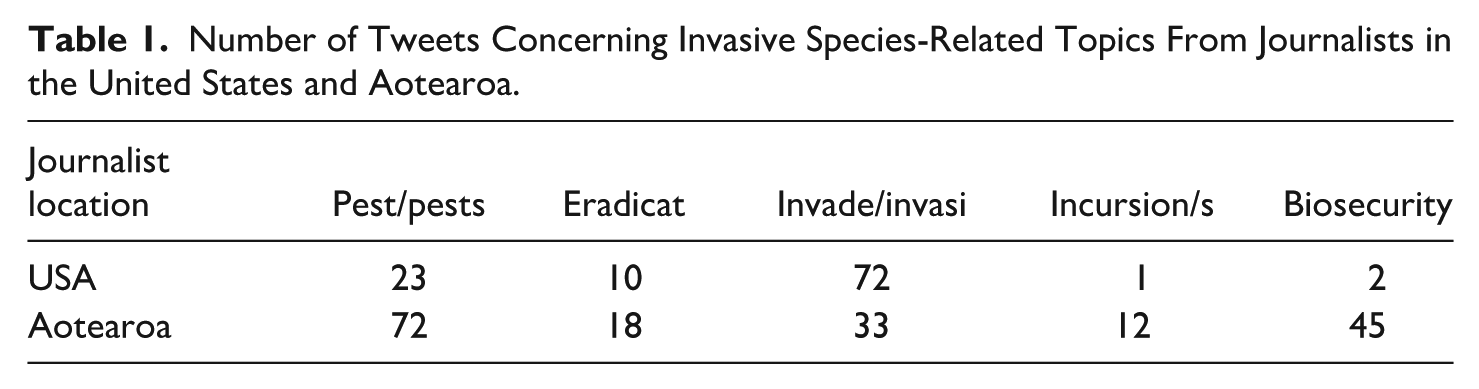
All available tweets by these journalists were drawn down from their accounts using the NVivo tool, NCapture. In total, data across 15 years was collected, from 2007 when Twitter launched to 2022. Tweets were then filtered for key terms: “biosecurity,” “invasive,” “invade,” “pest,” “incursion” and “eradicate” including variants such as “invader” or “eradication.” NCapture accesses Twitter’s keyword search functionality and is promoted by NVivo as having few systemic data limitations. This resulted in a sample of 108 tweets from 25 US journalists sampled and 180 tweets from 32 Aotearoa journalists (some journalists did not produce any relevant data; see Supplemental Appendix 1 for a full list). As Table 1 reports, there was variation in terms of the two countries, but a general picture of very low activity. A manual search for tweets on particular species confirmed the keywords had picked up most tweets from these journalists discussing the topic of invasive species—some other tweets discussed pests such as rabbits or unwanted plants, but not in the context of invasive species.
Number of Tweets Concerning Invasive Species-Related Topics From Journalists in the United States and Aotearoa.
The tweets were initially analyzed by the lead author for evidence of discursive labor and then discussed with the second author, leading to further rounds of analysis by both authors. The small samples meant texts could also be searched up on Twitter when further context was needed to understand the journalists’ practices better. This was done for all tweets where matters of interest were identified and allowed images and occasional comments made on the tweets to inform the analysis. The analysis was inductive, in that texts were read for their meaning-making practices rather than for a list of features or for themes. The existing literature on journalistic tweeting and environmental communication informed the practices looked for. These included: promotion of news stories; retweeting of other tweets, including other journalists’ stories; claims to authority or scientific knowledge; commentary or opinion; calls on the audience to know, be aware of risks or take action; use of emotional language; and links made between topics. In Pahl’s (2008) terms, the texts were read for traces of the ways of being and social practices that settled into those texts in their creation (p. 191). The process accords with Guba and Lincoln’s (1989) criteria of authenticity in naturalistic inquiry (see also Schwandt, 2007). For example, the credibility of the analysis of those traces of habitus was enhanced through attention to context; “confirmable” analysis was achieved through close attention to textual detail, an emphasis on patterns rather than individual instances and long quotations from the texts. The analysis remains an argument of the authors.
The patterns in practices identified were then organized into four main observations: the journalists’ positioning in networks; the narratives they aligned with; moments of discursive work to broaden those narratives; and the narrow and marginal roles they took on. These are detailed in the Findings below.
Findings
Positioning in Networks
We first discuss the network practices within which the tweets about invasive species occasionally arose, because of the centrality of relational work to symbolic power. The journalists in the two countries took part in quite different kinds of networks. In Aotearoa, invasive species were discussed by journalists tweeting largely in front of their source networks, whereas in the United States, they arose as part of journalists’ interventions in broader public discourse. Their relationships with these networks are relevant to the question of what was relevant for them to tweet.
The Aotearoa Twitter accounts belong to two small and distinct networks: on the one hand, an agricultural network; and on the other, a science and environmental network. These two sets of journalists were each connected internally by follower relationships with sources and with organizations in their respective sectors. There was a similar bifurcation of the information the journalists tweeted, retweeted, or commented on, focusing respectively on either agricultural voices or scientists and environmental lobbies. Comments on their posts came mostly from these source networks. The networks were also relatively distinct from other parts of Twitter. Thus, when Jamie Morton, science reporter at the country’s largest newspaper, the New Zealand Herald, tweeted a story undermining a claim linking a controversial pesticide to bird deaths, he received a comment predicting a backlash from anti-poison campaigners but no actual backlash. Those campaigners were not present or not active in the network he took part in.
When Aotearoa journalists tweeted on invasive species, it was in what Mellado (2022) terms “promotional tweets” about news stories that were written for a wider public. As tweets, however, they were produced in front of and sometimes at actors within those source networks. These include state agencies, agribusiness, scientists, or agentless actions, such as “pest control” and “pest management.” Sometimes, as in this example from a farming sector journalist, the source network is explicitly invoked as a Twitter network, through @mentions of key actors in the story: 50 NZ companies pledge to protect us from pests and diseases. Biosecurity Business Pledge Backed by @fronterra, @TeAraMiraka, @TatuaFoodsNZ @dairynz @Fedfarmers, @silverfernfarms among others @DamienO’connorMP says we must protect agri trade ($46 billion) and tourism ($39b).” [Image of business logos] Sudesh Kissun @sudeshkissun October 31, 2019
Invasive species also arose in a few more casual tweets, but almost always as asides in tweets on other topics. For example, an agricultural reporter commented: Had the grumpiest/most entertaining taxi driver from the airport in Wellies [Wellington], complained about roadworks, lack of biosecurity and Fonterra and not even the rain. . . and I didn’t even tell him what I did for a job. Sheryl Haitana @SherylHaitana October 18, 2019
The topic is secondarily relevant to the network, part of the already known, rather than a focus of discursive work in the network. The journalistic habitus of scrutinizing or challenging is not present.
In the United States, the networks for these tweets look quite different: these occasional tweets about invasive species rarely include @mentions and rarely mention specific actors. Instead, they stayed focused much more on the natural phenomena themselves, as befits tweets that are contributing to a more generalized public knowledge. Where journalists gave details in their tweets, it was less on who was responding to incursions and more on the habitats and ecosystems themselves. Individuals were occasionally mentioned as part of the explanation, such as: On the spread #spottedlanternfly and other invasive pests, I spoke to an @NCstate forestry expert about why they can be problematic. Her response: “Invasive species aren’t usually a problem in their native range because they have natural predators, diseases there” Laura Jane Oleniacz @Laura_Oleniacz August 26, 2022
In contrast to Aotearoa, government or industry actors, along with their apparatus for responding to incursions, did not frame the discourse. Tweets on invasives were scattered amidst the work of the science or environmental reporter to explain a wide range of natural phenomena to a science-interested public.
Narratives of Incursion and Control
In the narratives drawn on, Aotearoa journalists we sampled frequently showed alignment with a nation state-centered biosecurity project of keeping the country safe and targeting pests. “Biosecurity,” the common term for invasive species management in Aotearoa, appears available to discuss within a collective habitus. In contrast, we saw no evidence in the United States of any coherent narrative organizing tweeting, but a range of ways of doing journalism in which the topic sporadically arose.
The Aotearoa discourse on biosecurity was expressed in coherent and well-worn narratives. The words “pest” or “pests” and “biosecurity” were dominant as search terms and the words “eradicate”/“eradication” and “control” commonly co-occurred in phrases. A heavy focus on technical solutions to pests is evident as part of this narrative, with—in contrast to the United States—much less about the nature of the species themselves. As Figure 1 illustrates, a narrative of incursion + response ran through much of the tweeting, reflecting the New Zealand state’s emphasis on catching pests and diseases at the border or eradicating those that got in. In this and similar tweets, the journalists appear to align with this national project as part of their self-positioning, whether that alignment is with the farming sector or with conservation. The focus was also frequently on whether responses to pests were effective or not. A discourse of science as the solution was common (Figure 2, a tweet from a farming news site, included in the dataset because it was retweeted by a journalist in the sample). The tweet promotes a story about a genetic study in which sterile codling moths (a fruit tree pest) are aerially distributed to outcompete other populations. Invasives appear likely to be tweeted about and news stories retweeted in Aotearoa when they fit with a narrative of tackling invaders.
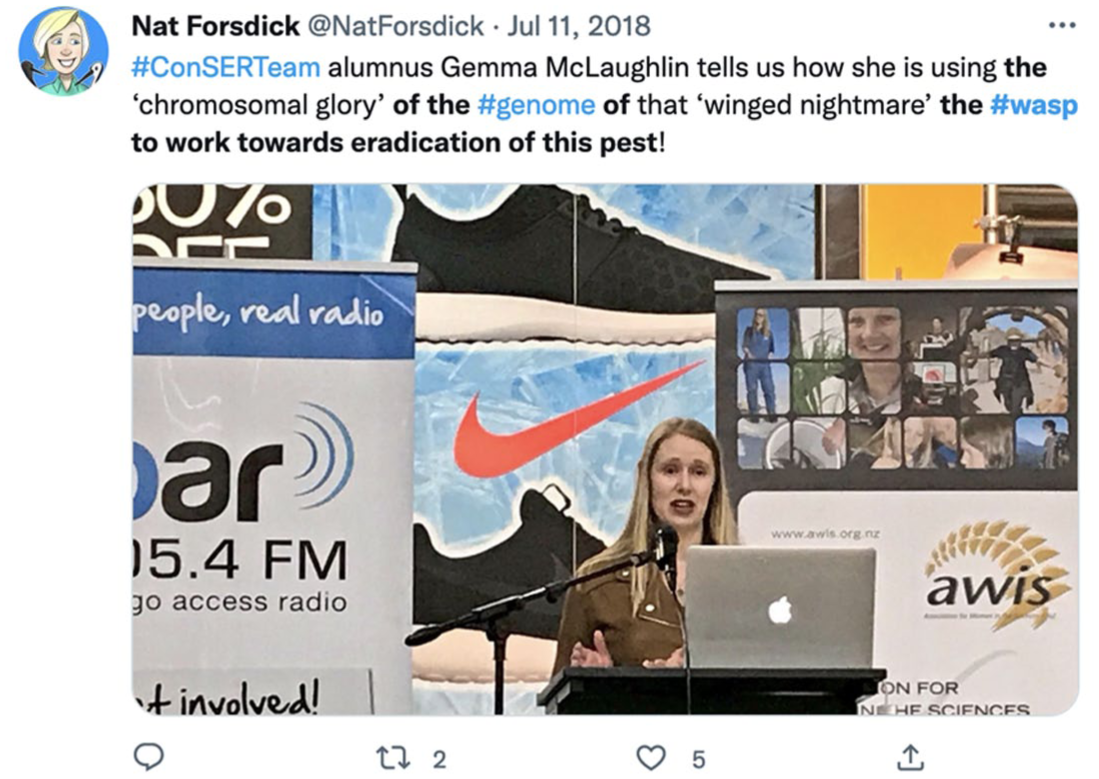
Incursion + Response Tweet (Aotearoa Sample)
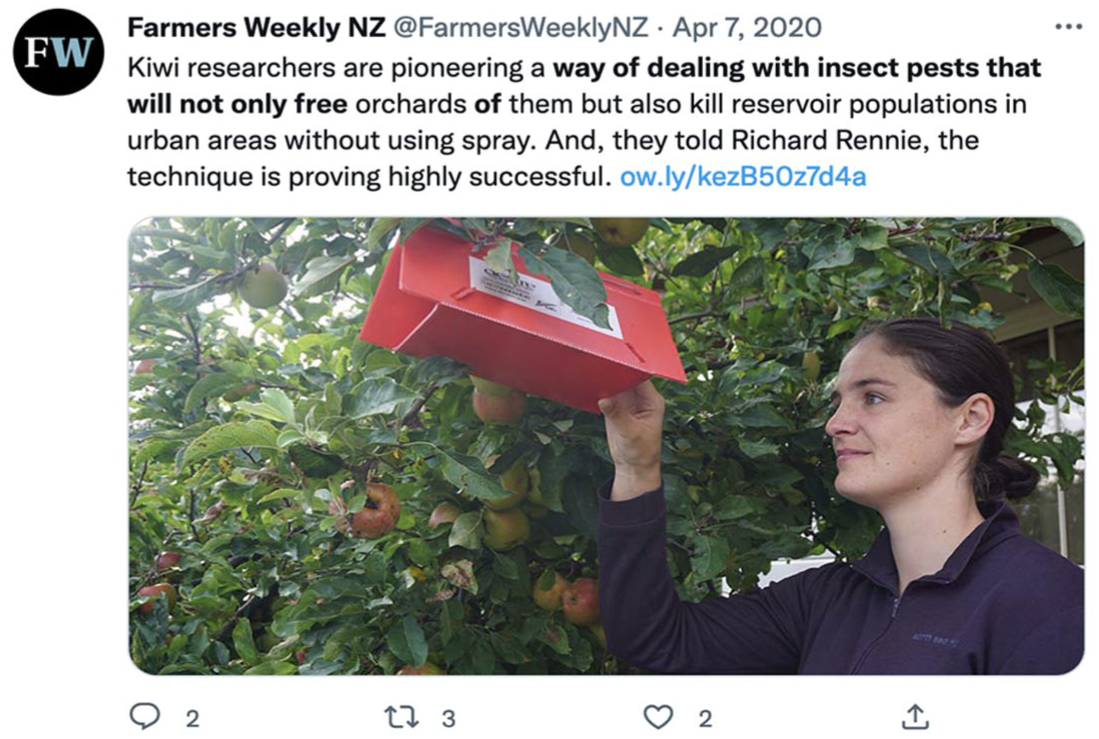
A Science-as-Solution Tweet (Aotearoa Sample)
In the United States, with an exception we discuss in the next section, invasive species were understood largely in terms of the moment of emergence. But there was otherwise little work done to align with any common understanding, likely because there is less of a common discourse in US agricultural or environmental policy and practice. As the prevalence of variants on the words “invader” or “invasion” suggests (Table 1), invasive species are newsworthy as fresh challenges, tellable as a new, potential environmental issue. But they are also occasionally tweetable in a range of story types and specific narratives. Some tweets were “Hey Martha” human-interest stories; others were pure natural history stories that told of species responding to other species in their environments. One journalist, for example, retweeted a story about a “record-breaking invasive Burmese python” containing 122 eggs found in a Florida wilderness. Another tweeted about the invasion of North Carolina by “kinda ‘cute’ armadillos,” with a photograph of one; another on the adaptive behaviors of lizards to invasive fire ants. This diversity is likely explained by invasives being an occasional topic, with little established position in the news cycle or source agendas. The journalist does not emerge as able to take on any clear role in speaking about the topic.
Broadening the Discourse
Given calls for a sustainable journalism that connects ecology and society (Brüggemann & Engesser, 2017), the paucity of tweets advocating social change or fresh understanding was noteworthy. In neither country did we see many tweets that pushed knowledge on invasive species into public debate more actively. However, a small number of tweets, all of them from the very end of the sampling period, in 2021 and 2022, discussed invasive species in the context of larger patterns of human modification of the environment, such as the climate crisis. While atypical, these are worthy of analysis for what they tell us about the conditions under which journalists stepped outside the norms.
In all these activist posts, links were made between different ecological topics. Thus, one Aotearoa news organization promoted a story from a staff member making this link from the country’s dominant control discourse discussed above to climate: Efforts to control invasive pests could be in vain without climate consideration (https://www.stuff.co.nz/environment/climate-news/124219484/efforts-to-control-invasive-pests-could-be-in-vain-without-climate-consideration) Stuff @NZStuff February 11, 2021
The US sample provided more complex examples, in terms both of the role that the journalist was taking on and of the narratives they drew on. Some critiqued inaction. Others concatenated a series of incursions to produce a sense of broader ecological risk: Add this disease carrying ticks to the list of stink bugs, snakeheads, cane toads and many other invasive species from Asia. (https://www.washingtonpost.com/health/2018/11/29/new-tick-species-capable-transmitting-deadly-disease-is-spreading-us/) Darryl Fears @bydarrylfears November 30, 2018
Others connected invasive species to threats to ecosystems, such as the Great Lakes or forest systems. These tweets discussing pests in the context of the climate crisis and other human-induced impacts were more likely to be from elite or alternative national media or retweets by local journalists of links to longer-form, more analytical journalism from those elite media. Invasive species were connected to other ecological matters. In some of these, by journalists working independently or for specialist environmental publications such as the sustainable agricultural outlet CivilEats, the narrative is about ecological crisis. For example: Forget a shift in baselines- we’re entering the era of ‘no’ baselines: “More than a quarter of all species w/in an ecosystem are being replaced every decade. . .(due to) local extinctions, invasive species and migrations motivated by climate change.” (https://www.washingtonpost.com/science/2019/10/17/worlds-ecosystems-are-being-fundamentally-transfigured-human-era/) Ben Goldfarb @ben_a_goldfarb October 3, 2019
Such tweets were frequently more political, in contrast to the more consensual Aotearoa tweeting. Differences in the ways the two countries do public debate and the ways news media contribute to debate may be at work, and it is hard to conclude about patterns in such sporadic tweeting, but it is possible that the less clear demarcation of the topic in the United States fosters a less constrained habitus. Invasives thus sometimes arise as a subsidiary topic in the United States when journalists are tweeting about existential crises related to the human impact on ecosystems. While journalists in Aotearoa may focus on those crises too, they very rarely seem to make the link to systemic problems associated with global trade, tourism or anthropogenic climate change.
A Narrow and Marginal Role
Journalism scholars frequently observe that the role of the journalist is less constrained by classic role conceptions on platforms such as Twitter (Gulyas, 2017). However, that freedom requires more self-management and leaves individual journalists more exposed. Aside from the rare cases of more political tweeting in elite and activist US media just noted, in which invasive species were drawn into broader political debates, the topic did not demand journalists affiliate with the habitus of an independent journalist initiating debate. A largely promotional practice, where articles written by the owner of the Twitter account or occasionally a colleague were boosted, did not accommodate much agenda-setting or critique, particularly as few of the scattered articles promoted sought to set agendas either.
In Aotearoa, we found only one tweet where a journalist sought to place an issue on the public agenda by pointing out future risks. A public radio producer, who had worked previously at the nation’s Science Media Center, commented on a biosecurity issue with some emotional urgency: If Kiwis think NZ has been ravaged by fungal incursions such as kauri dieback and myrtle rust, just wait until some tourist or traveller returning from the US brings spores of Fusarium circinatum and wipes out radiata forestry with pitch canker and pines eurekalert.org/e/8gz9 Kent Atkinson @kentakinson June 2, 2018
Also rare were tweets with an analytical or accountability focus or tweets seeking to prompt or contribute to debate. When analysis was present, as in the following post announcing a documentary on the success of a 40-year pest-eradication plan, it came from a broadcaster account deploying the habitus of autonomous investigative reporting: It’s a big year for our threatened native species. The risk is greater because of #megamast. With pest numbers exploding, we go bush to determine if NZ can be predator free by 2050. @docgovtnz @Maungatautari1@mwlr_NZ @MattChisTVNZ Sunday @ SundayTVNZ June 23, 2019
We came across almost no individual Aotearoa journalists taking on a similar role.
We found much the same in the United States. Most tweets were promotional; a few tweets passed on stories by other journalists, usually tweets by science journalists at elite outlets, such as the Washington Post or the Smithsonian Magazine. Commonly, journalists were dependent on others’ initiative. They might tweet a link in the wake of a biosecurity or invasive species story or, at times, boost a tweet by one of their major sources in science, government, or industry. There were occasional instances here, which were absent in Aotearoa, of specialist environmental journalists seeking to raise awareness about invasive species risks through pushing their stories (Figure 3, a tweet by Sarah Kaplan with a note of urgency in it, or Figure 4, a tweet by Juan Pablo Ramirez-Franco asking, “who is protecting the Mississippi river?”). But the rarity of these calls to public action suggests little agenda-setting is going on.
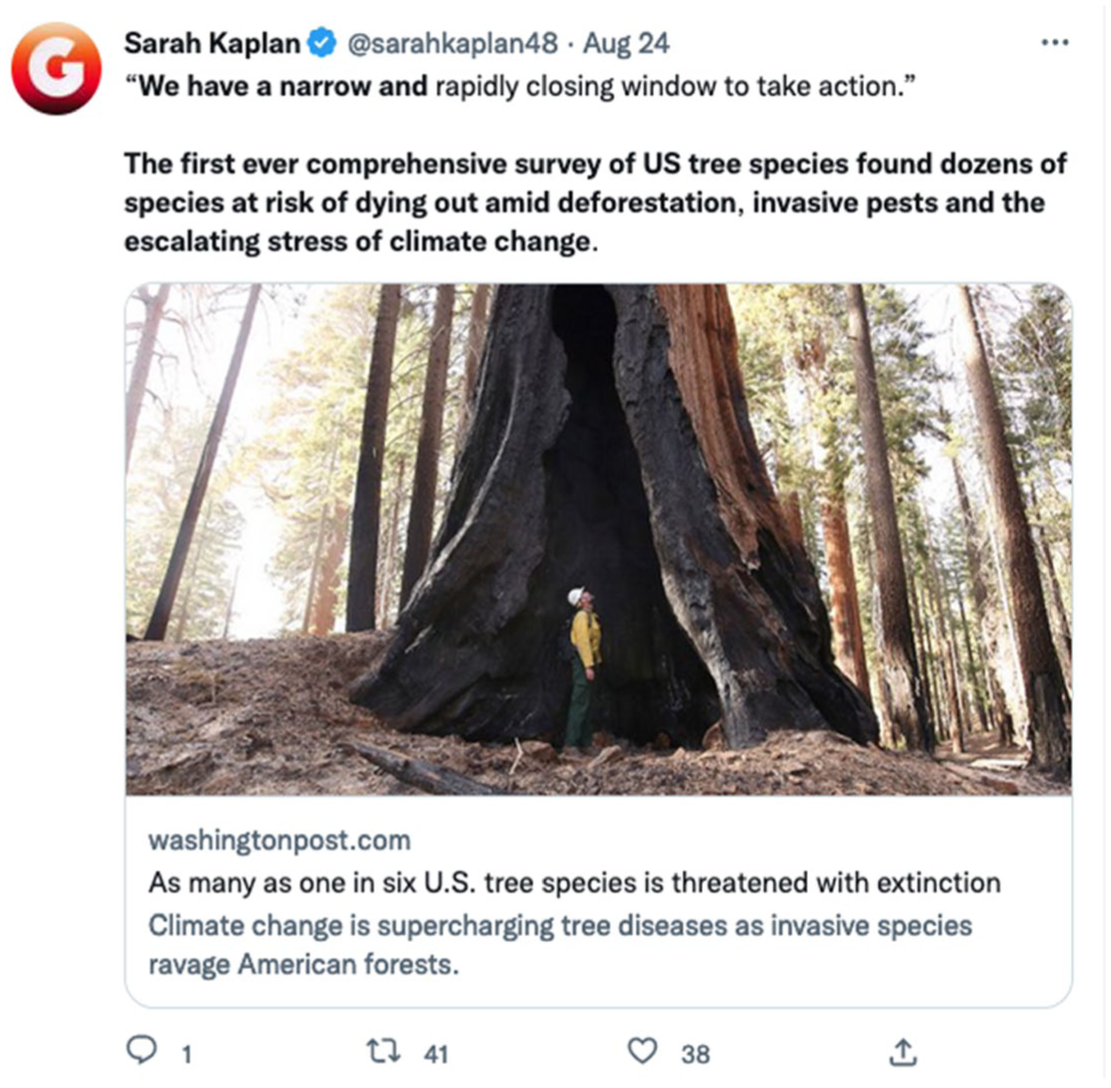
A Rare Awareness-Raising Tweet (US Sample)
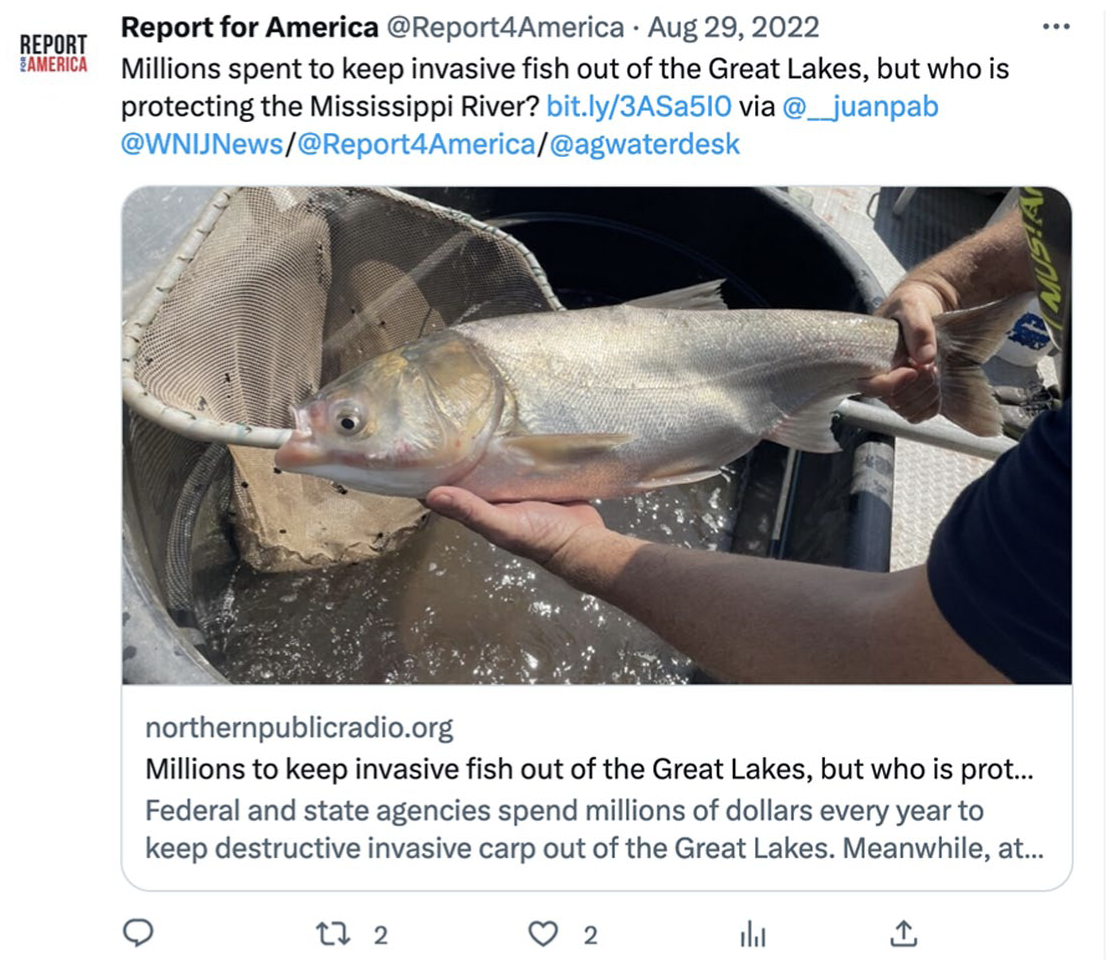
A Rare Agenda-Setting Tweet (US Sample)
A few tweets (although only in the United States) took on the role of raising public awareness about emergent pests or trends. These science-oriented tweets, always from reporters specializing in the field, invoked an audience whose awareness was being raised—sometimes local audiences, with explicit references to places and people’s lives and gardens, and sometimes more generalized audiences. Lexical patterns provide evidence of this role: in these tweets “invade” frequently co-occurred with language of urgency, such as “quickly spreading,” “on the brink” or “from the brink” that signal the scale of risk to the audience. While both countries contained some tweets that commented upon scientific findings, it was only in these few tweets by US science journalists that strong claims were made about scientific knowledge being translated into a form that could aid the public. These, we would emphasize again, were the exceptions to the pattern in both countries that journalists did not perform their authority within their Twitter networks or within journalism through the topic of invasive species.
Discussion
The paucity of tweeting on invasives is hard to probe further, requiring broader analysis of news coverage of the topic and of journalistic practices. Moreover, it is hard to make claims about how much public attention this one phenomenon merits in a crowded field of planetary crises or how much discourse on the topic would be relevant in the two Twitterspheres we studied.
This article has instead focused on the discursive work done when the topic does figure in journalists’ tweets. We find consistently that, in both countries, invasive species are not prominent as a site of struggle over the meaning of the environment and human relationships to it. The reasons appear to differ in each country, although in both the predominant use of social media as a promotional tool militates against more complex discursive activity. Aotearoa journalists in our sample align with a particular national discourse of eliminating pests in which journalists are doing their bit, alongside their source networks in the environmental or agricultural sectors. When they occasionally mention the topic, they almost always do so in ways that boost researchers or agricultural sector organizations. Not only is this discourse consensual, but it is largely self-contained so that biosecurity in Aotearoa is very rarely connected to other issues or places. A public habitus rather than a journalistic habitus of investigation, agenda-setting or skepticism prevails, with the consequence that the topic is rarely brought into the world of political debate on the social media platform. This alignment is perhaps unacknowledged or reflected on but embedded in the habitus of a responsible public actor. In Bourdieu’s (1977, p. 167) terms, “it goes without saying because it comes without saying” for Aotearoa journalists to speak from within this biosecurity discourse.
US journalists in our sample appeared more constrained in their limited tweeting by the lack of a coherent discourse on invasive species. Non-native, pest species occur sporadically in science and environmental journalists’ tweets across a range of contexts. US journalists are more likely to tweet at the public and to explain natural phenomena to them, in line with well-defined roles of informing the public on science. This rarely extends, however, to joining up natural and human phenomena or advocating for action. They too rarely bring the environment into the world of politics or social action through their tweets. Instead, the topic is constantly emergent as new incursions or impacts are described, without becoming a site of debate about human impacts on other species. On the other hand, the less defined habitus also paradoxically means less constraint, with invasives arising in a few tweets alongside discussion of topics such as global extinction trends.
Why is the habitus of the critical, analytical journalist rarely mobilized in relation to tweets on invasives? The sporadic and scattered posting is consistent with public awareness in the United States. Surveys in the United States show public interest and public ranking of invasive species are low compared to other environmental challenges (Schelhas et al., 2021). In Aotearoa, however, there is higher public awareness: a 2018 government survey reported 61% of adults felt they had a good understanding of biosecurity and regarded it as important (MPI, 2018). So, alignment with low public interest is not an adequate explanation of the topic’s marginalization in Aotearoa tweets—indeed, it is highly inadequate, given the interest networks the journalists engage with in their tweets. We would not emphasize the media sector’s recent resource challenges either, for the patterns we found extend across 15 years of data. In addition, the likelihood that some journalists at least would pursue capital by differentiating themselves by tweeting on new topics suggests the issue is about more than capacity. We might not expect to find many journalists tweeting, but, as Carrasco Polaino et al. (2021) found on journalists’ tweets from the COP25 climate summit, we could expect a small number of very active accounts. Perhaps, as happened in the early years of the climate change debate, when journalists were constrained in challenging economic interests (trade, tourism and other aspects of neoliberal globalization), discussion of the impacts of human activities on invasive species or raising broader issues around sustainability can occur only after significant symbolic capital has been deployed by non-media actors such as non-governmental organizations or politicians (Kunelius & Eide, 2012). Without other actors producing coherent and explicitly politicized discourses that connect incursions with human practices such as trade, tourism, agricultural or habitat destruction, the topic is likely to remain marginal in the journalistic habitus, on Twitter and elsewhere.
We therefore also echo findings in the literature (Djerf-Pierre et al., 2016) that the affordances of Twitter, as a space where new norms of publicness can be negotiated, play only a small role. Stepping outside norms and inhabiting the habitus of an independent source of knowledge or politically enmeshed actor was available, in our sample, at only a few moments and to specific individuals with a more specialist and scientifically expert habitus. These were journalists at elite national media or at activist media who accessed the symbolic capital of the expert to connect together a number of human-induced alterations to the ecosystem, sometimes from a global vantage point. Such isolated instances of sustainability journalism in which the social and the environmental were considered together (Brüggemann & Engesser, 2017; Weder et al., 2021) were almost all in the much larger US mediascape and from tweets in the final years of the study, 2021 and 2022.
Conclusion
Journalists’ tweets on invasive species offer some insight into how symbolic power excludes or includes discussion of the environment. Our study does not provide evidence of invasive species being suppressed but rather that discussion of the huge movements of species during the accelerated globalization of the past 50 years has little political power. As Peters et al. (2014) note, coverage of science tends to be driven by journalistic rather than scientific norms and priorities. Through analysis of journalists’ embodied understanding of the topic in their tweets, we find invasive species tend to fall outside the “rules of the game” because they do not connect with journalistic claims to authority to lead public debate or social responsibilities. It remains a technical rather than political subject. Journalists gain little from invoking it on social media.
Further work on news texts and practices would extend these points into an understanding of how science or agricultural journalism could support the kind of socially transformative and ultimately political task that might turn the tide on ecosystem modification and collapse (IPBES, 2019). Work is also needed on the communication practices of other actors, such as scientists, activists, and governmental organizations, who we suggest hold more authority and symbolic power in defining the problem and solutions. But this article contributes to the understanding of sustainability communication by highlighting the disconnect between the journalistic habitus and the power to name an environmental crisis in two countries with major challenges in this area.
Supplemental Material
sj-docx-1-jmq-10.1177_10776990251410598 – Supplemental material for Journalism, Invasive Species, and Marginalized Environmental Discourse on Social Media
Supplemental material, sj-docx-1-jmq-10.1177_10776990251410598 for Journalism, Invasive Species, and Marginalized Environmental Discourse on Social Media by Donald Matheson and Mildred F. Perreault in Journalism & Mass Communication Quarterly
Footnotes
Acknowledgements
Karl Patrick Mendoza, Brooke Sowden and Derrick Vaz prepared and organized data for this paper. Mendoza and Sowden were research assistants at the University of Canterbury in 2022. Vaz was a graduate assistant to Dr. Perreault at East Tennessee State University in 2021 to 2022.
Declaration of Conflicting Interests
The authors declared no potential conflicts of interest with respect to the research, authorship, and/or publication of this article.
Funding
The authors disclosed receipt of the following financial support for the research, authorship, and/or publication of this article: Some data analysis was supported by a 2022 summer studentship grant from the UC Biosecurity Innovations cluster at the University of Canterbury.

Supplemental Material
Supplemental material for this article is available online.