



Abstract
This article reflects on a curatorial and pedagogical research project to reactivate ARTIUM’s contemporary art collection (Vitoria-Gasteiz, Spain) after a decade of acquisitions and institutionalization by seeking experimental involvement with difficult knowledge, through prosthetic pedagogy inspired in the time-image and paradoxical modes of address. Three moments of this project are discussed: (a) the selection and research of a number of artworks from the aforementioned collection; (b) the design of a museum space in ARTIUM’s Sala Este Baja; and (c) the activation of the exhibition space through a Laboratory of logics of vision.
Keywords
Introduction
In the winter of 2010, Mar Villaespesa and Joaquín Vázquez from BNV Producciones invited me to participate in the curatorial project Stanzas. Restitutive Practices on the ARTIUM Collection in the Basque Museum-Center of Contemporary Art, situated in the city of Victoria-Gasteiz, in northern Spain. ARTIUM had commissioned these two independent curators an exhibition to critically reflect on its collection after one decade of institutionalization. Villaespesa and Vázquez (2011) founded the project on Agamben’s (1992) Stanzas: Word and Phantasm in Western Culture, and more specifically in the argument that a work of art contains a potentiality beyond its moment of creation; a potentiality which is understood as an act of decreation, and constitutes the very life of the work of art, its possibilities of readership, translation, discussion, and the enabling of a multiplicity of readings.
ARTIUM is the most recently formed collection of contemporary art in a Spanish state-owned museum, its central body is formed by conceptual and political art from recent decades; artistic projects that actively engaged in philosophical and political ruptures. Its institutionalization in a museum space that privileges experiences of decontextualized opticality (aesthetic autonomy), and that strips works of art from their extended cultural and intellectual linkages, was seen by Villaespesa and Vázquez (2011) as something problematic and worthy of investigation.
Their approach connected with the critical theory frameworks of feminism and institutional critique. They questioned how the function of art is established beyond originality and authorship, how this function can instead involve collective imagination, and how its depoliticization can be reversed. In this respect, Villaespesa and Vázquez (2011) envisioned Stanzas as a number of collaborative curatorial exercises with four independent cultural workers (individuals and collectives) with the goal to produce restitutive practices:
[B]earing in mind the etymology of the term “restitute” (to restore something to its former state or position), we have developed what we term restitutive practices, in other words, our aim is to take a number of important works in the ARTIUM Collection and restore their potential. [This is to] be achieved through certain curatorial exercises based on the premise of activation. (p. 30)
The exhibition format of Stanzas had different parts that unfolded at different moments:
The four independent co-curators researched the collection and selected works for their stanzas.
The four independent co-curators wrote a text to be included in the exhibition catalog. These texts discussed the philosophy behind each stanza: Its conceptual framework, selected artworks, and exhibition space design. Stanzas aimed to be more than a series of displaying spaces. Their goal was to create places for collective work and experience.
The design, construction, and implementation of the exhibition space in ARTIUM Sala Este Baja. The exhibition was opened during October 2011 and March 2012.
Different moments of activation of the exhibition spaces occurred during these months. These activations consisted of orchestrated interactions between the curators, the selected works, and different museum audiences. Some activations included collective actions in the museum, seminars with young artists, dance–music–art choreographies, and experiments with museum pedagogy.
I collaborated on the curation of Stanza 4. This article reflects on the process and aforementioned moments of research, design, and activation.
Prosthetic Museum Pedagogy: The Time-Image and Its Paradoxical Modes of Address
When Villaespesa and Vázquez invited me to the project Stanzas, they did so with the understanding that I could envision and set in motion a restitution of select works from ARTIUM’s collection through practices of critical pedagogy and audience engagement. In response to these expectations, my curatorial proposal sought to create, both in the space of the exhibition and in its moment of activation, through the Laboratory of logics of vision that followed, an “experimental involvement with difficult knowledge” (Trafí-Prats, 2011, p. 38). This is knowledge that defies representation, closure, or museum control of knowledge (Frenkel, 2007). In this respect, central questions in my initial research included the following:
How practices of looking and talking about works of art representing histories and memories of extreme difference might function as forms of responsibility, and becoming implicated in the tales of others?
How might they inform acts of resisting silence, oblivion, and indifference?
How might they enable us to encounter knowledge that is genuinely new and consequently transform our teaching, learning, and cultural locations?
These questions were inquired through a philosophical framework that included Ellsworth’s (1997) concept of paradoxical modes of address and Deleuze’s (2010) concept of the time-image. Since The Prosthetic Pedagogy of Art by Charles Garoian (2013) was released 2 years after the finalization of Stanzas, I cannot say that it directly inspired the project. In this respect, what I try to do in this foundational section is what Ellsworth (1997) denominates reading through, which is to put these three texts together to construct new possibilities of interpretation, and conceptualization of this research project in its aftermath.
For Garoian (2013), a prosthetic museum pedagogy centers on the criticality of subjectivity as fostered through art research. Criticality of subjectivity, understood as intellectual curiosity, capacity of association, and risk taking to move from what is familiar into what is new. Such pedagogy is considered prosthetic because it happens in a space of continuous addition and extension. It is constituted by “associative, yet indeterminate relationships between our individual, private memories and the corporate and public memory of the museum” (p. 84). It is prosthetic because it supplements what is lacking in institutional narratives, but it also produces excess, and slippages of meaning that resist being incorporated. Therefore, understanding occurs in an interstitial space making knowledge “contingent, fragmented, strange, unknown, grotesque, indeterminate, and undecidable” (p. 86). This challenges the unity or fixity of any cultural narrative, such as for example the narrative of ARTIUM’s Collection.
Garoian argues that prosthetic pedagogy is embodied in the sense that it entails a negotiation with disparate, fragmented, and unfamiliar bodies of knowledge. This potentially can bring the subject to a sense of disequilibrium, and a crisis of understanding. By connecting with the theories of Jean Piaget, Garoian suggests that this disequilibrium holds the capacity to create deeper levels of understanding in which knowledge is reorganized in new schemas.
This transformative aspect of the prosthetic resonates with how Deleuze (2010) describes the workings of the time-image. The time-image comes from the outside and holds the power to shock our assumed clichés. A cliché is an understanding of the image that is reductive. It occurs when a spectator sees less than what the image offers to be seen due to personal, economic, and cultural perspectives that mediate her experience. Like prosthesis, the time-image makes this transformation possible via reorganizations of the image:
Sometimes it is necessary to restore the lost parts, to rediscover everything that cannot be seen in the image, everything that has been removed to make it “interesting.” But sometimes, on the contrary, it is necessary to make holes, to introduce voids, and white spaces, to rarify the image, by suppressing many things that have been added to make us believe that we are seeing everything. (p. 21)
The time-image is an image that occurs in a situation of discontinuity or shock within a diachronic or cause-logic narrative. It reveals “how time is a process of becoming which affords a temporal perspective of images that problematizes classical philosophy’s categorizations of ‘truth’ and the ‘reality’ of the world” (Colman, 2011, p. 180). The time-image suspends time, amplifies the moment, and situates the spectator in a state of indeterminacy, in which the more she looks, the more she is compelled to reconstitute the image, becoming increasingly conscious that she is looking (Cowie, 2011).
The time-image is a composite, and an expression of different layers of time, including the interval between virtual time (past) and actual time (present) within the same image, and in this sense prosthetic. The time-image creates interdependences between subjective memories, dreams, perceptions, and the actuality or course of events. In the time-image, learning occurs in an expanded space where, “Time provides access to thinking, to the very nature of being, and the forms it takes and can take, through expression on screen” (Colman, 2011, p. 145). Learning is not about mimesis or realism but about possibility.
What modes of address enable prosthetic understanding in the museum? According to Ellsworth (1997), a mode of address is an invisible pedagogical relation between educator and student, museum and visitor. It has to do with the cultural and social power that forms and deforms who the museum thinks visitors are, who the visitors think they are, and the possible misfits, lacks, and failures in the dialogs between the two. While Ellsworth identifies a predominance in education of modes of address that pre-fix knowledge and understand learning as a repetition of the same, she is more interested in modes of address that multiply and mobilize teaching and learning positions, thus enlarging the possibilities of response, and meaning making.
In advocating for finding these mobilizing modes of address outside education, Ellsworth looks to contemporary film. She argues that there are films, like Shoah (Lanzmann, 1985), that function as instances of critical art pedagogy, presenting partial histories, resisting a mimetic function, and constructing forms of cultural dialog that instead of repeating the same, function in self-reflexive ways bringing both the characters and the spectators back to knowledge that they tend to ignore, marginalize, and displace. This is what Ellsworth (1997) calls “the return of a difference” (p. 147). These are films that perform address as paradox, that bring an open logic of possibility. In this logic, audiences look without reason or final outcome, transformative teaching or learning happens without authority.
Such paradoxical modes of address are also identifiable in the forms of thinking that the time-image propels. The time-image emerged in the aftermath of the Second World War, in devastated countries and societies experiencing deep transitions, mostly in Europe and Japan. In this respect, the films of the time-image do not propose final solutions, their characters and narratives appear confronted by problems but are unable to find definitive responses to them. The world is shocking, confusing, and many times unbearable for these film characters. As a result, the time-image engages the viewer in a form of seeing or knowing that connects with the transformative aspects of the prosthetic:
A form of seeing that is not bound to what one has learned to see or been told to see. It is we may say, the experience of seeing something as though for the first time, so what one is seeing is not on the basis of what one already knows, but instead on the basis of what it is unknown. (Rushton, 2012, p. 62)
In the same way that Garoian (2013) sees prosthetic pedagogy as leading to deeper levels of understanding, the characters in these films of the time-image emerge from daunting and disorienting situations with a renewed way of seeing the world, and amplified consciousness (Rushton, 2012).
Researching ARTIUM’s Collection
For Stanza 4, I selected three artworks from ARTIUM’s collection that engaged difference, ambiguity, and memory. These works were The salt of the sea (2006) by Alfredo Jaar; We will all die (2003) by Mikel Eskauriaza; and Limpieza social (2006) by Regina José Galindo. My research reflected on how these artworks connected to and expanded the concept of the time-image.
The salt of the sea (2006) by Alfredo Jaar (Figure 1) shows a slightly changing image 12 times organized in a grid structure. There is a footbridge into a marina on top of which lays a large screen. Projected on this screen, we see a monumental close-up of a Black woman’s face. She is crying. We are confronted with what Deleuze (2010) calls an affection-image, which occurs in the interval between perception and action (Colman, 2011). Deleuze’s (1978) considers affect as a form of thought that encounters a body altering the course of its actions or movements. Put in filmic terms, the affection-image, “gives a proper consistency to the possible, it expresses the possible without actualizing it, whilst making it a complete mode . . . it is a quality or power, it is potentiality considered for itself as expressed” (Deleuze, 1986, p. 98).
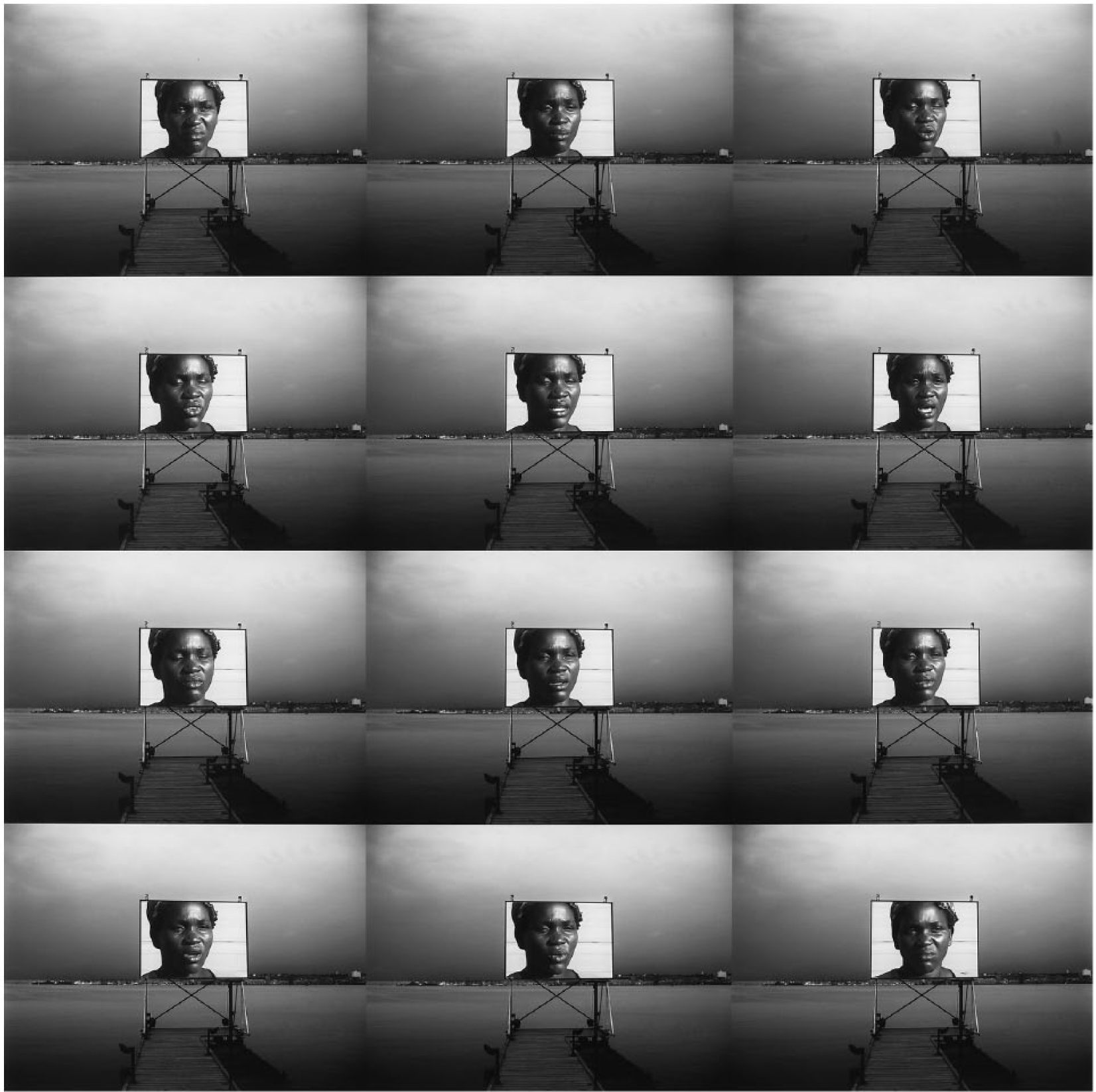
Alfredo Jaar, The salt of the sea, 2006, ARTIUM de Álava, Vitoria-Gasteiz. Depósito Juan Bonet Gambins, © Gert Voor in’ t Holt.
The salt of the sea presents a number of stills that capture a screening of the film Muxima (2005) that Jaar produced during a trip to Angola. To construct this image, Jaar chose the moment in the film showing the testimony of a woman narrating how her daughter had been missing for a number of years as a result of civil war. The screen has been placed against an open space somewhere on the Angolan shore of the Atlantic Ocean.
Deleuze and Guattari (2005) argue that faces are culturally produced by “an abstract machine of faciality” (p. 168) that functions in a double-coded system, the “white wall” of the signifier, and the “black hole” of subjectivity (p. 168) that is a process of facialization that deterritorializes the face from the whole organism of the body, its actions, and historical contexts. There is nothing human in this process. It is machinistic and unconscious. It simplifies nuance, creates abstraction and sameness. Does The salt of the sea merely function as the facialization of a face and a landscape?
No, there is more. The salt of the sea does not bring “absolute deterritorialization” (p. 174) as faciality does. Besides a face, and a landscape, there is the passage of the footbridge to the screen, which implies a third space, one of viewing, of being confronted with a signifier, and the face crying while projected on a screen erected in front of the sea. Homi Bhabha (1994) described this third space as “the enunciatory disorder of the colonial present . . . [that] lies in the staging of the colonial signifier in the narrative uncertainty of culture’s in-between: between sign and signifier, neither one nor the other” (p. 180).
The salt of the sea alludes to this enunciatory disorder resisting to fix representation, through a hybrid space made up of the aforementioned arrangement of elements that opens up a relationship with a radical other. Griselda Pollock (2008) states, “Alfredo Jaar’s work is not the production of images, but the creation and choreographing of the viewer’s encounter with and reflection upon the encounter with images in an image-saturated culture structured about its unprocessed relation to Africa” (p. 132). The salt of the sea choreographs, to use Pollock’s expression, an arrangement that puts us beyond the colonial tropes that have historically rendered a dehumanized view of Africa, either through the presentation of its compelling landscapes or through the deceased or mutilated bodies of war and hunger that cannot speak for themselves. Jaar’s affection-image is newness and possibility; it is both moving and confusing—the profound grief of a woman crying, but why is she crying? It fosters curiosity, the desire to see close up, and beyond the false obviousness of prevailing clichés. As mentioned earlier, an affection-image constructs a hinge between perception and action. And the action that The salt of the sea points to is a transformation of thinking. It compels the viewer to experiment with the difficulty of translation, to struggle with cultural authority, and the traumatic negotiation of one’s own identity when confronted with images of radical otherness and colonial history.
We will all die by Basque photographer Mikel Eskauriaza (2003) is a large format photograph presenting the geological cross-section of a generic space in the Basque mountains. We are shown a forest divided by a paved road. The cross-sectional view, typical of topographic photography, makes the cut inflicted by the construction of the road clearly visible and a central aspect of the picture. This section of the forest has a fence, which indicates that it is a private estate. There are also few electrical cables crossing the image, and in the center of this space, a large banner hangs with the statement Vamos a Morir (Figure 2).
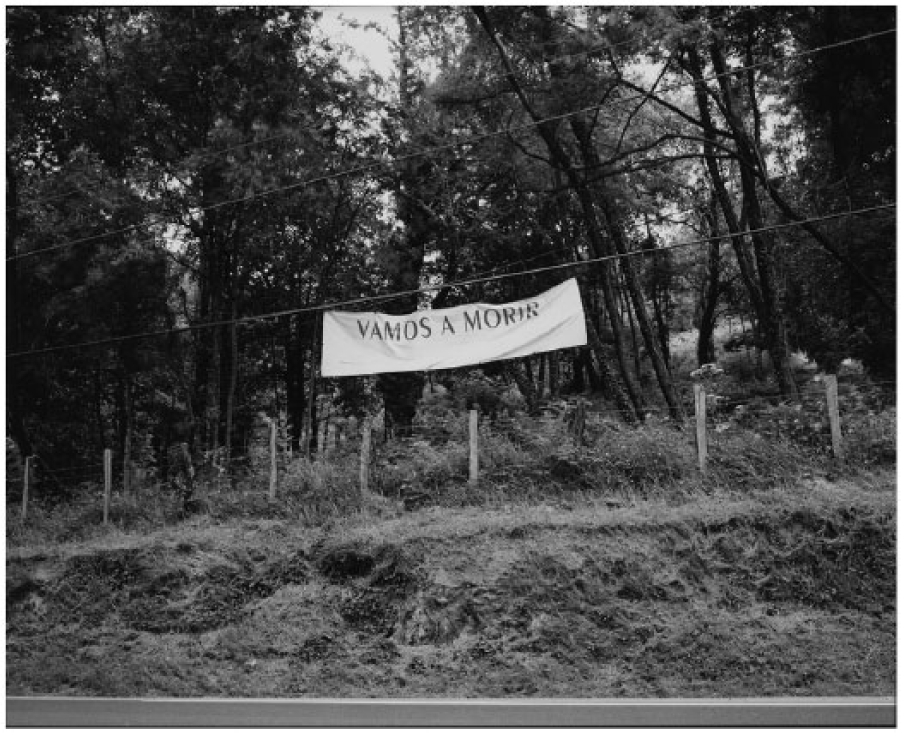
Mikel Eskauriaza, We will all die, 2003, ARTIUM de Álava, Vitoria-Gasteiz, Colección Ipiña-Bidaurrazaga, © Gert Voor in’ t Holt.
Following the logic of the time-image, We will all die accesses different modalities of time through topos, or an arrangement of things that come together due to a matter of localization. Deleuze (2010) brings the notion of topology to the study of the image because he is interested in how the different points of the image as space are presented and interconnected in a given fashion (the mountain, the road, the cables, the phrase, privatization, the cross-sectional view . . . ). “Topologies are formed,” says Deleuze, “by the redistributed, coexistent, transformed and fragmented forms” (pp. 119-120). By the act of stopping in this indifferent space and placing a banner, We will all die plants what Deleuze calls a “crystalline seed” (p. 74), which coalesces actual and virtual time as inseparable in a circuit. The actual time of the forest as seen from the road with a banner hanging is inseparable from the virtual time of the thoughts and memories that this space might evoke. What happened to this place? Why is the forest, a significant cultural ecosystem for the Basques, presented in this indistinctive, violated, and privatized space? Whose voice is speaking? Who is going to die? Should the phrase “We will all die” be attributed to someone or something? Who is included in this we?
Eskauriaza’s art connects with the critique of unitary urbanism in which artists of the Situationist International engaged in the 1960s. These artists questioned the dominance of functionalism in the creation and use of public spaces, and advocated instead for playful uses and interventions. They also criticized the compartmentalization of art in institutions and its detachment from social practice. Like Situationist artists, Eskauriaza’s artwork engages in tactics of détournement, which is a recontextualization of a work of art, image, or literary message to enact radical shifts both in the work and the public context. Eskauriaza does this by inserting messages in humanly modified environments to reorganize visions and relations with these spaces that move us away from indifference and toward difference. Like Deleuze’s crystalline seed, We will all die creates new circuits of relations between the physical and the mental; the real and the imaginary; past, present, and future; and actuality and possibility. The crystal is where “the expression of time coalesces, and the image both expresses and produces a composite (time-image) of different layers of time, and different signs of time” (Colman, 2011, p. 135).
In this sense, We will all die situates the viewer in a “time abyss,” enabling her to “see time in the crystal” (Deleuze, 2010, p. 78), situating her in a threshold, a liminal point in which to imagine that something that now exists will disappear. It opens the possibility of reflexivity and recollection in a world that seems silent, anesthetized, and indifferent.
Limpieza social (Social cleaning) by Regina José Galindo (2006, Figure 3) consists of a video-still from a performance with the same title that the artist described in the following way: “I am given a bath with a high-pressure hose, a method used to pacify demonstrations and to bath prison inmates.”
1
Some films of the time-image, such as for instance the ones directed by Michelangelo Antonioni, introduced a new type of character who embodied the states of dislocation and disintegration of the surrounding world. Antonioni presented these characters in an objective way, approaching them
. . . from the outside, so that one thing we can say about these characters is that they are not self-willed or self-defined; they are not ‘subjects’ in the strong sense in which we might understand that term. If they have traits of human subjectivity, then these traits are the ones defined by the other people and objects, the spaces and situations with which they come into contact or which they occupy. (Rushton, 2012, p. 66)
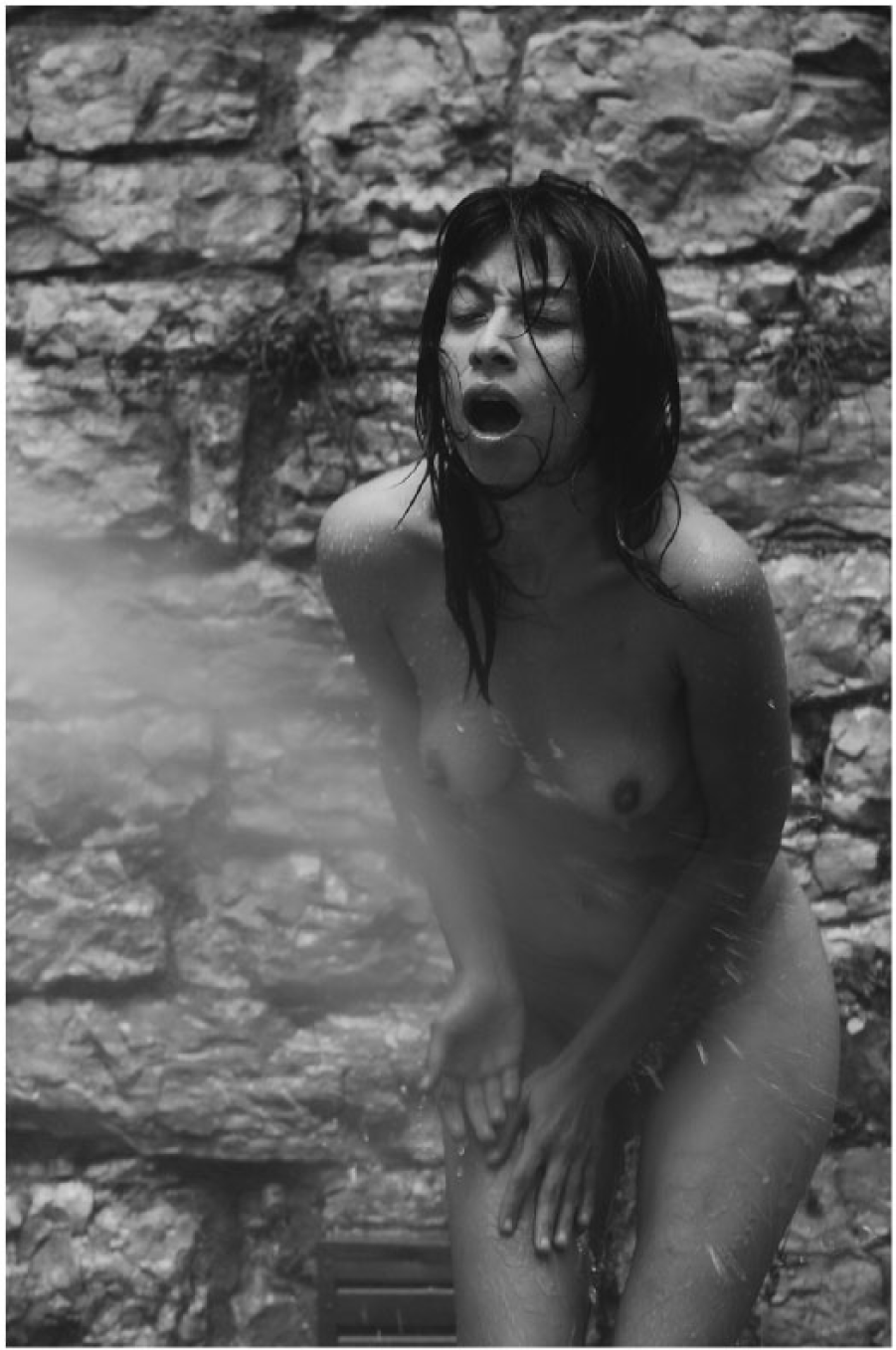
Regina J. Galindo, Limpieza social, 2006 ARTIUM de Álava, Vitoria-Gasteiz, Depósito Juan Bonet Gambins © Gert Voor in’ t Holt.
The spaces, objects, and situations about which Rushton refers are similar to those presented in Limpieza social, a vacated space, a power-hose, and water against a body. It is a force that comes from the outside affecting a subject who is unable to act against it: “I am given a bath with a high-pressure hose . . . ”
As an artist living in Guatemala, a country with a recent history of more than 30 years of civil war, Galindo’s performance-based work embodies the silencing, and oblivion perpetrated on subjugated and erased territories and bodies. Galindo uses her body as a central resource to explore memory and the (dis)location of history from the point of view of the victims of extreme violence. In this respect, Limpieza social constitutes a political image, one that interrupts prevalent clichés and unquestioned cultural behaviors as looking at the pain of others and remaining indifferent (Sontag, 2004).
Galindo’s work provokes an encounter with radical dispossession and vulnerability, compelling the viewer to empathize with the other, raising an ethical question about the limits of what is culturally acceptable to look at, and the use of estrangement and discomfort as critical resources.
Design of the Exhibition Space
Right at the first moment of Stanza 4, the research on the aforementioned artworks in ARTIUM’s collection opened a prosthetic space for looking beyond what was obvious in them, connecting visuality with theory, and as a result altering dominant ecologies of images that erase, dehumanize, and homogenize cultural and personal singularities. Such a space of learning raised questions about how others could encounter the potentialities of these three works of art in the format of a museum experience, and how the exhibition space could foster looking experiences that would not dissolve in pure contemplation but initiate mobilization and implication.
After researching the collection, our next task was to design the exhibition space for Stanza 4. As mentioned earlier, Villaespesa and Vázquez (2011) devised the exhibition space for the four stanzas as places of collective work and experience. They specifically referred to Bretch’s (1932) notion of Umfunktionierung, refunctionalization, elaborated in his essay “The radio as an apparatus of communication.” Bretch understood that if radio were to be a public medium, audiences ought to instruct as well as be instructed. Radio ought to reveal its distinctive public character by documenting and intervening directly within daily life. The idea of refunctionalization in museum education invokes audience participation, and their intervention in the public knowledge of museum collections and exhibitions in a similar way. It seeks a museum education centered on the institutional knowledge of artists, artworks and collections, and alliances of such knowledge with the cultural memories and personal experiences of the viewers (Garoian, 2013).
This idea of refunctionalizing the collection as pedagogy enabled me to consider that an exhibition like Stanzas, which encompasses different moments of activation perhaps did not require starting with a traditional display of the artworks. Viewers’ experiences and thinking in the time-image could be easily overlooked by traditional, chronological modes of display—what Deleuze (1986) refers to as the movement-image.
As Ellsworth (1997) suggests, a curriculum is never a direct journey. It never works linearly that by the end of a museum experience each participant learns according to the goals, ideas, and skills of the curator or the museum educator. Instead, oscillations, returns, folds, and failures constitute learning in the museum according to the time-image. The mode of address of the time-image is indirect. It allows for differential spaces between the museum’s curatorial curriculum and the responses of its visitors. To facilitate engagement with the open-ended, ambiguous, and difficult knowledge of the time-image, exhibition designs must cultivate uncertainty, and resist closure. As Frenkel (2007) suggests, “Difficult knowledge [should be] evoked rather than stated and made present to the imagination through a mix of absence, indirection, and incompleteness that brings the viewer out of passivity” (p. 122).
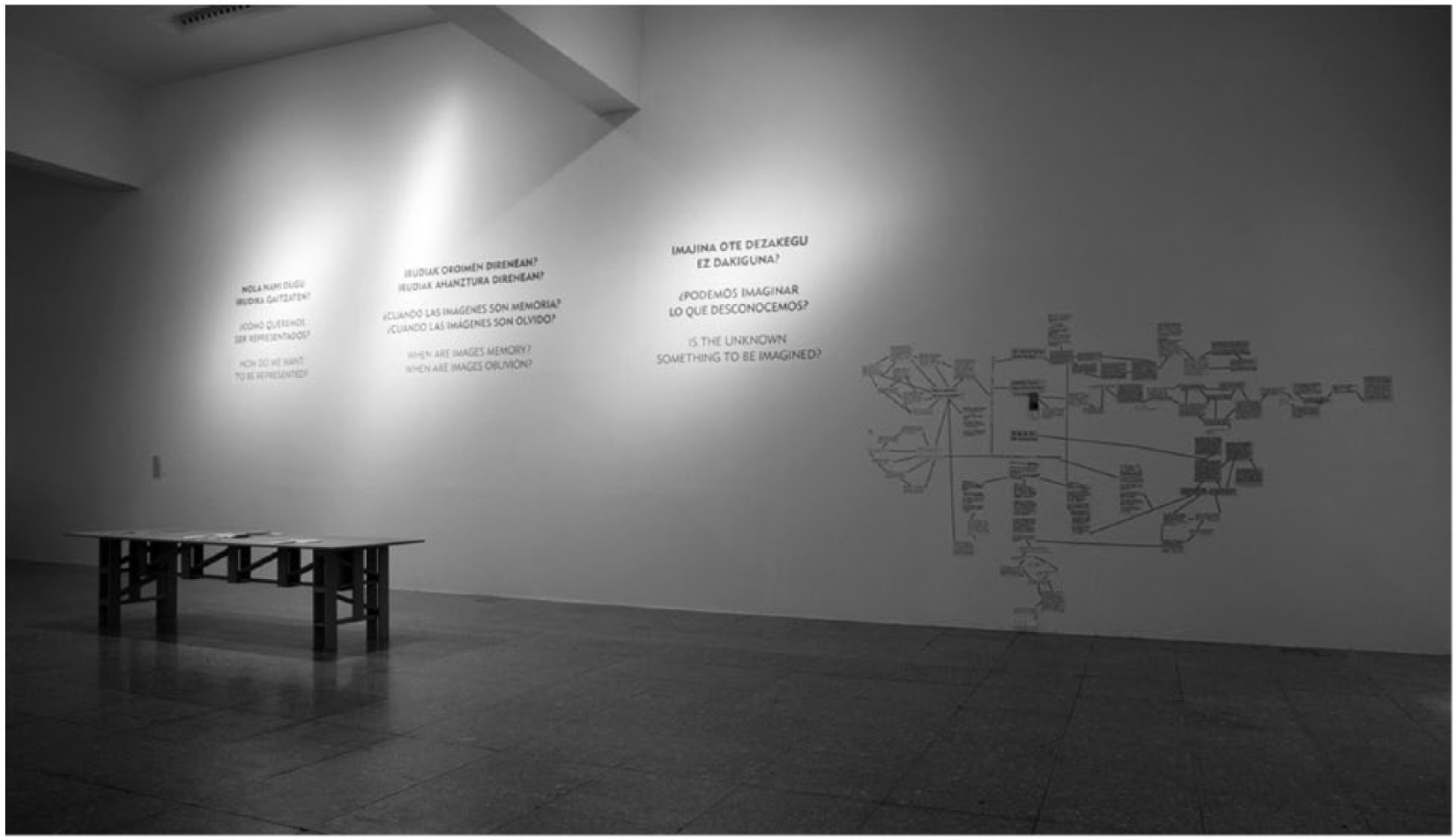
In this respect, Stanza 4 unfolded through two moments: An initial one that lasted several months where viewers encountered selected questions. These questions emerged indirectly from what I had learned through researching The salt of the sea, We will all die, and Limpieza social. Disconnected from the artworks and self-standing, the questions opened a space of potentiality for viewers’ multiple connections, extensions, and understandings; a multiplicity enabled similar to that of the time-image mode of address. These questions, which were printed in large typeface and installed on the exhibition walls in three languages (Euskera, Spanish, and English), were as follows:
How do we want to be represented?
When are images memory, when are images oblivion?
Is the unknown something to be imagined? (Figure 4).
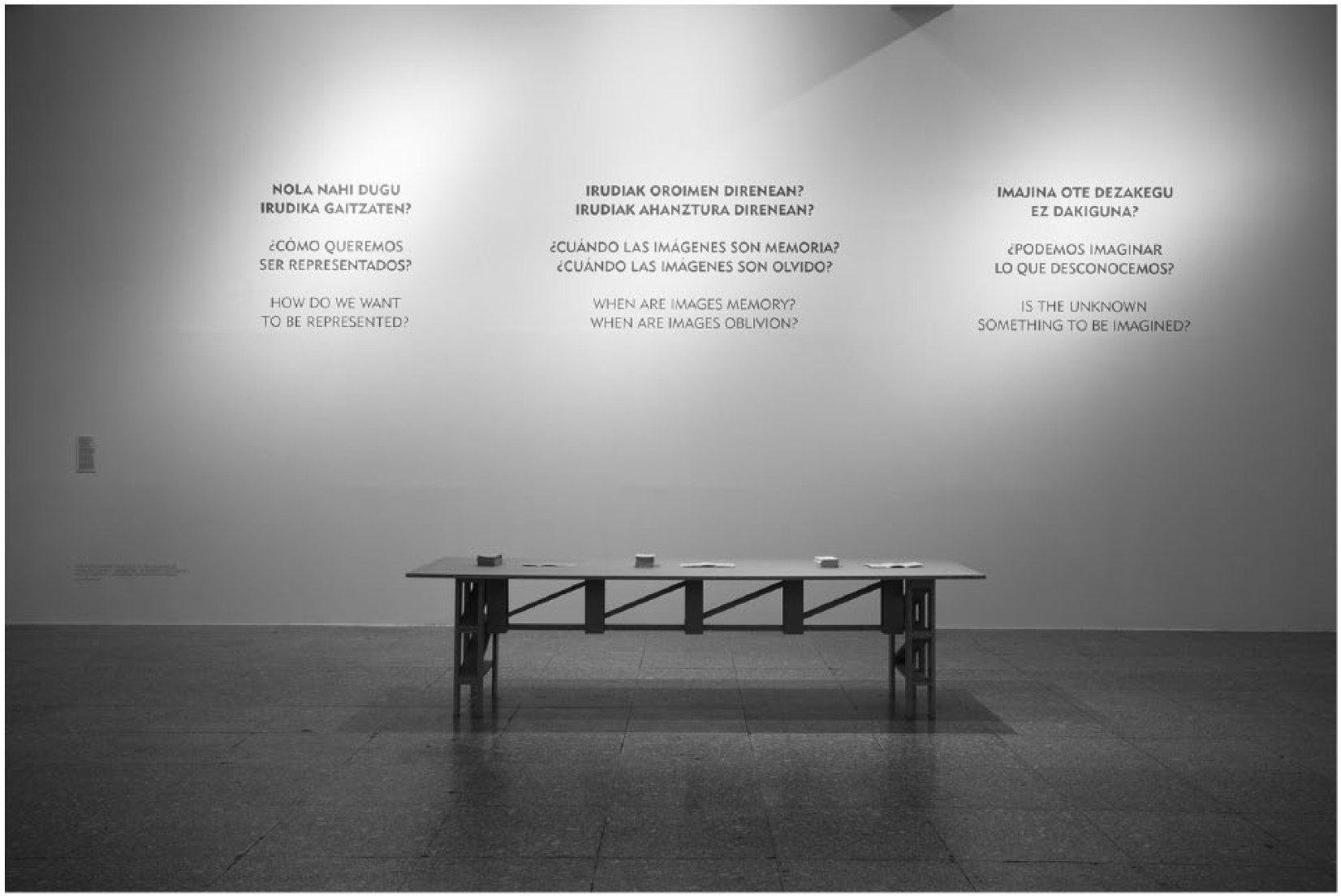
Stanza 4, ARTIUM de Álava, Vitoria-Gasteiz, © Gert Voor in’ t Holt.
The viewers’ encounter with these questions constituted a prosthetic space where instruction was postponed and ignorance took place. I refer to ignorance in the sense that the space raised complex questions rather than easy answers. It enabled learning through connectivity by addressing the viewer and asking for her own ways of responding to the questions. Inspired by Rancière (1991), Garoian (2013) suggests that ignorance is a way
to postpone predetermined, academic teachings and allow for [visitors] playful observations, explorations, and improvisations . . . the positioning of ignorance constitutes a pedagogical strategy whereby both [museum educator] and [visitor] are emancipated to learn from and about each other. (p. 45)
Three pamphlets, one per question on the wall, emphasized the active role of viewers in considering their own responses. These pamphlets, which were placed on a table situated right below the questions on the wall, invited viewers to respond to such questions by either leaving or mailing the museum their own reactions in the form of text, visuals, or objects. The received responses were displayed on the walls of the exit hallway till the exhibition lasted. In addition, the pamphlet included a call for viewers interested in investigating connections between the questions in the wall and ARTIUM’s collection, and requested their participation in a Laboratory of logics of vision. In this way, the Laboratory of logics of vision became the activation moment of Stanza 4, when the three selected artworks from the collection came into play, which took place during the final week of the exhibition Stanzas.
Laboratory of Logics of Vision
The participants in the Laboratory of logics of vision were nine women who introduced themselves as visual artists, art students, art teachers, university professors, doctoral students, or just surviving through multiple part-time jobs. For the week of the Laboratory, we transformed the exhibition space into a study room, and installed a table to work on with our computers, texts, images, and bodies.
The Laboratory aimed to map the group’s collective thinking on the three questions, the three selected artworks, and theory related to the time-image. On the mornings previous to each session, I worked in the exhibition space rereading and editing my notes, and the videos of the sessions. I transcribed central ideas and fragments of our conversations and mapped how meaning was networked and flowed through the group as a collective (Bohm, 2012). I concentrated on moments when co-creation, reassessment, and suspension of meaning took place through exchanges involving multiple participants. As conversations are contingent and ephemeral, happening in a fast pace, and could be easily forgotten, I installed the emerging map on the main wall of Stanza 4 where it expanded during the days of the Laboratory; its purpose being to build relevance and awareness of our collective process. As the Laboratory continued, the map became an important part of the Stanza 4 space, and remained on view through the last weekend that the exhibition was open to the public (Figure 5).
Laboratory of logics of vision map, courtesy of Laura Trafí-Prats.

Laboratory of logics of vision map (detail), courtesy of Laura Trafí-Prats.
As Ellsworth (1997) explains, paradoxical modes of address mobilize viewers by transforming the ways they connect theory and practice, provoking a reassessment of stuck ideas in renewed ways. The central aim of the Laboratory was to see how the visual logic of the time-image, its modes of address could enable this type of mobilization in museum education. The visual logic of the time-image can be summarized through three central ideas reviewed in the sections above:
The openness of the time-image calls for emancipated viewing experiences (Garoian, 2013; Rancière, 2009).
The viewing experience of the time-image brings a renewed and deeper way of looking at the world (Rushton, 2012).
The time-image does not function as a reflection of a given world, but as alteration and linkage that brings the possibility of unexpected meaning and engagement with difficult knowledge (Rancière, 2009).
Paradoxical Modes of Address in the Museum
In the months that followed, the research that emerged from the pedagogical experiment that took flight during the Laboratory, extended in multiple directions. I transcribed the sessions’ videos to enrich my rough field notes into thicker narratives, and to develop an analysis of the data based on Ellsworth’s (1997) theory of learning as a scene of address.
The concept “scene of address” comes from film studies. It is not necessarily the moment when we are watching the film in question. It is the moment when relations between the film and its spectators shape through time, and amplify cultural connections. Ellsworth finds a correspondence between the scene of address and psychoanalysis. An analyst knows when the process of interpretation starts, but cannot control when and how it progresses and finalizes. The analyst
. . . speaks back from the position of [the patient’s] resistances, stuck places, active ignore-ances, sets into motion an asymmetrical dynamic between client and analysts . . . The analyst responds to the client’s questions, but not from the place to which those questions are addressed. (Ellsworth, 1997, p. 69)
If we introduce these ideas into a model of museum education centered on learning through the time-image, we see how the visual logic of the time-image brings into awareness something new, something that we do not yet know, like the scenes of address in a process of psychoanalysis and in the films of the time-image. The time-image engages in a process of becoming that alters what is true and real. It situates the viewer in a crisis of understanding, and eventually generates new forms of thinking (Colman, 2011; Deleuze, 2010).
In what follows, I concentrate on two scenes of address that occurred during the Laboratory. In these scenes, understanding was resisted, and questions prevailed upon certainties. They constituted key moments of learning through the time-image in the museum, breaking the illusion that dialogic learning and a sense of collectivity could occur without discontinuity, ruptures, and rejections.
Scene #1: Interpretation as a Circuit of Open Relations
Designated museum workers moved The salt of the sea by Alfredo Jaar (2006) from the museum vault into Stanza 4. While Marta was speaking, I noticed that others were looking elsewhere, I turned around, and suddenly saw the photograph mounted in a bright yellow metal easel on four wheels, moving smoothly through the room. It was with us for a short evening visit and returned to the vault at the end of the day. I invited the participants to move away from the table, stand up, and spend few moments observing and thinking. After a period of personal engagement with Jaar’s photograph, we resumed work back at the table and our conversations continued. I raised a question that art historian Griselda Pollock (2008) formulated in relation to Jaar’s The salt of the sea: How can a non-African create images about Africa without reproducing a visual cultural legacy of violence and colonialism?
Marta: Why do we have to speak of Africa? For me, it is like throwing the ball to another court, and not wanting to look in our own backyard. Africa is here, in our streets, in our schools, in our personal relations with our neighbors.
Clara: I do not see many differences between this image and many of the documentary images about Africa in the newspapers, on the TV.
Laura: One of the reasons that propelled Jaar to travel to Angola was that there were very few images documenting the 30 years of the Angolan civil war, and less images making this event visible in the Western world.
Clara: Yes, and how do we know that the existing images are true, many images in the mass media are manipulated.
Laura: What if instead of thinking in what is not there, or looking for what is similar, we really look at The salt of the sea for what it offers, what it is there, and what is truly different from other images?
Maria: Honestly, I really do not know what to say. I feel I just do not want to say much without knowing who this woman is, what is the context, what is the relation with the artist? (Trafí-Prats, 2012)
This conversational fragment represents the difficulties of looking and seeing The salt of the sea. As discussed above, this work creates a different type of non-voyeuristic encounter “with images in an image-saturated culture structured about its unprocessed relation to Africa” (Pollock, 2008, p. 132). As Judith Butler (2004) points out, voyeurism and mediatization may provoke a “derealization of loss:” “[T]he insensitivity to human suffering and death [that] becomes the mechanism through which dehumanization is accomplished. This derealization takes place neither inside nor outside the image, but through the very framing by which the image is contained” (p. 148).
The framing to which Butler refers is the capitalistic and imperialistic world saturated by mass-media images that tend to fix identities through binary, oppositional orders of good and evil, perpetrator and victim. For Butler, images like The salt of the sea bring us closer to the face of precariousness and loss that has been practically erased from contemporary regimes of representation of the world and its conflicts. At an individual level, The salt of the sea may shock, confuse, outrage us, but it holds the potential to “disrupt the visual field and the entire sense of public identity that was built upon that field” (p. 150). It holds this potential because it confronts us with an image that constitutes our relation with radical otherness in affective ways. It transforms the whole circuit of subjective relations. Were the failures and resistances to seeing The salt of the sea that Maria and Clara manifested reductive perceptions of this image, what Deleuze (2010) called “clichés” (p. 20)? Or, were they signs of a crisis of understanding that eventually would lead to subjective transformation and deeper understanding?
Beyond its initial moment of shock and discomfort, the image-time seeks for a renewed subject, one that looks deeper, works through uncertainty, and builds evocative connections (Rushton, 2012). Ellsworth (1997) suggests that cultural dialog about difficult knowledge does not begin and end with the message that the educator sends and the responses that participants give in return. Dialog goes on in opened and extended circuits of relations that are beyond any control. In the course of the Laboratory, and after its early conversations, participants continued engaging with artworks, ideas, and theory. And through these acts, they kept coming back to issues of address, subjectivity, and cultural meaning that were implicitly at play in their encounter with The salt of the sea:
What happens to my own processes of thinking, my own symbolic constellation when I read [The salt of the sea]? Where, as I read this [artwork] do I get stuck, do I forget, do I resist? Where, when I listen to a classmate’s response to this [artwork], does my own project of becoming get shifted, troubled, unsettled—why there? Why now? (Ellsworth, 1997, p. 73)
Scene 2: Teaching Without a Positive Reference
Running in parallel with Stanzas, ARTIUM installed other exhibitions, including that of Regina José Galindo titled Piel de Gallina (Goose pumps), which contained Limpieza social, the work from the collection that I had selected. The participants in the Laboratory spent time in this exhibition, looking and talking about Limpieza social, and considering this artwork in relation to Galindo’s larger body of work. Galindo uses performance and poetic writing to look back at memory, oblivion, indifference of violent events like the Guatemalan genocide, slavery, deportation camps in Arizona, or the so-called enhanced interrogation procedures that have emerged as part of The Patriot Act (2001) to evoke in viewers a liminal experience through which the limits of what is culturally and personally acceptable to look at can be contested. As Castro Flórez (2011) describes, Galindo’s work
. . . always comes to reference the lower levels of society, and women in particular . . . [I]t deals with all those “others” who have been subjected to violence . . . Galindo takes the place of the victims, inflicting upon her petite body the same violence that she denounces. Her works, which are of great visual impact, go beyond sociological or contextual comment, and refer to global issues, such insane male violence, marginalization, and subordination, torture and, in more general terms (neo)imperialist violence. (pp. 114-115)
In pedagogic terms, Galindo’s work teaches “without a positive reference” (Ellsworth, 1997, p. 152). It functions within a mode of address that deliberately avoids authority. Authority understood as the subjective locations determining who or what is good and bad, who or what is critical, just, emancipated. Teaching without a positive reference suggests that subjectivity and power are strategically performed in moving networks of social relations that are contextually bounded. Teaching without positive reference implies that neither Galindo nor we, when looking at her works, can take the place of the victims or the other actors in the history of genocide, state-violence, or other forms of oppression. Teaching without authority brings self-reflexivity. It questions how and where we locate ourselves when the habits, tacit agreements, casual conversation, social practices constituting our lives are entangled with practices of racism, violence, and control of others. How to become culturally responsible for the texts and behaviors that we produce and that produce us? How our cultural locations are not the outcome of our individual morals or choices, but historically framed in contextually formed relations of power?
One of the initial conversations about Galindo’s work centered on her performance XX (2010), which took place in the Cemetery of La Verbena in Guatemala City. Galindo was part of a crew of workers burying 52 corpses, Genocide victims wrapped in black plastic bags. We see the workers moving the corpses from pick-up trucks, digging tombs, interring corpses, and sealing marble tombstones with the inscription XX carved and painted in gold. XX is the expression that the Guatemalan government uses for unclaimed bodies, killed during the Guatemalan Civil War. Often these bodies are found in mass graves in decomposed, unrecognizable states. Family members of the victims are standing by as witnesses of the mass burial scene, some of whom are attempting to interfere with the work while shouting names of victims that the term XX denies. Military police dissolve any signs of resistance. The video of the performance documents the complexity of the scene and interrelatedness of all actors (workers, authorities, and witnesses) without choosing sides. 2
Clara, one the participants in the Laboratory, questioned the purpose of XX; namely, why Galindo did not stand up for the victims rights:
Clara: I cannot see how Regina’s actions affect anything. In her gallery talk she affirmed that she is not an artist activist. She clarified this in connection to the work where she is digging tombs for the unrecognized bodies. While she is digging, a woman runs into her and asks to change the name in the tomb. The woman says that she knows the name of one of the bodies. Regina does not even react, she continues digging, and the police grabs the woman and takes her back to the group of bystanders. The installation of tombs continues. The woman is ignored. After the tombs are installed and the workers and trucks leave, the woman goes and marks with a stick the name of the victim in one of the tombstones.
Edurne: This is what performance art precisely is for, to activate a space where unplanned actions and consequences become possible. Performance art is political in this way.
Marta: I think that by not doing anything she respects the voice of the woman. Also, the video of the performance ends with the woman marking the name, and the image of the XX tombstone altered. . . . This means that she is interested in the independent actions of the woman, and how they contribute to the performance. (Trafí-Prats, 2011)
What we learn from Galindo’s XX is not about the assumption of authority (what Clara is demanding and identifies as activist art). It is instead the production of an indirect scene of address that makes visible the power relations between a state that builds common graves, ignores the individuality and history of the victims of organized violence, and the minimal, almost invisible yet present actions of bystanders raising their voices, or the precarious marking with a stick of a victim’s name on marble (what Edurne and Marta recognize as a political form of art practice). To adopt a position of authority in this network of relations would conceal the asymmetries of power that are part of it. While Clara was looking for a definitive representation, Ellsworth (1997) affirms representation is never one clear thing:
[Representation] always conveys more than it intends to convey, and the “excess” of meaning conveyed by representation creates a supplement. This supplement makes multiple and resistant readings possible, and prevents the reproduction of the same meaning or sense from one reading of a text or event to the next. ( . . . ) Representation is never totalizing—it never gives a complete, exact picture of what is being represented, it always fails to reproduce the real exactly. Therefore, representation also produces ruptures, and gaps, making full, complete, or adequate understanding of the world impossible. (p. 163)
As the sessions of the Laboratory progressed, the participants’ thinking of images grew relationally (e.g., thinking images with other images, ideas, texts, statements of others in the group) and evocatively (connecting with personal experience and cultural memory). The participants showed an understanding that interpreting works like The salt of the sea, We will all die, and Limpieza social did not equate with “fixed, singular, unified position[s] within power and social relations in order to respond to the address being offered” (Ellsworth, 1997, p. 9). The cultural experience in the museum, and the dialogue with others about specific, questions, ideas, and works of art connected with personal experiences and cultural memories, “transforming [participants’] understanding of the cultural dislocations of [their own lives] into associative, prosthetic relationships” (Garoian, 2013, p. 95). These prosthetic relationships played a central role when participants created their own time-images.
Time-Images
In the final two sessions of the Laboratory, we centered on the artifacts and narratives that the participants brought and wrote in response to one of the three questions of Stanza 4. The goal was to use them as a starting point to construct a time-image, an image that encompassed different layers of time. I suggested a do-it-yourself approach, and we utilized readily available technology—cameras in cell phones, software in our own computers, or other devices that the participants had at home. In the following sections, I review two of the time-images that students produced.
Time-Image #1 We Can Build Your Future
Arantxa considered how a collection of photographs that documented objects and spaces in her grandparents’ apartment after both passed away, related to Stanza 4 Question #2: “When are images memory, when are images oblivion?” (Figure 4):
They show objects and spaces in the house as they were left, making the existence of my grandparents present. For example, the undergarments in the drawer are folded in my grandmothers specific and elaborated style. At the same time, these photos show a modest, old-fashioned way of living typical of the new working class that emerged in the post-war period. They seem to refer to a time that has passed, to a generation that is growing old. They are about images, people and values that are disappearing [transcription of Arantxa’s personal statement]. (Trafí-Prats, 2012)
In the extended conversation about the questions, Arantxa shared details about the life story of her grandparents, as immigrants who moved from central Spain to the Basque industrial city of Mondragón in the early 1950s to find a better life working in the factories there. They bought a very modest apartment in the projects that the Spanish State partly paid to sponsor the arrival of non-Basque workers to Hispanicize Basque culture. The building where Arantxa’s grandparents lived was just by the factory where her grandfather worked. That location in the city of Mondragón became the central physical and social landscape of her grandparents’ adult lives. Theirs, and other apartment buildings, as well as the factory, had been sold to a real estate company, and this industrial neighborhood was about to disappear by being gentrified into a suburb. Such plans were started before the financial system collapsed, and at the time of our conversation in the Laboratory the reforms were in standby.
I encouraged Arantxa to go back to Mondragón and capture some images that reflected the neighborhood, the building, its surroundings, and the factory, to then experiment with a montage that overlapped different layers of time combining the private space of the apartment with the social space of the neighborhood. Her resulting slide show worked as a “crystal-image,” which Deleuze (2010) refers to as an image that invocates a “vanishing limit” (p. 81). On some layers of this crystal we see the “immediate future which is not yet” (p. 81). This is conveyed by the retro look of the apartment building, the fenced factory, and signs of the upcoming gentrification of the neighborhood, into a suburb. On other layers of this crystal we see a recollection of a past that is still passing in the interior of the apartment building with objects, and spaces functioning as indexes of lives that are not there anymore (Deleuze, 2010, p. 81). 3
There is one photograph in the slide show that more clearly points at the multifaceted temporality of the crystal image, and that is the image of the fenced plot. Not long ago in this plot stood the factory building where Arantxa’s grandfather worked. On top of the stone wall, there is a billboard announcing in Spanish “Sale of 2-3 bedroom homes: We can build your future.” This statement is ironically adjacent to several black and red graffiti, including one that says in Basque “U-27 Greba Orokorra” (Jan-27 General Strike). The factory, a space of production, will become a suburb, a space of reproduction, but more than likely this change will not occur without conflict—hence, past, present, and future existing within a single image.
Time-Image #2 Sometimes I Feel Animal
Edurne constructed an expanded image starting with an autobiographical text that she presented at the beginning of the Laboratory as her personal response to Question #1, “How do we want to be represented?” (Figure 4):
Sometimes I feel animal. Sometimes I hope my canines would grow. I hope that my sight would attentively capture everything surrounding me. If I was an animal, I would not be a bird or a fish, but an animal attached to the soil, and hidden in the forest. I climb because I love to touch the rocks, the branches, and to insert my fingers in the gaps that you find in your way; for not all the ways must be paved. I enjoy ways that are irregular, different step after step. Sometimes I feel animal, and I would like to remain this way [transcription of Edurne’s text]. (Trafí-Prats, 2012)
Edurne juxtaposed the sound of her voice reading this text with a video record of her movements on one of her morning hikes. A veces me siento animal (Sometimes I feel animal) is a singular tracking shot, in which the video camera is hand-held at hip level and directed to the ground, thus recording Edurne’s body movements while she ran, climbed, and breathed along a mountain trail. Two soundtracks, voiceovers of Edurne reading the text, are synchronized with her body movements to create a resonating effect. The voiceovers end at a point where Edurne discovers the projection of her silhouetted shadow in a water spring. When seeing this image, Edurne stops for an extended period of time to frame this indirect image of her body. A veces me siento animal suggests a desire for differentiation. The frantic shaking images of mountain ground, the found image of the body, and the depersonalized voice evokes in the spectator a movement not as something motor, but as change, subjectivity, and the possibility of the self being altered. 4
Conclusion
In this article, I have outlined a number of ideas and practices on how the time-image and its paradoxical modes of address may contribute to Garoian’s (2013) project for a prosthetic pedagogy in museums. The multifaceted characteristics of the time-image, together with its commitment to the representation of difficult knowledge, connect with non-linear modes of address that incorporate ambiguity, resistance, and silences as important elements structuring the relations between viewers, museum exhibitions, and resulting representations of knowledge.
The open-logic and indirectness of the time-image, reveals that representation is always prosthetic, it is neither one, nor exact, but holds the potential for multiple interpretations and the impossibility of being complete or fully controlled. The time-image calls for emancipated viewing experiences and risk-taking at the museum that consist in ways of interconnecting “the public memory of the museum . . . with the private memories of learners,” and as a result of this “an anxiety of disequilibrium occurs at their border, a crisis of understanding that augments their respective regimes of knowledge” (Garoian, 2013, p. 84).
The time-image and its modes of address are powerful resources for reactivating contemporary artworks and collections that have gone through processes of dramatic institutionalization and depoliticization. For reactivation to happen, however, it is imperative that museum educators invite visitors’ performances of subjectivity as critical resources with which to create connections between different forms of knowledge and what is yet-to-be-known. Disequilibrium, shock, estrangement should be considered as learning moments not to be avoided, resolved, or sensed as failures, but observed as central elements of cultural interpretation that may lead to renewed ways of seeing the world.
Footnotes
Declaration of Conflicting Interests
The author(s) declared no potential conflicts of interest with respect to the research, authorship, and/or publication of this article.
Funding
The author(s) received no financial support for the research, authorship, and/or publication of this article.