




Abstract
The purpose of this study was to engage in a collaborative, artistic inquiry to examine the self–other processes of transference and counter transference. Over the course of 10 weeks, the two researcher-participants co-constructed several self-portraits using sheets of acetate transparencies positioned in-between them. They gathered and analyzed data using collaborative paintings, photography, journal entries, letter writing, dialogue, and an art installation. Findings were synthesized and represented in the form of an audiovisual compilation.
Foreword: Priming the Canvas
Sitting on opposite sides of the acetate transparencies that we had mounted on wooden frames between us, we stared at each other and the transparent canvas that we had set up. We had come together as PhD students in creative arts therapies in an experiential classroom setting designed for the purpose of both experiencing self–other processes and finding a method to investigate these processes. How were we to do this? As art therapists, we encourage our clients to make art. By expressing themselves and making meaning of their artwork, they look for solutions to their problems and to experience personal growth and healing. Moreover, we use art making for professional purposes of reflexivity and exploration of our work. Although art making is inherent in our work, we predominantly engage in it individually. The nature of the question, however, necessarily involved two parties—the self and the other—thus, we decided to move out of our comfort zone and embark on a joint exploration (Figure 1).
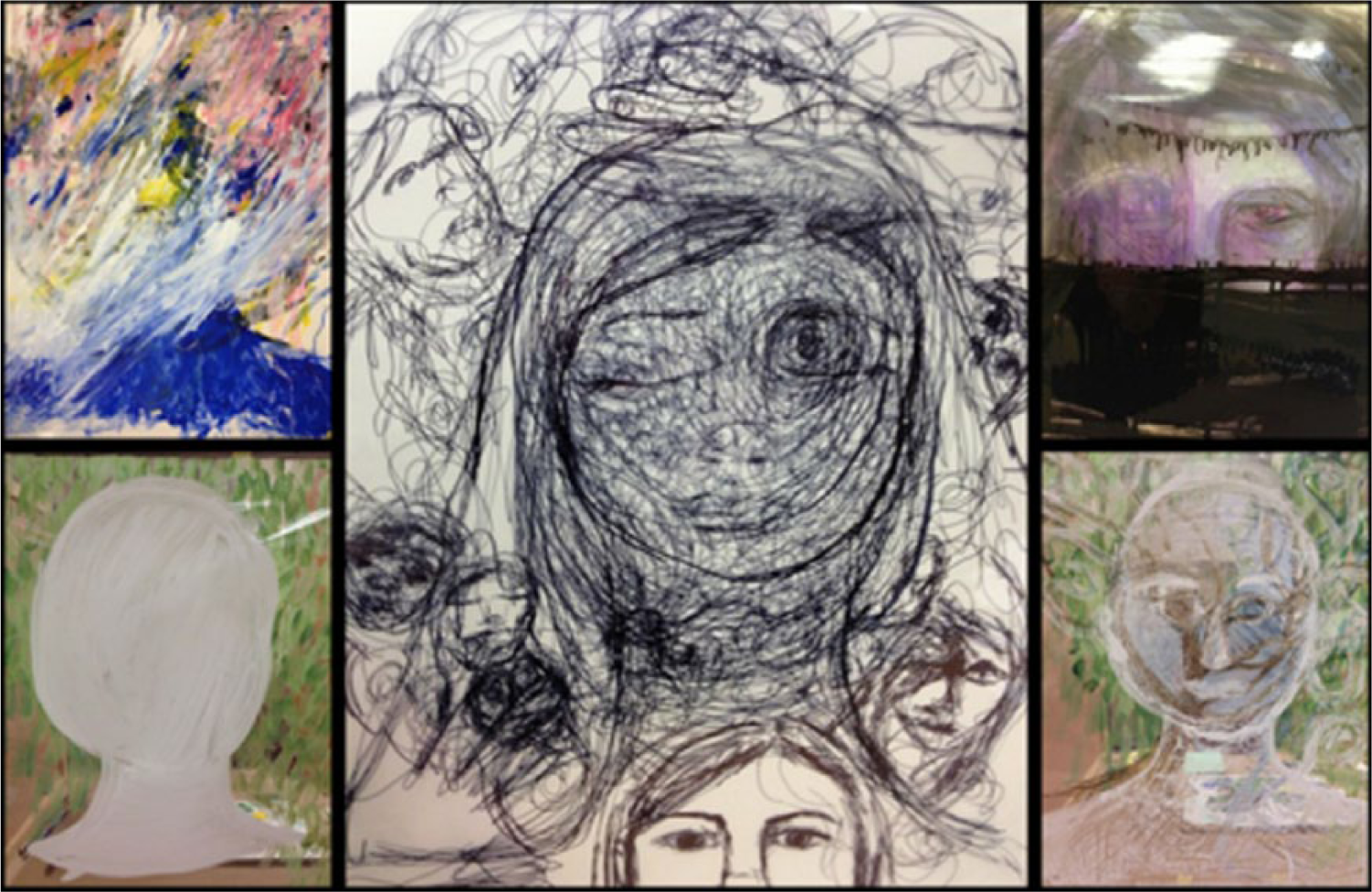
A collage of self-portraits that were created during this inquiry.
At the time of the inquiry, we had known each other for about 6 months in the context of our PhD studies. Although we were acquainted in the classroom context, we knew little about each other’s lives. From the point that we mounted our canvas, this was to change. Each week, this “canvas” was to become the space where an intimate encounter veiled and unveiled self–other processes as we simultaneously expressed ourselves and witnessed each other through the art of self-portraiture. What follows is a description of an artistic journey that enabled us to personally experience the depth of self–other processes and also transformed our awareness of each other.
Introduction
Transferences are traditionally viewed as multidimensional ways in which patients and analysts organize experiences of the analytic relationship (Stolorow & Lachmann, 1984-1985). As such, therapists knowingly expect to encounter the self–other processes of transference and counter transference in their clinical work. However, it has become generally recognized that early relational responses and patterns of transference and counter transference exist in many other everyday interactions (Robbins, 1988). The exploration and analysis of transference and counter transference depends on a person’s capacity to subjectively and intersubjectively perceive and engage with the notion that feelings, thoughts, and attitudes from original experiences can be reassigned to present experiences and relationships (Smith, 2003).
Much of what we can learn and know about another person arises and unfolds within the “in-between” space of relationships known as the intersubjective space. In this relational place, understanding develops through intimacy, empathy, and self-reflection, embracing the social and historical dimensions of the protagonists and welcoming the vulnerability and uniqueness of subjectivities (Finlay & Evans, 2009). Intersubjectivity is an experience of growth and transformation that brings an awareness and understanding to experiences and relationships, both past and present. To explore this development, there must be an openness to not only face oneself but also to face how others see us and how we, in turn, see others. This is an ongoing and intimate process.
Within the context of qualitative inquiry, reflexivity can be used to understand transference and counter transference. The importance of reflexivity in qualitative research has been robustly emphasized (e.g., Birks, Chapman, & Francis, 2008; Finlay, 2011; Gemignani, 2011; Maxwell, 1998). Reflexivity, in its most applied sense, is a methodological tool stemming from philosophical as well as theoretical adaptations of both phenomenology and relational psychoanalysis (transference/counter transference). Like relational psychoanalysis, a core tenet of reflexivity is that relationships are “continually established and re-established through ongoing mutual influence” (Aron, 1996, p. 77). “The very nature of qualitative research requires the researcher to assume a reflexive stance in relation to the research situation, participants and data under study” (Birks et al., 2008, p. 69). Reflexivity can assist a researcher to become increasingly aware of his or her subjectivity and to develop an empathic understanding of another person. Although there is an inevitable limit to the understanding and sharing of another’s experience, the development of empathy, awareness, and growth that comes from embracing reflexivity may contribute to the emergence of knowledge. According to Finlay (2011), researchers, like therapists, are tasked with recognizing “various intrapersonal, relational and cultural attachments” (p. 20) affecting them as well as those with whom they are working.
Our experience of another person is layered and shifts over time. “In the context of two people in relationship to each other, the reciprocal co-constitution of what is experienced is amplified in powerful, unpredictable and ambiguous ways” (Finlay & Evans, 2009, p. 9). Traditionally, qualitative researchers have relied on textual memos and journaling to aid the researcher in reflexive processing. This article demonstrates how the visual arts can be used to explore self–other processes.
Art making offers a unique way of reflecting on and investigating human experiences. Art therapy pioneer Edith Kramer (2000) wrote that art therapists can explore the phenomena of transference and counter transference through the artistic process. She claimed that the nature of the art therapist’s work, namely, creating art, affords insights that can only be experienced through creating art. According to Kapitan (2010), “Art is a valued means to constructing new knowledge” (p. 162). Yet, art has remained on the periphery of social research (Sullivan, 2005). Sullivan (2005) advocated for including the visual arts into the research context. Sullivan (2005) stated, “The critical and creative investigations that occur in studios, galleries, on the Internet, in community spaces, and in other places where artists work, are forms of research grounded in art practice” (p. xi). Research grounded in art practice can be considered the foundation of artistic inquiry. Artistic investigation is not only verbal or textual but also visual, multisensorial, and embodied. According to Kapitan (2010), “Art practice is a form of thinking, problem solving, and investigation of direct perceptual evidence that, as in all research, lays the groundwork for concept formation” (p. 162).
This hypermodal artistic inquiry is relevant for the qualitative researcher because it makes visible the invisible, intangible processes that exist between self and other, therapist and client, researcher and participant. By showing these processes in the visual form, this inquiry unveils their complexity. Self–other processes are intersubjective phenomena that manifest as transference and counter transference in clinical work and reflexivity in the context of qualitative research. We realized that finding a way to explore self–other processes was a challenging task because these phenomena exist intangibly. This elusiveness makes accessibility, comprehension, and translation difficult. We decided to engage in a collaborative, artistic inquiry to capture and examine self–other processes of transference and counter transference in an artistic, multisensorial way. We gathered and analyzed the data using images, photography, journal entries, letter writing, dialogue, and an art installation. We then communicated the findings artistically and discursively using the hypermodal inclusion of video- and audio-recorded results embedded elsewhere in this article. We present the hypermodal presentation of findings as an integrative and interactive way for viewers to access our multisensory, lived experience of exploring transference and counter transference.
Method
Using art is not an entirely new way of exploring self–other processes. Art therapists use artwork in their clinical work to reflect on their own counter transference and to deepen their understanding of the therapeutic process (Fish, 1989, 2012; Franklin, 2010; Kielo, 1991; Wadeson, 2003). Similarly, researchers have benefited from investigating their emotional reactions to participants whose stories and experiences can stir up strong emotions and personal associations. Influences from transference and counter transference are significant aspects of research that are often overlooked in reflexive analysis (Gemignani, 2011). Inviting researchers “to embrace their vulnerability and to use their emotional reactions as sources of knowledge about the other, the self, and the rapport between them renders the inquiry process more transparent, communicable, sophisticated, and enjoyable” (Gemignani, 2011, p. 705).
Collaborative artistic inquiry provides a method by which researchers can evoke as well as reflect on the relational dynamics of transference and counter transference and can assist in constructing understandable meaning within this shared space. Using an interactive artistic and reflexive process to study the concepts of transference and counter transference relative to art therapy, we asked the following question: How are the experiences of transference and counter transference explored through artistic inquiry?
Over the course of 10 weeks, we co-constructed several interactive self-portraits. Each week, we created visual representations of self on sheets of acetate transparency. Acetate sheets were layered allowing for our portraits to be superimposed; however, the images could be separated and viewed individually if desired.
Following each art-making session, we journaled about our experiences. We wrote the journal entries in the form of letters that we addressed to and later shared with each other. After sharing the letters, we discussed any thoughts, feelings, or other findings relevant to the emergent data and memoed about the subjective and intersubjective artistic, written, and oral data.
We were aware that the proposed method would, as we hoped, lead to the manifestation and disclosure of sensitive and personal material. We were open to the emergence of this material for the purposes of enhancing our understanding of the self–other phenomena. The provocation of emotions, attachments, reactions, transference, and counter transference led to the identification and further exploration of reflexivity as a factor necessary for change and meaning making to occur. To set the context for understanding this process, we would like to situate ourselves.
Victoria:
I am an art therapist and PhD candidate in Creative Arts Therapies, and a mother of two children (5 and 3 years of age). During this investigation, my daughter turned five and, being an active and independent child, demanded greater autonomy from me. I reacted to this developmental move with being overprotective. I felt sad because I became aware of my child’s growing up, which brought up the feelings of grief because of the inevitable separation that happens as the child matures.
Angela:
I am an art therapist and PhD candidate in Creative Arts Therapies. At the time of this inquiry, I experienced several, major life transitions. Most notably, I took on the role of caretaker for my terminally ill father; managed his personal, medical, and legal affairs; and endured his death. Concurrently, I was planning my wedding and got married. I experienced the extremes of both loss and union within the span of less than a week.
During the first phase of data analysis, each of us individually conducted a comprehensive review and thematic coding of her journal entries, class discussion notes, and artwork. Then, we together combined our individual data (i.e., visual images, snippets from journals/letters, and thematic data) and conjointly entered them into an organizational matrix for collaborative review and analysis. We engaged in a reflective process captured by inserting memos, concept mapping, and art-making techniques. The coding and analysis of all data resulted in the emergence of several themes including embodiment, transparency, deconstruction/reconstruction, and layering. The overall theme was that of “veiling and unveiling.” By peeling back layers or veils and allowing ourselves to become vulnerable, to be seen, we invited the permeability and receptivity necessary to begin understanding the subjective and intersubjective dynamics of beingness.
Peer Validation
As stated by several authors (e.g., Barone & Eisner, 2012; Cole & Knowles, 2008; Hervey, 2000; Leavy, 2009), traditional criteria of validity and objectivity are not compatible with the philosophy of artistic inquiry. Because this kind of research is deeply personal and subjective, it cannot be generalized to other situations. However, Hervey (2000), following Guba and Lincoln (1989), suggested application of the term “authenticity” to artistic inquiry. According to Leavy (2009), artistic inquiry should engage aesthetically and emotionally and initiate dialogue. To include the aspects suggested by Leavy, a peer review of the study was conducted. To capture and convey the personal meaning of the experience for each of us, we created a series of photographed portraits representative of embodied meaning and reflexivity between the self, the artwork, and the other (i.e., the witness/observer). We created an interactive walk-through art installation comprised of the original artwork as well as the responsive photographs. The aim of presenting the installation in this way was to provide peers with a sensorial lived experience akin to that of the researcher-participants’ and to elicit responses. Visit https://www.youtube.com/watch?v=rKWULRH57HA to view a short video clip of the art installation.

Peers were invited to witness the art installation and encouraged to engage openly in a dialogue regarding their reactions or thoughts after viewing the artistic presentation of the results. Some comments illustrating peers’ responses to the installation were as follows:
Peer 1: I was so struck by multidimensionality of this and how it reflected our experience of others. I thought that was really powerful. I wondered how seeing the other through a specific lens conveys transference.
Peer 2: One of the things that startles me, that shakes me, is the idea of being a witness to each other and what it entails. The veiling and unveiling and the wish to be seen and not to be seen. That I feel is so strong in here and made me think about what the experience would be without the other. There is no self without the other. And no ability to reflect without the other.
Peer 1: The whole idea to be seen in totality is to integrate the whole self and not be fragmented. The more we hide the more visible we are. There is an interplay between transparency and hiding.
Peer 1: I kept thinking what it would be like to write a narrative. What is the story? It is part of artistic inquiry: First we see it, then it is out there, then we look at it and have another perspective. You are always a participant and a researcher.
The impressions and comments shared by peers supported the represented theme—veiling and unveiling—as a well-suited metaphor for our experience. After engaging with the arts installation, peers expressed an understanding and connection with the researcher-participants’ self–other experiences of transference and counter transference as communicated via the interactive, artistic presentation of findings. Feedback from peers enhanced the research process by addressing the study’s aim of presenting and having the findings understood artistically.
Hypermodal Representation of Findings
Artistic inquiry uses the art process as a method of investigation as well as artwork as a way of presenting research results. In this artistic inquiry, an art installation using the transparency portraits and photographic portraits created in response to the ongoing inquiry were used to convey research results. The photographic portraits were used as an artistic response to the transparency portraits to further investigate the phenomena of transference and counter transference.
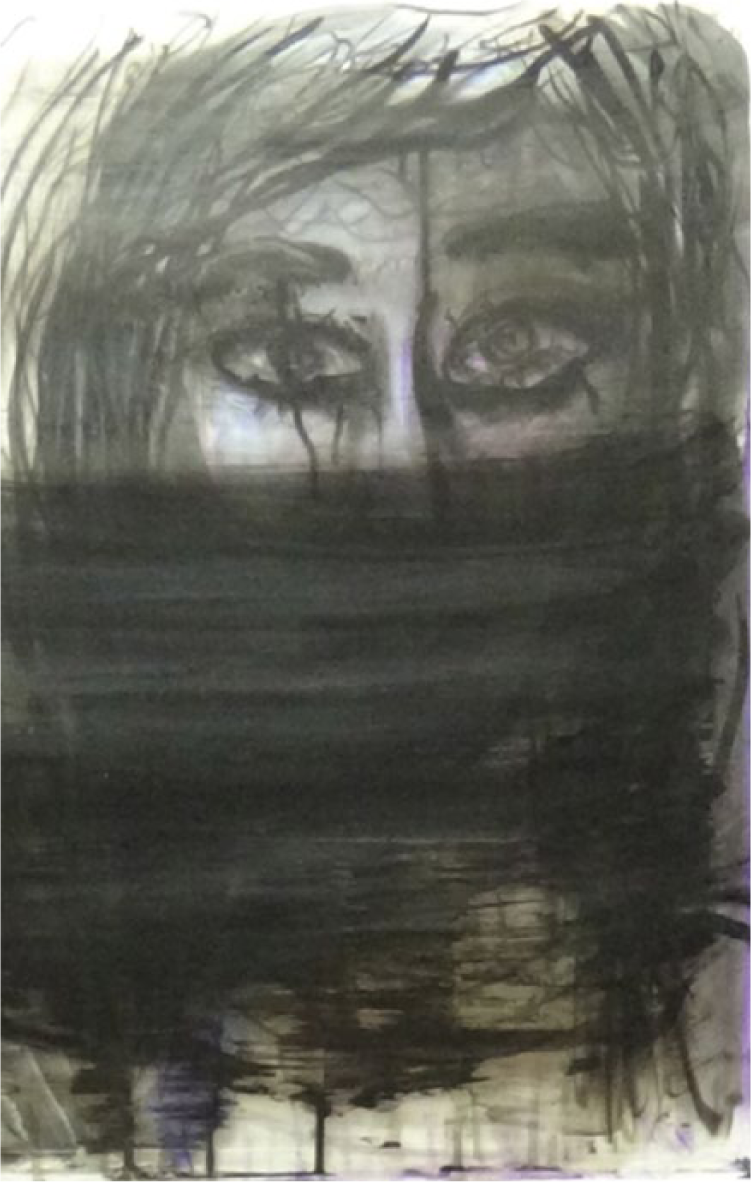
To represent out findings, we integrated self-portraits and excerpts from journal entries using video- and audio-recording equipment and software. We audio-recorded each other while reading journal excerpts aloud, and these audio recordings were later added to videos capturing corresponding portraits. The hypermodal presentation of findings, including the written and spoken discourses along with the visually communicative images, is accessible to readers by visiting https://www.youtube.com/watch?v=PeC6tBY4n2c.
Discussion
The purpose of this study was to engage in a collaborative, artistic inquiry designed to offer a multisensorial way of capturing and examining the self–other experiences of transference and counter transference. We experienced and invited outside viewers to listen, see, explore, and understand the dynamic and representative unfolding of transference and counter transference within this self–other experience. We found that exploring these phenomena required openness to experiencing the self–other processes. Moreover, we needed an approach to open innovative ways of conducting and presenting research. The hypermodality of capturing collaborative image making, performative photography responses, voiced journal entries/letter writing, and an interactive art installation allowed previously hidden or unknown relational aspects of transference and counter transference to surface and become shareable. Furthermore, the hypermodal representation of data and findings captured and aligned with the multisensorial and visceral components of artistic inquiry often at risk of becoming muddied when discursively translated. The artistic inquiry process circumvented the complex and invisible nature of transference and counter transference through the metaphor of veiling and unveiling.
Much like the exploration of transference and counter transference, the intimate act of creating portraits face-to-face was emotionally evocative. At times, the interaction felt confrontational, uncomfortable, and exposing; at other times, the interface offered a place of safety and acceptance. The presence of an other, as well as the fluidity and transparency of the media choices, created a space capable of eliciting, capturing, and holding ambivalent responses and the emergent awareness of the transference and counter transference phenomena among us.
Artistic inquiry and the use of art materials provided a method that remained close to the “core practices of art therapy” (Kapitan, 2010, p. 165). Self-portraiture as a way of investigating self–other processes offered the interesting production of portraits that were not always realistic. Merleau-Ponty (2004) wrote that a painting is not an imitation of the world; “when we experience a portrait aesthetically, its ‘resemblance’ to the model is of no importance” (p. 71). We created the portraits intuitively and spontaneously with little interest in capturing physical likeness. Instead, we strived to focus and capture the essence of our being during these moments of meeting and co-creation. The resulting images were a series of co-constructed uncontrolled, morphed portraits. The process of creation and the resulting portraits reinforced the notion that the self and the other are constantly interrelating and intertwining (Gemignani, 2011). We represented this coalescence metaphorically via themes related to veiling and unveiling (i.e., protection, revealing, hiding, layers, etc.).
An emergent inner awareness and outer realness, brought on by a reflexive way of working, focused on important transferences and counter transferences being played out in our interactive and artistic perceptions and understandings of self and other. This representative dynamic was influenced by the events that were happening in our lives outside of the study. The transference and counter transference that veiled and unveiled throughout our interactions were parent–child. Victoria responded to Angela with a desire to take care of her as though she was her own child—offering yet withdrawing nurturance for fear of being too protective and motherly. Angela saw Victoria as a parental–maternal figure she suspected privy to her childlike vulnerabilities. Despite best efforts to reject associations and instead be seen as peers, masking veils lifted and we both eventually recognized and accepted these parent–child roles.
Conclusion
The knowledge gained from this artistic inquiry provides a theoretically relevant and applicable approach aimed at exploring the phenomena of transference and counter transference. To uncover how transference and counter transference manifest themselves in the intersubjective space, this intersubjective and invisible place of “meeting” can be made visible using artistic inquiry. Moreover, by unveiling the phenomena of transference and counter transference, this inquiry shed light on related self–other processes such as reflexivity. Reflexivity through journal entries and discussions assisted us in more consciously reflecting on the unconscious processes of transference and counter transference that emerged through art making. Similar to the therapist, the qualitative researcher finds him or herself in an intersubjective space with the research participant. In this space, connections are made, stories are told, and meaning is co-created. There is a complexity that exists in the multiple layers of experiences between the therapist and the client and between the researcher and the participant. By unveiling these previously invisible and unconscious layers, these complex self–other processes become visible and accessible to conscious processing.
Footnotes
Declaration of Conflicting Interests
The authors declared no potential conflicts of interest with respect to the research, authorship, and/or publication of this article.
Funding
The authors received no financial support for the research, authorship, and/or publication of this article.