




Abstract
Over the last decade, academic institutions around the globe have archived qualitative data. While scholars have deliberately used them for research purposes, insufficient attention has been directed to their utility for the teaching of qualitative research (QR). In this article, I will discuss how I have used 39 interview transcripts of new immigrants to Canada to develop Lives & Legacies, an online digital courseware available free of charge through Open Access to advance the teaching and learning of qualitative interviewing (QI) for students and other novice researchers. After discussing challenges in teaching QI, I identify four pedagogical principles I have used and draw examples from the courseware to demonstrate their applications. I also discuss the transgressive potentials of using Open Access and a digital format for the courseware. I conclude this article by discussing the future prospects of using archival qualitative data in the teaching/learning of QR.
Keywords
Over the last decade, academic institutions around the globe have devoted extensive resources to archiving qualitative data sets because of their immense potential for secondary data analysis (Bishop, 2007; Broom, Cheshire, & Emmison, 2009; Camfield, 2013; Corti & Bishop, 2005). This has raised questions about the methodological and/or epistemological issues pertinent to secondary data analysis in light of the doing of qualitative research (QR), particularly around concerns over decontextualization, confidentiality, and consent (Corti & Bishop, 2005; Corti, Day, & Backhouse, 2000; Corti, Witzel, & Bishop, 2005; Parry, 2004; van den Berg, 2005). Insufficient attention, however, has been directed to the utility of qualitative archival data in the teaching of QR. In this article, I will discuss how I have used 39 interview transcripts of Italian, Tamil, Caribbean, and Chinese immigrants to Canada to develop Lives & Legacies, an online digital courseware available free of charge through Open Access to advance the teaching and learning of qualitative interviewing (QI). 1
I will begin by first identifying challenges I have observed in the teaching/learning of QI. I then discuss four pedagogical principles I employed when I used the interview transcripts as raw material to develop the digital courseware. For each principle, I draw on examples from Lives & Legacies to demonstrate their applications. This is followed by a discussion on the transgressive attributes of Lives & Legacies as an online digital courseware available free of charge through Open Access for the teaching/learning of QI. In conclusion, I discuss the limitations as well as future prospects of using archival qualitative data in the teaching/learning of QR.
Conceptualizing Interview Transcripts as Pedagogical Materials
I am quite familiar with challenges in the teaching and learning of QR not only because many of them have been covered in the literature (Cobb & Hoffart, 1999; Delyser, 2008; Michael, 2006; Snyder, 1995; Tierney & Lincoln, 1994; Webb & Glesne, 1992) but also from my own experiences teaching undergraduate and graduate QR methods courses for more than two decades. With increases in class size, decreases in resources, and multiple demands on students’ time and commitment, it has become increasingly challenging for instructors of qualitative methods to retain the value of hands-on learning in QR (Hellawell, 2006; Keen, 1996; Nyden, 1991; Strauss, 1988). Even though I continue to adhere to the pedagogical principles of experiential learning, I have become keenly aware of the inherent advantages of data sets available for the teaching of quantitative research and the disadvantage of teaching/learning QR without the benefit of comparable resources.
In the teaching/learning of QI, hands-on learning implies a linear process that does not really allow students to learn from one’s mistakes; each cohort of students repeatedly makes similar mistakes as they develop and carry out their hands-on interview projects. For example, in conducting qualitative interviews, students often follow their prepared interview guide too closely to either hear what the informant has to say or to ask follow-up questions that will fully explore issues/experiences that are meaningful to the informant. Students usually are not aware of these shortcomings until they transcribe their interviews or much later when they sit down to analyze their interview transcripts. By that time, there is insufficient time left in an academic term for them to conduct additional interviews to craft their interview skills and to rectify their mistakes. Most detrimentally, students are left with thin interview data which do not allow them to acquire data analysis skills. Writing a meaningful final paper becomes a frustrating process, rather than a productive learning experience. Furthermore, I have always been struck by the hefty prices of the available textbooks and other handbooks on QR and how these prices in particular act as access barriers, hindering the learning of QR.
To meet these challenges, I decided to use 39 interview transcripts from a research project about experiences of new immigrants in Canada as the raw material to address challenges in the teaching and learning of QI. These were not my own transcripts, but I was entrusted with them by the principal investigator for the project. With the pedagogical objectives in mind, I applied and received a teaching grant from the University of Toronto to develop courseware. A digital format also had the advantage of providing the space needed to appendix the transcripts as archival data. To use the transcripts beyond the project’s original scope and objectives, I also applied and received ethics approval from the Research Ethnics Board (REB) at the University. 2 Mary-Beth Raddon and I selected and anonymized 39 suitable transcripts to develop Lives & Legacies: A Guide to Qualitative Interviewing. The courseware includes five main sections that function as webpages with an appendix archiving the 39 interview transcripts and subpages filled with instructional content around QI, reflexivity, and data analysis.
Four pedagogical principles guided our use of the interview transcripts in the courseware. Although they are interconnected, I will discuss them one by one for the clarity of my discussion.
Challenging Imbedded Linear, Progressive Process
We sought to address challenges imbedded in the linear, progressive process of teaching/learning QI. As students often come to realize that they do not have high-quality interview data at a late stage of their own interview project, we decided to first demonstrate characteristics of thick, rich narratives and the emotional significance of the first-person accounts. We showed what kind of data one would need at the data analysis stage to articulate the complexity and layers of meaning in an informant’s narration about his or her lived experiences. Drawing excerpts from the interview transcripts, we compare those rich narratives with thin, general statements which left little data for the researcher to work with.
Underscoring Hands-On Learning
We upheld hands-on learning in the teaching of QR. We understood that experiential learning encourages students to advance their research capacity through hands-on experience: that students consolidate and expand their knowledge as they apply what they have learned into practice. For this reason, we included excerpts to develop specific exercises to provide hands-on, proactive learning experiences. This invites students to be active learning agents to identify problems, provide revision, and justify their critique and amendments. For example, the exercise, titled “Keep the questions open,” helps student avoid asking “multiple-choice” interview questions by instructing them to rephrase “multiple-choice” interview questions excerpted from the interview transcripts into open-ended questions. The exercise, titled “Don’t ask me ‘why’!” asks students to locate an excerpt of the “why” question in the data set and to rephrase the question into a “how” question. And, the exercise, titled “No clues, please!” helps students avoid asking leading questions. It asks student to comment on an excerpt to discuss how the interviewer led the respondent in the question, whether or not the respondent followed the lead in his response, and how to phrase the question differently (see table 1).
Example of Experiential Learning.

Demystifying QR and Destigmatizing Mistakes
We sought to simultaneously demystify QR and destigmatize mistakes. We therefore selected both exemplars and informative mistakes to excerpt for our pedagogical instructions. We then compared and contrasted attributes of the exemplars and mistakes to discuss methodological and/or epistemological issues in QI. Taking full advantages of interview transcripts as pedagogical materials, all the rocky (“failed”) interview encounters became treasures for our courseware project. We selected examples of thin narratives, discussed what type of interview encounters and/or questions lead to shallow answers, and demonstrated the effects of unexamined assumptions and conceptual baggage in QI. Rocky interview encounters and mistakes were showcased and examined, rather than stigmatized and hidden. We considered valuable lessons could be drawn from those encounters/mistakes when archival transcripts were used for teaching and learning purposes.
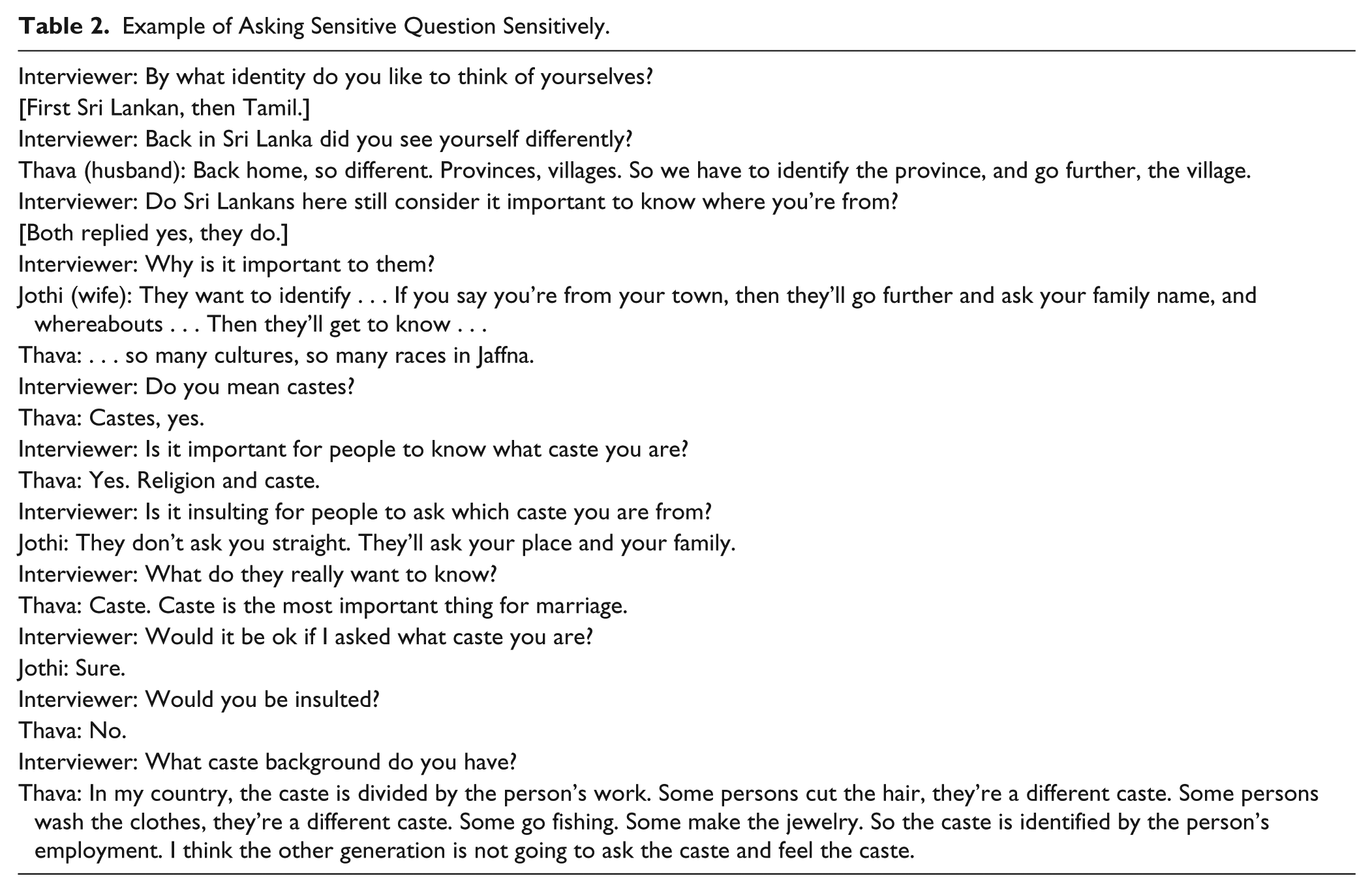
For example, the section called “phrasing questions and other interview techniques” includes Do and Don’t lists. The Do list includes excerpts of exemplars on how to “listen attentively,” “ask about sensitive issues skillfully,” “adjust questions to the respondent’s situation,” “ask open-ended questions,” “ask the respondent to tell a story,” and “ask questions to elicit the personal voice.” The wealth of the data set allows us to demonstrate that, for example, some issues are difficult to pursue. It takes a great deal of sensitivity and skill for an interviewer to handle them. While rapport and trust from the respondent are vital, there is still no guarantee that the respondent will be willing to address sensitive issues. We use an excerpt from a Tamil interview to demonstrate the delicacy of pursuing sensitive issues about the Tamil caste system with the informant. We note that the respondents averted a direct reply to the question in the end, showing the deep sensitivity of issues related to the caste system (see Table 2).
Example of Asking Sensitive Question Sensitively.
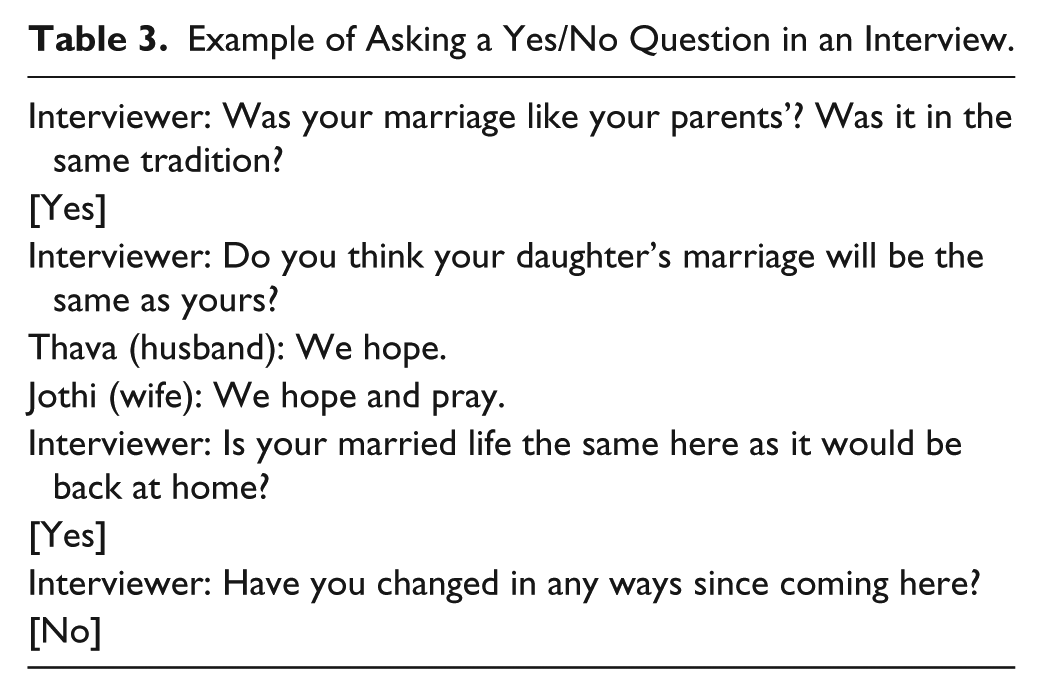
The Don’t list, on the other hand, consists of excerpts exemplifying “informative mistakes.” We used them to underscore the rationale for avoiding “yes/no questions,” “‘multiple-choice’ and double-barreled questions,” “‘why’ questions,” “asking for little-known facts,” and “imposing concepts.” Using excerpts from the transcripts, we demonstrate the interactive process and effects of asking yes/no, multiple-choice, and double-barreled questions. Table 3 includes an excerpt we used to demonstrate that Yes/No questions lead to Yes/No answers.
Example of Asking a Yes/No Question in an Interview.
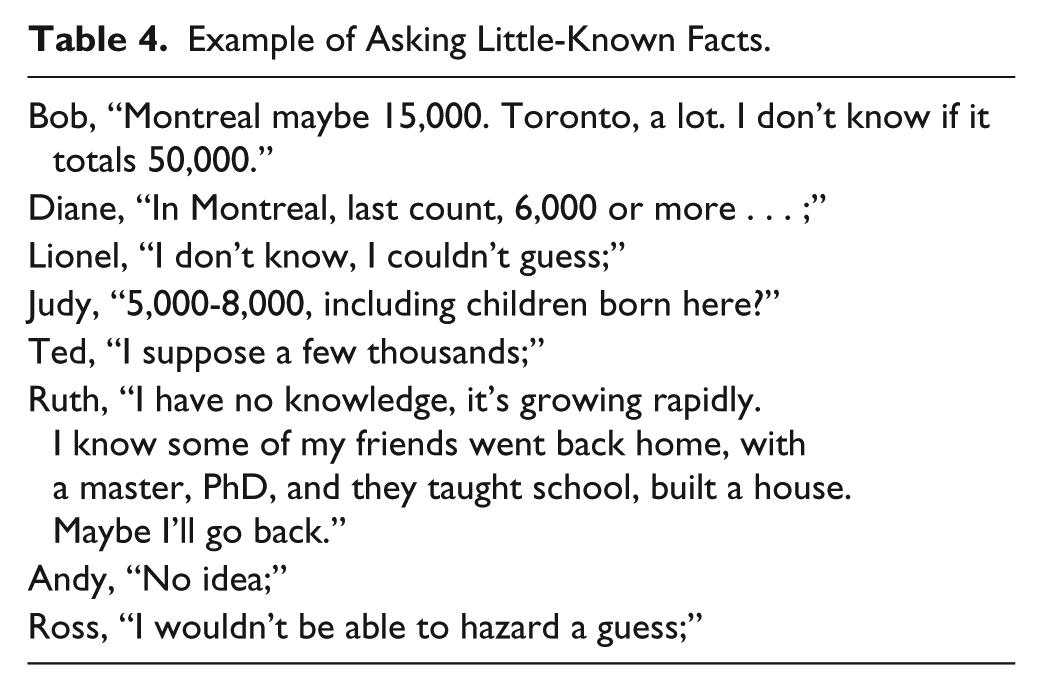
To demonstrate why an interviewer should avoid asking little-known facts, we reviewed 15 transcripts to show what happened when an interviewer asked “How many people from St. Vincent are here living in Canada and Montreal?” These answers illustrate the futility of asking for little-known facts; respondents cannot be expected to provide reliable information and data. There are, moreover, more reliable ways to find demographic information (see Table 4).
Example of Asking Little-Known Facts.
Connecting Methodology and Epistemology
Our courseware seeks to underscore the interconnectiveness of methodology and epistemology in QR. This is particularly evident when we discussed the practice and centrality of reflexivity in QI. We use excerpts of interview transcripts to demonstrate that a rocky interview encounter is not necessarily the result simply of poor interview techniques. One must interrogate the encounter epistemologically to identify conceptual baggage.
In the section “Reflexivity,” we further challenge the assumption that the “truth” is simply “out there” waiting to be discovered by the interviewer if only she or he asks the right questions. We remind students that qualitative interviewers should not assume that their questions are “objective,” nor should they assume that respondents’ answers have straightforward, definitive meanings that mirror a singular “reality.” Instead, QI involves a continuous process of reflection that examines both oneself as researcher and the research relationship. We point out that unacknowledged or unexamined implicit stereotypical assumptions, idiosyncratic concepts, and theoretical frameworks influence knowledge production and reproduction. These unexamined assumptions, concepts, and theoretical frameworks affect what questions are asked, from which angle issues are taken up, what social realities are considered worth pursuing, and which group’s experiences are legitimized and theorized.
We illustrate this with an example from the Caribbean interviews, in which interviewers explore issues of integration and ethnic identity. The interviewers ask the Caribbean immigrants whether they have participated in the “dominant” group’s institutions, or whether they remain in their own “ethnic” enclave. Specific questions include the following: “Are you a member of any Canadian clubs, like Rotary, or political parties?” “What newspapers do you read?” “Was the thinking before migration based on the understanding that you or your relatives would join the Canadian community or would you join a transplanted St. Vincent and the Grenadines community?”
We point out that by assuming a dichotomy between the “Canadian” and Vincentian organizations, newspapers, and communities, an assimilationist bias is implicitly assumed. The following excerpts help to illustrate how such a rigid dichotomy fails to adequately capture immigrants’ “Canadian” experiences.
Are you a member of any Canadian clubs, like Rotary, or political parties?
No, no, definitely not. Most of these associations want to have an African Canadian as a token person, these groups use us as tokens. They don’t want to give you a role on the basis of your qualifications. People who become tokens may do well for themselves but they can’t do anything for their community from that position (Caribbean, Interview #4).
What kind of newspaper do you read?
I read Parents magazine, the child care magazines, and I read newspaper from St. Vincent [which I get] every week so I know what’s going on. (Caribbean, Interview # 2).
We point out that both informants have challenged the bias and assumptions imbedded in the dichotomy; Paul rejects the notion that membership in a “Canadian” organization is an adequate indicator of an immigrant’s integration to the dominant society, and Diane’s answer illustrates an immigrant mother’s multiple identities. As a whole, the excerpts demonstrate the working and effects of conceptual baggage.
We further illustrate the pedagogical values of a rocky interview encounter in reflexivity. For example, because women’s domestic unpaid labor has long been neglected and trivialized, when women respondents are asked about their “occupation” before and after marriage, some informants have replied “I have never worked.” Only when the interviewer follows up with the question, “how about housework,” the respondent then replies, “Sure I did it. I’ve done that all my life.”
To fully realize the pedagogical potential of the interview transcripts, we unpack the interactive effects of methodology and epistemology in QI. Calling upon the Caribbean interviews, we point out that many of the respondents’ childhood and parental experiences, kinship relationships, and patterns of family formation, marriage, and divorce are distinctively different from assumptions embedded in the conceptual framework of the heterosexual nuclear family. Without questioning such assumptions, the exchange below led to a set of rocky, downward spiral exchanges.
Are you married?
No.
Do you have any children?
Yes, I do. I have four; the youngest is 6, and then 10, 13, and 14. They all live in Montreal. Two (the youngest) live with their mother and me and the other two have different mothers and live apart.
Are you divorced?
No, I was never married (Caribbean, Interview #7).
The unchecked heterosexual nuclear family assumptions not only make the interviewer an ineffective researcher, but they also leave insufficient space for the respondent to articulate his experiences in his own terms and from his point of references. This is evident in the brief, as-a-matter-of-fact answers provided by Carl; the switches of questions by the interviewer; and the reminder Carl made when he was asked whether he was divorced after he had already disclosed his marital status. When the interview continued and the interviewer asked Carl “What are the main things you want for your children,” it is not surprising that Carl shifted from speaking in a personal voice to stances of public declaration.
An Open Access Digital Courseware as a Transgressive Platform to Pass on the Torch
As courseware on QI, Lives & Legacies is a transgressive platform because it (a) removes the price and permission barriers currently imposed by conventional, printed textbooks and refereed journal articles on QI; (b) uses hyperlinks and digital features to underscore the methodological/epistemological objectives of QI; (c) makes qualitative data sets available for teaching/learning purposes.
Open Access and Creative Commons
Lives & Legacies is now available publicly through Open Access and Creative Commons. This has a number of advantages as compared with publishing the work as a textbook. One of the most significant advantages is that the courseware is available online, free of charge. It undermines inequalities of funding and access that not only restrict knowledge dissemination but perpetuate preexisting inequalities (Biggerstaff & Thompson, 2008; Harper, O’connor, Self, & Stevens, 2008). While many of the topics Lives & Legacies addresses are covered in textbooks or refereed journal articles authored by seasoned scholars in the field (Archibald, 2008; Delgado, 2000; Grande, 2008; Lewis, 2011; Mitchell, Friesen, Friesen, & Rose, 2007; Nikander, 2008; Thomas, 2005), textbooks are not cost-effective and journal articles are not freely accessible. My motivation for Open Access is to defy the identified obstacles and hefty cost associated with the access gap (Biggerstaff & Thompson, 2008; Harper et al., 2008). Open Access also offers opportunities for self-directed, self-paced learning at a time and place that meets the needs of the learners. 3 Since its publication, I have received appreciative emails from students, instructors, and researchers from diverse disciplines and various countries around the globe.
Hyperlinks and Digital Features
Hyperlinks and digitalized features help to realize pedagogical objectives. We use the hyperlink feature to underscore the interconnected relationship between methodology and epistemology. In the Don’t list, for example, to demonstrate that not imposing an interviewer’s own concepts upon the informant is not solely a technical issue, we use hyperlinks to connect it to three different sections of the courseware where we discuss (a) the objectives of QR, (b) the epistemological meaning of the informant’s life experiences, and (c) conceptual baggage. In addition, we use hyperlinks to emphasize the importance of examining one’s “research relationship” and the relationship between “reflexivity” and “conceptual baggage.”
Another digital feature effectively illustrates the interpretative premise of QR. For the Open Coding page, we present an interview passage with two buttons on the bottom, one that shows Mary-Beth’s line-by-line open coding when clicked and the other that reveals mine. This illustrates that there is no singular “right” way of coding. Because our codes are hidden initially, students can derive their own codes before clicking on a button to compare their codes with ours. Knowing that students often struggle with data analysis, we designed the hyperlink feature to provide an opportunity for modeling and comparing the perspective of more experienced researchers while not compromising the pedagogical values of experiential learning.
Data Set Appendix
Another advantage of the digital format is the storage capacity to hold an appendix of all 39 transcripts. As a databank, the transcripts serve several pedagogical functions. While the courseware excerpts particular passages, it also references the full transcripts in the databank. In this way, students/readers can select examples from the transcripts to harness their research skills in QI. In my own teaching, I have assigned methodological papers on hearing data and interpreting silences in QI that use this data set, have guided students to call upon selected transcripts as supplementary data when their own interview data was insufficient, and I have worked with students to use the transcripts for their independent research projects on immigration.
Conclusion
In this article, I have discussed how I have used 39 interview transcripts to develop the Lives & Legacies courseware to address challenges in the teaching/learning of QI. The courseware is suitable for undergraduate and graduate students and novice researchers engaging in QI. It can be used to supplement existing textbooks and publications. For students who conduct in-depth interviews for their course, it will be most useful if Lives & Legacies is used before and throughout their data collection. Instructors of courses on data analysis will find the sections on reflexivity, coding, and writing up useful. Instructors of undergraduate courses on family and immigrations can use attached transcripts as text-based raw materials for research-based projects on family (e.g., family structure, norms, and intergenerational relations), ethnicity (e.g., change and continuity in ethic and cultural identities), immigrations (e.g., personal and familial experiences of the immigration process, settlement, and community building), and gender relations (e.g., transformation and perpetuation of gender stratification).
The courseware has its limitations. Although I received feedback from students and colleagues on the manuscript before it was turned into the courseware, there was no formal, refereed review process that could have strengthened the manuscript. Furthermore, although the data set and the interpretative framework provided in the courseware point to new possibilities in pedagogy, Lives & Legacies cannot replace a textbook. It is not as comprehensive as many textbooks currently available on the market about the same subject, and its discussion of methodological issues is not as theoretically thorough as textbooks or articles devoted to those issues. Besides, instructors and students in social sciences may find it easier than those in other fields to relate to Lives & Legacies because issues on QI are discussed through substantive topics central on family, immigration, and race/ethnicity. Due to the scope of interview transcripts, Lives & Legacies do not address issues on QI that are uniquely discipline-specific and outside of the social sciences.
Nevertheless, as a catalyst, Lives & Legacies invites others to use qualitative data sets in teaching/learning of QR. In applied fields such as nursing and rehabilitation sciences, for example, “rocky” interview encounters between the interviewers/scientists and patients/users may shed lights on patterns and sources of communication breakdown. Analyzing the interview transcripts of such encounters not only enhances the teaching/learning of QI but also promises to advance the fields where both the interviewer/researcher and patients/informants have much to gain by bridging the hierarchal divide between the former as the knowledge producer and the latter as the knowledge consumer.
As a sociologist with extremely limited understanding about technology and digital design, I was also not in a position to realize the full potential when the manuscript was turned into courseware. Since its publication in 2010, Google analytics has regularly sent me access statistics. I have also occasionally received praise from students, instructors, and researchers around the globe who have found Lives & Legacies useful, sometimes with suggestions for improvement. Clearly, in a digital era, it is important for qualitative scholars to work with technology professionals to explore new media for teaching/learning QR and overcome barriers that continue to perpetuate inequalities in knowledge production and reproduction in qualitative inquiry. However, to improve and expand such endeavors, additional financial resources and institutional technological support are needed. An academic culture and structure that facilitate this type of innovative undertaking is imperative.
Footnotes
Acknowledgements
Over the years, I have benefitted from conversations and support of Leslie Chan who is committed to Open Access and digital publishing. I would like to thank Joan Eakin who has facilitated review of this article. I acknowledge Adrian Guta and Sandra Moll’s contribution as the reviewers who have provided very useful comments. Elise Maiolino and Jackson Yuebin Guo have provided research assistance at various stages of this article’s development. Sherri Klassen has copyedited the article.
Declaration of Conflicting Interests
The author declared no potential conflicts of interest with respect to the research, authorship, and/or publication of this article.
Funding
The author disclosed receipt of the following financial support for the research, authorship, and/or publication of this article: This project is partially funded by a Teaching Innovation Fund by the University of Toronto. Additional funding for the courseware development is partially provided by the Centre for Critical Qualitative Health Research, University of Toronto.