



Abstract
Identity among Puerto Ricans of the diaspora on the U.S. mainland is fluid, fragmented, multifocal, and nuanced. We explore Puerto Rican identity through the use of poetry, by presenting I-poems of adult Puerto Ricans living in the Greater Boston area, which we extract from qualitative interviews from the Boston Puerto Rican Health Study. I-poems are presented in conjunction with published poetry of Puerto Rican poets, with the aim of underscoring resonating sentiments and experiences. Poetry allows us to bring voice to the ambiguity of transnational and diasporic identity that is not as accessible and perceptible through other methodology.
Keywords
Introduction
“Break a vase, and the love that reassembles the fragments is stronger than that love which took its symmetry for granted when it was whole.”
In his well-known metaphor of the broken vase, Caribbean poet Walcott emphasizes the importance of the multiple components that form the identity of Caribbean people. This entails accepting ambivalence and complexity, as well as identifying the congruence among visibly different elements (Torres-Saillant, 2013). Poetry has a unique ability to shed light on this complexity. Throughout this article, we allow poems to expose the disparate and enmeshed fragments of identity among Puerto Ricans of the diaspora living on the U.S. mainland. We listened to stories told by Puerto Ricans living on the mainland, 1 and we focused on experiences related to cultural identity, the meaning of home and homeland, as well as their sense of origins. We developed poems from those stories, and then connected them with published poetry by Puerto Rican poets and became attuned to the analogous dialogues among the diaspora.
Historically, Puerto Rican cultural identity incorporates various elements, given the many centuries Puerto Rico spent as a colony of Spain as well as the invasion and occupation by the United States since the Spanish Cuban American War. 2 Those Puerto Ricans who are born on the Island and move to the United States also add other dimensions to their identity, such as that of migrant, foreigner, minority, and transnational, despite technically being citizens of the United States. As with frequent referendums 3 on the political status of the Island, Puerto Ricans frequently face the need to choose between the United States and Puerto Rico, to compare the two, and how they fit within their lives and their identity. Thus, they grapple with somewhat opposing forces within their sense of self.
I think (I feel it’s) my home (the US) I think that I belong to another place I’m here I belong there I’m Puerto Rican I feel like my home is there I’m here (since it’s easier for me)
Upegui-Hernández (2012) discusses concepts of bifocality and double consciousness to describe immigrants’ state of being in which there is “a dual frame of reference” resulting in continuous comparisons between their place of origin and their host society. Among Puerto Ricans living on the mainland, this bifocality, which seems to be inherent in any transnational identity, is apparent through different expressions involving a continuous negotiation within the self: fluctuation between place attachments, “in-betweeness,” half here/half there, neither from here nor there (Guzzardo, Todorova, Adams, & Falcón, 2015).
When considering Puerto Rican cultural identity, there is a need to embrace the ambivalence and fluctuation within the self. In his seminal work, Flores (1993) describes four moments that define the development of a Nuyorican cultural awareness, which can be applied to the development of a cultural identity among Puerto Ricans in Boston. These moments allude to the oscillation and the various opposing elements within Puerto Rican identity on the U.S. mainland. He describes them as follows: (a) the “here and now” including Puerto Rican migrants’ “immediate perception” of New York (NY), being faced with aspects of the environment that comprise disadvantage, abandonment, poverty, and crime; (b) a spiritual and nostalgic enchantment with the Island in which there is a retrieval of an African and Indigenous heritage, and that entails romanticizing and idealizing Puerto Rico; (c) a movement back to life in NY that now includes Puerto Ricans and their cultural energy—a moment that constructs and validates a new identity—the Nuyorican 5 consciousness; and (d) a connection and interaction with U.S. society, illustrated through the close relationship between African Americans and Puerto Ricans in NY. These moments are manifested through Nuyorican poetry (Flores, 1993), and therefore, Flores demonstrates how poetry becomes a valuable method for elaborating on the complexity of cultural identity.
Poems
I don’t know I was born there I miss there (PR) more I feel like I am Puerto Rican, one hundred percent I like being here, but no, my Puerto Rico comes first I feel entirely Puerto Rican, for sure
Poetry can be an insightful approach to qualitative research, as it is evocative of emotion and encourages reflection. Poetry can communicate dimensions, nuances, and subtleties of experience to which other forms of research, including arts-based methods, are less attuned (Leavy, 2009). Poetic representation as a research approach can be particularly illuminative of identity work, including in the contexts of migration (Glesne, 1997; Hanauer, 2013; Leavy, 2009; Reale, 2014).
In order to explore cultural identity through poetic representation, we read transcripts of interviews that were conducted with Puerto Rican adults living on the U.S. mainland as part of a larger project 6 (Tucker et al., 2010). Dialogical voices of Puerto Rican adults have previously been identified within these interviews (Guzzardo et al., 2015). As we considered these voices, we started to hear embedded poems, to which we bring a more focused lens in this article. We used an adaptation of the Listening Guide approach (Gilligan, Spencer, Wineberg, & Bertsch, 2003) with the purpose of identifying and extracting poetic representation of experiences related to cultural identity hidden in the text of the transcripts. The Listening Guide leads us through several steps and readings of the text that entail listening for “I-poems.” This listening can reveal co-occurring and contrapuntal voices that may be concealed, bringing forward individuals’ subjectivity. Specifically, we identified all the “I” pronouns, along with the verb and several meaningful words that follow. We then pulled out these “I” phrases, placing them on a separate line and keeping them in the order that they appear in the text in order to form an “I-poem.” Thus, following the “I” voice, we identify dialogues on identity, home, and sense of belonging. The I-poems are selected from the participants’ own words and make visible these expressions of self-definition. When extracting the I-poems from the full transcripts, the experience is analogous to watching sand being blown away by the wind, to reveal a beautiful, clear, but complex mosaic that was previously hidden under the sand.
We look more broadly and identify echoing sentiments in a selection of published poetry of the diaspora. The I-poems are presented below in conjunction with poetry of the Puerto Rican diaspora, 7 and in this way, they speak to each other. The I-poems give us insights into personal experiences and identity construction for several individuals. Poems in general are sensitive to silenced and to marginalized voices; therefore, poetry can function to “bring attention to silence” (Reale, 2014, p. 66), which we hope happens through the I-poems. The published poems, however, while also expressions of individual sentiments, are more widely available. Through this availability, published poetry can represent shared meaning-making with regard to identity of the wider Puerto Rican diaspora and “sensitize the reader to existential themes that are often shared by many people” (Furman, Langer, Davis, Gallardo, & Kulkarni, 2007, p. 303). The dialogue between the two types of poems, when presented together, further evokes the complexity and dilemmas of identity. It is through this integrated poetry that we draw a complex and ambiguous picture of Puerto Rican self-definition.
Wherever I Go
Pride as “la mancha de plátano.”

For many Puerto Ricans who moved to the mainland in the 1950s and 1960s, the move to the United States was a difficult transition full of challenges and feelings of being a fish out of water. As a fish would struggle to breathe, so do Puerto Ricans emphasize their puertorriqueñidad (sense of being Puerto Rican) on the U.S. mainland (Acosta-Belén et al., 2000; Acosta-Belén & Santiago, 2006; Barreras, 1998). The individuals whose I-poems are presented here moved to the United States between 1950 and 1973 with most having moved during the 1960s. Several moved to New York or other parts of the United States before establishing themselves in Boston. Some moved as children with their families and others as young adults seeking better life opportunities (e.g., work, education, health). Duany (2011) explains that the 1950s and early 1960s were characterized by massive emigration to the mainland because of insufficient employment opportunities on the Island and a demand for “cheap labor” on the mainland. During the 1960s, many workers traveled to the mainland under Puerto Rico’s Farm Labor Program and migrant communities developed, comprised mostly of former contract workers, in several major cities, including Boston (Duany, 2011).
These migrants tended to be “young, male, unskilled workers with little education and knowledge of the English language” (Duany, 2011, p. 52). They tended to work in seasonal agriculture, manufacturing, and domestic service and faced discrimination in employment, housing, and education (Acosta-Belén et al., 2000; Acosta-Belén & Santiago, 2006; Duany, 2002, 2011). Examples of these hardships have been expressed in the poetry of Miguel Algarín where he correlates sexual impotence with the exploitative working conditions of Puerto Ricans on the mainland: “Often presented with advertisements for jobs that do not materialize, these migrant workers end up compromising their health, or in this case their manhood, over jobs that could provide some support for their families” (Soto-Crespo, 2009, p. 128).
According to Acosta-Belén et al. (2000), themes of Puerto Rican literature in the United States presented a constant need to assert one’s puertorriqueñidad, which they define as “an idyllic connection to the homeland, an impassioned sense of patriotic pride and love, and an insatiable longing for what one has left behind” (p. 1). Through Juan’s voice (above), we see a strong attachment to the homeland and a resilient sense of patriotic pride that permeates the self-definition of many Puerto Ricans who are far away from the Island. The enduring identification with Puerto Rico and sense of patriotism is also expressed in a poem by one of Puerto Rico’s leading poets, Luis Lloréns Torres, which ends with “llevaré siempre la mancha, per secula seculorum.” 8 Puerto Ricans will forever have a “plantain stain,” an essence of being Puerto Rican, that, according to Lloréns, neither soap nor an iron could remove, as if it were a pervasive truth.
Even though Juan’s I-poem shows a commitment to Puerto Rico, during his explicit full story, he asserts that life can be easier on the U.S. mainland because of more work opportunities and prospects of progress. Juan does not discuss the kind of struggles that the speaker in Corretjer’s poem (Márquez, 2007) went through, the child of “a tear” and of “sweat.” Still, the commitment to the Island through his cultural identity and roots is pervasive throughout his story. The fact that life might be easier in the United States does not take away from the fact that he is Puerto Rican. This image reinforces the belief that being Puerto Rican is like an indelible sign, something that one is, not something one becomes, recalling the idea that Corretjer puts forth—He would be Puerto Rican even if he were not born on earth.
Holding on to roots while adapting
Given the permanence of one’s roots and the “mancha de plátano” that does not fade, the Puerto Ricans we spoke to discuss the difficulty of adapting to life in the United States, feeling strange or as an outsider, and experiencing difficulty with the new language, the new climate, or the new social atmosphere. In fact, several participants relay stories in which they were targets of prejudice.
9
They narrated stories about being denied housing or job promotions and related it partly to discrimination because of their ethnic identity. For example, Juan explains, “when you are Latino, you are not treated in the same way.” Hortensia also comments on how she believes others perceive Hispanics, like herself: “A lot of people still believe that we are disorganized, that we are disorderly, that we are dirty.” She also mentions that in the United States, there are a lot of places “where Hispanics are not well-liked,” but she has persevered and that because of these experiences she has become “a fighter” and “more independent.” In addition, some discuss language barriers they have faced, especially when first arriving in the United States, as well as encountering prejudice when unable to speak English. For example, Sofia relays others’ attitudes about her not being a proficient English speaker and how these experiences have affected her: Sometimes . . . aha . . . It’s a little embarrassing because sometimes . . . there are people who are very understanding. But there are others who try to humiliate you when you cannot speak their language . . . .
Furthermore, in the U.S. mainland, Puerto Ricans have experienced marginalization typically associated with the African American experience, facing not only prejudice as foreigners and Spanish-speakers but also discrimination and marginalization related to race (e.g., Niggerlips by Martín Espada). In fact, scholars discuss the interaction among Puerto Ricans and African Americans in New York, the connections and cultural proximity between the two groups, based on Caribbean and African ancestry (Acosta-Belén et al., 2000; Flores, 1993). Nuyorican poets, such as Felipe Luciano “positively testified to the historically close ties, regular commingling, and intimacy of affiliations between the black and Puerto Rican communities” (Márquez, 2007, p. 408), as well as to the similar injustices both groups face in the United States. For the individuals we spoke to, being in a new environment with different challenges, and the need to adapt and change accordingly, did not necessarily mean relinquishing connections to the Island. It entails change while maintaining the influence of the Island and one’s background there.
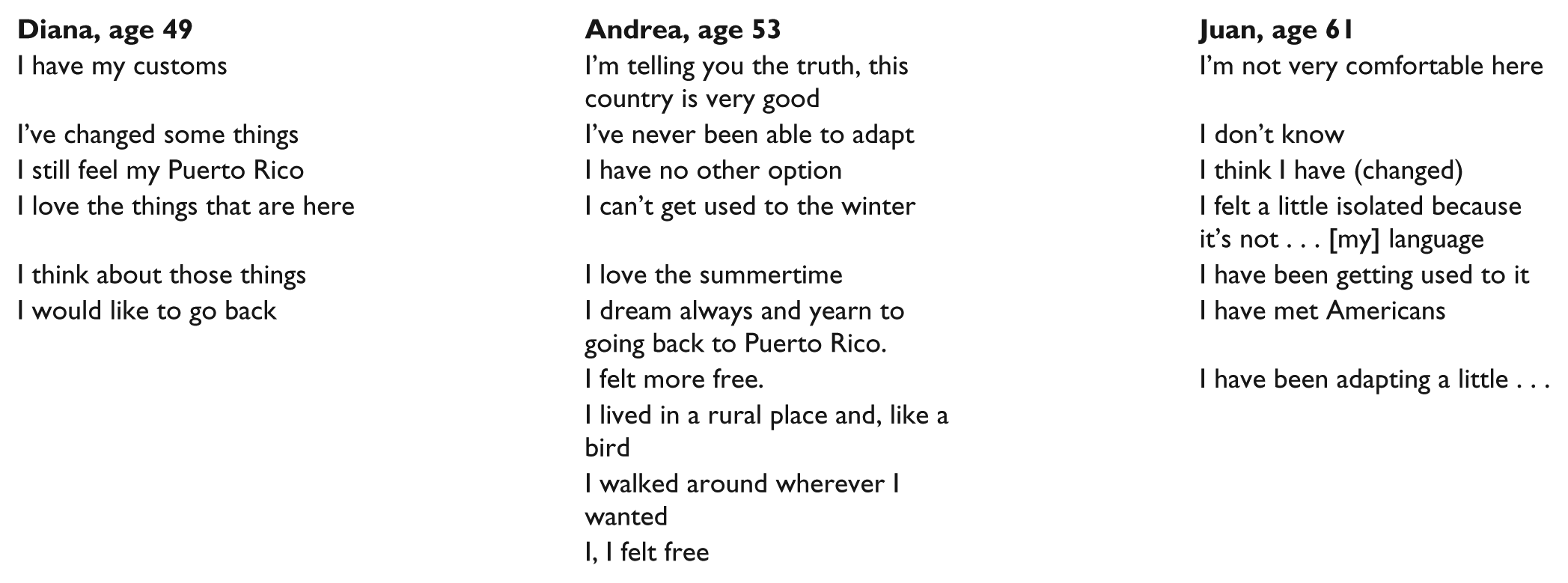
Adaptation is difficult but change is possible. Through their struggles, there is a need to hold on to customs and what one holds dear. Juan further discusses the challenges he faces: You know, since it’s not one’s own language and you don’t feel the freedom of expression . . . you know. Open. Like you feel when you’re in Puerto Rico, where you feel . . . a hundred percent . . . ehh . . . in other words confident. It’s like, here there’s insecurity.
One’s origins can make it difficult to adapt to a new, different place. In her poem presented below, Ortiz Cofer (Poetry Foundation, n.d.) discusses the importance of holding on to one’s birthplace and not forgetting it. Even though one struggles, changes, and adapts, one must not forget Puerto Rico, and therein lies an undying patriotic pride.
It is a dangerous thing
to forget the climate of your birthplace,
to choke out the voices of dead relatives
when in dreams they call you
by your secret name.
It is dangerous
to spurn the clothes you were born to wear
for the sake of fashion; dangerous
to use weapons and sharp instruments
you are not familiar with; dangerous
to disdain the plaster saints
before which your mother kneels
praying with embarrassing fervor
that you survive in the place you have chosen to live:
a bare, cold room with no pictures on the walls,
a forgetting place where she fears you will die
of loneliness and exposure.
Jesús, María, y José, she says,
el olvido is a dangerous thing.
“Home” Built Through Time and “Home” Through Imaginings
Home is where I am, not where I am from
So here I am, look at me
I stand proud as you can see
pleased to be from the Lower East
a street fighting man
a problem of this land
I am the Philosopher of the Criminal Mind
a dweller of prison time
a cancer of Rockefeller’s ghettocide
this concrete tomb is my home
to belong to survive you gotta be strong
you can’t be shy less without request
someone will scatter your ashes thru
the Lower East Side.
I don’t wanna be buried in Puerto Rico
I don’t wanna rest in long island cemetery
I wanna be near the stabbing shooting
gambling fighting & unnatural dying
& new birth crying
so please when I die . . .
don’t take me far away
keep me nearby
take my ashes and scatter them thru out
the Lower East Side . . .
I’m settled here
I like it here a lot
I can’t figure out (how to get myself over there)
I like to go for visit
I last 10 days (in Puerto Rico)
I come back here again
I feel good here now
I say that when I die
I don’t want them to take me to Puerto Rico
I want them to bury me here
I’ve spent all my life here
I have everything here, my children, my children’s culture is here
Contrasting greatly with the prideful poems expressed earlier about Puerto Rican roots and identity, these poems relocate their sense of identity. Identity is thus equated with where they are situated and based on their experiences in this host country. Another I-poem extracted from Eugenia’s story is presented below, representing the same sentiment:
I have my children
I have
I live well
I have everything
I have everything
I can’t complain
I tell you honestly
I can’t complain
I’m the first one in line (to vote)
I’m that way for everything
I’m right there (when they ask people to sign, or vote)
I consider myself from the United States
I came here when I was 16, just imagine
I’m 57
Time spent in this location is of crucial importance because through time one forms relationships and attachments to place and people. Piñero’s poem (Márquez, 2007) talks about the roughness of the city life with crime and illicit activities. However, he is fond of where he lives. It is his home. Piñero, Eugenia, and Enrique have a stronger connection to their place in the United States than to Puerto Rico, expressing no interest in returning to the Island. This contrasts with Juan’s patriotic I-poem discussed earlier in which he feels that he would like his life to end in Puerto Rico, finishing where he was born. For Eugenia and Enrique, identity is not only equaled to being Puerto Rican but also to where one is located. It is not that they are now Americans—They are living here, and they like it here. Piñero describes how he is here but as a marginal figure, an outsider—“a problem of this land”—but he is here and here he wants to stay.
I consider it my home
I’ve had the opportunity (to move out here)
I feel now like this is my place
I don’t . . .
I don’t have the desire to go somewhere else
I feel . . .
I feel . . . at peace
I know that people care about me here
I care about them
A flight (“fuga”) of the psyche
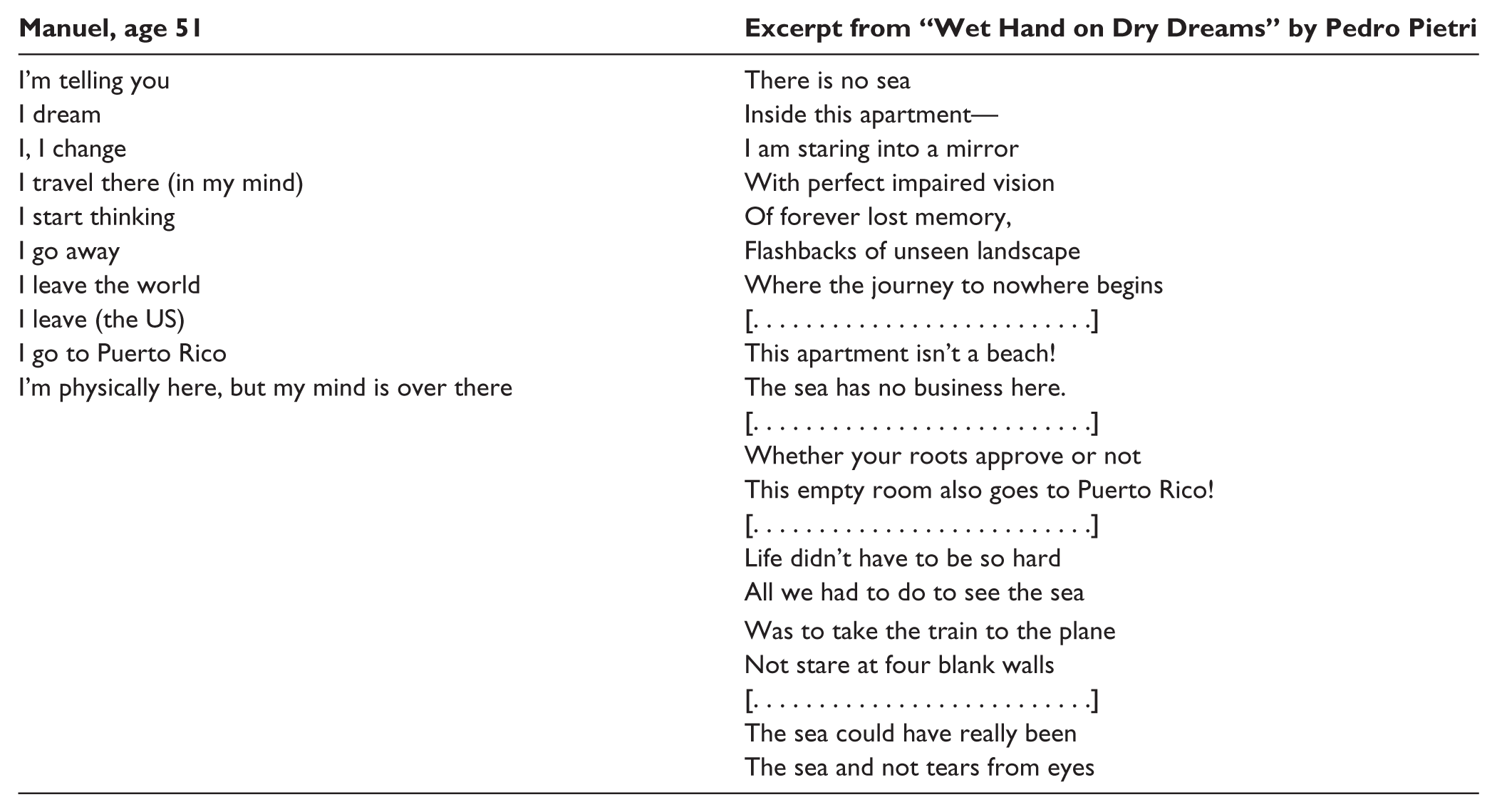
The voices in these poems allude to a split or contrast between where their bodies are located and the place for which they long and dream. For Manuel, the warm, familiar and friendly environment of the Island contrasts with a feeling of being confined within a closed space. Pietri (López, 2005, Spring) seems to be alluding to the same feeling in the phrase, “four blank walls” in his poem. Other Puerto Ricans with whom we spoke also equate being in the U.S. mainland as being “inside four walls.” Being stuck inside is connected to the cold weather months and the way that the atmosphere outside becomes hostile, which is very distinct from the welcoming warmth of the Island (Todorova, Guzzardo, Adams, & Falcón, 2015). Thus, there is a need to take a mental flight to Puerto Rico, leaving a restricting environment behind. According to these Puerto Ricans, life should be spent outside, interacting with nature and other people. However, when one cannot experience the outdoors, the only solution is to dream. Thus, Manuel truly “lives” when he “dreams” of Puerto Rico. In these cases, the subject finds his homeland inside himself, in his memories and in his imagination.
The island as utopia
According to Acosta-Belén et al. (2000), Puerto Ricans’ cultural expression on the mainland (e.g., theater, poetry, literature, etc.) involves a “compelling nostalgia and longing for the homeland [that] has inspired the many voices of those who left, returned, or remained on distant shores” (p. 1). There is a passionate nostalgia in these poems in which Puerto Rico is an intangible fantasy far away, something that can only be conjured up in dreams when one is living on the U.S. mainland. Puerto Ricans living in the Greater Boston area also expressed these sentiments. They feel distant from the Island, long for it, and idealize it through the romanticized imagery of tranquility, peace, freedom of movement (outside), freedom of expression (language), warmth, the flora and fauna, frequent interactions with neighbors, and the closeness of family (Todorova et al., 2015).

In Espada’s poem (Encyclopedia.com, n.d.), he imagines what it might have been like for his father who immigrated from Puerto Rico to the U.S. mainland. The Puerto Rican rural landscape is contrasted with the city. Lucía’s reminiscence of the island and the countryside is bittersweet, something she misses. Similarly, Juan (age 61) says of the island, “It’s like people there spend more time together and there’s more freedom of expression,” later noting that “It’s like paradise to live in Puerto Rico”; consequently, thoughts of Puerto Rico provide sustenance to the soul.
Paradise lost, new home found
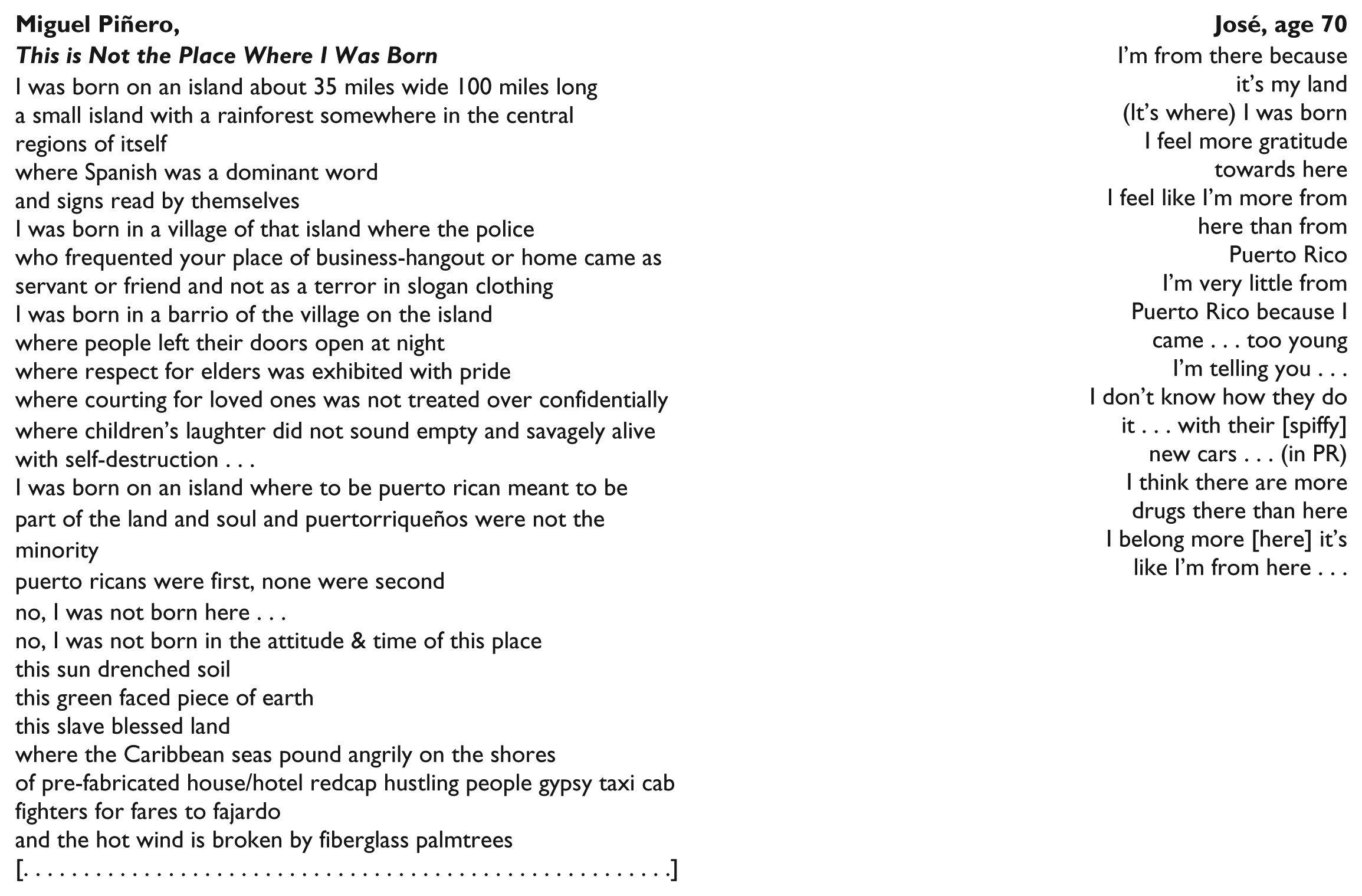
In these poems by Juan and Miguel Piñero (Márquez, 2007), there is a recognition that places change over time; there is a shifting of homes and attachments to place. The utopic aspect of the Island has been lost to modernization, consumerism, and the harmful consequences of U.S. influence. Parallel to Tato Laviera’s poem Nuyorican, Puerto Ricans are “eating McDonald’s in American discoteques” (López, 2005, Spring). Laviera adds that when he visits San Juan, he is unable to dance salsa but can do so in the barrios on the U.S. mainland where he resides. For these individuals, the Island is no longer “my home” or an ideal place, and, instead, one’s place of residence on the mainland is what provides a feeling of contentment; it is the best option of the two. Acosta-Belén et al. (2000) explain that to many Puerto Ricans of the diaspora, The idealization of paradise lost has been tempered by the realization of new generations of Puerto Rican artists that “you can’t go home again.” Those who try to go back to the enchanted Island are themselves disenchanted. The mythical island they dreamed of is overflowing with the detritus of US style, consumerism and many of the same problems that confront other modern societies. Instead of a warm welcome, they often find themselves misunderstood and mocked as foreigners who do not belong. (p. 86)
There is a demythologizing of Puerto Rico in these poems, contrasting with the nostalgic, prideful poems about a utopic Puerto Rico seen earlier in this article. In these poems, rather, there is a nostalgia for a culture and place that is disappearing and the subsequent profound disappointment that it engenders. Martín Espada (below), in his poem Coca-Cola and Coco Frío (López, 2005, Spring), presents a Puerto Rican boy who lives in Brooklyn and while he “visits the island of family folklore” is bored with the Coca-Cola offered to him. Finally, he is able to try coconut milk and the poet concludes,
For years afterward, the boy marveled at an island
where the people drank Coca-Cola [. . .]
while so many coconuts in the tress
sagged heavy with milk, swollen
and unsuckled.
Similar to the sentiment expressed in Piñero and Espada’s poems above, several other Puerto Ricans who spoke with us discuss how Puerto Rico is no longer the place where they were born. Puerto Ricans in Boston, whom we spoke with, feel strange in their “own country” when they return. Juan often compares the Island of the present with that of the past. He laments that people cannot celebrate the Christmas tradition of parrandas anymore, because there is “mistrust” (crime) and that there are lost customs, such as sharing a pig roast.
Because the last time I went, I was astonished. When I saw so many cars and everyone with a car and a telephone. And going around with all those things I said . . . “Look at that!” When I . . . when I left the first time, what there were . . . ox drawn carts . . . like the one my grandfather had . . . . (Juan, age 61)
He explains that ambition and selfishness have taken the place of the old customs. Their homeland has changed, and they no longer fit in. They discuss the flashy new cars and the large houses, as well as the rise in crime. “Now it’s different, now there are drugs everywhere, now there are a lot of drug addicts everywhere. Before you didn’t hear of people robbing in houses, now if you leave your house alone [empty] they’ll steal it” (Rafael, age 65). In fact, for Rafael, the people in his current neighborhood on the U.S. mainland are more similar to how he remembers life in Puerto Rico 40 years ago with a friendly and social atmosphere, in which neighbors celebrate and have parties together.
There is a desire to experience the elements of one’s culture in one’s current home that through time become entrenched in these spaces in which Puerto Ricans reside in together. Miguel Algarín’s “4th St” (López, 2005, Spring) discusses the hope that comes from sounds and feeling of one’s culture while living in the United States:
La salsa resuena
and the people are poor
but wait
this isn’t a poem
of complaint
this is a poem of hope,
la salsa resuena
and my veins choke up with blood,
my skin stretches
over my bone frame
and resounds to the street music
that taps my every pore
La salsa resuena translates as “the salsa (music) resonates.” The music transforms the tough streets for Miguel Algarín and provides hope. It is obviously something with which he identifies and which helps provide a sense of belonging. Similarly, José and Rafael feel that the Puerto Rican atmosphere they have where they live is more similar to what they remember from their past on the Island than it is to contemporary Puerto Rico. For example, in José’s story, he discusses how “Puerto Rican” his neighborhood is, with the familiar noises and people talking and spending time together in outside areas. Puerto Rican culture comes to life in his neighborhood, as it does for Algarín for whom la salsa is not just enjoyable music but something that causes a profound physical and spiritual reaction. For Algarín, it is “hope” in the tough poverty-stricken streets of New York, but for José, that music means “home.”
Ambiguity Can Lead to Wholeness
Identity as a tangle or “un amasijo.” 10
The political status of Puerto Rico facilitates a back-and-forth migration pattern between the Island and the mainland. Historically, there have been multiple waves of diaspora from Puerto Rico to the United States (Duany, 2002), and movement toward the mainland continues today. However, many of these individuals and/or their descendants sometimes return to the Island, either for short periods of time or to move back permanently (Acosta-Belén et al., 2000; Ramos, 2004, 2007). This Puerto Rican migratory movement, circular and bidirectional, has been described as el vaivén 11 (Duany, 2002). Duany uses the common metaphor of “a revolving door” to describe Puerto Ricans’ movement between the Island and the U.S. mainland. This fluid bidirectional movement makes it easy to maintain transnational ties to both the Island and the U.S. mainland, and in this way contributes to interwoven identities.

I am a child of the Americas,
a light-skinned mestiza of the Caribbean,
a child of many diaspora, born into this continent at a crossroads.
I am a U.S. Puerto Rican Jew,
a product of the ghettos of New York I have never known
An immigrant and the daughter and granddaughter of many immigrants.
I speak English with passion: It’s the tongue of my consciousness,
A flashing knife blade of crystal, my tool, my craft.
I am Caribeña, island grown. Spanish is in my flesh,
ripples from my tongue, lodges in my hips:
the language of garlic and mangoes,
the singing in my poetry, the flying gestures of my hands.
I am of Latinoamerica, rooted in the history of my continent:
I speak from that body.
I am not african. Africa is in me, but I cannot return.
I am not taína. Taíno is in me, but there is no way back.
I am not european. Europe lives in me, but I have no home there.
I am new. History made me. My first language was Spanglish.
I was born at the crossroads and I am whole.
In these poems, we see the fluidity of identity, the pulling together of disparate pieces of one’s self (e.g., feelings of belonging and of not belonging, feeling ties to place and also feeling strange in places associated with one’s identity). For Levins Morales in the poem above (Santiago, 1995), she is made “whole” through a synergy of components that make up their identity. The I-poems of Rafaela and Hortensia illuminate these different components, a sense of belonging to both places or being in between (Rafaela) and feeling as though one is not completely either one nor the other (Hortensia). Hortensia illustrates an identity that is created by not identifying completely with one place or the other. While Rafaela’s I-poem shows a connection and identification with the U.S. mainland, the rest of her story shows a commitment to Puerto Rico, and when asked directly where she belongs, she says “in between.” Rafaela discusses the need to be in the United States for the medical treatment and family. She explains that here in the U.S. mainland, “one does not live, here one survives,” and that the “living” is done in Puerto Rico.
The idea of identity as “un amasijo” is also visible through Sandra María Esteves’ poem below (PBS/WGBH, n.d.). She says she has no name for her identity and that she is “ni portorra, pero sí portorra too” (not a Puerto Rican, but also a Puerto Rican).
Sandra María Esteves
Being Puertorriqueña Dominicana
Born in the Bronx, not really jíbara
Not really hablando bien
But yet, not Gringa either
Pero ni portorra, pero sí portorra too
Pero ni que what am I?
Y que soy, pero con what voice do my lips move?
Rhythms of Rosa wood feet dancing Bomba Not even here, but here, y Conga
Yet not being, pero soy, and not really
Y somos, y cómo somos?
Bueno, eso si es algo lindo Algo muy lindo
We defy translation
Ni tengo nombre
nameless, we are a whole culture once removed[. . . . . . . . . . . . . . . . . . . . . . . . . . . . . . . . . . . . . . . . . . . . . . .]
Esteves has a different experience from the Puerto Ricans we spoke to because she was born and raised in the Bronx. Many Puerto Ricans we spoke to feel strange in Puerto Rico because of the time spent away and the unfamiliar aspect of it now. However, Esteves was not born and raised there. Her connection to Puerto Rico is through her parents. Estevez, similar to the poems above of Hortensia, integrates multiple identities, by also renouncing them, similar to the concept of a “nomadic subject” (Braidotti, 1994). Braidotti explains that [The nomadic subject is] a figuration for the kind of subject who has relinquished all idea, desire, or nostalgia for fixity. This figuration expresses the desire for an identity made of transitions, successive shifts, and coordinated changes, without and against an essential unity. (p. 34)
Estevez’ point of “defying translation” is particularly relevant to the point of tolerating complexity within identity. She is arguing for namelessness because the name would only exist to make her more comprehensible to a colonizer/oppressor/host country. To name something is to make it fixed/static, and to define means to impose limits around something, including identity. In terms of Puerto Ricans’ identity among those of the diaspora, there is also a need to avoid a concrete definition, consequently limiting their identity with classification. Instead, there must be a tolerance of an unfixed and open-ended identity, one that accepts ambiguity. However, ambiguity does not necessarily mean that one is incomplete or lacking something, but rather that very ambiguity can make a person feel “whole” as in Levins Morales’ poem (above).
Akin to our description of Puerto Rican identity as “un amasijo” replete with ambiguity, Soto-Crespo (2009) similarly makes a case for embracing the ambiguity inherent in the Puerto Rican identity. In fact he goes further to reject the word “identity” and calls it instead, “a de-essentialized entity” (Soto-Crespo, 2009, p. 143). This entity is unbound by place, and the Puerto Rican people are, therefore, an “unassimilated multitude” (pp. xiii-xiv). Consequently, he argues that Puerto Ricans constitute “a cultural anomaly” that he calls a “Borderland state,” given that its influences spread beyond the Island or U.S. borders. Soto-Crespo explains that the paradox inherent in the Puerto Rican identity must be defended as a defiance to normalization. In that way, we can maintain meanings and flexibility or “structural openness” that is permitted through the anomaly of the Borderland state (p. 22).
Puerto Rican people as islands
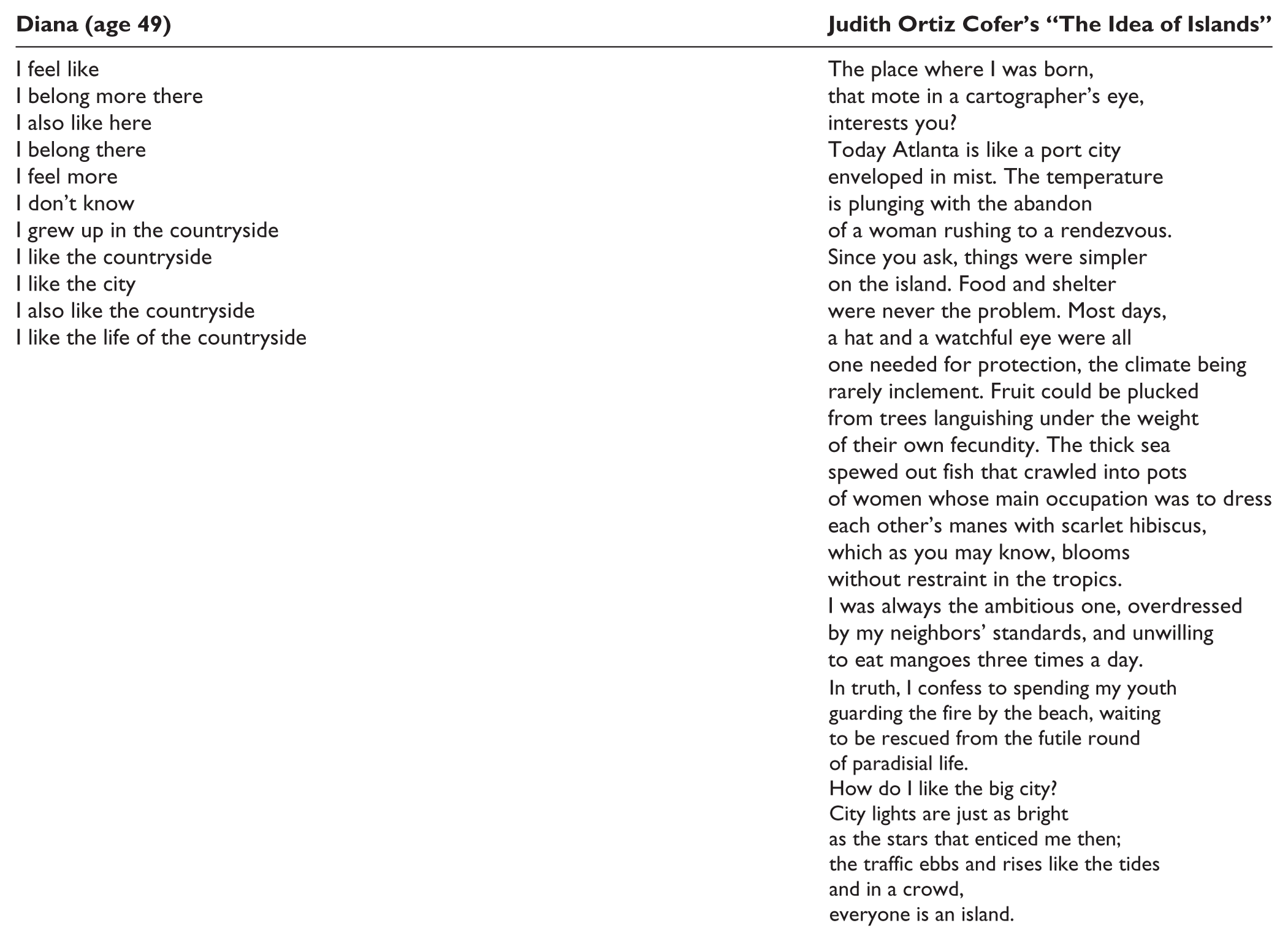
The metaphor of diasporic Puerto Ricans as “islands” in the subheading is meant to highlight their individuality and complexity. The structure of their identity comprises a complex and multifaceted process that involves choosing, rejecting, and negotiating the various elements that make up their sense of self. This structure is unique to each individual, and it differs from mainland or island surroundings. For Judith Ortiz Cofer (Márquez, 2007), Puerto Rico is a place where one can live, where the basic things of life can be enjoyed, where there is a good climate, food, and the beauty of nature can be experienced. The imagery that provides a positive aspect to the City is imagery from the Island—the stars and the waves, suggesting that she identifies with both and has established connections with both places. While Diana also sees positives in both places, her sense of belonging is more strongly anchored in Puerto Rico. The tolerance for ambiguity can be achieved by understanding people as islands, as complex beings, in which ambivalence relating to identity and belonging is a given. As one is both everything and nothing, one wonders why there is a need to choose between Puerto Rico and the United States.
The difficulty in choosing between Puerto Rico and United States is illustrated through Francisco’s I-poem below in which we hear the patriotic voice tempered by a secondary voice that shows some opposition to that pride.
I would like to live in Puerto Rico
I’m going to tell you the truth (things have changed)
I would prefer to live in Puerto Rico it’s my climate, my people.
I went a month to Miami with a friend of mine
I saw the atmosphere [the feel of it, environment]
I had a good time
(And now that I’m here) I’d like to live in Puerto Rico
(Another thing) I don’t like about Puerto Rico
I have all my (medical) papers (here)
I had the problem in my leg while in Puerto Rico (“agonizing” in a clinic or hospital for hours)
I don’t know
I say Puerto Rico is my country
I love it
I know I can’t talk [badly] about my country.
He says he prefers to live in Puerto Rico but mentions also enjoying Miami. Then, we continue to hear the repetitive commitment to Puerto Rico, along with a voice that mentions some disadvantages about living there. Finally at the end, with “I know I can’t talk [badly] about my country,” Francisco suggests that this commitment should be unwavering even though it does apparently waver within his own I-poem. We see, therefore, how Francisco’s I-poem illustrates the disparate elements inherent in Puerto Rican identity.
Keeping one foot on each side of the puddle
I enjoy it
I can speak Spanish
I can speak English
I can speak both
I am bilingual now
The regularity and ease of movement between Puerto Rico and the U.S. mainland is demonstrated through the popular phrase “brincar el charco” (jump over the puddle; Acosta-Belén & Santiago, 2006); traveling to one place or the other is a matter of simply jumping over the puddle. With the phrase “keeping one foot on each side of the puddle,” we allude to how Puerto Ricans try to preserve both the Puerto Rican and U.S. dimensions of their identity. For many Puerto Ricans, it is impossible to consider the concept of home without incorporating a discussion of both United States and Puerto Rico and how these two are present within one’s identity.
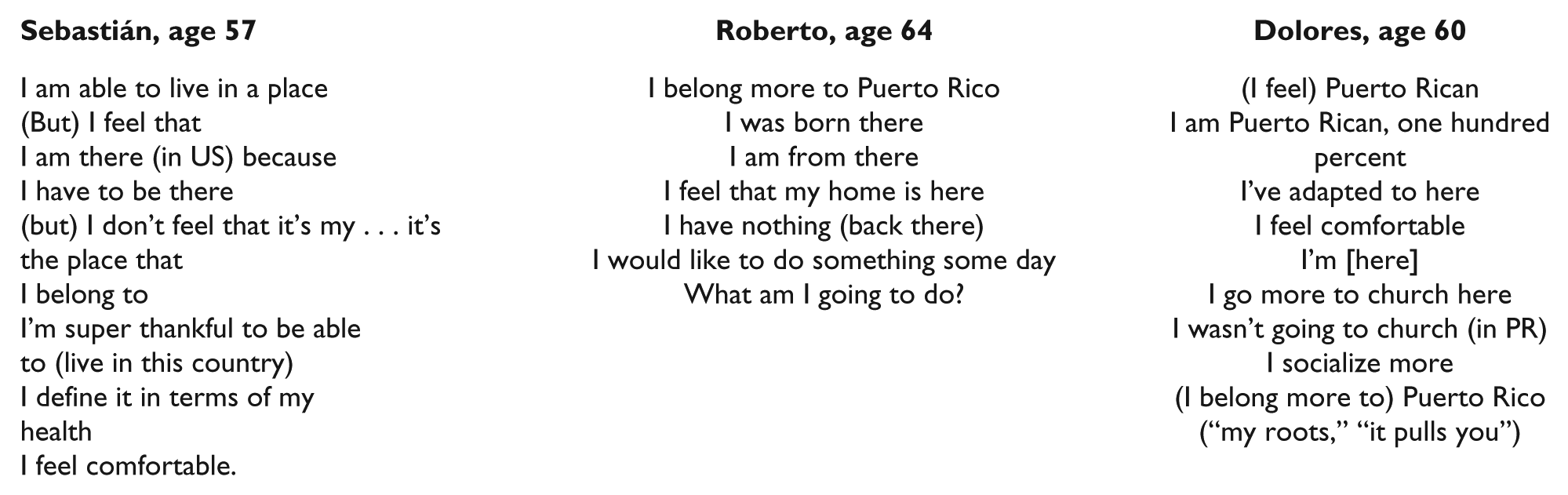
For Sebastián, Roberto, and Dolores, home in the United States is a place that is made or built, imbued with meaning through the passing of time, a place of their choosing, and where they can grow old. They may consider themselves to be better off in the U.S. mainland because they have made it their home over the years, family members and friends are located there, and they have what they believe are the means to survive (e.g., better work opportunities and health care; Adams, Todorova, Guzzardo, & Falcón, 2015; Todorova et al., 2015). However, belonging to Puerto Rico is related to the foundation of oneself, it has to do with a “primordial link to the Island” (Acosta-Belén et al., 2000, p. 1), it is the enduring mancha de plátano. There, Puerto Ricans find a locus for their identity between the place where they come from (where they belong) and where they now reside (their home)—an intermediate space. The I-poems reveal this back and forth, a constant metaphorical movement of a floating identity between “here” and “there.”
In the I-poems above, Sebastián, Roberto, and Dolores discuss their identity in a matter-of-fact way, with acceptance and even contentment. However, for some there is also an ultimate uncertainty regarding this middle or intermediate space between here and there. For example, we see this vacillation of identity at the end of Roberto’s I-poem (above), with the line “what am I going to do?” It is also evident in other I-poems:

While Diana’s I-poem is filled with indecision, Rosario at first seems to reiterate her certainty with her “‘I tell you’s,” as if it is a declaration or vow—that she will return to Puerto Rico. The definitiveness of telling us that she would be in Puerto Rico is destabilized by the “I do not know” at the end of the I-poem and in the rest of her story. The uncertainty leads one not only to question identification about home and belonging but it also alludes once more to the question of whether one will return to the island to live, in the future. Consequently, being Puerto Rican frequently entails open-ended questions, revealing ambiguity in his or her identity. As with other Latina/o or Caribbean people (Anzaldúa, 2007; Lugones, 1994; Torres-Saillant, 2013), the Puerto Rican cultural identity comprises an amalgam or synthesis of visibly different and sometimes conflicting elements—It is an identity that requires a recognition and tolerance of complexity and ambiguity.
Conclusion
Questions of cultural identity, home, and belonging include numerous definitions and explanations when it comes to Puerto Ricans of the diaspora. When attempting to define Puerto Rican cultural identity among individuals of the diaspora, there is no simple answer, there is no clear resolution, and rather, the answer comprises a continuous, fluid dialogue regarding self-definition. Poetry contributes to pulling out this self-definition, the nuances about the self, and the multiple voices within the same person or between different people, making ideas of cultural identity more apparent.
This article extends previous work related to Nuyorican poetry (Flores, 1993; Soto-Crespo, 2009), which has focused primarily on poets in New York. We believe that Puerto Ricans who live in Boston, such as the individuals whose I-poems we have included in this work, can further inform how Puerto Rican cultural identity develops in different areas of the U.S. mainland. In addition, in our work we combine the words of individuals who participated in an empirical study, whose I-poems otherwise would not be published. By combining their words with poetry of the diaspora, we provide an innovative method of examining cultural identity. The poetic representation of Puerto Ricans’ responses provides insights that are not as easily revealed when simply presenting the quotation of participants in a qualitative study. Through the I-poems we see the fluctuation between voices and discourses about identity, making the multiple meanings and internal dilemmas within the self more visible. Therefore, this poetic method highlights the dialogical nature of identity issues. It also magnifies individual experiences and variations between people, while also demonstrating a broad, shared relevance across people. We see this shared relevance in how the I-poems can resonate with the published poems, showing similar sentiments related to identity. The connections between published poets and the Puerto Ricans with whom we spoke allow voices that may be overlooked (silenced or ignored) more audible. There are parallel emotions and an empathic sense of what it means to be Puerto Rican in the U.S. mainland that is made evident through a poetic representation of qualitative data that bonds participants, poets, and readers.
I’ve changed because . . .
I feel better here
I feel happier . . .
I feel better
I like it here.
(When I came) I didn’t like it.
I had never come here
I went through a time when I couldn’t get used to it
I didn’t feel good . . . really . . . sometimes
I’d cry
I got used to it
Footnotes
Acknowledgements
We would like to thank the participants who took part in the interviews for their generous time and insight, as well the poets whose work we, and countless others, draw upon. We are grateful to the National Institutes of Health, who have funded this project.
Authors’ Note
The data can be accessed by contacting Luis M. Falcón, PhD, Dean of Fine Arts, Humanities & Social Sciences, 978-934-3843,
Declaration of Conflicting Interests
The authors declared no potential conflicts of interest with respect to the research, authorship, and/or publication of this article.
Funding
The authors disclosed receipt of the following financial support for the research, authorship, and/or publication of this article: This study was funded by National Institutes of Health, under Grants P01AG023394 and P50HL105185.