




Abstract
The pragmatist roots of constructivist grounded theory make it a useful method for pursuing critical qualitative inquiry. Pragmatism offers ways to think about critical qualitative inquiry; constructivist grounded theory offers strategies for doing it. Constructivist grounded theory fosters asking emergent critical questions throughout inquiry. This method also encourages (a) interrogating the taken-for-granted methodological individualism pervading much of qualitative research and (b) taking a deeply reflexive stance called methodological self-consciousness, which leads researchers to scrutinize their data, actions, and nascent analyses. The article outlines how to put constructivist grounded theory into practice and ends with where this practice could take us.
Keywords
When the British mystery writer P. D. James died in 2014, her obituary traced James’s long interest in crime to her childhood (Associated Press, 2014). The obituary mentioned an anecdote about P. D. James that she relished retelling throughout her life. At 8 years of age, James first heard the nursery rhyme about Humpty Dumpty’s 1 fatal fall. She immediately asked, “Was he pushed?” We researchers must echo this kind of incisive question. The questions we ask matter; the perspectives underlying our questions count.
Doubt shaped P. D. James’s perspective and sparked her unconventional question about Humpty Dumpty’s fall. Doubt involves having reservations about what is happening or happened, defining uncertainty, and interrogating ready explanations. Questions flow from our perspectives. Like mystery writers, critical qualitative researchers must raise probing questions. As Karen Locke, Karen Golden-Biddle, and Martha Feldman (2008) argue, doubt can generate theory. Furthermore, doubt both inspires and sustains critical inquiry. We need to begin from a perspective of doubt, not only about empirical events but also about how we view, analyze, and represent them. Which perspectives encourage us to raise probing questions? Which methods can help us conduct critical inquiry?
The constructivist version of grounded theory 2 befits critical qualitative inquiry. Constructivist grounded theory is a contemporary version of Barney Glaser and Anselm Strauss’s (1967) original statement. The constructivist version fosters asking probing questions about the data and scrutinizing the researcher and the research process. Unlike other versions of grounded theory, the constructivist version also locates the research process and product in historical, social, and situational conditions. Constructivist grounded theory adopts earlier methodological strategies such as coding, memo-writing, and theoretical sampling. However, it shifts the epistemological foundations of the original version and integrates methodological innovations in qualitative inquiry occurring over the past 59 years (Charmaz, 2000, 2014; Mills, Bonner, & Francis, 2006). These epistemological shifts and methodological innovations form a foundation for bringing grounded theory into critical inquiry and enhancing it.
Before showing how constructivist grounded theory can enhance critical inquiry, I consider what stands as critical inquiry and briefly describe the foundations of constructivist grounded theory in pragmatist philosophy, whose founders advocated reformist goals. The pragmatist goal of democratic social reform links constructivist grounded theory with critical inquiry. We can adopt pragmatism to help us make actions and processes visible that otherwise remain tacit. Constructivist grounded theory gives us a method for conceptualizing these actions and processes to reveal their implications for critical inquiry. Pragmatism offers ways of thinking about critical qualitative inquiry; constructivist grounded theory offers ways of doing it.
I argue that Anglo-North American worldviews, particularly those based on individualism, pervade much of qualitative inquiry and foster adopting a taken-for-granted methodological individualism. 3 Subsequently, many researchers import preconceptions about individualism into their methodologies. They focus on individuals and emphasize the individual level of analysis without excavating the structural contexts, power arrangements, and collective ideologies on which the specific analysis rests (Charmaz, 2016). To grapple with these preconceptions, I advocate developing methodological self-consciousness to turn a deeply reflexive gaze back on ourselves and the research process as well as on the empirical world. This methodological self-consciousness requires scrutinizing our positions, privileges, and priorities and assessing how they affect our steps during the research process and our relationships with research participants. Thus, engaging in this kind of reflexivity profoundly affects the practice of constructivist grounded theory in critical inquiry and where it could take us.
What Is Critical Qualitative Inquiry?
Defining Critical Inquiry
Numerous scholars consider themselves proponents of critical inquiry. But what do they mean? What does it include? When I speak of critical inquiry, I include concerns and studies about social justice, although it is an ambiguous and elastic concept. In its various forms, critical inquiry addresses power, inequality, and injustice. Consistent with Donna Mertens (2009) and Norman Denzin (2015, p. 31), I see critical inquiry as embedded in a transformative paradigm that seeks to expose, oppose, and redress forms of oppression, inequality, and injustice (see also, Cannella, 2015; Cannella & Lincoln, 2007, 2015; Pasque & Pérez, 2015; Strega, 2005). Critical inquiry begins with conceptions of justice and injustice. Notions of justice and injustice are abstract concepts but mean more than mere abstractions. Rather, these concepts encompass moral judgments and shape moral actions. Thus, notions of justice and injustice become “enacted processes, made real through actions performed again and again” (Charmaz, 2005, p. 508). Studying questions about justice and injustice as enacted processes can inform critical inquiry and initiate new research directions.
Critical inquiry usually begins from a researcher’s explicit value position that defines the meaning of the research question in advance of conducting the study. A critical researcher may pursue a cause and intend to advocate in the public realm or to educate in the academic domain. Quantitative critical inquiry has focused on structural inequalities and their subsequent disparities such as those in education, employment, health, and the criminal justice system (see, for example, Truesdale & Jencks, 2016; Volscho, 2011). With some notable exceptions such as Clarke, Friese, and Washburn (2015), qualitative critical inquiry, which I emphasize in this article, has focused on the plight of disadvantaged peoples and the effects of structural inequities on them (see, for example, Dunn, 2002; Ghaziani, 2004; Veale & Stavrou, 2007; Wasserman & Clair, 2010).
The roots of critical inquiry reside in both classic and contemporary traditions. We can draw upon multiple forms of critical inquiry. Some scholars treat critical inquiry as emanating from the postmodern turn. However, critical inquiry has had a long history preceding postmodernism. In several social sciences, Karl Marx indelibly shaped this history. Over the decades, Marxist and neo-Marxist perspectives have implicitly or explicitly influenced numerous studies about power, ideology, class divisions, social and cultural reproduction, and the consequences of capitalism (see, for example, Auyero, 2012; Bettie, 2003, 2014; Thompson, 1963; Willis, 1977). Early Chicago school protagonists, such as Jane Addams (1910) and Robert E. Park (R. E. Park & Burgess, 1925), also pursued critical research and advocated social reform. 4 More recently, feminist theory, critical race theory, and queer theorizing, as well as various forms of postmodernist and poststructuralist theorizing, have informed critical inquiry.
We can broaden both the foundations and the practice of critical inquiry by including an emergent approach with inductive qualitative research. In addition to linking critical inquiry to emancipation and transformation before inquiry, we can also emphasize developing it during the research process. An open-ended, emergent method fosters developing a critical stance. Constructivist grounded theory is an emergent method, because it is “. . . inductive, indeterminate, and open-ended. An emergent method begins with the empirical world and builds an inductive understanding of it as events unfold and knowledge accrues” (Charmaz, 2008, p. 155). Much qualitative research is inductive and emergent but constructivist grounded theory goes further than other approaches in two ways. First, as noted above and explained below, constructivist grounded theory systematically brings doubt into the analytic process. Second, using constructivist grounded theory means designing and fitting methodological strategies to explore what the researcher discovers along the way (Charmaz, 2014; Charmaz, Thornberg, & Keane, in press). Hence, constructivist grounded theory facilitates defining and developing emergent critical questions systematically.
What stands as critical qualitative inquiry can develop long after researchers begin to pursue their initial research questions. An innocuous research question may produce findings that arouse doubt and spur critical analysis and subsequently contribute to furthering human rights. In addition, such questions may spark examining taken-for-granted methodological individualism in our methods. By subjecting our data, our practices, and ourselves to rigorous scrutiny throughout inquiry, researchers’ critical stance can emerge and change how we see our research participants, our research goals, and ourselves (see also, Fontes, 2004; Foster-Fishman, Nowell, Deacon, Nievar, & McCann, 2005; Swartz, 2011). In short, constructivist grounded theory may spark new ideas and kindle new questions.
Developing Methodological Self-Consciousness
Constructivist grounded theory relies on developing and maintaining methodological self-consciousness, which calls for reflexivity of a depth researchers may not routinely undertake. Methodological self-consciousness means detecting and dissecting our worldviews, language, and meanings and revealing how they enter our research in ways we had previously not realized. Thus, tacit individualism becomes visible. Methodological self-consciousness means examining ourselves in the research process, the meanings we make and the actions we take each step along the way. Methodological self-consciousness also means becoming aware of our unearned privileges as well as taken-for-granted privileges accompanying our positions and roles (see also, herising, 2005). This type of self-consciousness involves defining intersecting relationships with power, identity, subjectivity—and marginality—for both the researcher and research participants. Moreover it involves seeing what constitutes these relationships and how, when, why, and to what extent they shift and change. We cannot assume and reify their stability.
Methodological self-consciousness harkens back to Sandra Harding’s (1991) concept of strong reflexivity and Adele Clarke’s (2005) emphasis on positionality, which includes examining the researcher’s social locations. Harding invites us to imagine how our research project, the research process, and we ourselves look from the standpoints of our participants. But she takes her point further. She next asks us to stand behind our participants and then look back at the specific social and cultural content of our project and locate it with other projects. Simultaneously, we make this assessment while looking forward to shape the next step of the research process. Harding’s strong reflexivity spurs methodological self-consciousness. We may see our work anew and hear tough criticisms but the flexibility of qualitative inquiry and, particularly, of constructivist grounded theory allows rethinking and redirecting the research process.
Through writing critical reflections throughout her research, Elaine Keane (2015) brings Harding’s strong reflexivity to life. Keane aimed to enact principles of constructivist grounded theory by explicating her position in her texts as she coded data, wrote memos, drafted her dissertation, and crafted papers (Keane, 2011a, 2011b, 2012). She reveals the methodological self-consciousness that she developed during her study of widening student access to and participation in higher education in an Irish university. In one reflection, Keane recounts the following realization about her undergraduate years in this university where she now teaches:
As a lecturer now in the same university, I feel increasingly “at home” here over time. In recent months, however, my mind began to harp back to specific incidents, fleeting moments, and powerful feelings, and I clearly remember refusing to engage in any process in which I felt I might be “found out” and thus rejected. Whilst it is indeed obvious to me now, it was with genuine surprise that I began to see the similarity between some of what I’ve found in this study and my own personal experiences as an undergraduate. I have realized the provenance of my interest in social class, the student experience, peer relationships and social integration. (Keane, 2015, p. 422)
Indigenous and international scholars also have described similar epiphanies to Keane’s as they juxtapose their experience against conventional methodological assumptions. These scholars are bringing new insights to qualitative inquiry in general and to critical qualitative inquiry in particular. Qualitative research has been infused with and dominated by white Anglo-North American worldviews, methodological assumptions, and concrete methodological strategies. Indigenous and international scholars continually confront the relative fit, or lack of it, between these dominant—and often taken-for-granted—modes of thinking about and doing research (see, for example, Absolon & Willett, 2005; Bhattacharya, 2013; Hsiung, 2012, 2015; Kovach, 2005, 2009). 5 S. Park and Neil Lunt (2015) find that the individualism shaping qualitative research did not fit conducting research in South Korean society with its emphasis on collectivism, homogeneity, and personal networks. They write, “Social research methods are in fact typically ontologically and epistemologically individualistic. The methods have been developed to study particular ‘social’ settings (western, industrialized, capitalist) but in so doing, a broader methodological veil is drawn across all cultures and situations” (p. 5). Park and Lunt show how Confucianism shapes the context of research, and the relative strength or weakness of personal networks affects whether participants define risks of losing face and their subsequent willingness to talk.
Locations of both researchers and participants matter. Indigenous researchers explicate the significance of multiple locations, such as those in familial, local, communal, traditional, and academic places, spaces, times, and moments. Ways of knowing are embedded in these locations. Indigenous researchers may, however, juxtapose their unique and collective experiences. Kathy Absolon (Absolon & Willett, 2005) writes,
In my work, I often find myself trailblazing, cutting through ideologies, attitudes, and structures ingrained in euro-Western thought that can make the path for aboriginal self-determination difficult, even impassable. . . . I am a visionary with thoughts and dreams about life as an Anishinabe person. . . . Yet, I know that I speak and write truly from my own position, experiences, and perspectives and do not represent the Aboriginal peoples’ voice. The only voice I can represent is my own and this is where I place myself. (p. 99)
Absolon and Willett understand the collective in the subjective, but ground their respective subjectivities in experience. By extension, they contend that differences among aboriginal peoples cannot be erased or reduced to a single voice. Ping-Chun Hsiung (2015) also points out the significance of the collective and local ways of knowing throughout the globe. She portrays tensions between Anglo-North American qualitative inquiry and the situation of researchers in China as a divide between the dominant “core” and the “periphery.” Hsiung states, “. . . qualitative researchers doing critical work in the periphery in the global era need to negotiate an intellectual space locally by confronting the interplay between imported Anglo-American theories and local hegemonic discourse” (p. 97). 6
Individualism pervades Anglo-North American inquiry. Individualism shapes our worldviews, underlies our methods, informs our relationships with research participants, and frames our interpretations in taken-for-granted ways. Indigenous and international research exposes the taken-for-granted methodological individualism inhering in Anglo-North American inquiry (Charmaz, 2016). Not only do we gather data from and about individuals, but also our analyses often remain at the level of individuals. In my field of medical sociology, many of us have focused on people with illnesses and disabilities without acknowledgment, much less careful analysis, of how their situations shape their lives. Nor do our analyses suggest how our research may have challenged our taken-for-granted views. 7
In contrast, indigenous and international researchers increasingly focus on collective, communal, relational, traditional, and contextual ways of knowing anchored in time and place. Differences between these ways of knowing become evident in the following emphases: Storytelling rather than written reports; honoring tradition, rather than celebrating the new; using traditional language rather than imposing Anglo-North American words and meanings on experience; attending to the collective, rather than the individual; and seeing stories, history, tradition, collectivities, and subjectivities as interrelated, rather than as discrete and separate.
Recognizing these contrasting emphases helps us see where individualism enters our assumptions and our research. Developing methodological self-consciousness then prompts us to interrogate how, when, to what extent, and with which consequences individualism influences our research actions and analyses.
Methodological self-consciousness can also help us cut through the complacent, comfortable—and uncritical—assumptions about our research advancing human rights and social justice that Julianne Cheek (2011) has observed. She proposes that qualitative researchers’ commitment to social justice as the reason for doing research can have problematic consequences. Cheek proposes that this commitment can result in researchers constructing familiar assumptions that by virtue of conducting qualitative inquiry we advance human rights and social justice. Subsequently, we researchers may acquire a sense of comfort or complacency about what we do. Cheek argues that these familiar assumptions and our complacency about them can hinder or preclude us from examining what we think and do as qualitative researchers (p. 209).
By developing a new methodological self-consciousness, we can interrogate how, when, and to what extent taken-for-granted individualism shapes our assumptions and actions. Taking Cheek’s observation a step further, some scholars are self-congratulatory about assuming the import of their contributions to critical inquiry, whether they claim theoretical, methodological, or substantive contributions. Yet their work may lack depth and their audiences may be limited. Many researchers write for the audiences with which they are most comfortable or with whom they can have a voice. A few scholars take a more skeptical view of the quality and reach of studies that claim to engage in critical inquiry and promote social justice. Tyler Okimoto (2014) challenges such claims in his review essay of Alvesson and Sandberg’s (2013) book on asking interesting research questions. Okimoto writes,
The majority of research in social justice, indeed in all of social science, is incremental, has received few citations, has garnered little attention in the public, and can be viewed as dull and uninteresting by both academics and lay readers. (p. 395)
8
A major task of critical inquiry is to take our interesting questions and produce thoughtful, often provocative, analyses that challenge current social and economic assumptions and arrangements. Constructivist grounded theory with its roots in pragmatism can aid us in this task.
How Does Pragmatist Philosophy Inform Constructivist Grounded Theory?
Constructivist grounded theory complements the goals of critical inquiry because its pragmatist heritage includes commitment to social justice. And as theory and method, pragmatism and constructivist grounded theory complement each other. Constructivist grounded theory has retained its pragmatist foundation through Anselm Strauss, one of the originators of grounded theory. 9 The influence of pragmatists John Dewey, George Herbert Mead, and Charles S. Peirce’s central ideas permeates Strauss’s sociological and methodological works (Glaser & Strauss, 1967; Strauss, 1959, 1961, 1987, 1993; Strauss & Corbin, 1990, 1998; Strauss & Fisher, 1979a, 1979b). Grounded theorists who follow Strauss remain anchored in the pragmatist tradition (Clarke, 2005, 2006; Clarke & Friese, 2007; Star, 1989, 2007) whereas those who follow Glaser rarely acknowledge or claim it.
Essentially, constructivist grounded theory is a direct methodological descendent of the pragmatist tradition. 10 A thorough explication of the connections between constructivist grounded theory and pragmatism exceeds the scope of this article. However, Figure 1 depicts and compares key assumptions and features of pragmatism with those of constructivist grounded theory. 11
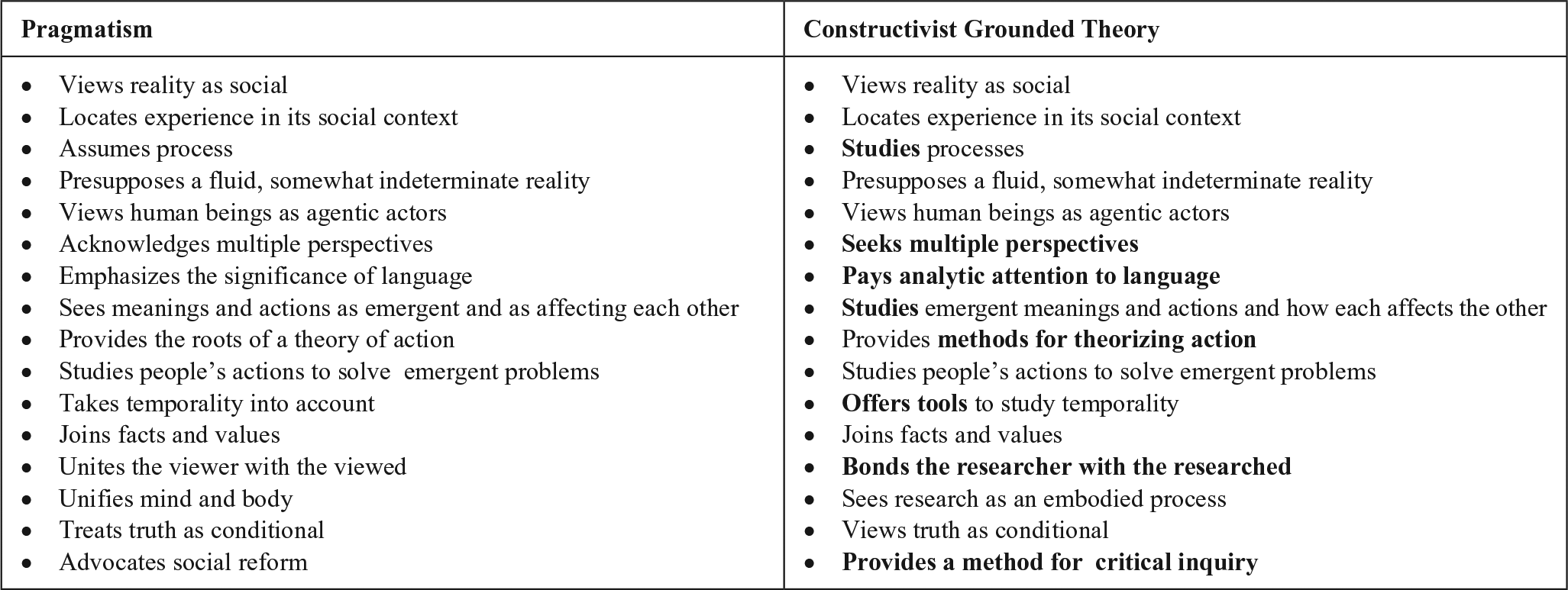
Comparison of pragmatism and constructivist grounded theory.
The continuities between constructivist grounded theory and pragmatism are striking. Both view reality as fundamentally social and processual. Life is social and in process. Unlike most social science perspectives, pragmatism assumes process and takes stability as problematic. Stable social structures depend on the processes that constitute them. These processes largely occur through people’s actions although scholars now also take into account the environment and nonhuman actors.
Dynamic relationships between meaning and action permeate pragmatist thought (Musolf, 2003). Each affects the other. Actions shape meanings and meanings evoke actions. Constructivist grounded theory provides ways of showing and theorizing how meaning and action influence each other, albeit not always in predictable ways. Meanings, actions and events are emergent and, thus, novel meanings and new actions can arise. From its beginnings in 1967 (Glaser & Strauss, 1967), grounded theory has had the distinctive feature of providing methods to study action and process, as well as meanings.
Constructivist grounded theory offers tools to study temporality. This method allows us to trace our assumptions about time and actions concerning it, in addition to mapping change over time at micro, meso, and macro levels of analysis. Pragmatism has provided a compelling theory of time and of action (Mead, 1932, 1938). Like pragmatism, constructivist grounded theory assumes that reality is fluid and somewhat indeterminate. Both perspectives are inherently social and thus do not separate individuals from the social realities in which they exist. Pragmatist philosophy assumes an agentic actor. People can think and reevaluate their situations, and subsequently alter their course of action (Blumer, 1969, 1979). Much of life is routine and habitual—even one’s sense of self (Charmaz, 2002). Yet problematic experience—whether it occurs in science, social life, or subjective experience—calls for rethinking, reinterpreting, and perhaps redirecting action. Hence, the use of language and symbols plays a crucial role in thought and action.
Both pragmatist philosophy and constructivist grounded theory foster openness to the world, curiosity about it, and a belief in gaining knowledge through experience in it. Like the doubt 8-year-old P. D. James raised in her question, both pragmatism and constructivist grounded theory involve doubt. Locke et al. (2008) view doubt as disrupting usual beliefs and explanations. Following Peirce (1958), they invoke pragmatism as a means of making doubt generative for theorizing. Consistent with my argument above, doubt is similarly generative for critical inquiry and plays a crucial role in the pragmatist logic of constructivist grounded theory.
Pragmatist Charles S. Peirce’s (1958) concept of abduction involves pursuing doubt rather than dismissing it. For Peirce, abduction begins with surprising observations given in experience that current theories cannot explain. Thus, these theories become subject to doubt. Abduction involves imagining all possible theoretical explanations for the puzzling observations and then testing the explanations in experience against new empirical data. The purpose of abduction is to identify the most plausible theoretical explanation, which may be a new theory. Consistent with Strübing’s (2007) clarification of abduction, research is a systematic form of problem solving that requires considered decisions and actions. This moving back and forth between possible theoretical explanations and data to construct robust theory is central to problem solving in both pragmatism and constructivist grounded theory. When combined with interrogating our actions, moving back and forth between data and our interpretations of them can further the methodological self-consciousness that we need for critical qualitative inquiry. In addition to scientific knowledge production, problem solving in pragmatism includes how people solve emergent problems in daily life. 12 This emphasis on problem solving provides a window for studying actions and has guided many grounded theory studies.
Pragmatism and constructivist grounded theory both assume that the viewer and the viewed are joined in the research experience. Positivism, in contrast, separates the viewer from the viewed. Similarly, both pragmatism and constructivist grounded theory join facts and values. From a pragmatist perspective, we define facts through the meanings we hold and the actions we perform. And we construct meanings through the actions we take toward objects and events in the world.
The conditional view of truth in pragmatism and grounded theory opens possibilities for shifts and changes in scientific knowledge. Truth changes as we gain knowledge through subjecting our experience to tests in the empirical world. This fluid view of truth relies on the skepticism of doubt and the acknowledgment of process, both of which further critical inquiry.
Why Constructivist Grounded Theory in Critical Inquiry?
Critical inquiry means a penetrating study of problems and often requires a sustained involvement with research participants. It can mean engagement with the problems they define, as in critical participatory action research (Dick, 2007). What is it about constructivist grounded theory that works with critical inquiry? The method emphasizes openness to the empirical world. It favors starting inquiry with a broad research topic and following specific research questions arising from issues in the field. This approach lessens the likelihood that constructivist grounded theorists will reify conventional definitions of empirical problems or take an uncritical view of their nascent analyses. Instead, constructivist grounded theorists focus on critical analysis and bring it into questions concerning social justice. In the past, what many researchers have done in the name of grounded theory has not been the least bit critical. Rather, like other products of qualitative inquiry, it celebrates conventionality.
Constructivist grounded theory developed from pragmatist values promoting social justice. By providing analytic tools to probe how events, processes, and outcomes are constructed, the method provides a means of studying power, inequality, and marginality. This method aids in explicating research participants’ implicit meanings and actions along with those buried in policies and organizational texts. Through moving back between theorizing and collecting data while using comparative methods, the level of abstraction and complexity of the analysis increases.
Critical inquiry takes into account how problematic phenomena develop and what their consequences are. Grounded theory emphasizes the conditions under which an abstract category holds and the consequences of the studied process or category(ies). Both critical inquiry and constructivist grounded theory start from a position of doubt and, unlike early versions of grounded theory, reject value-free inquiry.
The heavy hand of positivism in earlier forms of grounded theory led to concentrating on “what is happening” (Glaser, 1978) in the research setting. 13 A critical stance can uncover more than a depiction of what is happening. Rather, critical questions concern what researchers see and whether they see what they think they see as well as how things came about and where they lead. What are the implications of what is happening now? What does it portend for various actors in the setting? For social justice? For power?
Since its beginnings, grounded theorists ordinarily focused on “what is happening” without examining how social, historical, temporal, and situational contexts of research affected their definitions and explanations. Glaser and other objectivist grounded theorists seldom consider their own research standpoints and starting points, much less their tacit epistemology and the preconceptions they contain. 14 The absence of such scrutiny is curious and contradictory, given Glaser’s (2013) lifelong and recent pronouncements about allowing no preconceptions to enter the research process. In addition, Glaser and his followers do not acknowledge the influences of their privileges and positions. As Karl Mannheim (1936) observed long ago, standpoints emanating from our statuses and positions are ideological. The most important preconceptions to excavate are ones we take for granted, such as those concerning individualism. Hidden preconceptions stem from class, gender, race, age, health, and professional statuses. Because Glaser and his followers overlook all these sources of preconceptions, they close a valuable route into critical inquiry. Grounded theorists who forgo subjecting their privileges and positions to rigorous scrutiny are unlikely to take their research into critical inquiry.
A comparison of critical qualitative inquiry and constructivist grounded theory shows their compatibility, as Figure 2 demonstrates.

Comparison of critical inquiry and constructivist grounded theory.
The critical turn in qualitative inquiry brings interpretive epistemologies into the lengthy critical tradition in social science and broadens it to include subjectivity. Constructivist grounded theory and critical qualitative inquiry both reject positivist epistemologies and objectivist social science. They each reach across disciplines and bring power and inequality into the center of discourse. Constructivist grounded theory provides tools for studying power and inequality. To illustrate, Sheila Katz (2013) analyzed the survival narratives of mothers on welfare who attempted to get an education despite the notable inequalities they experienced. Through her coding her interviews and field notes, Katz identified and quoted key statements from mothers and compared them with other mothers. These quotations became in vivo codes because they crystallized many research participants’ concerns, illuminated their struggles, and afforded advice to other women. Subsequently Katz created her category, “Constructing Survival Narratives” (p. 286). One of her participants, Sydney, gave this advice:
I’d say it’s worth whatever fight that you have to put up to finish school. And in whatever degree that you decide to be in. Be it however you have to work the system, don’t lose yourself because of the welfare system, because it’s easy to do. It’s easy to lose what you want and who you are in the welfare system. (p. 287)
Katz takes her analysis beyond individuals’ situations by connecting their plight with institutionalized policies and practices. She explains how the welfare system systematically imposes obstacles on women who attempt to gain sufficient skills to support themselves and their children.
While critical inquiry may begin from a place of doubt, constructivist grounded theory methodically invokes doubt about our analyses throughout the research process. Adopting a stance of doubt helps us to sharpen our analyses and, as a result, to increase the influence of our work. This stance complements Karen Henwood and Nick Pidgeon’s (2003) concept of “theoretical agnosticism,” in which researchers take a skeptical view of all possible theoretical understandings of the studied phenomenon, including their own. Examining the local discourse of research participants with power, for example, can produce innovative analyses. Jason Wasserman and Jeffrey Clair (2011) unveiled service providers’ use of the term, “fairness.” Their analysis revealed a model of service based on an exchange model. Service providers gave assistance to homeless people in exchange for accepting, discrediting identities conferred on them, such as being mentally ill or alcoholic. We can apply a similar logic to scrutinizing concepts in critical inquiry as they emerge in our discourse. Constructivist grounded theory enables us to define and redefine taken-for-granted concepts in critical inquiry and to show how and to what extent they are enacted in the empirical world and in our research practice.
Many qualitative studies ask questions interrogating how people act. Constructivist grounded theory can lead to “why” questions without the type of generalizing impulse of objectivist grounded theory that erases variation and difference. Instead, constructivist grounded theory helps us to identify differences, locate our generalizations, and recognize the conditions of their production. These questions build on “what” and “how” questions to ask why our findings appear to be congruent with how we represent them. The answer raises more questions such as: What accounts for the representations we portray? Why is it that people act in ways that produce patterned outcomes? In short, critical questions flow from the researchers’ interrogation of data and the context in which these data are situated.
What Does Using Constructivist Grounded Theory in Critical Inquiry Involve?
Before ending, some brief comments are in order about what to attend to when conducting constructivist grounded theory in critical inquiry. Methodological self-consciousness includes careful consideration of data collection in addition to data analysis. Engaging in critical inquiry intensifies our need to examine the sources and quality of our data. Among the questions we might ask are the following: How do we find our participants? In which settings do we observe, participate, and conduct our research? How do we write our field notes, conduct our interviews, and select the texts to analyze? Such questions raise knotty problems for those interested in critical inquiry.
All the usual problems of gaining access to settings and finding research participants intensify in critical qualitative inquiry. When the research portends of divisiveness or the researcher enters a setting fraught with conflict, problems of access and participation escalate further. Perhaps ironically, it appears that few researchers closely monitor how they obtain participants. Guro Korsnes Kristensen and Malin Noem Ravn (2015) 15 demonstrate that qualitative methodologists have given scant attention to sampling for interview studies.
Constructivist grounded theory depends on pursuing emergent questions during the study. Answering these questions can mean gathering different types of data that the researcher may not have anticipated such as institutional records, public policy statements, or follow-up interviews. In actual practice, few researchers add methods that pose difficulties in gaining institutional approval or in fitting the timeline for the project.
A major contribution of constructivist grounded theory to critical qualitative inquiry resides in the interactive nature of the method (Charmaz, 2014). This method prompts researchers to read data closely, to conduct initial coding thoroughly yet with speed and spontaneity, to write quickly, and to keep improving the precision and scope of the analysis. Moreover constructivist grounded theory keeps researchers involved in the research process by encouraging them to raise critical questions from the beginning of data collection through the analysis and the writing. This engagement not only fosters increasing the theoretical depth and reach of the analysis but also stimulates recognizing and revealing a nascent critique that otherwise may have been invisible. For example, Carmel Hobbs (in Charmaz, 2015) interviewed Marcus, a 16-year-old student, for her dissertation research in public health at La Trobe University in Australia. Marcus had been expelled from school and was now attending an alternative school, the site of Hobbs’s research. Marcus had just disclosed how he could not ask for help while at his former school. He said the teachers treated him as though he was stupid and embarrassed him. Hobbs asked the question above and coded the interview excerpt, as shown in Figure 3.

Carmel Hobbs’s line-by-line initial coding of an interview excerpt.
Hobbs raised questions about her codes. In her subsequent memo, she analyzed her code, “feeling worthy,” but she saw greater significance in Marcus’s remark than this code indicated. By asking herself “feeling worthy of what?” Hobbs renamed the code “feeling worthy of a positive future” and treated it as a category to develop. In doing so, her analysis simultaneously became more theoretical and more critical. This category suggests far more than Marcus’s subjective feelings. It leads to questions about schooling, marginality, opportunity structures, and temporality. Through such interrogation, researchers can connect the subjective with the collective, and move their analyses to make statements about injustice, inequities, and human rights.
Conclusion
Constructivist grounded theory connects theorizing and research practice. Moreover, this method joins critical analysis with people’s lives. Both theory and critique are all too often far removed from the people each purports to serve. Constructivist grounded theory brings people and their perspectives into the foreground. How we do it resembles the pragmatist logic of abductive reasoning. We move back and forth between stories and analysis and thus create a delicate balance between the evanescence of experience and the permanence of the published word.
To render our participants’ experience we need to dig deep into their meanings and actions. We listen to their stories and view their actions, and hope to grasp their meanings. But our way of knowing is always interpretive of a reality, not a reproduction of it. Pragmatist sensibilities can open us to intuitive ways of knowing, in which we sense implicit meanings. But only through connecting and questioning can we bring these to the surface. This connecting and questioning is tangible when our lives blend with those of our participants. Connecting and questioning transpires with our written texts when our lives and worldviews remain separate from those we study, such as when we study powerful people whose actions we oppose. Nonetheless, our excitement about making discoveries, our sense of mission can inspire us to construct an imaginative interpretation of the worlds we visit and the texts we study.
Does constructivist grounded theory have exclusive purchase on conducting critical inquiry in these ways? No. Instead, the method explicates and expedites the process. Yet the method draws upon its pragmatist heritage in ways that can make it distinctive.
Our research tools enable us to look backward at standpoints past. These tools assist us to look forward and create new methods to address the collective, comprehend the subjective, and challenge oppression. The method can take us into the future. By spelling out consequences of the actions, meanings, and processes we study, constructivist grounded theory encourages us to look forward as well as backward. Constructivist grounded theory propels our thinking forward in unanticipated ways and subsequently sparks new understandings of experiencing and redressing injustice.
Footnotes
Acknowledgements
Thanks are due to Uwe Flick for editing the special issue. I am grateful for comments on an earlier version of this article from Diana Grant, Lauren Morimoto, and Cindy Stearns, members of the Sonoma State University Faculty Writing Program.
Author’s Note
My initial thoughts on the topic were presented at the International Congress of Qualitative Inquiry, May 22, 2015.
Declaration of Conflicting Interests
The author declared no potential conflicts of interest with respect to the research, authorship, and/or publication of this article.
Funding
The author received no financial support for the research, authorship, and/or publication of this article.