




Abstract
Through exchanges within a doctoral supervision, the authors explore a range of dilemmas and challenges for reflexive inquiry. These include the problematic business of naming, the impossibility of objective separation of self from research, the merging of researcher subjectivities, and differences between performance and performativity. We note the educational potential in what can conventionally be considered “unprofessional” approaches to qualitative inquiry: neologisms, personal experience, stories, conversations, music, poetry, paintings, and film. We engage in reflexive interactions with each other and with such “data.” This was undertaken in the spirit of jazz improvisation—an unrehearsed performance—something that “happened,” an unplanned educational event but also an agency enabled by structure.
I think of the warmth spun by the word around its center the dream called ourselves
Sophie/a:
This auto/ethnographic work was initially about myself and my names. However my supervisors eventually became co-auto/ethnographers, each in their own way. Mainly I talked with Ian, who is my main PhD supervisor. Periodically the five of us met to talk. I also had one-on-one meetings with Feng and Phil. In these jazzy exchanges we all pitched in, sometimes in unison, at times with discordant voices. In spite of our agreement to develop an atmosphere of collaboration, the “co” in “co-autoethnographers” did not take away unequal power relationships in the group. We were still each performing within our own roles and positions. In our exchanges we experienced the tension between resistance against regular, uniform thinking and submission to institutional affinity and regulation.
This inquiry illustrates a process of doctoral supervision within an education studies department. As part of my intention to interrogate my own production of research and to improvise a form of reciprocal reflexivity, we undertook in the first few months of the doctoral study a series of interviews, conversations, and reflections that addressed the condition of the international student in U.K. Higher Education, and our own preliminary engagements and assumptions. The working title of the PhD study was “Questioning Representations of International Student-Mothers in the UK.” We all had international experiences of one sort or another and had undertaken “migrations” of different kinds. The research acknowledges
that representations are always questionable, not excluding those which are produced during the supervision and writing of research. But such uncertainty lies at the “heart” of an inquiry that aims to be educational.
The research began when I introduced a small piece of data to which Ian first responded. The two of us then responded to each other, thus making each turn a call and a response at the same time. We invited Alex, Feng, and Phil to join in. It turned out that the exchange of returns was not only an event that allowed space for productive dialogue but also an example of how distinct tones of voice can blend without losing their own sound and color (Blyth, Chapman, & Stronach, 2016; Callahan, 2001). Call-and-response thus seemed something worth pursuing as an experimental method, given its potential for democratic collaboration and its insistence on improvisation. In spite (and perhaps also because) of the unequal relations of power, experience, and knowledge in the group, reciprocity was necessary as both an ethical and psychological move (Bibi-Nawaz, Stronach, Grant, & Frankham, 2016; Lather, 1991). Our responses were disparate because we were disparate: myself (Filipino), Alex (British), Phil (English), Feng (British Chinese), Ian (Scottish), the last four comprising the supervision team.
There are at least two kinds of reflexivity possible in this piece. “Call-and-response” is where one “voice” responds to the other—an interactive reflexivity, collaborative in ambition, conversational in style. Then there’s an epistemological reflexivity where we look at the different kinds of writing (like metaphor, story) using a more analytical perspective. For example, an analytical reflexivity would note the emphasis on improvisation, a stress on the accidental. Together they reflect a different kind of disordering of method/methodology that reminded us of jazz or the blues. It stands in great contrast to the sorts of conventional approaches which emphasize the precision of concepts, their separability, their definition, and openness to a certainty that some have been claiming for a “science” of educational research (think “gold standard” randomized controlled trials [RCTs], systematic reviewing, statistical correlation, and “best practice” outcomes that are generalizable across individuals, populations, and contexts). This reflexive process developed as an open-ended exploration of a substantive terrain (international student/mother/doctoral study), and also with shards of our selves, as we progress.
Who said which when?
Conversations, like thoughts, jump about: One suddenly remembers something worth telling, which is irrelevant to what has just been said. A response may not always seem appropriate or made at the right time. Our (incon)sequential turns take unexpected routes. As when overhearing a conversation, you, dear Reader, may miss some of the context around parts of this work. Consequently you are also not reassured of any certainties about what you might hear/read, or of their meaning. Like in our conversations, pronouns in this work shift in number and point-of-view. Even a monologue can contain such shifts (such as Feng’s on page 256). His change from I to you is an authorial-to-existential shift (Spry, 2001), where the Self could also become an acknowledged Other.
Our contextual and perspectival failures, nevertheless, invite the reader to fill in gaps and choose their own perspectives. This article can then cease to be merely static print, and can itself become conversational and thought-provoking.
With such openness we risk our work being seen as casual and narcissistic fabrications, also a widely used criticism against autoethnography (Ellis, 2004). Dangers in this discourse include the fickleness of memory, the impossibility of complete comprehension, variations in culture, trivialities of individual experience, and the restlessness of emotions—all embedded in processes of writing, reading, and interpretation. As much as these are dangerous, however, these risks also bring with them the chance (instead of the imposition) of learning.
The group was not the first to note that improvisation is important in the research supervision process (Frankham et al., 2013; Grant, 2010; Stronach et al., 2013). Our (non-)method is also an attempt to do something different from other more accepted approaches to qualitative/interpretive research that are more procedural in their search of categories and themes. One example is the systematic review which, with its “rage for clarity, transparency and certainty of outcomes” (MacLure, 2005, p. 394), debases researchers’ interpretive actions. What we try to resist are types of thinking that have become central both in their influence on research practice and on education policy (see Cohen & Manion, 1989; Glaser & Strauss, 1967). We have been performing a more idiosyncratic, unrehearsed, and collaborative exchange and development. Concerned much more with the educational in “educational research,” we strive for invention instead of patterned repetition. Through our reflexive negotiations, we have given recognition to our thinking, breathing, erring selves involved in the process of research (Frankham et al., 2013), and what these selves might contribute to our learning. As a result, our “technique” was conversational and interactive—improvised. Hopefully this work also performs improvisation. Thus begins an old jazz number by the 1920s King of Jazz (self-styled), Oliver and Melrose (1959): Hello Central, Give me Doctor Jazz.
We were interested in how this line from an iconic Dixieland jazz tune inadvertently echoes the team’s aspirations toward academic equality, creativity, and serendipity. It came to mind as autobiographical experience rather than a substantive claim to expertise about jazz improvisation. The “theme” has the property of an “event” rather than a deduction. It is deployed as an analogy for the sorts of free association to which the group aspired in thinking about our collective engagement in the research process. “Central” conjured up the kinds of procedurally defined and deductively policed methodology invoked by current orthodoxy (in some disciplines like economics, since 2008, now a crumbling certainty; see Earle, Moran, & Ward-Perkins, 2016). Such “centralities” or certainties have long been doubted in other disciplines or fields, at least in poststructuralist and postmodernist circles (e.g., Stronach, 2010). The “econocracy” (Earle et al., 2016) that centralized thinking about the political and the social in economistic and reductive terms has already been identified—and variously named (e.g., “educationomics”; Stronach, 2010; see also Strathern, 2000).
Our collective ambition is, we acknowledge, a “utopian impulse” in character (Dolan, 2001, p. 455). In our writing and thinking—and they are not separate—we try to express something of the liveness of the “desire to be there, in the moment” (Dolan, 2001, p. 455). We agree with Dolan’s anthropological appeals to the likes of Turner (1969), on “communitas” and Schechner (2003), on the nature of “performance.” The liveness of text as performance also engages the reader providing opportunities for taking an authorial stance. Its undulations and alternations are set on the text as a performative stage of critique and reciprocal reasoning. We wish to make the research performance rather more public, to think “in front of ourselves” (Stronach et al., 2014, p. 395). Such processes involve “story-telling, creating order and criticizing underlying assumptions” (Dolan, 2001, p. 477) although we would resist any Habermasian dénouement in terms of a possible utopian destination rather than journey.
Mis-Identification and Representation—Some Problems in Naming
As a postmodern response to the crisis of representation, our auto/ethnography is concerned with names and naming as we engage ourselves in “[i]nterpreting culture through the self-reflections and cultural refractions of identity” (Spry, 2001, p. 727). The name “Doctor Jazz” came to mind as a reminder of the early Jazz of Jelly Roll as well as a joke about the doctoral ambitions of the group. A reviewer rightly pointed out that Morton’s jazz was limited in its improvisational agency, but so too is our freedom as a group—institutional 12-bar blues apply to us as well! “Doctor Jazz” might not be sufficient to stand as a representation for the processes within doctoral supervision, as it is not a name that denotes a fixed identity or thematic interest in jazz as a metaphor for learning. It brings along a trace of events that have in themselves moved on (Badiou, 2001), as the following first “response” illustrates:
Ian:
We began with a name. Or rather two names, Sophie and Sophia. Which was correct? S’s previous Master’s supervisor said “Sophia.” I had said “Sophie.” She said “Sophie.” I asked what her mother would call her. The answer was “Pia,” an abbreviation. Others might say “Ping,” where the “-ng” suffix denotes familiarity. But her birth certificate said “Sophia.” OK, so back to “Sophie”: Why the change? She thought that Sophia was foreign-sounding in a way that Sophie was not. So already she was engaged in cultural translation and a form of minimalist “integration.” We could conclude that, stretching it a bit, Sophie began her doctoral career, and the development of an early reflexivity, with a tiny act of self-estrangement.
We could even play at theorizing “Sophie/Sophia.” First came a discrepancy in the data, which might or might not be significant. It turned out that were four possible names for Sophie. Each was explored in turn (an excursion). And on “return” to Sophie we can better understand not just the “what” of the choice but also a sliver of “why.” Isn’t this a microcosmic hermeneutic circle, as Gadamer (1975) or Ricoeur (1984) would have it?
In spite of efforts to avoid planning and encourage the playful flow of ideas, members of the group had been procedural in some of their contributions. They identified research aims, set a deadline, and offered some formal structure to this work. While asserting the importance of spontaneity, creativity, and unplanned learning, we could not help but strive for some formality and organization. This is not surprising if we consider that doctoral supervision is an institutional practice which comes with written as well as unwritten norms for the production of academic research. There is then the possibility of failing, in each instance of collaboration, to recognize these limitations of working within structural positions in society (Frankham & Tracy, 2012).
We do not assume that these problems of power are satisfactorily redressed by improvisation. We are interested in the process of performance as a learning opportunity which introduces the “play” between philosophy, theory, methodology, and praxis. Each performance is a “take” that could be somewhat otherwise, that involves a personal investment. As soon as we say that, we begin to envisage educational research, at least in its hermeneutical forms, as an event rather than a procedure. Such a conceptualization can find support in the works of Badiou (2001) and Žižek (2014).
What had been prompted by the innocent desire from Phil and the team to get the name right, a mere politeness, became a first research enactment, a tiny, speculative exemplar of interpretive inquiry. The initial “data” were only two vowels, “a” and “e,” and their discrepancy as “difference” and “change” raised questions around motivation and meaning. In subsequent reflections, Sophia wondered about a number of possibilities:
Sophia: Am I a fake? Am I performing an act of conformity, or a novel labeling of self which associates me with the more powerful, more desirable place? As much as embracing a new one, is this also a shunning of an old person? On the other hand wasn’t this a small kind of “liberation;” a kind of trial commitment to a new version of the “self,” trying to become integrated elsewhere in a Western context? It set me off to examine the multiplicity of (my) selves
1
:

Circles/shards of student–mother selves.
Sophia:
The first thing I wrote was “student.” Then I thought I’m not only a student; so I added “/mother/wife,” and so on. I then thought about each identity as a possible center of another. Teachers may think students are central to their profession, etc. Other roles, however, are in tangential relationship with each other, shown here where the circles are next to each other (e.g., businessman with mother and classmate with classmate). The picture as it is looks like a mess, an unfinished draft. More circles could be created—intersecting, repeating, piling over each other. I presume this draft can never reach completion, let alone capture the haecceity of the self. The “slashing” of roles has implicated others in an incoherent and confusing predicament. The “map,” if I may call it that, is open to other readings, and might be approached in different ways. A reader, for example, may start from “student” which is the first word when reading from the left. Others, less inclined to look at this as “text,” may start from one of the circles. Still others might choose to read from right to left and might wonder why the backslash is there to begin with. Thus, from the outset, the diagram may already be differently interpreted and variously translated.
Ian:
In the diagram of the “selves,” there is another question remaining: Is the paper itself (the actual piece of paper) part of the diagram? Maybe it relates to Zizek’s analysis of St. Paul. The former argues that shards of selves are “immature,” that we need to envisage somehow the Universal Self. He connects the former “selving” to mere “private” reasoning rather than the contrasting “public” reasoning as contemplated by Kant in “What Is Enlightenment?” So could we envisage the paper on which the diagram rests as a kind of ontological analogy for that?
Sophia:
I think your analogy of the paper as universal self is a possible interpretation, although I think that sharding itself is not necessarily immature at all times. I agree that it can be immature to think always from a categorical point of view (e.g., Filipino, Non-EU, mother, etc.). However at the same time, I find it difficult to imagine thinking from a purely universal standpoint.
Later, she presented to the group the following passage by Deleuze and Guattari (1987): Segmentarity is inherent to all the strata composing us. Dwelling, getting around, working, playing: life is spatially and socially segmented. The house is segmented according to its rooms’ assigned purposes; streets, according to the order of the city; the factory, according to the nature of the work and operations performed in it. We are segmented in a binary fashion, following the great major dualist oppositions: social classes, but also men-women, adults-children, and so on. We are segmented in a circular fashion, in ever larger circles, ever wider disks or coronas, like Joyce’s “letter”: my affairs, my neighborhood’s affairs, my city’s, my country’s, the world’s . . . We are segmented in a linear fashion, along a straight line or a number of straight lines, of which each segment represents an episode or “proceeding”: as soon as we finish one proceeding we begin another, forever proceduring or procedured, in the family, in school, in the army, on the job. . . . But these figures of segmentarity, the binary, circular, and linear, are bound up with one another, even cross over into each other, changing according to the point of view. (pp. 208-209, emphasis in original)
Phil expressed his liking of the quote in its use of mathematical concepts. Feng also thought that this passage, juxtaposed with the diagram of circles, is useful in helping illustrate problems and conflicts in identity. Ian provoked the group into thinking about a hidden positivity in the passage:
Isn’t this kind of summarizing a kind of linear account of “proceeding,” as D&G put it? The quotation maps our thinking, at least to some extent. And we can go further. Binary, circular, and linear, as well as figures of segmentarity, at a deeper level of metaphor, begin to constitute an implicit geometry of being, diagrams of the self, that we need subsequently to deconstruct in the spirit of the endless becoming of being, perhaps as dasein (Heidegger, 1962), or more likely mitsein (Nancy, 2000). More simply, you can begin with yourself, but you will never end with yourself.
Naming—Allusive or Illusive?
During a trip to the Tate Art Gallery at Liverpool a few years ago, Sophia encountered a striking example of the problems of representation. Some of the dilemmas of real/false, complete/incomplete are reflected in Joseph Kosuth’s “Clock One and Five.” 2 Ian recalled his own earlier trip to the same gallery. With several students, he went to see a Magritte exhibition and recounted his thoughts on how the artist plays a similar game with representation in his famous counter-re/presentation piece, The Treachery of Images.
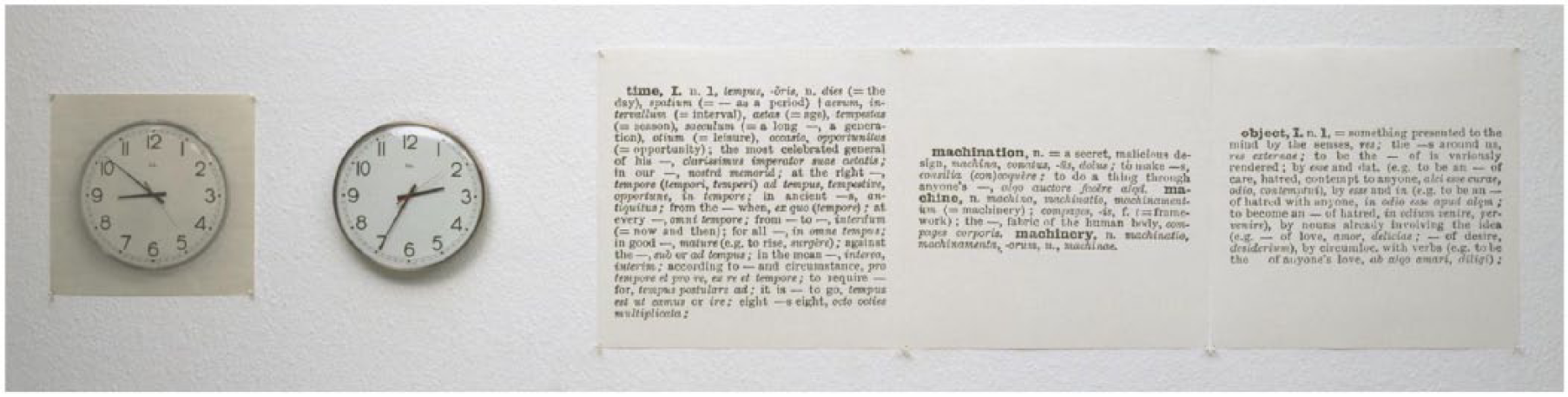
Clock (one and five), English/Latin version (exhibition version).

The treachery of images.
Treacherous names.
Denying the representation its supposed referent, Magritte disturbs our insistence on a correspondence between illustration and object. The painting teases our tendency to name and define. One obvious deviance is that this is indeed not a pipe but only its image. Feng suggested a possible reinterpretation—that the pictured object can sometimes be used for other purposes (and children are known for such reassignments and invention of use or meaning). Function betrays name during play, and a preference for a particular meaning may reflect a neglect of process and event. Sophia’s diagram of shards of self can therefore be important not so much in its “truth” but in how representations such as circles, words, and indeed a sheet of paper can posit limited and temporary subjectivities.
During a subsequent group meeting, we talked about how we might like this current work to differ from research which hierarchically positions subjects according to measurements and attributes. However, it is interesting how we can sometimes also be engaged in the very kind of thinking which in this research we are trying to resist.
Ian:
Mainly on holiday, I was casually looking at a Sunday Times league table of UK university qualities . . . Who was “up,” who was “down?” I had feelings about these “results.” I “cared.” But where did these feelings come from? At Hope [University] I was a mainly retired superannuated superfluity: the 71-year-old in Room 071! The rest were history as ancient as myself. Yet the “affect” was there, despite my age and my (published) skepticism about all such league tables as fantasies of merit. Reflecting on this, I realized that I was reading these academic league tables exactly as I followed football teams . . . I had some sort of historic connection with them. For example, UEA/Norwich FC, Aberdeen University/Aberdeen FC. So football teams and universities followed the same geographic trace. It was a direct analogy, a kind of unbidden league-tableitis that did its thinking and feeling behind my back, generating both affect and comparison groups.
So when I came to re-read the “Shouting theatre . . .” (Stronach, 1999) article I could see personally as well as intellectually the ability of an audit culture to perform “ourselves” beyond our agency and intention. This seems to be the reverse of Goleman’s (1995) emotional intelligence. It’s “emotional stupidity, but as a current cultural norm.” So that’s a shard of identity worth thinking about?
“it’s not real, not a real pipe”
“a critique of the naïve reading . . . of the clocks”
“definition trying to nail down precisely what time can mean”
“the more detail, the more we cannot point out what it is”
“but we can’t deconstruct nothing”
“even nothing has a meaning”
Sophia:
Yes, there’s a possible parallel between names and audit—we “make a name for ourselves” when we are placed well on the league tables. Also, our names bring with them their own reputation that may work behind our backs . . . We do not own our names but we may sometimes forget this. When they are used in ways that can disparage our public identities (such as in scandals) we may feel a sense of shame, even if they sometimes don’t refer to us—indeed a sickness in which displaced correspondence is a pathological symptom, much like your “league-tableitis.”
The thinking of the self had at first offered false binaries (e.g., fake/real me), but now a much more plural, intersecting and dynamic “whole” seemed more interesting. Although we did note a couple of contradictions. The longer the inventory of roles and selves, the greater the fantasy of completion, and the further we get from how we actually experience ourselves. You can’t inventory yourself into identity. Second, diagrams act as visual dramas that are inherently static, and full of nouns. Yet the key words in our data were verbs, words of movement like “faking,” “shunning,” and “becoming.” Movements require time, and thus the need for stories around, about, and behind names; “Naming,” in its verb form, seemed more apposite, as the following narratives from the authors reveal:
Feng:
My name had always been “Feng Su.” When I moved to Britain in 2003 from China, I decided to give myself an English name—“Frank.” On reflection, I think it was mainly driven by the desire of “integrating” into the new environment quickly. I liked the meaning and the sound of “Frank.” Also it shares the same initial with “Feng.” It seemed to be a good move. Gradually in the following years I became well known as “Frank” both in my social circles and workplaces. I think I achieved my goal of blending in by giving myself an English name. However, there was a moment of sudden realization that it was kind of sad that not many people knew my original name “Feng Su.” Even my closest friends sometimes struggled to remember my “real” name. There was a sense of betrayal to my Chinese roots; a betrayal of where I came from. After I moved to academia in 2010, I made a conscious decision to keep my original Chinese name “Feng Su” for all formal occasions. Today I am still known by many as “Frank” but I am happy for such a compromise because I am also known as “Feng Su.” I became comfortable to have this dual identity as a British Chinese.
Sophi-
outside but same on the inside?
Phil:
My grandma was quite poorly after the birth and Grandad couldn’t get to the registry office and Grandad just changed the name, chose a totally different name! And he ended up using . . . two different names. When we were sorting out his will, it was quite difficult. So there are some split identities in the family.
Alex:
I was asked to “Google” my name and, as expected, the majority of images were White and male. This reminded me of trips away in the past as a young person and being assigned to the boy’s dormitory! Not fun when you are an 11-year-old girl! My image did, however, make the first page of the Google search—not as an academic but the image used as a parent governor at my children’s school.
Ian:
My first thought was a kind of failed parallel thinking. If Sophie could be Pia, and both Frank
3
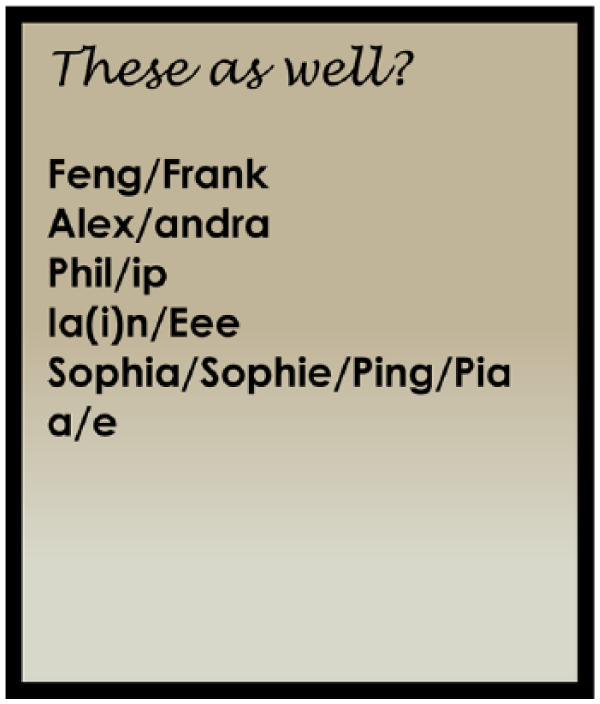
and Phil were abbreviations, what about “Ian?” It didn’t work—There is no abbreviation. Reflexive dead-end. Both Francis and Philip could drop a syllable easily enough, but if I tried that I’d end up as “Eee,” a mouse-squeak.
4
Did I know anything about name-changing in my own experience? I remembered teaching in Zambia in the 70s. Zambian kids—especially in the remote bush school I taught in—liked to give themselves non-Lozi names, I think as part of their considerable new status as secondary school students. I taught them African and world history, and they renamed themselves, sometimes strangely—Hitler Muyumbana, Stalin Namushi. (I had not taught them to admire these figures and have no idea why they made the choices they made.) But the broader question of “status” seemed to be involved . . .
This notion of status also played out as the group worked toward an ideal of equality. Professional titles attributed to each member of the group—Professor (Ian), Department Head (Phil and Alex), Senior Lecturer (Frank), and Student or Associate Tutor (Sophia)—denote a hierarchy of power positions and carry assumptions about seniority. Juniors usually rely on Seniors to take on most of the responsibility of instruction and guidance. The titles also suggest a sort of linear progression in thinking. The higher one is on the ladder of roles, the bigger their potential weighting would be. However, as we have observed, the dynamics of the group cannot simply be represented by an upward curve, or a ladder of progression of thinking. Alex, Phil, Feng, and Ian all noted the leading role Sophia had taken during the supervisory meetings, despite being a student. This did not seem to fit with the progression of seniority suggested by our titles, nor does it accurately reflect the thinking done by the group as a dynamic whole. Similar to how children approach reading, our thinking did not form a straight line but was less rigid, like squiggles, as illustrated by Pattison (2016) in Figures 5 and 6.
A singular “we” is made possible during narration. Does this mean that we were speaking in a chorus or a cacophony?
Not all we’s are singular. Some are duets. Some are intended for the collective—a plural minus one? (cf. Spry’s, 2001, I–we shift, p. 711)
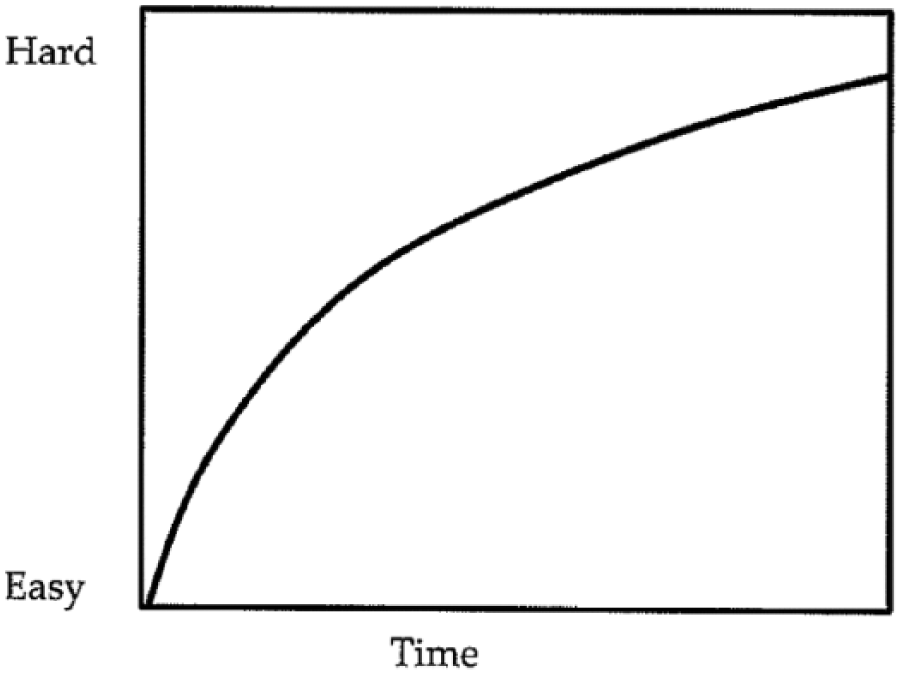
“Standard reading trajectory” (Pattison, 2016, p. 122).

“Squiggles” (Pattison, 2016, p. 128).
The variety of our cultural backgrounds brings with it peculiar knowledge and experience. Consequently, we might have become inured to our respective learning environments and practices. As a response, the doctoral supervision group aimed to take part in “building, by virtue of constructing locations . . . a founding and joining of spaces” (Heidegger, 1971, p. 156) 5 —a possible “third space” (Bhabha, 2004). The issue of dialogue as an appropriate label for our reflexive discussions was raised. Its appeal came from the idea of the to-ing and fro-ing of ideas between people, but as there were five in the group, the term quintalogue was also suggested. We were still unsure about which word was appropriate, but at this point it was certain that we had arrived (or perhaps got stuck) at another conundrum about representation. Phil’s attempt to empower Sophia by asking how she would like to be called led to confusion instead of clarity:
Phil:
I’ve always felt that I was empowering students or that was a nice thing to say to students. Maybe students of Chinese origin in my experience they’ll [say] just call me Irene because you can’t say the name. No, I want to try and say it but it came across to me from your comment that that wasn’t always a helpful thing.
Phil’s question led me to answer “Sophie” as I understood this to be a Western abbreviation of Sophia. Although Phil and Ian are British, they “didn’t get it,” thinking that Sophia is simply a more European-sounding name. Ian also mistook Frank as an abbreviation of Francis. We later learned that Frank, as we knew him, had a story to tell about his names and that Frank/Feng was not a representation that serves justice to the story about his names. Some members of the group also initially assumed that Alex is male but also found that her name is an abbreviation of Alexandra. Simple labels are complex libels!
Another online pursuit of name-changing (this time as a disciplinary rather than a personal construct) yielded an interesting 1899 illustration in the American Anthropologist: . . . as a man is climbing up, he does something that marks a place in his life where the gods have given him the opportunity to express in acts his peculiar powers, so this place, this act, forms a stage in his career, and he takes a new name to indicate that he is on a level different from that which he occupied previously. (Fletcher, 1899, p. 86)
A new name for a new status. That certainly seemed relevant to a doctoral research. More generally, and thinking about “English” culture, it is perhaps relevant to note that people have “got” qualifications, but that they “are” a graduate. Having becomes being, but what’s the tipping point? In both cases, there is a sense of having reached a finality that in Western cultures has increasingly been deemed worth celebrating. 6 However, just how people get to achieve goals or arrive at destinations often does not coincide with a predetermined set of bullet-pointed aims or planned learning outcomes. It is striking how anyone’s life journey could also not be represented by any predetermined course:
Feng:
And you know, life wasn’t planned in such a way but you end up where you are . . . I’m very happy where I am and doing something I love to do. So basically, you know, to me, it’s a very unplanned journey. I was here initially only for postgraduate study then should head back to the company I used to work for but then you meet your partner here then you have your kids, your trajectory changes.
Feng was initially considering a career in information technology, but eventually found research and teaching in higher education more attractive. His “unfinished journey” (Su, 2011) resonates with the resistance, in this article, against finality and predictability. In his autobiographical narrative, he reveals an initial anxiety toward open-ended research which puts forward not a predefined trajectory but “a kind of theoretical searchlight” (Su, 2011, p. 11).
The next chance encounter showed that selving was also a sort of merging between researcher selves. Ian encountered a morphophonetic oddity which brought to light some cultural and linguistic nuances between English and Filipino. Indigenous Filipino languages did not originally have the /f/ sound 7 (Schachter & Otanes, 1972), which could be why Pia (with /p/ instead of /f/) is used in this context as a nickname for Sophia. Ian realized he would not have understood the following reference in Nguyen’s novel without previously engaging in those exchanges about her name.
You hear how he says feelings and not peelings? she whispered. Lessons in elocution! He does not speak like a Filipino at all. (Nguyen, 2015, p. 153, emphasis in original)
Sophia: My mother would call me Ping and I never questioned that. My aunts and uncles are also fond of calling me this. It is a derivative of my name, Sophia, however unbelievable this might seem. Where I grew up, people usually add “-ng” as a suffix to a name to mark it as a term of endearment. This is also something many Filipino speakers would do. And so Sophia turned to “Soping”. . .
I must have liked the way “Ping” sounded when I was young. Usually addressed to me in the second person perspective, it reminded me of kindhearted relatives and endearing moments. And so while I imagine that a ping to you may be the sound the typewriter makes at the end of a line, it is something else entirely to me, completely alien to your world as a name. Or is it?
Ian: For me, now, a “ping” is the time-up noise on a cooker. Or the deep-sea detection device called asdic—when you hit the sought-after object with your signal you get back a “ping” from the submarine’s hull. Taking that latter metaphor as a kind of analogy, and applying it to reflexive enquiries and qualitative work more generally, could we not see “Ping” as just that sort of “ping”—a return that is our hermeneutic reward?
We recognize both the ludic and the instrumental capacities of the mind, seeking to demonstrate the tension between Apollonian and Dionysian ways of thinking. The two mythological Greek deities offer opposing views, the former in favor of rational, ordered linearity (cf. “centre”) and the latter epitomizing serendipitous, liberal creativity (cf. “jazz”). We have observed that our interpretive inquiry remains within jazz-like struggles between Apollonian and Dionysian approaches to qualitative research. We have also taken these approaches dialectically, at times coming from either of these two perspectives, as we carry along with us our cultural, academic, and personal baggage. Feng, Alex, and Phil, whose research experience had mainly resided within the more central view, renegotiated their research identities within our recent doctoral exchanges. With feelings of excitement and uneasiness, they stepped into the peripheral, uncomfortable zones of unpredictability and minimal methodological planning and organization. Ian and Sophia, who have tended to inhabit the liberal periphery, were also aware of the “realities” that relate more to the institutional, structural and rhetorical constraints of doctoral thesis writing and supervision.
We also noted that our interpretive circle may have re-turned but she has not arrived full circle as we continue to engage in further exploration and interpretation. We therefore do not lay claim to a pure, free noninstitutional thinking. However, we have thus far suggested how serendipity, improvisation, undecidability, and indeterminacy can open up paths to educational experience. Processes such as shared reflection, immersion, deliberation, and exchange are inimical to pedagogies and curricula which prespecify learning procedures and/or outcomes. Instead of coming out as specified, transformative learning emerges but often in a form and at a time least expected. We do not know if, or when, we might learn and if this learning will coincide with what was previously envisioned. From this view, sometimes “not looking” for learning becomes strength, and informal, marginal, or liminal spaces and times can become the priority. This places demands upon educators who must become accustomed to living alongside and sharing experiences with their students to fully understand them. This is redolent of Hannah Arendt’s (1977) call for educators not to predict the needs of the future and inhibit what cannot be foreseen and instead prepare their students “in advance for the task of renewing a common world” (p. 177).
While improvising, we tried to avoid methodological directives and sought indirect ways of expression. We would like our (playful) performance to differ from a culture of (foolish) performativity 8 in educational research (Frankham & Smears, 2012). Perhaps another illusion/allusion can help us recognize any learning from this work as an unplanned event, rather than a fixed goal or destination.
Sophia:
In my MRes dissertation (Deterala, 2015) I offered what I thought was a simile taken from the film The Dark Knight for the sorts of preliminary excursions we have been undertaking here. I likened the enquiry to a “dog chasing cars” (Nolan, 2008). Have we caught up with any of these “cars”? Of course not, but famously dogs that chase cars “never learn.”
Hopefully, we are learning how to run (in a hermeneutic fashion?), rather than at this stage where to run, or what to run after. Most of this “running” has not been motivated by pursuit but has so far tacked between the present and the past with the research “future” to come. As we await what may come in response to this call, the famous quotation from the Great Gatsby (Fitzgerald, 1925/2004) might be an appropriate resting place, for now at least: So we beat on, boats against the current, borne back ceaselessly into the past. (p. 180)
Footnotes
Acknowledgements
The authors thank Jo Frankham (Liverpool John Moores University, UK) for her critical comments on an earlier draft of this paper.
Declaration of Conflicting Interests
The author(s) declared no potential conflicts of interest with respect to the research, authorship, and/or publication of this article.
Funding
The author(s) disclosed receipt of the following financial support for the research, authorship, and/or publication of this article: This article was funded by the Faculty of Education in Liverpool Hope University for the licensing of some copyrighted images used in this article.