




Abstract
As we become more and more algorithmic subjects, algorithms shape the news we access, our political and social views, how and what we buy, as well as the emotional tenor of our lives. Tracking how algorithms work on and with our senses and activate our bodies in different ways requires experimental approaches. To explore affect, algorithms, and method, we work/think/play via two reassemblages of algorithmic tools borrowed from the corporate and art worlds: Moodlens and the Listening Machine. Our algorithmic play with educational reformers’ images and tweets suggests a strategy for fattening our methods and theories to respond to ever-increasing data flows and thinking additively, fractally, and exponentially.
Welcome to the first museum that reacts to emotions—and turns them into art. [I]t’s difficult enough just understanding the problem someone’s framing and how they’re framing it, all you should ever do is explore it, play around with the terms, add something, relate it to something else, never discuss it. —Gilles Deleuze (1995, p. 139)
Museum of Feelings
We are interested in affect. And we’re not alone. There is an “appetite for affect,” as Nigel Thrift (2011, p. 14) puts it. Beyond the bevy of affect theories stimulating cultural studies and the social sciences, corporations and politicians are curious about the capacities for affect to move us to act (or to click, vote, and buy). In 2015, S. C. Johnson’s fragrance manufacturer Glade® partnered with marketing firm RadicalMedia to install a “Museum of Feelings” in New York City:
Each installation invites emotional interaction. Touch, feel, play, listen, imagine and breathe. Step into the first kaleidoscope controlled by emotion. Float through the feeling of calm on a lavender cloud. Use your own biometric data to create a MoodLens—or unique emotional selfie—and match it with a perfect custom fragrance. (https://www.themuseumoffeelings.com)
Glade’s® marketing gimmick is part and parcel of an age marked by an “onflow of information in motion” (Thrift, 2011, p. 16) and where corporations, politicians, health care providers, artists, and consumers, among others, mobilize streams of data that are dependent on constant feedback, user interaction, and a shared connectivity across technologies and social spheres. Like Glade’s® self-termed “kaleidoscope controlled by emotion,” such practices employ “calculated marriage[s] of apperception and feeling, moment by moment” (Thrift, 2011, p. 15). These algorithmic technologies move (with) us in real time, literally traveling with (and perhaps in the near future within) our bodies, and being directed and recalibrated by our shifting moods, bodily states, and feelings.
Deemed the “new oil” (Amoore & Piotukh, 2015) for their market-energizing potential, algorithms are a response to what’s been deemed the “datalogical turn” (Clough, Gregory, Haber, & Scannell, 2015). Information pools are increasing at rapid rates with IBM declaring that “90% of the data in the world was created in the last two years alone” (cited in Clough et al., 2015, p. 152). In addition to tracking and influencing our bodily states, shopping habits, and moods, the algorithm is an active force in politics. It was publicized that Hillary Clinton’s campaign relied on a highly secretive (and ultimately flawed) algorithm named “Ada,” which analyzed data to determine where she should campaign. Facebook has even been blamed for Brexit and the U.S. 2016 election results because of its so-called “filter bubble” that algorithmically aligns content to users’ tastes and preferences to increase engagement (Bort, 2016).
Algorithms are designed to study and know us, aggregating our patterns, behaviors, movements, and moods in increasingly intimate ways. How often do we find ourselves surprised by Facebook’s capacity to facially recognize our friends and family, Amazon.com’s spot-on book recommendations, or check our FitBit data to make sense of our days? In many ways, we are becoming more and more algorithmic subjects being reproduced through digital programs designed to “impel new affective tendencies of bodies, new forms of attention, distraction, practice, and repetition” (Puar, 2012, p. 151). Like Glade®, Facebook infamously used its personalization algorithm in an attempt to study the contagious capacities of emotion. By culling users’ feeds to display either predominantly positive or negative posts, they tracked the emotional tenor of users’ subsequent posts (Boler, 2015; Sampson, 2016). Widely critiqued for making unwitting guinea pigs out of its users, the study reveals the power of the algorithm in shaping the emotional tenor of our lives.
In addition to parsing aggregates of data, algorithms are being designed to capture affect (Hillis, Paasonen, & Petit, 2015). As Karppi, Kähkönen, Mannevuo, Pajala, and Sihvonen (2016) elaborate,
With the development of Big Data, algorithmic culture and datafication—tools and technologies that make it possible to turn aspects of our life into computerised data and further into new forms of value—affect does not have to be verbalised as emotions in therapeutic communication in order for companies to be able to mine for profit “archives of affect” (Gehl, 2011) left by people’s digital media use, networked social relations, and consumption habits. (p. 5)
These “archives of affect” (Gehl, 2011) are becoming increasingly interesting to educational reformers. The rampant datafication of learning has been well documented (see, for example, Friedrich, Walter, & Colmenares, 2015; Roberts-Holmes, 2015; Taubman, 2009), and a growing body of research is focusing on the infiltration, and concomitant racialization, of bioinformatic practices in school spaces (Nguyen, 2015) such as fingerprinting (Taylor, 2010a), closed-circuit television (CCTV; Taylor, 2010b), hand-held and walk-through metal detectors (Nance, 2017), and radio-frequency identification (RFID; Taylor, 2017). In this article, we explore the algorithm’s infiltration into education. Educational reform efforts are moving toward both Big Data and the networked potential of affect (Hillis et al., 2015). As Diane Ravitch (2016b) points out on her blog, a new buzzword of ed reform is “social emotional learning”:
They do not mean that teachers and parents should pay attention to children’s ability to work and play well with others, or to their feelings of adequacy and self-worth. Behind the new buzzwords is a renewed effort to push competency based education (CBE) and computer-based teaching and assessment. The leaders of the new reform movement hail from the tech sector—Gates, Zuckerberg, Reed Hastings, Pearson, and more—and they see a future of computer-driven education, teaching and testing at all times, measuring and ranking students. (n.p.)
Newly confirmed U.S. Secretary of Education, Betsy DeVos, advocates for competency-based education (CBE) through what is deemed “school choice.” In a 2015 interview, she stated that she’s in favor of “charter schools, online schools, virtual schools, blended learning, any combination thereof—and, frankly, any combination, or any kind of choice that hasn’t yet been thought of” (Pozzuoli, 2015, quoted in Ravitch, 2016a). These global trends in computer-based education and educational reform debates have been deemed “Ed Reform 2.0” (Ravitch, 2016b). We use the term Ed Reform 2.0 and the hashtag #edreform in this piece to signal the move of reform debates from the town hall to digital spaces, most prominently through the algorithmic flows of Twitter. As Donald Trump declared in defense of his social media use, Twitter is “a modern form of communication,” one we find rife for analyses of the algorithm’s influence on educational debates. Jodi Dean (2010) submits that Twitter has a unique capacity to capture affect: “[t]he flow of tweets transmits what exceeds any specific tweet, that is, a broader, less tangible, more general mood. One even gets accustomed to overlooking tweets in their singularity, enjoying instead getting swept into their flow” (p. 24).
“Lifeworld, Inc.”
Social theory is still searching for adequate vocabularies to describe the tenor of the present. Rosi Braidotti (2013) often uses “cognitive capitalism,” Eva Illousz (2007) “emotional capitalism, “ Jodi Dean (2010) “communicative capitalism,” and Karppi et al. (2016) “affective capitalism” to describe how “[o]ur capacities to affect and become affected are transformed into assets, goods, services, and managerial strategies” (p. 9). In addition, Crampton and Miller (2017) argue that we are embroiled in an age shifting to “algorithm governance” whereby “algorithms are now embedded in a proliferation of objects, bodies, databases, and software stacks, as well as what Ian Shaw [(2017)] describes as deterritorialized series of non-human and immaterial vectors of state power” (n.p.). Intuiting the increasing importance of affect in such modes of governance, Thrift (2011) uses the term “Lifeworld, Inc” which is characterized by
a mutation in the means of social control which draws on continuous recording of the emotional investments of the population for fuel—and for power. It is a new infrastructure of feeling, one which acts rather like the electricity grid or roads in its ability to both transport and energise the economy. (p. 14)
These practices of what Thrift terms “social control” and their movements in education unnerve us, yet rather than taking a reactive distance to them, we intentionally get close to them. As #edreform, and global politics writ large, are more and more being marked by polarized positions (Hochschild, 2016), we are interested in exploring what we might learn from modes of rapprochement rather than distance. In part, our attempt to get close to the algorithm’s intrusion in educational reform is spurred by Sedgwick’s (2003) call for reparative, in contrast to paranoid, modes of thinking. The reparative position urges us to learn through a closeness with the objects that fascinate and terrify, while the paranoid position seeks to maintain a skeptical distance to mitigate the shocks of surprise. While a paranoid position closes off the body to receptivity, a reparative position opens it up to a wider range of affects beyond an ego-preserving I told you so.
In an age seeped in real-time fluid flows of data, Thrift (2011) suggests that as social scientists “we may not need data as such—that will be there in increasing abundance—so much as new means of probing what is going on and instigating new behaviors/assemblages” (pp. 7-8). If algorithms are being used more intently, sensitized to our tastes, preferences, and habits, how might we usurp their aims of knowing us and use them to get close to other things? As we write in the wake of Brexit and the 2016 U.S. election, a moment where many constituents seemingly voted against their economic and social interests (Hochschild, 2016), thinking through affect seems all the more pertinent. As Jasbir Puar (2012) puts it, “[i]f signification and representation (what things mean) are no longer the only primary realm of the political, then bodily processes (how things feel) must be irreducibly central to any notion of the political” (p. 151). We see attuning to affect as an important means of “probing what’s going on” in educational reform.
Massumi (2015) submits, “[o]ur bodies and our lives are almost a kind of resonating chamber for media-borne perturbations that strike us and run through us, that strike us and strike beyond us simultaneously” (p. 114). How might we use algorithmic tools to feel out the present?
Following Dean (2010), we feel “the circulation of intensities leave traces we might mark and follow: blog anxiety, mood flows on Twitter, military message intensification, irrational exuberance” (p. 22). By dwelling in these flows, we might find new modes of engaging affect in the present that are less focused on the individual and the preeminence of language and more attuned to the flickering tonalities of the historical present (Berlant, 2011).
Methods of the Present
As folks interested in affect, a methodological concern has been how to research affect—a relational process, rather than a thing, that is defined by its capacities to resist representational logics (Stewart, 2007). How can we feel out how algorithms get their “hooks in the flesh” (Massumi, 2015, p. 85), working on and with our senses and activating our bodies in different ways? We are certainly not alone in being concerned about affect and method, and follow in the steps of a vibrant body of postqualitative research theorizing and experimenting with posthuman affect and method (see, for example, Coleman & Ringrose, 2013; Cvetkovich, 2012; Gershon, 2013; Hickey-Moody, 2012, 2013; Hillis et al., 2015; Ivinson & Renold, 2013; Jackson & Mazzei, 2012; Johansson, 2015; Juelskjær, Staunæs, & Ratner, 2013; Knudsen & Stage, 2015; Lather & St. Pierre, 2013; Leander & Boldt, 2013; Lenz Taguchi, 2016; MacLure, 2013; Renold, 2017; Renold & Ivinson, 2014; Ringrose, 2010, 2013; Rotas, 2014; Springgay, 2011; Springgay & Rotas, 2015; Springgay & Zaliwska, 2016; St. Pierre, 2011; Thiel, 2015; Vannini, 2015; among many others).
Researching affect is an affective process. As Clough (2009) argues,
Any method of attending to affect cannot simply be a matter of containment; it also cannot simply be a matter of interpretation, meaning, signification or representation. Method cannot help but produce affective resonance, attunement, that is, the intensifying or the dampening of affect. (p. 49)
We particularly struggle with how to present research on affect and follow Clough’s (2010) urgings that
affect studies calls for experimentation in methodology and presentational style. How to engage affect? How to present affect so that the presentation performs its connection to individuation, near-actualization, virtuality, resonance and more? What now is method? What now is style? (p. 228)
So, in this piece, we work to loosen our humanist researcher dreams of devising a method, and instead, try to work like/with a machine, and allow algorithms to be both the subject of our study as well as the driving force in our data generation. We experiment then with letting methods already devised within Lifeworld, Inc. motor our research, rather than indulging our own attempts at sovereignty over method. If Lifeworld, Inc. is intent on turning our affects, experiences, and perceptions into market value, what would happen if we turned these same practices on their heel and worked/thought/played with them to feel out the way affect is captured and moved in the present?
To work toward this goal, we take up Deleuze’s (1995) injunction “all you should ever do is explore it, play around with the terms, add something, relate it to something else” (p. 139). In an effort to work/think/play with Deleuze’s words, we offer two reassemblages that work to produce affects and labor less, as Deleuze cautions, to “discuss” (p. 139). To reassemble is different than putting something together (assembling) or disaggregating something to its constituent parts (disassembling). To reassemble is to play with how things operate and to experiment with how they might work in new ways. The reassemblages we offer work to simultaneously evoke, feel, and experiment with affect. We work/think/play with reassembling algorithmic tools in the corporate and art worlds not because we think they capture the “truth” or are “right,” or even because we find them particularly novel or exciting. Instead, we cross wires between these two domains as a means of engaging affect in the present (Berlant, 2011). If the algorithm is a tool used to know and learn about us, what might happen if we used the algorithm as a tool for thinking? We are simply curious, if we reassemble how the algorithm works, what will we find out about what else these tools can do?
Our first reassemblage uses algorithmic facial recognition and emotion-detecting applications to play/work/think with/in the affective intensities circulating around some of educational reforms most established voices, Michelle Rhee and Diane Ravitch, as well as newcomer Betsy DeVos. In the second reassemblage, we work/think/play with the data-mining practices of the “Listening Machine” (LM), an art installation that ran in London from 2012 to 2013, which used the activity of 500 Twitter users to create a continuous symphonic musical score. To study algorithmic affect, we are curious to see what these contemporary apparatuses for “capturing” affect for profit, entertainment, and even aesthetic intervention, might move qualitative methods.
We explore these as offering micro-experiments in methods of the present. We intentionally mobilize the preposition of rather than for in this figuration to signal the way these methods are already underway and emergent from marketing tactics and aesthetic genres, rather than prescriptive for future research. We sense that getting under the skin of such practices might offer insight into new demands for contemporary research in an algorithmic age, and we sense that our senses are where we might find means of disturbing, rewiring, haywiring, or simply setting off in unexpected directions algorithmic circuits.
Perturbing Presences
There’s certainly a lot of algorithmic noise around Ed Reform 2.0. In recent years, this static has found anchoring points in debates on the merits of charter versus public schools and in the personas of their respective champions Michelle Rhee and Diane Ravitch. Representing the polarized debates over charter schools versus public schools and privatization versus public funding, Rhee and Ravitch have been deemed “The Two Faces of American Education” (Delbanco, 2013) and become widely recognized “education celebrit[ies]” (Layton, 2013, 2014). An educational historian, Ravitch is perhaps most famous for her dramatic about-face, where she went from authoring the accountability movement to vociferously sounding against it. Rhee acted as Washington, D.C.,’s controversial school chancellor from 2007 to 2010 and alongside a media frenzy was briefly considered for Trump’s Secretary of Education (Cockerham, 2016). The contested position was eventually taken by the equally controversial DeVos. A quick sweep of the hashtag #edreform on Twitter reveals that Ravitch and Rhee both remain prominent voices in contemporary debates. Following Trump’s election, DeVos entered the #edreform conversation with great intensity.
Like Justin Timberlake and Grace Jones, Rhee and Ravitch are what Shaviro (2010) calls “perturbing presences” (p. 7). They provoke intense feelings in their proponents and opponents, electrifying anxieties, hopes, and fears around education. In a seemingly endless proliferation of media—interviews, books, Tweets, blogs, newscasts, political debates, cartoons, and caricatures—Ravitch and Rhee circulate as affective conduits, galvanizing support, amplifying excitement and anxieties, and producing frenetic energies. They are then “machines for generating affect” (Shaviro, 2010, p. 3). We work to think through this networked shift in #edreform debates, and how Rhee, Ravitch, and more recently, Secretary of Education, DeVos, work as affective nodes of intensity. Cuban (2013) goes so far as to deem Rhee, in particular, “radioactive” because of her capacity to spark intensities around education:
she is a divisive figure and damaged goods as an educator. Both mean that her celebrity-hood as a school reformer—on the cover of Time magazine, chatting with Oprah and Jon [Stewart]—will give her visibility in 24/7 news cycle but not lead to any substantial elected or appointed political or educational office. . . . She is a polarizing, radioactive figure who will set off Geiger counters and create instant political turmoil and organizational instability—outcomes that may be good for media attention and garnering large speaker fees but disastrous for those responsible for making schools better and improving student performance. (n.p.)
The “radioactivity” attributed to Rhee might alternately be described as an affective intensity—a capacity, much like confidence, to activate, charge up, and move bodies. Gary Delbanco (2013) notes an affective synchronicity to Rhee and Ravitch. Using a financial metaphor, he writes,
To read Rhee and Ravitch in sequence is like hearing a too-good-to-be-true sales pitch followed by the report of an auditor who discloses mistakes and outright falsehoods in the accounts of the firm that’s trying to make the sale. Both books are driven by hot indignation. (n.p., italics added)
A caricature accompanying Delbanco’s (2013) piece pictures Rhee and Ravitch back-to-back with stubbornly crossed arms. Although politically opposed, Rhee and Ravitch have similar affective personas: Both have a tough, no-nonsense air coupled with a strong stake in their political views. DeVos entered the #edreform media circuit with a bang. In spite of her perma-smile during media appearances, DeVos inspired some of the most impassioned on- and off-line activism against the Trump administration in his first 90 days of office. As educational reform debates have moved online, we see these three reformers’ algorithmic presences as being “radioactive” conduits for stoking and circulating affects around education. We work/think/play with how we might capture, experiment, think, and play with their algorithmic intensities in the two reassemblages that follow.
Reassemblage 1: Moodlens
Feel Happy. Feel Spontaneous. Feel Cozy. Feel Carefree. Feel Invigorated. However you want to feel, we’re here to bring those positive feelings to life. #FeelGlade (https://www.glade.com/en/inspire/feeling-fragrance)
Before the 2016 U.S. election, Rhee and Ravitch were #edreform’s figureheads. DeVos’s historic confirmation, warranting a tiebreaking vote from the vice president, as U.S. Secretary of Education has hurled her into #edreform as well as reanimated reform debates with renewed intensity.
Our first reassemblage relies on the (newly deactivated) Museum of Feeling webpage. On this Glade®-sponsored site, users are invited to try the “Moodlens” application. The app takes an uploaded selfie and uses real-time biometric data “tranform[ing]” it into “a living work of emotional art that reflects feelings.” The technology mobilizes a composite stream of data in motion including biometrics (“your voice, body movements or pulse rate”), weather (“what’s happening outside your window can affect your mood”), and social sentiment (the “general feelings on social media in your region”) to create a shifting “emotional portrait” in real time (https://www.themuseumoffeelings.com/create-mood/). In addition, the Museum of Feeling’s website houses a “Living Gallery,” where you can see past visitors’ selfies, filter selfies by emotions (e.g., anxious, exhilarated, indifferent), track “moods over time,” and view candy-colored composites of moods by location.
The Moodlens provides a dominant mood for each persona and determines that Rhee’s dominant mood is “confident” (see Figure 1), while Ravitch’s is “wild.” Because the Moodlens relies on the faciality of the selfie, we used Rhee’s and Ravitch’s respective Wikipedia photos. For the biometric data (in which the website prompted us to record our voices and “express ourselves freely”), we fed audio from the most recent videos we could find on Youtube.com. After inputting these data, Ravitch’s image emerges, shimmering in purples and turquoises, while Rhee flickers in greens and browns (Figure 2). These shifting saturations of light and dark are intended to signal modulations in mood and make the portrait “alive.” According to the website’s color key, Rhee is awash in the greens of “joyfulness” and “inspiration” with red lines of “confidence” emitting like radioactive energy from the right side of her face. In contrast to Rhee’s red-hot confidence, Ravitch appears in cool turquoises, which are coded as “wild,” “refreshed,” “tranquil,” and “inspired.”
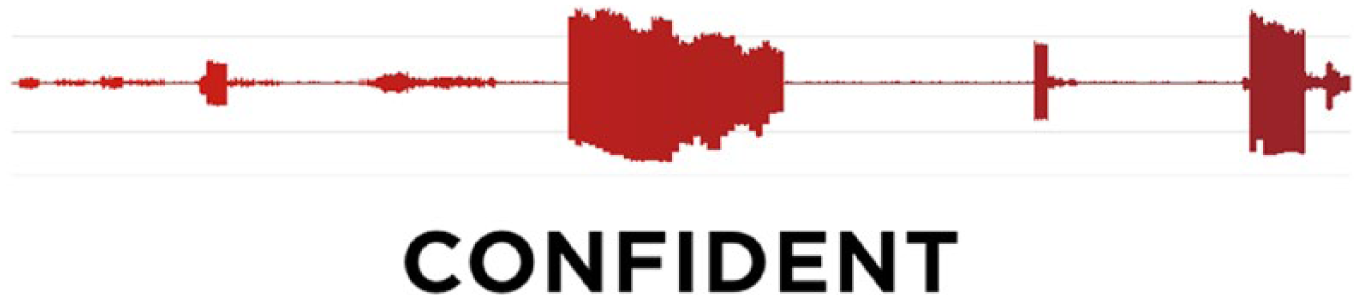
Biometric analysis of Rhee’s voice from the Moodlens tool.
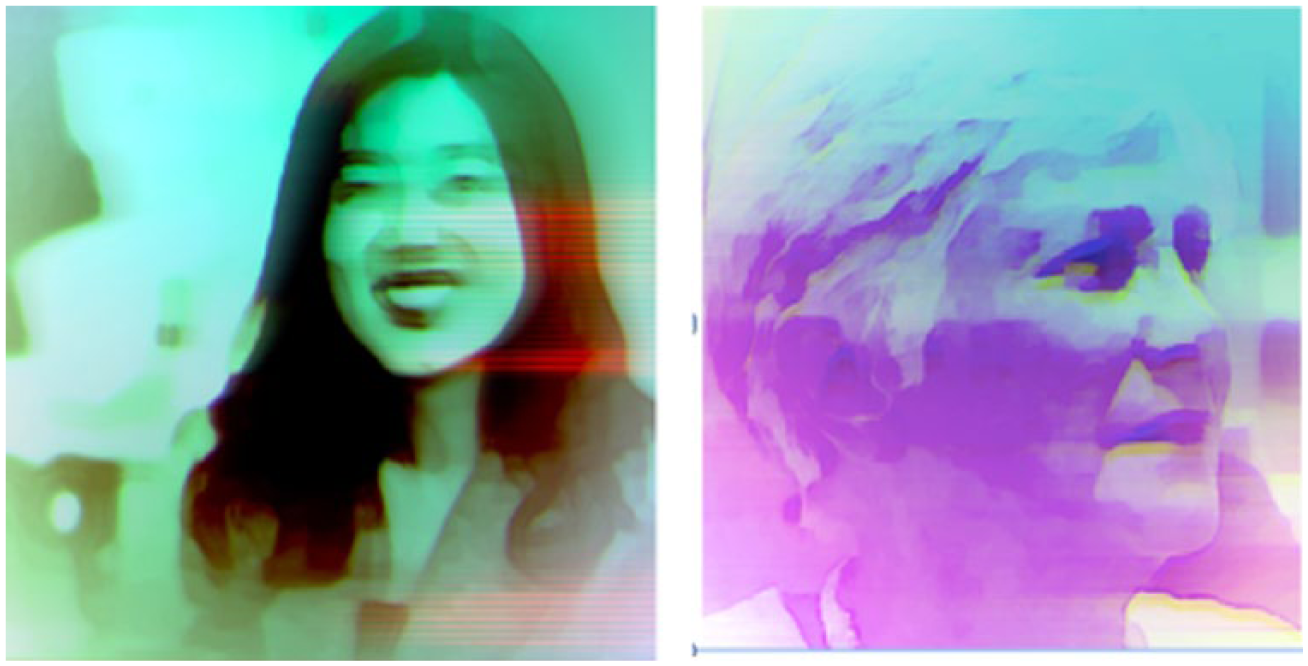
Moodlens “emotional portraits” for Michelle Rhee (left) and Diane Ravitch (right).
The Moodlens App has been deactivated after DeVos’s appointment, so we experiment with other emotion-detecting apps. We are surprised to find a wide range of mood- and emotion-tracking apps available for mobile phones. Many use biometric data such as fingerprints or facial recognition, and employ algorithmic analysis to determine emotion. We try out two apps: fACE-e (Apliko Technologies, 2017), which provides an emotional breakdown of a still photo, and Emotion Detector, which uses facial recognition technology to “detect emotion in real time” (Gaaaron, 2017). Nearly all of the mood- and emotion-detecting apps we find emphasize that they are purely for entertainment. The Emotion Detector, ironically echoes our own cautions in this article, disclaiming, “Note: this tool is experimental, and not always accurate” (https://play.google.com/store/apps/details?id=hu.gaaaron.emotiondetector&hl=en).
It is perhaps not so much the final “emotional portraits” of Rhee, Ravitch, and Devos that give us insight into the affective tenor of their personas, but the noise around #edreform we have to dwell in to produce their Moodlens portraits. As we work to produce them, image and sound intermesh getting “hooks” into our researcher flesh. For example, the biometric data we used for Ravitch was a video posted on Youtube.com a week before titled “Diane Ravitch on Public Education” published by Nebraska Loves Public Schools. It begins with Ravitch’s voice accompanied by tense piano notes. We hear the words “unnecessary disruption, chaos, turmoil” in her distinct voice. She declares in the first 10 seconds: “What we have today is an existential threat to the future of public education and that has never happened before” (Ravitch quoted in Nebraska Love Public Schools, 2016, n.p.). The “hot indignation,” Delbanco (2013) notes, can be felt in a statement she makes on policy makers: “I don’t know how it came to be that legislators directly intervene and tell schools how to reform themselves because they lack the ability to do that. They don’t know what they’re talking about” (Nebraska Loves Public Schools, 2016, n.p.).
During a Senate hearing in January 2017, DeVos can be seen answering “tough questions” on education (Turner, 2017) with an unshakeable smile. It is little surprise that when we plug her beaming Wikipedia headshot into the faCE-e application, it detects 100% happiness and 0% anger, contempt, disgust, fear, neutrality, sadness, and surprise. We next try the Emotion Detector application, which uses “real-time” data. The most recent video of DeVos available on Youtube.com is a 2-week-old posting of her addressing the Conservative Political Action Conference (CPAC). When we use this video as her biometric data, the Emotion Detector app codes DeVos’s face with shifting emoticons (see Figure 3). As the app algorithmically codes her facial movements, she talks about her mother being a public school teacher, how excellent teachers should be rewarded, and how school choice needs to be supported. Unlike the tenuousness about education policy she exhibited during the Senate hearing, she comes across more resolute and indignant. She asks the audience, “How many of you are college students? Well, the fight against the education establishment extends to you, too. The faculty from adjunct professors to deans tell you what to do, what to say, and more ominously, what to think” (https://www.youtube.com/watch?v=99Sj2k_uVpE&t=227s).

Emotion detector stills from video analysis of Betsy DeVos.
It is curious how, as silly and entertaining as they are, the Moodlens, FaCE-e, and Emotion Detector applications do capture recognizable qualities of Rhee, Ravitch, and DeVos. There is indeed a wild confidence to Rhee and Ravitch—perhaps the radioactivity (Cuban, 2013) or hot indignation that Delbanco (2013) describes as their similar “sales pitches.” Rhee’s confidence is a quality the media has picked up on and may be in part what gets her picked up by online search algorithms. Writing in 2013, Cuban intuited Rhee’s power as an educational celebrity and unelectability in terms of politics. Her brief consideration for Trump’s Secretary of Education did indeed set off the media’s Geiger counters, but didn’t result in her appointment. If Rhee could be characterized as “radioactive,” we might argue that all three reformers are nodal points of intensity in larger education debates. Rhee, Ravitch, and DeVos are steadfast in their positions, indignant about what is happening now, and passionate about their hopes for the future of education.
Reassemblage 2: Becoming a Listening Machine
Our first reassemblage drew from corporate gimmicks that use algorithms to mine affect for profit, while this one shifts to a data-mining practice mobilized in the art world. Having been named “The Internet’s Mood Ring” (JohnJay & Rich, 2015), Twitter is being algorithmically studied by corporations and politicians to measure public sentiment. One global pharmaceutical company uses a practice called “web listening” to conduce “sentiment analysis” of Twitter users to “understand the churn in patients moving to an alternative drug” (p. 346). Not unakin to “web listening,” we put our ear to noise around #edreform for this reassemblage, taking our cue from a web-based art installation called the Listening Machine (LM).
The LM ran in London from 2012 to 2013 with the stated goal of “creating a soundtrack to our everyday social lives” (http://www.thelisteningmachine.org/faq). Over its 9-month installation, the LM played a continuous piece of music generated by scraping 500 U.K. residents’ Twitter feeds and encoding them into music. The unwitting users’ Tweets were algorithmically analyzed for “group’s sentiments (positive or negative), topics of conversation (from sports and culture to technology and education), rate of activity, and the rhythms and tone of their speech itself” (http://www.thelisteningmachine.org/about). On the LM’s Frequently Asked Questions (FAQ) page, the creators of the project report that they were inspired, in part, by the Mass Observation Movement (MOM; http://www.thelisteningmachine.org/faq). Undertaken in 1937 and running until the 1950s (and then revived in the 1980s), the MOM was initiated by a group of social researchers who intended to create “an anthropology of ourselves” (Mass Observation, 2015) through the self-recorded diaries, observations, and experiences of U.K. citizens. The project sought “to bridge the gap between how the media represented public opinion and what ordinary people actually felt and thought” (Jones, 2012, n.p.). The MOM has been both critiqued as a form of social surveillance and celebrated for its marking of the wisdom of everyday people. In this section, we work/think/play with reassembling the LM. We play with two attunements of the machine (e.g., the listener, the phonomat) and work to dwell in the algorithmic “soundtrack” to the contemporary moment in #edreform.
The Phonomat
After the machine listens for updates, the phonomat “analyzes the sentiment and rhythm of the content.” The creators of the LM define sentiment as “[t]he average level of emotional polarity; positive; negative or neutral” (http://www.thelisteningmachine.org). What is the “emotional parity” of Rhee’s, Ravitch’s, and DeVos’s Tweets? In terms of sentiment, Rhee’s and DeVos’s Tweets are energetic, hopeful, and upbeat. Rhee and DeVos express patriotism and gratitude. Rhee expresses patriotism on July 4, thanks for the service of Washington, D.C.,’s school chancellor Kaya Henderson, and congratulations to DeVos. She shouts out school farming and art programs and offers links to various programs she supports. DeVos’s feed has a similar cluster of positive affects: gratitude, hopefulness, pride. Ravitch’s feed focuses on a wider breadth of political topics such as climate change, Trump’s cabinet picks, and Putin’s influence on the U.S. election. Although Ravitch also frequently links to educational programs she supports, they stand out less in the density of tweets she sends out, often numbering more than two dozen per day. In terms of sentiment, her Tweets are darker and stronger. They have an urgency and sense of outrage to them, stoked even more strongly following Trump’s election. This is not to say Ravitch is without a sense of humor. She is at times funny and even pens her own #TrumpBookReport (a Twitter trend in which people write book reports as if they were Trump).
Using the language of the LM, when “people are tweeting more rapidly, the tempo of the piece will increase and orchestration ‘fatten’” (http://www.thelisteningmachine.org/faq#music). The fullness of Ravitch’s feed would indeed be “fatter” than Rhee and DeVos’s based on the sheer amount she tweets. If we attune ourselves to what the phonomat terms “rate,” we can hear how Rhee and Ravitch’s Twitter feeds are out-of-synch in terms of speeds. For the LM, rhythms are comprised of “[t]he current rate of overall activity, based on number of tweets per minute.” Ravitch is a much more prolific Tweeter than Rhee with an astounding 68.9K Tweets and 134K followers to Rhee’s 2,871 Tweets and 77.7K followers. Ravitch is a machine: Her Twitter feed is fast-paced, urgent, and intense. She shares an enormous amount of information and is linked to a huge network of other Tweeters and online news sources.
Compared with this “fat” density of information and sharing, Rhee and DeVos tweet at a much slower rate. Rhee’s Tweets, such as a birthday message to a friend, tend to be more personal than Ravitch’s. After a media frenzy around Rhee’s consideration for Secretary of Education, she clarifies why she met with Trump in spite of strident objections. There is a tipping point on DeVos’s Twitter feed when speeds seem to get out of hand. On November 23, 2016, a Tweet reads, “Greatly appreciate all the support and interest. At this time, all comments are deferred to @transition2017.” Her About Me includes the line, “Tweets from Betsy are signed ‘-Betsy,’” signaling that an administrator may be writing all others.
There is also an interesting intertextuality to the three reformers’ tweets. In musical terms, we might express this with antiphony, a process when sounds are used to echo or respond to each other, almost as if they are in symphonic conversation. On November 3, 2016, for example, Ravitch tweets, “How did that work out?” accompanied by a picture of Michelle Rhee on a Time magazine cover with the headline “How to fix American Schools” (though she doesn’t include Rhee’s handle). In another web of connection, on November 23, 2016, Rhee tweets a congratulations to @BetsyDeVos for her selection as Trump’s Secretary of Education. If we were to create a soundtrack from DeVos, Rhee and Ravitch’s Twitter feeds, it might have a political, urgent, even patriotic ring to it. To capture the sentiment of their Tweets, we would need strong and urgent notes. An antiphonic phrasing would be required with Ravitch’s score being “fat” and swift, answered by more upbeat C-major phrases from Rhee and DeVos. There is a forward motion, a marching to the future of education in all of their Twitter activity. They each share a wild confidence in their distinct visions for what education might be and become and they are eager for us to hear them.
Fat Theory: A Qualitative Politics of the Algorithm
The final step of the LM is called “encoding,” a process in which the machine “broadcasts the live audio stream to the internet” (http://www.thelisteningmachine.org/about). When it was in operation, the LM encoded music in real time based on the data it algorithmically analyzed. As tweeting increased, the orchestration was fattened. As we research in a digital age with ever-increasing data flows, we too may need to find means of fattening our methods and theories to keep up. Here, we have worked/thought/played with two different algorithmic data streams to see what ideas, linkages, and affects about #edreform they produced. This is not to suggest we must operate like algorithms, but to work toward reparatively (Sedgwick, 2003), rather than paranoidly, relating to the present. By way of conclusion, we tenuously imagine what fat theory might do through three figurations (a grammatical, a spatial, and an exponential) drawn from the logics, and limits, of the algorithm.
Figuration 1: An Additive Grammar
How might we move with ever more rapid accumulations of data and increasingly sophisticated digital tools? Kaufman (2017) outlines how algorithms are generally defined by the Boolean sequence IF X . . . THEN Y. In contrast, Deleuze and Parnet (2007) offer the conjunction and as a means of offering an ever-accumulating or additive grammar. Neither predictive of a controllable and containable future or descriptive of a still and finished present, an additive grammar produces
neither a union, or a juxtaposition, but the birth of a stammering, the outline of a broken line, which always sets off a right angles, a sort of active and creative line of flight . . . AND . . . AND . . . AND. (pp. 9-10)
A reparative affect theory may ask us to return to objects we’ve written off as failed, flawed, problematic, or threatening and seek plentitude from them (Sedgwick, 2003), adding onto and affixing our own practices, feelings, hunches, and ideas.
For the LM, when the number of tweets increased, a fullness in sound was produced by the simultaneous sounding of more players. AND may help us get outside of dualistic thinking and hierarchical logics and look for more forms of relationality and rapprochement between unexpected elements (Sedgwick, 2003). We wonder what it might mean to increase the amount, modes, and styles of research being produced? This might entail a wider breath of sources of data. Perhaps, qualitative researchers might work/think/play with traditionally positivist data sources, not in a move toward mixed methods or in a “return” to the perceived “validity” of such practices, but in aesthetic, playful, experimental, and, heretofore, unimagined ways. Such an additive grammar might offer new means of adding onto, intervening, and setting off in creative right angles the lines set out for qualitative work. An additive impulse might entail imagining more forums for how research is “encoded” or broadcast in and outside of academia. As information surges, we’ll need to create more hospitable spaces for a wider range of players and styles as we add a saxophonist AND a flutist AND a bassist AND a percussionist AND another saxophonist.
Figuration 2: A Fractal Fullness
We might also think of fat theory through the spatial logic of fractals. Laura Marks (2003) argues that, rather than staying in a flat two- dimensionality, or a point-to-point grid space, fractal algorithms “attain spongelike dimensions . . . filling up the space between two hierarchically related elements” (p. xv). As an algorithm collects more information, it achieves fractal density, “a form of subtle complexity, building toward its object, brushing into its pores and touching its varied textures” (p. xv). If algorithms fatten as they learn from our varied textures, what might happen if we look into their textures and touch back? Certainly, our own bemusement at Glade’s® marketing gimmick and skepticism of the MOM’s practices of surveillance, might have urged us as researchers to maintain a safe distance, but what happens when we get close to the objects that offend, take on their textures, and move with them? What happens, when as Deleuze (1995) urges, we reassemble—adding something, relating it to something else—urging a fatness to theory?
Activists, political collectives, and artists have already been underway reassembling—subverting, politicizing, parodying, and haywiring—Big Data’s reach. Akin to Patti Lather’s (1993) paralogic validity, such reassembling has worked to use the fractal space left open by algorithms and actualize potent political strategies. For example, the class action suit that made Stop-and-Frisk unlawful in New York used the initiative’s own algorithmic logics to declare it “statistically unreasonable” (Kaufman, 2017). Crampton and Miller (2017) point out how Standing Rock water protectors used the surveillatory capacities of drones to document law enforcement actions. In a similar move, a call for more data was urged in response to Trump’s campaign promise to create a registry for Muslims in America. At the 2017 Women’s March on Washington, Gloria Steinem declared “If you force Muslims to register, we will all register as Muslims” (Seipel, 2017), a call that if followed would render the registry meaningless through an overflow of data. In a more playful move, Tyler Vigen’s ongoing project Spurious Correlations finds elegant correlations between as unrelated phenomena as the divorce rate in Maine and U.S. per capita consumption of margarine or the per capita cheese consumption and number of people who died becoming entangled in their bed sheets. The public is also demanding more transparency in algorithms uses in government. For example, a bill was recently introduced in New York City to make the algorithms used in government decision practices from school assignments to trash pickup to teacher ratings open to “algorithmic audits” (Dwyer, 2017).
We want to emphasize that Big Data is not the enemy. Global scientists have been contributing to the Disappearing Data Project, for example, to quickly back up data on climate change research they fear will disappear under the Trump administration (Eaton, 2017). And, to be certain, haywiring algorithms is not always in line with socially just political futures—or as Deleuze and Guattari (1987) put it, every deterritorialization is haunted by potential for reterritorializing. One such example was highlighted recently by Digital Lab Pedagogy. Morris and Stommel (2017) write,
A funny thing happened on the way to academic integrity. Plagiarism detection software (PDS), like Turnitin, has seized control of student intellectual property. While students who use Turnitin are discouraged from copying other work, the company itself can strip mine and sell student work for profit. (n.p.)
Figuration 3: An Exponential Expansion
The algorithm bears an almost infinite accumulative impulse. The quest for the ultimate machine learning algorithm, for example, promises that “the master algorithm can derive all knowledge in the world—past, present and future—from data” (Domingos, 2015, p. 5, quoted in Amoore, 2017, p. 3). Perhaps, one of the most quoted (and more controversial) lines in A Thousand Plateaus is Deleuze and Guattari’s (1987) call for “molecular combinations bringing into play not only the man in the woman and the woman in the man, but the relation of each to the animal, the plant, etc.: a thousand tiny sexes” (p. 213). What if we thought of research as bringing into play a thousand tiny projects? Such tiny projects might be small fits and starts that offer “stammerings” that refuse the seductively elegant analyses that algorithms promise.
Fat theory puts pressure on the algorithm’s promise that “with more data comes more accuracy and truth” (Crawford, 2014, n.p.). It also makes too simple critiques impossible. We have used algorithmic technologies, such as the surveillatory logics of facial recognition and affective residues of Twitter flows, to work/think/play with what they can do beyond naming, surveilling, predicting, networking, profitizing, and containing. Finding and digging into these gaps and uncertainties may in some instances open up powerful spaces of intervention and interruption. Reassembling offers a fat theory of connectivity akin to algorithmic practices, but untethered to promises of more rationality, efficiency, or validity. Kaufman (2017) cautions, “the place of science and technology in fighting the war on terror’—or the war on the poor, on drugs, or on crime—is ever more secured if we overstate the coherence of the grip it has on life itself’” (Amoore, 2006, p. 338, quoted in Kaufman, 2017, p. 3). Fat theory works to show the “absurd, nonrational, and insecure hiding behind a screen of algorithmic precision” (Kaufman, 2017, p. 6). Fat theory encourages adding onto instead of cleanly partitioning. It acknowledges that AND can cause things to veer off in unexpected way—ways that might be deemed politically useful in some contexts and politically dangerous in others. It avoids polarization—charter school/public schools, left/right, Republican/Democrat, conservative/liberal, liberatory/oppressive, even quantitative/qualitative—looking to resonances and reverberations between bodies (human bodies, bodies of data, body politics). It explores how ever-increasing amounts of data are neither the enemy nor a source of salvation.
We have gestured to some politics of the algorithm that urge a reparative, but not uncritical, relation to the present. This piece is too provisional to determine what the limits of fat theory might be. To explore further is the question: How are bodies differentially enfolded into fat theory’s accumulations? When do a thousand tiny projects reach a saturation point shifting to static or white noise? In a lean and mean neoliberal present, who bears the privilege of fattening, rather than scaling down inquiries without traditionally identifiable uses and ends? But for now, our curiosity with, and anxieties about, algorithms have opened up an attunement to additive processes of accretion and accumulation, or, put perhaps more generously, modes of plentitude. The more we experiment and reassemble, the more we carrot “AND” into our questions, the more answers we get to and what else can this tool/this gimmick/this method/this theory/this practice do. Our two projects are micro-experiments in such reassembling. We call out to others to experiment with tiny projects to further fatten qualitative methods of the present.
Footnotes
Declaration of Conflicting Interests
The author(s) declared no potential conflicts of interest with respect to the research, authorship, and/or publication of this article.
Funding
The author(s) received no financial support for the research, authorship, and/or publication of this article.